Properties of Matter
$ \text { Match List I with List II: } $
| $ \text { List I } $ |
$ \text { List I I} $ |
||
|---|---|---|---|
| A. | Young's Modulus | I. | $ \frac{\Delta d}{\Delta L}\left(\frac{L}{d}\right) $ |
| B. | Compressibility | II. | $ \frac{F L}{A(\Delta L)} $ |
| C. | Bulk Modulus | III. | $ -\frac{1}{\Delta P}\left(\frac{\Delta V}{V}\right) $ |
| D. | Poisson's Ratio | IV. | $ -P\left(\frac{V}{\Delta V}\right) $ |
Choose the correct answer from the options given below:
A-IV, B-I, C-II, D-III
A-III, B-II, C-I, D-IV
A-I, B-IV, C-III, D-II
A-II, B-III, C-IV, D-I
A submarine is designed to withstand an absolute pressure of 100 atm . How deep can it go below the water surface?
(Consider the density of water $=1000 \mathrm{~kg} \mathrm{~m}^{-3}$, $1 \mathrm{~atm}=1 \times 10^5 \mathrm{~Pa}$ and gravitational acceleration $g=10 \mathrm{~m} / \mathrm{s}^2$ )
990 m
9900 m
99 m
9000 m
Water flows in a streamline motion through a horizontal pipe of circular cross-section as shown in the figure. The pressure difference of water between $P$ and $Q$ is $15 \mathrm{Nm}^{-2}$. The area of cross-section at $P$ and $Q$ are $40 \mathrm{~cm}^2$ and $20 \mathrm{~cm}^2$, respectively. The rate of flow of water through the pipe, in $\mathrm{cm}^3 \mathrm{~s}^{-1}$, is:
[Take density of water $=1000 \mathrm{~kg} \mathrm{~m}^{-3}$ ]
400
100
200
300
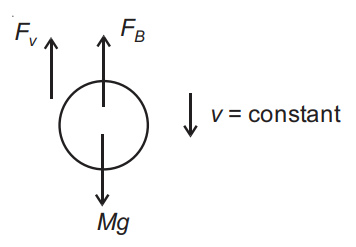
In the measurement of viscosity of liquids using terminal velocity experiment, spherical balls of same radius but having different densities are used. The variation of the terminal velocity ( $v$ ) with the ratio of density of spherical ball ( $\sigma$ ) to density of the liquid ( $\rho$ ), is best represented by:


Consider a water tank shown in the figure. It has one wall at $x=L$ and can be taken to be very wide in the $z$ direction. When filled with a liquid of surface tension $S$ and density $\rho$, the liquid surface makes angle $\theta_0\left(\theta_0 \ll 1\right)$ with the $x$-axis at $x=L$. If $y(x)$ is the height of the surface then the equation for $y(x)$ is:

(take $\theta(x)=\sin \theta(x)=\tan \theta(x)=\frac{d y}{d x}, g$ is the acceleration due to gravity)


An ideal fluid is flowing in a non-uniform cross-sectional tube $X Y$ (as shown in the figure) from end $X$ to end $Y$. If $K_1$ and $K_2$ are the kinetic energy per unit volume of the fluid at $X$ and $Y$ respectively, then the correct option is :

The maximum elongation of a steel wire of $1 \mathrm{~m}$ length if the elastic limit of steel and its Young's modulus, respectively, are $8 \times 10^8 \mathrm{~N} \mathrm{~m}^{-2}$ and $2 \times 10^{11} \mathrm{~N} \mathrm{~m}^{-2}$, is:
A thin flat circular disc of radius $4.5 \mathrm{~cm}$ is placed gently over the surface of water. If surface tension of water is $0.07 \mathrm{~N} \mathrm{~m}^{-1}$, then the excess force required to take it away from the surface is

A metallic bar of Young's modulus, $0.5 \times 10^{11} \mathrm{~N} \mathrm{~m}^{-2}$ and coefficient of linear thermal expansion $10^{-5}{ }^{\circ} \mathrm{C}^{-1}$, length $1 \mathrm{~m}$ and area of cross-section $10^{-3} \mathrm{~m}^2$ is heated from $0^{\circ} \mathrm{C}$ to $100^{\circ} \mathrm{C}$ without expansion or bending. The compressive force developed in it is :
The amount of elastic potential energy per unit volume (in SI unit) of a steel wire of length $100 \mathrm{~cm}$ to stretch it by $1 \mathrm{~mm}$ is (if Young's modulus of the wire $=2.0 \times 10^{11} \mathrm{Nm}^{-2}$ ) :
Which of the following statement is not true?
The viscous drag acting on a metal sphere of diameter $1 \mathrm{~mm}$, falling through a fluid of viscosity $0.8 \mathrm{~Pa}$ s with a velocity of $2 \mathrm{~m} \mathrm{~s}^{-1}$ is equal to :
The amount of energy required to form a soap bubble of radius $2 \mathrm{~cm}$ from a soap solution is nearly: (surface tension of soap solution $=0.03 \mathrm{~N} \mathrm{~m}^{-1}$ )
The venturi-meter works on :
Let a wire be suspended from the ceiling (rigid support) and stretched by a weight $W$ attached at its free end. The longitudinal stress at any point of cross-sectional area $A$ of the wire is :
Two copper vessels A and B have the same base area but of different shapes. A takes twice the volume of water as that B requires to fill upto a particular common height. Then the correct statement among the following is :
The terminal velocity of a copper ball of radius 5 mm falling through a tank of oil at room temperature is 10 cm s$-$1. If the viscosity of oil at room temperature is 0.9 kg m$-$1 s$-$1, the viscous drag force is :
A spherical ball is dropped in a long column of a highly viscous liquid. The curve in the graph shown, which represents the speed of the ball (v) as a function of time (t) is


If a soap bubble expands, the pressure inside the bubble
Given below are two statements : One is labelled as Assertion (A) and the other is labelled as Reason (R).
Assertion (A) : The stretching of a spring is determined by the shear modulus of the material of the spring.
Reason (R) : A coil spring of copper has more tensile strength than a steel spring of same dimensions.
In the light of the above statements, choose the most appropriate answer from the options given below:

If a small orifice is made at a height of 0.25 m from the ground, the horizontal range of water stream will be


Determine the pressure difference in tube of non-uniform cross sectional area as shown in figure.
$\Delta P=?, d_1=5 \mathrm{~cm}, v_1=4 \mathrm{~m} / \mathrm{s}, d_2=2 \mathrm{~cm}, v_2=?$

In an isothermal process 2 water drops of radius $1 \mathrm{~mm}$ are combined to form a bigger drop. Find the energy change in this process if $T=0.1 \mathrm{~N} / \mathrm{m}$.
Assertion : Water drops take spherical shape when falling freely.
Reason : Water has minimum surface tension among all liquids.
Assertion : Sometimes insects can walk on water.
Reason : The gravitational force on insect is balanced by force due surface tension.
Assertion Smaller drop of water resist deformation forces better than the larger drops.
Reason Excess pressure inside drop is inversely proportional to its radius.


