An ac circuit contains a resistance of $1 \mathrm{k} \Omega$, a capacitor of $0.1 \mu \mathrm{~F}$ and an inductor of 1 mH connected in series. The resonance frequency of the circuit is approximately:
13.5 kHz
10.1 kHz
20.7 kHz
15.9 kHz
The peak value of an alternating current is 5 A and frequency is 60 Hz . How long will the current, starting from zero, take to reach the peak value?
$\frac{1}{120} \mathrm{~s}$
$\frac{1}{60} \mathrm{~s}$
$\frac{1}{30} \mathrm{~s}$
$\frac{1}{240} \mathrm{~s}$
An ac voltage $V=220 \sin \left(2 \times 10^3 t\right)$ Volt is applied to a series LCR circuit. Then the current amplitude in this circuit is:
(Given : $L=10 \mathrm{mH}, C=25 \mu \mathrm{~F}, R=100 \Omega$ )
22.0 A
2.2 A
5.5 A
11.0 A
To an ac power supply of 220 V at 50 Hz , a resistor of $20 \Omega$, a capacitor of reactance $25 \Omega$ and an inductor of reactance $45 \Omega$ are connected in series. The corresponding current in the circuit and the phase angle between the current and the voltage is, respectively
In the circuit shown below, the inductance $L$ is connected to an ac source. The current flowing in the circuit is $I=I_0 \sin \omega t$. The voltage drop $\left(V_L\right)$ across $L$ is

A step up transformer is connected to an ac mains supply of $220 \mathrm{~V}$ to operate at $11000 \mathrm{~V}, 88$ watt. The current in the secondary circuit, ignoring the power loss in the transformer, is
The amplitude of the charge oscillating in a circuit decreases exponentially as $Q=Q_0 e^{-R t/2 L}$, where $Q_0$ is the charge at $t=0 \mathrm{~s}$. The time at which charge amplitude decreases to $0.50 Q_0$ is nearly:
[Given that $R=1.5 \Omega, L=12 \mathrm{~mH}, \ln (2)=0.693$]
In an ideal transformer, the turns ratio is $\frac{N_P}{N_S}=\frac{1}{2}$. The ratio $V_S: V_P$ is equal to (the symbols carry their usual meaning) :
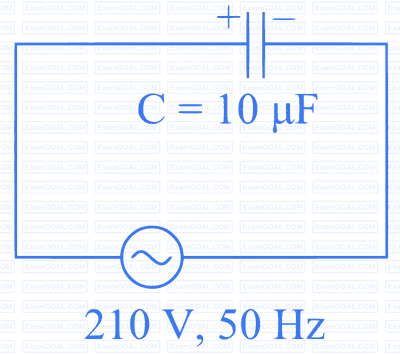
A $10 \mu \mathrm{F}$ capacitor is connected to a $210 \mathrm{~V}, 50 \mathrm{~Hz}$ source as shown in figure. The peak current in the circuit is nearly $(\pi=3.14)$ :
An ac source is connected in the given circuit. The value of $\phi$ will be :

If Z$_1$ and Z$_2$ are the impedances of the given circuits (a) and (b) as shown in figures, then choose the correct option

The maximum power is dissipated for an ac in a/an:
For very high frequencies, the effective impedance of the circuit (shown in the figure) will be:-


In a series LCR circuit, the inductance $L$ is $10 ~\mathrm{mH}$, capacitance $C$ is $1 ~\mu \mathrm{F}$ and resistance $R$ is $100 ~\Omega$. The frequency at which resonance occurs is :-
A $12 \mathrm{~V}, 60 \mathrm{~W}$ lamp is connected to the secondary of a step down transformer, whose primary is connected to ac mains of $220 \mathrm{~V}$. Assuming the transformer to be ideal, what is the current in the primary winding ?
An ac source is connected to a capacitor C. Due to decrease in its operating frequency
The magnetic energy stored in an inductor of inductance $4 ~\mu \mathrm{H}$ carrying a current of $2 \mathrm{~A}$ is :
The net impedance of circuit (as shown in figure) will be :

Given below are two statements
Statement I : In an a.c circuit, the current through a capacitor leads the voltage across it.
Statement II : In a.c circuit containing pure capacitance only, the phase difference between the current and voltage is $\pi$.
In the light of the above statements, choose the most appropriate answer from the options given below


An inductor of inductance 2 mH is connected to a 220 V, 50 Hz ac source. Let the inductive reactance in the circuit is X1. If a 220 V dc source replace the ac source in the circuit, then the inductive reactance in the circuit is X2. X1 and X2 respectively are :
A standard filament lamp consumes 100 W when connected to 200 V ac mains supply. The peak current through the bulb will be :
The peak voltage of the ac source is equal to
A series LCR circuit with inductance 10 H, capacitance 10 $\mu$F, resistance 50 $\Omega$ is connected to an ac source of voltage, V = 200sin(100t) volt. If the resonant frequency of the LCR circuit is v0 and the frequency of the ac source is v, then

V = V0sin$\omega$t
The displacement current between the plates of the capacitor, would then be given by :
A transformer with turns ratio $\frac{N_1}{N_2}=\frac{50}{1}$ is connected to a $120 \mathrm{~V}$ AC supply. If primary and secondary circuit resistances are $1.5 \mathrm{~k} \Omega$ and $1 \Omega$ respectively, then find out power of output.
If maximum energy is stored in a capacitor at t = 0, then find the time after which current in the circuit will be maximum.

In a $L C R$ series circuit source voltage is $120 \mathrm{~V}$ and voltage in inductor $50 \mathrm{~V}$ and resistance is $40 \mathrm{~V}$, then determine voltage in the capacitor
In a series R-C circuit shown in figure, the applied voltage is 10 V and the voltage across capacitor is found to be 8V. Then, the voltage across R and the phase difference between current and the applied voltage will respectively be


An ideal coil of $10 \mathrm{~H}$ is connected in series with a resistance of $5 \Omega$ and a battery of $5 \mathrm{~V}$. After $2 \mathrm{~s}$, after the connection is made, the current flowing (in ampere) in the circuit is
In a circuit $L, C$ and $R$ are connected in series with an alternating voltage source of frequency $f$. The current leads the voltage by $45^{\circ}$. The value of $C$ is

A series R-C circuit is connected to AC voltage source. Consider two cases; (A) When C is without a dielectric medium and (B) When C is filled with dielectric of constant 4. The current I$_R$ through the resistor and voltage V$_C$ across the capacitor are compared in two cases.
Assertion : The average value of alternating emf is $63.39 \%$ of the peak value.
Reason : The rms value of alternating emf is $70.72 \%$ of peak value.
(a) When capacitor is air filled.
(b) When capacitor is mica filled.
Current through resistor is $I$ and voltage across capacitor is $V$ then
