2003
Q51
NEET
MCQ
10 Mar 2026
The potential energy of a simple harmonic oscillator when the particle is half way to its end point is
A.
${2 \over 3}$E
B.
${1 \over 8}$E
C.
${1 \over 4}$E
D.
${1 \over 2}$E
2003
Q52
NEET
MCQ
10 Mar 2026
The time period of mass suspended from a spring is T. If the spring is cut into four equal parts and the same mass is suspended from one of the parts, then the new time period will be
A.
T/4
B.
T
C.
T/2
D.
2T
2003
Q53
NEET
MCQ
10 Mar 2026
Which one of the following statements is true for the speed v and the acceleration a of a particle executing simple harmonic motion?
A.
When v is maximum, $a$ is maximum
B.
Value of $a$ is zero, whatever may be the value of v.
C.
When v is zero, $a$ is zero
D.
When v is maximum, $a$ is zero.

2003
Q54
NEET
MCQ
10 Mar 2026
A particle of mass m oscillates with simple harmonic motion between points x1 and x2, the equilibrium position being O. Its potential energy is plotted. It will be as given below in the graph
A.

B.

C.

D.

2003
Q55
NEET
MCQ
10 Mar 2026
In case of a forced vibration, the resonance peak becomes very sharp when the
A.
damping force is small
B.
restoring force is small
C.
applied periodic force is small
D.
quality factor is small
2002
Q56
NEET
MCQ
10 Mar 2026
Displacement between maximum potential energy position and maximum kinetic energy position for a particle executing simple harmonic motion is
A.
$ \pm $ $a$/2
B.
+ $a$
C.
$ \pm $ $a$
D.
$-$ 1

2002
Q57
NEET
MCQ
10 Mar 2026
When an oscillator completes 100 oscillations its amplitude reduced to ${1 \over 3}$ of initial value. What will be its amplitude, when it complettes 200 oscillations ?
A.
${1 \over 8}$
B.
${2 \over 3}$
C.
${1 \over 6}$
D.
${1 \over 9}$
2002
Q58
NEET
MCQ
10 Mar 2026
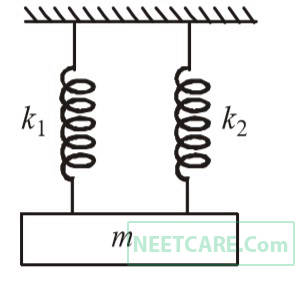
A mass is suspended separately by two different springs in (successive order then time periods is t1 and t2 respectively, If it is connected by both spring as shown in figure then time period is t0 , the correct relation is
A.
$t_0^2 = t_1^2 + t_2^2$
B.
$t_0^{ - 2} = t_1^{ - 2} + t_2^{ - 2}$
C.
$t_0^{ - 1} = t_1^{ - 1} + t_2^{ - 1}$
D.
${t_0} = {t_1} + {t_2}$


2001
Q59
NEET
MCQ
10 Mar 2026
The total energy of particle performing SHM depend on
A.
k, a, m
B.
k, a
C.
k, a, x
D.
k, x
2000
Q60
NEET
MCQ
10 Mar 2026
Two masses $M$A and $M$B are hung from two strings of length $l$A and $l$B respectively. They are executing SHM with frequency relation $f$A = 2$f$B, then relation
A.
${l_A} = {{{l_B}} \over 4}$ does not depend on mass
B.
${l_A} = 4{l_B}$, does not depend on mass
C.
${l_A} = 2{l_B}$ and ${M_A} = 2{M_B}$
D.
${l_A} = {{{l_B}} \over 2}$ and ${M_A} = {{{M_B}} \over 2}$.
2000
Q61
NEET
MCQ
10 Mar 2026
The bob of simple pendulum having length $l$, is displaced from mean position to an angular position q with respect to vertical. If it is released, then velocity of bob at equilibrium position
A.
$\sqrt {2gl\left( {1 - \cos \theta } \right)} $
B.
$\sqrt {2gl\left( {1 + \cos \theta } \right)} $
C.
$\sqrt {2gl\cos \theta } $
D.
$\sqrt {2gl} $
