Oscillations
For a simple pendulum, having time period $T$, the variation of kinetic energy (K.E.) with time $(t)$ is represented by:


The sum of kinetic energy and potential energy of a simple pendulum bob is 0.02 joule. The speed of the simple pendulum bob at equilibrium position is approximately:
(Consider mass of the bob $=20 \mathrm{~g}$ )
$0.2 \mathrm{~m} / \mathrm{s}$
$1.41 \mathrm{~m} / \mathrm{s}$
$14.1 \mathrm{~m} / \mathrm{s}$
$2.0 \mathrm{~m} / \mathrm{s}$
Savitha, a XI standard student, while conducting an experiment to determine the effective length of a simple pendulum $L$, notes down the data of time taken to complete 30 oscillations as 60 s and hence calculates the length of the simple pendulum as: (Take $\pi^2=9.8$, and $g=9.8 \mathrm{~m} / \mathrm{s}^2$ )
0.75 m
1.5 m
2 m
1 m
A cylindrical cork of uniform density floats in a liquid of density $\rho_1$. If the cork is depressed slightly and released, it oscillates harmonically with time period $T$. If the same cork floats in another liquid of density $\rho_2$, then the similar oscillation has time period $2 T$. The value of $\rho_2 / \rho_1$ is:
1/4
4
2
$1 / 2$
Consider a spring-mass simple harmonic oscillator in one dimension. The mass of the particle is $m \mathrm{~kg}$ and the spring constant is $k \mathrm{Nm}^{-1}$. At a given instant, the extension of the spring is $x$-meter and the speed of the particle is $v \mathrm{~ms}^{-1}$. On the $x-v$ plane, if the graph of $v$ as a function of $x$ is a circle, then the correct option is:
$k=\sqrt{m}$
$k=\frac{1}{m}$
$k=m$
$k=m^2$
In an oscillating spring mass system, a spring is connected to a box filled with sand. As the box oscillates, sand leaks slowly out of the box vertically so that the average frequency $\omega(t)$ and average amplitude $A(t)$ of the system change with time $t$. Which one of the following options schematically depicts these changes correctly?


Two identical point masses $P$ and $Q$, suspended from two separate massless springs of spring constants $k_1$ and $k_2$, respectively, oscillate vertically. If their maximum speeds are the same, the ratio ( $A Q / A_\rho$ ) of the amplitude $A Q$ of mass $Q$ to the amplitude $A_\rho$ of mass $P$ is
A particle executing simple harmonic motion with amplitude A has the same potential and kinetic energies at the displacement
The two-dimensional motion of a particle, described by $\vec{r}=(\hat{i}+2 \hat{j}) A \cos \omega t$ is a/an:
A. parabolic path
B. elliptical path
C. periodic motion
D. simple harmonic motion
Choose the correct answer from the options given below:
If $x=5 \sin \left(\pi t+\frac{\pi}{3}\right) \mathrm{m}$ represents the motion of a particle executing simple harmonic motion, the amplitude and time period of motion, respectively, are
If the mass of the bob in a simple pendulum is increased to thrice its original mass and its length is made half its original length, then the new time period of oscillation is $\frac{x}{2}$ times its original time period. Then the value of $x$ is:
A simple pendulum oscillating in air has a period of $\sqrt{3} \mathrm{~s}$. If it is completely immersed in non-viscous liquid, having density $\left(\frac{1}{4}\right)^{\text {th }}$ of the material of the bob, the new period will be :-
The $x$ - $t$ graph of a particle performing simple harmonic motion is shown in the figure. The acceleration of the particle at $t=2 \mathrm{~s}$ is :

Match List-I with List-II
| List-I (x-y graphs) |
List-II (Situations) |
||
|---|---|---|---|
| (a) |  |
(i) | Total mechanical energy is conserved |
| (b) |  |
(ii) | Bob of a pendulum is oscillating under negligible air friction |
| (c) |  |
(iii) | Restoring force of a spring |
| (d) |  |
(iv) | Bob of a pendulum is oscillating along with air friction |
Choose the correct answer from the options given below

Identify the function which represents a non-periodic motion.
Two pendulums of length 121 cm and 100 cm start vibrating in phase. At some instant, the two are at their mean position in the same phase. The minimum number of vibrations of the shorter pendulum after which the two are again in phase at the mean position is :
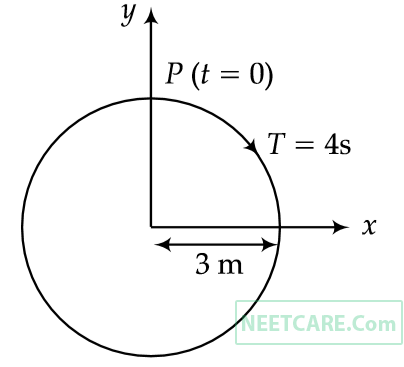
y- projection of the radius vector of rotating particle P is :
y = A0 + A sin$\omega $t + B cos$\omega $t.
Then the amplitude of its oscillation is given by :
A block of rectangular size of mass $m$ and area of cross-section $A$, floats in a liquid of density $\rho$. If we give a small vertical displacement from equilibrium, it undergoes SHM with time period $T$, then

Assertion A pendulum is falling freely its time period becomes zero.
Reason Freely falling body has the acceleration equal to g.

A load of mass $m$ falls from a height $h$ on the scale pan hung from a spring as shown. If the spring constant is $k$ and mass of the scale pan is zero and the mass $m$ does not bounce relative to the pan, then the amplitude of vibration is
Assertion : A spring of force constant $k$ is cut into two pieces having lengths in the ratio 1 : 2. The force constant of series combination of the two parts is $\frac{3 k}{2}$.
Reason : The spring connected in series are represented by $k=k_1+k_2$

X = A cos$\left( {\omega t} \right)$
where X = displacement at time t
$\omega $ = frequency of oscillation
Which one of the following graphs shows correctly the variation a with t?
Here a = acceleration at time t
T = time period


(1) y = sin$\omega $t $-$ cos$\omega $t
(2) y = sin3$\omega $t
(3) y = 5cos$\left( {{{3\pi } \over 4} - 3\omega t} \right)$
(4) y = 1 + $\omega $t + $\omega $2t2
where k, k0, k1 and a are all positive.
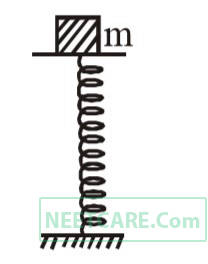
When pressed slightly and released the mass executes a simple harmonic motion. The spring constant is 200 N/m. What should be the minimum amplitude of the motion so that the mass gets detached from the pan (take g = 10 m/s2).