Electrostatics
Which of the following statements are correct?
A. Inside a conductor, the electrostatic field is zero.
B. Electric field at the surface of a charged conductor does not depend on its surface charge density.
C. The interior of a charged conductor can have no excess charge in the static situation.
D. At the surface of a charged conductor, the electrostatic field must be normal to the surface at every point.
E. The electrostatic potential is zero everywhere inside a charged conductor.
Choose the correct answer from the options given below:
A, B and D only
A, C and E only
A, C and D only
C, D and E only
A unit positive point charge is taken slowly through an infinitesimally thin tube that is inside a charged dielectric sphere of radius $R$, having uniform positive charge density $\rho$, as shown in the figure. The initial and final positions of the charge are marked by $A$ and $B$ at distance $2 R$ and $3 R$ respectively, from the centre of the sphere. In this process, the magnitude of the total work done on the point charge is $\frac{\rho R^2}{n \varepsilon_0}$. The value of $n$ is : ( $\varepsilon_0$ is the permittivity of vacuum)

18
2
6
9
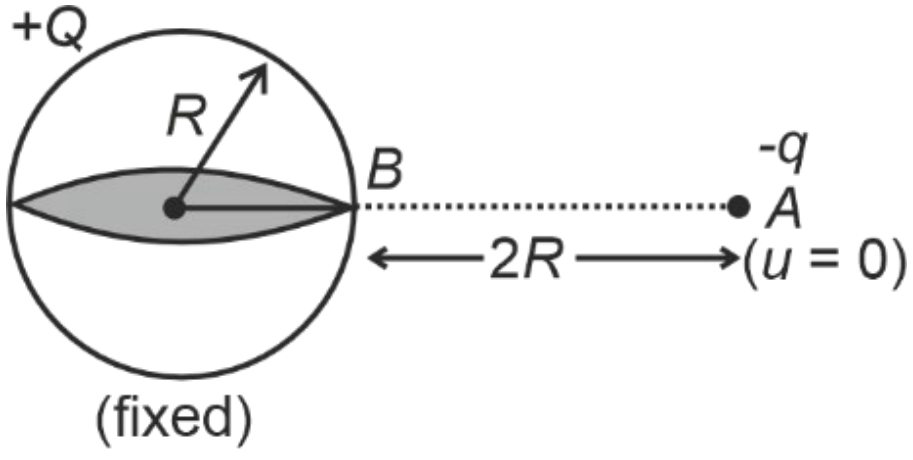
Consider a fixed uniformly charged insulating sphere with radius $R$ and total charge $+Q$. A point charge $-q$ ( $q \ll Q$ ) with mass $m$ is released from rest at a distance of $3 R$ from the centre of the charged sphere. When the point charge reaches the surface of the sphere, its speed is:
( $\varepsilon_0$ is the permittivity of vacuum, neglect gravitational forces).
$\sqrt{\frac{Q q}{4 \pi \varepsilon_0 m R}}$
$\sqrt{\frac{3 Q q}{4 \pi \varepsilon_0 m R}}$
$\sqrt{\frac{2 Q q}{3 \pi \varepsilon_0 m R}}$
$\sqrt{\frac{Q q}{3 \pi \varepsilon_0 m R}}$
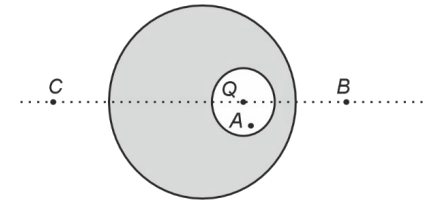
A point charge $Q$ is placed inside a cavity within a solid isolated conducting sphere. Consider points $A, B$ and $C$ as shown in the figure, where the magnitudes of the electric fields are $E_A, E_B, E_C$, respectively. The points $B$ and $C$ are at the same distance from the center of the solid sphere. The correct option is :
$E_A \neq 0, E_B< E_C$
$E_A=0, E_B=E_C$
$E_A \neq 0, E_B=E_C$
$E_A=0, E_B>E_C$

An electric dipole with dipole moment $5 \times 10^{-6} \mathrm{Cm}$ is aligned with the direction of a uniform electric field of magnitude $4 \times 10^5 \mathrm{~N} / \mathrm{C}$. The dipole is then rotated through an angle of $60^{\circ}$ with respect to the electric field. The change in the potential energy of the dipole is:
Two identical charged conducting spheres $A$ and $B$ have their centres separated by a certain distance. Charge on each sphere is $q$ and the force of repulsion between them is $F$. A third identical uncharged conducting sphere is brought in contact with sphere $A$ first and then with $B$ and finally removed from both. New force of repulsion between spheres $A$ and $B$ (Radii of $A$ and $B$ are negligible compared to the distance of separation so that for calculating force between them they can be considered as point charges) is best given as:

A metal cube of side $5 \mathrm{~cm}$ is charged with $6 \mu \mathrm{C}$. The surface charge density on the cube is
The value of electric potential at a distance of $9 \mathrm{~cm}$ from the point charge $4 \times 10^{-7} \mathrm{C}$ is [Given $\frac{1}{4 \pi \varepsilon_0}=9 \times 10^9 \mathrm{~N} \mathrm{~m}^2 \mathrm{C}^{-2}$] :
A thin spherical shell is charged by some source. The potential difference between the two points $C$ and $P$ (in V) shown in the figure is:
(Take $\frac{1}{4 \pi \varepsilon_0}=9 \times 10^9$ SI units)

Given below are two statements: one is labelled as Assertion A and the other is labelled as Reason R.
Assertion A: The potential (V) at any axial point, at $2 \mathrm{~m}$ distance $(r)$ from the centre of the dipole of dipole moment vector $\vec{P}$ of magnitude, $4 \times 10^{-6} \mathrm{C} \mathrm{m}$, is $\pm 9 \times 10^3 \mathrm{~V}$.
(Take $\frac{1}{4 \pi \epsilon_0}=9 \times 10^9 \mathrm{SI}$ units)
Reason R: $V= \pm \frac{2 P}{4 \pi \epsilon_0 r^2}$, where $r$ is the distance of any axial point, situated at $2 \mathrm{~m}$ from the centre of the dipole.
In the light of the above statements, choose the correct answer from the options given below:
According to Gauss law of electrostatics, electric flux through a closed surface depends on :
A charge $\mathrm{Q} ~\mu \mathrm{C}$ is placed at the centre of a cube. The flux coming out from any one of its faces will be (in SI unit) :
If a conducting sphere of radius $\mathrm{R}$ is charged. Then the electric field at a distance $\mathrm{r}(\mathrm{r} > \mathrm{R})$ from the centre of the sphere would be, $(\mathrm{V}=$ potential on the surface of the sphere)
An electric dipole is placed at an angle of $30^{\circ}$ with an electric field of intensity $2 \times 10^{5} \mathrm{NC}^{-1}$. It experiences a torque equal to $4 ~\mathrm{N~m}$. Calculate the magnitude of charge on the dipole, if the dipole length is $2 \mathrm{~cm}$.
If $\oint_\limits{s} \vec{E} \cdot \overrightarrow{d S}=0$ over a surface, then:

An electric dipole is placed as shown in the figure.

The electric potential (in 102 V) at point P due to the dipole is ($\in_0$ = permittivity of free space and $\frac{1}{4 \pi \epsilon_{0}}$ = K) :

Six charges +q, $-$q, +q, $-$q, +q, and $-$q are fixed at the corners of a hexagon of side d as shown in the figure. The work done in bringing a charge q0 to the centre of the hexagon from infinity is
(${\varepsilon _0}$ - permittivity of free space)


The angle between the electric lines of force and the equipotential surface is
Two hollow conducting spheres of radii R1 and R2 (R1 >> R2) have equal charges. The potential would be
Two point charges $-$q and +q are placed at a distance of L, as shown in the figure.

The magnitude of electric field intensity at a distance R(R >> L) varies as:


$\left( {{1 \over {4\pi {\varepsilon _0}}} = 9 \times {{10}^9}N{m^2}/{C^2}} \right)$
$\left( {{1 \over {4\pi {\varepsilon _0}}} = 9 \times {{10}^9}N{m^2}/{c^2}} \right)$

A half ring of radius $R$ has a charge of $\lambda$ per unit length. The electric force on $1 \mathrm{C}$ charged placed at the centre is

Positive charge $Q$ is distributed uniformly over a circular ring of radius $R$. A point particle having a mass $(m)$ and a negative charge $-q$ is placed on its axis at a distance $x$ from the centre. Assuming $x < R$, find the time period of oscillation of the particle, if it is released from there [neglect gravity].

Assertion Mass of a body decreases slightly when it is negatively charged.
Reason Charging is due to transfer of electrons.
[Given : mass of hydrogen mh = 1.67 $ \times $ 10$-$27 kg]

A positive charge is moved from A to B in each diagram.
Charges $+q$ and $-q$ are placed at points $A$ and $B$ respectively which are a distance $2 L$ apart, $C$ is the mid-point between $A$ and $B$. The work done in moving a charge $+Q$ along the semicircle $C R D$ is


Assertion : The electric field due to a dipole on its axis line at a distance $r$ is $E$. Then, electric field due to the same dipole on the equatorial line and at the same distance will be $E / 2$.
Reason : Electric field due to dipole varies inversely as the square of the distance.


