NEET
2026
MCQ
Which of the following statements are correct?
A. Inside a conductor, the electrostatic field is zero.
B. Electric field at the surface of a charged conductor does not depend on its surface charge density.
C. The interior of a charged conductor can have no excess charge in the static situation.
D. At the surface of a charged conductor, the electrostatic field must be normal to the surface at every point.
E. The electrostatic potential is zero everywhere inside a charged conductor.
Choose the correct answer from the options given below:
NEET
2026
MCQ
A unit positive point charge is taken slowly through an infinitesimally thin tube that is inside a charged dielectric sphere of radius $R$, having uniform positive charge density $\rho$, as shown in the figure. The initial and final positions of the charge are marked by $A$ and $B$ at distance $2 R$ and $3 R$ respectively, from the centre of the sphere. In this process, the magnitude of the total work done on the point charge is $\frac{\rho R^2}{n \varepsilon_0}$. The value of $n$ is : ( $\varepsilon_0$ is the permittivity of vacuum)

NEET
2026
MCQ
Consider a fixed uniformly charged insulating sphere with radius $R$ and total charge $+Q$. A point charge $-q$ ( $q \ll Q$ ) with mass $m$ is released from rest at a distance of $3 R$ from the centre of the charged sphere. When the point charge reaches the surface of the sphere, its speed is:
( $\varepsilon_0$ is the permittivity of vacuum, neglect gravitational forces).
NEET
2026
MCQ
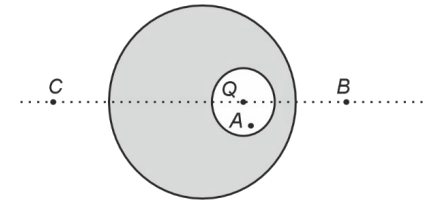
A point charge $Q$ is placed inside a cavity within a solid isolated conducting sphere. Consider points $A, B$ and $C$ as shown in the figure, where the magnitudes of the electric fields are $E_A, E_B, E_C$, respectively. The points $B$ and $C$ are at the same distance from the center of the solid sphere. The correct option is :
NEET
2025
MCQ
An electric dipole with dipole moment $5 \times 10^{-6} \mathrm{Cm}$ is aligned with the direction of a uniform electric field of magnitude $4 \times 10^5 \mathrm{~N} / \mathrm{C}$. The dipole is then rotated through an angle of $60^{\circ}$ with respect to the electric field. The change in the potential energy of the dipole is:
NEET
2025
MCQ
Two identical charged conducting spheres $A$ and $B$ have their centres separated by a certain distance. Charge on each sphere is $q$ and the force of repulsion between them is $F$. A third identical uncharged conducting sphere is brought in contact with sphere $A$ first and then with $B$ and finally removed from both. New force of repulsion between spheres $A$ and $B$ (Radii of $A$ and $B$ are negligible compared to the distance of separation so that for calculating force between them they can be considered as point charges) is best given as:
NEET
2024
MCQ
A metal cube of side $5 \mathrm{~cm}$ is charged with $6 \mu \mathrm{C}$. The surface charge density on the cube is
NEET
2024
MCQ
The value of electric potential at a distance of $9 \mathrm{~cm}$ from the point charge $4 \times 10^{-7} \mathrm{C}$ is [Given $\frac{1}{4 \pi \varepsilon_0}=9 \times 10^9 \mathrm{~N} \mathrm{~m}^2 \mathrm{C}^{-2}$] :
NEET
2024
MCQ
A thin spherical shell is charged by some source. The potential difference between the two points $C$ and $P$ (in V) shown in the figure is:
(Take $\frac{1}{4 \pi \varepsilon_0}=9 \times 10^9$ SI units)

NEET
2024
MCQ
Given below are two statements: one is labelled as Assertion A and the other is labelled as Reason R.
Assertion A: The potential (V) at any axial point, at $2 \mathrm{~m}$ distance $(r)$ from the centre of the dipole of dipole moment vector $\vec{P}$ of magnitude, $4 \times 10^{-6} \mathrm{C} \mathrm{m}$, is $\pm 9 \times 10^3 \mathrm{~V}$.
(Take $\frac{1}{4 \pi \epsilon_0}=9 \times 10^9 \mathrm{SI}$ units)
Reason R: $V= \pm \frac{2 P}{4 \pi \epsilon_0 r^2}$, where $r$ is the distance of any axial point, situated at $2 \mathrm{~m}$ from the centre of the dipole.
In the light of the above statements, choose the correct answer from the options given below:
NEET
2023
MCQ
According to Gauss law of electrostatics, electric flux through a closed surface depends on :
NEET
2023
MCQ
A charge $\mathrm{Q} ~\mu \mathrm{C}$ is placed at the centre of a cube. The flux coming out from any one of its faces will be (in SI unit) :
NEET
2023
MCQ
If a conducting sphere of radius $\mathrm{R}$ is charged. Then the electric field at a distance $\mathrm{r}(\mathrm{r} > \mathrm{R})$ from the centre of the sphere would be, $(\mathrm{V}=$ potential on the surface of the sphere)
NEET
2023
MCQ
An electric dipole is placed at an angle of $30^{\circ}$ with an electric field of intensity $2 \times 10^{5} \mathrm{NC}^{-1}$. It experiences a torque equal to $4 ~\mathrm{N~m}$. Calculate the magnitude of charge on the dipole, if the dipole length is $2 \mathrm{~cm}$.
NEET
2023
MCQ
If $\oint_\limits{s} \vec{E} \cdot \overrightarrow{d S}=0$ over a surface, then:
NEET
2023
MCQ
An electric dipole is placed as shown in the figure.

The electric potential (in 102 V) at point P due to the dipole is ($\in_0$ = permittivity of free space and $\frac{1}{4 \pi \epsilon_{0}}$ = K) :
NEET
2022
MCQ
Six charges +q, $-$q, +q, $-$q, +q, and $-$q are fixed at the corners of a hexagon of side d as shown in the figure. The work done in bringing a charge q0 to the centre of the hexagon from infinity is
(${\varepsilon _0}$ - permittivity of free space)

NEET
2022
MCQ
The angle between the electric lines of force and the equipotential surface is
NEET
2022
MCQ
Two hollow conducting spheres of radii R1 and R2 (R1 >> R2) have equal charges. The potential would be
NEET
2022
MCQ
Two point charges $-$q and +q are placed at a distance of L, as shown in the figure.

The magnitude of electric field intensity at a distance R(R >> L) varies as:
NEET
2021
MCQ
Polar molecules are the molecules :
NEET
2021
MCQ
A dipole is placed in an electric field as shown. In which direction will it move?

NEET
2021
MCQ
Two charged spherical conductors of radius R1 and R2 are connected by a wire. Then the ratio of surface charge densities of the spheres ($\sigma$1 / $\sigma$2) is :
NEET
2021
MCQ
Twenty seven drops of same size are charged at 220V each. They combine to form a bigger drop. Calculate the potential of the bigger drop.
NEET
2020
MCQ
A short electric dipole has a dipole moment of 16 $ \times $ 10-9 Cm. The electric potential due to the dipole at a point at a distance of 0.6 m from the centre of the dipole, situated on a line making an angle of $60^\circ $ with the dipole axis is :
$\left( {{1 \over {4\pi {\varepsilon _0}}} = 9 \times {{10}^9}N{m^2}/{C^2}} \right)$
NEET
2020
MCQ
In a certain region of space with volume 0.2 m3, the electric potential is found to be 5 V throughout. The magnitude of electric field in this region is :
NEET
2020
MCQ
A spherical conductor of radius 10 cm has a charge of 3.2 $ \times $ 10-7 C distributed uniformly. That is the magnetude of electric field at a point 15 cm from the centre of the sphere?
$\left( {{1 \over {4\pi {\varepsilon _0}}} = 9 \times {{10}^9}N{m^2}/{c^2}} \right)$
NEET
2019
MCQ
A hollow metal sphere of radius R is uniformly charged. The electric field due to the sphere at a distance r from the centre :
NEET
2019
MCQ
Two point charges A and B, having charges +Q and – Q respectively, are placed at certain distance apart and force acting between them is F. If 25% charge of A is transferred to B, then force between the charges becomes :
NEET
2019
MCQ
Two parallel infinite line charges with linear charge densities +$\lambda $ C/m and -$\lambda $ C/m are placed at a distance of 2R in free space. What is the electric field mid-way between the two line charges?
NEET
2018
MCQ
A toy car with charge q moves on a frictionless
horizontal plane surface under the influence of
a uniform electric field $\overrightarrow E $
. Due to the force q$\overrightarrow E $
,
its velocity increases from 0 to 6 m s–1 in one
second duration. At that instant the direction of
the field is reversed. The car continues to move
for two more seconds under the influence of this
field. The average velocity and the average speed
of the toy car between 0 to 3 seconds are
respectively
NEET
2018
MCQ
An electron falls from rest through a vertical
distance h in a uniform and vertically upward
directed electric field E. The direction of electric
field is now reversed, keeping its magnitude the
same. A proton is allowed to fall from rest in it
through the same vertical distance h. The time
of fall of the electron, in comparison to the time
of fall of the proton is
NEET
2017
MCQ
Suppose the charge of a proton and an electron differ slightly. One of them is $-$e, the other is (e + $\Delta $e). If the net of electrostatic force and gravitational force between two hydrogen atoms placed at a distance d (musch greater than atomic size) apart is zero, then $\Delta $e is of the order of
[Given : mass of hydrogen mh = 1.67 $ \times $ 10$-$27 kg]
NEET
2017
MCQ
The diagrams below show regions of equipotentials.

A positive charge is moved from A to B in each diagram.
NEET
2016
MCQ
An electric dipole is placed at an angle of 30o with an electric field intensity 2 $ \times $ 105 N C$-$1. It experiences a torque equal to 4 N m. The charge on the dipole, if the dipole length is 2 cm, is
NEET
2016
MCQ
Two identical charged spheres suspended from a common point by two massless strings of lengths $l$, are initially at a distance d(d < < $l$) apart because of their mutual repulsion. The charges begin to leak from both the spheres at a constant rate. As a result, the spheres approach each other with a velocity v. Then v varies as a function of the distance x between the spheres, as
NEET
2015
MCQ
If potential (in volts) in a region is expressed as V(x, y, z) = 6xy $-$ y + 2yz, the electric field (in N/C) at point (1, 1, 0) is
NEET
2015
MCQ
The electric field in a certain region is acting radially outward and is given by E = Ar. A charge contained in a sphere of radius 'a' centred at the origin of the field, will be given by
NEET
2014
MCQ
In a region, the potential is represented by V(x, y, z) = 6x $-$ 8xy $-$ 8y + 6yz, where $V$ is in volts and x, y, z are in metres. The electric force experienced by a charge of 2 coulomb situated at point (1, 1, 1) is
NEET
2014
MCQ
A conducting sphere of radius R is given a charge Q. The electric potential and the electric field at the centre of the sphere rrespectively are
NEET
2013
MCQ
An electric dipole of dipole moment p is aligned parallel to a uniform electric field E. The energy required to rotate the dipole by 90o is
NEET
2013
MCQ
A charge q is placed at the centre of the line joining two equal charges Q. The system of the three charges will be in equilibrium if q is equal to
NEET
2013
MCQ
Two pith balls carrying equal charges are suspended from a common point by strings of equal length, the equilibrium separation between them is r. Now the strings are rigidly clamped at half the height. The equilibrium separation between the balls now become

NEET
2013
MCQ
A, B and C are three points in a uniform electric field. The electric potential is

NEET
2012
MCQ
Two metallic spheres of radii 1 cm and 3 cm are given charges of $-$1 $ \times $ 10$-$2 C and 5 $ \times $ 10$-$2 C, respectively. If these are connected by a conducting wire, the final charge on the bigger sphere is
NEET
2012
MCQ
What is the flux through a cube of side $a$ if a point charge of q is at one of its corner?
NEET
2012
MCQ
Four point charges $-$Q, $-$q, 2q and 2Q are placed, one at each corner of the square. The relation between Q and q for which the potential at the centre of the square is zero is
NEET
2012
MCQ
An electric dipole of moment p is placed in an electric field of intensity E. The dipole acquires a position such that the axis of the dipole makes an angle $\theta $ with the direction of the field. Assuming that the potential energy of the dipole to be zero when $\theta $ = 90o, the torque and the potential energy of the dipole will respectively be
NEET
2011
MCQ
Three charges, each +q, are placed at the corners of an isosceles triangle ABC of sides BC and AC, 2$a$. D and E are the mid points of BC and CA. The work done in taking a charge Q from D to E is

NEET
2011
MCQ
The electric potential V at any point (x, y, z), all in metres in space is given by V = 4x2 volt. The electric field at the point (1, 0, 2) in volt/meter, is
NEET
2011
MCQ
A charge Q is enclosed by a Gaussian spherical surface of radius R. If the radius is doubled, then the outward electric flux will
NEET
2011
MCQ
Four electric charges +q, +q, $-$ q and $-$ q are placed at the corners of a square of side 2L (see figure). The electric potential at point A, midway between the two charges + q and +q, is

NEET
2010
MCQ
The electric field at a distance ${{3R} \over 2}$ from the centre of a charged conducting spherical shell of radius R is E. The electric field at a distance ${R \over 2}$ from the centre of the sphere is
NEET
2010
MCQ
Two positives ions, each carrying a charge q, are separated by a distance d. If F is the force of repulsion between the ions, the number of electrons missing from each ion will be (e being the charge on an electron)
NEET
2010
MCQ
A square surface of side L meter in the plane of the paper is placed in a uniform electric field $E$(volt/m) acting along the same plane at an angle $\theta $ with the horizontal side of the square as shown in figurre.

The electric flux linked to the surface, in units of volt m is
NEET
2009
MCQ
The electric potential at a point (x, y, z) is given by V = $-$x2y $-$ xz3 + 4
The electric field at that point is
NEET
2009
MCQ
Three concentric spherical shells have radii a, b and c (a < b < c) anf have surface charge densities $\sigma $, $-$$\sigma $ and $\sigma $ respectively. If VA, VB and VC denote the potentials of the three shells, then, for c = a + b, we have
NEET
2008
MCQ
A thin conducting ring of radius R is given a charge +Q. The electric field at the centre O of the ring due to the charge on the part AKB of the ring is E. The electric field at the centre due to the charge on the part ACDB of the ring is

NEET
2008
MCQ
The electric potential at a point in free space due to charge Q coulomb is Q $ \times $ 1011 volts. The electric field at that point is
NEET
2007
MCQ
Charges +q and $-$q are placed at points A and B respectively which are a distance 2L apart, C is the midnight between A and B. The work done in moving a charge + Q along the semicircle CRD is

NEET
2007
MCQ
A hollow cylinder has a charge q coulomb within it. If $f$ is the electric flux in units of voltmeter associated with the curved surface B, the flux linked with the plane surface A in units of V-m will be

NEET
2007
MCQ
Three point charges +q, $-$ 2q and + q are placed at points (x = 0, y = a, z = 0), (x = 0, y = 0, z = 0) and (x = $a$, y = 0, z = 0) respectively. The magnitude and direction of the electric dipole moment vector of this charge assembly are
NEET
2006
MCQ
A square surface of side L metres is in the plane of the paper. A uniform electric field $\overrightarrow E $ (volt/m), also in the plane of the paper is limited only to the lower half of the square surface (see figure). The electric flux in SI inits associated with the surface is

NEET
2006
MCQ
An electric dipole of moment $\overrightarrow p $ is lying along a uniform electric field $\overrightarrow E $. The work done in rotating the dipole by 90o is
NEET
2005
MCQ
As per the diagram a point charge +q is placed at the origin O. Work done in taking another point charge $-$Q from the point A [coordinates (0, $a$)] to another point B

NEET
2005
MCQ
Two charges q
1 and q
2 are placed 30 cm apart, as shown in the figure. A third charge q
3 is moved along the arc of a circle of radius 40 cm from C to D.
The change in the potential energy of the system is ${{{q_3}} \over {4\pi {\varepsilon _0}}}$ where k is

NEET
2004
MCQ
A bullet of mass 2 g is having a charge of 2 $\mu $C. Through what potential difference must it be accelerated, starting from rst, to acquire a speed of 10 m/s ?
NEET
2004
MCQ
An electric dipole has the magnitude of its charge as q and its dipole moment is p. It is placed in a uniform electric field E. If its dipole moment is along the direction of the field, the force on it and its potential energy are respectively
NEET
2003
MCQ
A charge q is located at the centre of a cube. The electric flux through any face is
NEET
2002
MCQ
Identical charges ($-$q) are placed at each corners of cube of side b then electrostatic potential energy of charge (+q) which is placed at centre of cube will be
NEET
2002
MCQ
Some charge is being given to a conductor. Then its potential is
NEET
2001
MCQ
A charge Q$\mu $C is placed at the centre of a cube, the flux coming out from each face will be
NEET
2001
MCQ
A dipole of dipole moment $\overrightarrow p $ is placed in uniform electric field $\overrightarrow E $ then torque acting on it is given by
NEET
2000
MCQ
A charge Q is situated at the corner of a cube, the electric flux passed through all the six faces of the cube is
NEET
2000
MCQ
Electric field at centre O of semicircle of radius $a$ having linear charge density $\lambda $ given as
