2021
Q301
JEE Mains
MCQ
iCON Education HYD, 79930 92826, 73309 72826
14 Mar 2026
If $\mathop {\lim }\limits_{x \to \infty } \left( {\sqrt {{x^2} - x + 1} - ax} \right) = b$, then the ordered pair (a, b) is :
A.
$\left( {1,{1 \over 2}} \right)$
B.
$\left( {1, - {1 \over 2}} \right)$
C.
$\left( { - 1,{1 \over 2}} \right)$
D.
$\left( { - 1, - {1 \over 2}} \right)$
Show Answer
Correct Answer: B
Explanation:
$\mathop {\lim }\limits_{x \to \infty } \left( {\sqrt {{x^2} - x + 1} } \right) - ax = b$ ($\infty$ $-$ $\infty$)
2021
Q302
JEE Mains
MCQ
iCON Education HYD, 79930 92826, 73309 72826
14 Mar 2026
If $\alpha$, $\beta$ are the distinct roots of x2 + bx + c = 0, then
Show Answer
Correct Answer: C
Explanation:
$\mathop {\lim }\limits_{x \to \beta } {{{e^{2({x^2} + bx + c)}} - 1 - 2({x^2} + bx + c)} \over {{{(x - \beta )}^2}}}$
2021
Q303
JEE Mains
MCQ
iCON Education HYD, 79930 92826, 73309 72826
14 Mar 2026
Let [t] denote the greatest integer less than or equal to t. Let
A.
continuous in [$-$2, 2] but not differentiable at more than
B.
not continuous at exactly three points in [$-$2, 2]
C.
continuous in [$-$2, 2] but not differentiable at exactly
D.
not continuous at exactly four points in [$-$2, 2]
Show Answer
Correct Answer: A
Explanation:
min{x $-$ [x], 1 $-$ x + [x]}
h(x) = min{x $-$ [x], 1 $-$ [x $-$ [x])}
$\Rightarrow$ always continuous in [$-$2, 2] but not differentiable at 7 points.
2021
Q304
JEE Mains
MCQ
iCON Education HYD, 79930 92826, 73309 72826
14 Mar 2026
$\mathop {\lim }\limits_{x \to 2} \left( {\sum\limits_{n = 1}^9 {{x \over {n(n + 1){x^2} + 2(2n + 1)x + 4}}} } \right)$ is equal to :
Show Answer
Correct Answer: A
Explanation:
$S = \mathop {\lim }\limits_{x \to 2} \sum\limits_{n = 1}^9 {{x \over {n(n + 1){x^2} + 2(2n + 1)x + 4}}} $
2021
Q305
JEE Mains
MCQ
iCON Education HYD, 79930 92826, 73309 72826
14 Mar 2026
The value of
Show Answer
Correct Answer: C
Explanation:
$\mathop {\lim }\limits_{x \to 0} \left( {{x \over {\root 8 \of {1 - \sin x} - \root 8 \of {1 + \sin x} }}} \right)$
2021
Q306
JEE Mains
MCQ
iCON Education HYD, 79930 92826, 73309 72826
14 Mar 2026
Let $f:[0,\infty ) \to [0,3]$ be a function defined by
A.
f is continuous everywhere but not differentiable exactly at one point in (0, $\infty$)
B.
f is differentiable everywhere in (0, $\infty$)
C.
f is not continuous exactly at two points in (0, $\infty$)
D.
f is continuous everywhere but not differentiable exactly at two points in (0, $\infty$)
Show Answer
Correct Answer: B
Explanation:
Graph of $\max \{ \sin t:0 \le t \le x\} $ in $x \in [0,\pi ]$
& graph of cos x for $x \in [\pi ,\infty )$
So graph of
$f(x) = \left\{ {\matrix{
{\max \{ \sin t:0 \le t \le x\} ,} & {0 \le x \le \pi } \cr
{2 + \cos x,} & {x > \pi} \cr
} } \right.$
f(x) is differentiable everywhere in (0, $\infty$)
2021
Q307
JEE Mains
MCQ
iCON Education HYD, 79930 92826, 73309 72826
14 Mar 2026
Let $f:\left( { - {\pi \over 4},{\pi \over 4}} \right) \to R$ be defined as $f(x) = \left\{ {\matrix{
{{{(1 + |\sin x|)}^{{{3a} \over {|\sin x|}}}}} & , & { - {\pi \over 4} < x < 0} \cr
b & , & {x = 0} \cr
{{e^{\cot 4x/\cot 2x}}} & , & {0 < x < {\pi \over 4}} \cr
} } \right.$2 is equal to :
Show Answer
Correct Answer: C
Explanation:
$\mathop {\lim }\limits_{x \to 0} f(x) = b$
2021
Q308
JEE Mains
MCQ
iCON Education HYD, 79930 92826, 73309 72826
14 Mar 2026
Let f : R $\to$ R be a function such that f(2) = 4 and f'(2) = 1. Then, the value of $\mathop {\lim }\limits_{x \to 2} {{{x^2}f(2) - 4f(x)} \over {x - 2}}$ is equal to :
Show Answer
Correct Answer: D
Explanation:
This limit can be solved using L'Hopital's Rule, which states that for the limit of the form 0/0 or ±∞/±∞, the limit can be found by taking the derivative of the numerator and the derivative of the denominator separately.
2021
Q309
JEE Mains
MCQ
iCON Education HYD, 79930 92826, 73309 72826
14 Mar 2026
Let f : R $\to$ R be defined as
Show Answer
Correct Answer: A
Explanation:
$\mathop {\lim }\limits_{x \to {2^ + }} f(x) = \mathop {\lim }\limits_{x \to {2^ + }} {e^{{{\tan (x - 2)} \over {x - 2}}}} = {e^1}$
2021
Q310
JEE Mains
MCQ
iCON Education HYD, 79930 92826, 73309 72826
14 Mar 2026
Let f : R $\to$ R be defined as $f(x) = \left\{ {\matrix{
{{{{x^3}} \over {{{(1 - \cos 2x)}^2}}}{{\log }_e}\left( {{{1 + 2x{e^{ - 2x}}} \over {{{(1 - x{e^{ - x}})}^2}}}} \right),} & {x \ne 0} \cr
{\alpha ,} & {x = 0} \cr
} } \right.$
Show Answer
Correct Answer: A
Explanation:
For continuity
2021
Q311
JEE Mains
MCQ
iCON Education HYD, 79930 92826, 73309 72826
14 Mar 2026
If $f:R \to R$ is given by $f(x) = x + 1$, then the value of $\mathop {\lim }\limits_{n \to \infty } {1 \over n}\left[ {f(0) + f\left( {{5 \over n}} \right) + f\left( {{{10} \over n}} \right) + ...... + f\left( {{{5(n - 1)} \over n}} \right)} \right]$ is :
Show Answer
Correct Answer: D
Explanation:
$f(0) + f\left( {{5 \over n}} \right) + f\left( {{{10} \over n}} \right) + ...... + f\left( {{{5(n - 1)} \over n}} \right)$
2021
Q312
JEE Mains
MCQ
iCON Education HYD, 79930 92826, 73309 72826
14 Mar 2026
Let a function f : R $\to$ R be defined as $f(x) = \left\{ {\matrix{
{\sin x - {e^x}} & {if} & {x \le 0} \cr
{a + [ - x]} & {if} & {0 < x < 1} \cr
{2x - b} & {if} & {x \ge 1} \cr
} } \right.$
Show Answer
Correct Answer: B
Explanation:
Continuous x = 0+ ) = f(0$-$ ) $\Rightarrow$ a $-$ 1 = 0 $-$ e0 + ) = f(1$-$ )
2021
Q313
JEE Mains
MCQ
iCON Education HYD, 79930 92826, 73309 72826
14 Mar 2026
Let f : R $ \to $ R be a function defined as
Show Answer
Correct Answer: D
Explanation:
Given, $f(x)=\left\{\begin{array}{cl}\frac{\sin (a+1) x+\sin 2 x}{2 x}, & x<0 \\ b, & x=0 \\ \frac{\sqrt{x+b x^3}-\sqrt{x}}{b x^{5 / 2}}, & x>0\end{array}\right.$
2021
Q314
JEE Mains
MCQ
iCON Education HYD, 79930 92826, 73309 72826
14 Mar 2026
If $\mathop {\lim }\limits_{x \to 0} {{{{\sin }^{ - 1}}x - {{\tan }^{ - 1}}x} \over {3{x^3}}}$ is equal to L, then the value of (6L + 1) is
Show Answer
Correct Answer: D
Explanation:
$L = \mathop {\lim }\limits_{x \to 0} {{\left( {x + {{{x^3}} \over 6} + .....} \right) - \left( {x - {{{x^3}} \over 3}.....} \right)} \over {3{x^3}}}$
2021
Q315
JEE Mains
MCQ
iCON Education HYD, 79930 92826, 73309 72826
14 Mar 2026
If $f(x) = \left\{ {\matrix{
{{1 \over {|x|}}} & {;\,|x|\, \ge 1} \cr
{a{x^2} + b} & {;\,|x|\, < 1} \cr
} } \right.$ is differentiable at every point of the domain, then the values of a and b are respectively :
A.
${1 \over 2},{1 \over 2}$
B.
${1 \over 2}, - {3 \over 2}$
C.
${5 \over 2}, - {3 \over 2}$
D.
$ - {1 \over 2},{3 \over 2}$
Show Answer
Correct Answer: D
Explanation:
$f(x) = \left\{ {\matrix{
{{1 \over {|x|}},} & {|x| \ge 1} \cr
{a{x^2} + b,} & {|x| < 1} \cr
} } \right.$
2021
Q316
JEE Mains
MCQ
iCON Education HYD, 79930 92826, 73309 72826
14 Mar 2026
The value of the limit
Show Answer
Correct Answer: B
Explanation:
Given,
2021
Q317
JEE Mains
MCQ
iCON Education HYD, 79930 92826, 73309 72826
14 Mar 2026
The value of $\mathop {\lim }\limits_{n \to \infty } {{[r] + [2r] + ... + [nr]} \over {{n^2}}}$, where r is a non-zero real number and [r] denotes the greatest integer less than or equal to r, is equal to :
Show Answer
Correct Answer: B
Explanation:
We know,
2021
Q318
JEE Mains
MCQ
iCON Education HYD, 79930 92826, 73309 72826
14 Mar 2026
The value of
Show Answer
Correct Answer: C
Explanation:
$\mathop {\lim }\limits_{x \to {0^ + }} {{{{\cos }^{ - 1}}\left( {x - {{[x]}^2}} \right).{{\sin }^{ - 1}}\left( {x - {{[x]}^2}} \right)} \over {x - {x^3}}}$
2021
Q319
JEE Mains
MCQ
iCON Education HYD, 79930 92826, 73309 72826
14 Mar 2026
Let f : S $ \to $ S where S = (0, $\infty $) be a twice differentiable function such that f(x + 1) = xf(x). If g : S $ \to $ R be defined as g(x) = loge f(x), then the value of |g''(5) $-$ g''(1)| is equal to :
Show Answer
Correct Answer: D
Explanation:
$f(x + 1) = xf(x)$
2021
Q320
JEE Mains
MCQ
iCON Education HYD, 79930 92826, 73309 72826
14 Mar 2026
Let $\alpha$ $\in$ R be such that the function $f(x) = \left\{ {\matrix{
{{{{{\cos }^{ - 1}}(1 - {{\{ x\} }^2}){{\sin }^{ - 1}}(1 - \{ x\} )} \over {\{ x\} - {{\{ x\} }^3}}},} & {x \ne 0} \cr
{\alpha ,} & {x = 0} \cr
} } \right.$ is continuous at x = 0, where {x} = x $-$ [ x ] is the greatest integer less than or equal to x. Then :
A.
no such $\alpha$ exists
C.
$\alpha$ = ${\pi \over 4}$
D.
$\alpha$ = ${\pi \over {\sqrt 2 }}$
Show Answer
Correct Answer: A
Explanation:
$RHL = \mathop {\lim }\limits_{x \to {0^ + }} {{{{\cos }^{ - 1}}(1 - {x^2}){{\sin }^{ - 1}}(1 - x)} \over {x(1 - {x^2})}} $
2021
Q321
JEE Mains
MCQ
iCON Education HYD, 79930 92826, 73309 72826
14 Mar 2026
Let ${S_k} = \sum\limits_{r = 1}^k {{{\tan }^{ - 1}}\left( {{{{6^r}} \over {{2^{2r + 1}} + {3^{2r + 1}}}}} \right)} $. Then $\mathop {\lim }\limits_{k \to \infty } {S_k}$ is equal to :
A.
${\cot ^{ - 1}}\left( {{3 \over 2}} \right)$
D.
${\tan ^{ - 1}}\left( {{3 \over 2}} \right)$
Show Answer
Correct Answer: A
Explanation:
Sk = $\sum\limits_{r = 1}^k {{{\tan }^{ - 1}}} \left( {{{{6^r}(3 - 2)} \over {\left( {1 + {{\left( {{3 \over 2}} \right)}^{2r + 1}}} \right){2^{2r + 1}}}}} \right)$
2021
Q322
JEE Mains
MCQ
iCON Education HYD, 79930 92826, 73309 72826
14 Mar 2026
Let the functions f : R $ \to $ R and g : R $ \to $ R be defined as :
Show Answer
Correct Answer: C
Explanation:
$fog(x) = \left\{ {\matrix{
{{x^3} + 2,} & {x \le 0} \cr
{{x^6},} & {0 \le x \le 1} \cr
{{{(3x - 2)}^2},} & {x \ge 1} \cr
} } \right.$
2021
Q323
JEE Mains
MCQ
iCON Education HYD, 79930 92826, 73309 72826
14 Mar 2026
Let f(x) be a differentiable function at x = a with f'(a) = 2 and f(a) = 4.
Show Answer
Correct Answer: A
Explanation:
$L = \mathop {\lim }\limits_{x \to a} {{xf(a) - af(x)} \over {x - a}}$ [${0 \over 0}$ form]
2021
Q324
JEE Mains
MCQ
iCON Education HYD, 79930 92826, 73309 72826
14 Mar 2026
Let $f(x) = {\sin ^{ - 1}}x$ and $g(x) = {{{x^2} - x - 2} \over {2{x^2} - x - 6}}$. If $g(2) = \mathop {\lim }\limits_{x \to 2} g(x)$, then the domain of the function fog is :
A.
$( - \infty , - 2] \cup \left[ { - {4 \over 3},\infty } \right)$
B.
$( - \infty , - 2] \cup [ - 1,\infty )$
C.
$( - \infty , - 2] \cup \left[ { - {3 \over 2},\infty } \right)$
D.
$( - \infty , - 1] \cup [2,\infty )$
Show Answer
Correct Answer: A
Explanation:
$g(2) = \mathop {\lim }\limits_{x \to 2} {{(x - 2)(x + 1)} \over {(2x + 3)(x - 2)}} = {3 \over 7}$
2021
Q325
JEE Mains
MCQ
iCON Education HYD, 79930 92826, 73309 72826
14 Mar 2026
Let f : R $ \to $ R be defined as
Show Answer
Correct Answer: C
Explanation:
$f( - {1^ - }) = 2$
2021
Q326
JEE Mains
MCQ
iCON Education HYD, 79930 92826, 73309 72826
14 Mar 2026
The value of $\mathop {\lim }\limits_{h \to 0} 2\left\{ {{{\sqrt 3 \sin \left( {{\pi \over 6} + h} \right) - \cos \left( {{\pi \over 6} + h} \right)} \over {\sqrt 3 h\left( {\sqrt 3 \cosh - \sinh } \right)}}} \right\}$ is :
D.
${2 \over {\sqrt 3 }}$
Show Answer
Correct Answer: A
Explanation:
Let L = $\mathop {\lim }\limits_{h \to 0} 2\left\{ {{{\sqrt 3 \sin \left( {{\pi \over 6} + h} \right) - \cos \left( {{\pi \over 6} + h} \right)} \over {\sqrt 3 h\left( {\sqrt 3 \cosh - \sinh } \right)}}} \right\}$
2021
Q327
JEE Mains
MCQ
iCON Education HYD, 79930 92826, 73309 72826
14 Mar 2026
$\mathop {\lim }\limits_{n \to \infty } {\left( {1 + {{1 + {1 \over 2} + ........ + {1 \over n}} \over {{n^2}}}} \right)^n}$ is equal to :
Show Answer
Correct Answer: B
Explanation:
It is ${1^\infty }$ form
2021
Q328
JEE Mains
MCQ
iCON Education HYD, 79930 92826, 73309 72826
14 Mar 2026
If f : R $ \to $ R is a function defined by f(x)= [x - 1] $\cos \left( {{{2x - 1} \over 2}} \right)\pi $, where [.] denotes the greatest
integer function, then f is :
A.
continuous for every real x
B.
discontinuous at all integral values of x except at x = 1
C.
discontinuous only at x = 1
D.
continuous only at x = 1
Show Answer
Correct Answer: A
Explanation:
Given, $f(x) = [x - 1]\cos \left( {{{2x - 1} \over 2}} \right)\pi $ where [ . ] is greatest integer function and f : R $\to$ R
2021
Q329
JEE Mains
Numerical
iCON Education HYD, 79930 92826, 73309 72826
14 Mar 2026
Let $f(x) = {x^6} + 2{x^4} + {x^3} + 2x + 3$, x $\in$ R. Then the natural number n for which $\mathop {\lim }\limits_{x \to 1} {{{x^n}f(1) - f(x)} \over {x - 1}} = 44$ is __________.
Show Answer
Correct Answer: 7
Explanation:
$f(x) = {x^6} + 2{x^4} + {x^3} + 2x + 3$
2021
Q330
JEE Mains
Numerical
iCON Education HYD, 79930 92826, 73309 72826
14 Mar 2026
Let [t] denote the greatest integer $\le$ t. The number of points where the function $f(x) = [x]\left| {{x^2} - 1} \right| + \sin \left( {{\pi \over {[x] + 3}}} \right) - [x + 1],x \in ( - 2,2)$ is not continuous is _____________.
Show Answer
Correct Answer: 2
Explanation:
$f(x) = [x]\left| {{x^2} - 1} \right| + \sin \left( {{\pi \over {[x] + 3}}} \right) - [x + 1]$
2021
Q331
JEE Mains
Numerical
iCON Education HYD, 79930 92826, 73309 72826
14 Mar 2026
Let a, b $\in$ R, b $\in$ 0, Define a function
Show Answer
Correct Answer: 14
Explanation:
$f(x) = \left\{ {\matrix{
{a\sin {\pi \over 2}(x - 1),} & {for\,x \le 0} \cr
{{{\tan 2x - \sin 2x} \over {b{x^3}}},} & {for\,x > 0} \cr
} } \right.$
2021
Q332
JEE Mains
Numerical
iCON Education HYD, 79930 92826, 73309 72826
14 Mar 2026
Let $f:[0,3] \to R$ be defined by $f(x) = \min \{ x - [x],1 + [x] - x\} $ where [x] is the greatest integer less than or equal to x. Let P denote the set containing all x $\in$ [0, 3] where f i discontinuous, and Q denote the set containing all x $\in$ (0, 3) where f is not differentiable. Then the sum of number of elements in P and Q is equal to ______________.
Show Answer
Correct Answer: 5
Explanation:
1 $-$ {x} = 1 $-$ x; 0 $\le$ x < 1
Non differentiable at
$x = {1 \over 2},1,{3 \over 2},2,{5 \over 2}$
2021
Q333
JEE Mains
Numerical
iCON Education HYD, 79930 92826, 73309 72826
14 Mar 2026
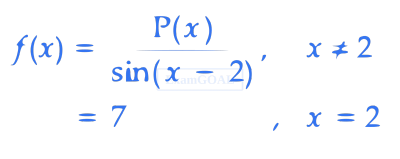
Consider the function
where P(x) is a polynomial such that P'' (x) is always a constant and P(3) = 9. If f(x) is continuous at x = 2, then P(5) is equal to _____________.
Show Answer
Correct Answer: 39
Explanation:
$f(x) = \left\{ {\matrix{
{{{P(x)} \over {\sin (x - 2)}},} & {x \ne 2} \cr
{7,} & {x = 2} \cr
} } \right.$+ ) = f(2$-$ )
2021
Q334
JEE Mains
Numerical
iCON Education HYD, 79930 92826, 73309 72826
14 Mar 2026
Let f : R $\to$ R be a function defined as $f(x) = \left\{ {\matrix{
{3\left( {1 - {{|x|} \over 2}} \right)} & {if} & {|x|\, \le 2} \cr
0 & {if} & {|x|\, > 2} \cr
} } \right.$
Show Answer
Correct Answer: 4
Explanation:
$f(x) = \left\{ {\matrix{
{3\left( {{{1 - \left| x \right|} \over 2}} \right)} & {if\,\left| x \right| \le 2} \cr
0 & {if\,\left| x \right| > 2} \cr
} } \right.$
$g(x) = f(x + 2) - f(x - 2)$
$f(x) = \left\{ {\matrix{
{0,} & {x < - 2} \cr
{{3 \over 2}(1 + x),} & { - 2 \le x < 0} \cr
{{3 \over 2}(1 - x),} & {0 \le x < 2} \cr
{0,} & {x > 2} \cr
} } \right.$
$f(x + 2) = \left\{ {\matrix{
{0,} & {x < - 4} \cr
{{3 \over 2}( 3 + x),} & { - 4 \le x < - 2} \cr
{{3 \over 2}( - 1 - x),} & { - 2 \le x < 0} \cr
{0,} & {x > 4} \cr
} } \right.$
$f(x - 2) = \left\{ {\matrix{
{0,} & {x < 0} \cr
{{3 \over 2}(x - 1),} & {0 \le x < 2} \cr
{{3 \over 2}( - 1 - x),} & {2 \le x < 4} \cr
{0,} & {x > 4} \cr
} } \right.$
$g(x) = f(x + 2) + f(x - 2)$
$ = \left\{ {\matrix{
{{{3x} \over 2} + 6,} & { - 4 \le x \le 2} \cr
{ - {{3x} \over 2},} & { - 2 < x < 2} \cr
{{{3x} \over 2} - 6,} & {2 \le x \le 4} \cr
{0,} & {\left| x \right| > 4} \cr
} } \right.$
So, n = 0 and m = 4
$\therefore$ m + n = 4
2021
Q335
JEE Mains
Numerical
iCON Education HYD, 79930 92826, 73309 72826
14 Mar 2026
Let a function g : [ 0, 4 ] $\to$ R be defined as
Show Answer
Correct Answer: 1
Explanation:
$f(x) = {x^3} - 6{x^2} + 9x - 3$
2021
Q336
JEE Mains
Numerical
iCON Education HYD, 79930 92826, 73309 72826
14 Mar 2026
If $\mathop {\lim }\limits_{x \to 0} {{\alpha x{e^x} - \beta {{\log }_e}(1 + x) + \gamma {x^2}{e^{ - x}}} \over {x{{\sin }^2}x}} = 10,\alpha ,\beta ,\gamma \in R$, then the value of $\alpha$ + $\beta$ + $\gamma$ is _____________.
Show Answer
Correct Answer: 3
Explanation:
$\mathop {\lim }\limits_{x \to 0} {{\alpha x\left( {1 + x + {{{x^2}} \over x}} \right) - \beta \left( {x - {{{x^2}} \over 2} + {{{x^3}} \over 3}} \right) + \gamma {x^2}(1 - x)} \over {{x^3}}}$
2021
Q337
JEE Mains
Numerical
iCON Education HYD, 79930 92826, 73309 72826
14 Mar 2026
If the value of $\mathop {\lim }\limits_{x \to 0} {(2 - \cos x\sqrt {\cos 2x} )^{\left( {{{x + 2} \over {{x^2}}}} \right)}}$ is equal to ea , then a is equal to __________.
Show Answer
Correct Answer: 3
Explanation:
$\mathop {\lim }\limits_{x \to 0} {(2 - \cos x\sqrt {\cos 2x} )^{{{x + 2} \over {{x^2}}}}}$$\infty$ $ = {e^{\mathop {\lim }\limits_{x \to 0} \left( {{{1 - \cos x\sqrt {\cos 2x} } \over {{x^2}}}} \right) \times (x + 2)}}$
2021
Q338
JEE Mains
Numerical
iCON Education HYD, 79930 92826, 73309 72826
14 Mar 2026
Let f : R $ \to $ R satisfy the equation f(x + y) = f(x) . f(y) for all x, y $\in$R and f(x) $\ne$ 0 for any x$\in$R. If the function f is differentiable at x = 0 and f'(0) = 3, then
Show Answer
Correct Answer: 3
Explanation:
Given, $f(x + y) = f(x)\,.\,f(y)\,\forall x,y \in R$
$\therefore$ $f(x) = {a^x} \Rightarrow f'(x) = {a^x}\,.\,\log (a)$
Now, $f'(0) = \log (a) \Rightarrow 3 = \log (a) \Rightarrow a = {e^3}$
$\therefore$ $f(x) = {({e^3})^x} = {e^{3x}}$
$\therefore$ $f(h) = {e^{3h}}$
Now, $\mathop {\lim }\limits_{h \to 0} \left( {{{f(h) - 1} \over h}} \right) = \mathop {\lim }\limits_{h \to 0} \left( {{{{e^{3h}} - 1} \over h}} \right)$
$ = \mathop {\lim }\limits_{h \to 0} \left( {{{{e^{3h}} - 1} \over {3h}} \times 3} \right) = 3 \times 1 = 3$
2021
Q339
JEE Mains
Numerical
iCON Education HYD, 79930 92826, 73309 72826
14 Mar 2026
If the function $f(x) = {{\cos (\sin x) - \cos x} \over {{x^4}}}$ is continuous at each point in its domain and $f(0) = {1 \over k}$, then k is ____________.
Show Answer
Correct Answer: 6
Explanation:
$\mathop {\lim }\limits_{x \to 0} f\left( x \right) = \mathop {\lim }\limits_{x \to 0} {{\cos \left( {\sin x} \right) - \cos x} \over {{x^4}}}$
2021
Q340
JEE Mains
Numerical
iCON Education HYD, 79930 92826, 73309 72826
14 Mar 2026
Let f : R $ \to $ R and g : R $ \to $ R be defined as
Show Answer
Correct Answer: 1
Explanation:
$g[f(x)] = \left[ {\matrix{
{f(x) + 1} & {f(x) < 0} \cr
{{{(f(x) - 1)}^2} + b} & {f(x) \ge 0} \cr
} } \right.$2 + b
2 + b = (|0 - 1| - 1)2 + b
2 + b = b
2021
Q341
JEE Mains
Numerical
iCON Education HYD, 79930 92826, 73309 72826
14 Mar 2026
If $\mathop {\lim }\limits_{x \to 0} {{a{e^x} - b\cos x + c{e^{ - x}}} \over {x\sin x}} = 2$, then a + b + c is equal to ____________.
Show Answer
Correct Answer: 4
Explanation:
$\mathop {\lim }\limits_{x \to 0} {{\left\{ {a\left( {1 + x + {{{x^2}} \over {2!}} + .....} \right) - b\left( {1 - {{{x^2}} \over {2!}} + {{{x^4}} \over {4!}}......} \right) + c\left( {1 - x + {{{x^2}} \over {2!}}......} \right)} \right\}} \over {x\left( {x - {{{x^3}} \over {3!}} + .....} \right)}} = 2$
2021
Q342
JEE Mains
Numerical
iCON Education HYD, 79930 92826, 73309 72826
14 Mar 2026
A function f is defined on [$-$3, 3] as
Show Answer
Correct Answer: 5
Explanation:
Points of non-differentiability in ($-$3, 3) are at x = $-$2, $-$1, 0, 1, 2.
i.e. 5 points.
2021
Q343
JEE Mains
Numerical
iCON Education HYD, 79930 92826, 73309 72826
14 Mar 2026
If $\mathop {\lim }\limits_{x \to 0} {{ax - ({e^{4x}} - 1)} \over {ax({e^{4x}} - 1)}}$ exists and is equal to b, then the value of a $-$ 2b is __________.
Show Answer
Correct Answer: 5
Explanation:
$\mathop {\lim }\limits_{x \to 0} {{ax - \left( {{e^{4x}} - 1} \right)} \over {ax\left( {{e^{4x}} - 1} \right)}}$
2021
Q344
JEE Mains
Numerical
iCON Education HYD, 79930 92826, 73309 72826
14 Mar 2026
The number of points, at which the function 2 + x $-$ 2 |, x$\in$R is not differentiable, is __________.
Show Answer
Correct Answer: 2
Explanation:
$f(x) = |2x + 1| - 3|x + 2| + |{x^2} + x - 2|$
2021
Q345
JEE Mains
Numerical
iCON Education HYD, 79930 92826, 73309 72826
14 Mar 2026
$\mathop {\lim }\limits_{n \to \infty } \tan \left\{ {\sum\limits_{r = 1}^n {{{\tan }^{ - 1}}\left( {{1 \over {1 + r + {r^2}}}} \right)} } \right\}$ is equal to ______.
Show Answer
Correct Answer: 1
Explanation:
${\tan ^{ - 1}}\left( {{1 \over {1 + r + {r^2}}}} \right)$
2021
Q346
JEE Advanced
MSQ
iCON Education HYD, 79930 92826, 73309 72826
14 Mar 2026
Let f : R $\to$ R be defined by $f(x) = {{{x^2} - 3x - 6} \over {{x^2} + 2x + 4}}$
A.
f is decreasing in the interval ($-$2, $-$1)
B.
f is increasing in the interval (1, 2)
D.
Range of f is $\left[ { - {3 \over 2},2} \right]$
Show Answer
Correct Answer: A,B
Explanation:
Given,
$f(x) = {{{x^2} - 3x - 6} \over {{x^2} + 2x + 4}}$ .... (i)
$ \Rightarrow f'(x) = {{({x^2} + 2x + 4)(2x - 3) - ({x^2} - 3x - 6)(2x + 2)} \over {{{({x^2} + 2x + 4)}^2}}}$
$ \Rightarrow f'(x) = {{5x(x + 4)} \over {{{({x^2} + 2x + 4)}^2}}}$
Sign scheme for f'(x)
Here, f is decreasing in the interval ($-$2, $-$1) and f is increasing in the interval (1, 2).
Now, $f( - 4) = {{11} \over 6},f(0) = {{ - 3} \over 2}$ [from Eq. (i)]
and $\mathop {\lim }\limits_{x \to \pm \,\infty } f(x) = 1$
$\therefore$ Range $ = \left[ {{{ - 3} \over 2},{{11} \over 6}} \right]$
Hence, f(x) is into.
f(x) has local maxima at x = $-$4
and local minima at x = 0.
2021
Q347
AP-EAPCET
MCQ
iCON Education HYD, 79930 92826, 73309 72826
20 May 2026
If $\lim _\limits{x \rightarrow 0}\left(\frac{11 x^3-3 x+4}{13 x^3-5 x^2-7}\right)=\frac{a}{b}$, then the value of $a+b$ equals
Show Answer
Correct Answer: D
Explanation:
$\begin{aligned}
& \lim _{x \rightarrow 0}\left(\frac{11 x^3-3 x+4}{13 x^3-5 x^2-7}\right) \\
& =\frac{11(0)-3(0)+4}{13(0)-5(0)-7}=\frac{+4}{-7}=\frac{a}{b} \\
& \Rightarrow \quad a=4 \alpha \text { and } b=-7 \alpha \\
& \Rightarrow a+b=-3 \alpha \text { or } a+b=3 \alpha \\
\end{aligned}$
Then, any multiple of 3 will be equal to $a+b$.
Among options 24 is multiple of 3.
$\therefore 24$ is required value of $a+b$.
2021
Q348
AP-EAPCET
MCQ
iCON Education HYD, 79930 92826, 73309 72826
20 May 2026
$\lim _\limits{x \rightarrow 1} \frac{(1-x)\left(1-x^2\right) \ldots\left(1-x^{2 n}\right)}{\left\{(1-x)\left(1-x^2\right) \ldots \ldots\left(1-x^n\right)\right\}^2}=
$ _____________, $\forall n \in N$
B.
${ }^{2 n} \mathrm{C}$
Show Answer
Correct Answer: B
Explanation:
$\begin{aligned} & \lim _{x \rightarrow 1} \frac{(1-x)\left(1-x^2\right) \ldots\left(1-x^{2 n}\right)}{\left\{(1-x)\left(1-x^2\right) \ldots\left(1-x^n\right)\right\}^2} \\ & =\lim _{x \rightarrow 1} \frac{(x-1)\left(x^2-1\right) \ldots\left(x^{2 n}-1\right)}{\left\{(x-1)\left(x^2-1\right) \ldots\left(x^n-1\right)\right\}^2} \\ & =\lim _{x \rightarrow 0} \frac{(x-1)\left(x^2-1\right) \ldots\left(x^{2 n}-1\right)}{\left\{\frac{(x-1)}{(x-1)} \cdot \frac{\left(x^2-1\right)}{(x-1)} \ldots \frac{\left(x^n-1\right)}{(x-1)}\right\}^2 \cdot(x-1)^{2 n}} \\ & =\lim _{x \rightarrow 1} \frac{\frac{(x-1)}{(x-1)} \frac{\left(x^2-1\right)}{(x-1)} \ldots \frac{\left(x^{2 n}-1\right)}{(x-1)}}{\left\{\frac{(x-1)}{(x-1)} \cdot \frac{\left(x^2-1\right)}{(x-1)} \cdots \frac{\left(x^n-1\right)}{(x-1)}\right\}^2} \\ & =\frac{1 \cdot 2 \cdot 3 \cdot \ldots 2 n}{\{1 \cdot 2 \ldots n\}^2} \\ & =\frac{(2 n) !}{(n !)^2}=\frac{(2 n) !}{n ! n !}={ }^{2 n} C_n\left[\because \lim _{x \rightarrow a} \frac{x^n-a^n}{x-a} n a^{n-1}\right]\end{aligned}$
2021
Q349
AP-EAPCET
MCQ
iCON Education HYD, 79930 92826, 73309 72826
20 May 2026
If $f(x)=\frac{\log _e\left(1+x^2(\tan x)\right)}{\sin x^3}, x \neq 0$ is to be continuous at $x=0$, then $f(0)$ must be equal to
Show Answer
Correct Answer: A
Explanation:
$f(x)=\frac{\log _e\left(1+x^2 \tan x\right)}{\sin x^3} \cdot x \neq 0$
$f$ is continuous at $x=0$, then
$f(0)=\mathrm{LHL}=\mathrm{RHL}$
$\mathrm{RHL}=\lim _\limits{h \rightarrow 0} \frac{\log _e\left(1+h^2 \tan h\right)}{\sin h^3}$
$\begin{array}{rlr}
& =\lim _{h \rightarrow 0} \frac{\log _e\left(1+h^2 \tan h\right)}{h^3 \cdot\left(\frac{\sin h^3}{h^3}\right)} & \\
& =\lim _{h \rightarrow 0} \frac{\log _e\left(1+h^2 \tan h\right)}{h^3} & {\left[\because \lim _{h \rightarrow 0} \frac{\sin h}{h}=1\right]} \\
& =\lim _{h \rightarrow 0} \frac{\log _e\left(1+h^3 \frac{\tan h}{h}\right)}{h^3} \\
& =\lim _{h \rightarrow 0} \frac{\log _e\left(1+h^3\right)}{h^3} & \left(\because \lim _{h \rightarrow 0} \frac{\tan h}{h}=1\right) \\
& =\lim _{h \rightarrow 0} \frac{\frac{1}{\left(1+h^3\right)}\left(3 h^2\right)}{3 h^2} \\
& =\lim _{h \rightarrow 0} \frac{1}{1+h^3}=1 \\
\therefore f(0) & =1
\end{array}$
[L-Hospital]
2021
Q350
AP-EAPCET
MCQ
iCON Education HYD, 79930 92826, 73309 72826
20 May 2026
$\mathop {\lim }\limits_{n \to \infty } {{n{{(2n + 1)}^2}} \over {(n + 2)({n^2} + 3n - 1)}}$ is equal to
Show Answer
Correct Answer: B
Explanation:
$\mathop {\lim }\limits_{n \to \infty } {{n{{(2n + 1)}^2}} \over {(n + 2)({n^2} + 3n - 1)}}$
$=\mathrm{\frac{Coefficient \,of \,n^3 \,in \,numerator}{Coefficient \,of \,n^3 \,in \,denominator}}=\frac{4}{1}$