Properties of Triangle
Let the area of a $\triangle P Q R$ with vertices $P(5,4), Q(-2,4)$ and $R(a, b)$ be 35 square units. If its orthocenter and centroid are $O\left(2, \frac{14}{5}\right)$ and $C(c, d)$ respectively, then $c+2 d$ is equal to

Let $\mathrm{A}(6,8), \mathrm{B}(10 \cos \alpha,-10 \sin \alpha)$ and $\mathrm{C}(-10 \sin \alpha, 10 \cos \alpha)$, be the vertices of a triangle. If $L(a, 9)$ and $G(h, k)$ be its orthocenter and centroid respectively, then $(5 a-3 h+6 k+100 \sin 2 \alpha)$ is equal to ___________.
Explanation:
All the three points $A, B, C$ lie on the circle $x^2+y^2=100$ so circumcentre is $(0,0)$

$\begin{aligned} & \frac{a+0}{3}=h \Rightarrow a=3 h \\ & \text { and } \frac{9+0}{3}=k \Rightarrow k=3 \\ & \text { also centroid } \frac{6+10 \cos \alpha-10 \sin \alpha}{3}=h \\ & \Rightarrow 10(\cos \alpha-\sin \alpha)=3 h-6\quad\text{.... (i)} \end{aligned}$
$\begin{aligned} &\begin{aligned} & \text { and } \frac{8+10 \cos \alpha-10 \sin \alpha}{3}=\mathrm{k} \\ & \Rightarrow 10(\cos \alpha-\sin \alpha)=3 \mathrm{k}-8=9-8=1 \quad\text{.... (ii)}\\ & \text { on squaring } 100(1-\sin 2 \alpha)=1 \\ & \Rightarrow 100 \sin 2 \alpha=99 \end{aligned}\\ &\text { from equ. (i) and (ii) we get } \mathrm{h}=\frac{7}{3}\\ &\begin{aligned} & \text { Now } 5 a-3 h+6 k+100 \sin 2 \alpha \\ & =15 h-3 h+6 k+100 \sin 2 \alpha \\ & =12 \times \frac{7}{3}+18+99 \\ & =145 \end{aligned} \end{aligned}$
Two vertices of a triangle $\mathrm{ABC}$ are $\mathrm{A}(3,-1)$ and $\mathrm{B}(-2,3)$, and its orthocentre is $\mathrm{P}(1,1)$. If the coordinates of the point $\mathrm{C}$ are $(\alpha, \beta)$ and the centre of the of the circle circumscribing the triangle $\mathrm{PAB}$ is $(\mathrm{h}, \mathrm{k})$, then the value of $(\alpha+\beta)+2(\mathrm{~h}+\mathrm{k})$ equals

Let $\left(5, \frac{a}{4}\right)$ be the circumcenter of a triangle with vertices $\mathrm{A}(a,-2), \mathrm{B}(a, 6)$ and $C\left(\frac{a}{4},-2\right)$. Let $\alpha$ denote the circumradius, $\beta$ denote the area and $\gamma$ denote the perimeter of the triangle. Then $\alpha+\beta+\gamma$ is
In a triangle $\mathrm{ABC}, \mathrm{BC}=7, \mathrm{AC}=8, \mathrm{AB}=\alpha \in \mathrm{N}$ and $\cos \mathrm{A}=\frac{2}{3}$. If $49 \cos (3 \mathrm{C})+42=\frac{\mathrm{m}}{\mathrm{n}}$, where $\operatorname{gcd}(m, n)=1$, then $m+n$ is equal to _________.
Explanation:

$\begin{aligned} & \cos A=\frac{2}{3}=\frac{\alpha^2+8^2-7^2}{2 \cdot \alpha \cdot 8} \\ & \Rightarrow\left(\alpha^2+15\right) 3=32 \alpha \\ & 3 \alpha^2-32 \alpha+45=0 \\ & \Rightarrow \alpha=\frac{5}{3}, 9 \\ & \because \alpha \in N \Rightarrow \alpha=9 \\ & \cos C=\frac{7^2+8^2-9^2}{2 \cdot 7 \cdot 8}=\frac{2}{7} \end{aligned}$
$ \begin{aligned} \cos 3 C & =4 \cos ^3 C-3 \cos C \\ = & \frac{4 \times 8}{7^3}-\frac{6}{7} \\ 49 \cos 3 C & =\frac{32}{7}-42 \\ \Rightarrow \quad & 49 \cos 3 C+42=\frac{32}{7} \\ \Rightarrow \quad & m+n =39 \end{aligned} $
Consider a triangle $\mathrm{ABC}$ having the vertices $\mathrm{A}(1,2), \mathrm{B}(\alpha, \beta)$ and $\mathrm{C}(\gamma, \delta)$ and angles $\angle A B C=\frac{\pi}{6}$ and $\angle B A C=\frac{2 \pi}{3}$. If the points $\mathrm{B}$ and $\mathrm{C}$ lie on the line $y=x+4$, then $\alpha^2+\gamma^2$ is equal to _______.
Explanation:

$\begin{aligned} & P=\frac{|2-1-4|}{\sqrt{1^2+1^2}}=\frac{3}{\sqrt{2}} \\ & \sin \left(\frac{\pi}{6}\right)=\frac{3 / \sqrt{2}}{A B}=\frac{1}{2} \Rightarrow A B=\frac{6}{\sqrt{2}} \\ & \Rightarrow(\alpha-1)^2+(\alpha+4-2)^2=18 \end{aligned}$
$\Rightarrow 2 \alpha^2+2 \alpha-13=0 \rightarrow \alpha$ and $\gamma$ satisfy same equation

$\begin{aligned} & \Rightarrow \alpha^2+\gamma^2=(\alpha+\gamma)^2-2 \alpha \gamma \\ & =(-1)^2-2\left(\frac{-13}{2}\right)=1+13=14 \end{aligned}$
In a triangle ABC, if $\cos \mathrm{A}+2 \cos \mathrm{B}+\cos C=2$ and the lengths of the sides opposite to the angles A and C are 3 and 7 respectively, then $\mathrm{\cos A-\cos C}$ is equal to
For a triangle $ABC$, the value of $\cos 2A + \cos 2B + \cos 2C$ is least. If its inradius is 3 and incentre is M, then which of the following is NOT correct?

A straight line cuts off the intercepts $\mathrm{OA}=\mathrm{a}$ and $\mathrm{OB}=\mathrm{b}$ on the positive directions of $x$-axis and $y$ axis respectively. If the perpendicular from origin $O$ to this line makes an angle of $\frac{\pi}{6}$ with positive direction of $y$-axis and the area of $\triangle \mathrm{OAB}$ is $\frac{98}{3} \sqrt{3}$, then $\mathrm{a}^{2}-\mathrm{b}^{2}$ is equal to :

$x \sin A+y \sin B+z \sin C-18=0=x \sin 2 A+y \sin 2 B+z \sin 2 C-9$,
where $A, B, C$ are the angles of a triangle $A B C$, then $80\left(\sin \frac{A}{2} \sin \frac{B}{2} \sin \frac{C}{2}\right)$
is equal to ______________.
Explanation:
In the figure, $\theta_{1}+\theta_{2}=\frac{\pi}{2}$ and $\sqrt{3}(\mathrm{BE})=4(\mathrm{AB})$. If the area of $\triangle \mathrm{CAB}$ is $2 \sqrt{3}-3$ unit ${ }^{2}$, when $\frac{\theta_{2}}{\theta_{1}}$ is the largest, then the perimeter (in unit) of $\triangle \mathrm{CED}$ is equal to _________.

Explanation:

We have, $\theta_1+\theta_2=\frac{\pi}{2}$ and $\sqrt{3}(B E)=4 A B$
Let $A B=x$ unit
$ \begin{aligned} & A C=x \tan \theta_1 \\\\ & E D=x \tan \theta_2 \\\\ & B E=B D+D E \end{aligned} $
$ \begin{array}{rlrl} & \Rightarrow \frac{4}{\sqrt{3}} x =x\left(\tan \theta_1+\tan \theta_2\right) {[\because \sqrt{3} B E=4 A B]} \\\\ & \Rightarrow \frac{4}{\sqrt{3}}=\tan \theta_1+\tan \left(\frac{\pi}{2}-\theta_1\right) {\left[\because \theta_1+\theta_2=\frac{\pi}{2}\right]} \end{array} $
$ \begin{aligned} & \Rightarrow \tan \theta_1+\cot \theta_1=\frac{4}{\sqrt{3}}=\sqrt{3}+\frac{1}{\sqrt{3}} \\\\ & \Rightarrow \tan \theta_1=\sqrt{3} \text { or } \theta_1=\frac{\pi}{3} \text { and } \theta_2=\frac{\pi}{6} \\\\ & \operatorname{or} \theta_1=\frac{\pi}{6} \text { and } \theta_2=\frac{\pi}{3} \end{aligned} $
$\because \frac{\theta_2}{\theta_1}$ is largest
$ \therefore \theta_1=\frac{\pi}{6} \text { and } \theta_2=\frac{\pi}{3} $
$ \begin{aligned} & \text { Area of } \triangle C A B=\frac{1}{2} \times x \times x \tan \theta_1 \\\\ & \Rightarrow \frac{x^2 \tan \theta_1}{2}=2 \sqrt{3}-3 \\\\ & \Rightarrow x^2=\frac{2(2 \sqrt{3}-3)}{\tan \frac{\pi}{6}}=12-6 \sqrt{3} \\\\\ & \Rightarrow x=3-\sqrt{3} \end{aligned} $
$ \text { Also, } C E=\sqrt{x^2+x^2 \tan ^2 \frac{\pi}{3}}=(3-\sqrt{3}) \times 2=6-2 \sqrt{3} $
Perimeter of $\triangle C E D$
$ \begin{aligned} & =C D+D E+C E \\\\ & =(3-\sqrt{3})+(3-\sqrt{3}) \tan \frac{\pi}{3}+6-2 \sqrt{3} \\\\ & =3-\sqrt{3}+3 \sqrt{3}-3+6-2 \sqrt{3}=6 \end{aligned} $
Explanation:
$ \begin{aligned} \Rightarrow a & =\frac{8 \sin A \cdot \sin B \sin C}{4} \\\\ & =2 \sin \left(\frac{\pi}{2}-2 C\right) \sin \left(\frac{\pi}{2}+C\right) \sin C \\\\ & =2 \cos 2 C \cdot \cos C \cdot \sin C \\\\ & =\cos 2 C \cdot \sin 2 C \\\\ & =\sqrt{1-\sin ^2 2 C} \cdot \sin 2 C \\\\ & =\sqrt{1-\frac{9}{6}} \cdot \times \frac{3}{4} \\\\ &\Rightarrow a =\frac{3 \sqrt{7}}{16} \\\\ & \therefore (64 a)^2 =1008 \end{aligned} $
The lengths of the sides of a triangle are 10 + x2, 10 + x2 and 20 $-$ 2x2. If for x = k, the area of the triangle is maximum, then 3k2 is equal to :

Let a, b and c be the length of sides of a triangle ABC such that ${{a + b} \over 7} = {{b + c} \over 8} = {{c + a} \over 9}$. If r and R are the radius of incircle and radius of circumcircle of the triangle ABC, respectively, then the value of ${R \over r}$ is equal to :


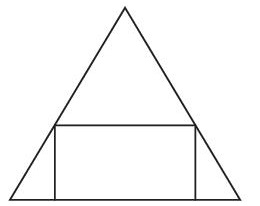
Explanation:

In $\Delta$DBF
$\tan 60^\circ = {{2b} \over {2\sqrt 2 - l}} \Rightarrow b = {{\sqrt 3 \left( {2\sqrt 2 - l} \right)} \over 2}$
A = Area of rectangle = l $\times$ b
$A = l \times {{\sqrt 3 } \over 2}\left( {2\sqrt 2 - l} \right)$
${{dA} \over {dl}} = {{\sqrt 3 } \over 2}\left( {2\sqrt 2 - l} \right) - {{l.\sqrt 3 } \over 2} = 0$
$l = \sqrt 2 $
$A = l \times b = \sqrt 2 \times {{\sqrt 3 } \over 2}\left( {\sqrt 2 } \right) = \sqrt 3 $
$\Rightarrow$ A2 = 3
Explanation:

Area = ${1 \over 2}(5)(12)\sin \theta = 30$
$\sin \theta = 1 \Rightarrow \theta = {\pi \over 2}$
$\Delta$ is right angle $\Delta$

$r = (s - a)\tan {A \over 2}$
$r = (s - a)$$\tan {{90} \over 2}$
$r = (s - a)$
$2R + r = s$, (As $a = 2R$)
$2R + r = {{5 + 12 + 13} \over 2} = 15$
Explanation:

(i) $\sqrt 2 r + r = 1$
$r = {1 \over {\sqrt 2 + 1}}$
$r = \sqrt 2 - 1$
(ii) $C{C_2} = 2\sqrt 2 - 2 = 2\left( {\sqrt 2 - 1} \right)$
From $\Delta C{C_2}N = \sin \phi = {{\sqrt 2 - 1} \over {2\left( {\sqrt 2 - 1} \right)}}$
$\phi = 30^\circ $
(iii) In $\Delta$ACE apply sine law
${{AE} \over {\sin \phi }} = {{AC} \over {\sin 105^\circ }}$
$AE = {1 \over 2} \times {{\sqrt 2 } \over {\sqrt 3 + 1}}.2\sqrt 2 $
$AE = {2 \over {\sqrt 3 + 1}} = \sqrt 3 - 1$
$ \therefore $ $EB = 1 - \left( {\sqrt 3 - 1} \right)$
= $2 - \sqrt 3 $
$ \therefore $ $\alpha$ = 2, $\beta$ = $-$1 $ \Rightarrow $ $\alpha$ + $\beta$ = 1
Explanation:
$AB = \sqrt {23} = c$
$BC = 3 = a$
$CA = 4 = b$

Now,
${{\cot A + \cot C} \over {\cot B}} = {{{{\cos A} \over {\sin A}} + {{\cos C} \over {\sin C}}} \over {{{\cos B} \over {\sin B}}}}$
$ = {{{{{b^2} + {c^2} - {a^2}} \over {2bc(\sin A)}} + {{{a^2} + {b^2} - {c^2}} \over {2ab(\sin C)}}} \over {{{{c^2} + {a^2} - {b^2}} \over {2ac(\sin B)}}}}$
$ = {{{{{b^2} + {c^2} - {a^2}} \over {4\Delta }} + {{{a^2} + {b^2} - {c^2}} \over {4\Delta }}} \over {{{{c^2} + {a^2} - {b^2}} \over {4\Delta }}}}$
$ = {{{b^2} + {c^2} - {a^2} + {a^2} + {b^2} - {c^2}} \over {{c^2} + {a^2} - {b^2}}}$
$ = {{2{b^2}} \over {{a^2} + {c^2} - {b^2}}} = {{2 \times 16} \over {9 + 23 - 16}} = {{32} \over {16}} = 2$


and ${{a\,.(\,c - \,b)} \over {c\,.\,(a - \,b)}} = {{|a|} \over {|a| + |b|}}$, then the value of |a $ \times $ b|2 is ......
Explanation:
PQ = c, QR = a and RP = b, so a + b + c = 0
$ \therefore $ |a|2 + a . b + a . c = 0 ....(i)
and a . b + |b|2 + c . b = 0 ....(ii)
and, also given that |a| = 3, |b| = 4
and ${{a\,.\,c - a\,.\,b} \over {c\,.\,a - c\,.\,b}} = {{|a|} \over {|a| + |b|}} = {3 \over 7}$
$ \Rightarrow 7[(a\,.\,c) - (a\,.\,b)] = 3[(c\,.\,a) - (c\,.\,b)]$
from Eqs. (i) and (ii), on putting the values of a . c and c . b, we get,
$ \Rightarrow 7[ - 9 - (a\,.\,b) - (a\,.\,b)] = 3[ - 9 - (a\,.\,b) + 16 + (a\,.\,b)]$
$ \Rightarrow 7[ - 9 - 2(a\,.\,b)] = 3 \times 7$
$ \Rightarrow a\,.\,b = - 6$
$ \because $ $|a \times b{|^2} = {(|a||b|)^2} - {(a\,.\,b)^2}$
= $144 - 36 = 108$
$\tan {X \over 2} + \tan {Z \over 2} = {{2y} \over {x + y + z}}$, then which of the following statements is/are TRUE?


If ${{\cos A} \over \alpha } = {{\cos B} \over \beta } = {{\cos C} \over \gamma },$ then the ordered triad ($\alpha $, $\beta $, $\gamma $) has a value :


If ${{s - x} \over 4} = {{s - y} \over 3} = {{s - z} \over 2}$ and area of incircle of the triangle $XYZ$ is ${{8\pi } \over 3}$, then

| Column I | Column I | ||
|---|---|---|---|
| (A) | $\begin{array}{l}\text { In a triangle } \Delta X Y Z \text {, let } a, b \text { and } c \text { be the lengths of the sides } \\\text { opposite to the angles } X, Y \text { and } Z \text {, respectively. If } 2\left(a^2-b^2\right)=c^2 \\\text { and } \lambda=\frac{\sin (X-Y)}{\sin Z} \text {, then possible values of } n \text { for which } \cos (n \lambda) \\=0 \text { is (are) }\end{array}$ | (P) | 1 |
| (B) | $\begin{array}{l}\text { In a triangle } \triangle X Y Z \text {, let } a, b \text { and } c \text { be the lengths of the sides } \\\text { opposite to the angles } X, Y \text { and } Z \text {, respectively. If } 1+\cos 2 X-2 \\\cos 2 Y=2 \sin X \sin Y \text {, then possible value(s) of } \frac{a}{b} \text { is (are) }\end{array}$ | (Q) | 2 |
| (C) | $\begin{array}{l}\text { In } \mathbb{R}^2 \text {, let } \sqrt{3} \hat{i}+\hat{j}, \hat{i}+\sqrt{3} \hat{j} \text { and } \beta \hat{i}+(1-\beta) \hat{j} \text { be the position } \\\text { vectors of } X, Y \text { and } Z \text { with respect of the origin } \mathrm{O} \text {, respectively. If } \\\text { the distance of } \mathrm{Z} \text { from the bisector of the acute angle of } \overrightarrow{\mathrm{OX}} \text { with } \\\overrightarrow{\mathrm{OY}} \text { is } \frac{3}{\sqrt{2}} \text {, then possible value(s) of }|\beta| \text { is (are) }\end{array}$ | (R) | 3 |
| (D) | $\begin{array}{l}\text { Suppose that } F(\alpha) \text { denotes the area of the region bounded by } \\x=0, x=2, y^2=4 x \text { and } y=|\alpha x-1|+|\alpha x-2|+\alpha x \text {, } \\\text { where, } \alpha \in\{0,1\} \text {. Then the value(s) of } F(\alpha)+\frac{8}{2} \sqrt{2} \text {, when } \alpha=0 \\\text { and } \alpha=1 \text {, is (are) }\end{array}$ | (S) | 5 |
| (T) | 6 |


Explanation:
$\sin C = {{\sqrt 3 } \over 2}$ and C is given to be obtuse
$ \Rightarrow C = {{2\pi } \over 3} = \sqrt {{a^2} + {b^2} - 2ab\cos C} $
$ = \sqrt {{6^2} + {{10}^2} - 2 \times 6 \times 10 \times \cos {{2\pi } \over 3}} = 14$
$\therefore$ $r = {\Delta \over s} \Rightarrow {r^2} = {{225 \times 3} \over {{{\left( {{{6 + 10 + 14} \over 2}} \right)}^2}}} = 3$
Let ABC and ABC' be two non-congruent triangles with sides AB = 4, AC = AC' = 2$\sqrt2$ and angle B = 30$^\circ$. The absolute value of the difference between the areas of these triangles is ___________.
Explanation:
We have,
$\cos \beta = {{{a^2} + 16 - 8} \over {2 \times a \times 4}}$
$ \Rightarrow {{\sqrt 3 } \over 2} = {{{a^2} + 8} \over {8a}}$
$ \Rightarrow {a^2} - 4\sqrt 3 a + 8 = 0$
$ \Rightarrow {a_1} + {a_2} = 4\sqrt 3 ,{a_1}{a_2} = 8$
$ \Rightarrow |{a_1} - {a_2}| = 4$
$ \Rightarrow |{\Delta _1} - {\Delta _2}| = {1 \over 2} \times 4\sin 30^\circ \times 4 = 4$

Given an isosceles triangle, whose one angle is $120^{\circ}$ and radius of its incircle $=\sqrt{3}$. Then the area of the triangle in sq. units is
$7+12 \sqrt{3}$
$12-7 \sqrt{3}$
$12+7 \sqrt{3}$
$4 \pi$
 Let, $\quad \mathrm{AB}=\mathrm{AC}=b$
Internal bisector of $\angle A$ of triangle $A B C$ meets side BC at D . A line drawn through D perpendicular to AD intersects the side AC at E and the side AB at F . If $a, b, c$ represent sides of $\triangle \mathrm{ABC}$ then
AE is HM of $b$ and $c$
$\mathrm{AD}=\frac{2 b c}{b+c} \cos \frac{\mathrm{~A}}{2}$
$\mathrm{EF}=\frac{4 b c}{b+c} \sin \frac{\mathrm{~A}}{2}$
the triangle AEF is isosceles
 $ \begin{aligned} & \text { = area }(\Delta \mathrm{ABD})+\text { area }(\Delta \mathrm{ACD}) \\ & \text { Let } \mathrm{AB}=c, \mathrm{BC}=a \text { and } \mathrm{AC}=b \\ & \frac{1}{2} b c \sin \mathrm{~A}=\frac{1}{2} c \times \mathrm{AD} \sin \frac{\mathrm{~A}}{2} \\ & +\frac{1}{2} \times b \times \mathrm{AD} \sin \frac{\mathrm{~A}}{2} \\ & \Rightarrow b c \sin \mathrm{~A}=c \times \mathrm{AD} \sin \frac{\mathrm{~A}}{2}+b \mathrm{AD} \sin \frac{\mathrm{~A}}{2} \\ & \Rightarrow b c 2 \sin \frac{\mathrm{~A}}{2} \cdot \cos \frac{\mathrm{~A}}{2}=c \times \mathrm{AD} \\ & \sin \frac{\mathrm{~A}}{2}+b \mathrm{AD} \sin \frac{\mathrm{~A}}{2} \\ & \because \quad \left(\sin \mathrm{~A}=2 \sin \frac{\mathrm{~A}}{2} \cos \frac{\mathrm{~A}}{2}\right) \\ & \Rightarrow \quad 2 b c \cos \frac{\mathrm{~A}}{2}=c \times \mathrm{AD}+b \times \mathrm{AD} \end{aligned} $