Limits, Continuity and Differentiability
For a real number $\alpha$, let $[\alpha]$ denote the greatest integer less than or equal to $\alpha$. For a finite set $S$, let $|S|$ denote the number of elements in the set $S$.
Consider the functions $f:(-3,3) \rightarrow(-\infty, \infty)$ and $g:(-3,3) \rightarrow(-\infty, \infty)$ defined by
$ f(x)=\left[x^3\right] \log _e\left(1+\sin ^2(\pi(x-[x]))\right) $
and
$ g(x)=x^3 \sin ^2\left(\pi \log _e(1+x-[x])\right) . $
Let
$ A=\{x \in(-3,3): f \text { is discontinuous at } x\} $
and
$ B=\{x \in(-3,3): g \text { is discontinuous at } x\} . $
Then the value of $|A|+2|B|-|A \cap B|$ is $\_\_\_\_$ .
Explanation:
We are given:
$ f(x) = [x^3] \log \left(1 + \sin^2(\pi(x - [x]))\right) $
and
$ g(x) = x^3 \sin^2\left(\pi \log_e(1 + x - [x])\right) ,$
for $x \in (-3,3)$.
Simplify the expressions
Since $(x - [x])$ represents the fractional part of $x$, we can replace it by $\{x\}$. Then, because $\sin(\pi(x - [x])) = \sin(\pi x)$, we have
$ f(x) = [x^3] \log(1 + \sin^2 \pi x). $
Here, $[x^3]$ is the greatest integer less than or equal to $x^3$, and the fraction part repeats every integer shift in $x$. So $f(x)$ behaves differently in each interval between consecutive integers.
Determine where $f(x)$ is discontinuous
The expression $\log(1 + \sin^2 \pi x)$ is always continuous and periodic. The only chance of discontinuity comes from $[x^3]$ because it jumps whenever $x^3$ crosses an integer.
Since $x \in (-3,3)$, $x^3$ takes values from $-27$ to $27$. The integers in this range are from $-26$ to $26$, a total of $53$ integers. Whenever $x^3$ equals one of these integers, $[x^3]$ changes value.
At points where $x^3$ is an integer, $f(x)$ is likely discontinuous, except possibly where $\log(1 + \sin^2 \pi x) = 0$. That happens when $\sin \pi x = 0$, i.e., when $x$ is an integer.
Therefore, $f(x)$ is continuous at $x = -2, -1, 0, 1, 2$ but discontinuous where $x^3$ is an integer and $x$ is not an integer. So, out of 53 points, 5 are continuous, giving:
$ |A| = 53 - 5 = 48. $
Determine where $g(x)$ is discontinuous
We have
$ g(x) = x^3 \sin^2\left(\pi \log(1 + \{x\})\right). $
Here $\{x\} = x - [x]$, which is continuous everywhere except at integers. The function $\log(1 + \{x\})$ is defined for $\{x\} \in [0,1)$, so it is continuous within all open intervals between integers.
At integer values of $x$, $\{x\}$ jumps from $1^-$ to $0$, leading to discontinuities. So $g(x)$ is discontinuous only at integer points within $(-3,3)$, i.e., $x = -2, -1, 0, 1, 2$.
However, checking $x=0$, we find $g(0) = 0$, and the limit from both sides is also $0$, making it continuous at $x=0$. Hence, discontinuities are at $x = \pm 1, \pm 2$.
Thus, $|B| = 4$.
Intersection of discontinuities
Since $f(x)$ is continuous at $x = \pm 1, \pm 2$, none of these belong to both $A$ and $B$.
Hence, $|A \cap B| = 0.$
Final computation
$ |A| + 2|B| - |A \cap B| = 48 + 8 - 0 = 56. $
Consider the function $f:\left(-\frac{\pi}{2},\frac{\pi}{2}\right) \to (-\infty, \infty)$ defined by
$f(x) = (|x| + |x-1|) \sin x + \left[ x \sin x \right],$
where $\left[ x \sin x \right]$ is the greatest integer less than or equal to $x \sin x$.
Let $\alpha$ be the total number of points in the interval $\left(-\frac{\pi}{2}, \frac{\pi}{2}\right)$ at which $f$ is NOT continuous, and let $\beta$ be the total number of points in the interval $\left(-\frac{\pi}{2}, \frac{\pi}{2}\right)$ at which $f$ is NOT differentiable.
Then the value of $\alpha + \beta$ is ____________.
Explanation:
Let us write the function as $ f(x) = g(x) + h(x) $, where
$ g(x) = (|x| + |x - 1|)\sin x $ and $ h(x) = [x \sin x] $.
Check continuity of $ g(x) $
The expression $ |x| + |x - 1| $ is made up of absolute value functions. Absolute value functions are always continuous, and sine is also continuous. Therefore, $ g(x) $ is continuous for all $ x $ in $ \left(-\frac{\pi}{2}, \frac{\pi}{2}\right) $.
Check continuity of $ h(x) = [x \sin x] $
The greatest integer function $ [x \sin x] $ is discontinuous whenever $ x \sin x $ takes an integer value, because the value jumps at those points. So we must find where $ x \sin x $ equals an integer.
Case (i): $ x \sin x = 0 \Rightarrow x = 0 $
At $ x = 0 $, the function $ h(x) = [x \sin x] $ does not actually jump, so it is continuous at $ x = 0 $. Hence, $ f(x) $ is continuous there.
Case (ii): $ x \sin x = 1 \Rightarrow x = x_1 $ and because $ x \sin x $ is even, we also have another point $ x = -x_1 $.
Just before $ x_1 $, $ [x \sin x] = 0 $; just after $ x_1 $, $ [x \sin x] = 1 $. So there is a jump at $ x = x_1 $ and at $ x = -x_1 $.
Therefore, $ f(x) $ is not continuous at $ x = x_1 $ and $ x = -x_1 $.
Hence, $ \alpha = 2 $.
Check differentiability
We already know $ f(x) $ is not continuous at $ x = x_1, -x_1 $, so it cannot be differentiable there either.
We must also test $ x = 0 $ and $ x = 1 $, since $ g(x) $ involves absolute values and these points can cause problems with slope.
At $ x = 0 $:
$ f'(0^-) = f'(0^+) = 1 $, hence $ f(x) $ is differentiable at $ x = 0 $.
At $ x = 1 $:
$ f'(1^-) = \cos 1 $ and $ f'(1^+) = \cos 1 + 2\sin 1 $
Since these two are not equal, $ f(x) $ is not differentiable at $ x = 1 $.
Therefore, the points of non-differentiability are $ x = x_1, -x_1 $, and $ 1 $.
Hence, $ \beta = 3 $.
Final Answer:
$ \alpha + \beta = 5 $
Let $f(x)=\left\{\begin{array}{ll}x^3+8 ; & x<0, \\ x^2-4 ; & x \geq 0,\end{array}\right.$ and $g(x)= \begin{cases}(x-8)^{1 / 3} ; & x<0, \\ (x+4)^{1 / 2} ; & x \geq 0 .\end{cases}$
Then the number of points, where the function $g \circ f$ is discontinuous, is $\_\_\_\_$ .
Explanation:
We need to find the points where the composite function $g \circ f$ is discontinuous.
That means we first find
$ (g \circ f)(x)=g(f(x)). $
So we must see, for each value of $x$, which branch of $g$ will be used.
1. Given functions
$ f(x)= \begin{cases} x^3+8, & x<0,\\ x^2-4, & x\ge 0 \end{cases} $
and
$ g(x)= \begin{cases} (x-8)^{1/3}, & x<0,\\ (x+4)^{1/2}, & x\ge 0. \end{cases} $
Now,
$ (g\circ f)(x)=g(f(x)). $
The definition of $g$ depends on whether its input is negative or non-negative. So we must check the sign of $f(x)$.
2. Find where $f(x)<0$ and where $f(x)\ge 0$
Case 1: $x<0$
Then
$ f(x)=x^3+8. $
We check when this is negative:
$ x^3+8<0 \implies x^3<-8 \implies x<-2. $
So for $x<0$:
if $x<-2$, then $f(x)<0$,
if $-2\le x<0$, then $f(x)\ge 0$.
Case 2: $x\ge 0$
Then
$ f(x)=x^2-4. $
We check when this is negative:
$ x^2-4<0 \implies x^2<4 \implies -2 But here $x\ge 0$, so this becomes $ 0\le x<2. $ Thus for $x\ge 0$: if $0\le x<2$, then $f(x)<0$, if $x\ge 2$, then $f(x)\ge 0$. Now use the correct branch of $g$. Here $f(x)<0$, so use $ g(y)=(y-8)^{1/3}. $ Thus $ (g\circ f)(x)=\big((x^3+8)-8\big)^{1/3}=(x^3)^{1/3}=x. $ So for $x<-2$, $ (g\circ f)(x)=x. $ Here $f(x)\ge 0$, so use $ g(y)=\sqrt{y+4}. $ Thus $ (g\circ f)(x)=\sqrt{(x^3+8)+4}=\sqrt{x^3+12}. $ So for $-2\le x<0$, $ (g\circ f)(x)=\sqrt{x^3+12}. $ Here $f(x)<0$, so use $ g(y)=(y-8)^{1/3}. $ Thus $ (g\circ f)(x)=\big((x^2-4)-8\big)^{1/3}=(x^2-12)^{1/3}. $ So for $0\le x<2$, $ (g\circ f)(x)=(x^2-12)^{1/3}. $ Here $f(x)\ge 0$, so use $ g(y)=\sqrt{y+4}. $ Thus $ (g\circ f)(x)=\sqrt{(x^2-4)+4}=\sqrt{x^2}=x $ since $x\ge 2$. So for $x\ge 2$, $ (g\circ f)(x)=x. $ Each expression is continuous in its own interval. So we only check the joining points: $ x=-2,\quad x=0,\quad x=2. $ Left-hand limit: for $x<-2$, $(g\circ f)(x)=x$, so $ \lim_{x\to -2^-}(g\circ f)(x)=-2. $ Right-hand limit: for $-2\le x<0$, $(g\circ f)(x)=\sqrt{x^3+12}$, so $ \lim_{x\to -2^+}(g\circ f)(x)=\sqrt{(-2)^3+12}=\sqrt{4}=2. $ Since $ -2\ne 2, $ the function is discontinuous at $x=-2$. Left-hand limit: $ \lim_{x\to 0^-}(g\circ f)(x)=\sqrt{0^3+12}=\sqrt{12}. $ Right-hand limit: $ \lim_{x\to 0^+}(g\circ f)(x)=(0^2-12)^{1/3}=(-12)^{1/3}. $ These are not equal, so discontinuous at $x=0$. Left-hand limit: $ \lim_{x\to 2^-}(g\circ f)(x)=(2^2-12)^{1/3}=(-8)^{1/3}=-2. $ Right-hand limit: $ \lim_{x\to 2^+}(g\circ f)(x)=2. $ These are not equal, so discontinuous at $x=2$. The function $g\circ f$ is discontinuous at $ x=-2,\quad x=0,\quad x=2. $ Hence, the number of points of discontinuity is $ \boxed{3}. $
3. Write $(g\circ f)(x)$ piecewise
(i) When $x<-2$
(ii) When $-2\le x<0$
(iii) When $0\le x<2$
(iv) When $x\ge 2$
4. Check continuity at possible boundary points
At $x=-2$
At $x=0$
At $x=2$
5. Conclusion
Let $f(x)=\left\{\begin{array}{cc}e^{x-1} & , x<0 \\ x^2-5 x+6 & , x \geq 0\end{array}\right.$ and $g(x)=f(|x|)+|f(x)|$. If the number of points where $g$ is not continuous and is not differentiable are $\alpha$ and $\beta$ respectively, then $\alpha+\beta$ is equal to $\_\_\_\_$
Explanation:

First look at $|f(x)|$.
For $x<0$, we have $f(x)=e^{x-1}$, which is always positive, so $|f(x)|=e^{x-1}$. This part is continuous and differentiable for all $x<0$.
For $x\\ge 0$, $f(x)=x^2-5x+6=(x-2)(x-3)$. This becomes $0$ at $x=2$ and $x=3$, and it changes sign between $2$ and $3$. So when we take absolute value, $|f(x)|$ gets a “sharp corner” at $x=2$ and $x=3$, hence it is not differentiable at $x=2,3$.
At $x=0$, check continuity of $|f(x)|$: left value tends to $|e^{-1}|=e^{-1}$, but right value is $|f(0)|=|6|=6$. Since these are not equal, $|f(x)|$ is discontinuous at $x=0$ (and therefore also not differentiable at $x=0$).
Now consider $g(x)=f(|x|)+|f(x)|$.
Here $f(|x|)$ always uses the $x\\ge 0$ definition because $|x|\\ge 0$. So $f(|x|)$ is continuous for all $x$, but it is not differentiable at $x=0$ because of $|x|$.
So, discontinuity in $g$ can only come from $|f(x)|$, which happens at $x=0$ only. Also, $g$ will be non-differentiable where either term is non-differentiable, i.e., at $x=0,2,3$.
$\begin{aligned} & |\mathrm{f}(\mathrm{x})| \text { is discontinuous at } \mathrm{x}=0 \\ & |\mathrm{f}(\mathrm{x})| \text { is non-diff. at } \mathrm{x}=0,2,3 \\ & \mathrm{~g}(\mathrm{x})=\mathrm{f}(|\mathrm{x}|)+|\mathrm{f}(\mathrm{x})| \\ & \mathrm{g}(\mathrm{x}) \text { will be discontinuous at } \mathrm{x}=0 \\ & \mathrm{~g}(\mathrm{x}) \text { will be non diff at } \mathrm{x}=0,2,3 \\ & \alpha=1, \beta=3 \\ & \alpha+\beta=1+3=4\end{aligned}$
The number of points, at which the function $f(x)=\max \left\{6 x, 2+3 x^2\right\}+|x-1| \cos \left|x^2-\frac{1}{4}\right|, x \in(-\pi, \pi)$, is not differentiable, is
$\_\_\_\_$ .
Explanation:
For the part $\max \left\{6 x, 2+3 x^2\right\}$, the function can change its “active” expression only at those points where the two inside expressions become equal.
$2+3 x^2=6 x \Rightarrow 3 x^2-6 x+2=0$

$ \mathrm{x}=\frac{6 \pm \sqrt{12}}{6}=\frac{3 \pm \sqrt{2}}{3} $
At these two values of $x$, the max function switches between $6x$ and $2+3x^2$. Also, the derivatives of the two expressions are different there (since $\frac{d}{dx}(6x)=6$ and $\frac{d}{dx}(2+3x^2)=6x$), so $\max \left\{6 x, 2+3 x^2\right\}$ is not differentiable at both points.
Now look at the second part $|x-1| \cos \left|x^2-\frac{1}{4}\right|$. The factor $\cos \left|x^2-\frac{1}{4}\right|$ is continuous for all $x$, and at $x=1$ it becomes $\cos \left|1-\frac{1}{4}\right|=\cos \left(\frac{3}{4}\right)\neq 0$.
Because $\cos \left|x^2-\frac{1}{4}\right|$ is nonzero at $x=1$, multiplying it by $|x-1|$ does not remove the “corner” of $|x-1|$. So $|x-1| \cos \left|x^2-\frac{1}{4}\right|$ is not differentiable at $x=1$.
Total number of points where $f(x)$ is nonDifferentiable is 3
The number of points in the interval $[2, 4]$, at which the function $f(x) = \left[ x^2 - x - \frac{1}{2} \right]$, where $[ \cdot ]$ denotes the greatest integer function, is discontinuous, is ________.
Explanation:
For the greatest integer function
$ f(x)=\left[x^2-x-\frac12\right], $
the function is discontinuous at those points where
$ x^2-x-\frac12 $
takes an integer value.
So, let
$ x^2-x-\frac12=n, $
where $n$ is an integer.
We need to find how many such points lie in the interval $[2,4]$.
First, consider
$ g(x)=x^2-x-\frac12. $
Now check its values at the endpoints:
At $x=2$,
$ g(2)=4-2-\frac12=\frac32. $
At $x=4$,
$ g(4)=16-4-\frac12=\frac{23}{2}=11.5. $
Also,
$ g'(x)=2x-1. $
For $x\in[2,4]$, we have $2x-1>0$, so $g(x)$ is strictly increasing on $[2,4]$.
Hence, as $x$ goes from $2$ to $4$, $g(x)$ takes every value from $\frac32$ to $\frac{23}{2}$ exactly once.
Now count the integers in the interval
$ \left[\frac32,\frac{23}{2}\right]=[1.5,11.5]. $
These integers are
$ 2,3,4,5,6,7,8,9,10,11. $
There are $10$ integers.
Since each integer value corresponds to exactly one $x\in[2,4]$, the function $f(x)$ is discontinuous at exactly $10$ points.
Therefore, the required number of points is
$ \boxed{10}. $
Explanation:
$\lim _\limits{x \rightarrow 0} \frac{\frac{\tan (\tan x)-\tan x}{\tan ^3 x} \frac{\tan ^3 x}{x^3}+\frac{\tan x-\sin x}{x^3}+\frac{\sin x-\sin (\sin x)}{\sin ^3 x} \frac{\sin ^3 x}{x^3}}{\frac{\tan x-\sin x}{x^3}}$
$=\frac{\frac{1}{3}+\frac{1}{2}+\frac{1}{6}}{\frac{1}{2}}=2$
For $\mathrm{t}>-1$, let $\alpha_{\mathrm{t}}$ and $\beta_{\mathrm{t}}$ be the roots of the equation
$ \left((\mathrm{t}+2)^{1 / 7}-1\right) x^2+\left((\mathrm{t}+2)^{1 / 6}-1\right) x+\left((\mathrm{t}+2)^{1 / 21}-1\right)=0 \text {. If } \lim \limits_{\mathrm{t} \rightarrow-1^{+}} \alpha_{\mathrm{t}}=\mathrm{a} \text { and } \lim \limits_{\mathrm{t} \rightarrow-1^{+}} \beta_{\mathrm{t}}=\mathrm{b} \text {, } $
then $72(a+b)^2$ is equal to ___________.
Explanation:
$\begin{aligned} &a+b=\lim _{t \rightarrow-1^{+}}(\alpha+\beta)=\lim _{t \rightarrow-1^{+}}-\frac{(t+2)^{\frac{1}{6}}-1}{(t+2)^{\frac{1}{7}}-1}\\ &\begin{aligned} & \text { let } t+2=y \\ & a+b=\lim _{y \rightarrow 1^{+}} \frac{y^{1 / 6}-1}{y^{1 / 7}-1}=\frac{7}{6} \\ & 72(a+b)^2=72 \frac{49}{36}=98 \end{aligned} \end{aligned}$
The number of points of discontinuity of the function $f(x)=\left[\frac{x^2}{2}\right]-[\sqrt{x}], x \in[0,4]$, where $[\cdot]$ denotes the greatest integer function, is ________.
Explanation:
To determine the points of discontinuity of the function $ f(x) = \left[\frac{x^2}{2}\right] - [\sqrt{x}] $, where $[\cdot]$ denotes the greatest integer function, we need to identify possible values of $ x $ where discontinuities might occur within the interval $[0,4]$.
Discontinuity Analysis
For the term $\left[\frac{x^2}{2}\right]$:
The probable values of $ x $ that could cause discontinuities are the roots or specific values where the integer part changes between consecutive integers. The transitions happen when:
$ \begin{aligned} & = 1, 2, 3, 4, 5, 6, 7, 8 \\ & \implies x = \sqrt{2}, 2, \sqrt{6}, 2\sqrt{2}, \sqrt{10}, 2\sqrt{3}, \sqrt{14}, 4 \end{aligned} $
For the term $[\sqrt{x}]$:
The values of $ x $ where $[\sqrt{x}]$ changes are straightforward. They occur at:
$ x = 1, 2 $
Discontinuity Check
By evaluating $ f(x) $ at all these potential points, we find the function is indeed discontinuous at:
$ x = 1, \sqrt{2}, 2, \sqrt{6}, 2\sqrt{2}, \sqrt{10}, 2\sqrt{3}, \sqrt{14} $
Thus, the function $ f(x) $ has 8 discontinuities on the interval $[0,4]$.
Let $m$ and $n$ be the number of points at which the function $f(x)=\max \left\{x, x^3, x^5, \ldots x^{21}\right\}, x \in \mathbb{R}$, is not differentiable and not continuous, respectively. Then $m+n$ is equal to _________.
Explanation:
$\begin{aligned} &\text { for } x \geq 1, x^{21} \geq x^{19} \geq \ldots \geq x \text {. }\\ &f(x)=\left\{\begin{array}{lr} x & x<-1 \\ x^{21} & -1 \leq x \leq 0 \\ x & 0< x<1 \\ x^{21} & x \geq 1 \end{array}\right. \end{aligned}$

$\begin{aligned} &\text { Clearly, } f(x) \text { is continuous everywhere. }\\ &\begin{aligned} & \Rightarrow \alpha=0 \\ & f^{\prime}(x)=\left\{\begin{array}{cl} 1 & ; x<-1 \\ 21 x^{20} & ;-1 \leq x \leq 0 \\ 1 & ; 0< x<1 \\ 21 \cdot x^{20} & ; x \geq 1 \end{array}\right. \\ & \Rightarrow \beta=3 \\ & \Rightarrow \alpha+\beta=3 \end{aligned} \end{aligned}$
Explanation:
To solve the given limit problem, we start by analyzing the expression:
$ \lim\limits_{x \rightarrow 0}\left(\frac{\tan x}{x}\right)^{\frac{1}{x^2}} = p $
This limit exhibits the indeterminate form $1^{\infty}$. To handle this form, we use the transformation:
$ p = e^{\lim_{x \to 0} \left( \frac{\tan x}{x} - 1 \right) \frac{1}{x^2}} $
Expanding $\tan x$ using its Taylor series near $x = 0$, we have:
$ \tan x = x + \frac{x^3}{3} + \frac{2}{15}x^5 + \ldots $
Substituting this expansion into the limit, we get:
$ \frac{\tan x - x}{x^3} = \frac{\left(x + \frac{x^3}{3} + \frac{2}{15}x^5 + \ldots - x\right)}{x^3} = \frac{\frac{x^3}{3} + \frac{2}{15}x^5 + \ldots}{x^3} $
This simplifies to:
$ \frac{x^3}{3x^3} = \frac{1}{3} $
Thus, the limit becomes:
$ p = e^{\frac{1}{3}} $
Therefore, the expression for $\log_e p$ is:
$ \log_e p = \frac{1}{3} $
Finally, computing $96 \log_e p$:
$ 96 \log_e p = 96 \cdot \frac{1}{3} = 32 $
Let [t] be the greatest integer less than or equal to t. Then the least value of p ∈ N for which
$ \lim\limits_{x \to 0^+} \left( x (\left[ \frac{1}{x} \right] + \left[ \frac{2}{x} \right] + \ldots + \left[ \frac{p}{x} \right] \right) - x^2 \left( \left[ \frac{1}{x^2} \right] + \left[ \frac{2^2}{x^2} \right] + \ldots + \left[ \frac{9^2}{x^2} \right] \right) \geq 1 $ is equal to _______.
Explanation:
To find the least natural number $ p $ for which the following inequality holds:
$ \lim \limits_{x \rightarrow 0^{+}}\left(x\left(\left[\frac{1}{x}\right]+\left[\frac{2}{x}\right]+\ldots+\left[\frac{p}{x}\right]\right)-x^2\left(\left[\frac{1}{x^2}\right]+\left[\frac{2^2}{x^2}\right]+\ldots+\left[\frac{9^2}{x^2}\right]\right)\right) \geq 1 $
we simplify the expression inside the limit.
As $ x \to 0^+ $, $ \left[\frac{n}{x}\right] $ approximates to $ \frac{n}{x} $. Thus, the problem becomes finding:
$ \left(1 + 2 + \ldots + p\right) - \left(1^2 + 2^2 + \ldots + 9^2\right) \geq 1 $
The sum of the first $ p $ natural numbers is given by:
$ \frac{p(p+1)}{2} $
And the sum of the squares of the first 9 natural numbers is:
$ 1^2 + 2^2 + \ldots + 9^2 = \frac{9 \cdot 10 \cdot 19}{6} $
Thus, the inequality becomes:
$ \frac{p(p+1)}{2} - \frac{9 \cdot 10 \cdot 19}{6} \geq 1 $
Solving this, we rewrite:
$ p(p+1) \geq 572 $
The least natural number $ p $ satisfying this condition is $ 24 $.
Let $f(x)=\lim \limits_{n \rightarrow \infty} \sum\limits_{r=0}^n\left(\frac{\tan \left(x / 2^{r+1}\right)+\tan ^3\left(x / 2^{r+1}\right)}{1-\tan ^2\left(x / 2^{r+1}\right)}\right)$ Then $\lim\limits_{x \rightarrow 0} \frac{e^x-e^{f(x)}}{(x-f(x))}$ is equal to ___________.
Explanation:
$\begin{aligned} & f(x)=\lim _{n \rightarrow \infty} \sum_{r=0}^n\left(\tan \frac{x}{2^r}-\tan \frac{x}{2^{r+1}}\right)=\tan x \\ & \lim _{x \rightarrow 0}\left(\frac{e^x-e^{\tan x}}{x-\tan x}\right)=\lim _{x \rightarrow 0} e^{\tan x} \frac{\left(e^{x-\tan x}-1\right)}{(x-\tan x)} \\ & =1 \end{aligned}$
Let $\mathrm{f}(x)=\left\{\begin{array}{lc}3 x, & x<0 \\ \min \{1+x+[x], x+2[x]\}, & 0 \leq x \leq 2 \\ 5, & x>2\end{array}\right.$
where [.] denotes greatest integer function. If $\alpha$ and $\beta$ are the number of points, where $f$ is not continuous and is not differentiable, respectively, then $\alpha+\beta$ equals _______ .
Explanation:
$\begin{aligned} & f(x)=\left\{\begin{array}{ccc} 3 x & ; & x<0 \\ \min \{1+x, x\} & ; & 0 \leq x<1 \\ \min \{2+x, x+2\} & ; & 1 \leq x<2 \\ 5 & ; & x>2 \end{array}\right. \\ & f(x)=\left\{\begin{array}{ccl} 3 \mathrm{x} & ; & x<0 \\ \mathrm{x} & ; & 0 \leq x<1 \\ \mathrm{x}+2 & ; & 1 \leq x<2 \\ 5 & ; & x>2 \end{array}\right. \end{aligned}$

Not continuous at $\mathrm{x} \in\{1,2\} \Rightarrow \alpha=2$
Not diff. at $\mathrm{x} \in\{0,1,2\} \Rightarrow \beta=3$
$\alpha+\beta=5$
Let the function,
$f(x)= \begin{cases}-3 \mathrm{ax}^2-2, & x<1 \\ \mathrm{a}^2+\mathrm{b} x, & x \geqslant 1\end{cases}$
be differentiable for all $x \in \mathbf{R}$, where $\mathrm{a}>1, \mathrm{~b} \in \mathbf{R}$. If the area of the region enclosed by $y=f(x)$ and the line $y=-20$ is $\alpha+\beta \sqrt{3}, \alpha, \beta \in Z$, then the value of $\alpha+\beta$ is ___________ .
Explanation:
$\mathrm{f}(\mathrm{x})$ is continuous and differentiable
$ \begin{array}{ll} \text { at } x=1 ; & \text { LHL }=\text { RHL, LHD }=\text { RHD } \\ & -3 a-2=a^2+b,-6 a=b \\ & a=2,1 ; b=-12 \end{array} $
$f(x)=\left\{\begin{array}{cc}-6 x^2-2, & x<1 \\ 4-12 x, & x \geq 1\end{array}\right.$

$\begin{aligned} & \left.\text { Area }=\int_{-\sqrt{3}}^1\left(-6 x^2-2+20\right) d x+\int_1^2(4-12 x+20) d x\right] \\\\ & =16+12 \sqrt{3}+6=22+12 \sqrt{3} \\\\ & \therefore \quad \alpha+\beta=34\end{aligned}$
Let α and β be the real numbers such that
$ \lim\limits_{x \to 0} \frac{1}{x^3} \left( \frac{\alpha}{2} \int\limits_0^x \frac{1}{1-t^2} \, dt + \beta x \cos x \right) = 2. $
Then the value of α + β is ___________.
Let $f:(0, \pi) \rightarrow \mathbf{R}$ be a function given by $f(x)=\left\{\begin{array}{cc}\left(\frac{8}{7}\right)^{\frac{\tan 8 x}{\tan 7 x}}, & 0< x<\frac{\pi}{2} \\ \mathrm{a}-8, & x=\frac{\pi}{2} \\ (1+\mid \cot x)^{\frac{\mathrm{b}}{\mathrm{a}}|\tan x|}, & \frac{\pi}{2} < x < \pi\end{array}\right.$
where $\mathrm{a}, \mathrm{b} \in \mathbf{Z}$. If $f$ is continuous at $x=\frac{\pi}{2}$, then $\mathrm{a}^2+\mathrm{b}^2$ is equal to _________.
Explanation:
$\lim _\limits{x \rightarrow \frac{\pi^{-}}{2}} f(x)=f\left(\frac{\pi}{2}\right)=\lim _\limits{x \rightarrow \frac{\pi^{+}}{2}} f(x) \text { for continuity at } x=\frac{\pi}{2}$
$\begin{aligned} & \Rightarrow \quad \lim _{x \rightarrow \frac{\pi^{-}}{2}}\left(\frac{8}{7}\right)^{\left(\frac{\tan 8 x}{\tan 7 x}\right)} \quad \text { Let } x=\frac{\pi}{2}-h \\ & \Rightarrow \quad \lim _{h \rightarrow 0}\left(\frac{8}{7}\right)^{\frac{\tan (4 \pi-8 h)}{\tan \left(3 \pi+\frac{\pi}{2}-7 h\right)}}=\lim _{h \rightarrow 0}\left(\frac{8}{7}\right)^{\frac{\tan (-8 h)}{\cot (7 h)}}=\left(\frac{8}{7}\right)^0=1 \\ & \Rightarrow \quad a-8=1 \Rightarrow a=9 \end{aligned}$
$\lim _\limits{x \rightarrow \frac{\pi^{+}}{2}}(1+|\cot x|)^{\frac{b}{a}|\tan x|}, x=\frac{\pi}{2}+h$
$\lim _\limits{h \rightarrow 0}(1-\tan h)^{-\frac{b}{9} \cot h}=\lim _\limits{h \rightarrow 0}(1-\tan h)^{-\frac{b}{9} \cot h}$
$\begin{aligned} & =\lim _\limits{h \rightarrow 0}(1-\tan h)^{\left(\frac{-1}{\tan h}\right) \cdot(-\tan h) \cdot\left(\frac{-b}{9} \cot h\right)} \\ & =e^{\frac{b}{9}}=1 \quad \Rightarrow b=0 \\ & \Rightarrow a^2+b^2=81+0=81 \end{aligned}$
If $\alpha=\lim _\limits{x \rightarrow 0^{+}}\left(\frac{\mathrm{e}^{\sqrt{\tan x}}-\mathrm{e}^{\sqrt{x}}}{\sqrt{\tan x}-\sqrt{x}}\right)$ and $\beta=\lim _\limits{x \rightarrow 0}(1+\sin x)^{\frac{1}{2} \cot x}$ are the roots of the quadratic equation $\mathrm{a} x^2+\mathrm{b} x-\sqrt{\mathrm{e}}=0$, then $12 \log _{\mathrm{e}}(\mathrm{a}+\mathrm{b})$ is equal to _________.
Explanation:
$\begin{aligned} \alpha & =\lim _{x \rightarrow 0^{+}} \frac{e^{\sqrt{\tan x}}-e^{\sqrt{x}}}{(\sqrt{\tan x}-\sqrt{x})} \\ & =\lim _{x \rightarrow 0} \frac{e^{\sqrt{x}}\left(e^{\sqrt{\tan x}-\sqrt{x}}-1\right)}{(\sqrt{\tan x}-\sqrt{x})}=1 \\ \beta & =\lim _{x \rightarrow 0}(1+\sin x)^{\frac{1}{2} \cot x}=\lim _{x \rightarrow 0} e^{(\sin x)\left(\frac{1}{2} \cot x\right)} \\ & =\lim _{x \rightarrow 0} e^{\frac{1}{2} \cos x}=e^{1 / 2} \end{aligned}$
$\begin{aligned} & \text { Product of roots }=\sqrt{e}=\frac{-\sqrt{e}}{a} \Rightarrow a=-1 \\ & \text { Sum of roots }=\frac{-b}{a}=1+\sqrt{e} \\ & \qquad=b=\sqrt{e}+1 \\ & \Rightarrow 12 \ln (a+b)=12 \ln (\sqrt{e}+1-1)=12 \ln \left(e^{1 / 2}\right)=6 \end{aligned}$
The value of $\lim _\limits{x \rightarrow 0} 2\left(\frac{1-\cos x \sqrt{\cos 2 x} \sqrt[3]{\cos 3 x} \ldots \ldots . \sqrt[10]{\cos 10 x}}{x^2}\right)$ is __________.
Explanation:
$\mathop {\lim }\limits_{x \to 0} 2\left( {{{1 - \cos x{{(\cos 2x)}^{{1 \over 2}}}{{(\cos 3x)}^{{1 \over 3}}}\,...\,{{(\cos 10x)}^{{1 \over {10}}}}} \over {{x^2}}}} \right)$ $\left(\frac{0}{0} \text { form }\right)$
Using L' hospital
$2 \lim _\limits{x \rightarrow 0} \frac{\sin x(\cos 2 x)^{\frac{1}{2}} \ldots(\cos 10 x)^{\frac{1}{10}} \ldots(\sin 2 x)(\cos x)(\cos 3 x)^{\frac{1}{3}}+\ldots}{2 x}$
$\begin{aligned} \Rightarrow & \lim _{x \rightarrow 0}\left(\frac{\sin x}{x}+\frac{\sin 2 x}{x}+\ldots+\frac{\sin 10 x}{x}\right) \\ \quad & =1+2+\ldots+10=55 \end{aligned}$
Let $[t]$ denote the greatest integer less than or equal to $t$. Let $f:[0, \infty) \rightarrow \mathbf{R}$ be a function defined by $f(x)=\left[\frac{x}{2}+3\right]-[\sqrt{x}]$. Let $\mathrm{S}$ be the set of all points in the interval $[0,8]$ at which $f$ is not continuous. Then $\sum_\limits{\text {aes }} a$ is equal to __________.
Explanation:
$\begin{aligned} f(x) & =\left[\frac{x}{3}+3\right]-[\sqrt{x}] \\ & =\left[\frac{x}{2}\right]-[\sqrt{x}]+3 \end{aligned}$
Critical points where $f(x)$ might change behaviours when $\frac{x}{2} \in$ integer and $\sqrt{x} \in$ integer
$\Rightarrow$ Critical points,
$\begin{aligned} & f(0)=3 \\ & f\left(0^{+}\right)=3 \\ & f\left(1^{-}\right)=3 \\ & f\left(1^{+}\right)=2 \\ & f\left(2^{-}\right)=2 \\ & f\left(2^{+}\right)=3 \\ & f\left(3^{+}\right)=f\left(3^{-}\right)=3=f\left(4^{+}\right)=f\left(4^{-}\right)=f\left(5^{+}\right)=f\left(5^{-}\right) \\ & f\left(6^{-}\right)=3 \\ & f\left(6^{+}\right)=4 \\ & f\left(7^{-}\right)=f\left(7^{+}\right)=4 \\ & f\left(8^{-}\right)=4 \\ & f(8)=5 \end{aligned}$
$\begin{aligned} & \Rightarrow f(x) \text { is not continuous at } \\ & x=1,2,6,8 \\ & \Rightarrow \sum_{a \in s} a=1+2+6+8 \\ & \quad=17 \end{aligned}$
Let $\mathrm{a}>0$ be a root of the equation $2 x^2+x-2=0$. If $\lim _\limits{x \rightarrow \frac{1}{a}} \frac{16\left(1-\cos \left(2+x-2 x^2\right)\right)}{(1-a x)^2}=\alpha+\beta \sqrt{17}$, where $\alpha, \beta \in Z$, then $\alpha+\beta$ is equal to _________.
Explanation:
$\because 2 x^2+x-2=0$ has two roots where $a=\frac{\sqrt{17}-1}{4}$ and another root is $\frac{-\sqrt{17}-1}{4}$
And $2+x-2 x^2=-2\left(x-\frac{1}{a}\right)\left(x+\frac{4}{\sqrt{17}+1}\right)$
Now $\lim _\limits{x \rightarrow \frac{1}{a}} \frac{16\left(1-\cos \left(2+x-2 x^2\right)\right)}{(1-a x)^2}$
$\begin{aligned} & =\lim _{x \rightarrow \frac{1}{a}} \frac{32 \sin ^2\left(\frac{2+x-2 x^2}{2}\right)}{a^2\left(\frac{1}{a}-x\right)^2} \\ & =\lim _{x \rightarrow \frac{1}{a}} \frac{\left(x+\frac{4}{\sqrt{17}+1}\right)^2 32 \cdot\left(\sin \left(\frac{1}{2} \cdot(-2)\right)\left(x-\frac{1}{a}\right)\left(x+\frac{4}{\sqrt{17}+1}\right)\right)^2}{a^2\left(\left(x-\frac{1}{a}\right)\left(x+\frac{4}{\sqrt{17}+1}\right)\right)^2} \\ & =2 \cdot\left(\frac{1}{a}+\frac{4}{\sqrt{17}+1}\right)^2 \cdot\left(\frac{4}{\sqrt{17}-1}\right)^2 \\ & =2\left(\frac{4}{\sqrt{17}-1}+\frac{4}{\sqrt{17}+1}\right)^2 \cdot\left(\frac{4}{\sqrt{17}-1}\right)^2 \\ & =\frac{17 \times 4}{18-2 \sqrt{17}}=\frac{68}{9-\sqrt{17}} \\ & =17(9+\sqrt{17}) \\ & \alpha+\beta=170 \end{aligned}$
Let $f$ be a differentiable function in the interval $(0, \infty)$ such that $f(1)=1$ and $\lim _\limits{t \rightarrow x} \frac{t^2 f(x)-x^2 f(t)}{t-x}=1$ for each $x>0$. Then $2 f(2)+3 f(3)$ is equal to _________.
Explanation:
$\lim _\limits{t \rightarrow x} \frac{t^2 f(x)-x^2 f(t)}{(t-x)}=1 \quad\left(\frac{0}{0} \text { form }\right)$
$\begin{aligned} & \lim _{t \rightarrow x} \frac{2 \operatorname{tf}(x)-x^2 f^{\prime}(t)}{1}=1 \\ & \Rightarrow 2 x f(x)-x^2 f'(x)=1 \\ & \frac{d y}{d x}-\frac{2 x y}{x^2}=\frac{-1}{x^2} \\ & \Rightarrow \frac{d y}{d x}-\left(\frac{2}{x}\right) y=\frac{-1}{x^2} \\ & \Rightarrow \text { I.F. }=e^{\int \frac{-2}{x} d x}=e^{-2 \ln x}=x^{-2}=\frac{1}{x^2} \end{aligned}$
$\begin{aligned} \Rightarrow & y\left(\frac{1}{x^2}\right)=\int\left(\frac{-1}{x^2}\right)\left(\frac{1}{x^2}\right) d x+C \\ & \frac{y}{x^2}=\frac{1}{3 x^3}+C \text { at } x=1, y=1 \\ \Rightarrow & 1=\frac{1}{3}+C \Rightarrow C=\frac{2}{3} \\ \Rightarrow & y=\frac{1}{3 x}+\frac{2}{3} x^2=f(x) \\ \Rightarrow & 2 f(2)+3 f(3)=24 \end{aligned}$
If $\lim _\limits{x \rightarrow 1} \frac{(5 x+1)^{1 / 3}-(x+5)^{1 / 3}}{(2 x+3)^{1 / 2}-(x+4)^{1 / 2}}=\frac{\mathrm{m} \sqrt{5}}{\mathrm{n}(2 \mathrm{n})^{2 / 3}}$, where $\operatorname{gcd}(\mathrm{m}, \mathrm{n})=1$, then $8 \mathrm{~m}+12 \mathrm{n}$ is equal to _______.
Explanation:
$I=\lim _\limits{x \rightarrow 1} \frac{(5 x+1)^{1 / 3}-(+5)^{1 /}}{(2 x+3)^{1 / 2}-(x+4)^{1 / 2}}$
From: $\frac{0}{0}$, using $\mathrm{L}-\mathrm{H}$ rule
$\begin{aligned} & I=\lim _{x \rightarrow 1} \frac{\frac{1}{3} \times 5(5 x+1)^{-2 / 3}--(+5)}{\frac{1}{2} \times 2(2 x+3)^{-1 / 2}-\frac{1}{2}(x+4)^{-1 / 2}} \\ & =\frac{\left(\left.\frac{5}{3}-\frac{1}{3} \right\rvert\, 6^{-2 / 3}\right.}{\frac{1}{2} 5^{-1 / 2}}=\frac{8}{3} \times \frac{5^{1 / 2}}{6^{2 / 3}}=\frac{m \sqrt{5}}{n(2 n)^{2 / 3}} \\ & \Rightarrow m=8, n=3 \\ & \Rightarrow 8 m+12 n=100 \end{aligned}$
Explanation:
R = $ \begin{gathered} \lim _{x \rightarrow 0^{+}} f(x)=\lim _{h \rightarrow 0} f(0+h) =\lim _{h \rightarrow 0} f(h) \end{gathered} $
$\begin{aligned} & =\lim _{h \rightarrow 0} \frac{\cos ^{-1}\left(1-h^2\right) \sin ^{-1}(1-h)}{h\left(1-h^2\right)} \\\\ & =\lim _{\mathrm{h} \rightarrow 0} \frac{\cos ^{-1}\left(1-\mathrm{h}^2\right)}{\mathrm{h}}\left(\frac{\sin ^{-1} 1}{1}\right)\end{aligned}$
Let $\cos ^{-1}\left(1-h^2\right)=\theta \Rightarrow \cos \theta=1-h^2$
$ \begin{aligned} & =\frac{\pi}{2} \lim _{\theta \rightarrow 0} \frac{\theta}{\sqrt{1-\cos \theta}} \\\\ & =\frac{\pi}{2} \lim _{\theta \rightarrow 0} \frac{1}{\sqrt{\frac{1-\cos \theta}{\theta^2}}} \\\\ & =\frac{\pi}{2} \frac{1}{\sqrt{1 / 2}} \\\\ & \therefore \mathrm{R}=\frac{\pi}{\sqrt{2}} \end{aligned} $
Now finding left hand limit
$ \begin{aligned} & L=\lim _{x \rightarrow 0^{-}} f(x) =\lim _{h \rightarrow 0} f(-h) \end{aligned} $
$\begin{aligned} & =\lim _{h \rightarrow 0} \frac{\cos ^{-1}\left(1-\{-h\}^2\right) \sin ^{-1}(1-\{-h\})}{\{-h\}-\{-h\}^3} \\\\ & =\lim _{h \rightarrow 0} \frac{\cos ^{-1}\left(1-(-h+1)^2\right) \sin ^{-1}(1-(-h+1))}{(-h+1)-(-h+1)^3} \\\\ & =\lim _{h \rightarrow 0} \frac{\cos ^{-1}\left(-h^2+2 h\right) \sin ^{-1} h}{(1-h)\left(1-(1-h)^2\right)}\end{aligned}$
$\begin{aligned} & =\lim _{h \rightarrow 0}\left(\frac{\pi}{2}\right) \frac{\sin ^{-1} h}{\left(1-(1-h)^2\right)} \\\\ & =\frac{\pi}{2} \lim _{h \rightarrow 0}\left(\frac{\sin ^{-1} h}{-h^2+2 h}\right) \\\\ & =\frac{\pi}{2} \lim _{h \rightarrow 0}\left(\frac{\sin ^{-1} h}{h}\right)\left(\frac{1}{-h+2}\right) \\\\ & \quad L=\frac{\pi}{4}\end{aligned}$
$\begin{aligned} & \frac{32}{\pi^2}\left(\mathrm{~L}^2+\mathrm{R}^2\right)=\frac{32}{\pi^2}\left(\frac{\pi^2}{2}+\frac{\pi^2}{16}\right) \\\\ & =16+2 \\\\ & =18\end{aligned}$
If $\lim _\limits{x \rightarrow 0} \frac{a x^2 e^x-b \log _e(1+x)+c x e^{-x}}{x^2 \sin x}=1$, then $16\left(a^2+b^2+c^2\right)$ is equal to ________.
Explanation:
$\mathop {\lim }\limits_{x \to 0} {{a{x^2}\left( {1 + x + {{{x^2}} \over {2!}} + {{{x^3}} \over {3!}} + ....} \right) - b\left( {x - {{{x^2}} \over 2} + {{{x^3}} \over 3} - .....} \right) + cx\left( {1 - x + {{{x^2}} \over {x!}} - {{{x^3}} \over {3!}} + .....} \right)} \over {{x^3}\,.\,{{\sin x} \over x}}}$
$=\lim _\limits{x \rightarrow \infty} \frac{(c-b) x+\left(\frac{b}{2}-c+a\right) x^2+\left(a-\frac{b}{3}+\frac{c}{2}\right) x^3+\ldots \ldots}{x^3}=1$
$\begin{aligned} & \mathrm{c}-\mathrm{b}=0, \quad \frac{\mathrm{b}}{2}-\mathrm{c}+\mathrm{a}=0 \\ & \mathrm{a}-\frac{\mathrm{b}}{3}+\frac{\mathrm{c}}{2}=1 \quad \mathrm{a}=\frac{3}{4} \quad \mathrm{~b}=\mathrm{c}=\frac{3}{2} \\ & \mathrm{a}^2+\mathrm{b}^2+\mathrm{c}^2=\frac{9}{16}+\frac{9}{4}+\frac{9}{4} \\ & 16\left(\mathrm{a}^2+\mathrm{b}^2+\mathrm{c}^2\right)=81 \end{aligned}$
If the function
$f(x)= \begin{cases}\frac{1}{|x|}, & |x| \geqslant 2 \\ \mathrm{a} x^2+2 \mathrm{~b}, & |x|<2\end{cases}$
is differentiable on $\mathbf{R}$, then $48(a+b)$ is equal to __________.
Explanation:
$\mathrm{f}(\mathrm{x})\left\{\begin{array}{c} \frac{1}{\mathrm{x}} ; \mathrm{x} \geq 2 \\ \mathrm{ax}^2+2 \mathrm{~b} ;-2<\mathrm{x}<2 \\ -\frac{1}{\mathrm{x}} ; \mathrm{x} \leq-2 \end{array}\right.$
Continuous at $\mathrm{x}=2 \quad \Rightarrow \frac{1}{2}=\frac{\mathrm{a}}{4}+2 \mathrm{~b}$
Continuous at $\mathrm{x}=-2 \quad \Rightarrow \frac{1}{2}=\frac{\mathrm{a}}{4}+2 \mathrm{~b}$
Since, it is differentiable at $\mathrm{x}=2$
$-\frac{1}{x^2}=2 \mathrm{ax}$
Differentiable at $x=2 \quad \Rightarrow \frac{-1}{4}=4 a \Rightarrow a=\frac{-1}{16}, b =\frac{3}{8}$
Let $f(x)=\sqrt{\lim _\limits{r \rightarrow x}\left\{\frac{2 r^2\left[(f(r))^2-f(x) f(r)\right]}{r^2-x^2}-r^3 e^{\frac{f(r)}{r}}\right\}}$ be differentiable in $(-\infty, 0) \cup(0, \infty)$ and $f(1)=1$. Then the value of ea, such that $f(a)=0$, is equal to _________.
Explanation:
$\begin{aligned} & f(1)=1, f(a)=0 \\ & {f^2}(x) = \mathop {\lim }\limits_{r \to x} \left( {{{2{r^2}({f^2}(r) - f(x)f(r))} \over {{r^2} - {x^2}}} - {r^3}{e^{{{f(r)} \over r}}}} \right) \\ & = \mathop {\lim }\limits_{r \to x} \left( {{{2{r^2}f(r)} \over {r + x}}{{(f(r) - f(x))} \over {r - x}} - {r^3}{e^{{{f(r)} \over r}}}} \right) \\ & f^2(x)=\frac{2 x^2 f(x)}{2 x} f^{\prime}(x)-x^3 e^{\frac{f(x)}{x}} \\ & y^2=x y \frac{d y}{d x}-x^3 e^{\frac{y}{x}} \\ & \frac{y}{x}=\frac{d y}{d x}-\frac{x^2}{y} e^{\frac{y}{x}} \end{aligned}$
Put $y=v x \Rightarrow \frac{d y}{d x}=v+x \frac{d v}{d x}$
$\begin{aligned} & v=v+x \frac{d v}{d x}-\frac{x}{v} e^v \\ & \frac{d v}{d x}=\frac{e^v}{v} \Rightarrow e^{-v} v d v=d x \end{aligned}$
Integrating both side
$\begin{aligned} & \mathrm{e}^{\mathrm{v}}(\mathrm{x}+\mathrm{c})+1+\mathrm{v}=0 \\ & \mathrm{f}(1)=1 \Rightarrow \mathrm{x}=1, \mathrm{y}=1 \end{aligned}$
$\begin{aligned} & \Rightarrow c=-1-\frac{2}{e} \\ & e^v\left(-1-\frac{2}{e}+x\right)+1+v=0 \\ & e^{\frac{y}{x}}\left(-1-\frac{2}{e}+x\right)+1+\frac{y}{x}=0 \\ & x=a, y=0 \Rightarrow a=\frac{2}{e} \\ & a e=2 \end{aligned}$
Let $[x]$ be the greatest integer $\leq x$. Then the number of points in the interval $(-2,1)$, where the function $f(x)=|[x]|+\sqrt{x-[x]}$ is discontinuous, is ___________.
Explanation:
1. The greatest integer function $[x]$ is discontinuous at every integer, since it jumps from one integer to the next without taking any values in between. The absolute value does not affect where this function is continuous or discontinuous. So within the interval $(-2,1)$, $[x]$ is discontinuous at $-2, -1, 0$ and $1$. However, because the interval is open $(-2,1)$, the endpoints $-2$ and $1$ are not included.
2. The function $\sqrt{x-[x]}$ is the square root of the fractional part of $x$. The fractional part function $x-[x]$ is continuous everywhere, as it always takes a value between $0$ and $1$ (inclusive of $0$, exclusive of $1$). However, the square root function $\sqrt{x}$ is only defined for $x \geq 0$, and so $\sqrt{x-[x]}$ is discontinuous wherever $x-[x] < 0$. This happens exactly at the points where $x$ is a negative integer, as the fractional part of a negative integer is $1$ (considering that the "fractional part" is defined as the part of the number to the right of the decimal point, which for negative numbers works a bit differently). Within the interval $(-2,1)$, this is the case for $-2$ and $-1$. However, since the interval is open $(-2,1)$, the endpoint $-2$ is not included.
Now, let's analyze the discontinuities within the given interval $(-2,1)$:
At $x=-1$: $f(-1^{+})=1+0=1$ and $f(-1^{-})=2+1=3$. Since these two values are different, $f(x)$ is discontinuous at $x=-1$.
At $x=0$: $f(0^{+})=0+0=0$ and $f(0^{-})=1+1=2$. Again, these two values are different, so $f(x)$ is discontinuous at $x=0$.
At $x=1$: $f(1^{+})=1+0=1$ and $f(1^{-})=0+1=1$. These two values are the same, so $f(x)$ is continuous at $x=1$. However, this point is not within the open interval $(-2,1)$.
So within the interval $(-2,1)$, the function $f(x) = |[x]| + \sqrt{x-[x]}$ is discontinuous at the points $-1$ and $0$ (2 points in total).
Let $f:( - 2,2) \to R$ be defined by $f(x) = \left\{ {\matrix{ {x[x],} & { - 2 < x < 0} \cr {(x - 1)[x],} & {0 \le x \le 2} \cr } } \right.$ where $[x]$ denotes the greatest integer function. If m and n respectively are the number of points in $( - 2,2)$ at which $y = |f(x)|$ is not continuous and not differentiable, then $m + n$ is equal to ____________.
Explanation:
When $[x]$ is denotes greatest integer function

Clearly, $|f(x)|$ remains same.
Given that, $m$ and $n$ respectively are the number points in $(-2,2)$ at which $y=|f(x)|$ is not continuous and not differentiable
So, $m=1$ where $y=|f(x)|$ not continuous
and $n=3$ where $|f(x)|$ is not differentiable.
Thus, $m+n=4$
Let $\mathrm{k}$ and $\mathrm{m}$ be positive real numbers such that the function $f(x)=\left\{\begin{array}{cc}3 x^{2}+k \sqrt{x+1}, & 0 < x < 1 \\ m x^{2}+k^{2}, & x \geq 1\end{array}\right.$ is differentiable for all $x > 0$. Then $\frac{8 f^{\prime}(8)}{f^{\prime}\left(\frac{1}{8}\right)}$ is equal to ____________.
Explanation:
$\because f(x)$ is differentiable at $x>0$
So, $f(x)$ is differentiable at $x=1$
$ \begin{gathered} f\left(1^{-}\right)=f(1)=f\left(1^{+}\right) \\\\ 3+k \sqrt{2}=m+k^2 ......(i) \end{gathered} $
$ \begin{aligned} & f^{\prime}\left(1^{-}\right)=f^{\prime}\left(1^{+}\right) \\\\ & 6(1)+\frac{k}{2 \sqrt{1+1}}=2 m(1) \\\\ & \Rightarrow 6+\frac{k}{2 \sqrt{2}}=2 m ......(ii) \end{aligned} $
Using (i) and (ii),
$ \begin{aligned} & 3+k \sqrt{2}=3+\frac{k}{4 \sqrt{2}}+k^2 \\\\ & \Rightarrow k^2+k\left[\frac{1}{4 \sqrt{2}}-\sqrt{2}\right]=0 \end{aligned} $
$ \Rightarrow k\left[k+\frac{1-8}{4 \sqrt{2}}\right]=0 \Rightarrow k=0, \frac{7}{4 \sqrt{2}} $
As the problem specifies k to be a positive real number, we can rule out k = 0. Hence, k = $\frac{7}{4 \sqrt{2}}$
$ \begin{aligned} & \text { for } k=\frac{7}{4 \sqrt{2}}, m=3+\frac{\frac{7}{4 \sqrt{2}}}{4 \sqrt{2}} \\\\ & =3+\frac{7}{32}=\frac{96+7}{32}=\frac{103}{32} \end{aligned} $
$ \text { So, } \frac{8 f^{\prime}(8)}{f^{\prime}\left(\frac{1}{8}\right)}=\frac{8 \times\left[2 \times \frac{103}{32} \times 8\right]}{6 \times \frac{1}{8}+\frac{7}{4 \sqrt{2}} \times 2 \sqrt{918}} $
$ =\frac{412}{\frac{3}{4}+\frac{7}{12}}=\frac{412}{\frac{9+7}{12}}=\frac{412 \times 12}{16}=309 $
Concept :
$f(x)$ is differentiable at $x=a$, if $f^{\prime}\left(a^{-}\right)=f'\left(a^{+}\right)$
Let $a \in \mathbb{Z}$ and $[\mathrm{t}]$ be the greatest integer $\leq \mathrm{t}$. Then the number of points, where the function $f(x)=[a+13 \sin x], x \in(0, \pi)$ is not differentiable, is __________.
Explanation:
Given that $ f(x) = [a + 13\sin(x)] $, where $[t]$ is the greatest integer function and $ x \in (0, \pi) $.
The function $[t]$ is not differentiable wherever $ t $ is an integer because at these points, the function has a jump discontinuity.
For $ f(x) $ to have a point of non-differentiability, the value inside the greatest integer function, i.e., $ a + 13\sin(x) $, should be an integer.
So, we need to find the values of $ x $ in the interval $ (0, \pi) $ for which $ a + 13\sin(x) $ is an integer.
Now, $ \sin(x) $ varies from 0 to 1 in the interval $ (0, \pi) $, so the maximum value of $ 13\sin(x) $ in this interval is 13.
For each integer value of $ 13\sin(x) $ between 0 and 13, we'll have a corresponding value of $ x $. There will be two such values of $ x $ for each value of $ 13\sin(x) $ (because of the periodic and symmetric nature of sine function over the interval $ (0, \pi) $), except for the maximum value, 13, which will have only one corresponding value of $ x $ (namely $ x = \frac{\pi}{2} $).
Thus, the total number of integer values of $ 13\sin(x) $ between 0 and 13 is 13. Excluding the maximum value, we have 12 integer values, each giving rise to two values of $ x $. Including the maximum value, which gives one value of $ x $, we have :
$ 12 \times 2 + 1 = 25 $
Thus, $ f(x) $ is not differentiable at 25 points in the interval $ (0, \pi) $.
If $[t]$ denotes the greatest integer $\leq t$, then the number of points, at which the function $f(x)=4|2 x+3|+9\left[x+\frac{1}{2}\right]-12[x+20]$ is not differentiable in the open interval $(-20,20)$, is __________.
Explanation:
$ =4|2 x+3|+9\left[x+\frac{1}{2}\right]-12[x]-240 $
$f(x)$ is non differentiable at $x=-\frac{3}{2}$
and $f(x)$ is discontinuous at $\{-19,-18, \ldots ., 18,19\}$
as well as $\left\{-\frac{39}{2},-\frac{37}{2}, \ldots,-\frac{3}{2},-\frac{1}{2}, \frac{1}{2}, \ldots, \frac{39}{2}\right\}$,
at same point they are also non differentiable
$ \begin{aligned} \therefore & \text { Total number of points of non differentiability } \\ &=39+40 \\ &=79 \end{aligned} $
Let $f:[0,1] \rightarrow \mathbf{R}$ be a twice differentiable function in $(0,1)$ such that $f(0)=3$ and $f(1)=5$. If the line $y=2 x+3$ intersects the graph of $f$ at only two distinct points in $(0,1)$, then the least number of points $x \in(0,1)$, at which $f^{\prime \prime}(x)=0$, is ____________.
Explanation:

If a graph cuts $y = 2x + 5$ in (0, 1) twice then its concavity changes twice.
$\therefore$ $f'(x) = 0$ at at least two points.
$\lim\limits_{x \rightarrow 0}\left(\frac{(x+2 \cos x)^{3}+2(x+2 \cos x)^{2}+3 \sin (x+2 \cos x)}{(x+2)^{3}+2(x+2)^{2}+3 \sin (x+2)}\right)^{\frac{100}{x}}$ is equal to ___________.
Explanation:
Let $x + 2\cos x = a$
$x + 2 = b$
as $x \to 0$, $a \to 2$ and $b \to 2$
$\mathop {\lim }\limits_{x \to 0} {\left( {{{{a^3} + 2{a^2} + 3\sin a} \over {{b^3} + 2{b^2} + 3\sin b}}} \right)^{{{100} \over x}}}$
$ = {e^{\mathop {\lim }\limits_{x \to 0} \,.\,{{100} \over x}\,.\,{{({a^3} - {b^3}) + 2({a^2} - {b^2}) + 3(\sin a - \sin b)} \over {{b^3} + 2{b^2} + 3\sin b}}}}$
$\because$ $\mathop {\lim }\limits_{x \to 0} {{a - b} \over x} = \mathop {\lim }\limits_{x \to 0} {{2(\cos x - 1)} \over x} = 0$
$ = {e^0}$
$ = 1$
Let $f(x)=\left\{\begin{array}{l}\left|4 x^{2}-8 x+5\right|, \text { if } 8 x^{2}-6 x+1 \geqslant 0 \\ {\left[4 x^{2}-8 x+5\right], \text { if } 8 x^{2}-6 x+1<0,}\end{array}\right.$ where $[\alpha]$ denotes the greatest integer less than or equal to $\alpha$. Then the number of points in $\mathbf{R}$ where $f$ is not differentiable is ___________.
Explanation:
$ = \begin{cases}4 x^{2}-8 x+5, & \text { if } x \in\left[-\infty, \frac{1}{4}\right] \cup\left[\frac{1}{2}, \infty\right) \\ {\left[4 x^{2}-8 x+5\right]} & \text { if } x \in\left(\frac{1}{4}, \frac{1}{2}\right)\end{cases} $
$f(x)=\left\{\begin{array}{cc} 4 x^2-8 x+5 & \text { if } x \in\left(-\infty, \frac{1}{4}\right] \cup\left[\frac{1}{2}, \infty\right) \\ 3 & x \in\left(\frac{1}{4}, \frac{2-\sqrt{2}}{2}\right) \\ 2 & x \in\left[\frac{2-\sqrt{2}}{2}, \frac{1}{2}\right) \end{array}\right.$

$\therefore \quad$ Non-diff at $x=\frac{1}{4}, \frac{2-\sqrt{2}}{2}, \frac{1}{2}$
Suppose $\mathop {\lim }\limits_{x \to 0} {{F(x)} \over {{x^3}}}$ exists and is equal to L, where
$F(x) = \left| {\matrix{ {a + \sin {x \over 2}} & { - b\cos x} & 0 \cr { - b\cos x} & 0 & {a + \sin {x \over 2}} \cr 0 & {a + \sin {x \over 2}} & { - b\cos x} \cr } } \right|$.
Then, $-$112 L is equal to ___________.
Explanation:
Given,
$F(x) = \left| {\matrix{ {a + \sin {x \over 2}} & { - b\cos x} & 0 \cr { - b\cos x} & 0 & {a + \sin {x \over 2}} \cr 0 & {a + \sin {x \over 2}} & { - b\cos x} \cr } } \right|$
$ = \left( {a + \sin {x \over 2}} \right)\left( { - {{\left( {a + \sin {x \over 2}} \right)}^2}} \right) + b\cos x \times {b^2}{\cos ^2}x$
$ = - {\left( {a + \sin {x \over 2}} \right)^3} - {b^3}{\cos ^3}x$
Now,
$\mathop {\lim }\limits_{x \to 0} {{F(x)} \over {{x^3}}}$
$ = \mathop {\lim }\limits_{x \to 0} {{ - {{\left( {a + \sin {x \over 2}} \right)}^3} - {b^3}{{\cos }^3}x} \over {{x^3}}}$
Given limit exists, it only possible when a = 0 and b = 0.
$ = \mathop {\lim }\limits_{x \to 0} {{ - {{\left( {\sin {x \over 2}} \right)}^3}} \over {{x^3}}}$
$ = \mathop {\lim }\limits_{x \to 0} - {\left( {{1 \over 2} \times \left( {{{\sin {x \over 2}} \over {{x \over 2}}}} \right)} \right)^3}$
$ = \mathop {\lim }\limits_{x \to 0} - {\left( {{1 \over 2}} \right)^3} \times {\left( {{{\sin {x \over 2}} \over {{x \over 2}}}} \right)^3}$
$ = - {1 \over 8} \times 1 = L$
$\therefore$ $ - 112L = - 112 \times - {1 \over 8} = 14$
If $\mathop {\lim }\limits_{x \to 1} {{\sin (3{x^2} - 4x + 1) - {x^2} + 1} \over {2{x^3} - 7{x^2} + ax + b}} = - 2$, then the value of (a $-$ b) is equal to ___________.
Explanation:
So $f(x)=2 x^{3}-7 x^{2}+a x+b=0$ has $x=1$ as repeated root, therefore $f(1)=0$ and $f^{\prime}(1)=0$ gives
$ a+b+5 \text { and } a=8 $
So, $a-b=11$
Let [t] denote the greatest integer $\le$ t and {t} denote the fractional part of t. The integral value of $\alpha$ for which the left hand limit of the function
$f(x) = [1 + x] + {{{\alpha ^{2[x] + {\{x\}}}} + [x] - 1} \over {2[x] + \{ x\} }}$ at x = 0 is equal to $\alpha - {4 \over 3}$, is _____________.
Explanation:
$f(x) = [1 + x] + {{{a^{2[x] + \{ x\} }} + [x] - 1} \over {2[x] + \{ x\} }}$
$\mathop {\lim }\limits_{x \to {0^ - }} f(x) = \alpha - {4 \over 3}$
$ \Rightarrow \mathop {\lim }\limits_{x \to {0^ - }} 1 + [x] + {{{\alpha ^{x + [x]}} + [x] - 1} \over {x + [x]}} = \alpha - {4 \over 3}$
$ \Rightarrow \mathop {\lim }\limits_{h \to {0^ - }} 1 - 1 + {{{\alpha ^{ - h - 1}} - 1 - 1} \over { - h - 1}} = \alpha - {4 \over 3}$
$\therefore$ ${{{\alpha ^{ - 1}} - 2} \over { - 1}} = \alpha - {4 \over 3}$
$ \Rightarrow 3{\alpha ^2} - 10\alpha + 3 = 0$
$\therefore$ $\alpha = 3$ or ${1 \over 3}$
$\because$ $\alpha$ in integer, hence $\alpha$ = 3
Let $f(x) = \left[ {2{x^2} + 1} \right]$ and $g(x) = \left\{ {\matrix{ {2x - 3,} & {x < 0} \cr {2x + 3,} & {x \ge 0} \cr } } \right.$, where [t] is the greatest integer $\le$ t. Then, in the open interval ($-$1, 1), the number of points where fog is discontinuous is equal to ______________.
Explanation:
$ =\left\{\begin{array}{l} {\left[2(2 x-3)^2\right]+1 ; x<0} \\ {\left[2(2 x+3)^2\right]+1 ; x \geq 0} \end{array}\right. $
$\therefore$ fog is discontinuous whenever $2(2 x-3)^2$ or $2(2 x+3)^2$ belongs to integer except $x=0$
$\therefore 62$ points of discontinuity.
The number of points where the function
$f(x) = \left\{ {\matrix{ {|2{x^2} - 3x - 7|} & {if} & {x \le - 1} \cr {[4{x^2} - 1]} & {if} & { - 1 < x < 1} \cr {|x + 1| + |x - 2|} & {if} & {x \ge 1} \cr } } \right.$
[t] denotes the greatest integer $\le$ t, is discontinuous is _____________.
Explanation:
For $x \in(-1,1),\left(4 x^{2}-1\right) \in[-1,3)$
hence $f(x)$ will be discontinuous at $x=1$ and also
whenever $4 x^{2}-1=0,1$ or 2
$ \Rightarrow x=\pm \frac{1}{2}, \pm \frac{1}{\sqrt{2}} \text { and } \pm \frac{\sqrt{3}}{2} $
So there are total 7 points of discontinuity.
$ \beta=\lim \limits_{x \to 0} \frac{e^{x^{3}}-\left(1-x^{3}\right)^{\frac{1}{3}}+\left(\left(1-x^{2}\right)^{\frac{1}{2}}-1\right) \sin x}{x \sin ^{2} x}, $
then the value of $6 \beta$ is ___________.
Explanation:
Given,
$\beta = \mathop {\lim }\limits_{x \to 0} {{{e^{{x^3}}} - {{(1 - {x^3})}^{{1 \over 3}}} + ({{(1 - {x^2})}^{{1 \over 2}}} - 1)\sin x} \over {x{{\sin }^2}x}}$
$ = \mathop {\lim }\limits_{x \to 0} {{(1 + {x^3}\, + \,...) - \left( {1 - {{{x^3}} \over 3}\, + \,...} \right) + \left( {\left( {1 - {1 \over 2}{x^2}\, + \,...} \right) - 1} \right)x} \over {x\,.\,{{{{\sin }^2}x} \over {{x^2}}}\,.\,{x^2}}}$
$ = \mathop {\lim }\limits_{x \to 0} {{\left( {{x^3} + {{{x^3}} \over 3} - {{{x^3}} \over 2}} \right) + {x^4}(......)} \over {{x^3}}}$
$ = \mathop {\lim }\limits_{x \to 0} {{{x^3}\left( {1 + {1 \over 3} - {1 \over 2}} \right)} \over {{x^3}}}$ [Neglecting higher power of x]
$ = 1 + {1 \over 3} - {1 \over 2} = {5 \over 6}$
$\therefore$ $6\beta = 6 \times {5 \over 6} = 5$
$ f(x)=\sin \left(\frac{\pi x}{12}\right) \quad \text { and } \quad g(x)=\frac{2 \log _{\mathrm{e}}(\sqrt{x}-\sqrt{\alpha})}{\log _{\mathrm{e}}\left(e^{\sqrt{x}}-e^{\sqrt{\alpha}}\right)} . $
Then the value of $\lim \limits_{x \rightarrow \alpha^{+}} f(g(x))$ is
Explanation:
$\mathop {\lim }\limits_{x \to {\alpha ^ + }} f(g(x)) = f\left( {\mathop {\lim }\limits_{x \to {\alpha ^ + }} g(x)} \right)$ [As $f(x)$ is continuous function so we can write this]
Now,
$\mathop {\lim }\limits_{x \to {\alpha ^ + }} g(x)$
$ = \mathop {\lim }\limits_{x \to {\alpha ^ + }} {{2{{\log }_e}(\sqrt x - \sqrt \alpha )} \over {{{\log }_e}\left( {{e^{\sqrt x }} - {e^{\sqrt \alpha }}} \right)}}$
$ = \mathop {\lim }\limits_{x \to {\alpha ^ + }} {{2{{\log }_e}(\sqrt x - \sqrt \alpha )} \over {{{\log }_e}\left( {{e^{\sqrt \alpha }}\left( {{{{e^{\sqrt x }}} \over {{e^{\sqrt \alpha }}}} - 1} \right)} \right)}}$
$ = \mathop {\lim }\limits_{x \to {\alpha ^ + }} {{2{{\log }_e}(\sqrt x - \sqrt \alpha )} \over {{{\log }_e}\left[ {{e^{\sqrt \alpha }}({e^{\sqrt x - \sqrt \alpha }} - 1)} \right]}}$
$ = \mathop {\lim }\limits_{x \to {\alpha ^ + }} {{2{{\log }_e}(\sqrt x - \sqrt \alpha )} \over {{{\log }_e}{e^{\sqrt \alpha }} + {{\log }_e}({e^{\sqrt x - \sqrt \alpha }} - 1)}}$
$ = \mathop {\lim }\limits_{x \to {\alpha ^ + }} {{2{{\log }_e}(\sqrt x - \sqrt \alpha )} \over {\sqrt \alpha + {{\log }_e}\left[ {{{{e^{\sqrt x - \sqrt \alpha }} - 1} \over {(\sqrt x - \sqrt \alpha )}} \times (\sqrt x - \sqrt \alpha )} \right]}}$
$ = \mathop {\lim }\limits_{x \to {\alpha ^ + }} {{2{{\log }_e}(\sqrt x - \sqrt \alpha )} \over {\sqrt \alpha + {{\log }_e}\left[ {\mathop {\lim }\limits_{x \to {\alpha ^ + }} \left( {{{{e^{\sqrt x - \sqrt \alpha }} - 1} \over {(\sqrt x - \sqrt \alpha )}} \times (\sqrt x - \sqrt \alpha )} \right)} \right]}}$
$ = \mathop {\lim }\limits_{x \to {\alpha ^ + }} {{2{{\log }_e}(\sqrt x - \sqrt \alpha )} \over {\sqrt \alpha + {{\log }_e}(1 \times \sqrt x - \sqrt \alpha )}}$ [using $\mathop {\lim }\limits_{x \to 0} {{{e^2} - 1} \over x} = 1$]
$ = \mathop {\lim }\limits_{x \to {\alpha ^ + }} {{2{{\log }_e}(\sqrt x - \sqrt \alpha )} \over {\sqrt \alpha + {{\log }_e}(\sqrt x - \sqrt \alpha )}}$
$ = \mathop {\lim }\limits_{x \to {\alpha ^ + }} {2 \over {{{\sqrt \alpha } \over {{{\log }_e}(\sqrt x - \sqrt \alpha )}} + 1}}$

From graph you can see $\log _e^{{0^ + }} \to \, - \alpha $
$\therefore$ $\mathop {\lim }\limits_{x \to {\alpha ^ + }} {\log _e}(\sqrt x - \sqrt \alpha ) = \log _e^{{0^ + }} = - \alpha $
$ = \mathop {\lim }\limits_{x \to {\alpha ^ + }} {2 \over {{{\sqrt \alpha } \over { - \alpha }} + 1}}$
$ = {2 \over {0 + 1}}$
$ = 2$
$\therefore$ $f\left( {\mathop {\lim }\limits_{x \to {\alpha ^ + }} g(x)} \right) = f(2) = \sin \left( {{{\pi \times 2} \over {12}}} \right) = \sin {\pi \over 6} = {1 \over 2}$
Explanation:
$\mathop {\lim }\limits_{x \to 1} {{{x^n}f(1) - f(x)} \over {x - 1}} = 44$
$\mathop {\lim }\limits_{x \to 1} {{9{x^n} - ({x^6} + 2{x^4} + {x^3} + 2x + 3)} \over {x - 1}} = 44$
$\mathop {\lim }\limits_{x \to 1} {{9n{x^{n - 1}} - (6{x^5} + 8{x^3} + 3{x^2} + 2)} \over 1} = 44$
$\Rightarrow$ 9n $-$ (19) = 44
$\Rightarrow$ 9n = 63
$\Rightarrow$ n = 7
Explanation:
$f\left( x \right) = \left\{ {\matrix{ { - 2\left| {{x^2} - 1} \right| + 1,} & { - 2 < x < - 1} \cr { - \left| {{x^2} - 1} \right| + 1,} & { - 1 \le x < 0} \cr {\sin {\pi \over 3} + 1,} & {0 \le x < 1} \cr {\left| {{x^2} - 1} \right| + {1 \over {\sqrt 2 }} - 2,} & {1 \le x < 2} \cr } } \right.$
$ \therefore $ at x = -1, $\mathop {\lim }\limits_{x \to - {1^ - }} f\left( x \right) = 1$ and $\mathop {\lim }\limits_{x \to - {1^ + }} f\left( x \right) = 1$
Hence continuous at x = –1
Similarly check at x = 0,
$\mathop {\lim }\limits_{x \to {0^ - }} f\left( x \right) = - 1$ and $\mathop {\lim }\limits_{x \to {0^ + }} f\left( x \right) = 1 + {{\sqrt 3 } \over 2}$
So, f(x) discontinuous and at x = 0
$\mathop {\lim }\limits_{x \to {1^ - }} f\left( x \right) = 1 + {{\sqrt 3 } \over 2}$ and $\mathop {\lim }\limits_{x \to {1^ + }} f\left( x \right) = {1 \over {\sqrt 2 }} - 2$
So, f(x) discontinuous and at x = 1
Hence 2 points of discontinuity.
$f(x) = \left\{ {\matrix{ {a\sin {\pi \over 2}(x - 1),} & {for\,x \le 0} \cr {{{\tan 2x - \sin 2x} \over {b{x^3}}},} & {for\,x > 0} \cr } } \right.$.
If f is continuous at x = 0, then 10 $-$ ab is equal to ________________.
Explanation:
For continuity at '0'
$\mathop {\lim }\limits_{x \to {0^ + }} f(x) = f(0)$
$ \Rightarrow \mathop {\lim }\limits_{x \to {0^ + }} {{\tan 2x - \sin 2x} \over {b{x^3}}} = - a$
$ \Rightarrow \mathop {\lim }\limits_{x \to {0^ + }} {{{{8{x^3}} \over 3} + {{8{x^3}} \over {3!}}} \over {b{x^3}}} = - a$
$ \Rightarrow 8\left( {{1 \over 3} + {1 \over {3!}}} \right) = - ab$
$ \Rightarrow 4 = - ab$
$ \Rightarrow 10 - ab = 14$
Explanation:

1 $-$ {x} = 1 $-$ x; 0 $\le$ x < 1

Non differentiable at
$x = {1 \over 2},1,{3 \over 2},2,{5 \over 2}$
where P(x) is a polynomial such that P'' (x) is always a constant and P(3) = 9. If f(x) is continuous at x = 2, then P(5) is equal to _____________.
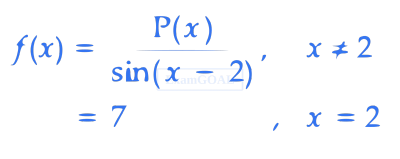
Explanation:
P''(x) = const. $\Rightarrow$ P(x) is a 2 degree polynomial
f(x) is cont. at x = 2
f(2+) = f(2$-$)
$\mathop {\lim }\limits_{x \to {2^ + }} {{P(x)} \over {\sin (x - 2)}} = 7$
$\mathop {\lim }\limits_{x \to {2^ + }} {{(x - 2)(ax + b)} \over {\sin (x - 2)}} = 7 \Rightarrow 2a + b = 7$
P(x) = (x $-$ 2)(ax + b)
P(3) = (3 $-$ 2)(3a + b) = 9 $\Rightarrow$ 3a + b = 9
a = 2, b = 3
P(5) = (5 $-$ 2)(2.5 + 3) = 3.13 = 39
Let g : R $\to$ R be given by $g(x) = f(x + 2) - f(x - 2)$. If n and m denote the number of points in R where g is not continuous and not differentiable, respectively, then n + m is equal to ______________.
Explanation:
$f(x) = \left\{ {\matrix{ {3\left( {{{1 - \left| x \right|} \over 2}} \right)} & {if\,\left| x \right| \le 2} \cr 0 & {if\,\left| x \right| > 2} \cr } } \right.$
$g(x) = f(x + 2) - f(x - 2)$
$f(x) = \left\{ {\matrix{ {0,} & {x < - 2} \cr {{3 \over 2}(1 + x),} & { - 2 \le x < 0} \cr {{3 \over 2}(1 - x),} & {0 \le x < 2} \cr {0,} & {x > 2} \cr } } \right.$
$f(x + 2) = \left\{ {\matrix{ {0,} & {x < - 4} \cr {{3 \over 2}( 3 + x),} & { - 4 \le x < - 2} \cr {{3 \over 2}( - 1 - x),} & { - 2 \le x < 0} \cr {0,} & {x > 4} \cr } } \right.$
$f(x - 2) = \left\{ {\matrix{ {0,} & {x < 0} \cr {{3 \over 2}(x - 1),} & {0 \le x < 2} \cr {{3 \over 2}( - 1 - x),} & {2 \le x < 4} \cr {0,} & {x > 4} \cr } } \right.$
$g(x) = f(x + 2) + f(x - 2)$
$ = \left\{ {\matrix{ {{{3x} \over 2} + 6,} & { - 4 \le x \le 2} \cr { - {{3x} \over 2},} & { - 2 < x < 2} \cr {{{3x} \over 2} - 6,} & {2 \le x \le 4} \cr {0,} & {\left| x \right| > 4} \cr } } \right.$
So, n = 0 and m = 4
$\therefore$ m + n = 4
$g(x) = \left\{ {\matrix{ {\mathop {\max }\limits_{0 \le t \le x} \{ {t^3} - 6{t^2} + 9t - 3),} & {0 \le x \le 3} \cr {4 - x,} & {3 < x \le 4} \cr } } \right.$, then the number of points in the interval (0, 4) where g(x) is NOT differentiable, is ____________.
Explanation:
$f(x) = 3{x^2} - 12x + 9 = 3(x - 1)(x - 3)$
$f(1) = 1$, $f(3) = 3$
$g(x) = \left[ {\matrix{ {f(9x)} & {0 \le x \le 1} \cr 0 & {1 \le x \le 3} \cr { - 1} & {3 < x \le 4} \cr } } \right.$
g(x) is continuous
$g'(x) = \left[ {\matrix{ {3(x - 1)(x - 3)} & {0 \le x \le 1} \cr 0 & {1 \le x \le 3} \cr { - 1} & {3 < x \le 4} \cr } } \right.$
g(x) is non-differentiable at x = 3
Explanation:
$\mathop {\lim }\limits_{x \to 0} {{x(\alpha - \beta ) + {x^2}\left( {\alpha + {\beta \over 2} + \gamma } \right) + {x^3}\left( {{\alpha \over 2} - {\beta \over 3} - \gamma } \right)} \over {{x^3}}} = 10$
For limit to exist
$\alpha - \beta = 0,\alpha + {\beta \over 2} + \gamma = 0$${\alpha \over 2} - {\beta \over 3} - \gamma = 10$ ..... (i)
$\beta = \alpha ,\gamma = - 3{\alpha \over 2}$
Put in (i)
${\alpha \over 2} - {\alpha \over 3} + {{3\alpha } \over 2} = 10$
${\alpha \over 6} + {{3\alpha } \over 2} = 10 \Rightarrow {{\alpha + 9\alpha } \over 6} = 10$
$ \Rightarrow \alpha = 6$
$\alpha$ = 6, $\beta$ = 6, $\gamma$ = $-$9
$\alpha$ + $\beta$ + $\gamma$ = 3