Thermodynamics
233 Questions
Start JEE Mains Test
2020
Q151
JEE Mains
MCQ
14 Mar 2026
The process that is NOT endothermic in nature
is :
A.
Ar(g) + e- $ \to $ Ar-(g)
B.
H(g) + e- $ \to $ H-(g)
C.
Na(g) $ \to $ Na+(g) + e-
D.
O-(g) + e- $ \to $ O2-(g)
2020
Q152
JEE Mains
MCQ
14 Mar 2026
For one mole of an ideal gas, which of these
statements must be true?
(a) U and H each depends only on temperature
(b) Compressibility factor z is not equal to 1
(c) CP, m – CV, m = R
(d) dU = CVdT for any process
(a) U and H each depends only on temperature
(b) Compressibility factor z is not equal to 1
(c) CP, m – CV, m = R
(d) dU = CVdT for any process
A.
(a), (c) and (d)
B.
(a) and (c)
C.
(c) and (d)
D.
(b), (c) and (d)
2020
Q153
JEE Mains
MCQ
14 Mar 2026
The true statement amongst the following is :
A.
S is a function of temperature but $\Delta $S is not
a function of temperature.
B.
Both S and $\Delta $S are not functions of
temperature.
C.
Both $\Delta $S and S are functions of temperature.
D.
S is not a function of temperature but $\Delta $S is
a function of temperature.
2020
Q154
JEE Mains
MCQ
14 Mar 2026
If enthalpy of atomisation for Br2(1) is x kJ/mol
and bond enthalpy for Br2 is y kJ/mol, the
relation between them :
A.
does not exist
B.
is x < y
C.
is x > y
D.
is x = y

2020
Q155
JEE Mains
Numerical
14 Mar 2026
For a dimerization reaction,
2A(g) $ \to $ A2(g)
at 298 K, $\Delta $Uo = –20 kJ mol–1, $\Delta $So = –30 JK–1 mol–1,
then the $\Delta $Go will be _____ J.
2A(g) $ \to $ A2(g)
at 298 K, $\Delta $Uo = –20 kJ mol–1, $\Delta $So = –30 JK–1 mol–1,
then the $\Delta $Go will be _____ J.
Correct Answer: -13540to-13537
Explanation:
$\Delta $Go = $\Delta $Ho - T$\Delta $So
= ($\Delta $Uo + $\Delta $ngRT) - T$\Delta $So
= $\left[ {\left\{ { - 20 + \left( 1 \right){{8.314} \over {1000}} \times 298} \right\} - {{298} \over {1000}} \times \left( { - 30} \right)} \right]$ kJ
= – 13.537572 kJ
= – 13537.57 Joule
= ($\Delta $Uo + $\Delta $ngRT) - T$\Delta $So
= $\left[ {\left\{ { - 20 + \left( 1 \right){{8.314} \over {1000}} \times 298} \right\} - {{298} \over {1000}} \times \left( { - 30} \right)} \right]$ kJ
= – 13.537572 kJ
= – 13537.57 Joule
2020
Q156
JEE Mains
Numerical
14 Mar 2026
The heat of combustion of ethanol into carbon
dioxide and water is – 327 kcal at constant
pressure. The heat evolved (in cal) at constant
volume and 27oC (if all gases behave ideally) is
(R = 2 cal mol–1 K–1) ________.
Correct Answer: 326400
Explanation:
C2H5OH (l) + 3O2(g) $ \to $ 2CO2(g) + 3H2O(l)
$\Delta $H = –327 kcal; $\Delta $ng = – 1
$\Delta $H = $\Delta $U + $\Delta $ngRT
$ \Rightarrow $ $\Delta $U = – 327 + 2 × 10–3 × 300
= – 326.4 kcal
= – 326400 cal
$ \therefore $ Heat evolved = 326400 cal.
$\Delta $H = –327 kcal; $\Delta $ng = – 1
$\Delta $H = $\Delta $U + $\Delta $ngRT
$ \Rightarrow $ $\Delta $U = – 327 + 2 × 10–3 × 300
= – 326.4 kcal
= – 326400 cal
$ \therefore $ Heat evolved = 326400 cal.
2020
Q157
JEE Mains
Numerical
14 Mar 2026
The internal energy change (in J) When 90 g of
water undergoes complete evaporation at
100oC is ____________.
(Given : $\Delta $Hvap for water at 373 K = 41 kJ/mol,
R = 8.314 JK–1 mol–1)
(Given : $\Delta $Hvap for water at 373 K = 41 kJ/mol,
R = 8.314 JK–1 mol–1)
Correct Answer: 189494TO189495
Explanation:
H2O(l) ⇌ H2O(g)
90 gm of H2O = ${{90} \over {18}}$ moles of H2O = 5 moles of H2O
$\Delta $Hvap = $\Delta $U + $\Delta $ngRT
$ \Rightarrow $ $\Delta $U = $\Delta $Hvap - $\Delta $ngRT
= 41000 - 1$ \times $8.314$ \times $373
= 37898.878
For 5 moles, $\Delta $U = 37898.878 $ \times $ 5 = 189494.39 Joule
90 gm of H2O = ${{90} \over {18}}$ moles of H2O = 5 moles of H2O
$\Delta $Hvap = $\Delta $U + $\Delta $ngRT
$ \Rightarrow $ $\Delta $U = $\Delta $Hvap - $\Delta $ngRT
= 41000 - 1$ \times $8.314$ \times $373
= 37898.878
For 5 moles, $\Delta $U = 37898.878 $ \times $ 5 = 189494.39 Joule
2020
Q158
JEE Mains
Numerical
14 Mar 2026
At constant volume, 4 mol of an ideal gas when
heated from 300 K to 500K changes its internal
energy by 5000 J. The molar heat capacity at
constant volume is _______.
Correct Answer: 6.25
Explanation:
$\Delta $U = nCv$\Delta $T
$ \Rightarrow $ 5000 = 4 × Cv(500 – 300)
$ \Rightarrow $ Cv = 6.25 JK–1mol–1
$ \Rightarrow $ 5000 = 4 × Cv(500 – 300)
$ \Rightarrow $ Cv = 6.25 JK–1mol–1
2020
Q159
JEE Mains
Numerical
14 Mar 2026
The magnitude of work done by a gas that undergoes a reversible expansion along the path ABC shown in
the figure is _______.
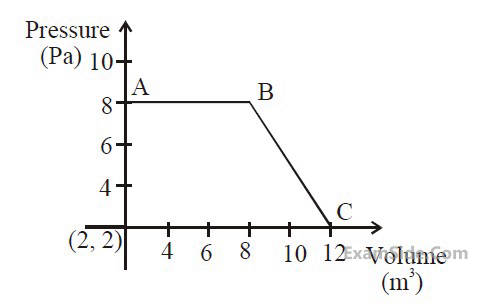
Correct Answer: 48
Explanation:
Work done = Area covered by the diagram
= $1\over2$ × (sum of parallel sides) × height
= $1\over2$ × (10+6) × 6
= $1\over2$ × 16 × 6
= 48 Joule
Note : Here pressure difference = 8 - 2 = 6 Pa and volume difference = 12 - 2 = 10
= $1\over2$ × (sum of parallel sides) × height
= $1\over2$ × (10+6) × 6
= $1\over2$ × 16 × 6
= 48 Joule
Note : Here pressure difference = 8 - 2 = 6 Pa and volume difference = 12 - 2 = 10
2020
Q160
JEE Mains
Numerical
14 Mar 2026
The standard heat of formation $\left( {{\Delta _f}H_{298}^0} \right)$ of ethane (in kj/mol), if the heat of combustion of
ethane, hydrogen and graphite are - 1560, -393.5 and -286 Kj/mol, respectively is :
Correct Answer: -192.5
Explanation:
2C(graphite)+ 3H(g) $ \to $ C2H6(g)
${\Delta _f}H$(C2H6) = 2$\Delta H$comb(Cgraphite) + 3$\Delta H$comb(H2)
- $\Delta H$comb(C2H6)
= – (286$ \times $2) - (393.5$ \times $3) -(-1560)
= -572 –1180.5+1560 = -192.5 kJ/mole
${\Delta _f}H$(C2H6) = 2$\Delta H$comb(Cgraphite) + 3$\Delta H$comb(H2)
- $\Delta H$comb(C2H6)
= – (286$ \times $2) - (393.5$ \times $3) -(-1560)
= -572 –1180.5+1560 = -192.5 kJ/mole
2020
Q161
JEE Mains
Numerical
14 Mar 2026
For the reaction :
A($l$) $ \to $ 2B(g)
$\Delta U = 2.1\,kcal,\,\Delta S = 20\,cal\,{K^{ - 1}}$ at 300 K
Hence $\Delta $G in kcal is :
A($l$) $ \to $ 2B(g)
$\Delta U = 2.1\,kcal,\,\Delta S = 20\,cal\,{K^{ - 1}}$ at 300 K
Hence $\Delta $G in kcal is :
Correct Answer: -2.7
Explanation:
A($l$) $ \to $ 2B(g)
We know, $\Delta $H = $\Delta $U + $\Delta $ngRT
and $\Delta $G = $\Delta $H - T$\Delta $S
$ \therefore $ $\Delta $G = $\Delta $U + $\Delta $ngRT - T$\Delta $S
= 2.1 + ${{2 \times 2 \times 300} \over {1000}}$ - ${{300 \times 20} \over {1000}}$
= 2.1 + 1.2 - 6 = – 2.70 Kcal/mol
We know, $\Delta $H = $\Delta $U + $\Delta $ngRT
and $\Delta $G = $\Delta $H - T$\Delta $S
$ \therefore $ $\Delta $G = $\Delta $U + $\Delta $ngRT - T$\Delta $S
= 2.1 + ${{2 \times 2 \times 300} \over {1000}}$ - ${{300 \times 20} \over {1000}}$
= 2.1 + 1.2 - 6 = – 2.70 Kcal/mol
2019
Q162
JEE Mains
MCQ
14 Mar 2026
An ideal gas is allowed to expand form 1 L to 10 L against a constant external pressure of I bar. The work
done in kJ is :
A.
+10.0
B.
–0.9
C.
– 2.0
D.
– 9.0
2019
Q163
JEE Mains
MCQ
14 Mar 2026
Enthalpy of sublimation of iodine is 24 cal g–1
at 200 oC. If specific heat of I2(s) and l2 (vap) are 0.055 and
0.031 cal g–1K
–1
respectively, then enthalpy of sublimation of iodine at 250 oC in cal g–1
is :
A.
2.85
B.
22.8
C.
11.4
D.
5.7
2019
Q164
JEE Mains
MCQ
14 Mar 2026
The difference between $\Delta $H and $\Delta $U ($\Delta $H – $\Delta $U), when the combustion of one mole of heptane(l) is carried
out at a temperature T, is equal to :
A.
– 4 RT
B.
3 RT
C.
– 3 RT
D.
4 RT
2019
Q165
JEE Mains
MCQ
14 Mar 2026
A process will be spontaneous at all temperatures if :
A.
$\Delta $H < 0 and $\Delta $S > 0
B.
$\Delta $H < 0 and $\Delta $S < 0
C.
$\Delta $H > 0 and $\Delta $S < 0
D.
$\Delta $H > 0 and $\Delta $S > 0
2019
Q166
JEE Mains
MCQ
14 Mar 2026
During compression of a spring the work done
is 10kJ and 2kJ escaped to the surroundings as
heat. The change in internal energy, $\Delta $U(inkJ)
is :
A.
- 12
B.
8
C.
- 8
D.
12
2019
Q167
JEE Mains
MCQ
14 Mar 2026
Among the following, the set of parameters that
represents path function, is :
(A) q + w
(B) q
(C) w
(D) H–TS
(A) q + w
(B) q
(C) w
(D) H–TS
A.
(B) and (C)
B.
(A) and (D)
C.
(B), (C) and (D)
D.
(A), (B) and (C)
2019
Q168
JEE Mains
MCQ
14 Mar 2026
5 moles of an ideal gas at 100 K are allowed
to undergo reversible compression till its
temperature becomes 200 K.
If CV = 28 JK–1mol–1, calculate $\Delta $U and $\Delta $pV for
this process. (R = 8.0 JK–1 mol–1]
A.
$\Delta $U = 14 kJ; $\Delta $(pV) = 4 kJ
B.
$\Delta $U = 2.8 kJ; $\Delta $(pV) = 0.8 kJ
C.
$\Delta $U = 14 kJ; $\Delta $(pV) = 18 kJ
D.
$\Delta $U = 14 kJ; $\Delta $(pV) = 0.8 kJ
2019
Q169
JEE Mains
MCQ
14 Mar 2026
Which one of the following equations does not correctly represent the first law of thermodynamics
for the given processes involving an ideal gas? (Assume non-expansion work is zero)
A.
Adiabatic process : $\Delta $U= – w
B.
Cyclic process : q = –w
C.
Isochoric process : $\Delta $U= q
D.
Isothermal process : q = – w
2019
Q170
JEE Mains
MCQ
14 Mar 2026
For silver, Cp(J K–1 mol–1) = 23 +0.01 T. If the temperature (T) of 3 moles of silver is raised from 300
K to 1000 K at 1 atm pressure, the value of $\Delta H$ will be close to :
A.
62 KJ
B.
16 KJ
C.
13 KJ
D.
21 KJ
2019
Q171
JEE Mains
MCQ
14 Mar 2026
Given
(i) C (graphite) + O2(g) $ \to $ CO2(g); $\Delta $rH$^\Theta $ = x kJ mol$-$1
(ii) C(graphite) + ${1 \over 2}$O2(g) $ \to $ CO(g); $\Delta $rH$^\Theta $ = y kJ mol$-$1
(iii) CO(g) + ${1 \over 2}$ O2(g) $ \to $ CO2(g); $\Delta $rH$^\Theta $ = z kJ mol$-$1
Based on the above thermochemical equations, find out which one of the following algebraic relationships is correct?
(i) C (graphite) + O2(g) $ \to $ CO2(g); $\Delta $rH$^\Theta $ = x kJ mol$-$1
(ii) C(graphite) + ${1 \over 2}$O2(g) $ \to $ CO(g); $\Delta $rH$^\Theta $ = y kJ mol$-$1
(iii) CO(g) + ${1 \over 2}$ O2(g) $ \to $ CO2(g); $\Delta $rH$^\Theta $ = z kJ mol$-$1
Based on the above thermochemical equations, find out which one of the following algebraic relationships is correct?
A.
z = x + y
B.
x = y + z
C.
x = y – z
D.
y = 2z – x
2019
Q172
JEE Mains
MCQ
14 Mar 2026
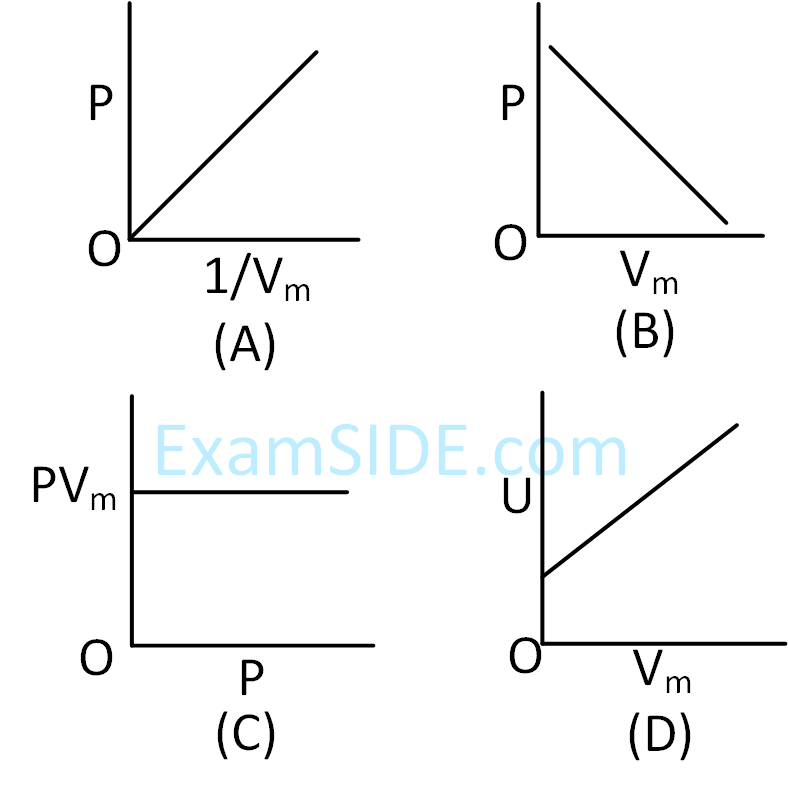
The combination of plots which does not represent isothermal expansion of an ideal gas is –
A.
A and D
B.
B and D
C.
B and C
D.
A and C
2019
Q173
JEE Mains
MCQ
14 Mar 2026
For diatomic ideal gas in a closed system, which of the following plots does not correctly describe the relation between various thermodynamic quantities?
A.

B.

C.

D.

2019
Q174
JEE Mains
MCQ
14 Mar 2026
The reaction, MgO(s) + C(s) $ \to $ Mg(s) + CO(g), for which $\Delta $rHo + 491.1 kJ mol–1 and $\Delta $rSo = 198.0 JK–1 mol–1, is not feasible at 298 K. Temperature above which reaciton will be feasible is :
A.
2480.3 K
B.
2040.5 K
C.
2380.5 K
D.
1890.0 K
2019
Q175
JEE Mains
MCQ
14 Mar 2026
For the equilibrium,
2H2O $\rightleftharpoons$ H3O+ + OH$-$, the value of $\Delta $Go at 298 K is approximately :
2H2O $\rightleftharpoons$ H3O+ + OH$-$, the value of $\Delta $Go at 298 K is approximately :
A.
$-$ 80 kJ mol–1
B.
100 kJ mol$-$1
C.
$-$ 100 kJ mol$-$1
D.
80 kJ mol–1
2019
Q176
JEE Mains
MCQ
14 Mar 2026
The standard reaction Gibbs energy for a chemical reaction at an absolute temperature T is given by
$\Delta $rGo = A – BT
Where A and B are non-zero constants. Which of the following is TRUE about this reaction?
Where A and B are non-zero constants. Which of the following is TRUE about this reaction?
A.
Exothermic if B < 0
B.
Endothermic if A > 0
C.
Exothermic if A > 0 and B < 0
D.
Endothermic if A < 0 and B > 0
2019
Q177
JEE Mains
MCQ
14 Mar 2026
For the chemical reaction X $\rightleftharpoons$ Y, the standard reaction Gibbs energy depends on temperature T (in K) as
$\Delta $rGo (in kJ mol–1) = 120 $ - {3 \over 8}$ T.
The major component of the reaction mixture at T is :
The major component of the reaction mixture at T is :
A.
Y if T = 300 K
B.
Y if T = 280 K
C.
X if T = 350 K
D.
X if T = 315 K
2019
Q178
JEE Mains
MCQ
14 Mar 2026
Two blocks of the same metal having same mass and at temperature T1 and T2, respectively, are brought in contact with each other and allowed to attain thermal equilibrium at constant pressure. The change in entropy, $\Delta $S, for this process is :
A.
2Cp In $\left[ {{{{{\left( {{T_1} + {T_2}} \right)}^{{1 \over 2}}}} \over {{T_1}{T_2}}}} \right]$
B.
2Cp In $\left[ {{{\left( {{T_1} + {T_2}} \right)} \over {2{T_1}{T_2}}}} \right]$
C.
Cp In $\left[ {{{{{\left( {{T_1} + {T_2}} \right)}^2}} \over {4{T_1}{T_2}}}} \right]$
D.
2Cp In $\left[ {{{\left( {{T_1} + {T_2}} \right)} \over {4{T_1}{T_2}}}} \right]$
2019
Q179
JEE Mains
MCQ
14 Mar 2026
The process with negative entropy change is :
A.
Dissociation of CaSO4 (s) to CaO(s) and SO3(g)
B.
Dissolution of iodine in water
C.
Synthesis of ammonia from N2 and H2
D.
Sublimation of dry ice
2019
Q180
JEE Mains
MCQ
14 Mar 2026
An ideal gas undergoes isothermal compression from 5m3 to 1 m3 against a constant external pressure of 4 Nm–2. Heat released in this process is used to increase the temperature of 1 mole of Al. If molar heat capacity of Al is 24 J mol–1 K–1, the temperature of Al increases by :
A.
${2 \over 3}K$
B.
${3 \over 2}K$
C.
1 K
D.
2 K
2019
Q181
JEE Mains
MCQ
14 Mar 2026
A process has $\Delta $H = 200 J mol–1 and $\Delta $S = 40 JK–1 mol–1. Out of the values given below, choose the minimum temperature above which the process will be spontaneous :
A.
4 K
B.
20 K
C.
5 K
D.
12 K
2019
Q182
JEE Mains
MCQ
14 Mar 2026
The entropy change associated with the conversion of 1 kg of ice at 273 K to water vapours at 383 K is :
(Specific heat of water liquid and water vapour are 4.2 kJ K$-$1 kg$-$1 and 2.0 kJ K$-$1 kg$-$1; heat of liquid fusion and vapourisation of water are 334 kJ$-$1 and 2491 kJ kg$-$1, respectively). (log 273 = 2.436, log 373 = 2.572, log 383 = 2.583)
(Specific heat of water liquid and water vapour are 4.2 kJ K$-$1 kg$-$1 and 2.0 kJ K$-$1 kg$-$1; heat of liquid fusion and vapourisation of water are 334 kJ$-$1 and 2491 kJ kg$-$1, respectively). (log 273 = 2.436, log 373 = 2.572, log 383 = 2.583)
A.
7.90 kJ kg$-$1 K$-$1
B.
2.64 kJ kg$-$1 K$-$1
C.
8.49 kJ kg$-$1 K$-$1
D.
9.26 kJ kg$-$1 K$-$1

2019
Q183
JEE Mains
MCQ
14 Mar 2026
Consider the reversible isothermal expansion of an ideal gas in a closed system at two different temperatures T1 and T2 (T1 < T2). The correct graphical depiction of the dependence of work done (w) on the final volume (V) is :
A.

B.

C.

D.

2018
Q184
JEE Mains
MCQ
14 Mar 2026
For which of the following processes, $\Delta $S is negative ?
A.
H2(g) $ \to $ 2H(g)
B.
N2(g, 1 atm) $ \to $ N2(g, 5 atm)
C.
C(diamond) $ \to $ C(graphite)
D.
N2(g, 273 K) $ \to $ N2(g, 300 K)
2018
Q185
JEE Mains
MCQ
14 Mar 2026
At 320 K, a gas A2 is 20% dissociated to A(g). The standard free energy change at 320 K and 1 atm in J mol-1 is approximately : (R = 8.314 JK-1 mol-1; ln2 = 0.693; ln 3 = 1.098)
A.
4763
B.
2068
C.
1844
D.
4281
2018
Q186
JEE Mains
MCQ
14 Mar 2026
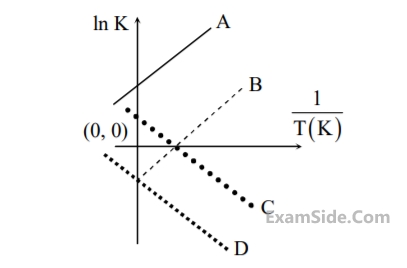
Which of the following lines correctly show the temperature dependence of equilibrium constant K, for an
exothermic reaction?
A.
A and D
B.
A and B
C.
B and C
D.
C and D

2018
Q187
JEE Mains
MCQ
14 Mar 2026
The combustion of benzene(l) gives CO2(g) and H2O(l). Given that heat of combustion of benzene at constant volume is –3263.9 kJ mol–1 at 25oC; heat of combustion (in kJ mol–1) of benzene at constant pressure will be :
(R = 8.314 JK–1 mol–1)
(R = 8.314 JK–1 mol–1)
A.
–3267.6
B.
4152.6
C.
–452.46
D.
3260
2018
Q188
JEE Mains
MCQ
14 Mar 2026
Given
(i) 2Fe2O3(s) $ \to $ 4Fe(s) + 3O2(g);
$\Delta $rGo = + 1487.0 kJ mol-1
(ii) 2CO(g) + O2(g) $ \to $ 2CO2(g);
$\Delta $rGo = $-$ 514.4 kJ mol-1
Free energy change, $\Delta $rGo for the reaction
2Fe2O3(s) + 6CO(g) $ \to $ 4Fe(s) + 6CO2(g) will be :
(i) 2Fe2O3(s) $ \to $ 4Fe(s) + 3O2(g);
$\Delta $rGo = + 1487.0 kJ mol-1
(ii) 2CO(g) + O2(g) $ \to $ 2CO2(g);
$\Delta $rGo = $-$ 514.4 kJ mol-1
Free energy change, $\Delta $rGo for the reaction
2Fe2O3(s) + 6CO(g) $ \to $ 4Fe(s) + 6CO2(g) will be :
A.
$-$ 112.4 kJ mol-1
B.
$-$ 56.2 kJ mol-1
C.
$-$ 168.2 kJ mol-1
D.
$-$ 208.0 kJ mol-1
2018
Q189
JEE Mains
MCQ
14 Mar 2026
$\Delta $fGo at 500 K for substance 'S' in liquid state and gaseous state are +100.7 kcl mol-1 and +103 kcal mol-1, respectively. Vapour pressure of liquid 'S' at 500 K is approximately equal to : ( R = 2 cal K-1 mol-1 )
A.
0.1 atm
B.
1 atm
C.
10 atm
D.
100 atm
2018
Q190
JEE Mains
MCQ
14 Mar 2026
An ideal gas undergoes a cyclic process as shown in Figure.

$\Delta $UBC = $-$5 kJ mol-1, qAB = $2$ kJ mol-1, WAB = $-$5 kJ mol-1, WCA = 3 kJ mol-1. Heat absorbed by the system during process $CA$ is :
$\Delta $UBC = $-$5 kJ mol-1, qAB = $2$ kJ mol-1, WAB = $-$5 kJ mol-1, WCA = 3 kJ mol-1. Heat absorbed by the system during process $CA$ is :
A.
$-$5 kJ mol-1
B.
+5 kJ mol-1
C.
18 kJ mol-1
D.
$-$18 kJ mol-1
2018
Q191
JEE Mains
MCQ
14 Mar 2026
For which of the following reactions, $\Delta $H is equal to $\Delta $U?
A.
N2(g) + 3H2(g) $ \to $ 2NH3(g)
B.
2HI(g) $ \to $ H2(g) + I2(g)
C.
2NO2(g) $ \to $ N2O4(g)
D.
2SO2(g) + O2(g) $ \to $ 2SO3(g)
2017
Q192
JEE Mains
MCQ
14 Mar 2026
A gas undergoes change from state A to state B. In this process, the heat absorbed
and work done by the gas is 5 J and 8 J, respectively. Now gas is brought back to
A by another process during which 3 J of heat is evolved. In this reverse process of
B to A :
A.
10 J of the work will be done by the gas.
B.
6 J of the work will be done by the gas.
C.
10 J of the work will be done by the surrounding on gas.
D.
6 J of the work will be done by the surrounding on gas.
2017
Q193
JEE Mains
MCQ
14 Mar 2026
An ideal gas undergoes isothermal expansion at constant pressure. During
the process :
A.
enthalpy increases but entropy decreases.
B.
enthalpy remains constant but entropy increases.
C.
enthalpy decreases but entropy increases.
D.
Both enthalpy and entropy remain constant.
2017
Q194
JEE Mains
MCQ
14 Mar 2026
The enthalpy change on freezing of 1 mol of water at 5oC to ice at −5oC is :
(Given $\Delta $fusH = 6 kJ mol$-$1 at 0oC,
Cp(H2O, $\ell $ = 75.3J mol$-$1 K$-$1)
Cp(H2O s) =36.8 J mol$-$1 K$-$1)
(Given $\Delta $fusH = 6 kJ mol$-$1 at 0oC,
Cp(H2O, $\ell $ = 75.3J mol$-$1 K$-$1)
Cp(H2O s) =36.8 J mol$-$1 K$-$1)
A.
5.44 kJ mol$-$1
B.
5.81 kJ mol$-$1
C.
6.56 kJ mol$-$1
D.
6.00 kJ mol$-$1
2017
Q195
JEE Mains
MCQ
14 Mar 2026
For a reaction, A(g) $ \to $ A($\ell $); $\Delta $H= $-$ 3RT.
The correct statement for the reaction is :
The correct statement for the reaction is :
A.
$\Delta $H = $\Delta $U $ \ne $ O
B.
$\Delta $H = $\Delta $U = O
C.
$\left| {} \right.$$\Delta $H$\left| {} \right.$ < $\left| {} \right.$$\Delta $U$\left| {} \right.$
D.
$\left| {} \right.$$\Delta $H$\left| {} \right.$ > $\left| {} \right.$$\Delta $U$\left| {} \right.$
2017
Q196
JEE Mains
MCQ
14 Mar 2026
$\Delta $U is equal to :
A.
Isobaric work
B.
Adiabatic work
C.
Isothermal work
D.
Isochoric work
2017
Q197
JEE Mains
MCQ
14 Mar 2026
Given, ${C_{(graphite)}} + {O_2} \to C{O_2}(g)$;
${\Delta _r}{H^o}$ = - 393.5 kJ mol-1
${{\rm H}_2}(g)$ + ${1 \over 2}{O_2}(g)$$\to {{\rm H}_2}{\rm O}(l)$
${\Delta _r}{H^o}$ = - 285.8 kJ mol-1
$C{O_2}(g)$ + $2{{\rm H}_2}{\rm O}(l) \to$ $C{H_4}(g)$ + $2{O_2}(g)$
${\Delta _r}{H^o}$ = + 890.3 kJ mol-1
Based on the above thermochemical equations, the value of ${\Delta _r}{H^o}$ at 298 K for the reaction
${C_{(graphite)}}$ + $2{{\rm H}_2}(g) \to$ $C{H_4}(g)$ will be :
${\Delta _r}{H^o}$ = - 393.5 kJ mol-1
${{\rm H}_2}(g)$ + ${1 \over 2}{O_2}(g)$$\to {{\rm H}_2}{\rm O}(l)$
${\Delta _r}{H^o}$ = - 285.8 kJ mol-1
$C{O_2}(g)$ + $2{{\rm H}_2}{\rm O}(l) \to$ $C{H_4}(g)$ + $2{O_2}(g)$
${\Delta _r}{H^o}$ = + 890.3 kJ mol-1
Based on the above thermochemical equations, the value of ${\Delta _r}{H^o}$ at 298 K for the reaction
${C_{(graphite)}}$ + $2{{\rm H}_2}(g) \to$ $C{H_4}(g)$ will be :
A.
+144.0 kJ mol–1
B.
– 74.8 kJ mol–1
C.
-144.0 kJ mol–1
D.
+ 74.8 kJ mol–1
2016
Q198
JEE Mains
MCQ
14 Mar 2026
If 100 mole of H2O2 decompose at 1 bar and 300 K, the work done (kJ) by one mole of O2(g) as it expands against 1 bar pressure is :
2H2O2(l) $\rightleftharpoons$ 2H2O(l) + O2(g)
(R = 8.3 J K $-$1 mol$-$1)
2H2O2(l) $\rightleftharpoons$ 2H2O(l) + O2(g)
(R = 8.3 J K $-$1 mol$-$1)
A.
62.25
B.
124.50
C.
249.00
D.
498.00
2016
Q199
JEE Mains
MCQ
14 Mar 2026
The plot shows the variation of −$ln$ Kp versus temperature for the two reactions.
M(s) + ${1 \over 2}$ O2(g) $ \to $ MO(s) and
C(s) + ${1 \over 2}$ O2(g) $ \to $ CO(s)

Identify the correct statement :
M(s) + ${1 \over 2}$ O2(g) $ \to $ MO(s) and
C(s) + ${1 \over 2}$ O2(g) $ \to $ CO(s)
Identify the correct statement :
A.
At T > 1200 K, carbon will reduce MO(s) to M(s).
B.
At T < 1200 K, the reaction
MO(s) + C(s) $ \to $ M(s) + CO(g) is spontaneous.
MO(s) + C(s) $ \to $ M(s) + CO(g) is spontaneous.
C.
At T < 1200 K, oxidation of carbon is unfavourable
D.
Oxidation of carbon is favourable at all temperatures.
2016
Q200
JEE Mains
MCQ
14 Mar 2026
A reaction at 1 bar is non-spontaneous at low temperature but becomes spontaneous
at high temperature. Identify the correct statement about the reaction among the
following :
A.
Both $\Delta $H and $\Delta $S are negative.
B.
Both $\Delta $H and $\Delta $S are positive.
C.
$\Delta $H is positive while $\Delta $S is negative.
D.
$\Delta $H is negative while $\Delta $S is positive.