JEE Mains
2026
MCQ
The plot of $\log_{10} K$ vs $\frac{1}{T}$ gives a straight line. The intercept and slope respectively are (where K is equilibrium constant).
JEE Mains
2026
MCQ
$20.0 \mathrm{dm}^3$ of an ideal gas ' X ' at 600 K and 0.5 MPa undergoes isothermal reversible expansion until pressure of the gas is 0.2 MPa . Which of the following option is correct?
(Given: $\log 2=0.3010$ and $\log 5=0.6989$ )
JEE Mains
2026
MCQ
The heat of atomisation of methane and ethane are ' x ' $\mathrm{kJ} \mathrm{mol}^{-1}$ and ' y ' $\mathrm{kJ} \mathrm{mol}^{-1}$ respectively. The longest wavelength ( $\lambda$ ) of light capable of breaking the $\mathrm{C}-\mathrm{C}$ bond can be expressed in SI unit as :
JEE Mains
2026
MCQ
$ \text { Match the LIST-I with LIST-II } $
| List-I Isothermal process for ideal gas system |
List-II Work done ( V_(f) > V_(i) ) |
| A. |
Reversible expansion |
I. |
w=0 |
| B. |
Free expansion |
II. |
w=-nRT ln((V_(f))/(V_(i))) |
| C. |
Irreversible expansion |
III. |
w=-p_(ex)(V_(f)-V_(i)) |
| D. |
Irreversible compression |
IV. |
w=-p_(ex)(V_(i)-V_(f)) |
Choose the correct answer from the options given below:
JEE Mains
2026
MCQ
A cup of water at $5^{\circ} \mathrm{C}$ (system) is placed in a microwave oven and the oven is turned on for one minute during which the water begins to boil. Which of the following option is true?
JEE Mains
2026
MCQ
$ \text { Match the LIST-I with LIST-II } $
| List-I Thermodynamic Process |
List-II Magnitude in kJ |
| A. |
Work done in reversible, isothermal expansion of 2 mol of ideal gas from 2dm^(3) to 20dm^(3) at 300 K . |
I. |
4 |
| B. |
Work done in irreversible isothermal expansion of 1 mol ideal gas from 1m^(3) to 3m^(3) at 300 K against a constant pressure of 3 kPa . |
II. |
11.5 |
| C. |
Change in internal energy for adiabatic expansion of a 1 mol ideal gas with change of temperature =320K and bar(C)_(V)=(3)/(2)R. |
III. |
6 |
| D. |
Change in enthalpy at constant pressure of 1 mol ideal gas with change of temperature =337K and bar(C)_(p)=(5)/(2)R. |
IV. |
7 |
JEE Mains
2026
MCQ
Consider the following data :
$\Delta_{f}H^{\circ}$ (methane, g) = $-X \; \text{kJ mol}^{-1}$
Enthalpy of sublimation of graphite = $Y \; \text{kJ mol}^{-1}$
Dissociation enthalpy of $H_2 = Z \; \text{kJ mol}^{-1}$
The bond enthalpy of C–H bond is given by :
JEE Mains
2026
MCQ
Which of the following graphs between pressure ' p ' versus volume ' V ' represents the maximum work done?
JEE Mains
2026
MCQ
For the reaction, $\mathrm{N}_2 \mathrm{O}_4 \rightleftharpoons 2 \mathrm{NO}_2$, graph is plotted as shown below. Identify correct statements.
A. Standard free energy change for the reaction is $-5.40 \mathrm{~kJ} \mathrm{~mol}^{-1}$.
B. As $\Delta \mathrm{G}^{\ominus}$ in graph is positive, $\mathrm{N}_2 \mathrm{O}_4$ will not dissociate into $\mathrm{NO}_2$ at all.
C. Reverse reaction will go to completion.
D. When 1 mole of $\mathrm{N}_2 \mathrm{O}_4$ changes into equilibrium mixture, value of $\Delta \mathrm{G}^{\ominus}=-0.84 \mathrm{~kJ} \mathrm{~mol}^{-1}$
E. When 2 mole of $\mathrm{NO}_2$ changes into equilibrium mixture, $\Delta \mathrm{G}^{\ominus}$ for equilibrium mixture is $-6.24 \mathrm{~kJ} \mathrm{~mol}^{-1}$.

Choose the correct answer from the options given below :
JEE Mains
2026
MCQ
Match List - I with List - II.
Given $V_1$ and $V_2$ are initial and final volumes respectively.
List - I
(Isothermal process) |
List - II
(Expression) |
| A. |
Reversible
expansion |
I. |
$
\mathrm{q}=0
$ |
| B. |
Free expansion |
II. |
$
\mathrm{q}=\mathrm{nRT} \ln \frac{\mathrm{~V}_2}{\mathrm{~V}_1}
$ |
| C. |
Irreversible
Compression |
III. |
$
\mathrm{w}=-\mathrm{p}_{\mathrm{ext}}\left(\mathrm{~V}_1-\mathrm{V}_2\right)
$ |
| D. |
Cyclic reversible |
IV. |
$
\frac{\mathrm{q}_{\mathrm{rev}}}{\mathrm{~T}}=0
$ |
Choose the correct answer from the options given below :
JEE Mains
2026
MCQ
Arrange the following isothermal processes in order of the magnitude of the work $(\mathrm{p}-\mathrm{V})$ involved between states 1 and 2.
A. Expansion in single stage $\mathrm{w}_{\mathrm{A}}$
B. Expansion in multi stages $w_B$
C. Compression in single stage $\mathrm{w}_{\mathrm{C}}$
D. Compression in multi stages $w_D$
Choose the correct option.
JEE Mains
2026
MCQ
Consider the following data for the reaction
$ X_2(g)+Y_2(g) \rightleftharpoons 2 X Y(g) $
at $600 \mathrm{~K}^{\circ}$. The $\Delta_{\mathrm{r}} \mathrm{G}^{\ominus}$ (in $\mathrm{kJ} \mathrm{mol}^{-1}$ ) for the reaction is :
$ \begin{array}{|c|c|c|} \hline \text { Compound } & \Delta_f \mathrm{H}_{600 \mathrm{~K}}^{\ominus}\left(\mathrm{kJ} \mathrm{~mol}^{-1}\right) & \mathrm{S}^{\ominus}{ }_{600 \mathrm{~K}}\left(\mathrm{~J} \mathrm{~mol}^{-1} \mathrm{~K}^{-1}\right) \\ \hline \mathrm{XY}(\mathrm{~g}) & 42 & 200 \\ \hline \mathrm{X}_2(\mathrm{~g}) & 8 & 140 \\ \hline \mathrm{Y}_2(\mathrm{~g}) & 80 & 250 \\ \hline \end{array} $
JEE Mains
2026
MCQ
The correct order of molar heat capacities measured at 298 K and 1 bar is :
JEE Mains
2026
MCQ
Given below are two statements :
Statement I : For an ideal gas, heat capacity at constant volume is always greater than the heat capacity at constant pressure.
Statement II : In a constant volume process, no work is produced and all the heat withdrawn goes into the chaotic motion and is reflected by a temperature increase of the ideal gas.
In the light of the above statements, choose the correct answer from the options given below
JEE Mains
2026
MCQ
Gas 'A' undergoes change from state 'X' to state 'Y'. In this process, the heat absorbed and work done by the gas is 10 J and 18 J respectively. Now gas is brought back to state 'X' by another process during which 6 J of heat is evolved. In the reverse process of 'Y' to 'X',
JEE Mains
2026
MCQ
Consider the following data.
(i) $2\text{Al(s)} + 6\text{HCl(aq)} \rightarrow \text{Al}_2\text{Cl}_6\text{(aq)} + 3\text{H}_2\text{(g)} + 1200~\text{kJ/mol}$
(ii) $\text{H}_2\text{(g)} + \text{Cl}_2\text{(g)} \rightarrow 2\text{HCl(g)} + 164~\text{kJ/mol}$
(iii) $\text{HCl(g)} + \text{aq} \rightarrow \text{HCl(aq)} + 83~\text{kJ/mol}$
(iv) $\text{Al}_2\text{Cl}_6\text{(s)} + \text{aq} \rightarrow \text{Al}_2\text{Cl}_6\text{(aq)} + 663~\text{kJ/mol}$
The enthalpy of formation of anhydrous solid $\text{Al}_2\text{Cl}_6$ is :
JEE Mains
2025
MCQ
The hydration energies of $K^+$ and $Cl^-$ are $-x$ and $-y$ kJ/mol respectively. If the lattice energy of KCl is $-z$ kJ/mol, then the heat of solution of KCl is :
JEE Mains
2025
MCQ
The correct statement amongst the following is :
JEE Mains
2025
MCQ
Total enthalpy change for freezing of 1 mol of water at $10^{\circ} \mathrm{C}$ to ice at $-10^{\circ} \mathrm{C}$ is ________
(Given: $\Delta_{\text {fus }} \mathrm{H}=x \mathrm{~kJ} / \mathrm{mol}$
$\begin{aligned}
& \mathrm{C}_{\mathrm{p}}\left[\mathrm{H}_2 \mathrm{O}(\mathrm{l})\right]=y \mathrm{~J} \mathrm{~mol}^{-1} \mathrm{~K}^{-1} \\
& \mathrm{C}_{\mathrm{p}}\left[\mathrm{H}_2 \mathrm{O}(\mathrm{~s})\right]=z \mathrm{~J} \mathrm{~mol}^{-1} \mathrm{~K}^{-1}
\end{aligned}$
JEE Mains
2025
MCQ
Consider the given data :
(a) $\mathrm{HCl}(\mathrm{g})+10 \mathrm{H}_2 \mathrm{O}(\mathrm{l}) \rightarrow \mathrm{HCl} .10 \mathrm{H}_2 \mathrm{O} \Delta \mathrm{H}=-69.01 \mathrm{~kJ} \mathrm{~mol}^{-1}$
(b) $\mathrm{HCl}(\mathrm{g})+40 \mathrm{H}_2 \mathrm{O}(\mathrm{l}) \rightarrow \mathrm{HCl} .40 \mathrm{H}_2 \mathrm{O} \Delta \mathrm{H}=-72.79 \mathrm{~kJ} \mathrm{~mol}^{-1}$
Choose the correct statement :
JEE Mains
2025
MCQ
One mole of an ideal gas expands isothermally and reversibly from $10 \mathrm{dm}^3$ to $20 \mathrm{dm}^3$ at 300 K . $\Delta \mathrm{U}, \mathrm{q}$ and work done in the process respectively are
Given: $\mathrm{R}=8.3 \mathrm{~J} \mathrm{~K}^{-1} \mathrm{~mol}^{-1}$
$\ln 10=2.3$
$\log 2=0.30$
$\log 3=0.48$
JEE Mains
2025
MCQ
Let us consider a reversible reaction at temperature, T.
In this reaction, both $\Delta \mathrm{H}$ and $\Delta \mathrm{S}$ were observed to have positive values. If the equilibrium temperature is Te , then the reaction becomes spontaneous at:
JEE Mains
2025
MCQ
Given below are two statements:
Statement I : When a system containing ice in equilibrium with water (liquid) is heated, heat is absorbed by the system and there is no change in the temperature of the system until whole ice gets melted.
Statement II : At melting point of ice, there is absorption of heat in order to overcome intermolecular forces of attraction within the molecules of water in ice and kinetic energy of molecules is not increased at melting point.
In the light of the above statements, choose the correct answer from the options given below
JEE Mains
2025
MCQ
Arrange the following in order of magnitude of work done by the system/on the system at constant temperature.
(a) $\left|w_{\text {reversible }}\right|$ for expansion in infinite stages.
(b) $\left|w_{\text {irreversible }}\right|$ for expansion in single stage.
(c) $\left|\mathrm{w}_{\text {reversible }}\right|$ for compression in infinite stages.
(d) $\left|w_{\text {irreversible }}\right|$ for compression in single stage.
Choose the correct answer from the options given below :
JEE Mains
2025
MCQ
Which of the following graphs correctly represents the variation of thermodynamic properties of Haber's process?
JEE Mains
2025
MCQ

Two vessels A and B are connected via stopcock. The vessel A is filled with a gas at a certain pressure. The entire assembly is immersed in water and is allowed to come to thermal equilibrium with water. After opening the stopcock the gas from vessel A expands into vessel B and no change in temperature is observed in the thermometer. Which of the following statement is true ?
JEE Mains
2025
MCQ
If $\quad C$ (diamond $) \rightarrow C$ (graphite) $+X \mathrm{~kJ} \mathrm{~mol}^{-1}$
C (diamond) $+\mathrm{O}_2(\mathrm{~g}) \rightarrow \mathrm{CO}_2(\mathrm{~g})+\mathrm{Y} \mathrm{kJ} \mathrm{mol}{ }^{-1}$
C (graphite) $+\mathrm{O}_2(\mathrm{~g}) \rightarrow \mathrm{CO}_2(\mathrm{~g})+\mathrm{Z} \mathrm{kJ} \mathrm{mol}^{-1}$
at constant temperature. Then
JEE Mains
2025
MCQ
500 J of energy is transferred as heat to 0.5 mol of Argon gas at 298 K and 1.00 atm. The final temperature and the change in internal energy respectively are: Given: R = 8.3 J K-1 mol-1
JEE Mains
2025
MCQ

An ideal gas undergoes a cyclic transformation starting from the point A and coming back to the same point by tracing the path A→B→C→D→A as shown in the three cases above.
Choose the correct option regarding ΔU :
JEE Mains
2025
MCQ
Ice and water are placed in a closed container at a pressure of 1 atm and temperature 273.15 K . If pressure of the system is increased 2 times, keeping temperature constant, then identify correct observation from following
JEE Mains
2025
MCQ
$\begin{aligned}
& \mathrm{S}(\mathrm{~g})+\frac{3}{2} \mathrm{O}_2(\mathrm{~g}) \rightarrow \mathrm{SO}_3(\mathrm{~g})+2 x \mathrm{kcal} \\
& \mathrm{SO}_2(\mathrm{~g})+\frac{1}{2} \mathrm{O}_2(\mathrm{~g}) \rightarrow \mathrm{SO}_3(\mathrm{~g})+y \mathrm{kcal}
\end{aligned}$
The heat of formation of $\mathrm{SO}_2(\mathrm{~g})$ is given by :
JEE Mains
2025
MCQ
Which of the following mixing of 1 M base and 1 M acid leads to the largest increase in temperature?
JEE Mains
2025
MCQ
Let us consider an endothermic reaction which is non-spontaneous at the freezing point of water. However, the reaction is spontaneous at boiling point of water. Choose the correct option.
JEE Mains
2025
MCQ
The effect of temperature on spontaneity of reactions are represented as :
|
$\Delta$H |
$\Delta$S |
Temperature |
Spontaneity |
| (A) |
$+$ |
$-$ |
any T |
Non spontaneous |
| (B) |
$+$ |
$+$ |
low T |
spontaneous |
| (C) |
$-$ |
$-$ |
low T |
Non spontaneous |
| (D) |
$-$ |
$+$ |
any T |
spontaneous |
The incorrect combinations are :
JEE Mains
2025
MCQ
Ice at $-5^{\circ} \mathrm{C}$ is heated to become vapor with temperature of $110^{\circ} \mathrm{C}$ at atmospheric pressure. The entropy change associated with this process can be obtained from
JEE Mains
2025
MCQ
Match List - I with List - II.
|
List - I
(Partial Derivatives) |
|
List - II
(Thermodynamic Quantity) |
| (A) |
$\left(\frac{\partial \mathrm{G}}{\partial \mathrm{T}}\right)_{\mathrm{P}}$ |
(I) |
Cp |
| (B) |
$\left(\frac{\partial \mathrm{H}}{\partial \mathrm{T}}\right)_{\mathrm{P}}$ |
(II) |
$-$S |
| (C) |
$\left(\frac{\partial \mathrm{G}}{\partial \mathrm{P}}\right)_{\mathrm{T}}$ |
(III) |
Cv |
| (D) |
$\left(\frac{\partial \mathrm{U}}{\partial \mathrm{T}}\right)_{\mathrm{V}}$ |
(IV) |
V |
Choose the correct answer from the options given below :
JEE Mains
2025
MCQ
A liquid when kept inside a thermally insulated closed vessel at $25^{\circ} \mathrm{C}$ was mechanically stirred from outside. What will be the correct option for the following thermodynamic parameters ?
JEE Mains
2024
MCQ
Given below are two statements: One is labelled as Assertion (A) and the other is labelled as Reason (R)
Assertion (A) : Enthalpy of neutralisation of strong monobasic acid with strong monoacidic base is always $-57 \mathrm{~kJ} \mathrm{~mol}^{-1}$
Reason (R) : Enthalpy of neutralisation is the amount of heat liberated when one mole of $\mathrm{H}^{+}$ ions furnished by acid combine with one mole of ${ }^{-} \mathrm{OH}$ ions furnished by base to form one mole of water.
In the light of the above statements, choose the correct answer from the options given below.
JEE Mains
2024
MCQ
Choose the correct option for free expansion of an ideal gas under adiabatic condition from the following :
JEE Mains
2024
MCQ
Which of the following is not correct?
JEE Mains
2023
MCQ
What happens when methane undergoes combustion in systems A and B respectively?

JEE Mains
2023
MCQ
Given
| (A) |
$\mathrm{2CO(g)+O_2(g)\to 2CO_2(g)}$ |
|
$\mathrm{\Delta H_1^0=-x~kJ~mol^{-1}}$ |
| (B) |
$\mathrm{C(graphite)+O_2(g)\to CO_2(g)}$ |
|
$\mathrm{\Delta H_2^0=-y~kJ~mol^{-1}}$ |
$\mathrm{\Delta H^0}$ for the reaction
$\mathrm{C(graphite)+\frac{1}{2}O_2(g)\to CO(g)}$ is :
JEE Mains
2023
MCQ
Which of the following relations are correct?
(A) $\mathrm{\Delta U=q+p\Delta V}$
(B) $\mathrm{\Delta G=\Delta H-T\Delta S}$
(C) $\Delta \mathrm{S}=\frac{q_{rev}}{T}$
(D) $\mathrm{\Delta H=\Delta U-\Delta nRT}$
Choose the most appropriate answer from the options given below :
JEE Mains
2022
MCQ
Given below are two statements: One is labelled as Assertion $\mathbf{A}$ and the other is labelled as Reason $\mathbf{R}$
Assertion A : The reduction of a metal oxide is easier if the metal formed is in liquid state than solid state.
Reason $\mathbf{R}$ : The value of $\Delta G ^\Theta$ becomes more on negative side as entropy is higher in liquid state than solid state.
In the light of the above statements, choose the most appropriate answer from the options given below
JEE Mains
2022
MCQ
Which of the following relation is not correct?
JEE Mains
2022
MCQ
$\Delta$G$^\circ$ vs T plot for the formation of MgO, involving reaction
2Mg + O2 $\to$ 2MgO, will look like :
JEE Mains
2022
MCQ
Match List-I with List-II.
|
List - I |
|
List - II |
| (A) |
Spontaneous process |
(I) |
$\Delta H < 0$ |
| (B) |
Process with $\Delta P = 0$, $\Delta T = 0$ |
(II) |
$\Delta {G_{T,P}} < 0$ |
| (C) |
$\Delta {H_{reaction}}$ |
(III) |
Isothermal and isobaric process |
| (D) |
Exothermic Process |
(IV) |
[Bond energies of molecules in reactants] $ - $ [Bond energies of product molecules |
Choose the correct answer from the options given below :
JEE Mains
2022
MCQ
At 25$^\circ$C and 1 atm pressure, the enthalpy of combustion of benzene (I) and acetylene (g) are $-$ 3268 kJ mol$-$1 and $-$1300 kJ mol$-$1, respectively. The change in enthalpy for the reaction 3 C2H2(g) $\to$ C6H6 (I), is :
JEE Mains
2022
MCQ
At 25$^\circ$C and 1 atm pressure, the enthalpies of combustion are as given below :
| Substance |
${H_2}$ |
C (graphite) |
${C_2}{H_6}(g)$ |
| ${{{\Delta _c}{H^\Theta }} \over {kJ\,mo{l^{ - 1}}}}$ |
$ - 286.0$ |
$ - 394.0$ |
$ - 1560.0$ |
The enthalpy of formation of ethane is
JEE Mains
2021
MCQ
The incorrect expression among the following is :
JEE Mains
2021
MCQ
During which of the following processes, does entropy decrease?
(A) Freezing of water to ice at 0$^\circ$C
(B) Freezing of water to ice at $-$10$^\circ$C
(C) N2(g) + 3H2(g) $ \to $ 2NH3(g)
(D) Adsorption of CO(g) on lead surface.
(E) Dissolution of NaCl in water
Choose the correct answer from the options given below :
JEE Mains
2020
MCQ
For a reaction,
4M(s) + nO2(g) $ \to $ 2M2On(s)
the free energy change is plotted as a function
of temperature. The temperature below which
the oxide is stable could be inferred from the
plot as the point at which :
JEE Mains
2020
MCQ
Lattice enthalpy and enthalpy of solution of NaCl are 788 kJ mol–1, and 4 kJ mol–1, respectively.
The hydration enthalpy of NaCl is :
JEE Mains
2020
MCQ
Five moles of an ideal gas at 1 bar and 298 K
is expanded into vacuum to double the volume.
The work done is :
JEE Mains
2020
MCQ
The process that is NOT endothermic in nature
is :
JEE Mains
2020
MCQ
For one mole of an ideal gas, which of these
statements must be true?
(a) U and H each depends only on temperature
(b) Compressibility factor z is not equal to 1
(c) CP, m – CV, m = R
(d) dU = CVdT for any process
JEE Mains
2020
MCQ
The true statement amongst the following is :
JEE Mains
2020
MCQ
If enthalpy of atomisation for Br2(1) is x kJ/mol
and bond enthalpy for Br2 is y kJ/mol, the
relation between them :
JEE Mains
2019
MCQ
An ideal gas is allowed to expand form 1 L to 10 L against a constant external pressure of I bar. The work
done in kJ is :
JEE Mains
2019
MCQ
Enthalpy of sublimation of iodine is 24 cal g–1
at 200 oC. If specific heat of I2(s) and l2 (vap) are 0.055 and
0.031 cal g–1K
–1
respectively, then enthalpy of sublimation of iodine at 250 oC in cal g–1
is :
JEE Mains
2019
MCQ
The difference between $\Delta $H and $\Delta $U ($\Delta $H – $\Delta $U), when the combustion of one mole of heptane(l) is carried
out at a temperature T, is equal to :
JEE Mains
2019
MCQ
A process will be spontaneous at all temperatures if :
JEE Mains
2019
MCQ
During compression of a spring the work done
is 10kJ and 2kJ escaped to the surroundings as
heat. The change in internal energy, $\Delta $U(inkJ)
is :
JEE Mains
2019
MCQ
Among the following, the set of parameters that
represents path function, is :
(A) q + w
(B) q
(C) w
(D) H–TS
JEE Mains
2019
MCQ
5 moles of an ideal gas at 100 K are allowed
to undergo reversible compression till its
temperature becomes 200 K.
If CV = 28 JK–1mol–1, calculate $\Delta $U and $\Delta $pV for
this process. (R = 8.0 JK–1 mol–1]
JEE Mains
2019
MCQ
Which one of the following equations does not correctly represent the first law of thermodynamics
for the given processes involving an ideal gas? (Assume non-expansion work is zero)
JEE Mains
2019
MCQ
For silver, Cp(J K–1 mol–1) = 23 +0.01 T. If the temperature (T) of 3 moles of silver is raised from 300
K to 1000 K at 1 atm pressure, the value of $\Delta H$ will be close to :
JEE Mains
2019
MCQ
Given
(i) C (graphite) + O2(g) $ \to $ CO2(g); $\Delta $rH$^\Theta $ = x kJ mol$-$1
(ii) C(graphite) + ${1 \over 2}$O2(g) $ \to $ CO(g); $\Delta $rH$^\Theta $ = y kJ mol$-$1
(iii) CO(g) + ${1 \over 2}$ O2(g) $ \to $ CO2(g); $\Delta $rH$^\Theta $ = z kJ mol$-$1
Based on the above thermochemical equations, find out which one of the following algebraic relationships is correct?
JEE Mains
2019
MCQ
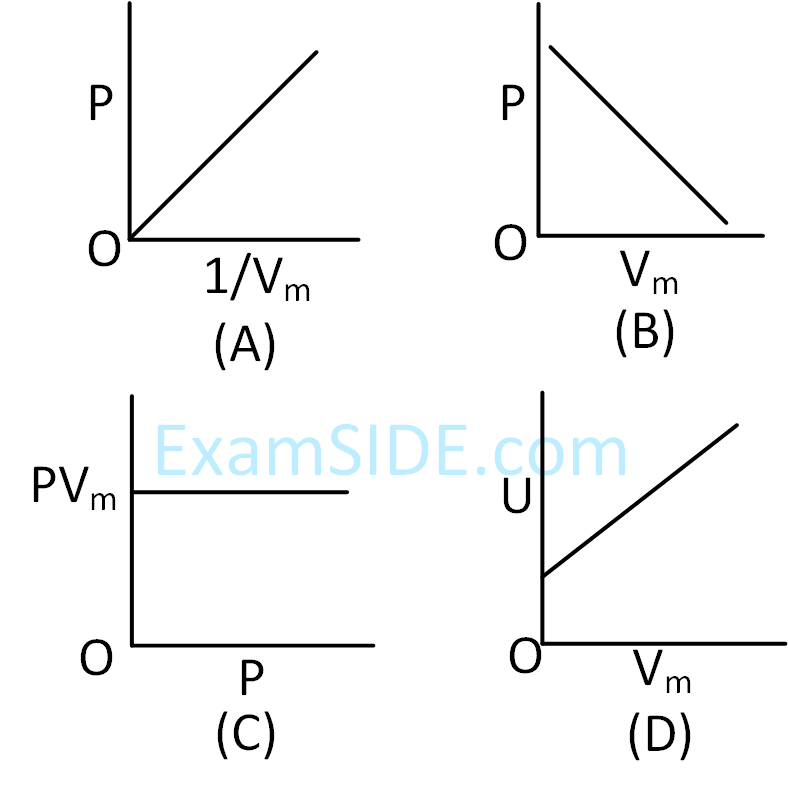
The combination of plots which does not represent isothermal expansion of an ideal gas is –
JEE Mains
2019
MCQ
For diatomic ideal gas in a closed system, which of the following plots does not correctly describe the relation between various thermodynamic quantities?
JEE Mains
2019
MCQ
The reaction, MgO(s) + C(s) $ \to $ Mg(s) + CO(g), for which $\Delta $rHo + 491.1 kJ mol–1 and $\Delta $rSo = 198.0 JK–1 mol–1, is not feasible at 298 K. Temperature above which reaciton will be feasible is :
JEE Mains
2019
MCQ
For the equilibrium,
2H2O $\rightleftharpoons$ H3O+ + OH$-$, the value of $\Delta $Go at 298 K is approximately :
JEE Mains
2019
MCQ
The standard reaction Gibbs energy for a chemical reaction at an absolute temperature T is given by
$\Delta $rGo = A – BT
Where A and B are non-zero constants. Which of the following is TRUE about this reaction?
JEE Mains
2019
MCQ
For the chemical reaction X $\rightleftharpoons$ Y, the standard reaction Gibbs energy depends on temperature T (in K) as
$\Delta $rGo (in kJ mol–1) = 120 $ - {3 \over 8}$ T.
The major component of the reaction mixture at T is :
JEE Mains
2019
MCQ
Two blocks of the same metal having same mass and at temperature T1 and T2, respectively, are brought in contact with each other and allowed to attain thermal equilibrium at constant pressure. The change in entropy, $\Delta $S, for this process is :
JEE Mains
2019
MCQ
The process with negative entropy change is :
JEE Mains
2019
MCQ
An ideal gas undergoes isothermal compression from 5m3 to 1 m3 against a constant external pressure of 4 Nm–2. Heat released in this process is used to increase the temperature of 1 mole of Al. If molar heat capacity of Al is 24 J mol–1 K–1, the temperature of Al increases by :
JEE Mains
2019
MCQ
A process has $\Delta $H = 200 J mol–1 and $\Delta $S = 40 JK–1 mol–1. Out of the values given below, choose the minimum temperature above which the process will be spontaneous :
JEE Mains
2019
MCQ
The entropy change associated with the conversion of 1 kg of ice at 273 K to water vapours at 383 K is :
(Specific heat of water liquid and water vapour are 4.2 kJ K$-$1 kg$-$1 and 2.0 kJ K$-$1 kg$-$1; heat of liquid fusion and vapourisation of water are 334 kJ$-$1 and 2491 kJ kg$-$1, respectively). (log 273 = 2.436, log 373 = 2.572, log 383 = 2.583)
JEE Mains
2019
MCQ
Consider the reversible isothermal expansion of an ideal gas in a closed system at two different temperatures T1 and T2 (T1 < T2). The correct graphical depiction of the dependence of work done (w) on the final volume (V) is :
JEE Mains
2018
MCQ
For which of the following processes, $\Delta $S is negative ?
JEE Mains
2018
MCQ
At 320 K, a gas A2 is 20% dissociated to A(g). The standard free energy change at 320 K and 1 atm in J mol-1 is approximately : (R = 8.314 JK-1 mol-1; ln2 = 0.693; ln 3 = 1.098)
JEE Mains
2018
MCQ
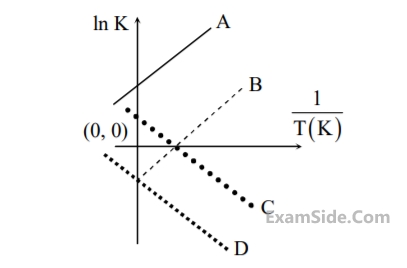
Which of the following lines correctly show the temperature dependence of equilibrium constant K, for an
exothermic reaction?
JEE Mains
2018
MCQ
The combustion of benzene(l) gives CO2(g) and H2O(l). Given that heat of combustion of benzene at constant volume is –3263.9 kJ mol–1 at 25oC; heat of combustion (in kJ mol–1) of benzene at constant pressure will be :
(R = 8.314 JK–1 mol–1)
JEE Mains
2018
MCQ
Given
(i) 2Fe2O3(s) $ \to $ 4Fe(s) + 3O2(g);
$\Delta $rGo = + 1487.0 kJ mol-1
(ii) 2CO(g) + O2(g) $ \to $ 2CO2(g);
$\Delta $rGo = $-$ 514.4 kJ mol-1
Free energy change, $\Delta $rGo for the reaction
2Fe2O3(s) + 6CO(g) $ \to $ 4Fe(s) + 6CO2(g) will be :
JEE Mains
2018
MCQ
$\Delta $fGo at 500 K for substance 'S' in liquid state and gaseous state are +100.7 kcl mol-1 and +103 kcal mol-1, respectively. Vapour pressure of liquid 'S' at 500 K is approximately equal to : ( R = 2 cal K-1 mol-1 )
JEE Mains
2018
MCQ
An ideal gas undergoes a cyclic process as shown in Figure.

$\Delta $U
BC = $-$5 kJ mol
-1, q
AB = $2$ kJ mol
-1, W
AB = $-$5 kJ mol
-1, W
CA = 3 kJ mol
-1. Heat absorbed by the system during process $CA$ is :
JEE Mains
2018
MCQ
For which of the following reactions, $\Delta $H is equal to $\Delta $U?
JEE Mains
2017
MCQ
A gas undergoes change from state A to state B. In this process, the heat absorbed
and work done by the gas is 5 J and 8 J, respectively. Now gas is brought back to
A by another process during which 3 J of heat is evolved. In this reverse process of
B to A :
JEE Mains
2017
MCQ
An ideal gas undergoes isothermal expansion at constant pressure. During
the process :
JEE Mains
2017
MCQ
The enthalpy change on freezing of 1 mol of water at 5oC to ice at −5oC is :
(Given $\Delta $fusH = 6 kJ mol$-$1 at 0oC,
Cp(H2O, $\ell $ = 75.3J mol$-$1 K$-$1)
Cp(H2O s) =36.8 J mol$-$1 K$-$1)
JEE Mains
2017
MCQ
For a reaction, A(g) $ \to $ A($\ell $); $\Delta $H= $-$ 3RT.
The correct statement for the reaction is :
JEE Mains
2017
MCQ
$\Delta $U is equal to :
JEE Mains
2017
MCQ
Given, ${C_{(graphite)}} + {O_2} \to C{O_2}(g)$;
${\Delta _r}{H^o}$ = - 393.5 kJ mol-1
${{\rm H}_2}(g)$ + ${1 \over 2}{O_2}(g)$$\to {{\rm H}_2}{\rm O}(l)$
${\Delta _r}{H^o}$ = - 285.8 kJ mol-1
$C{O_2}(g)$ + $2{{\rm H}_2}{\rm O}(l) \to$ $C{H_4}(g)$ + $2{O_2}(g)$
${\Delta _r}{H^o}$ = + 890.3 kJ mol-1
Based on the above thermochemical equations, the value of ${\Delta _r}{H^o}$ at 298 K for the reaction
${C_{(graphite)}}$ + $2{{\rm H}_2}(g) \to$ $C{H_4}(g)$ will be :
JEE Mains
2016
MCQ
If 100 mole of H2O2 decompose at 1 bar and 300 K, the work done (kJ) by one mole of O2(g) as it expands against 1 bar pressure is :
2H2O2(l) $\rightleftharpoons$ 2H2O(l) + O2(g)
(R = 8.3 J K $-$1 mol$-$1)
JEE Mains
2016
MCQ
The plot shows the variation of −$ln$ K
p versus temperature for the two reactions.
M(s) + ${1 \over 2}$ O
2(g) $ \to $ MO(s) and
C(s) + ${1 \over 2}$ O
2(g) $ \to $ CO(s)

Identify the correct statement :
JEE Mains
2016
MCQ
A reaction at 1 bar is non-spontaneous at low temperature but becomes spontaneous
at high temperature. Identify the correct statement about the reaction among the
following :
JEE Mains
2016
MCQ
For the reaction,
A(g) + B(g) $ \to $ C(g) + D(g), $\Delta $Ho and $\Delta $So are, respectively, − 29.8 kJ mol−1 and −0.100 kJ K−1 mol−1 at 298 K. The equilibrium constant for the reaction at 298 K is :
JEE Mains
2016
MCQ
The heats of combustion of carbon and carbon monoxide are –393.5 and –283.5 kJ mol–1, respectively. The
heat of formation (in kJ) of carbon monoxide per mole is :
JEE Mains
2015
MCQ
The following reaction is performed at 298 K
2NO(g) + O2 (g) $\leftrightharpoons$ 2NO2 (g)
The standard free energy of formation of NO(g) is 86.6 kJ/mol at 298 K. What is the standard free energy
of formation of NO2(g) at 298 K? (KP = 1.6 × 10¹²)
JEE Mains
2014
MCQ
For complete combustion of ethanol, C2H5OH(l) + 3O2(g) $\to$ 2CO2(g) + 3H2O(l) the amount of heat
produced as measured in bomb calorimeter, is 1364.47 kJ mol–1 at 25oC. Assuming ideality the Enthalpy of combustion, $\Delta _CH$, for the reaction will be : (R = 8.314 kJ mol–1)
JEE Mains
2013
MCQ
A piston filled with 0.04 mol of an ideal gas expands reversibly from 50.0 mL to 375 mL at a constant
temperature of 37.0oC. As it does so, it absorbs 208J of heat. The values of q and w for the process will be :
(R = 8.314 J/mol K) ( l n 7.5 = 2.01)
JEE Mains
2012
MCQ
The incorrect expression among the following is :
JEE Mains
2011
MCQ
The entropy change involved in the isothermal reversible expansion of 2 moles of an ideal gas from a
volume of 10 dm3 to a volume of 100 dm3 at 27oC is :
JEE Mains
2010
MCQ
For a particular reversible reaction at temperature T, ∆H and ∆S were found to be both +ve. If Te is
the temperature at equilibrium, the reaction would be spontaneous when :
JEE Mains
2010
MCQ
The standard enthalpy of formation of NH3 is –46.0 kJ mol–1. If the enthalpy of formation of H2 from its atoms is –436 kJ mol–1 and that of N2 is –712 kJ mol–1, the average bond enthalpy of N–H bond in NH3 is :
JEE Mains
2009
MCQ
On the basis of the following thermochemical data :
($\Delta _fG^oH^+_{(aq)}$ = 0)
H2O(l) $\to$ H+(aq) + OH-(aq); $\Delta H$ = 57.32 kJ
H2(g) + ${1 \over 2} O_2(g) \to$ H2O(l); $\Delta H$ = -286.20 kJ
The value of enthalpy of formation of OH− ion at 25oC is :
JEE Mains
2008
MCQ
Standard entropy of X2, Y2 and XY3 are 60, 40 and 50 JK−1
mol−1 , respectively. For the reaction,
${1 \over 2} X_2$ + ${3 \over 2} Y_2 \to$ XY3, $\Delta H$ = -30 kJ, to be at equilibrium, the temperature will be :
JEE Mains
2008
MCQ
Oxidising power of chlorine in aqueous solution can be determined by the parameters indicated
below:
${1 \over 2}C{l_2}(g)$ $\buildrel {{1 \over 2}{\Delta _{diss}}{H^\Theta }} \over
\longrightarrow $ $Cl(g)$ $\buildrel {{\Delta _{eg}}{H^\Theta }} \over
\longrightarrow $ $C{l^ - }(g)$ $\buildrel {{\Delta _{Hyd}}{H^\Theta }} \over
\longrightarrow $ $C{l^ - }(aq)$
(Using the data, ${\Delta _{diss}}H_{C{l_2}}^\Theta $ = 240 kJ/mol, ${\Delta _{eg}}H_{Cl}^\Theta $ = -349 kJ/mol, ${\Delta _{hyd}}H_{C{l^ - }}^\Theta $ = - 381 kJ/mol) will be :
JEE Mains
2007
MCQ
Assuming that water vapour is an ideal gas, the internal energy change $\left( {\Delta U} \right)$ when $1$ mol of water is vapourised at $1$ bar pressure and ${100^ \circ }C$ (Given : molar enthalpy of vapourisation of water at $1$ bar and $373$ $K$ $ = 41\,kJ\,mo{l^{ - 1}}\,$
and $R = 8.3\,J\,mo{l^{ - 1}}\,{K^{ - 1}}$ )
JEE Mains
2007
MCQ
In conversion of lime-stone to lime,
CaCO3(s) $\to$ CaO(s) + CO2 (g) the vales of ∆H° and ∆S° are +179.1 kJ mol−1
and 160.2 J/K respectively at 298 K and 1 bar.
Assuming that ∆H° do not change with temperature, temperature above which conversion of
limestone to lime will be spontaneous is :
JEE Mains
2007
MCQ
Identify the correct statement regarding a spontaneous process :
JEE Mains
2006
MCQ
The enthalpy changes for the following processes are listed below :
Cl2(g) = 2Cl(g), 242.3 kJ mol–1
I2(g) = 2I(g), 151.0 kJ mol–1
ICl(g) = I(g) + Cl(g), 211.3 kJ mol–1
I2(s) = I2(g), 62.76 kJ mol–1
Given that the standard states for iodine and chlorine are I2(s) and Cl2(g), the standard enthalpy of
formation for ICl(g) is :
JEE Mains
2006
MCQ
An ideal gas is allowed to expand both reversibly and irreversibly in an isolated system. If Ti is the
initial temperature and Tf is the final temperature, which of the following statements is correct?
JEE Mains
2006
MCQ
The standard enthalpy of formation $\Delta _fH^o$ at 298 K for methane, CH4(g), is –74.8 kJ mol–1. The additional information required to determine the average energy for C – H bond formation would be :
JEE Mains
2006
MCQ
($\Delta H - \Delta U$) for the formation of carbon monoxide (CO) from its elements at 298 K is : (R = 8.314 J K–1 mol–1)
JEE Mains
2005
MCQ
If the bond dissociation energies of XY, X2 and Y2 (all diatomic molecules) are in the ratio of 1:1:0.5 and $\Delta H_f$ for the formation of XY is -200 kJ mole-1. The bond
dissociation energy of X2 will be :
JEE Mains
2005
MCQ
Consider the reaction: N2 + 3H2 $\to$ 2NH3 carried out at constant temperature and
pressure. If $\Delta H$ and $\Delta U$ are the enthalpy and internal energy changes for the
reaction, which of the following expressions is true?
JEE Mains
2005
MCQ
Consider an endothermic reaction, X $\to$ Y with the activation energies Eb and Ef
for the backward and forward reactions, respectively. In general :
JEE Mains
2004
MCQ
An ideal gas expands in volume from 1$\times$10-3 m3 to 1 $\times$ 10-2 m3 at 300 K against a constant pressure of 1$\times$105 Nm-2. The work done is :
JEE Mains
2004
MCQ
The enthalpies of combustion of carbon and carbon monoxide are -393.5 and -283 kJ mol-1
respectively. The enthalpy of formation of carbon monoxide per mole is :
JEE Mains
2003
MCQ
The internal energy change when a system goes from state A to B is 40 kJ/mole. If the system goes from A to B by a reversible path and returns to state A by an irreversible path what would be the net change in internal energy?
JEE Mains
2003
MCQ
If at 298 K the bond energies of C - H, C - C, C = C and H - H bonds are respectively 414, 347, 615 and 435 kJ/mol, the value of enthalpy change for the reaction
H2C = CH2(g) + H2(g) $\to$ H3C - CH3(g) at 298 K will be :
JEE Mains
2003
MCQ
The correct relationship between free energy change in a reaction and the corresponding equilibrium constant Kc is :
JEE Mains
2003
MCQ
In an irreversible process taking place at constant T and P and in which only pressure-volume work is being done, the change in Gibbs free energy (dG) and change in entropy (dS), satisfy the criteria :
JEE Mains
2003
MCQ
The enthalpy change for a reaction does not depend upon :
JEE Mains
2002
MCQ
If an endothermic reaction is non-spontaneous at freezing point of water and becomes feasible at its boiling point, then :
JEE Mains
2002
MCQ
The heat required to raise the temperature of body by 1 K is called :
JEE Mains
2002
MCQ
A heat engine absorbs heat Q1 at temperature T1 and heat Q2 at temperature T2. Work done by the engine is J (Q1 + Q2). This data :
JEE Mains
2002
MCQ
For the reactions
2C + O2 $\to$ 2CO2; $\Delta H$ = -393 J
2Zn + O2 $\to$ 2ZnO; $\Delta H$ = -412 J