Thermodynamics
Given below are two statements: One is labelled as Assertion $\mathbf{A}$ and the other is labelled as Reason $\mathbf{R}$
Assertion A : The reduction of a metal oxide is easier if the metal formed is in liquid state than solid state.
Reason $\mathbf{R}$ : The value of $\Delta G ^\Theta$ becomes more on negative side as entropy is higher in liquid state than solid state.
In the light of the above statements, choose the most appropriate answer from the options given below
Which of the following relation is not correct?
$\Delta$G$^\circ$ vs T plot for the formation of MgO, involving reaction
2Mg + O2 $\to$ 2MgO, will look like :


Match List-I with List-II.
| List - I | List - II | ||
|---|---|---|---|
| (A) | Spontaneous process | (I) | $\Delta H < 0$ |
| (B) | Process with $\Delta P = 0$, $\Delta T = 0$ | (II) | $\Delta {G_{T,P}} < 0$ |
| (C) | $\Delta {H_{reaction}}$ | (III) | Isothermal and isobaric process |
| (D) | Exothermic Process | (IV) | [Bond energies of molecules in reactants] $ - $ [Bond energies of product molecules |
Choose the correct answer from the options given below :
At 25$^\circ$C and 1 atm pressure, the enthalpy of combustion of benzene (I) and acetylene (g) are $-$ 3268 kJ mol$-$1 and $-$1300 kJ mol$-$1, respectively. The change in enthalpy for the reaction 3 C2H2(g) $\to$ C6H6 (I), is :
At 25$^\circ$C and 1 atm pressure, the enthalpies of combustion are as given below :
| Substance | ${H_2}$ | C (graphite) | ${C_2}{H_6}(g)$ |
|---|---|---|---|
| ${{{\Delta _c}{H^\Theta }} \over {kJ\,mo{l^{ - 1}}}}$ | $ - 286.0$ | $ - 394.0$ | $ - 1560.0$ |
The enthalpy of formation of ethane is
When 600 mL of 0.2 M HNO3 is mixed with $400 \mathrm{~mL}$ of 0.1 M NaOH solution in a flask, the rise in temperature of the flask is ___________ $\times 10^{-2}{ }\,^{\circ} \mathrm{C}$.
(Enthalpy of neutralisation $=57 \mathrm{~kJ} \mathrm{~mol}^{-1}$ and Specific heat of water $=4.2 \,\mathrm{JK}^{-1} \mathrm{~g}^{-1}$) (Neglect heat capacity of flask)
Explanation:
600 mL × 0.2 M = 120 m mol
NaOH
400 mL × 0.1 M = 40 m mol

Heat liberated from reaction
$ =40 \times 10^{-3} \times 57 \times 10^{3} \mathrm{~J} $
Heat gained by solution $=m C \Delta T$
$ \begin{aligned} \mathrm{m}=\text { mass of solution }=\mathrm{V} \times \mathrm{d} &=1000 \times 1 \\\\ &=1000 \mathrm{~g} \end{aligned} $
Heat gained by solution $=1000 \times 4.2 \times \Delta \mathrm{T} \ldots(2)$
From (1) and (2)
Heat liberated $=$ Heat gained
$40 \times 10^{-3} \times 57 \times 10^{3}=1000 \times 4.2 \times \Delta T$
$\Delta T=54 \times 10^{-2}{ }^{\circ} \mathrm{C}$
(Rounded off to the nearest integer)
Among the following the number of state variables is ______________.
Internal energy (U)
Volume (V)
Heat (q)
Enthalpy (H)
Explanation:
A gas (Molar mass = 280 $\mathrm{~g} \mathrm{~mol}^{-1}$) was burnt in excess $\mathrm{O}_{2}$ in a constant volume calorimeter and during combustion the temperature of calorimeter increased from $298.0 \mathrm{~K}$ to $298.45$ $\mathrm{K}$. If the heat capacity of calorimeter is $2.5 \mathrm{~kJ} \mathrm{~K}^{-1}$ and enthalpy of combustion of gas is $9 \mathrm{~kJ} \mathrm{~mol}^{-1}$ then amount of gas burnt is _____________ g. (Nearest Integer)
Explanation:
$ \begin{aligned} &=2.5 \times 10^{3} \times 0.45 \\\\ &=1.125 \mathrm{~kJ} \end{aligned} $
Considering $\Delta \mathrm{H} \simeq \Delta \mathrm{U}$
$ \Delta \mathrm{H}=9 \mathrm{~kJ} / \mathrm{mol} \simeq \Delta \mathrm{U} $
$\therefore$ Mass of gas burnt $=\frac{1.125}{9} \times 280=35 \mathrm{~g}$
The molar heat capacity for an ideal gas at constant pressure is $20.785 \mathrm{~J} \mathrm{~K}^{-1} \mathrm{~mol}^{-1}$. The change in internal energy is $5000 \mathrm{~J}$ upon heating it from $300 \mathrm{~K}$ to $500 \mathrm{~K}$. The number of moles of the gas at constant volume is ____________. [Nearest integer] (Given: $\mathrm{R}=8.314 \mathrm{~J} \mathrm{~K}^{-1} \mathrm{~mol}^{-1}$)
Explanation:
$ \begin{aligned} &\text { and } \Delta \mathrm{U}=\mathrm{nC} \mathrm{v} \Delta \mathrm{T} \\\\ &\therefore \quad \mathrm{nC}_{\mathrm{v}}=\frac{5000}{200}=25 \end{aligned} $
and we know that
$ \begin{aligned} &C_{p}-C_{v}=R \\\\ &20.785-\frac{25}{n}=8.314 \\\\ &n=\frac{25}{(20.785-8.314)}=2 \end{aligned} $
For the reaction
$\mathrm{H}_{2} \mathrm{F}_{2}(\mathrm{~g}) \rightarrow \mathrm{H}_{2}(\mathrm{~g})+\mathrm{F}_{2}(\mathrm{~g})$
$\Delta U=-59.6 \mathrm{~kJ} \mathrm{~mol}^{-1}$ at $27^{\circ} \mathrm{C}$.
The enthalpy change for the above reaction is ($-$) __________ $\mathrm{kJ} \,\mathrm{mol}^{-1}$ [nearest integer]
Given: $\mathrm{R}=8.314 \mathrm{~J} \mathrm{~K}^{-1} \mathrm{~mol}^{-1}$.
Explanation:
$\Delta \mathrm{U}=-59.6 \mathrm{~kJ} \mathrm{~mol}^{-1}$ at $27^{\circ} \mathrm{C}$
$ \begin{aligned} \Delta \mathrm{H} &=\Delta \mathrm{U}+\Delta \mathrm{n}_{g} \mathrm{RT} \\ &=-59.6+\frac{1 \times 8.314 \times 300}{1000} \\ &=-57.10 \mathrm{~kJ} \mathrm{~mol}^{-1} \end{aligned} $
$2.4 \mathrm{~g}$ coal is burnt in a bomb calorimeter in excess of oxygen at $298 \mathrm{~K}$ and $1 \mathrm{~atm}$ pressure. The temperature of the calorimeter rises from $298 \mathrm{~K}$ to $300 \mathrm{~K}$. The enthalpy change during the combustion of coal is $-x \mathrm{~kJ} \mathrm{~mol}^{-1}$. The value of $x$ is ___________. (Nearest Integer)
(Given : Heat capacity of bomb calorimeter $20.0 \mathrm{~kJ} \mathrm{~K}^{-1}$. Assume coal to be pure carbon)
Explanation:
$\mathrm{n}_{\text {coal }}=\frac{2.4}{12}$
$\mathrm{Q}=\frac{-20(300-298)}{0.2}$
$Q=-200 \mathrm{~kJ} / \mathrm{mol}$
$x=200$
While performing a thermodynamics experiment, a student made the following observations.
HCl + NaOH $\to$ NaCl + H2O $\Delta$H = $-$57.3 kJ mol$-$1
CH3COOH + NaOH $\to$ CH3COONa + H2O $\Delta$H = $-$55.3 kJ mol$-$1
The enthalpy of ionization of CH3COOH as calculated by the student is _____________ kJ mol$-$1. (nearest integer)
Explanation:
$ \Delta \mathrm{H}_{1}=-57.3 \,\mathrm{KJ} \mathrm{mol}^{-1} $
(II) $\mathrm{CH}_{3} \mathrm{COOH}+\mathrm{NaOH} \rightarrow \mathrm{CH}_{3} \mathrm{COONa}+\mathrm{H}_{2} \mathrm{O}$
$ \Delta \mathrm{H}_{2}=-55.3 \,\mathrm{KJ} \mathrm{mol}^{-1} $
Reaction (I) can be written as
$ \text { (III) } \mathrm{NaCl}+\mathrm{H}_{2} \mathrm{O} \rightarrow \mathrm{HCl}+\mathrm{NaOH} $
$ \Delta \mathrm{H}_{3}=57.3 \,\mathrm{KJ} \mathrm{mol}^{-1} $
By adding (II) and (III)
$ \begin{aligned} &\mathrm{CH}_{3} \mathrm{COOH}+\mathrm{NaCl} \rightarrow \mathrm{CH}_{3} \mathrm{COONa}+\mathrm{HCl} \quad \Delta \mathrm{H}_{\mathrm{r}} \\ &\begin{aligned} \Delta \mathrm{H}_{\mathrm{r}}=\Delta \mathrm{H}_{3}+\Delta \mathrm{H}_{2} &=57.3-55.3 \\ &=2 \mathrm{~kJ} \mathrm{~mol}^{-1} \end{aligned} \end{aligned} $
The enthalpy of combustion of propane, graphite and dihydrogen at $298 \mathrm{~K}$ are $-2220.0 \mathrm{~kJ} \mathrm{~mol}^{-1},-393.5 \mathrm{~kJ} \mathrm{~mol}^{-1}$ and $-285.8 \mathrm{~kJ} \mathrm{~mol}^{-1}$ respectively. The magnitude of enthalpy of formation of propane $\left(\mathrm{C}_{3} \mathrm{H}_{8}\right)$ is _______________ $\mathrm{kJ} \,\mathrm{mol}^{-1}$. (Nearest integer)
Explanation:
$\mathrm{C}_{3} \mathrm{H}_{8}(\mathrm{~g})+5 \mathrm{O}_{2}(\mathrm{~g}) \rightarrow 3 \mathrm{CO}_{2}(\mathrm{~g})+4 \mathrm{H}_{2} \mathrm{O}(\mathrm{I}), \Delta \mathrm{H}_{1}=-2220 \mathrm{~kJ} \mathrm{~mol}^{-1}$
$\mathrm{C}($ graphite $)+\mathrm{O}_{2}(\mathrm{~g}) \rightarrow \mathrm{CO}_{2}(\mathrm{~g}), \quad \Delta \mathrm{H}_{2}=-393.5 \mathrm{~kJ} \mathrm{~mol}^{-1}$
$\mathrm{H}_{2}(\mathrm{~g})+\frac{1}{2} \mathrm{O}_{2}(\mathrm{~g}) \rightarrow \mathrm{H}_{2} \mathrm{O}(\mathrm{I}), \quad \Delta \mathrm{H}_{3}=-285.8 \mathrm{~kJ} \mathrm{~mol}^{-1}$
The desired reaction is
$3 \mathrm{C}$ (graphite) + $4 \mathrm{H}_{2}(\mathrm{~g}) \rightarrow \mathrm{C}_{3} \mathrm{H}_{8}(\mathrm{~g})$
$\Delta \mathrm{H}_{\mathrm{f}}=3 \Delta \mathrm{H}_{2}+4 \Delta \mathrm{H}_{3}-\Delta \mathrm{H}_{1}$
$ \begin{aligned} &=3(-393.5)+4(-285.8)-(-2220) \\ &=-103.7 \mathrm{~kJ} \mathrm{~mol}^{-1} \end{aligned} $
$\left|\Delta \mathrm{H}_{\mathrm{f}}\right| \simeq 104 \mathrm{~kJ} \mathrm{~mol}^{-1}$
1.0 mol of monoatomic ideal gas is expanded from state 1 to state 2 as shown in the figure. The magnitude of the work done for the expansion of gas from state 1 to state 2 at 300 K is ____________ J. (Nearest integer)
(Given : R = 8.3 J K$-$1 mol$-$1, ln10 = 2.3, log2 = 0.30)

Explanation:
2.2 g of nitrous oxide (N2O) gas is cooled at a constant pressure of 1 atm from 310 K to 270 K causing the compression of the gas from 217.1 mL to 167.75 mL. The change in internal energy of the process, $\Delta$U is '$-$x' J. The value of 'x' is ________. [nearest integer]
(Given : atomic mass of N = 14 g mol$-$1 and of O = 16 g mol$-$1. Molar heat capacity of N2O is 100 J K$-$1 mol$-$1)
Explanation:
$ \begin{aligned} \Delta U &=q+w \\\\ &=\frac{100 \times 2.2}{44}(-40)-(-49.39) \times 10^{-3} \times 101.325 \end{aligned} $
$ \begin{aligned} &=-200+5 \\\\ &=-195 \mathrm{~J} \\\\ \mathrm{x}=& 195 \end{aligned} $
17.0 g of NH3 completely vapourises at $-$33.42$^\circ$C and 1 bar pressure and the enthalpy change in the process is 23.4 kJ mol$-$1. The enthalpy change for the vapourisation of 85 g of NH3 under the same conditions is _________ kJ.
Explanation:
So, required $\Delta \mathrm{H}=5 \times 23.4$
$ =117 \mathrm{~kJ} $
For combustion of one mole of magnesium in an open container at 300 K and 1 bar pressure, $\Delta$CH$\Theta $ = $-$601.70 kJ mol$-$1, the magnitude of change in internal energy for the reaction is __________ kJ. (Nearest integer)
(Given : R = 8.3 J K$-$1 mol$-$1)
Explanation:
$ \begin{aligned} &\Delta \mathrm{H}=\Delta \mathrm{U}+\Delta \mathrm{ngRT} \\\\ &\Delta \mathrm{ng}=-\frac{1}{2} \\\\ &-601.70=\Delta \mathrm{U}-\frac{1}{2}(8.3)(300) \times 10^{-3} \\\\ &\Delta \mathrm{U}=-601.70+1.245 \\\\ &\Delta \mathrm{U} \simeq-600 \mathrm{~kJ} \end{aligned} $
The magnitude of change in internal energy is $600 \mathrm{~kJ}$.
4.0 L of an ideal gas is allowed to expand isothermally into vacuum until the total volume is 2.0 L. The amount of heat absorbed in this expansion is ____________ L atm.
Explanation:
$ \because P_{\text {ext }}=0 \quad \text { (vacuum) } $
$\therefore w=0, \quad\Delta U=0$ (as the process is isothermal)
So, $q=0$
When 5 moles of He gas expand isothermally and reversibly at 300 K from 10 litre to 20 litre, the magnitude of the maximum work obtained is __________ J. [nearest integer] (Given : R = 8.3 J K$-$1 mol$-$1 and log 2 = 0.3010)
Explanation:
A fish swimming in water body when taken out from the water body is covered with a film of water of weight 36 g. When it is subjected to cooking at 100$^\circ$C, then the internal energy for vaporization in kJ mol$-$1 is ___________. [nearest integer]
[Assume steam to be an ideal gas. Given $\Delta$vapH$^\Theta $ for water at 373 K and 1 bar is 41.1 kJ mol$-$1 ; R = 8.31 J K$-$1 mol$-$1]
Explanation:
$ \begin{aligned} \mathrm{n}_{\mathrm{H}_{2} \mathrm{O}} &=\frac{36}{18}=2 \quad \Delta \mathrm{n}_{\mathrm{g}}=1-0=1 \\\\ \Delta \mathrm{U}_{\text {vap }} &=\Delta \mathrm{H}_{\text {vap }}-\Delta \mathrm{n}_{\mathrm{g}} \mathrm{RT} \\\\ &=41.1-(1) \times 8.31 \times 10^{-3} \times 373 \\\\ &=41.1-3.099 \\\\ &=38 \mathrm{~kJ} / \mathrm{mol} \end{aligned} $
For complete combustion of methanol
CH3OH(I) + ${3 \over 2}$O2(g) $\to$ CO2(g) + 2H2O(I)
the amount of heat produced as measured by bomb calorimeter is 726 kJ mol$-$1 at 27$^\circ$C. The enthalpy of combustion for the reaction is $-$x kJ mol$-$1, where x is ___________. (Nearest integer)
(Given : R = 8.3 JK$-$1 mol$-$1)
Explanation:
$ \begin{aligned} &\Delta \mathrm{H}=\Delta \mathrm{U}+\Delta \mathrm{n}_{\mathrm{g}} \mathrm{RT} \\\\ &=-726 \mathrm{~kJ}+\left(\frac{-1}{2}\right) \times 8.3 \times 300 \\\\ &\simeq-727 \mathrm{~kJ} \mathrm{~mol}^{-1} \end{aligned} $
The standard entropy change for the reaction
4Fe(s) + 3O2(g) $\to$ 2Fe2O3(s) is $-$550 J K$-$1 at 298 K.
[Given : The standard enthalpy change for the reaction is $-$165 kJ mol$-$1]. The temperature in K at which the reaction attains equilibrium is _____________. (Nearest Integer)
Explanation:
$ \begin{aligned} &\Rightarrow-165 \times 10^3-\mathrm{T} \times(-505)=0 \\\\ &\Rightarrow \mathrm{T}=300 \mathrm{~K} \end{aligned} $
(A) Freezing of water to ice at 0$^\circ$C
(B) Freezing of water to ice at $-$10$^\circ$C
(C) N2(g) + 3H2(g) $ \to $ 2NH3(g)
(D) Adsorption of CO(g) on lead surface.
(E) Dissolution of NaCl in water
Choose the correct answer from the options given below :
Explanation:
$\Delta$S = $-$ 176 JK$-$1 mol$-$1
T = 298 K
Using Gibb's free energy relation
$\Delta$G = $\Delta$H $-$ T$\Delta$S
where, $\Delta$G = change in Gibb's free energy
$\Delta$H = change in enthalpy
T = temperature
$\Delta$S = change in entropy
$\Delta$G = 57.8 kJ/mol $-$ [298 K $\times$ ($-$ 176 Jk$-$1 mol$-$1)]
= 57.8 kJ/mol $-$ $\left( {298 \times {{ - 176} \over {1000}}kJ} \right)$ [$\therefore$ 1 kJ = 1000 J]
= $-$ 5.352 kJ/mol
| $\Delta$G | = 5.352
Hence, answer is 5.
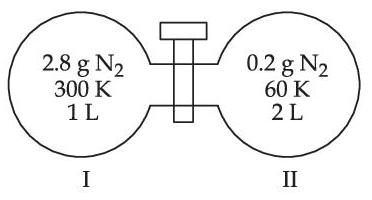
When the valve is opened, the final pressure of the system in bar is x $\times$ 10$-$2. The value of x is __________. (Integer answer)
[Assume - Ideal gas; 1 bar = 105 Pa; Molar mass of N2 = 28.0 g mol$-$1; R = 8.31 J mol$-$1 K$-$1]
Explanation:
$\Rightarrow$ Assuming the system attains a final temperature of T (such that 300 < T < 60)
$\Rightarrow$ $\left( {\matrix{ {Heat\,lost\,by} \cr {{N_2}\,of\,container} \cr I \cr } } \right) = \left( {\matrix{ {Heat\,gained\,by} \cr {{N_2}\,of\,container} \cr {II} \cr } } \right)$
$\Rightarrow$ n1Cm(300 $-$ T) = nIICm(T $-$ 60)
$ \Rightarrow \left( {{{2.8} \over {28}}} \right)(300 - T) = {{0.2} \over {28}}(T - 60)$
$\Rightarrow$ 14(300 $-$ T) = T $-$ 60
$\Rightarrow$ ${{(14 \times 300 + 60)} \over {15}} = T$
$\Rightarrow$ T = 284 K (final temperature)
$\Rightarrow$ If the final pressure = P
$\Rightarrow$ (nI + nII)final = $\left( {{{3.0} \over {28}}} \right)$
$\Rightarrow$${P \over {RT}}({V_I} + {V_{II}}) = {{3.0\,gm} \over {28\,gm/mol}}$
$P = \left( {{3 \over {28}}mol} \right) \times 8.31{J \over {mol - K}} \times {{284K} \over {3 \times {{10}^{ - 3}}{m^3}}} \times {10^{ - 5}}{{bar} \over {Pa}}$
$\Rightarrow$ 0.84287 bar
$\Rightarrow$ 84.28 $\times$ 10$-$2 bar
$\Rightarrow$ 84
FeO(s) + C(graphite) $\to$ Fe(s) + CO(g)
| Substance | $\Delta H^\circ $ (kJ mol$^{ - 1}$) |
$\Delta S^\circ $ (J mol$^{ - 1}$ K$^{ - 1}$) |
|---|---|---|
| $Fe{O_{(s)}}$ | $ - 266.3$ | 57.49 |
| ${C_{(graphite)}}$ | 0 | 5.74 |
| $F{e_{(s)}}$ | 0 | 27.28 |
| $C{O_{(g)}}$ | $ - 110.5$ | 197.6 |
The minimum temperature in K at which the reaction becomes spontaneous is ___________. (Integer answer)
Explanation:
${\Delta ^0}{H_{rxn}} = \left[ {\Delta _f^0H(Fe) + \Delta _f^0H(CO)} \right] - $
$ = \left[ {\Delta _f^0H(FeO) + \Delta _f^0H({C_{(graphite)}})} \right]$
$ = [0 - 110.5] - [ - 266.3 + 0]$
= 155.8 kJ/mol
${\Delta ^0}{S_{rxn}} = \left[ {{\Delta ^0}S(Fe) + {\Delta ^0}S(CO)} \right] - $
$\left[ {{\Delta ^0}S(FeO) + {\Delta ^0}S({C_{(graphite)}})} \right]$
$ = [27.28 + 197.6] - [57.49 + 5.74]$
= 161.65 J/mol-K
${T_{\min }} = {{155.8 \times {{10}^3}J/mol} \over {161.65J/mol - K}} = 963.8$ K
$ \simeq 964$ k (nearest integer)
[Given : Specific heat of water = 4.18 J g$-$1 K$-$1, Density of water = 1.00 g cm$-$3]
[Assume no volume change on mixing)
Explanation:
$\Rightarrow$ Millimoles of NaOH = 300 $\times$ 0.1 = 30
$\Rightarrow$ Heat released = $\left( {{{30} \over {1000}} \times 57.1 \times 1000} \right)$ = 1713 J
$\Rightarrow$ Mass of solution = 500 ml $\times$ 1 gm/ml = 500 gm
$\Rightarrow$ $\Delta T = {q \over {m \times c}} = {{1713J} \over {500g \times 4.18{J \over {g - K}}}}$ = 0.8196 K
= 81.96 $\times$ 10$-$2 K
[Use : R = 8.3 J mol$-$1 K$-$1]
Explanation:
$\Rightarrow$ From the relation : $\Delta$H = $\Delta$U + $\Delta$ngRT
$\Rightarrow$ 41${{kJ} \over {mol}}$ = $\Delta$U + (1) $\times$ ${{8.3} \over {1000}}$ $\times$ 373
$\Delta$ DU = 41 $-$ 3.0959 = 38 kJ/mol
${\Delta _f}{H^\Theta }$ for KCl = $-$436.7 kJ mol$-$1 ;
${\Delta _{sub}}{H^\Theta }$ for K = 89.2 kJ mol$-$1 ;
${\Delta _{ionization}}{H^\Theta }$ for K = 419.0 kJ mol$-$1 ;
${\Delta _{electron\,gain}}{H^\Theta }$ for Cl(g) = $-$348.6 kJ mol$-$1 ;
${\Delta _{bond}}{H^\Theta }$ for Cl2 = 243.0 kJ mol$-$1
The magnitude of lattice enthalpy of KCl in kJ mol$-$1 is _____________ (Nearest integer)
Explanation:
$ \Rightarrow - 436.7 = 89.2 + 419.0 + {1 \over 2}(243.0) + \{ - 348.6\} + {\Delta _{lattice}}H_{(KCl)}^\Theta $
$ \Rightarrow {\Delta _{lattice}}H_{(KCl)}^\Theta = - 717.8$ kJ mol$-$1
The magnitude of lattice enthalpy of KCl in kJ mol$-$1 is 718 (Nearest integer).
[Use : H+ (aq) + OH$-$ (aq) $\to$ H2O : $\Delta$$\gamma$H = $-$57.1 kJ mol$-$1]
Specific heat of H2O = 4.18 J K$-$1 g$-$1
density of H2O = 1.0 g cm$-$3
Assume no change in volume of solution on mixing.
Explanation:
${n_{O{H^ - }}} = {{600 \times 0.1} \over {1000}} = 0.06$ (L.R.)
Now, heat liberated from reaction = heat gained by solutions
or, 0.06 $\times$ 57.1 $\times$ 103
= (1000 $\times$ 1.0) $\times$ 4.18 $\times$ $\Delta$T
$\therefore$ $\Delta$T = 0.8196K
= 81.96 $\times$ 10$-$2 K $ \approx $ 82 $\times$ 10$-$2 K
$\Delta$vap H $-$ $\Delta$vap U = _____________ $\times$ 102 J mol$-$1. (Round off to the Nearest Integer)
[Use : R = 8.31 J mol$-$1 K$-$1]
[Assume volume of H2O(l) is much smaller than volume of H2O(g). Assume H2O(g) treated as an ideal gas]
Explanation:
$\Delta$H = $\Delta$U + $\Delta$ngRT
For 1 mole waters;
$\Delta$ng = 1
$\therefore$ $\Delta$ngRT = 1 mol $\times$ 8.31 J/mol-k $\times$ 373 K
= 3099.63 J $ \cong $ 31 $\times$ 102 J
Explanation:
$\Delta$U = 150 $-$ 200 = $-$50 J
Magnitude = 50 J = |$\Delta$U |
Explanation:
The enthalpy of sublimation is the total amount of energy required to convert a solid directly into a gas. This can be calculated by summing the enthalpy of fusion (solid to liquid) and the enthalpy of vaporization (liquid to gas). Mathematically, this relationship is represented as:
$ \Delta H_{\text{sublimation}} = \Delta H_{\text{fusion}} + \Delta H_{\text{vaporization}} $
Given:
Enthalpy of fusion, $\Delta H_{\text{fusion}} = 2.8 \, \text{kJ mol}^{-1}$
Enthalpy of vaporization, $\Delta H_{\text{vaporization}} = 98.2 \, \text{kJ mol}^{-1}$
Substitute these values into the equation:
$ \Delta H_{\text{sublimation}} = 2.8 \, \text{kJ mol}^{-1} + 98.2 \, \text{kJ mol}^{-1} = 101.0 \, \text{kJ mol}^{-1} $
Therefore, the enthalpy of sublimation of the substance (X) is approximately 101 kJ mol$-1$.
Explanation:
For 1 g of graphite = ${{248} \over {12}}$ = 20.67 kJ/gm heat evolved.
Explanation:
$\Delta$H = 51.4 kJ/mol
$\Delta$G = $\Delta$H $-$ T$\Delta$S
$-$49400 = 51400 $-$ 300$\Delta$S
$\Delta S = {{ + 100800} \over {300}} = 336$ JK$-$1 mol$-$1
the reaction enthalpy $\Delta$rH = __________ kJ mol$-$1. (Round off to the Nearest Integer).
[ Given : Bond enthalpies in kJ mol$-$1 : C-C : 347, C = C : 611; C-H : 414, H-H : 436 ]
Explanation:

$\Delta H = {E_{C - C}} + 6{E_{C - H}} - {E_{C = C}} - 4{E_{C - H}} - {E_{H - H}}$
$ = 347 + 6(414) - 611 - 4 \times 414 - 436$
$ = 347 + 828 - 1047$
$ = 128$ KJ/ mol
For the reaction
3CaO + 2Al $ \to $ 3Ca + Al2O3 the standard reaction enthalpy $\Delta$rH0 = _________ kJ.
(Round off to the Nearest Integer)
Explanation:
$\Delta H_{reaction}^o = 3\Delta {H^o}_f(Ca,s) + \Delta {H^o}_f(A{l_2}{O_3},s) - 3\Delta {H^o}_f(CaO,s) - 2\Delta {H^o}_f(Al,S)$
$ = 0 + ( - 1675) - 3( - 635) - 0$
$ = - 1675 + 1905$
$ = 230$ KJ
[Given : R = 8.314 J mol$-$1 K$-$1. Assume, hydrogen is an ideal gas] [Atomic mass of Fe is 55.85 u]
Explanation:
${{50} \over {55.85}}moles$
Moles of Fe = ${{50} \over {55.85}}moles$ = Moles of H2
No. of H2 produced $ = {{50} \over {55.85}}moles$
Work done $ = - {P_{ext}}\,.\,\Delta V$
$ = - \Delta {n_g}RT$
$ = - {{50} \over {55.85}} \times 8.314 \times 298$
= -2218.05 J
Nearest integer = 2218
[Given : The values of standard enthalpy of formation of SF6(g), S(g) and F(g) are - 1100, 275 and 80 kJ mol$-$1 respectively.]
Explanation:

So, $\Delta_f H^{\circ}[S, g]+6 \times \Delta_f H^{\circ}[F, g]=\Delta_f H^{\circ}\left[SF_6, g\right]$ $+ 6 \times E_{S-F}$
$\left[\therefore E_{S-F}=\right.$ Average $S-\mathrm{F}$ bond energy in $\left.\mathrm{SF}_6\right]$
$275+6 \times 80=-1100+6 \times E_{S-F}$
$\Rightarrow E_{S-F}=\frac{275+6 \times 80+1100}{6}$ $=309.16 \mathrm{~kJ} \mathrm{~mol}^{-1}=309 \mathrm{~kJ} \mathrm{~mol} \mathrm{~m}^{-1}$
(${\Delta _r}{H^\Theta }$ = 80 kJ mol$-$1) the entropy change ${\Delta _r}{S^\Theta }$ depends on the temperature T (in K) as ${\Delta _r}{S^\Theta }$ = 2T (J K$-$1mol$-$1).
Minimum temperature at which it will become spontaneous is ___________ K. (Integer)
Explanation:
For a reaction to be spontaneous
$\Delta G^\circ < 0$
$ \Rightarrow $ $\Delta H^\circ - T\Delta S^\circ < 0$
$ \Rightarrow $ $T > {{\Delta H^\circ } \over {\Delta S^\circ }}$
$ \Rightarrow $ $T > {{80000} \over {2T}}$
$ \Rightarrow $ 2T2 > 80000
$ \Rightarrow $ T2 > 40000
$ \Rightarrow $ T > 200
The minimum temperature to make it spontaneous is 200 K.
Explanation:
$\Delta $E = (Ea)f – (Ea)b
$ \Rightarrow $ – 20 = 30 – (Ea)b
$ \Rightarrow $ (Ea)b = 50 kJ
Explanation:
The gas performs isothermal irreversible work (W).
where, $\Delta$U = 0 (change in internal energy)
From, 1st law of thermodynamics,
$\Rightarrow$ $\Delta$U = $\Delta$Q + W
$\Rightarrow$ 0 = $\Delta$Q + W
$\Rightarrow$ $\Delta$Q = $-$W
Now, $W = - {p_{ext}}({V_2} - {V_1})$
$ = - {p_{ext}}\left( {{{nRT} \over {{p_2}}} - {{nRT} \over {{p_1}}}} \right) = - {p_{ext}} \times nRT\left( {{1 \over {{p_2}}} - {1 \over {{p_1}}}} \right)$
Given, pext = 4.3 MPa, p1 = 2.1 MPa, p2 = 1.3 MPa, n = 5 mol, T = 293 K and R = 8.314 J mol$-$1 K$-$1
$ = - 4.3 \times 5 \times 8.314 \times 293\left( {{1 \over {1.3}} - {1 \over {2.1}}} \right)$
= $-$ 15347.70 J mol$-$1
= $-$ 15.347 kJ mol$-$1 $ \simeq $ $-$ 15 kJ mol$-$1
$\Rightarrow$ $\Delta$Q = 15 kJ mol$-$1
$N{H_2}C{H_{(S)}} + {3 \over 2}{O_{2(g)}} \to {N_{2(g)}} + {O_{2(g)}} + {H_2}{O_{(I)}}$
is _________ kJ. (Rounded off to the nearest integer) [Assume ideal gases and R = 8.314 J mol$-$1 K$-$1]
Explanation:
$\Delta ng = (1 + 1) - {3 \over 2} = {1 \over 2}$
$\Delta H = \Delta U + \Delta ng\,RT$
$ = - 742.24 + {1 \over 2} \times {{8.314 \times 298} \over {1000}}$
$ = - 742.24 + 1.24$
$ = -741$ kJ/mol
Explanation:
$\Delta H = 495.8$
${1 \over 2}B{r_2}(l) + {e^ - }\buildrel {} \over \longrightarrow B{r^ - }(g)$
$\Delta H = 325$
$N{a^ + }(g) + B{r^ - }(g)\buildrel {} \over \longrightarrow NaBr(s)$
$\Delta H = - 728.4$
$Na(s) + {1 \over 2}B{r_2}(l)\buildrel {} \over \longrightarrow NaBr(s).$
$\Delta H = ?$
$\Delta H = 495.8 - 325 - 728.4 - 557.6$ kJ
$ = - 5576 \times {10^{ - 1}}$ kJ
$3HC \equiv C{H_{(g)}} \rightleftharpoons {C_6}{H_{6(l)}}$
[Given : ${\Delta _f}{G^o}(HC \equiv CH) = - 2.04 \times {10^5}$ J mol$-$1 ; ${\Delta _f}{G^o}({C_6}{H_6}) = - 1.24 \times {10^5}$ J mol$-$1 ; R = 8.314 J K-1 mol$-$1]
Explanation:
$\mathop {3HC \equiv CH(g)}\limits_{Acetylene} \to \mathop {{C_6}{H_6}(l)}\limits_{Benzene} $
Given, $\Delta G_f^o (CH \equiv CH) = - 2.04 \times {10^5}$ J mol$-$1
$\Delta G_f^o({C_6}{H_6}) = - 1.24 \times {10^5}$ J mol$-$1
Gibb's free energy, $\Delta G_f^o = - nRT\ln K$
$\Delta G_f^o = \sum {{{(\Delta G_F^o)}_P} - \sum {{{(\Delta G_F^o)}_R}} } $
$ - nRT\ln K = - n'RT\ln {K_p} - ( - n''RT\ln {K_f})$
$ \Rightarrow - RT\ln K = 1 \times ( - 1.24 \times {10^5}) - ( - 3 \times 2.04 \times {10^5}) $
$ \Rightarrow $ $- 2.303 \times R \times T\log K = 4.88 \times {10^5}$
$ \Rightarrow $ $\log K = - {{4.88 \times {{10}^5}} \over {2.303 \times 8.314 \times 273}}$
$ \Rightarrow $ $n\ln K = n'\ln {K_p} - ( - n''ln{K_f})$
$ \Rightarrow $ K = 85.52
$\Rightarrow$ K = 855 $\times$ 10$-$1
x = 855
4M(s) + nO2(g) $ \to $ 2M2On(s)
the free energy change is plotted as a function of temperature. The temperature below which the oxide is stable could be inferred from the plot as the point at which :
The hydration enthalpy of NaCl is :