Practical Organic Chemistry
Given below are two statements:
Statement I : Methyl orange is a weak acid.
Statement II : The benzenoid form of methyl orange is more intense/deeply coloured than the quinonoid form.
In the light of the above statement, choose the most appropriate answer from the options given below:
Match List I with List II
| LIST I Element detected |
LIST II Reagent used / Product formed |
||
|---|---|---|---|
| A. | Nitrogen | I. | $\mathrm{Na_2[Fe(CN)_5NO]}$ |
| B. | Sulphur | II. | $\mathrm{AgNO_3}$ |
| C. | Phosphorous | III. | $\mathrm{Fe_4[Fe(CN)_6]_3}$ |
| D. | Halogen | IV. | $\mathrm{(NH_4)_2MoO_4}$ |
Choose the correct answer from the options given below:
Given below are two statements :
Statement I : Sulphanilic acid gives esterification test for carboxyl group.
Statement II : Sulphanilic acid gives red colour in Lassigne's test for extra element detection.
In the light of the above statements, choose the most appropriate answer from the options given below :

Compound that will give positive Lassaigne's test for both nitrogen and halogen is :
$0.400 \mathrm{~g}$ of an organic compound $(\mathrm{X})$ gave $0.376 \mathrm{~g}$ of $\mathrm{AgBr}$ in Carius method for estimation of bromine. $\%$ of bromine in the compound $(\mathrm{X})$ is ___________.
(Given: Molar mass $\mathrm{AgBr=188~g~mol^{-1}}$
$\mathrm{Br}=80 \mathrm{~g} \mathrm{~mol}^{-1}$)
Explanation:
1. Calculate the moles of AgBr formed:
Moles of AgBr = mass / molar mass = 0.376 g / 188 g/mol = 0.002 mol
Since 1 mol of AgBr contains 1 mol of Br, the moles of Br in the compound X are also 0.002 mol.
2. Calculate the mass of bromine in the compound:
Mass of Br = moles of Br × molar mass of Br = 0.002 mol × 80 g/mol = 0.16 g
3. Calculate the percentage of bromine in the compound X:
Percentage of Br = (mass of Br / mass of compound X) × 100 = (0.16 g / 0.400 g) × 100 = 40%
So, the percentage of bromine in the compound X is 40%.
$\mathrm{KMnO}_{4}$ is titrated with ferrous ammonium sulphate hexahydrate in presence of dilute $\mathrm{H}_{2} \mathrm{SO}_{4}$. Number of water molecules produced for 2 molecules of $\mathrm{KMnO}_{4}$ is ___________.
Explanation:
$ 10\left[\mathrm{FeSO}_4 \cdot\left(\mathrm{NH}_4\right)_2 \mathrm{SO}_4 \cdot 6 \mathrm{H}_2 \mathrm{O}\right]+2 \mathrm{KMnO}_4+8 \mathrm{H}_2 \mathrm{SO}_4 \rightarrow $
$5 \mathrm{Fe}_2\left(\mathrm{SO}_4\right)_3+2 \mathrm{MnSO}_4+10\left(\mathrm{NH}_4\right)_2 \mathrm{SO}_4+\mathrm{K}_2 \mathrm{SO}_4+68 \mathrm{H}_2 \mathrm{O}$
Now, we are asked to find the number of water molecules produced for 2 molecules of KMnO₄.
From the balanced equation, we can observe that 2 moles of KMnO₄ produce 68 moles of H₂O. Therefore, for 2 molecules of KMnO₄, the number of water molecules produced will be:
2 molecules × 34 water molecules per molecule of KMnO₄ = 68 water molecules
So, 68 water molecules are produced for 2 molecules of KMnO₄ in this titration.
In base vs. acid titration, at the end point methyl orange is present as

The reagent neutral ferric chloride is used to detect the presence of ______________
The formula of the purple colour formed in Laissaigne's test for sulphur using sodium nitroprusside is :
Given below are two statements :
Statement I : In 'Lassaigne's Test', when both nitrogen and sulphur are present in an organic compound, sodium thiocyanate is formed.
Statement II : If both nitrogen and sulphur are present in an organic compound, then the excess of sodium used in sodium fusion will decompose the sodium thiocyanate formed to give NaCN and Na2S.
In the light of the above statements, choose the most appropriate answer from the options given below :
In bromination of Propyne, with Bromine, 1, 1, 2, 2-tetrabromopropane is obtained in 27% yield. The amount of 1, 1, 2, 2-tetrabromopropane obtained from 1 g of Bromine in this reaction is ___________ $\times$ 10$-$1 g. (Nearest integer)
(Molar Mass : Bromine = 80 g/mol)
Explanation:

2 moles $\mathrm{Br}_{2} \equiv 1$ mole 1,1,2,2-tetrabromopropane $\frac{1}{160}$ mole $\mathrm{Br}_{2}$
$\equiv \frac{1}{2} \times \frac{1}{160}$ mole 1,1,2,2-tetrabromopropane
But yield of reaction is only $27 \%$
Moles of 1,1,2,2-tetrabromopropane
$ =\frac{1}{2} \times \frac{1}{160} \times \frac{27}{100} $
Molar mass of 1,1,2,2-tetrabromopropane $=360 \mathrm{~g}$ Mass of 1,1,2,2-tetrabromopropane
$ \begin{aligned} &=\frac{1}{2} \times \frac{1}{160} \times \frac{27}{100} \times 360 \mathrm{~g} \\\\ &\approx 3 \times 10^{-1} \mathrm{~g} \end{aligned} $
A sample of $0.125 \mathrm{~g}$ of an organic compound when analyzed by Duma's method yields $22.78 \mathrm{~mL}$ of nitrogen gas collected over $\mathrm{KOH}$ solution at $280 \mathrm{~K}$ and $759 \mathrm{~mm}\, \mathrm{Hg}$. The percentage of nitrogen in the given organic compound is __________. (Nearest integer)
Given :
(a) The vapour pressure of water of $280 \mathrm{~K}$ is $14.2 \mathrm{~mm} \,\mathrm{Hg}$.
(b) $\mathrm{R}=0.082 \mathrm{~L}$ atm $\mathrm{K}^{-1} \mathrm{~mol}^{-1}$
Explanation:
$ \begin{aligned} \mathrm{n}_{\mathrm{N}_{2}} &=\frac{744.8 \times 22.78}{760 \times 0.0821 \times 280 \times 1000} \\\\ &=0.000971 \mathrm{~mol} \end{aligned} $
Mass of $\mathrm{N}_{2}=0.02719 \,\mathrm{gm}$
Percentage of nitrogen
$ =\frac{0.0271}{0.125} \times 100=21.75 \simeq 22 $

In the above reaction, $5 \mathrm{~g}$ of toluene is converted into benzaldehyde with $92 \%$ yield. The amount of benzaldehyde produced is ______________ $\times 10^{-2} \mathrm{~g}$. (Nearest integer)
Explanation:

Moles $=\frac{5}{92}$
Moles of benzaldehyde produced $=\frac{5}{92} \times 0.92=0.05$
$\therefore$ Mass of benzaldehyde formed
$=0.05 \times 106$
$=5.3 \mathrm{~g}$
$=530 \times 10^{-2}$
While estimating the nitrogen present in an organic compound by Kjeldahl's method, the ammonia evolved from $0.25 \mathrm{~g}$ of the compound neutralized $2.5 \mathrm{~mL}$ of $2 \,\mathrm{M} \,\mathrm{H}_{2} \mathrm{SO}_{4}$. The percentage of nitrogen present in organic compound is ______________.
Explanation:
$\therefore$ Moles of $\mathrm{NH}_{3}$ neutralized $=2.5 \times 2 \times 2$ millimole
$ =10 \times 10^{-3} \text { moles } $
$\therefore$ Weight of $\mathrm{N}$ present in the compound will be
$ \begin{aligned} &=10 \times 10^{-3} \times 14 \\ &=0.14 \mathrm{~g} \end{aligned} $
$\therefore \%$ of ' $\mathrm{N}$ ' in compound
$ \begin{aligned} &=\frac{0.14}{0.25} \times 100 \\ &=56 \% \end{aligned} $
An organic compound with 51.6% sulfur is heated in a Carius tube. The amount of this compound which will form 0.752 g of barium sulphate is ___________ $\times$ 10$-$1 g.
(Given molar mass of barium sulphate 233 g mol$-$1) (Nearest integer).
Explanation:
$0.752 \mathrm{~g}\, \mathrm{BaSO}_{4}$ contains $=\frac{32}{233} \times 0.752=0.1005 \mathrm{~g}$
Sulfur $\%=\frac{\text { Weight of Sulphur }}{\text { Weight of Compound }} \times 100$
$51.6=\frac{0.1005}{\text { Weight of compound }} \times 100$
$\Rightarrow$ Weight of compound $=\frac{0.1005}{51.6} \times 100=1.9 \times 10^{-1} \mathrm{~g}$
$ \approx 2 \times 10^{-1} \mathrm{~g} $
Kjeldahl's method was used for the estimation of nitrogen in an organic compound. The ammonia evolved from 0.55 g of the compound neutralised 12.5 mL of 1 M H2SO4 solution. The percentage of nitrogen in the compound is _____________. (Nearest integer)
Explanation:
12. $5 \times 1 \times 2=25$ meq. of $\mathrm{NH}_3$ $=25$ millimoles of $\mathrm{NH}_3$
So Millimoles of ${ }^{\prime} \mathrm{N}^{\prime}=25$
Moles of $\mathrm{N}^{\prime}=25 \times 10^{-3}$
wt. of $N=14 \times 25 \times 10^{-3}$
$ \begin{aligned} & \% \mathrm{~N}=\frac{14 \times 25 \times 10^{-3}}{0.55} \times 100 \\\\ & =63.66 \\\\ & \approx 64 \% \end{aligned} $
A 2.0 g sample containing MnO2 is treated with HCl liberating Cl2. The Cl2 gas is passed into a solution of KI and 60.0 mL of 0.1 M Na2S2O3 is required to titrate the liberated iodine. The percentage of MnO2 in the sample is _____________. (Nearest integer)
[Atomic masses (in u) Mn = 55; Cl = 35.5; O = 16, I = 127, Na = 23, K = 39, S = 32]
Explanation:
First Step :
MnO2 + 4HCl $\to$ MnCl2 + Cl2 + 2H2O
Here 1 mol of MnO2 produce 1 mol of Cl2
$\therefore$ Mole ratio of ${n_{Mn{O_2}}}:{n_{C{l_2}}} = 1:1$
Second Step :
Cl2 + 2KI $\to$ 2KCl + I2
Here, 1 mol of Cl2 produce 1 mol of I2
Mole ratio of ${n_{C{l_2}}}:{n_{{I_2}}} = 1:1$
Third Step :
I2 + 2Na2S2O3 $\to$ 2NaI + Na2S2O3
1 mol of I2 react with 2 mol of Na2S2O3
Mole ratio of ${n_{{I_2}}}:{n_{{N_2}{S_2}{O_3}}} = 1:2$
Given Na2S2O3 is 60 mL of 0.1 M
$\therefore$ Number of moles of Na2S2O3
= V (in L) $\times$ M (Molarity)
= ${{60} \over {1000}} \times 0.1$
= 0.006 mol
$\therefore$ Number of moles of I2
$ = {1 \over 2}(0.006)$
= 0.003
$\therefore$ Moles of MnO2 = 0.003 (as mole ratio of MnO2 and Cl2 = 1 : 1)
Molar mass of MnO2 = 55 + 32 = 87
$\therefore$ Mass of MnO2 = 0.003 $\times$ 87 = 0.261 gm
Given MnO2 = 2g
$\therefore$ % of MnO2 = ${{0.261} \over 2} \times 100 = 13\% $
In the estimation of bromine, 0.5 g of an organic compound gave 0.40 g of silver bromide. The percentage of bromine in the given compound is _________ % (nearest integer)
(Relative atomic masses of Ag and Br are 108u and 80u, respectively).
Explanation:
$ \therefore 0.4 \mathrm{~g} \mathrm{AgBr}=\frac{80}{188} \times 0.4 $
$\%$ of $\mathrm{Br}$ in given organic compound
$ \begin{aligned} &=\frac{80 \times 0.4}{188 \times 0.5} \times 100 \\\\ &\approx 34 \% \end{aligned} $
0.25 g of an organic compound containing chlorine gave 0.40 g of silver chloride in Carius estimation. The percentage of chlorine present in the compound is ___________. [in nearest integer]
(Given : Molar mass of Ag is 108 g mol$-$1 and that of Cl is 35.5 g mol$-$1)
Explanation:
Given, weight of organic compound = 0.25 g
Moles of AgCl = ${{0.4} \over M}$
Molecular mass of AgCl (M) = 143.5 gm
$\therefore$ Moles of AgCl = ${{0.4} \over 143.5}$
$\therefore$ Mass of Cl = ${{0.4} \over 143.5}$ $\times$ 35.5
Mass % of Cl in the organic compound
$ = {{{{35.5 \times 0.4} \over {143.5}}} \over {0.25}} \times 35.5$
$ = 39.58$
$ \simeq 40$
0.2 g of an organic compound was subjected to estimation of nitrogen by Dumas method in which volume of N2 evolved (at STP) was found to be 22.400 mL. The percentage of nitrogen in the compound is _________. [nearest integer]
(Given : Molar mass of N2 is 28 g mol$-$1. Molar volume of N2 at STP : 22.4 L)
Explanation:
Given volume of N2 = 22.400 mL
$\therefore$ Moles of N2 = ${{22.400} \over {22400}} = {10^{ - 3}}$ mole
$\therefore$ Moles of N atoms = 2 $\times$ 10$-$3 mole
$\therefore$ Weigh of N atoms = 14 $\times$ 2 $\times$ 10$-$3 mole
= 28 $\times$ 10$-$3 mole
$\therefore$ % of N atom in the compound
$ = {{28 \times {{10}^{ - 3}}} \over {0.2}} \times 100$
= 14


| List - I Test/Reagents/Observation(s) |
List - II Species detected |
||
|---|---|---|---|
| (a) | Lassaigne's Test | (i) | Carbon |
| (b) | Cu(II) oxide | (ii) | Sulphur |
| (c) | Silver nitrate | (iii) | N, S, P, and halogen |
| (d) | The sodium fusion extract gives black precipitate with acetic acid and lead acetate |
(iv) | Halogen Specifically |
The correct match is :
${C_2}{H_7}N + \left( {2x + {y \over 2}} \right)CuO \to xC{O_2} + {y \over 2}{H_2}O + {z \over 2}{N_2} + \left( {2x + {y \over 2}} \right)Cu$
The value of y is ______________. (Integer answer)
Explanation:
On balancing
${C_2}{H_7}N + {{15} \over 2}CuO \to 2C{O_2} + {7 \over 2}{H_2}O + {1 \over 2}{N_2} + {{15} \over 2}Cu$
On comparing
y = 7
Explanation:
$ \Rightarrow {C_7}{H_{17}}N + {{45} \over 2}CuO \to 7C{O_2} + {{17} \over 2}{H_2}O + {1 \over 2}{N_2} + {{45} \over 2}Cu$
${{{n_{CuO}}\,reacted} \over {\left( {{{45} \over 2}} \right)}} = {{{n_{{C_7}{H_{17}}N}}\,reacted} \over 1}$
$\Rightarrow$ nCuO reacted = $\left( {{{45} \over 2}} \right) \times 0.5 = 11.25$
[Atomic mass of K = 39, Mn = 55, O = 16]
Explanation:

(Equivalents of KMnO4 reacted) = (Equivalents of FeSO4 reacted)
$\Rightarrow$ (5 $\times$ x $\times$ 10 ml) = 1 $\times$ 0.1 $\times$ 10 ml
$\Rightarrow$ x = 0.02 M
Molar mass of KMnO4 = 158 gm/mol
$\Rightarrow$ Strength = (x $\times$ 158) = 3.16 g/l
(Atomic Mass of Ba = 137 u)
Explanation:
$\because$ 233 BaSO4 contain $\to$ 32 g sulphur
$\therefore$ 1.44 g BaSO4 contain $\to$ ${{32} \over {233}}$ $\times$ 1.44 g sulphur given : 0.471 g of organic compound
% of S = ${{32 \times 1.44} \over {233 \times 0.471}} \times 100 = 41.98\% \approx 42\% $
(Atomic masses of Ag and Cl are 107.87 and 35.5 respectively)
Explanation:
Mass of formed AgCl = 0.3849 gm
% of Cl = ${{atomic\,mass\,of\,Cl \times mass\,formed\,AgCl} \over {molecular\,mass\,of\,AgCl \times mass\,of\,organic\,compound}} \times 100$
$ = {{35.5 \times 0.3849} \over {143.37 \times 0.5}} \times 100$
= 19.06
$ \approx $ 19
Explanation:
wt. of N = $\left( {{{42} \over {100}} \times 0.8} \right)$ gm
mole of N = ${{{42 \times 0.8} \over {100 \times 14}} = {{2.4} \over {100}}}$ mol
moles of NH3 = ${{{2.4} \over {100}}}$

${{{1.2} \over {100}}}$ = 1 $\times$ V(l)
${ \Rightarrow {V_{{H_2}S{O_4}}} = {{1.2} \over {100}}l = 12}$ ml
Explanation:
10 gm of C6H6 = ${{10} \over {78}}$ mole
Moles of methylbenzene should be obtained = ${{10} \over {78}}$ mole
= $\left( {{{10} \over {78}} \times 92} \right)gm $
$ \therefore $ ${{{A_y}} \over {{T_y}}} = \% $ yield $ = {{9.2} \over {920}} \times 78 \times 100 \Rightarrow 78\% $
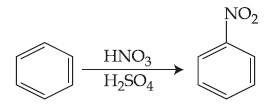
In the above reaction, 3.9 g of benzene on nitration gives 4.92 g of nitrobenzene. The percentage yield of nitrobenzene in the above reaction is ________%. (Round off to the Nearest Integer).
(Given atomic mass : C : 12.0 u, H : 1.0 u, O : 16.0 u, N : 14.0 u)
Explanation:

Weight of (C6H5NO2)Theoretical = ${{{3.9} \over {78}} \times 123}$ = 6.15 g
% yield of reaction = ${{{W_{actual}}} \over {{W_{theoretical}}}} \times 100 = {{4.92} \over {6.15}} \times = 80\% $
Explanation:
Hence actual pressure = (758 – 14)
= 744 mm of Hg.
Moles of ${N_2} = {{\left( {758 - 14} \right)} \over {760}} \times {{30 \times {{10}^{ - 3}}} \over {0.0821 \times 287}}$
$ = 1.246 \times {10^{ - 3}}$ mol
mass of ${N_2} = 1.246 \times {10^{ - 3}} \times 28$
mass % of N2 $ = {{mass\,of\,'N'} \over {total\,mass}} \times 100$
$ = {{1.246 \times 28 \times {{10}^{ - 3}}} \over {0.184}} \times 100$
$ = {{124.6 \times 28} \over {0.184}}\% = 18.96\% $
$ \simeq 19\% $
(i) 4.5 mL
(ii) 4.5 mL
(iii) 4.4 mL
(iv) 4.4 mL
(v) 4.4 mL
If the volume of oxalic acid taken was 10.0 mL then the molarity of the NaOH solution is ________ M. (Rounded off to the nearest integer)
Explanation:
Average burette reading = Volume of NaOH solution (V1)
$ = {{4.5 + 4.5 + 4.4 + 4.4 + 4.4} \over 5}$
= 4.44 mL
Strength of NaOH solution = S1(M) (say) = S1(N)
Volume of oxalic acid solution (V2) = 10 mL
Strength of oxalic acid solution (S2) = 1.25 M = 1.25 $\times$ 2 N
So, ${V_1}{S_1} = {V_2}{S_2}$ ($\because$ Law of equivalence)
$ \Rightarrow {S_1} = {{{V_2}{S_2}} \over {{V_1}}} = {{10 \times (1.25 \times 2)} \over {4.44}} = 5.63$ N
$ \simeq 6M = 6M$


$ \begin{array}{|l|l|l|l|} \hline & \begin{array}{l} \text { Molisch's } \\ \text { Test } \end{array} & \begin{array}{l} \text { Barfoed } \\ \text { Test } \end{array} & \begin{array}{l} \text { Biuret } \\ \text { Test } \end{array} \\ \hline \text { A } & \text { Positive } & \text { Negative } & \text { Negative } \\ \hline \text { B } & \text { Positive } & \text { Positive } & \text { Negative } \\ \hline \text { C } & \text { Negative } & \text { Negative } & \text { Positive } \\ \hline \end{array} $
A, B and C are respectively :
(Atomic mass, Ag = 108, Br = 80 g mol–1)
Explanation:
Mass of AgBr = 1.88 gm
Moles of Br = Moles of AgBr = ${{1.88} \over {188}}$ = 0.01
Mass of Br = 0.01 × 80 = 0.80 gm
% of Br = ${{0.80 \times 100} \over {1.60}}$ = 50 %
Based on above observation, the element present in the given compound is:

| Test | Inference | |
|---|---|---|
| (a) | Dil. HCl | Insoluble |
| (b) | NaOH solution | soluble |
| (c) | Br2/water | Decolourization |


| Item 'I' (compound) | Item 'II' (reagent) |
||
|---|---|---|---|
| (A) | Lysine | (P) | 1-naphthol |
| (B) | Furfural | (Q) | ninhydrin |
| (C) | Benzylalcohol | (R) | KMnO4 |
| (D) | Styrene | (S) | Ceric ammonium nitrate |