p-Block Elements
Dinitrogen and dioxygen, the main constituents of air do not react with each other in atmosphere to form oxides of nitrogen because :
Given below are two statements : one is labelled as Assertion (A) and the other is labelled as Reason (R).
Assertion (A) : Boron is unable to form $\mathrm{BF}_{6}^{3-}$.
Reason (R) : Size of B is very small.
In the light of the above statements, choose the correct answer from the options given below :
Given below are two statements. One is labelled as Assertion A and the other is labelled as Reason R.
Assertion A : Activated charcoal adsorbs SO2 more efficiently than CH4.
Reason R : Gases with lower critical temperatures are readily adsorbed by activated charcoal.
In the light of the above statements, choose the correct answer from the options given below.
Given below are two statements.
Statement I: The chlorides of $\mathrm{Be}$ and $\mathrm{Al}$ have Cl-bridged structure. Both are soluble in organic solvents and act as Lewis bases.
Statement II: Hydroxides of $\mathrm{Be}$ and $\mathrm{Al}$ dissolve in excess alkali to give beryllate and aluminate ions.
In the light of the above statements, choose the correct answer from the options given below.
Which oxoacid of phosphorous has the highest number of oxygen atoms present in its chemical formula?
Given below are two statements : one is labelled as Assertion A and the other is labelled as Reason R.
Assertion : Boric acid is a weak acid.
Reason R : Boric acid is not able to release $\mathrm{H}^{+}$ ion on its own. It receives $\mathrm{OH}^{-}$ ion from water and releases $\mathrm{H}^{+}$ ion.
In the light of the above statements, choose the most appropriate answer from the options given below.
Match List - I with List - II.
| List I (Processes / Reactions) |
List II (Catalyst) |
||
|---|---|---|---|
| (A) | 2SO$_2$(g) + O$_2$(g) $ \to $ 2SO$_3$(g) | (I) | Fe(s) |
| (B) | 4NH$_3$(g) + 5O$_2$(g) $ \to $ 4NO(g) + 6H$_2$O(g) | (II) | Pt(s) $ - $ Rh(s) |
| (C) | N$_2$(g) + 3H$_2$(g) $ \to $ 2NH$_3$(g) | (III) | V$_2$O$_5$ |
| (D) | Vegetable oil(l) + H$_2$ $ \to $ Vegetable ghee(s) | (IV) | Ni(s) |
Choose the correct answer from the options given below :
Borazine, also known as inorganic benzene, can be prepared by the reaction of 3-equivalents of "$X$" with 6-equivalents of "$Y$". "$X$" and "$Y$", respectively are :
The total number of acidic oxides from the following list is
NO, N2O, B2O3, N2O5, CO, SO3, P4O10
Match List I with List II:
| List I | List II | ||
|---|---|---|---|
| (A) | Sulphate | (I) | Pesticide |
| (B) | Fluoride | (II) | Bending of bones |
| (C) | Nicotine | (III) | Laxative effect |
| (D) | Sodium arsinite | (IV) | Herbicide |
Choose the correct answer from the options given below :
Match List I with List II
| List I | List II | ||
|---|---|---|---|
| (A) | N$_2$(g) + 3H$_2$(g) $ \to $ 2NH$_3$(g) | (I) | Cu |
| (B) | CO(g) + 3H$_2$(g) $ \to $ CH$_4$(g) + H$_2$O(g) | (II) | Cu/ZnO $ - $ Cr$_2$O$_3$ |
| (C) | CO(g) + H$_2$(g) $ \to $ HCHO(g) | (III) | Fe$_x$O$_y$ + K$_2$O + Al$_2$O$_3$ |
| (D) | CO(g) + 2H$_2$(g) $ \to $ CH$_3$OH(g) | (IV) | Ni |
Choose the correct answer from the options given below :
The geometry around boron in the product 'B' formed from the following reaction is
$ \begin{aligned} &\mathrm{BF}_{3}+\mathrm{NaH} \stackrel{450 \mathrm{~K}}{\rightarrow} \mathrm{A}+\mathrm{NaF} \\\\ &\mathrm{A}+\mathrm{NMe}_{3} \rightarrow \mathrm{B} \end{aligned} $

The interhalogen compound formed from the reaction of bromine with excess of fluorine is a :
A $\mathrel{\mathop{\kern0pt\longrightarrow} \limits_{}^{573\,K}} $ Red phosphorus $\mathrel{\mathop{\kern0pt\longrightarrow} \limits_{under\,pressure}^{heat\,;\,803\,K}} $ B
Red phosphorus is obtained by heating "A" at 573 K, and can be converted to "B" by heating at 803 K under pressure.
A and B, respectively, are
Aqueous solution of which of the following boron compounds will be strongly basic in nature?
Sulphur dioxide is one of the components of polluted air. SO2 is also a major contributor to acid rain. The correct and complete reaction to represent acid rain caused by SO2 is :
Match List-I with List-II.
| List-I (Metal) |
List-II (Application) |
||
|---|---|---|---|
| (A) | Cs | (I) | High temperature thermometer |
| (B) | Ga | (II) | Water repellent sprays |
| (C) | B | (III) | Photoelectric cells |
| (D) | Si | (IV) | Bullet proof vest |
Choose the most appropriate answer from the options given below :
The oxoacid of phosphorus that is easily obtained from a reaction of alkali and white phosphorus and has two P-H bonds, is :
Among the given oxides of nitrogen ; N2O, N2O3, N2O4 and N2O5, the number of compound/(s) having N - N bond is :

Which of the following oxoacids of sulphur contains "S" in two different oxidation states?

Nitrogen gas is obtained by thermal decomposition of :
Given below are two statements :
Statement I : The pentavalent oxide of group-15 element, E2O5, is less acidic than trivalent oxide, E2O3, of the same element.
Statement II : The acidic character of trivalent oxide of group 15 elements, E2O3, decreases down the group.
In light of the above statements, choose most appropriate answer from the options given below :
The gas produced by treating an aqueous solution of ammonium chloride with sodium nitrite is :
Given below are two statements : one is labelled as Assertion A and the other is labelled as Reason R.
Assertion A : Fluorine forms one oxoacid.
Reason R : Fluorine has smallest size amongst all halogens and is highly electronegative.
In the light of the above statements, choose the most appropriate answer from the options given below :
Match List - I with List - II.
| List - I (Si-Compounds) |
List - II (Si-Polymeric/Other Products |
||
|---|---|---|---|
| (A) | ${(C{H_3})_4}Si$ | (I) | Chain Silicone |
| (B) | $(C{H_3})Si{(OH)_3}$ | (II) | Dimeric Silicone |
| (C) | ${(C{H_3})_2}Si{(OH)_2}$ | (III) | Silane |
| (D) | ${(C{H_3})_3}Si(OH)$ | (IV) | 2D - Silicone |
Choose the correct answer from the options given below :
Heating white phosphorus with conc. NaOH solution gives mainly :
Which of the following elements is considered as a metalloid?
The oxide which contains an odd electron at the nitrogen atom is :

Choose the correct stability order of group 13 elements in their + 1 oxidation state :
The correct order of melting points of hydrides of group 16 elements is :
Consider the following reaction :
A + alkali $\to$ B (Major Product)
If B is an oxoacid of phosphorus with no P-H bond, then A is :
The number of bridged oxygen atoms present in compound B formed from the following reactions is
Pb(NO3)2 $\buildrel {673\,K} \over \longrightarrow $ A + PbO + O2
A $\buildrel {Dimerise} \over \longrightarrow $ B

White precipitate of AgCl dissolves in aqueous ammonia solution due to formation of :
Identify the correct statement for B2H6 from those given below :
(A) In B2H6, all B-H bonds are equivalent.
(B) In B2H6, there are four 3-centre-2-electron bonds.
(C) B2H6 is a Lewis acid.
(D) B2H6 can be synthesized from both BF3 and NaBH4.
(E) B2H6 is a planar molecule.
Choose the most appropriate answer from the options given below :

The most stable trihalide of nitrogen is :
Which one of the following elemental forms is not present in the enamel of the teeth?
Consider the following sulphur based oxoacids.
$\mathrm{H}_{2} \mathrm{SO}_{3}, \mathrm{H}_{2} \mathrm{SO}_{4}, \mathrm{H}_{2} \mathrm{S}_{2} \mathrm{O}_{8}$ and $\mathrm{H}_{2}\mathrm{S}_{2} \mathrm{O}_{7}$.
Amongst these oxoacids, the number of those with peroxo $(\mathrm{O}-\mathrm{O})$ bond is ________.
Explanation:


The number of non-ionisable protons present in the product B obtained from the following reactions is ___________.
$ \mathrm{C}_{2} \mathrm{H}_{5} \mathrm{OH}+\mathrm{PCl}_{3} \rightarrow \mathrm{C}_{2} {\mathrm{H}_{5} \mathrm{Cl}+\mathrm{A}} $
$\mathrm{A}\,{+}\, \mathrm{PCl}_{3} \rightarrow \mathrm{B}$
Explanation:
$ \underset{\text{(A)}}{\mathrm{H}_{3} \mathrm{PO}_{3}}+\mathrm{PCl}_{3} \rightarrow \underset{\text{(B)}}{\mathrm{H}_{4} \mathrm{P}_{2} \mathrm{O}_{5}} $
Structure of $\mathrm{H}_{4} \mathrm{P}_{2} \mathrm{O}_{5}$

Total 2 non-ionizable protons are present
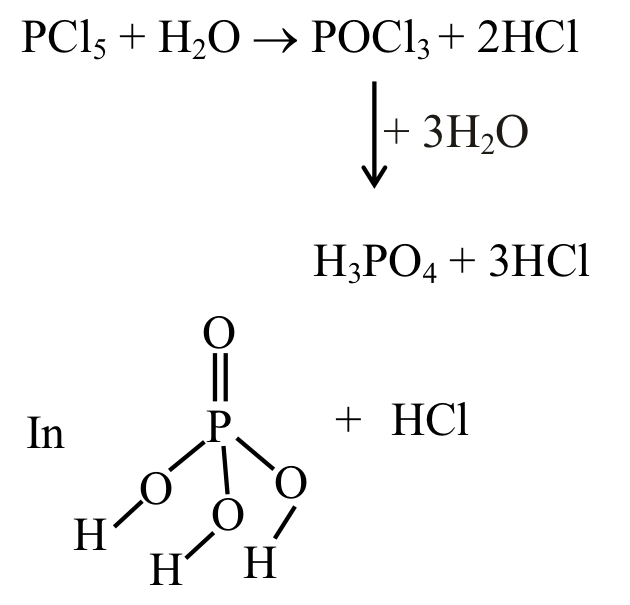
Consider the following reactions:
PCl3 + H2O $\to$ A + HCl
A + H2O $\to$ B + HCl
The number of ionisable protons present in the product B is _______________.
Explanation:
$ \underset{\mathrm{A}}{\mathrm{P}(\mathrm{OH})_{2} \mathrm{Cl}_{2}}+\mathrm{H}_{2} \mathrm{O} \longrightarrow \underset{\text{B}}{\mathrm{P}(\mathrm{OH})_{2} \mathrm{Cl}}+\mathrm{HCl} $
Hydrogen attached with oxygen are ionisable. Hence number of ionisable protons present in compound $B$ are 2.


Assertion A : SO2(g) is absorbed to a large extent than H2(g) on activated charcoal.
Reason R : SO2(g) has a higher critical temperature than H2(g).
In the light of the above statements, choose the most appropriate answer from the options given below.