Hydrocarbons
In the given reactions, identify the reagent A and reagent B.


Identify product A and product B :


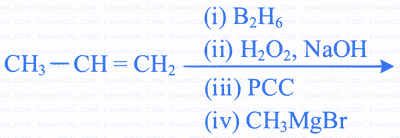
The final product A formed in the following multistep reaction sequence is


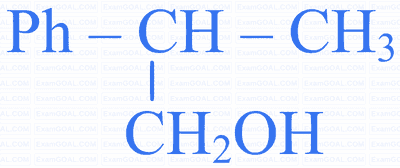
The final product A, formed in the following reaction sequence is:



Major product B of the following reaction has ________ $\pi$-bond.

Explanation:

Number of $\pi$ bonds in B = 5
The major product of the following reaction is P.
$\mathrm{CH}_3 \mathrm{C}\equiv\mathrm{C}-\mathrm{CH}_3$ $\xrightarrow[\substack{\text { (ii) dil. } \mathrm{KMnO}_4 \\ 273 \mathrm{~K}}]{\text { (i) } \mathrm{Na} \text { /liq. } \mathrm{NH}_3}$ 'P'
Number of oxygen atoms present in product '$\mathrm{P}$' is _______. (nearest integer)
Explanation:
Product is

Number of oxygen atoms = 2
The major products from the following reaction sequence are product A and product B.

The total sum of $\pi$ electrons in product A and product B are __________ (nearest integer)
Explanation:

Number of $\pi$ electron in A = 2
Number of $\pi$ electron in B = 6
Total Number of $\pi$ electron in (A) and (B) = 8

Consider the given reaction. The total number of oxygen atom/s present per molecule of the product $(\mathrm{P})$ is _________.
Explanation:

Hence, total number of oxygen atom present per molecule  is 1.
is 1.


In the above reaction, left hand side and right hand side rings are named as '$\mathrm{A}$' and 'B' respectively. They undergo ring expansion. The correct statement for this process is:

The major product formed in the following reaction is


Choose the correct answer from the options given below :

Given below are two statements, one is labelled as Assertion A and the other is labelled as Reason R.

In the light of the above statements, choose the correct answer from the options given below:

Find out the major product from the following reaction.


In the following reaction, 'B' is


'$\mathrm{X}$' is :


But-2-yne is reacted separately with one mole of Hydrogen as shown below :

A. A is more soluble than B.
B. The boiling point & melting point of A are higher and lower than B respectively.
C. A is more polar than B because dipole moment of A is zero.
D. $\mathrm{Br_2}$ adds easily to B than A.
Identify the incorrect statements from the options given below :


Choose the correct set of reagents for the following conversion.
trans $\left(\mathrm{Ph}-\mathrm{CH}=\mathrm{CH}-\mathrm{CH}_{3}\right) \rightarrow \operatorname{cis}\left(\mathrm{Ph}-\mathrm{CH}=\mathrm{CH}-\mathrm{CH}_{3}\right)$

The major products 'A' and 'B', respectively, are


The one giving maximum number of isomeric alkenes on dehydrohalogenation reaction is (excluding rearrangement)


The correct sequence of reagents for the preparation of Q and R is :

Find out the major products from the following reactions.


In the following given reaction, 'A' is


For the given reaction

The total number of possible products formed by tertiary carbocation of A is ____________.
Explanation:

Total 4 products are possible through 3° carbocation
The number of possible isomeric products formed when 3-chloro-1-butene reacts with $\mathrm{HCl}$ through carbocation formation is __________.
Explanation:

Total Possible Isomeric product = 1+3 = 4
Molar mass of the hydrocarbon (X) which on ozonolysis consumes one mole of $\mathrm{O}_{3}$ per mole of $(\mathrm{X})$ and gives one mole each of ethanal and propanone is _________ $\mathrm{g}~ \mathrm{mol}^{-1}$
(Molar mass of $\mathrm{C}: 12 \mathrm{~g} \mathrm{~mol}^{-1}, \mathrm{H}: 1 \mathrm{~g} \mathrm{~mol}^{-1}$ )
Explanation:

Hydrocarbon $(\mathrm{X})$ is 2-methyl-but-2-ene $\left(\mathrm{C}_5 \mathrm{H}_{10}\right)$
And the molecular mass is $5(12)+10(1)=70$.
Number of bromo derivatives obtained on treating ethane with excess of $\mathrm{Br}_{2}$ in diffused sunlight is ___________
Explanation:

17 mg of a hydrocarbon (M.F. $\mathrm{C_{10}H_{16}}$) takes up 8.40 mL of the H$_2$ gas measured at 0$^\circ$C and 760 mm of Hg. Ozonolysis of the same hydrocarbon yields

The number of double bond/s present in the hydrocarbon is ___________.
Explanation:
Mole of $\mathrm{H}_{2}$ gas
$\Rightarrow 1 \times \frac{8.40}{1000}=\mathrm{n} \times 0.0821 \times 273$
$\Rightarrow \mathrm{n}=3.75 \times 10^{-4}$
Hydrogen molecule used for 1 molecule of hydrocarbon is 3
$=\frac{3.75 \times 10^{-4}}{1.25 \times 10^{-4}}=3$
Maximum number of isomeric monochloro derivatives which can be obtained from 2,2,5,5-tetramethylhexane by chlorination is _____________
Explanation:

Total numbers of isomer = 03
$ \stackrel{\bullet}{\mathrm{Cl}}+\mathrm{CH}_{4} \rightarrow \mathrm{A}+\mathrm{B} $
A and B in the above atmospheric reaction step are :
Major product of the following reaction is


A compound ‘$\mathrm{A}$’ on reaction with ‘$\mathrm{X}$’ and ‘$\mathrm{Y}$’ produces the same major product but different by product '$a$' and '$b^{\prime}$. Oxidation of '$a$' gives a substance produced by ants.

'X' and 'Y' respectively are

Two isomers 'A' and 'B' with molecular formula C4H8 give different products on oxidation with KMnO4 in acidic medium. Isomer 'A' on reaction with KMnO4/H+ results in effervescence of a gas and gives ketone. The compound 'A' is

What will be the major product of following sequence of reactions?


Product 'A' of following sequence of reactions is


The major product in the following reaction


The product formed in the following reaction.


Given below are two statements :
Statement I : The presence of weaker $\pi$-bonds make alkenes less stable than alkanes.
Statement II : The strength of the double bond is greater than that of carbon-carbon single bond.
In the light of the above statements, choose the correct answer from the options given below :
Which of the following reagents / reactions will convert 'A' to 'B' ?


The major product 'A' of the following given reaction has _____________ sp2 hybridized carbon atoms.

Explanation:

Number of sp2 hybridised carbon atoms = 2

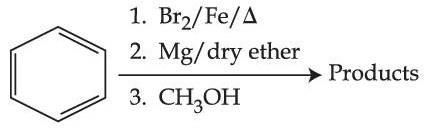


(ii) Cl2, HCl
(iii) NaNO2, HCl, 0$^\circ$C
(iv) H2O/H+
(ii) NaNO2, HCl, 0$^\circ$C
(iii) H2O/H+
(iv) Cl2, FeCl3
(ii) Fe, HCl
(iii) NaNO2, HCl, 0$^\circ$C
(iv) H2O/H+
(ii) NaNO2, HCl, 0$^\circ$C
(iii) Fe, HCl
(iv) H2O/H+

CH4 + I2 $\mathrel{\mathop{\kern0pt\rightleftharpoons} \limits_{{\mathop{\rm Re}\nolimits} versible}^{hv}} $ CH3 $-$ I + HI
Compound 'A' also yields compound 'B' an ozonolysis. Compound 'A' is :


Major product P of above reaction, is :


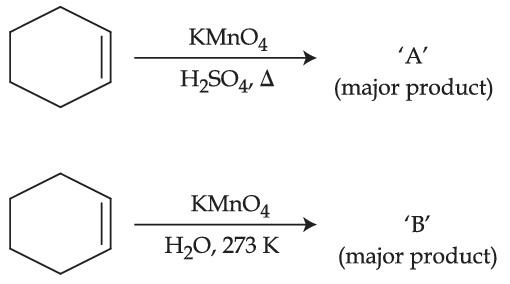
For above chemical reactions, identify the correct statement from the following :


List - I (Chemicals)
(a) Alcoholic potassium hydroxide
(b) Pd/BaSO4
(c) BHC (Benzene hexachloride)
(d) Polyacetylene
List - II (Use / Preparation / Constituent)
(i) Electrodes in batteries
(ii) Obtained by addition reaction
(iii) Used for $\beta$ - elimination reaction
(iv) Lindlar's catalyst
Choose the most appropriate match :