Haloalkanes and Haloarenes
191 Questions
Start JEE Mains Test
2019
Q151
JEE Mains
MCQ
14 Mar 2026
The major product of the following reaction is:
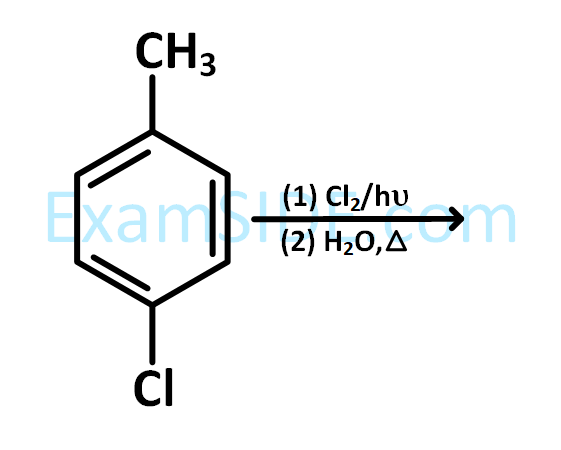
A.

B.

C.

D.


2019
Q152
JEE Mains
MCQ
14 Mar 2026
The major product in the following conversion is –

A.

B.

C.

D.


2019
Q153
JEE Mains
MCQ
14 Mar 2026
Which of the following compounds will produce a precipitate with AgNO3 ?
A.

B.

C.

D.


2019
Q154
JEE Mains
MCQ
14 Mar 2026
Which hydrogen in compound (E) is easily replaceable during bromination reaction in presence of light ?
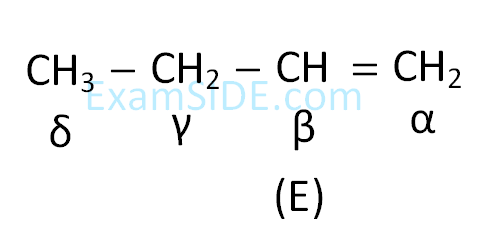
A.
$\beta $ $-$ hydrogen
B.
$\alpha $ $-$ hydrogen
C.
$\gamma $ $-$ hydrogen
D.
$\delta $ $-$ hydrogen
2019
Q155
JEE Mains
MCQ
14 Mar 2026
The major product of the following reaction is :

A.

B.

C.

D.


2019
Q156
JEE Mains
MCQ
14 Mar 2026
The compounds A and B in the following reaction are, respectively :

A.
A = Benzyl alcohol, B = Benzyl cyanide
B.
A = Benzyl chloride, B = Benzyl cyanide
C.
A = Benzyl alcohol, B = Benzyl isocyanide
D.
A = Benzyl chloride, B = Benzyl isocyanide


2019
Q157
JEE Mains
MCQ
14 Mar 2026
The major product of the following reaction is :

A.

B.

C.

D.


2018
Q158
JEE Mains
MCQ
14 Mar 2026
The most polar compound among the following is :
A.

B.

C.

D.

2018
Q159
JEE Mains
MCQ
14 Mar 2026
The major product of the following reaction is :

A.

B.

C.

D.


2018
Q160
JEE Mains
MCQ
14 Mar 2026
The major product of the following reaction is:

A.

B.

C.

D.


2017
Q161
JEE Mains
MCQ
14 Mar 2026
In the following reaction sequence :

The compound I is :
The compound I is :
A.

B.

C.

D.


2017
Q162
JEE Mains
MCQ
14 Mar 2026
The major product of the following reaction is :

A.
CH2 = CHCH2CH = CHCH3
B.
CH2 = CHCH = CHCH2CH3
C.
CH3CH = C = CHCH2CH3
D.
CH3CH = CH − CH = CHCH3

2017
Q163
JEE Mains
MCQ
14 Mar 2026
The major product of the following reaction is :

A.

B.

C.

D.


2017
Q164
JEE Mains
MCQ
14 Mar 2026
Which of the following compounds will not undergo Friedel Craft’s reaction with benzene ?
A.

B.

C.

D.

2017
Q165
JEE Mains
MCQ
14 Mar 2026
Which of the following, upon treatment with tert-BuONa followed by addition of bromine water, fails to
decolorize the colour of bromine?
A.

B.

C.

D.


2017
Q166
JEE Mains
MCQ
14 Mar 2026
3-Methyl-pent-2-ene on reaction with HBr in presence of peroxide forms an addition product. The number
of possible stereoisomers for the product is :
A.
Zero
B.
Two
C.
Four
D.
Six


2017
Q167
JEE Mains
MCQ
14 Mar 2026
The increasing order of the reactivity of the following halides for the SN1 reaction is :

A.
(II) < (I) < (III)
B.
(I) < (III) < (II)
C.
(II) < (III) < (I)
D.
(III) < (II) < (I)

2017
Q168
JEE Mains
MCQ
14 Mar 2026
The major product obtained in the following reaction is :

A.
C6H5CH = CHC6H5
B.
(+) - C6H5CH(Ot-Bu)CH2C6H5
C.
(-) - C6H5CH(Ot-Bu)CH2C6H5
D.
($ \pm $) - C6H5CH(Ot-Bu)CH2C6H5

2016
Q169
JEE Mains
MCQ
14 Mar 2026
Bromination of cyclohexene under conditions given below yields :

A.

B.

C.

D.


2016
Q170
JEE Mains
MCQ
14 Mar 2026
Which one of the following reagents is not suitable for the elimination reaction ?

A.
NaOH/H2O
B.
NaOEt/EtOH
C.
NaOH/H2O-EtOH
D.
NaI

2015
Q171
JEE Mains
MCQ
14 Mar 2026
The synthesis of alkyl fluorides is best accomplished by:
A.
Sandmeyer’s reaction
B.
Finkelstein reaction
C.
Swarts reaction
D.
Free radical fluorination
2014
Q172
JEE Mains
MCQ
14 Mar 2026
In SN2 reactions, the correct order of reactivity for the following compounds:
CH3Cl, CH3CH 2Cl, (CH3)2CHCl and (CH3)3CCl is:
CH3Cl, CH3CH 2Cl, (CH3)2CHCl and (CH3)3CCl is:
A.
CH3CH2Cl > CH3Cl > (CH3)2CHCl > (CH3)3CCl
B.
(CH3)2CHCl > CH3CH2Cl > CH3Cl > (CH3)3CCl
C.
CH3Cl > (CH3)2CHCl > CH3CH2Cl > (CH3)3CCl
D.
CH3Cl > CH3CH2Cl > (CH3)2CHCl > (CH3)3CCl
2014
Q173
JEE Mains
MCQ
14 Mar 2026
The major organic compound formed by the reaction of 1, 1, 1– trichloroethane with silver powder is:
A.
2- Butyne
B.
2- Butene
C.
Acetylene
D.
Ethene

2013
Q174
JEE Mains
MCQ
14 Mar 2026
A solution of (–$l$) – chloro –1 – phenylethane in toluene racemises slowly in the presence of a small
amount of SbCl5, due to the formation of :
A.
carbene
B.
carbocation
C.
free radical
D.
carbanion

2013
Q175
JEE Mains
MCQ
14 Mar 2026
Compound $\left( A \right),\,{C_8}{H_9}Br,\,\,\,$ gives a white precipitate when warmed with alcoholic $AgN{O_3}.$ Oxidation of $(A)$ gives an acid $\left( B \right),$ ${C_8}{H_6}{O_4}.\,\,\left( B \right)$ easily forms anhydride on heating. Identify the compound $(A).$
A.

B.

C.

D.


2012
Q176
JEE Mains
MCQ
14 Mar 2026
What is DDT among the following?
A.
Greenhouse gas
B.
A fertilizer
C.
Biodegradable pollutant
D.
Non–biodegradable pollutant
2012
Q177
JEE Mains
MCQ
14 Mar 2026
Iodoform can be prepared from all except :
A.
Ethyl methyl ketone
B.
Isopropyl alcohol
C.
3–Methyl – 2– butanone
D.
Isobutyl alcohol

2012
Q178
JEE Mains
MCQ
14 Mar 2026
How many chiral compounds are possible on monochlorination of 2–methyl butane ?
A.
8
B.
2
C.
4
D.
6

2010
Q179
JEE Mains
MCQ
14 Mar 2026
Consider the following bromides :
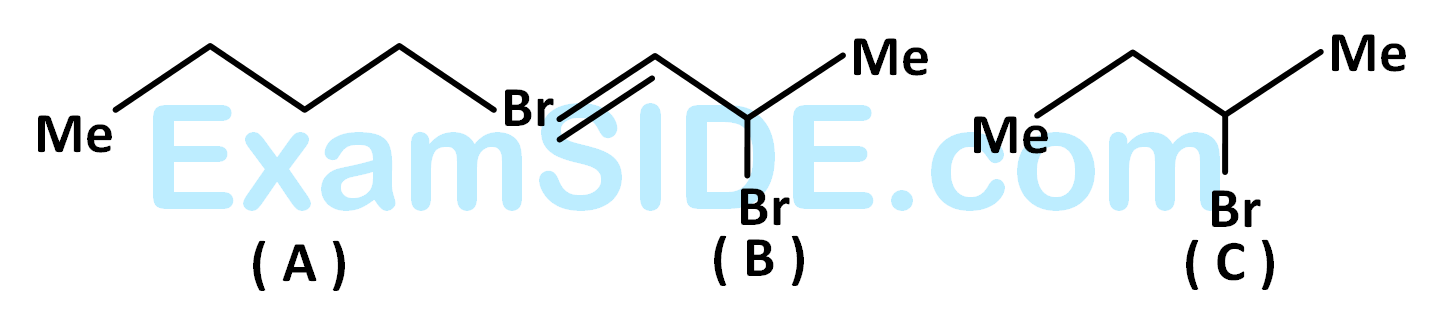
The correct order of ${S_N}1$ reactive is
The correct order of ${S_N}1$ reactive is
A.
$B > C > A$
B.
$B > A > C$
C.
$C > B > A$
D.
$A > B > C$

2009
Q180
JEE Mains
MCQ
14 Mar 2026
Which of the following on heating with aqueous KOH, produces acetaldehyde ?
A.
CH3COCl
B.
CH3CH2Cl
C.
CH2ClCH2Cl
D.
CH3CHCl2

2008
Q181
JEE Mains
MCQ
14 Mar 2026
The organic chloro compound, which shows complete stereochemical inversion during a SN2 reaction,
is
A.
(C2H5)2CHC
B.
(CH3)3CCl
C.
(CH3)2CHCl
D.
CH3Cl
2007
Q182
JEE Mains
MCQ
14 Mar 2026
Which of the following is the correct order of decreasing SN2 reactivity?
A.
RCH2X > R3CX > R2CHX
B.
RCH2X > R2CHX >
R3CX
C.
R3CX > R2CHX > RCH2X
D.
R2CHX > R3CX > RCH2X
2006
Q183
JEE Mains
MCQ
14 Mar 2026
The structure of the major product formed in the following reaction
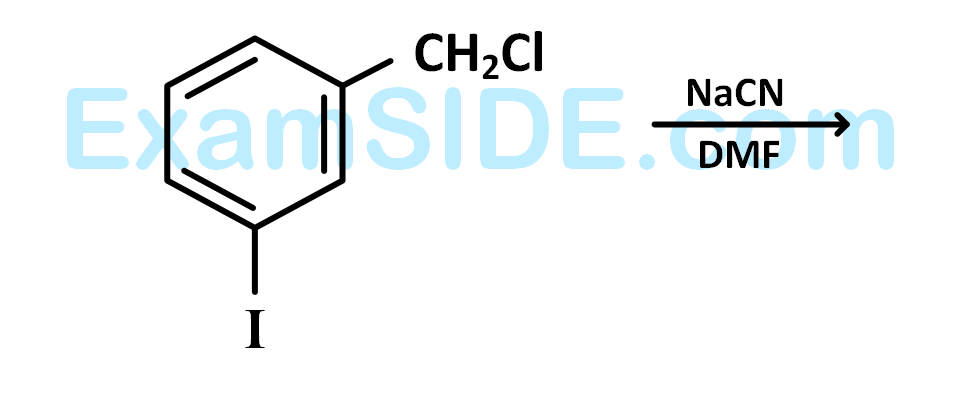
is
is
A.

B.

C.

D.


2006
Q184
JEE Mains
MCQ
14 Mar 2026
Fluorobenzene (C6H5F) can be synthesized in the laboratory
A.
by heating phenol with HF and KF
B.
from aniline by diazotisation followed by heating the diazonium salt with HBF4
C.
by direct fluorination of benzene with F2 gas
D.
by reacting bromobenzene with NaF solution

2006
Q185
JEE Mains
MCQ
14 Mar 2026
Reaction of trans-2-phenyl-1-bromocyclopentane on reaction with alcoholic KOH produces
A.
4-phenylcyclopentene
B.
2-phenylcyclopentene
C.
1-phenylcyclopentene
D.
3-phenylcyclopentene
 Hughes and Ingold proposed that bimolecular elimination
reactions take place when the two groups to be eliminated are
trans and lie in one plane with the two carbon atoms to which
they are attached i.e. E2 reactions are stereoselectively trans.
Hughes and Ingold proposed that bimolecular elimination
reactions take place when the two groups to be eliminated are
trans and lie in one plane with the two carbon atoms to which
they are attached i.e. E2 reactions are stereoselectively trans.
2005
Q186
JEE Mains
MCQ
14 Mar 2026
Alkyl halides react with dialkyl copper reagents to give
A.
alkenes
B.
alkyl copper halides
C.
alkanes
D.
alkenyl halides
2005
Q187
JEE Mains
MCQ
14 Mar 2026
Elimination of bromine from 2-bromobutane results in the formation of-
A.
equimolar mixture of 1 and 2-butene
B.
predominantly 2-butene
C.
predominantly 1-butene
D.
predominantly 2-butyne

2005
Q188
JEE Mains
MCQ
14 Mar 2026
Tertiary alkyl halides are practically inert to substitution by SN2 mechanism because of
A.
insolubility
B.
instability
C.
inductive effect
D.
steric hindrance
2004
Q189
JEE Mains
MCQ
14 Mar 2026
The compound formed on heating chlorobenzene with chloral in the presence concentrated
sulphuric acid is
A.
gammexene
B.
hexachloroethane
C.
Freon
D.
DDT

2003
Q190
JEE Mains
MCQ
14 Mar 2026
Bottles containing C6H5l and C6H5CH2I lost their original labels. They were labelled A and B for testing A and B were separately taken in test tubes and boiled with NaOH solution. The end solution in each tube was made acidic with dilute HNO3 and then some AgNO3 solution was added. Substance B gave a yellow precipitate. Which one of the following statements is true for this experiment?
A.
A and C6H5CH2I
B.
B and C6H5I
C.
Addition of HNO3 was unnecessary
D.
A was C6H5I
2002
Q191
JEE Mains
MCQ
14 Mar 2026
The reaction :
${(CH)_3}C - Br\buildrel {{H_2}O} \over \longrightarrow {(CH)_3}C - OH$
${(CH)_3}C - Br\buildrel {{H_2}O} \over \longrightarrow {(CH)_3}C - OH$
A.
elimination reaction
B.
substitution reaction
C.
free radical reaction
D.
displacement reaction
