iCON Education HYD, 79930 92826, 73309 7282614 Mar 2026
The molar conductivities at infinite dilution of barium chloride, sulphuric acid and hydrochloric acid are 280, 860 and 426 S cm2 mol$-$1 respectively. The molar conductivity at infinite dilution of barium sulphate is _________ S cm2 mol$-$1. (Round off to the Nearest Integer ).
iCON Education HYD, 79930 92826, 73309 7282614 Mar 2026
A KCl solution of conductivity 0.14 S m$-$1 shows a resistance of 4.19$\Omega$ in a conductivity cell. If the same cell is filled with an HCl solution, the resistance drops to 1.03$\Omega$. The conductivity of the HCl solution is ____________ $\times$ 10$-$2 S m$-$1. (Round off to the Nearest Integer).
iCON Education HYD, 79930 92826, 73309 7282614 Mar 2026
A 5.0 m mol dm$-$3 aqueous solution of KCl has a conductance of 0.55 mS when measured in a cell of cell constant 1.3 cm$-$1. The molar conductivity of this solution is ___________ mSm2 mol$-$1. (Round off to the Nearest Integer).
1 mole of MnO4- required 5 moles of
electrons or 5 F electricity.
$ \therefore $ 5 moles of MnO4- required 25 F electricity.
2021
Q209
JEE Mains
Numerical
iCON Education HYD, 79930 92826, 73309 7282614 Mar 2026
Copper reduces NO$_3^ - $ into NO and NO2 depending upon the concentration of HNO3 in solution. (Assuming fixed [Cu2+] and PNO = PNO2), the HNO3 concentration at which the thermodynamic tendency for reduction of NO$_3^ - $ into NO and NO2 by copper is same is 10x M. The value of 2x is _______. (Rounded off to the nearest integer)
[Given, $E_{C{u^{2 + }}/Cu}^o = 0.34$ V, $E_{NO_3^ - /NO}^o = 0.96$ V, $E_{NO_3^ - /N{O_2}}^o = 0.79$ V and at 298 K, ${{RT} \over F}$(2.303) = 0.059]
iCON Education HYD, 79930 92826, 73309 7282614 Mar 2026
The magnitude of the change in oxidising power of the $MnO_4^ - /M{n^{2 + }}$ couple is x $\times$ 10$-$4 V, if the H+ concentration is decreased from 1M to 10$-$4 M at 25$^\circ$C. (Assume concentration of $MnO_4^ - $ and $M{n^{2 + }}$ to be same on change in H+ concentration). The value of x is ___________. $\left[ {Given\,:{{2.303RT} \over F} = 0.059} \right]$
As the concentration decreases, the dilution increases which increases the degree of dissociation, thus increasing the no. of ions, which increases the molar conductance.
So Statement II is false.
Image
2021
Q213
JEE Mains
MCQ
iCON Education HYD, 79930 92826, 73309 7282614 Mar 2026
Compound A used as a strong oxidizing agent is amphoteric in nature. It is the part of lead storage batteries. Compound A is :
A.
PbO
B.
PbO2
C.
PbSO4
D.
Pb3O4
Correct Answer: B
Explanation:
PbO2 is strong oxidizing agent because Pb+4 is
not stable and can be easily reduced to Pb+2.
PbO2 is used in lead storage batteries. It is
also amphoteric in nature.
2021
Q214
JEE Mains
MCQ
iCON Education HYD, 79930 92826, 73309 7282614 Mar 2026
The electrode potential of M2+/M of 3d-series elements shows positive value for :
A.
Zn
B.
Fe
C.
Cu
D.
Co
Correct Answer: C
Explanation:
In the electrode potential series, only copper have positive value for electrode potential because copper has lower tendency than hydrogen to form ions. So, if standard hydrogen electrode (ECell = 0) is connected to copper half-cell, the copper with be relatively less negative or less number of electrons.
$\therefore$ Electrode potential of Cu $E_{(C{u^{2 + }}/Cu)}^o$ show positive value.
2021
Q215
JEE Advanced
Numerical
iCON Education HYD, 79930 92826, 73309 7282614 Mar 2026
At 298 K, the limiting molar conductivity of a weak monobasic acid is 4 $\times$ 102 S cm2 mol$-$1. At 298 K, for an aqueous solution of the acid the degree of dissociation is $\alpha$ and the molar conductivity is y $\times$ 102 S cm2 mol$-$1. At 298 K, upon 20 times dilution with water, the molar conductivity of the solution becomes 3y $\times$ 102 S cm2 mol$-$1.
iCON Education HYD, 79930 92826, 73309 7282614 Mar 2026
At 298 K, the limiting molar conductivity of a weak monobasic acid is 4 $\times$ 102 S cm2 mol$-$1. At 298 K, for an aqueous solution of the acid the degree of dissociation is $\alpha$ and the molar conductivity is y $\times$ 102 S cm2 mol$-$1. At 298 K, upon 20 times dilution with water, the molar conductivity of the solution becomes 3y $\times$ 102 S cm2 mol$-$1.
iCON Education HYD, 79930 92826, 73309 7282614 Mar 2026
Some standard electrode potentials at 298 K are given below :
Pb2+ /Pb = $- $0.13 V
Ni2+ /Ni = $-$ 0.24 V
Cd2+ /Cd = $-$ 0.40 V
Fe2+ /Fe = $-$ 0.44 V
To a solution containing 0.001 M of X2+ and 0.1 M of Y2+, the metal rods X and Y are inserted (at 298 K) and connected by a conducting wire. This resulted in dissolution of X. The correct combination(s) of X and Y, respectively, is(are)
(Given : Gas constant, R = 8.314 J K$-$ mol$-$1, Faraday constant, F = 96500 C mol$-$1)
Therefore, the correct combinations of X and Y are (a), (b) and (c).
2021
Q218
AP-EAPCET
MCQ
iCON Education HYD, 79930 92826, 73309 7282620 May 2026
In the electrolysis of a CuSO$_4$ solution, how
many grames of Cu are plated out on the
cathode, in the time that is required to
liberate 5.6 L of O$_2$(g), measured at 1 atm and
273 K, at the anode?
A.
31.75 g
B.
14.2 g
C.
4.32 g
D.
3.175 g
Correct Answer: A
Explanation:
Volume of $\mathrm{O}_2=5.6 \mathrm{~L}$
Number of moles of $\mathrm{O}_2=\frac{5.6}{22.4}=0.25 \mathrm{~mol}$
Equivalent of $\mathrm{O}_2=n$ factor $\times$ number of moles of $\mathrm{O}_2=4 \times 0.25=1$
Equivalent of $\mathrm{Cu}=$ equivalent of $\mathrm{O}_2=1$
$\frac{\text { Mass of } \mathrm{Cu}}{\text { Equivalent mass }}=1 \Rightarrow \frac{\text { Mass of } \mathrm{Cu}}{63.5 / 2}=1$
Mass of $\mathrm{Cu}=\frac{63.5}{2}=31.75 \mathrm{~g}$
2021
Q219
AP-EAPCET
MCQ
iCON Education HYD, 79930 92826, 73309 7282620 May 2026
If hydrogen electrons dipped in two solutions
of pH = 3 and pH = 6 are connected by a salt
bridge, the emf of the resulting cell is
iCON Education HYD, 79930 92826, 73309 7282620 May 2026
At $291 \mathrm{~K}$, saturated solution of $\mathrm{BaSO}_4$ was found to have a specific conductivity of $3.648 \times 10^{-6} \mathrm{ohm}^{-1} \mathrm{~cm}^{-1}$ and that of water being used is $1.25 \times 10^{-6} \mathrm{ohm}^{-1} \mathrm{~cm}^{-1}$. If the ionic conductances of $\mathrm{Ba}^{2+}$ and $\mathrm{SO}_4^{2-}$ are 110 and $136.6 \mathrm{ohm}^{-1} \mathrm{~cm}^2 \mathrm{~mol}^{-1}$ respectively. The solubility of $\mathrm{BaSO}_4$ at $291 \mathrm{~K}$ will be [Atomic masses of $\mathrm{Ba}=137, \mathrm{~S}=32, \mathrm{O}=16]$
A.
$1.435 \times 10^{-3} \mathrm{gL}^{-1}$
B.
$2.266 \times 10^{-3} \mathrm{gL}^{-1}$
C.
$2.843 \times 10^{-3} \mathrm{gL}^{-1}$
D.
$1.768 \times 10^{-3} \mathrm{gL}^{-1}$
Correct Answer: B
Explanation:
Specific conductivity of $\mathrm{BaSO}_4$ solution
Hence, the solubility of $\mathrm{BaSO}_4$ at $291 \mathrm{~K}$ will be $2.266 \times 10^{-3} \mathrm{~g} \mathrm{~L}^{-1}$
2021
Q221
AP-EAPCET
MCQ
iCON Education HYD, 79930 92826, 73309 7282620 May 2026
Find the emf of the following cell reaction. Given, $E_{\mathrm{Cr}^{3+} / \mathrm{Cr}^{2+}}^{\Upsilon}=-0.72 \mathrm{~V}$ and $E_{\mathrm{Fe}^{2+} / \mathrm{Fe}}^{\Upsilon}= -0.42 \mathrm{~V}$ at $25^{\circ} \mathrm{C}$ is $\mathrm{Cr}\left|\mathrm{Cr}^{3+}(0.1 \mathrm{M})\right| \mid \mathrm{Fe}^{2+} (0.1 \mathrm{M}) \mid \mathrm{Fe}$
As after completion of the reaction solution becomes alkaline, so $\mathrm{pH}$ of solution will increase. Sodium acetate on Kolbe's electrolysis gives ethane. It is formed at anode. $\dot{\mathrm{CH}}_3$ methyl radical is produced at anode only.
Hence, A is true but R is false.
2021
Q224
AP-EAPCET
MCQ
iCON Education HYD, 79930 92826, 73309 7282620 May 2026
When a current of 10 A is passes through
molten AlCl$_3$ for 1.608 minutes. The mass of
Al deposited will be
[Atomic mass of Al = 27 g]
A.
0.09 g
B.
0.81 g
C.
1.35 g
D.
0.27 g
Correct Answer: A
Explanation:
Given current, $i=10 \mathrm{~A}$
Time, $t=1.608 \mathrm{~min}$ or $96.5 \mathrm{~s}$
Weight of aluminium $W_{\mathrm{Al}}=$ ?
Atomic weight of aluminium $=27 \mathrm{~g} / \mathrm{mol}(M)$
We know that, $\mathrm{AlCl}_3 \rightarrow \mathrm{Al}^{3+}+3 \mathrm{Cl}^{-}, n=3$
At cathode, reduction $\mathrm{Al}^{3+}+3 e^{-} \rightarrow \mathrm{Al}$
Formula, $\quad W_{\mathrm{Al}}=\frac{\varepsilon \times i \times t}{96500}$, where $\varepsilon=\frac{M}{n}$
Mass of $\mathrm{Al}$ deposited will be $0.09 \mathrm{~g}$
2021
Q225
AP-EAPCET
MCQ
iCON Education HYD, 79930 92826, 73309 7282620 May 2026
The molar conductivities $\left(\lambda_{\mathrm{m}}^{\Upsilon}\right)$ at infinite dilution of $\mathrm{KBr}, \mathrm{HBr}$ and $\mathrm{KNH}_2$ are 120.5, 420.6 and $90.48 \mathrm{~S} \mathrm{~cm}^2 \mathrm{~mol}^{-1}$ respectively. Find the value of $\lambda_{\mathrm{m}}^\Upsilon$ for $\mathrm{NH}_3$.
= 28950 s $ = {{28960} \over {60 \times 60}} = 8.04$ = 8 h
2021
Q228
BITSAT
MCQ
iCON Education HYD, 79930 92826, 73309 7282611 Jun 2026
Given, the reduction potential of Na+, Mg2+, Al3+ and Ag+ as $E_{N{a^ + }/Na}^o$ = $-$ 2.17 V; $E_{M{g^{2 + }}/Mg}^o$ = $-$ 2.37 V; $E_{A{g^ + }/Ag}^o$ = $-$ 0.08 V.
The least stable oxide is
A.
Ag2O
B.
Al2O3
C.
MgO
D.
Na2O
Correct Answer: A
Explanation:
As the value of reduction potential of metal ion increases, the tendency of metal oxide to get reduce into metal increases.
Since, reduction potential of only Ag is positive among the given, thus Ag2O readily gets reduced to Ag metal. In other words, it can be said that Ag2O is the least stable oxide among the given.
2020
Q229
JEE Mains
Numerical
iCON Education HYD, 79930 92826, 73309 7282614 Mar 2026
Potassium chlorate is prepared by the
electrolysis of KCl in basic solution
6OH- + Cl- $ \to $ ClO3- + 3H2O + 6e-
If only 60% of the current is utilized in the
reaction, the time (rounded to the nearest hour)
required to produce 10 g of KClO3 using a
current of 2 A is_________.
(Given : F = 96,500 C mol–1; molar mass of
KCIO3 = 122 g mol–1)
Correct Answer: 11
Explanation:
For synthesis of 1 mole of ClO3- , 6F of charge
is required.
$ \therefore $ To synthesise
${{10} \over {122}}$ moles of KClO3,
iCON Education HYD, 79930 92826, 73309 7282614 Mar 2026
An oxidation-reduction reaction in which 3 electrons are transferred has a $\Delta $Gº of 17.37 kJ mol–1 at
25 oC. The value of Eo cell (in V) is ______ × 10–2.
(1 F = 96,500 C mol–1)
iCON Education HYD, 79930 92826, 73309 7282614 Mar 2026
An acidic solution of dichromate is electrolyzed
for 8 minutes using 2A current. As per the
following equation
Cr2O72-
+ 14H+ + 6e– $ \to $ 2Cr3+ + 7H2O
The amount of Cr3+ obtained was 0.104 g. The
efficiency of the process(in%) is
(Take : F = 96000 C, At. mass of chromium = 52)
______.
iCON Education HYD, 79930 92826, 73309 7282614 Mar 2026
The photoelectric current from Na (Work function, w0
= 2.3 eV) is stopped by the output voltage of
the cell Pt(s) | H2
(g, 1 Bar) | HCl (aq., pH =1) | AgCl(s) | Ag(s).
The pH of aq. HCl required to stop the photoelectric current form K(w0
= 2.25 eV), all other
conditions remaining the same, is _______ $ \times $ 10-2 (to the nearest integer).
iCON Education HYD, 79930 92826, 73309 7282614 Mar 2026
For the disproportionation reaction
2Cu+(aq) ⇌ Cu(s) + Cu2+(aq) at 298 K. ln K
(where K is the equilibrium constant) is
___________ × 10–1.
Given :
($E_{C{u^{2 + }}/C{u^ + }}^0 = 0.16V$
$E_{C{u^ + }/Cu}^0 = 0.52V$
${{RT} \over F} = 0.025$)
iCON Education HYD, 79930 92826, 73309 7282614 Mar 2026
108 g of silver (molar mass 108 g mol–1) is
deposited at cathode from AgNO3(aq) solution
by a certain quantity of electricity. The
volume (in L) of oxygen gas produced at
273 K and 1 bar pressure from water by the
same quantity of electricity is _______.
Correct Answer: 5.66to5.68
Explanation:
Cathode : Ag+(aq) + e- $ \to $ Ag(s)
Moles of Ag deposited = ${{108} \over {108}}$ = 1 mole
Anode : 2H2O $ \to $ O2 + 4H+ + 4e-
Here we have to find volume of O2 evolved.
Equivalance of Ag = Equivalance of O2
$ \Rightarrow $ 1 $ \times $ 1 = nO2 $ \times $ 4
$ \Rightarrow $ nO2 = ${1 \over 4}$ mol
$ \therefore $ Volume of O2 evolved
= ${1 \over 4}$ $ \times $ 22.4
= 5.6 lit
2020
Q236
JEE Mains
Numerical
iCON Education HYD, 79930 92826, 73309 7282614 Mar 2026
For an electrochemical cell
Sn(s) | Sn2+ (aq,1M)||Pb2+ (aq,1M)|Pb(s)
the ratio ${{\left[ {S{n^{2 + }}} \right]} \over {\left[ {P{b^{2 + }}} \right]}}$ when this cell attains
equilibrium is _________.
iCON Education HYD, 79930 92826, 73309 7282614 Mar 2026
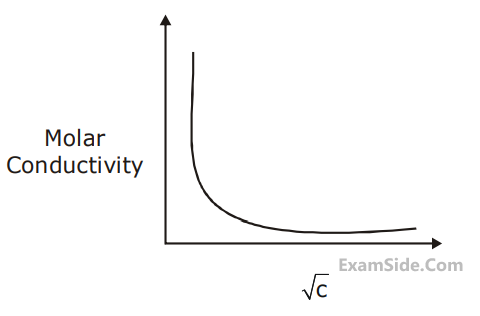
The variation of molar conductivity with concentration of an electrolyte (X) in aqueous solution
is shown in the given figure.
The electrolyte X is :
A.
HCl
B.
CH3COOH
C.
NaCl
D.
KNO3
Correct Answer: B
Explanation:
The electrolyte (X) must be weak electrolyte as such type of variation is always for weak electrolyte. So
X is CH3COOH.
2020
Q240
JEE Mains
MCQ
iCON Education HYD, 79930 92826, 73309 7282614 Mar 2026
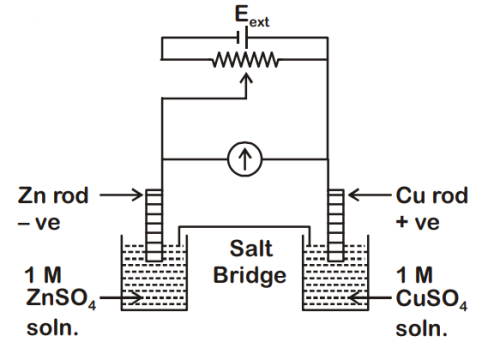
250 mL of a waste solution obtained from the
workshop of a goldsmith contains 0.1 M AgNO3
and 0.1 M AuCl. The solution was electrolyzed
at 2V by passing a current of 1A for 15
minutes. The metal/metals electrodeposited will
be
If Eext < 1.1 V then Zn dissolves at anode and
copper deposits at Cathode.
If Eext > 1.1V then Zn deposited at zinc
electrodes and Cu deposits at Cu electrode.
2020
Q242
JEE Mains
MCQ
iCON Education HYD, 79930 92826, 73309 7282614 Mar 2026
Let CNaCl
and CBaSO4 be the conductances (in S) measured for saturated aqueous solutions of NaCl
and BaSO4, respectively, at a temperature T.
Which of the following is false?
A.
Ionic mobilities of ions from both salts increase with T.
B.
CNaCl(T2) > CNaCl(T1) for T2 > T1
C.
CBaSO4(T2) > CBaSO4(T1) for T2 > T1
D.
CNaCl >> CBaSO4 at a given T
Correct Answer: D
Explanation:
BaSO4 is sparingly
soluble
salt but NaCl is completely soluble salt so it will produce more number of ions. That is why
Conductance (NaCl) > Conductance (BaSO4)
2020
Q243
JEE Mains
MCQ
iCON Education HYD, 79930 92826, 73309 7282614 Mar 2026
The work derived from the cell on the consumption of 1.0 $ \times $ 10$-$3 mole of H2(g) is used to compress 1.00 mole of a monoatomic ideal gas in a thermally insulated container. What is the change in the temperature (in K) of the ideal gas?
The standard reduction potentials for the two half-cells are given below :
iCON Education HYD, 79930 92826, 73309 7282620 May 2026
A solution of $\mathrm{Fe}^{2+}$ is titrated potentiometrically using $\mathrm{Ce}^{4+}$ solution. When $80 \% \mathrm{Fe}^{2+}$ is titrated, the EMF of the system in $V$ is
iCON Education HYD, 79930 92826, 73309 7282620 May 2026
$\mathrm{Mg}^{2+}$ displaces hydrogen from acids but copper does not. A galvanic cell prepared by combining $\mathrm{Cu} / \mathrm{Cu}^{2+}$ and $\mathrm{Mg} / \mathrm{Mg}^{2+}$ has an EMF of 2.71 V at 298 K . If the potential of copper electrode is 0.34 V , what is the reduction potential of Mg electrode?
iCON Education HYD, 79930 92826, 73309 7282620 May 2026
The standard electrode potentials of $\mathrm{Ag}^{+} / \mathrm{Ag}$ is +0.80 V and $\mathrm{Cu}^{+} / \mathrm{Cu}$ is +0.34 V . If these electrodes are connected through a salt-bridge, which of the following statements is correct?
A.
Silver electrode acts as anode and $E_{\text {cell }}^{\circ}$ is -0.34 V .
B.
Copper electrode acts as anode and $E_{\text {cell }}^{\circ}$ is +0.46 V .
C.
Silver electrode acts as a cathode and $E_{\text {cell }}^{\circ}$ is -0.34 V .
D.
Copper electrode acts as cathode and $E_{\text {cell }}^{\circ}$ is +0.46 V .
Correct Answer: B
Explanation:
Electrode having higher reduction potential has to be cathode.
Hence, silver electrode act as a cathode. Because reduction potential of silver electrode $\left(E^{\circ}\right)$ is +80 V . Which is more than given reduction potential of $\mathrm{Cu}(+34 \mathrm{~V})$.
Hence, $E_{\text {cell }}^{\circ}$ will determine as:
iCON Education HYD, 79930 92826, 73309 7282611 Jun 2026
A solution of copper sulphate is electrolyzed between copper electrodes by a current of 10.0A passing for one hour. Which of the following statements is correct regarding the changes occur at the electrodes and in the solution?
A.
11.84 g of copper will deposit on the cathode
B.
11.84 g of copper will deposit on the anode
C.
11.84 g of copper will deposit on the anode as well as on the cathode
D.
copper will not deposit on any of the electrode
Correct Answer: A
Explanation:
According to Faraday's first law of electrolysis:
The reaction at cathode : $\mathop {C{u^{2 + }}}\limits_{63.5\,g} + 2{e^ - } \to \mathop {Cu}\limits_{2 \times 96500C} $
The quantity of charge passed
= I $\times$ t = (10 amp) $\times$ (60 $\times$ 60s) = 36000 C.
2 $\times$ 96500 C of charge deposit copper - 63.5 g
Thus, 11.84 g of copper will dissolve from the anode and the same amount from the solution will get deposited on the cathode. The concentration of the solution will remain unchanged.