Electrochemistry
226 Questions
Start JEE Mains Test
2020
Q151
JEE Mains
Numerical
14 Mar 2026
For the disproportionation reaction
2Cu+(aq) ⇌ Cu(s) + Cu2+(aq) at 298 K. ln K
(where K is the equilibrium constant) is
___________ × 10–1.
Given :
($E_{C{u^{2 + }}/C{u^ + }}^0 = 0.16V$
$E_{C{u^ + }/Cu}^0 = 0.52V$
${{RT} \over F} = 0.025$)
2Cu+(aq) ⇌ Cu(s) + Cu2+(aq) at 298 K. ln K
(where K is the equilibrium constant) is
___________ × 10–1.
Given :
($E_{C{u^{2 + }}/C{u^ + }}^0 = 0.16V$
$E_{C{u^ + }/Cu}^0 = 0.52V$
${{RT} \over F} = 0.025$)
Correct Answer: 144
Explanation:
$E_{cell}^0$ = $E_{C{u^ + }/Cu}^0$ - $E_{C{u^{2 + }}/C{u^ + }}^0$
= 0.52 – 0.16
= 0.36 V
At equilibrium, Ecell = 0
$E_{cell}^0$ = ${{RT} \over {nF}}$ln K
$ \Rightarrow $ ln K = ${{E_{cell}^0 \times nF} \over {RT}}$
= ${{0.36 \times 1} \over {0.025}}$ = 14.4 = 144 $ \times $ 10-1
= 0.52 – 0.16
= 0.36 V
At equilibrium, Ecell = 0
$E_{cell}^0$ = ${{RT} \over {nF}}$ln K
$ \Rightarrow $ ln K = ${{E_{cell}^0 \times nF} \over {RT}}$
= ${{0.36 \times 1} \over {0.025}}$ = 14.4 = 144 $ \times $ 10-1
2020
Q152
JEE Mains
Numerical
14 Mar 2026
The Gibbs change (in J) for the given reaction at
[Cu2+] = [Sn2+] = 1 M and 298K is :
Cu(s) + Sn2+(aq.) $ \to $ Cu2+(aq.) + Sn(s);
($E_{S{n^{2 + }}|Sn}^0 = - 0.16\,V$,
$E_{C{u^{2 + }}|Cu}^0 = 0.34\,V$)
Take F = 96500 C mol–1)
[Cu2+] = [Sn2+] = 1 M and 298K is :
Cu(s) + Sn2+(aq.) $ \to $ Cu2+(aq.) + Sn(s);
($E_{S{n^{2 + }}|Sn}^0 = - 0.16\,V$,
$E_{C{u^{2 + }}|Cu}^0 = 0.34\,V$)
Take F = 96500 C mol–1)
Correct Answer: 96500
Explanation:
$\Delta $G = $\Delta $Go + RTln $\left[ {{{S{n^{ + 2}}} \over {C{u^{ + 2}}}}} \right]$
= –2 × 96500 [(–0.16) – 0.34] + RT$\left[ {{1 \over 1}} \right]$
= 96500 J
= –2 × 96500 [(–0.16) – 0.34] + RT$\left[ {{1 \over 1}} \right]$
= 96500 J
2020
Q153
JEE Mains
Numerical
14 Mar 2026
108 g of silver (molar mass 108 g mol–1) is
deposited at cathode from AgNO3(aq) solution
by a certain quantity of electricity. The
volume (in L) of oxygen gas produced at
273 K and 1 bar pressure from water by the
same quantity of electricity is _______.
Correct Answer: 5.66to5.68
Explanation:
Cathode : Ag+(aq) + e- $ \to $ Ag(s)
Moles of Ag deposited = ${{108} \over {108}}$ = 1 mole
Anode : 2H2O $ \to $ O2 + 4H+ + 4e-
Here we have to find volume of O2 evolved.
Equivalance of Ag = Equivalance of O2
$ \Rightarrow $ 1 $ \times $ 1 = nO2 $ \times $ 4
$ \Rightarrow $ nO2 = ${1 \over 4}$ mol
$ \therefore $ Volume of O2 evolved
= ${1 \over 4}$ $ \times $ 22.4
= 5.6 lit
Moles of Ag deposited = ${{108} \over {108}}$ = 1 mole
Anode : 2H2O $ \to $ O2 + 4H+ + 4e-
Here we have to find volume of O2 evolved.
Equivalance of Ag = Equivalance of O2
$ \Rightarrow $ 1 $ \times $ 1 = nO2 $ \times $ 4
$ \Rightarrow $ nO2 = ${1 \over 4}$ mol
$ \therefore $ Volume of O2 evolved
= ${1 \over 4}$ $ \times $ 22.4
= 5.6 lit
2020
Q154
JEE Mains
Numerical
14 Mar 2026
For an electrochemical cell
Sn(s) | Sn2+ (aq,1M)||Pb2+ (aq,1M)|Pb(s)
the ratio ${{\left[ {S{n^{2 + }}} \right]} \over {\left[ {P{b^{2 + }}} \right]}}$ when this cell attains equilibrium is _________.
(Given $E_{S{n^{2 + }}|Sn}^0 = - 0.14V$,
$E_{P{b^{2 + }}|Pb}^0 = - 0.13V$, ${{2.303RT} \over F} = 0.06$)
Sn(s) | Sn2+ (aq,1M)||Pb2+ (aq,1M)|Pb(s)
the ratio ${{\left[ {S{n^{2 + }}} \right]} \over {\left[ {P{b^{2 + }}} \right]}}$ when this cell attains equilibrium is _________.
(Given $E_{S{n^{2 + }}|Sn}^0 = - 0.14V$,
$E_{P{b^{2 + }}|Pb}^0 = - 0.13V$, ${{2.303RT} \over F} = 0.06$)
Correct Answer: 2.13TO2.16
Explanation:
Cell reaction is :
Sn(s) + Pb+2(aq) $ \to $ Sn+2(aq) + Pb(s)
Apply Nernst equation :
Ecell = $E_{cell}^0$ - ${{0.06} \over 2}\log {{\left[ {S{n^{ + 2}}} \right]} \over {\left[ {P{b^{ + 2}}} \right]}}$ ....(1)
$ \Rightarrow $ $E_{cell}^0$ = -0.13 + 0.14 = 0.01 V
At equilibrium : Ecell = 0
Substituting in (1), we get
0 = 0.01 - ${{0.06} \over 2}\log {{\left[ {S{n^{ + 2}}} \right]} \over {\left[ {P{b^{ + 2}}} \right]}}$
$ \Rightarrow $ $\log {{\left[ {S{n^{ + 2}}} \right]} \over {\left[ {P{b^{ + 2}}} \right]}}$ = ${1 \over 3}$
$ \Rightarrow $ ${{\left[ {S{n^{2 + }}} \right]} \over {\left[ {P{b^{2 + }}} \right]}}$ = 2.15
Sn(s) + Pb+2(aq) $ \to $ Sn+2(aq) + Pb(s)
Apply Nernst equation :
Ecell = $E_{cell}^0$ - ${{0.06} \over 2}\log {{\left[ {S{n^{ + 2}}} \right]} \over {\left[ {P{b^{ + 2}}} \right]}}$ ....(1)
$ \Rightarrow $ $E_{cell}^0$ = -0.13 + 0.14 = 0.01 V
At equilibrium : Ecell = 0
Substituting in (1), we get
0 = 0.01 - ${{0.06} \over 2}\log {{\left[ {S{n^{ + 2}}} \right]} \over {\left[ {P{b^{ + 2}}} \right]}}$
$ \Rightarrow $ $\log {{\left[ {S{n^{ + 2}}} \right]} \over {\left[ {P{b^{ + 2}}} \right]}}$ = ${1 \over 3}$
$ \Rightarrow $ ${{\left[ {S{n^{2 + }}} \right]} \over {\left[ {P{b^{2 + }}} \right]}}$ = 2.15
2020
Q155
JEE Mains
Numerical
14 Mar 2026
What would be the electrode potential for the given half cell reaction at pH = 5?
______.
2H2O $ \to $ O2 + 4H$ \oplus $ + 4e– ; $E_{red}^0$ = 1.23 V
(R = 8.314 J mol–1 K–1 ; Temp = 298 k;
oxygen under std. atm. pressure of 1 bar)
2H2O $ \to $ O2 + 4H$ \oplus $ + 4e– ; $E_{red}^0$ = 1.23 V
(R = 8.314 J mol–1 K–1 ; Temp = 298 k;
oxygen under std. atm. pressure of 1 bar)
Correct Answer: 1.52TO1.53
Explanation:
E = E0 - ${{0.0591} \over 4}\log {\left[ {{H^ + }} \right]^4}$
$ \Rightarrow $ E = 1.23 + 0.0591 × pH
$ \Rightarrow $ E = 1.23 + 0.0591 × (5)
$ \Rightarrow $ E = 1.52
$ \Rightarrow $ E = 1.23 + 0.0591 × pH
$ \Rightarrow $ E = 1.23 + 0.0591 × (5)
$ \Rightarrow $ E = 1.52
2020
Q156
JEE Mains
MCQ
14 Mar 2026
For the given cell :
Cu(s) | Cu2+(C1M) || Cu2+(C2M) | Cu(s)
change in Gibbs energy ($\Delta $G) is negative, if :
Cu(s) | Cu2+(C1M) || Cu2+(C2M) | Cu(s)
change in Gibbs energy ($\Delta $G) is negative, if :
A.
C2 = $\sqrt 2 $C1
B.
C2 = ${{{C_1}} \over {\sqrt 2 }}$
C.
C1 = 2C2
D.
C1 = C2
2020
Q157
JEE Mains
MCQ
14 Mar 2026
The variation of molar conductivity with concentration of an electrolyte (X) in aqueous solution
is shown in the given figure.
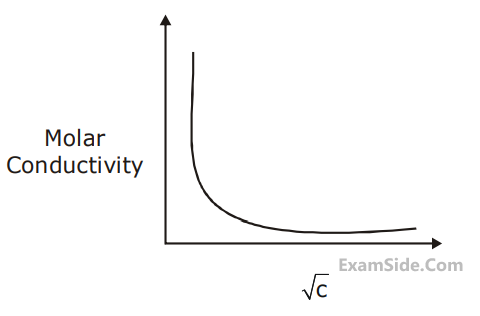
The electrolyte X is :
The electrolyte X is :
A.
HCl
B.
CH3COOH
C.
NaCl
D.
KNO3
2020
Q158
JEE Mains
MCQ
14 Mar 2026
250 mL of a waste solution obtained from the
workshop of a goldsmith contains 0.1 M AgNO3
and 0.1 M AuCl. The solution was electrolyzed
at 2V by passing a current of 1A for 15
minutes. The metal/metals electrodeposited will
be
[ $E_{A{g^ + }/Ag}^0$ = 0.80 V, $E_{A{u^ + }/Au}^0$ = 1.69 V ]
[ $E_{A{g^ + }/Ag}^0$ = 0.80 V, $E_{A{u^ + }/Au}^0$ = 1.69 V ]
A.
Silver and gold in equal mass proportion
B.
Silver and gold in proportion to their atomic
weights
C.
Only gold
D.
Only silver
2020
Q159
JEE Mains
MCQ
14 Mar 2026
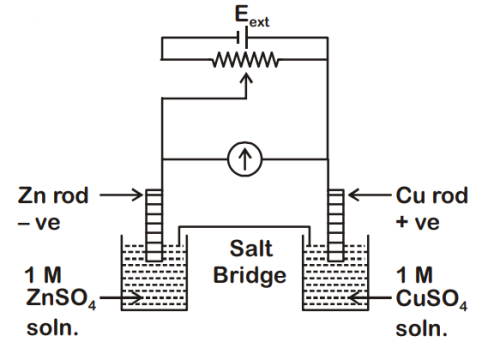
$E_{C{u^{2 + }}|Cu}^0$ = +0.34 V
$E_{Z{n^{2 + }}|Zn}^0$ = -0.76 V
Identify the incorrect statement from the option below for the above cell :
A.
If Eext < 1.1 V, Zn dissolves at anode and Cu
deposits at cathode
B.
If Eext = 1.1 V, no flow of e– or current
occurs
C.
If Eext > 1.1 V, e– flows from Cu to Zn
D.
If Eext > 1.1 V, Zn dissolves at Zn electrode
and Cu deposits at Cu electrode
2020
Q160
JEE Mains
MCQ
14 Mar 2026
Let CNaCl
and CBaSO4 be the conductances (in S) measured for saturated aqueous solutions of NaCl
and BaSO4, respectively, at a temperature T.
Which of the following is false?
A.
Ionic mobilities of ions from both salts increase with T.
B.
CNaCl(T2) > CNaCl(T1) for T2 > T1
C.
CBaSO4(T2) > CBaSO4(T1) for T2 > T1
D.
CNaCl >> CBaSO4 at a given T
2020
Q161
JEE Mains
MCQ
14 Mar 2026
The equation that is incorrect is :
A.
${\left( {\Lambda _m^0} \right)_{KCl}} - {\left( {\Lambda _m^0} \right)_{NaCl}} = {\left( {\Lambda _m^0} \right)_{KBr}} - {\left( {\Lambda _m^0} \right)_{NaBr}}$
B.
${\left( {\Lambda _m^0} \right)_{NaBr}} - {\left( {\Lambda _m^0} \right)_{NaI}} = {\left( {\Lambda _m^0} \right)_{KBr}} - {\left( {\Lambda _m^0} \right)_{NaBr}}$
C.
${\left( {\Lambda _m^0} \right)_{NaBr}} - {\left( {\Lambda _m^0} \right)_{NaCl}} = {\left( {\Lambda _m^0} \right)_{KBr}} - {\left( {\Lambda _m^0} \right)_{KCl}}$
D.
${\left( {\Lambda _m^0} \right)_{{H_2}O}} = {\left( {\Lambda _m^0} \right)_{HCl}} + {\left( {\Lambda _m^0} \right)_{NaOH}} - {\left( {\Lambda _m^0} \right)_{NaCl}}$
2020
Q162
JEE Mains
MCQ
14 Mar 2026
Given that the standard potentials (Eo) of Cu2+/Cu and Cu+/Cu are 0.34 V and 0.522 V respectively, the Eo of Cu2+/Cu+ :
A.
- 0.182 V
B.
- 0.158 V
C.
0.182 V
D.
+0.158 V
2019
Q163
JEE Mains
MCQ
14 Mar 2026
Given
CO3+ + e– $ \to $ CO2+ ; Eo = + 1.81 V
Pb4+ + 2e– $ \to $ Pb2+ ; Eo = + 1.67 V
Ce4+ + e– $ \to $ Ce3+ ; Eo = + 1.61 V
Bi3+ + 3e– $ \to $ Bi ; Eo = + 0.20 V
Oxidizing power of the species will increase in the order :
CO3+ + e– $ \to $ CO2+ ; Eo = + 1.81 V
Pb4+ + 2e– $ \to $ Pb2+ ; Eo = + 1.67 V
Ce4+ + e– $ \to $ Ce3+ ; Eo = + 1.61 V
Bi3+ + 3e– $ \to $ Bi ; Eo = + 0.20 V
Oxidizing power of the species will increase in the order :
A.
Co3+ < Ce4+
< Bi3+ < Pb4+
B.
Co3+ < Pb4+ < Ce4+
< Bi3+
C.
Ce4+
< Pb4+ < Bi3+ < Co3+
D.
Bi3+ < Ce4+
< Pb4+ < Co3+
2019
Q164
JEE Mains
MCQ
14 Mar 2026
Which one of the following graphs between molar conductivity (${\Lambda _m}$) versus $\sqrt C $ is correct ?
A.


B.


C.


D.


2019
Q165
JEE Mains
MCQ
14 Mar 2026
Consider the statements S1 and S2
S1 : Conductivity always increases with decrease in the concentration of electrolyte.
S2 : Molar conductivity always increases with decrease in the concentration of electrolyte.
The correct option among the following is :
S1 : Conductivity always increases with decrease in the concentration of electrolyte.
S2 : Molar conductivity always increases with decrease in the concentration of electrolyte.
The correct option among the following is :
A.
Both S1 and S2 are wrong
B.
S1 is correct and S2 is wrong
C.
Both S1 and S2 are correct
D.
S1 is wrong and S2 is correct
2019
Q166
JEE Mains
MCQ
14 Mar 2026
A solution of Ni(NO3)2 is electrolysed between
platinum electrodes using 0.1 Faraday
electricity. How many mole of Ni will be
deposited at the cathode?
A.
0.10
B.
0.15
C.
0.20
D.
0.05
2019
Q167
JEE Mains
MCQ
14 Mar 2026
The standard Gibbs energy for the given cell
reaction in kJ mol–1 at 298 K is :
Zn(s) + Cu2+ (aq) $ \to $ Zn2+ (aq) + Cu (s),
E° = 2 V at 298 K
(Faraday's constant, F = 96000 C mol–1)
Zn(s) + Cu2+ (aq) $ \to $ Zn2+ (aq) + Cu (s),
E° = 2 V at 298 K
(Faraday's constant, F = 96000 C mol–1)
A.
384
B.
–192
C.
–384
D.
192
2019
Q168
JEE Mains
MCQ
14 Mar 2026
Calculate the standard cell potential in (V) of the
cell in which following reaction takes place :
Fe2+(aq) + Ag+(aq) $ \to $ Fe3+(aq) + Ag (s)
Given that
$E_{A{g^ + }/Ag}^o = xV$
$E_{Fe^{2+ }/Fe}^o = yV$
$E_{Fe^{3+ }/Fe}^o = zV$
Fe2+(aq) + Ag+(aq) $ \to $ Fe3+(aq) + Ag (s)
Given that
$E_{A{g^ + }/Ag}^o = xV$
$E_{Fe^{2+ }/Fe}^o = yV$
$E_{Fe^{3+ }/Fe}^o = zV$
A.
x + 2y - 3z
B.
x - z
C.
x - y
D.
x + y - z
2019
Q169
JEE Mains
MCQ
14 Mar 2026
Given that ${E^\Theta }_{{O_2}/{H_2}O} = 1.23\,V$ ;
${E^\Theta }_{{S_2}O_8^{2 - }/SO_4^{2 - }} = 2.05\,V$
${E^\Theta }_{B{r_2}/B{r^ - }} = 1.09\,V$
${E^\Theta }_{A{u^{3 + }}/Au} = 1.4\,V$
The strongest oxidizing agent is :
${E^\Theta }_{{S_2}O_8^{2 - }/SO_4^{2 - }} = 2.05\,V$
${E^\Theta }_{B{r_2}/B{r^ - }} = 1.09\,V$
${E^\Theta }_{A{u^{3 + }}/Au} = 1.4\,V$
The strongest oxidizing agent is :
A.
O2
B.
Au3+
C.
Br2
D.
${S_2}O_8^{2 - }$
2019
Q170
JEE Mains
MCQ
14 Mar 2026
$ \wedge _m^ \circ $ for NaCl, HCl and NaA are 126.4, 425.9 and 100.5 S cm2 mol–1, respectively. If the conductivity of 0.001 M HA is-
5 $ \times $ 10–5 S cm–1, degree of dissociation of HA is -
5 $ \times $ 10–5 S cm–1, degree of dissociation of HA is -
A.
0.50
B.
0.125
C.
0.25
D.
0.75
2019
Q171
JEE Mains
MCQ
14 Mar 2026
The standard electrode potential ${E^o }$ and its temperature coefficient $\left( {{{d{E^o }} \over {dT}}} \right)$ for a cell are 2V and $-$ 5 $ \times $ 10$-$4 VK$-$1 at 300 K respectively.
The cell reaction is
Zn(s) + Cu2+ (aq) $\buildrel \, \over \longrightarrow $ Zn2+ (aq) + Cu(s)
The standard reaction enthalpy ($\Delta $rH${^o }$) at 300 K in kJ mol–1 is, [Use R = 8 JK–1 mol–1 and F = 96,000C mol–1]
The cell reaction is
Zn(s) + Cu2+ (aq) $\buildrel \, \over \longrightarrow $ Zn2+ (aq) + Cu(s)
The standard reaction enthalpy ($\Delta $rH${^o }$) at 300 K in kJ mol–1 is, [Use R = 8 JK–1 mol–1 and F = 96,000C mol–1]
A.
$-$ 412.8
B.
$-$ 384.0
C.
192.0
D.
206.4
2019
Q172
JEE Mains
MCQ
14 Mar 2026
Given the equilibrium constant:
KC of the reaction :
Cu(s) + 2Ag+ (aq) $ \to $ Cu2+ (aq) + 2Ag(s) is
10 $ \times $ 1015, calculate the E$_{cell}^0$ of this reaciton at 298 K
[2.303 ${{RT} \over F}$ at 298 K = 0.059V]
KC of the reaction :
Cu(s) + 2Ag+ (aq) $ \to $ Cu2+ (aq) + 2Ag(s) is
10 $ \times $ 1015, calculate the E$_{cell}^0$ of this reaciton at 298 K
[2.303 ${{RT} \over F}$ at 298 K = 0.059V]
A.
0.4736 mV
B.
0.04736 V
C.
0.4736 V
D.
0.04736 mV
2019
Q173
JEE Mains
MCQ
14 Mar 2026
For the cell Zn(s) |Zn2+ (aq)| |Mx+ (aq)| M(s), different half cells and their standard electrode potentials are given below :
If $E_{z{n^{2 + }}/zn}^0$ = $-$ 0.76 V, which cathode will give maximum value of Eocell per electron transferred?
| Mx+ (aq)/M(s) | Au3+(aq)/Au(s) | Ag+(aq)/Ag(s) | Fe3+(aq)/Fe2+ (aq) | Fe2+(aq)/Fe(s) |
|---|---|---|---|---|
| E0Mx+/M/(V) | 1.40 | 0.80 | 0.77 | $-$0.44 |
If $E_{z{n^{2 + }}/zn}^0$ = $-$ 0.76 V, which cathode will give maximum value of Eocell per electron transferred?
A.
Ag+/Ag
B.
Fe3+/Fe2+
C.
Au3+/Au
D.
Fe2+/Fe
2019
Q174
JEE Mains
MCQ
14 Mar 2026
In the cell
Pt$\left| {\left( s \right)} \right|$H2(g, 1 bar)$\left| {HCl\left( {aq} \right)} \right|$AgCl$\left| {\left( s \right)} \right|$Ag(s)|Pt(s)
the cell potential is 0.92 V when a 10–6 molal HCl solution is used. The standard electrode potential of (AgCl/ AgCl– ) electrode is :
$\left\{ {} \right.$Given, ${{2.303RT} \over F} = 0.06V$ at $\left. {298} \right\}$
Pt$\left| {\left( s \right)} \right|$H2(g, 1 bar)$\left| {HCl\left( {aq} \right)} \right|$AgCl$\left| {\left( s \right)} \right|$Ag(s)|Pt(s)
the cell potential is 0.92 V when a 10–6 molal HCl solution is used. The standard electrode potential of (AgCl/ AgCl– ) electrode is :
$\left\{ {} \right.$Given, ${{2.303RT} \over F} = 0.06V$ at $\left. {298} \right\}$
A.
0.94 V
B.
0.40 V
C.
0.76 V
D.
0.20 V
2019
Q175
JEE Mains
MCQ
14 Mar 2026
Consider the following reduction processes :
Zn2+ + 2e– $ \to $ Zn(s) ; Eo = – 0.76 V
Ca2+ + 2e– $ \to $ Ca(s); Eo = –2.87 V
Mg2+ + 2e– $ \to $ Mg(s) ; Eo = – 2.36 V
Ni2 + 2e– $ \to $ Ni(s) ; Eo = – 0.25
The reducing power of the metals increases in the order :
Zn2+ + 2e– $ \to $ Zn(s) ; Eo = – 0.76 V
Ca2+ + 2e– $ \to $ Ca(s); Eo = –2.87 V
Mg2+ + 2e– $ \to $ Mg(s) ; Eo = – 2.36 V
Ni2 + 2e– $ \to $ Ni(s) ; Eo = – 0.25
The reducing power of the metals increases in the order :
A.
Ca < Mg < Zn < Ni
B.
Ni < Zn < Mg < Ca
C.
Zn < Mg < Ni < Ca
D.
Ca < Zn < Mg < Ni
2019
Q176
JEE Mains
MCQ
14 Mar 2026
If the standard electrode potential for a cell is 2 V at 300 K, the equilibrium constant (K) for the reaction
Zn(s) + Cu2+ (aq) $\rightleftharpoons$ Zn2+(aq) + Cu(s)
at 300 K is approximately,
(R = 8 JK$-$1mol$-$1, F = 96000 C mol$-$1)
Zn(s) + Cu2+ (aq) $\rightleftharpoons$ Zn2+(aq) + Cu(s)
at 300 K is approximately,
(R = 8 JK$-$1mol$-$1, F = 96000 C mol$-$1)
A.
e$-$80
B.
e$-$160
C.
e320
D.
e160
2019
Q177
JEE Mains
MCQ
14 Mar 2026
The anodic half-cell of lead-acid battery is recharged using electricity of 0.05 Faraday. The amount of PbSO4 electrolyzed in g during the process is : (Molar mass of PbSO4 = 303 g mol$-$1)
A.
22.8
B.
15.2
C.
7.6
D.
11.4
2018
Q178
JEE Mains
MCQ
14 Mar 2026
When 9.65 ampere current was passed for 1.0 hour into nitrobenzene in acidic medium, the amount of p-aminophenol produced is :
A.
9.81 g
B.
10.9 g
C.
98.1 g
D.
109.0 g

2018
Q179
JEE Mains
MCQ
14 Mar 2026
How long (approximate) should water be electrolysed by passing through 100 amperes current so that the
oxygen released can completely burn 27.66 g of diborane?
(Atomic weight of B = 10.8 u)
(Atomic weight of B = 10.8 u)
A.
1.6 hours
B.
6.4 hours
C.
0.8 hours
D.
3.2 hours
2018
Q180
JEE Mains
MCQ
14 Mar 2026
When an electric currents passed through acidified water, 112 mL of hydrogen gas at N.T.P. was collected at the cathode in 965 seconds. The current passed, in ampere, is :
A.
1.0
B.
0.5
C.
0.1
D.
2.0
2017
Q181
JEE Mains
MCQ
14 Mar 2026
To find the standard potential of M3+/M electrode,the following cell is constituted : Pt/M/M3+(0.001 mol L−1 )/Ag+(0.01 mol L−1 )/Ag
The emf of the cell is found to be 0.421 volt at 298 K. The standard potential of half reaction M3+ + 3e−$ \to $ M at 298 K will be :
(Given $E_{A{g^ + }\,/\,Ag}^ - $ at 298 K = 0.80 Volt)
The emf of the cell is found to be 0.421 volt at 298 K. The standard potential of half reaction M3+ + 3e−$ \to $ M at 298 K will be :
(Given $E_{A{g^ + }\,/\,Ag}^ - $ at 298 K = 0.80 Volt)
A.
0.38 Volt
B.
0.32 Volt
C.
1.28 Volt
D.
0.66 Volt
2017
Q182
JEE Mains
MCQ
14 Mar 2026
Consider the following standard electrode potentials (Eo in volts) in aqueous solution :
Based on these data, which of the following statements is correct ?
| Element | M3+ /M | M+ /M |
|---|---|---|
| A1 | -1.66 | + 0.55 |
| T1 | +1.26 | - 0.34 |
Based on these data, which of the following statements is correct ?
A.
T1+ is more stable than A13+
B.
A1+ is more stable than A13+
C.
T1 + is more stable than A1+
D.
T13+ is more stable than A13+
2017
Q183
JEE Mains
MCQ
14 Mar 2026
What is the standard reduction potential (Eo) for Fe3+ $ \to $ Fe ?
Given that :
Fe2+ + 2e$-$ $ \to $ Fe; $E_{F{e^{2 + }}/Fe}^o$ = $-$0.47 V
Fe3+ + e$-$ $ \to $ Fe2+; $E_{F{e^{3 + }}/F{e^{2 + }}}^o$ = +0.77 V
Given that :
Fe2+ + 2e$-$ $ \to $ Fe; $E_{F{e^{2 + }}/Fe}^o$ = $-$0.47 V
Fe3+ + e$-$ $ \to $ Fe2+; $E_{F{e^{3 + }}/F{e^{2 + }}}^o$ = +0.77 V
A.
$-$ 0.057 V
B.
+ 0.057 V
C.
+ 0.30 V
D.
$-$ 0.30 V
2017
Q184
JEE Mains
MCQ
14 Mar 2026
Given
$E_{C{l_2}/C{l^ - }}^o$ = 1.36 V, $E_{C{r^{3 + }}/Cr}^o$ = - 0.74 V
$E_{C{r_2}{O_7}^{2 - }/C{r^{3 + }}}^o$ = 1.33 V, $E_{Mn{O_4}^ - /Mn ^{2+}}^o$ = 1.51 V
Among the following, the strongest reducing agent is :
$E_{C{l_2}/C{l^ - }}^o$ = 1.36 V, $E_{C{r^{3 + }}/Cr}^o$ = - 0.74 V
$E_{C{r_2}{O_7}^{2 - }/C{r^{3 + }}}^o$ = 1.33 V, $E_{Mn{O_4}^ - /Mn ^{2+}}^o$ = 1.51 V
Among the following, the strongest reducing agent is :
A.
Mn2+
B.
Cr3+
C.
Cl–
D.
Cr
2016
Q185
JEE Mains
MCQ
14 Mar 2026
Identify the correct statement :
A.
Iron corrodes in oxygen-free water.
B.
Iron corrodes more rapidly in salt water because its electrochemical
potential is higher.
C.
Corrosion of iron can be minimized by forming a contact with another
metal with a higher reduction potential.
D.
Corrosion of iron can be minimized by forming an impermeable barrier
at its surface.
2016
Q186
JEE Mains
MCQ
14 Mar 2026
Oxidation of succinate ion produces ethylene and carbon dioxide gases. On passing 0.2 Faraday electricity through an aqueous solution of potassium succinate, the total volume of gases (at both cathode and anode) at STP (1 atm and 273 K) is :
A.
2.24 L
B.
4.48 L
C.
6.72 L
D.
8.96 L

2016
Q187
JEE Mains
MCQ
14 Mar 2026
What will occur if a block of copper metal is dropped into a beaker containing a
solution of 1M ZnSO4?
A.
The copper metal will dissolve and zinc metal will be deposited.
B.
The copper metal will dissolve with evolution of hydrogen gas.
C.
The copper metal will dissolve with evolution of oxygen gas.
D.
No reaction will occur.
2016
Q188
JEE Mains
MCQ
14 Mar 2026
Galvanization is applying a coating of :
A.
Cr
B.
Cu
C.
Zn
D.
Pb
2015
Q189
JEE Mains
MCQ
14 Mar 2026
Two Faraday of electricity is passed through a solution of CuSO4. The mass of copper deposited at the
cathode is: (at. mass of Cu = 63.5 amu)
A.
63.5 g
B.
2 g
C.
127 g
D.
0 g
2014
Q190
JEE Mains
MCQ
14 Mar 2026
The equivalent conductance of NaCl at concentration C and at infinite dilution are ${\lambda _C}$ and ${\lambda _\infty }$, respectively. The correct relationship between ${\lambda _C}$ and ${\lambda _\infty }$ is given as:
(where the constant B is positive)
A.
${\lambda _C} = {\lambda _\infty } + (B)C$
B.
${\lambda _C} = {\lambda _\infty } - (B)C$
C.
${\lambda _C} = {\lambda _\infty } - (B)\sqrt C$
D.
${\lambda _C} = {\lambda _\infty } + (B)\sqrt C$
2014
Q191
JEE Mains
MCQ
14 Mar 2026
Resistance of 0.2 M solution of an electrolyte is 50 $\Omega$. The specific conductance of the solution is 1.4 S m-1. The resistance of 0.5 M solution of the same electrolyte is 280 $\Omega$. The molar conductivity of 0.5 M solution of the electrolyte in S m2 mol-1 is :
A.
5 × 10³
B.
5 × 10²
C.
5 × 10⁻⁴
D.
5 × 10⁻³
2014
Q192
JEE Mains
MCQ
14 Mar 2026
Given below are the half-cell reactions:
Mn2+ + 2e- $\to$ Mn; Eo = -1.18 V
2(Mn3+ + e- $\to$ Mn2+); Eo = +1.51 V
The Eo for 3Mn2+ $\to$ Mn + 2Mn3+ will be :
Mn2+ + 2e- $\to$ Mn; Eo = -1.18 V
2(Mn3+ + e- $\to$ Mn2+); Eo = +1.51 V
The Eo for 3Mn2+ $\to$ Mn + 2Mn3+ will be :
A.
– 0.33 V; the reaction will not occur
B.
– 0.33 V; the reaction will occur
C.
– 2.69 V; the reaction will not occur
D.
– 2.69 V; the reaction will occur
2013
Q193
JEE Mains
MCQ
14 Mar 2026
Given
$E_{C{r^{2 + }}/Cr}^o$ = -0.74 V; $E_{MnO_4^ - /M{n^{2 + }}}^o$ = 1.51 V
$E_{C{r_2}O_7^{2 - }/C{r^{3 + }}}^o$ = 1.33 V; $E_{Cl/C{l^ - }}^o$ = 1.36 V
Based on the data given above, strongest oxidising agent will be :
$E_{C{r^{2 + }}/Cr}^o$ = -0.74 V; $E_{MnO_4^ - /M{n^{2 + }}}^o$ = 1.51 V
$E_{C{r_2}O_7^{2 - }/C{r^{3 + }}}^o$ = 1.33 V; $E_{Cl/C{l^ - }}^o$ = 1.36 V
Based on the data given above, strongest oxidising agent will be :
A.
Cr3+
B.
Mn2+
C.
$MnO_4^ - $
D.
Cl-
2012
Q194
JEE Mains
MCQ
14 Mar 2026
The standard reduction potentials for Zn2+/ Zn, Ni2+/ Ni, and Fe2+/ Fe are –0.76, –0.23 and –0.44 V respectively. The reaction
X + Y2+ $\to$ X2+ + Y will be spontaneous when :
X + Y2+ $\to$ X2+ + Y will be spontaneous when :
A.
X = Ni, Y = Fe
B.
X = Ni, Y = Zn
C.
X = Fe, Y = Zn
D.
X = Zn, Y = Ni
2011
Q195
JEE Mains
MCQ
14 Mar 2026
The reduction potential of hydrogen half cell will be negative if :
A.
p(H2) = 1 atm and [H+] = 1.0 M
B.
p(H2) = 1 atm and [H+] = 2.0 M
C.
p(H2) = 2 atm and [H+] =1.0 M
D.
p(H2) = 2 atm and [H+] =2.0 M
2010
Q196
JEE Mains
MCQ
14 Mar 2026
The correct order of $E_{{M^{2 + }}/M}^o$ values with negative sign for the four successive elements Cr, Mn, Fe
and Co is :
A.
Mn > Cr > Fe > Co
B.
Cr > Fe > Mn > Co
C.
Fe > Mn > Cr > Co
D.
Cr > Mn > Fe > Co
2010
Q197
JEE Mains
MCQ
14 Mar 2026
The Gibbs energy for the decomposition of Al2O3 at 500oC is as follows :
${2 \over 3}A{l_2}{O_3}$ $\to$ ${4 \over 3}Al + {O_2}$, ${\Delta _r}G$ = + 966 kJ mol–1
The potential difference needed for electrolytic reduction of Al2O3 at 500oC is at least :
${2 \over 3}A{l_2}{O_3}$ $\to$ ${4 \over 3}Al + {O_2}$, ${\Delta _r}G$ = + 966 kJ mol–1
The potential difference needed for electrolytic reduction of Al2O3 at 500oC is at least :
A.
4.5 V
B.
3.0 V
C.
2.5 V
D.
5.0 V
2009
Q198
JEE Mains
MCQ
14 Mar 2026
Given : $E_{F{e^{3 + }}/Fe}^o$ = -0.036V; $E_{F{e^{2 + }}/Fe}^o$ = -0.439 V
The value of standard electrode potential for the change,
Fe3+ (aq) + e- $\to$ Fe2+ (aq) will be
The value of standard electrode potential for the change,
Fe3+ (aq) + e- $\to$ Fe2+ (aq) will be
A.
-0.072 V
B.
0.385 V
C.
0.770 V
D.
0.270
2009
Q199
JEE Mains
MCQ
14 Mar 2026
In a fuel cell methanol is used as fuel and oxygen gas is used as an oxidizer. The reaction is
CH3OH(l) + 3/2O2 $\to$ CO2 (g) + 2H2O (l)
At 298K standard Gibb’s energies of formation for CH3OH(l), H2O(l) and CO2 (g) are -166.2, -237.2 and -394.4 kJ mol−1 respectively. If standard enthalpy of combustion of methanol is -726 kJ mol−1, efficiency of the fuel cell will be
CH3OH(l) + 3/2O2 $\to$ CO2 (g) + 2H2O (l)
At 298K standard Gibb’s energies of formation for CH3OH(l), H2O(l) and CO2 (g) are -166.2, -237.2 and -394.4 kJ mol−1 respectively. If standard enthalpy of combustion of methanol is -726 kJ mol−1, efficiency of the fuel cell will be
A.
87%
B.
90%
C.
97%
D.
80%
2008
Q200
JEE Mains
MCQ
14 Mar 2026
Given $E_{C{r^{3 + }}/Cr}^o$ = -0.72 V; $E_{Fe^{2+}/Fe}^o$ = -0.42V, The potential for the cell Cr | Cr3+ (0.1M) || Fe2+ (0.01 M) | Fe is
A.
0.26 V
B.
0.399 V
C.
−0.339 V
D.
−0.26 V