JEE Mains
2026
MCQ

Consider the above electrochemical cell where a metal electrode ( M ) is undergoing redox reaction by forming $\mathrm{M}^{+}\left(\mathrm{M} \rightarrow \mathrm{M}^{+}+\mathrm{e}^{-}\right)$. The cation $\mathrm{M}^{+}$is present in two different concentrations $c_1$ and $c_2$ as shown above. Which of the following statement is correct for generating a positive cell potential?
JEE Mains
2026
MCQ
In the given electrochemical cell, $\mathrm{Ag}(\mathrm{s})|\mathrm{AgCl}(\mathrm{s})| \mathrm{FeCl}_2(\mathrm{aq}), \mathrm{FeCl}_3(\mathrm{aq}) \mid \mathrm{Pt}(\mathrm{s})$ at 298 K , the cell potential ( $\mathrm{E}_{\text {cell }}$ ) will increase when :
A. Concentration of $\mathrm{Fe}^{2+}$ is increased.
B. Concentration of $\mathrm{Fe}^{3+}$ is decreased.
C. Concentration of $\mathrm{Fe}^{2+}$ is decreased.
D. Concentration of $\mathrm{Fe}^{3+}$ is increased.
E. Concentration of $\mathrm{Cl}^{-}$is increased.
Choose the correct answer from the options given below :
JEE Mains
2026
MCQ
Consider the following reduction processes :
$ \begin{aligned} & \mathrm{Al}^{3+}+3 \mathrm{e}^{-} \longrightarrow \mathrm{Al}(\mathrm{~s}), \mathrm{E}^0=-1.66 \mathrm{~V} \\ & \mathrm{Fe}^{3+}+\mathrm{e}^{-} \longrightarrow \mathrm{Fe}^{2+}, \mathrm{E}^0=+0.77 \mathrm{~V} \\ & \mathrm{Co}^{3+}+\mathrm{e}^{-} \longrightarrow \mathrm{Co}^{2+}, \mathrm{E}^0=+1.81 \mathrm{~V} \\ & \mathrm{Cr}^{3+}+3 \mathrm{e}^{-} \longrightarrow \mathrm{Cr}(\mathrm{~s}), \mathrm{E}^0=-0.74 \mathrm{~V} \end{aligned} $
The tendency to act as reducing agent decreases in the order :
JEE Mains
2026
MCQ
For a closed circuit Daniell cell, which of the following plots is the accurate one at a given temperature?
JEE Mains
2026
MCQ
Given at 298 K :
$ \begin{aligned} & \mathrm{E}_{\mathrm{Fe}^{2+} / \mathrm{Fe}}^{\ominus}=\mathrm{X} \text { Volt } \\ & \mathrm{E}_{\mathrm{Fe}^{3+} / \mathrm{Fe}}^{\ominus}=\mathrm{Y} \text { Volt } \end{aligned} $
The $\mathrm{E}_{\mathrm{Fe}^{3+} / \mathrm{Fe}^{2+}}^{\ominus}$ in Volt at 298 K is given by :
JEE Mains
2026
MCQ
For a general redox reaction
Anode $\quad \operatorname{Red}_1 \rightarrow \mathrm{Ox}_1^{\mathrm{n}_1^{+}}+\mathrm{n}_1 \mathrm{e}^{-}$
Cathode $\mathrm{O} x_2+\mathrm{n}_2 \mathrm{e}^{-} \rightarrow \operatorname{Red}_2^{\mathrm{n}_2-}$
Which of the following statement is incorrect?
JEE Mains
2026
MCQ
$ \text { Consider the following data. } $
$ \begin{array}{|c|c|} \hline \text { Electrolyte } & \wedge^{\circ}_\mathbf{m}{\mathbf{(}} \mathbf{S ~ c m}^{\mathbf{2}} \mathbf{~ m o l}^{\mathbf{1}} \mathbf{)} \\ \hline \mathrm{BaCl}_2 & x_1 \\ \hline \mathrm{H}_2 \mathrm{SO}_4 & x_2 \\ \hline \mathrm{HCl} & x_3 \\ \hline \end{array} $
$\mathrm{BaSO}_4$ is sparingly soluble in water. If the conductivity of the saturated $\mathrm{BaSO}_4$ solution is $x \mathrm{~S} \mathrm{~cm}^{-1}$ then the solubility product of $\mathrm{BaSO}_4$ can be given as (Here $\wedge_{\mathrm{m}}=\wedge^{\circ}_{\mathrm{m}}$ )
JEE Mains
2026
MCQ
One half cell in a voltaic cell is constructed by dipping silver rod in $\mathrm{AgNO}_3$ solution of unknown concentration, other half cell is Zn rod dipped in 1 molar solution of $\mathrm{ZnSO}_4$.
A voltage of 1.60 V is measured at 298 K for this cell. What is the concentration of $\mathrm{Ag}^{+}$ions used in terms of $\log x\left(x=\left[\mathrm{Ag}^{+}\right]\right)$?
$ \mathrm{E}_{\mathrm{Zn}^{2+} / \mathrm{Zn}}^{\ominus}=-0.76 \mathrm{~V}, \quad \mathrm{E}_{\mathrm{Ag}^{+} / \mathrm{Ag}}^{\ominus}=+0.80 \mathrm{~V}, \frac{2.303 \mathrm{RT}}{\mathrm{~F}}=0.059 \mathrm{~V} $
JEE Mains
2026
MCQ
An electrochemical cell is constructed using half cells in the direction of spontaneous change:
Fe(OH)2(s) + 2e− → Fe(s) + 2OH−(aq) Eθ = −0.88 V
and AgBr(s) + e− → Ag(s) + Br−(aq) Eθ = +0.07 V
Which of the following option is correct?
JEE Mains
2025
MCQ
Given below are two statements :
1 M aqueous solutions of each of Cu(NO3)2, AgNO3, Hg2(NO3)2, Mg(NO3)2 are electrolysed using inert electrodes. Given: E0Ag+/Ag = 0.80 V, E0Hg22+/Hg = 0.79 V, E0Cu2+/Cu = 0.24 V and E0Mg2+/Mg = -2.37 V.
Statement (I) : With increasing voltage, the sequence of deposition of metals on the cathode will be Ag, Hg and Cu.
Statement (II) : Magnesium will not be deposited at the cathode instead oxygen gas will be evolved at the cathode.
In the light of the above statements, choose the most appropriate answer from the options given below :
JEE Mains
2025
MCQ
On charging the lead storage battery, the oxidation state of lead changes from $x_1$ to $y_1$ at the anode and from $x_2$ to $y_2$ at the cathode. The values of $x_1, y_1, x_2, y_2$ are respectively :
JEE Mains
2025
MCQ
The standard cell potential $\left(\mathrm{E}_{\text {cell }}^{\ominus}\right)$ of a fuel cell based on the oxidation of methanol in air that has been used to power television relay station is measured as 1.21 V . The standard half cell reduction potential for $\mathrm{O}_2\left(\mathrm{E}_{\mathrm{O}_2 / \mathrm{H}_2 \mathrm{O}}^{\circ}\right)$ is 1.229 V .
Choose the correct statement :
JEE Mains
2025
MCQ
Correct order of limiting molar conductivity for cations in water at 298 K is :
JEE Mains
2025
MCQ
Match List - I with List - II :
| List - I (Applications) |
List - II (Batteries/Cell) |
| (A) Transistors |
(I) Anode - Zn/Hg; Cathode - HgO + C |
| (B) Hearing aids |
(II) Hydrogen fuel cell |
| (C) Inverters |
(III) Anode - Zn; Cathode - Carbon |
| (D) Apollo space ship |
(IV) Anode - Pb; Cathode - Pb | PbO2 |
Choose the correct answer from the options given below :
JEE Mains
2025
MCQ
$\mathrm{O}_2$ gas will be evolved as a product of electrolysis of :
(A) an aqueous solution of $\mathrm{AgNO}_3$ using silver electrodes.
(B) an aqueous solution of $\mathrm{AgNO}_3$ using platinum electrodes.
(C) a dilute solution of $\mathrm{H}_2 \mathrm{SO}_4$ using platinum electrodes.
(D) a high concentration solution of $\mathrm{H}_2 \mathrm{SO}_4$ using platinum electrodes.
Choose the correct answer from the options given below :
JEE Mains
2025
MCQ
For a Mg | Mg2+ (aq) || Ag+ (aq) | Ag the correct Nernst Equation is :
JEE Mains
2025
MCQ
The molar conductivity of a weak electrolyte when plotted against the square root of its concentration, which of the following is expected to be observed?
JEE Mains
2025
MCQ
The standard reduction potential values of some of the p-block ions are given below. Predict the one with the strongest oxidising capacity.
JEE Mains
2025
MCQ
Based on the data given below :
$\begin{array}{ll}
\mathrm{E}_{\mathrm{Cr}_2 \mathrm{O}_7^{2-} / \mathrm{Cr}^{3+}}^{\circ}=1.33 \mathrm{~V} & \mathrm{E}_{\mathrm{Cl}_2 / \mathrm{Cl}^{(-)}}^{\circ}=1.36 \mathrm{~V} \\
\mathrm{E}_{\mathrm{MnO}_4^{-} / \mathrm{Mn}^{2+}}^0=1.51 \mathrm{~V} & \mathrm{E}_{\mathrm{Cr}^{3+} / \mathrm{Cr}}^{\circ}=-0.74 \mathrm{~V}
\end{array}$
the strongest reducing agent is :
JEE Mains
2025
MCQ
For the given cell
$\mathrm{Fe}^{2+}(\mathrm{aq})+\mathrm{Ag}_{(\mathrm{aq})}^{+} \rightarrow \mathrm{Fe}^{3+}(\mathrm{aq})+\mathrm{Ag}_{(\mathrm{s})}$
The standard cell potential of the above reaction is Given:
$\begin{array}{lr}
\mathrm{Ag}^{+}+\mathrm{e}^{-} \rightarrow \mathrm{Ag} & \mathrm{E}^\theta=\mathrm{xV} \\
\mathrm{Fe}^{2+}+2 \mathrm{e}^{-} \rightarrow \mathrm{Fe} & \mathrm{E}^\theta=\mathrm{yV} \\
\mathrm{Fe}^{3+}+3 \mathrm{e}^{-} \rightarrow \mathrm{Fe} & \mathrm{E}^\theta=\mathrm{zV}
\end{array}$
JEE Mains
2025
MCQ
Standard electrode potentials for a few half cells are mentioned below :
$\begin{aligned}
& \mathrm{E}_{\mathrm{Cu}^{2+} / \mathrm{Cu}}^{\circ}=0.34 \mathrm{~V}, \mathrm{E}_{\mathrm{Zn}^{2+} / \mathrm{Zn}}^{\circ}=-0.76 \mathrm{~V} \\
& \mathrm{E}_{\mathrm{Ag}^{+} / \mathrm{Ag}}^{\circ}=0.80 \mathrm{~V}, \mathrm{E}_{\mathrm{Mg}^{2+} / \mathrm{Mg}}^{\circ}=-2.37 \mathrm{~V}
\end{aligned}$
Which one of the following cells gives the most negative value of $\Delta \mathrm{G}^{\circ}$ ?
JEE Mains
2025
MCQ
$
\mathrm{FeO}_4^{2-} \xrightarrow{+2.0 \mathrm{~V}} \mathrm{Fe}^{3+} \xrightarrow{0.8 \mathrm{~V}} \mathrm{Fe}^{2+} \xrightarrow{-0.5 \mathrm{~V}} \mathrm{Fe}^0
$
In the above diagram, the standard electrode potentials are given in volts (over the arrow).
The value of $\mathrm{E}_{\mathrm{FeO}_4^{2-} / \mathrm{Fe}^{2+}}$ is :
JEE Mains
2025
MCQ
Given below are two statements :
Statement (I) : Corrosion is an electrochemical phenomenon in which pure metal acts as an anode and impure metal as a cathode.
Statement (II) : The rate of corrosion is more in alkaline medium than in acidic medium.
In the light of the above statements, choose the correct answer from the options given below :
JEE Mains
2025
MCQ
Which of the following electrolyte can be used to obtain $\mathrm{H}_2 \mathrm{~S}_2 \mathrm{O}_8$ by the process of electrolysis ?
JEE Mains
2025
MCQ
A solution of aluminium chloride is electrolysed for 30 minutes using a current of 2 A . The amount of the aluminium deposited at the cathode is __________ .
[Given : molar mass of aluminium and chlorine are $27 \mathrm{~g} \mathrm{~mol}^{-1}$ and $35.5 \mathrm{~g} \mathrm{~mol}^{-1}$ respectively. Faraday constant $\left.=96500 \mathrm{C} \mathrm{~mol}^{-1}\right]$
JEE Mains
2024
MCQ
Match List I with List II
|
LIST I
(Cell) |
|
LIST II
(Use/Property/Reaction) |
| A. |
Leclanche cell |
I. |
Converts energy of combustion into electrical energy |
| B. |
Ni - Cd cell |
II. |
Does not involve any ion in solution and is used in hearing aids |
| C. |
Fuel cell |
III. |
Rechargeable |
| D. |
Mercury cell |
IV. |
Reaction at anode $\mathrm{Zn} \rightarrow \mathrm{Zn}^{2+}+2 \mathrm{e}^{-}$ |
Choose the correct answer from the options given below :
JEE Mains
2024
MCQ
Which out of the following is a correct equation to show change in molar conductivity with respect to concentration for a weak electrolyte, if the symbols carry their usual meaning :
JEE Mains
2024
MCQ
The molar conductivity for electrolytes $A$ and $B$ are plotted against $C^{3 / 2}$ as shown below. Electrolytes $A$ and $B$ respectively are:

JEE Mains
2024
MCQ
The emf of cell $\mathrm{Tl}\left|\underset{(0.001 \mathrm{M})}{\mathrm{Tl}^{+}}\right| \underset{(0.01 \mathrm{M})}{\mathrm{Cu}^{2+}} \mid \mathrm{Cu}$ is $0.83 \mathrm{~V}$ at $298 \mathrm{~K}$. It could be increased by :
JEE Mains
2024
MCQ
The reaction;
$\frac{1}{2} \mathrm{H}_{2(\mathrm{~g})}+\mathrm{AgCl}_{(\mathrm{s})} \rightarrow \mathrm{H}_{(\mathrm{aq})}^{+}+\mathrm{Cl}_{(\mathrm{aq})}^{-}+\mathrm{Ag}_{(\mathrm{s})}$
occurs in which of the following galvanic cell :
JEE Mains
2024
MCQ
Given below are two statements :
Statement (I) : Fusion of $\mathrm{MnO}_2$ with $\mathrm{KOH}$ and an oxidising agent gives dark green $\mathrm{K}_2 \mathrm{MnO}_4$.
Statement (II) : Manganate ion on electrolytic oxidation in alkaline medium gives permanganate ion.
In the light of the above statements, choose the correct answer from the options given below :
JEE Mains
2024
MCQ
How can an electrochemical cell be converted into an electrolytic cell ?
JEE Mains
2024
MCQ
A conductivity cell with two electrodes (dark side) are half filled with infinitely dilute aqueous solution of a weak electrolyte. If volume is doubled by adding more water at constant temperature, the molar conductivity of the cell will -

JEE Mains
2024
MCQ
The quantity of silver deposited when one coulomb charge is passed through $\mathrm{AgNO}_3$ solution :
JEE Mains
2024
MCQ
For the electro chemical cell
$\mathrm{M}\left|\mathrm{M}^{2+}\right||\mathrm{X}| \mathrm{X}^{2-}$
If $\mathrm{E}_{\left(\mathrm{M}^{2+} / \mathrm{M}\right)}^0=0.46 \mathrm{~V}$ and $\mathrm{E}_{\left(\mathrm{x} / \mathrm{x}^{2-}\right)}^0=0.34 \mathrm{~V}$.
Which of the following is correct?
JEE Mains
2024
MCQ
Molar ionic conductivities of divalent cation and anion are $57 \mathrm{~S~cm}^2 \mathrm{~mol}^{-1}$ and $73 \mathrm{~S~cm}^2 \mathrm{~mol}^{-1}$ respectively. The molar conductivity of solution of an electrolyte with the above cation and anion will be:
JEE Mains
2024
MCQ
The reaction at cathode in the cells commonly used in clocks involves.
JEE Mains
2024
MCQ
Fuel cell, using hydrogen and oxygen as fuels,
A. has been used in spaceship
B. has as efficiency of $40 \%$ to produce electricity
C. uses aluminum as catalysts
D. is eco-friendly
E. is actually a type of Galvanic cell only
Choose the correct answer from the options given below:
JEE Mains
2024
MCQ
For a strong electrolyte, a plot of molar conductivity against (concentration) ${ }^{1 / 2}$ is a straight line, with a negative slope, the correct unit for the slope is
JEE Mains
2024
MCQ
One of the commonly used electrode is calomel electrode. Under which of the following categories, calomel electrode comes?
JEE Mains
2024
MCQ
What pressure (bar) of $\mathrm{H}_2$ would be required to make emf of hydrogen electrode zero in pure water at $25^{\circ} \mathrm{C}$ ?
JEE Mains
2024
MCQ
Identify the factor from the following that does not affect electrolytic conductance of a solution.
JEE Mains
2024
MCQ
Alkaline oxidative fusion of $\mathrm{MnO}_2$ gives "A" which on electrolytic oxidation in alkaline solution produces B. A and B respectively are
JEE Mains
2024
MCQ
Reduction potential of ions are given below:
$\begin{array}{ccc}
\mathrm{ClO}_4^{-} & \mathrm{IO}_4^{-} & \mathrm{BrO}_4^{-} \\
\mathrm{E}^{\circ}=1.19 \mathrm{~V} & \mathrm{E}^{\circ}=1.65 \mathrm{~V} & \mathrm{E}^{\circ}=1.74 \mathrm{~V}
\end{array}$
The correct order of their oxidising power is :
JEE Mains
2024
MCQ
Which of the following statements is not correct about rusting of iron?
JEE Mains
2023
MCQ
For lead storage battery pick the correct statements
A. During charging of battery, $\mathrm{PbSO}_{4}$ on anode is converted into $\mathrm{PbO}_{2}$
B. During charging of battery, $\mathrm{PbSO}_{4}$ on cathode is converted into $\mathrm{PbO}_{2}$
C. Lead storage battery consists of grid of lead packed with $\mathrm{PbO}_{2}$ as anode
D. Lead storage battery has $\sim 38 \%$ solution of sulphuric acid as an electrolyte
Choose the correct answer from the options given below:
JEE Mains
2023
MCQ
The reaction
$\frac{1}{2} \mathrm{H}_{2}(\mathrm{~g})+\mathrm{AgCl}(\mathrm{s}) \rightleftharpoons \mathrm{H}^{+}(\mathrm{aq})+\mathrm{Cl}^{-}(\mathrm{aq})+\mathrm{Ag}(\mathrm{s})$
occurs in which of the given galvanic cell.
JEE Mains
2023
MCQ
The standard electrode potential of $\mathrm{M}^{+} / \mathrm{M}$ in aqueous solution does not depend on
JEE Mains
2023
MCQ
Given below are two statements : one is labelled as Assertion (A) and the other is labelled as Reason (R)
Assertion (A) : An aqueous solution of $\mathrm{KOH}$ when used for volumetric analysis, its concentration should be checked before the use.
Reason (R) : On aging, $\mathrm{KOH}$ solution absorbs atmospheric $\mathrm{CO}_{2}$.
In the light of the above statements, choose the correct answer from the options given below :
JEE Mains
2023
MCQ
Which one of the following statements is correct for electrolysis of brine solution?
JEE Mains
2023
MCQ
The standard electrode potential $\mathrm{(M^{3+}/M^{2+})}$ for V, Cr, Mn & Co are $-$0.26 V, $-$0.41 V, + 1.57 V and + 1.97 V, respectively. The metal ions which can liberate $\mathrm{H_2}$ from a dilute acid are :
JEE Mains
2023
MCQ
Choose the correct representation of conductometric titration of benzoic acid vs sodium hydroxide.
JEE Mains
2022
MCQ
Match List - I with List - II.
|
List - I |
|
List - II |
| (A) |
$Cd(s) + 2Ni{(OH)_3}(s) \to CdO(s) + 2Ni{(OH)_2}(s) + {H_2}O(l)$ |
(I) |
Primary battery |
| (B) |
$Zn(Hg) + HgO(s) \to ZnO(s) + Hg(l)$ |
(II) |
Discharging of secondary battery |
| (C) |
$2PbS{O_4}(s) + 2{H_2}O(l) \to Pb(s) + Pb{O_2}(s) + 2{H_2}S{O_4}(aq)$ |
(III) |
Fuel cell |
| (D) |
$2{H_2}(g) + {O_2}(g) \to 2{H_2}O(l)$ |
(IV) |
Charging of secondary battery |
Choose the correct answer from the options given below:
JEE Mains
2022
MCQ
Given below are two statements :
Statement I : For KI, molar conductivity increases steeply with dilution
Statement II : For carbonic acid, molar conductivity increases slowly with dilution
In the light of the above statements, choose the correct answer from the options given below :
JEE Mains
2022
MCQ
The molar conductivity of a conductivity cell filled with 10 moles of 20 mL NaCl solution is ${\Lambda _{m1}}$ and that of 20 moles another identical cell heaving 80 mL NaCl solution is ${\Lambda _{m2}}$. The conductivities exhibited by these two cells are same. The relationship between ${\Lambda _{m2}}$ and ${\Lambda _{m1}}$ is
JEE Mains
2022
MCQ
In which of the following half cells, electrochemical reaction is pH dependent?
JEE Mains
2022
MCQ
In 3d series, the metal having the highest M2+/M standard electrode potential is :
JEE Mains
2022
MCQ
The ${\left( {{{\partial E} \over {\partial T}}} \right)_P}$ of different types of half cells are as follows:
| A |
B |
C |
D |
| $1 \times {10^{ - 4}}$ |
$2 \times {10^{ - 4}}$ |
$0.1 \times {10^{ - 4}}$ |
$0.2 \times {10^{ - 4}}$ |
(Where E is the electromotive force)
Which of the above half cells would be preferred to be used as reference electrode?
JEE Mains
2022
MCQ
The correct order of reduction potentials of the following pairs is
A. Cl2/Cl$-$
B. I2/I$-$
C. Ag+/Ag
D. Na+/Na
E. Li+/Li
Choose the correct answer from the options given below.
JEE Mains
2021
MCQ
Match List - I with List - II
|
List - I
(Parmeter) |
|
List - II
(Unit) |
| (a) |
Cell constant |
(i) |
$S\,c{m^2}mo{l^{ - 1}}$ |
| (b) |
Molar conductivity |
(ii) |
Dimensionless |
| (c) |
Conductivity |
(iii) |
${m^{ - 1}}$ |
| (d) |
Degree of dissociation of electrolyte |
(iv) |
${\Omega ^{ - 1}}{m^{ - 1}}$ |
Choose the most appropriate answer from the options given below :
JEE Mains
2021
MCQ
Given below are two statements :
Statement I : The limiting molar conductivity of KCl (strong electrolyte) is higher compared to that of CH3COOH (weak electrolyte).
Statement II : Molar conductivity decreases with decrease in concentration of electrolyte.
In the light of the above statements, choose the most appropriate answer from the options given below :
JEE Mains
2021
MCQ
Compound A used as a strong oxidizing agent is amphoteric in nature. It is the part of lead storage batteries. Compound A is :
JEE Mains
2021
MCQ
The electrode potential of M2+/M of 3d-series elements shows positive value for :
JEE Mains
2020
MCQ
For the given cell :
Cu(s) | Cu2+(C1M) || Cu2+(C2M) | Cu(s)
change in Gibbs energy ($\Delta $G) is negative, if :
JEE Mains
2020
MCQ
The variation of molar conductivity with concentration of an electrolyte (X) in aqueous solution
is shown in the given figure.
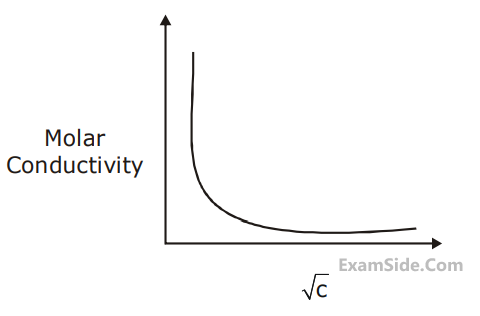
The electrolyte X is :
JEE Mains
2020
MCQ
250 mL of a waste solution obtained from the
workshop of a goldsmith contains 0.1 M AgNO3
and 0.1 M AuCl. The solution was electrolyzed
at 2V by passing a current of 1A for 15
minutes. The metal/metals electrodeposited will
be
[ $E_{A{g^ + }/Ag}^0$ = 0.80 V, $E_{A{u^ + }/Au}^0$ = 1.69 V ]
JEE Mains
2020
MCQ
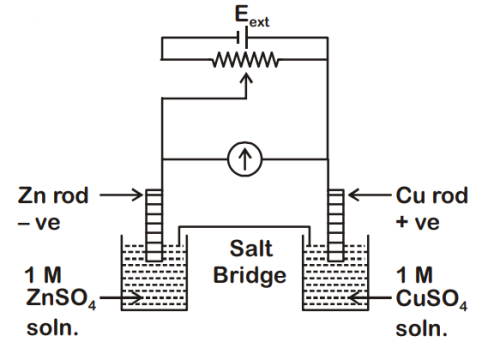
$E_{C{u^{2 + }}|Cu}^0$ = +0.34 V
$E_{Z{n^{2 + }}|Zn}^0$ = -0.76 V
Identify the incorrect statement from the option
below for the above cell :
JEE Mains
2020
MCQ
Let CNaCl
and CBaSO4 be the conductances (in S) measured for saturated aqueous solutions of NaCl
and BaSO4, respectively, at a temperature T.
Which of the following is false?
JEE Mains
2020
MCQ
The equation that is incorrect is :
JEE Mains
2020
MCQ
Given that the standard potentials (Eo) of Cu2+/Cu and Cu+/Cu are 0.34 V and 0.522 V respectively, the Eo of Cu2+/Cu+ :
JEE Mains
2019
MCQ
Given
CO3+ + e– $ \to $ CO2+ ; Eo = + 1.81 V
Pb4+
+ 2e– $ \to $ Pb2+ ; Eo = + 1.67 V
Ce4+
+ e– $ \to $ Ce3+
; Eo = + 1.61 V
Bi3+ + 3e– $ \to $ Bi ; Eo = + 0.20 V
Oxidizing power of the species will increase in the order :
JEE Mains
2019
MCQ
Which one of the following graphs between molar conductivity (${\Lambda _m}$) versus $\sqrt C $ is correct ?
JEE Mains
2019
MCQ
Consider the statements S1 and S2
S1 : Conductivity always increases with decrease in the concentration of electrolyte.
S2 : Molar conductivity always increases with decrease in the concentration of electrolyte.
The correct option among the following is :
JEE Mains
2019
MCQ
A solution of Ni(NO3)2 is electrolysed between
platinum electrodes using 0.1 Faraday
electricity. How many mole of Ni will be
deposited at the cathode?
JEE Mains
2019
MCQ
The standard Gibbs energy for the given cell
reaction in kJ mol–1 at 298 K is :
Zn(s) + Cu2+ (aq) $ \to $ Zn2+ (aq) + Cu (s),
E° = 2 V at 298 K
(Faraday's constant, F = 96000 C mol–1)
JEE Mains
2019
MCQ
Calculate the standard cell potential in (V) of the
cell in which following reaction takes place :
Fe2+(aq) + Ag+(aq) $ \to $ Fe3+(aq) + Ag (s)
Given that
$E_{A{g^ + }/Ag}^o = xV$
$E_{Fe^{2+ }/Fe}^o = yV$
$E_{Fe^{3+ }/Fe}^o = zV$
JEE Mains
2019
MCQ
Given that ${E^\Theta }_{{O_2}/{H_2}O} = 1.23\,V$ ;
${E^\Theta }_{{S_2}O_8^{2 - }/SO_4^{2 - }} = 2.05\,V$
${E^\Theta }_{B{r_2}/B{r^ - }} = 1.09\,V$
${E^\Theta }_{A{u^{3 + }}/Au} = 1.4\,V$
The strongest oxidizing agent is :
JEE Mains
2019
MCQ
$ \wedge _m^ \circ $ for NaCl, HCl and NaA are 126.4, 425.9 and 100.5 S cm2 mol–1, respectively. If the conductivity of 0.001 M HA is-
5 $ \times $ 10–5 S cm–1, degree of dissociation of HA is -
JEE Mains
2019
MCQ
The standard electrode potential ${E^o }$ and its temperature coefficient $\left( {{{d{E^o }} \over {dT}}} \right)$ for a cell are 2V and $-$ 5 $ \times $ 10$-$4 VK$-$1 at 300 K respectively.
The cell reaction is
Zn(s) + Cu2+ (aq) $\buildrel \, \over
\longrightarrow $ Zn2+ (aq) + Cu(s)
The standard reaction enthalpy ($\Delta $rH${^o }$) at 300 K in kJ mol–1 is, [Use R = 8 JK–1 mol–1 and F = 96,000C mol–1]
JEE Mains
2019
MCQ
Given the equilibrium constant:
KC of the reaction :
Cu(s) + 2Ag+ (aq) $ \to $ Cu2+ (aq) + 2Ag(s) is
10 $ \times $ 1015, calculate the E$_{cell}^0$ of this reaciton at 298 K
[2.303 ${{RT} \over F}$ at 298 K = 0.059V]
JEE Mains
2019
MCQ
For the cell Zn(s) |Zn
2+ (aq)| |M
x+ (aq)| M(s), different half cells and their standard electrode potentials are given below :
| Mx+ (aq)/M(s) |
Au3+(aq)/Au(s) |
Ag+(aq)/Ag(s) |
Fe3+(aq)/Fe2+ (aq) |
Fe2+(aq)/Fe(s) |
| E0Mx+/M/(V) |
1.40 |
0.80 |
0.77 |
$-$0.44 |
If $E_{z{n^{2 + }}/zn}^0$ = $-$ 0.76 V, which cathode will give maximum value of E
ocell per electron transferred?
JEE Mains
2019
MCQ
In the cell
Pt$\left| {\left( s \right)} \right|$H2(g, 1 bar)$\left| {HCl\left( {aq} \right)} \right|$AgCl$\left| {\left( s \right)} \right|$Ag(s)|Pt(s)
the cell potential is 0.92 V when a 10–6 molal HCl solution is used. The standard electrode potential of (AgCl/ AgCl– ) electrode is :
$\left\{ {} \right.$Given, ${{2.303RT} \over F} = 0.06V$ at $\left. {298} \right\}$
JEE Mains
2019
MCQ
Consider the following reduction processes :
Zn2+ + 2e– $ \to $ Zn(s) ; Eo = – 0.76 V
Ca2+ + 2e– $ \to $ Ca(s); Eo = –2.87 V
Mg2+ + 2e– $ \to $ Mg(s) ; Eo = – 2.36 V
Ni2 + 2e– $ \to $ Ni(s) ; Eo = – 0.25
The reducing power of the metals increases in the order :
JEE Mains
2019
MCQ
If the standard electrode potential for a cell is 2 V at 300 K, the equilibrium constant (K) for the reaction
Zn(s) + Cu2+ (aq) $\rightleftharpoons$ Zn2+(aq) + Cu(s)
at 300 K is approximately,
(R = 8 JK$-$1mol$-$1, F = 96000 C mol$-$1)
JEE Mains
2019
MCQ
The anodic half-cell of lead-acid battery is recharged using electricity of 0.05 Faraday. The amount of PbSO4 electrolyzed in g during the process is : (Molar mass of PbSO4 = 303 g mol$-$1)
JEE Mains
2018
MCQ
When 9.65 ampere current was passed for 1.0 hour into nitrobenzene in acidic medium, the amount of p-aminophenol produced is :
JEE Mains
2018
MCQ
How long (approximate) should water be electrolysed by passing through 100 amperes current so that the
oxygen released can completely burn 27.66 g of diborane?
(Atomic weight of B = 10.8 u)
JEE Mains
2018
MCQ
When an electric currents passed through acidified water, 112 mL of hydrogen gas at N.T.P. was collected at the cathode in 965 seconds. The current passed, in ampere, is :
JEE Mains
2017
MCQ
To find the standard potential of M3+/M electrode,the following cell is constituted : Pt/M/M3+(0.001 mol L−1 )/Ag+(0.01 mol L−1 )/Ag
The emf of the cell is found to be 0.421 volt at 298 K. The standard potential of half reaction M3+ + 3e−$ \to $ M at 298 K will be :
(Given $E_{A{g^ + }\,/\,Ag}^ - $ at 298 K = 0.80 Volt)
JEE Mains
2017
MCQ
Consider the following standard electrode potentials (E
o in volts) in aqueous solution :
| Element |
M3+ /M |
M+ /M |
| A1 |
-1.66 |
+ 0.55 |
| T1 |
+1.26 |
- 0.34 |
Based on these data, which of the following statements is
correct ?
JEE Mains
2017
MCQ
What is the standard reduction potential (Eo) for Fe3+ $ \to $ Fe ?
Given that :
Fe2+ + 2e$-$ $ \to $ Fe; $E_{F{e^{2 + }}/Fe}^o$ = $-$0.47 V
Fe3+ + e$-$ $ \to $ Fe2+; $E_{F{e^{3 + }}/F{e^{2 + }}}^o$ = +0.77 V
JEE Mains
2017
MCQ
Given
$E_{C{l_2}/C{l^ - }}^o$ = 1.36 V, $E_{C{r^{3 + }}/Cr}^o$ = - 0.74 V
$E_{C{r_2}{O_7}^{2 - }/C{r^{3 + }}}^o$ = 1.33 V, $E_{Mn{O_4}^ - /Mn ^{2+}}^o$ = 1.51 V
Among the following, the strongest reducing agent is :
JEE Mains
2016
MCQ
Identify the correct statement :
JEE Mains
2016
MCQ
Oxidation of succinate ion produces ethylene and carbon dioxide gases. On passing 0.2 Faraday electricity through an aqueous solution of potassium succinate, the total volume of gases (at both cathode and anode) at STP (1 atm and 273 K) is :
JEE Mains
2016
MCQ
What will occur if a block of copper metal is dropped into a beaker containing a
solution of 1M ZnSO4?
JEE Mains
2016
MCQ
Galvanization is applying a coating of :
JEE Mains
2015
MCQ
Two Faraday of electricity is passed through a solution of CuSO4. The mass of copper deposited at the
cathode is: (at. mass of Cu = 63.5 amu)
JEE Mains
2014
MCQ
The equivalent conductance of NaCl at concentration C and at infinite dilution are ${\lambda _C}$ and ${\lambda _\infty }$, respectively. The correct relationship between ${\lambda _C}$ and ${\lambda _\infty }$ is given as:
(where the constant B is positive)
JEE Mains
2014
MCQ
Resistance of 0.2 M solution of an electrolyte is 50 $\Omega$. The specific conductance of the solution is 1.4 S m-1. The resistance of 0.5 M solution of the same electrolyte is 280 $\Omega$. The molar conductivity of 0.5 M solution of the electrolyte in S m2 mol-1 is :
JEE Mains
2014
MCQ
Given below are the half-cell reactions:
Mn2+ + 2e- $\to$ Mn; Eo = -1.18 V
2(Mn3+ + e- $\to$ Mn2+); Eo = +1.51 V
The Eo for 3Mn2+ $\to$ Mn + 2Mn3+ will be :
JEE Mains
2013
MCQ
Given
$E_{C{r^{2 + }}/Cr}^o$ = -0.74 V; $E_{MnO_4^ - /M{n^{2 + }}}^o$ = 1.51 V
$E_{C{r_2}O_7^{2 - }/C{r^{3 + }}}^o$ = 1.33 V; $E_{Cl/C{l^ - }}^o$ = 1.36 V
Based on the data given above, strongest oxidising agent will be :
JEE Mains
2012
MCQ
The standard reduction potentials for Zn2+/ Zn, Ni2+/ Ni, and Fe2+/ Fe are –0.76, –0.23 and –0.44 V respectively. The reaction
X + Y2+ $\to$ X2+ + Y will be spontaneous when :
JEE Mains
2011
MCQ
The reduction potential of hydrogen half cell will be negative if :
JEE Mains
2010
MCQ
The correct order of $E_{{M^{2 + }}/M}^o$ values with negative sign for the four successive elements Cr, Mn, Fe
and Co is :
JEE Mains
2010
MCQ
The Gibbs energy for the decomposition of Al2O3 at 500oC is as follows :
${2 \over 3}A{l_2}{O_3}$ $\to$ ${4 \over 3}Al + {O_2}$, ${\Delta _r}G$ = + 966 kJ mol–1
The potential difference needed for electrolytic reduction of Al2O3 at 500oC is at least :
JEE Mains
2009
MCQ
Given : $E_{F{e^{3 + }}/Fe}^o$ = -0.036V; $E_{F{e^{2 + }}/Fe}^o$ = -0.439 V
The value of standard electrode potential for the change,
Fe3+ (aq) + e- $\to$ Fe2+ (aq) will be
JEE Mains
2009
MCQ
In a fuel cell methanol is used as fuel and oxygen gas is used as an oxidizer. The reaction is
CH3OH(l) + 3/2O2 $\to$ CO2 (g) + 2H2O (l)
At 298K standard Gibb’s energies of formation for CH3OH(l), H2O(l) and CO2 (g) are -166.2, -237.2 and -394.4 kJ mol−1 respectively. If standard enthalpy of combustion of methanol is -726 kJ mol−1, efficiency of the fuel cell will be
JEE Mains
2008
MCQ
Given $E_{C{r^{3 + }}/Cr}^o$ = -0.72 V; $E_{Fe^{2+}/Fe}^o$ = -0.42V, The potential for the cell Cr | Cr3+ (0.1M) || Fe2+ (0.01 M) | Fe is
JEE Mains
2007
MCQ
The equivalent conductances of two strong electrolytes at infinite dilution in H2O (where ions move
freely through a solution) at 25oC are given below:
$ \wedge _{C{H_3}COONa}^o$ = 91.0 S cm2/equiv
$ \wedge _{HCl}^o$ = 426.2 S cm2/equiv
What additional information/quantity one needs to calculate $ \wedge ^o$ of an aqueous solution of acetic acid?
JEE Mains
2007
MCQ
The cell, Zn | Zn2+ (1M) || Cu2+ (1M) | Cu($E_{cell}^o$ = 1.10V) was allowed to be completely discharged at 298 K. The relative concentration of Zn2+ to Cu2+ $\left[ {{{\left[ {Z{n^{2 + }}} \right]} \over {\left[ {C{u^{2 + }}} \right]}}} \right]$ is
JEE Mains
2006
MCQ
The molar conductivities $ \wedge _{NaOAc}^o$ and $ \wedge _{HCl}^o$ and at infinite dilution in water at 25oC are 91.0 and 426.2 Scm2/mol respectively. To calculate $ \wedge _{HOAc}^o$ , the additional value required is
JEE Mains
2006
MCQ
Given the data at 25oC,
Ag + I- $\to$ AgI + e- , Eo = 0.152 V
Ag $\to$ Ag+ + e-, Eo = -0.800 V
What is the value of log Ksp for AgI? (2.303 RT/F = 0.059 V)
JEE Mains
2006
MCQ
Resistance of a conductivity cell filled with a solution of an electrolyte of concentration 0.1 M is 100$\Omega $.
The conductivity of this solution is 1.29 S m–1. Resistance of the same cell when filled with 0.2 M of
the same solution is 520 $\Omega $, The molar conductivity of 0.02 M solution of the electrolyte will be
JEE Mains
2005
MCQ
The highest electrical conductivity of the following aqueous solutions is of :
JEE Mains
2005
MCQ
| Electrolyte: |
KCl |
KNO3 |
HCl |
NaOAc |
NaCl |
${ \wedge ^\infty }(Sc{m^2}mo{l^{ - 1}}):$
|
149.9 |
145 |
426.2 |
91 |
126.5 |
Calculate $ \wedge _{HOAc}^\infty $ Using appropriate molar conductances of the electrolytes listed
above at infinite dilution in H
2O at 25
oC
JEE Mains
2005
MCQ
For a spontaneous reaction the ∆G , equilibrium constant (K) and $E_{cell}^o$ will be respectively
JEE Mains
2005
MCQ
Aluminium oxide may be electrolysed at 1000oC to furnish aluminium metal (Atomic
mass = 27 amu; 1 Faraday = 96,500 Coulombs). The cathode reaction is Al3+ + 3e- $\to$ Alo To prepare 5.12 kg of aluminium metal by this method would require
JEE Mains
2004
MCQ
The standard e.m.f of a cell, involving one electron change is found to be 0.591 V at 25oC.
The equilibrium constant of the reaction is (F = 96,500 C mol-1: R = 8.314 JK-1 mol-1)
JEE Mains
2004
MCQ
Consider the following Eo values
$E_{F{e^{3 + }}/F{e^{2 + }}}^o$ = 0.77 V;
$E_{S{n^{2 + }}/S{n}}^o$ = -0.14 V
Under standard conditions the potential for the reaction
Sn(s) + 2Fe3+(aq) $\to$ 2Fe2+(aq) + Sn2+(aq) is :
JEE Mains
2004
MCQ
In a cell that utilises the reaction Zn(s) + 2H+
(aq) $\to$ Zn2+(aq) + H2(g) addition of H2SO4 to cathode compartment, will
JEE Mains
2004
MCQ
The $E_{{M^{3 + }}/{M^{2 + }}}^o$ values for Cr, Mn, Fe and Co are – 0.41, +1.57, + 0.77 and +1.97 V
respectively. For which one of these metals the change in oxidation state form +2 to +3 is
easiest?
JEE Mains
2004
MCQ
The limiting molar conductivities Λ° for NaCl, KBr and KCl are 126, 152 and 150 S cm2 mol-1 respectively. The Λ° for NaBr is
JEE Mains
2004
MCQ
In a hydrogen – oxygen fuel cell, combustion of hydrogen occurs to :
JEE Mains
2003
MCQ
For a cell reaction involving a two-electron change, the standard e.m.f. of the cell is found to be 0.295 V at 25oC. The equilibrium constant of the reaction at 25oC will be
JEE Mains
2003
MCQ
For the redox reaction Zn(s) + Cu2+(0.1 M) $\to$ Zn2+(1M) + Cu(s) taking place in a cell, $E_{cell}^o$ is 1.10 volt. Ecell for the cell will be ($2.303{{RT} \over F}$ = 0.0591)
JEE Mains
2003
MCQ
Several blocks of magnesium are fixed to the bottom of a ship to :
JEE Mains
2003
MCQ
Standard reduction electrode potentials of three metals A,B&C are respectively +0.5 V, -3.0 V & -1.2 V. The
reducing, powers of these metals are
JEE Mains
2003
MCQ
When during electrolysis of a solution of AgNO3, 9650 coulombs of charge pass through the electroplating
bath, the mass of silver deposited on the cathode will be :
JEE Mains
2002
MCQ
Conductivity (Seimen’s S) is directly proportional to area of the vessel and the concentration
of the solution in it and is inversely proportional to the length of the vessel then, then constant of proportionality is expressed in :
JEE Mains
2002
MCQ
For the following cell with hydrogen electrodes at two different pressure p1 and p2. What will be the emf for the given cell :
$\eqalign{
& Pt({H_2})|{H^ + }(aq)|Pt({H_2}) \cr
& \,\,\,\,\,{p_1}\,\,\,\,\,\,\,\,\,\,\,\,\,\,1M\,\,\,\,\,\,\,\,\,\,\,\,{p_2} \cr} $
JEE Mains
2002
MCQ
When the sample of copper with zinc impurity is to be purified by electrolysis, the appropriate
electrodes are :
JEE Mains
2002
MCQ
Which of the following reaction is possible at anode?
JEE Mains
2002
MCQ
EMF of a cell in terms of reduction potential of its left and right electrodes is :
JEE Mains
2002
MCQ
For a cell given below

$
\begin{aligned}
\mathrm{Ag}^{+}+\mathrm{e}^{-} & \longrightarrow \mathrm{Ag}; E^{\circ}=x \\\\
\mathrm{Cu}^{2+}+2 e^{-} & \longrightarrow \mathrm{Cu}{;} E^{\circ}=y
\end{aligned}
$
$
E^{\circ} \text { cell is }
$ :