iCON Education HYD, 79930 92826, 73309 7282614 Mar 2026
The molecule in which hybrid MOs involve only
one d-orbital of the central atom is :
A.
XeF4
B.
[Ni(CN)4]2–
C.
[CrF6]3–
D.
BrF5
Correct Answer: B
Explanation:
XeF4 = sp3d2
[Ni(CN)4]2– = dsp2
[CrF6]3– = d2sp2
BrF5 = sp3d2
2020
Q252
JEE Mains
MCQ
iCON Education HYD, 79930 92826, 73309 7282614 Mar 2026
The pair in which both the species have the
same magnetic moment (spin only) is :
A.
[Cr(H2O)6]2+ and [CoCl4]2–
B.
[Co(OH)4]2– and [Fe(NH3)6]2+
C.
[Mn(H2O)6]2+ and [Cr(H2O)]2+
D.
[Cr(H2O)6]2+ and [Fe(H2O)6]2+
Correct Answer: D
Explanation:
Species with same number of unpaired
electrons have equal magnetic moment.
Complex
Ligand
Ligand Type
Number of unpaired electrons
[Mn(H2O)6]2+
H2O
Weak Field Ligand
5
[Cr(H2O)]2+
H2O
Weak Field Ligand
4
[CoCl4]2–
Cl
Weak Field Ligand
3
[Fe(H2O)6]2+
H2O
Weak Field Ligand
4
[Co(OH)4]2–
OH
Weak Field Ligand
3
[Fe(NH3)6]2+
NH3
Weak Field Ligand
4
2020
Q253
JEE Mains
MCQ
iCON Education HYD, 79930 92826, 73309 7282614 Mar 2026
The number of isomers possible for
[Pt(en)(NO2)2] is :
A.
3
B.
1
C.
4
D.
2
Correct Answer: A
Explanation:
Total 3 geometrical isomers are possible.
2020
Q254
JEE Mains
MCQ
iCON Education HYD, 79930 92826, 73309 7282614 Mar 2026
The d-electron configuration of [Ru(en)3
]Cl2 and [Fe(H2O)6]Cl2
, respectively are :
A.
$t_{2g}^4e_g^2$ and $t_{2g}^6e_g^0$
B.
$t_{2g}^6e_g^0$ and $t_{2g}^6e_g^0$
C.
$t_{2g}^6e_g^0$ and $t_{2g}^4e_g^2$
D.
$t_{2g}^4e_g^2$ and $t_{2g}^4e_g^2$
Correct Answer: C
Explanation:
[Ru(en)3
]Cl2 :
Here CN = 6 so octahedral splitting happens.
'en' is strong field ligand so $\Delta $0 > P(pairing energy). That is why pairing of electrons happens.
$\Delta $0 = Energy gap between eg and t2g orbital.
[Fe(H2O)6]Cl2 :
Here CN = 6 so octahedral splitting happens.
H2O is weak field ligand so $\Delta $0 < P(pairing energy). That is why no pairing of electrons happens.
$\Delta $0 = Energy gap between eg and t2g orbital.
2020
Q255
JEE Mains
MCQ
iCON Education HYD, 79930 92826, 73309 7282614 Mar 2026
Complex A has a composition of H12O6Cl3Cr. If the complex on treatment with conc.H2SO4
loses
13.5% of its original mass, the correct molecular formula of A is :
[Given: atomic mass of Cr = 52 amu and Cl = 35 amu]
$ \therefore $ Around two moles of water are lost during
heating.
$ \therefore $ Formula of complex could be
[Cr(H2O)4Cl2]Cl.2H2O
2020
Q256
JEE Mains
MCQ
iCON Education HYD, 79930 92826, 73309 7282614 Mar 2026
The complex that can show optical activity is :
A.
cis-[Fe(NH3)2(CN)4]–
B.
trans-[Cr(Cl2)(ox)2]3–
C.
trans-[Fe(NH3)2(CN)4]–
D.
cis-[CrCl2(ox)2]3– (ox = oxalate)
Correct Answer: D
Explanation:
It does not have symmetry, so, optically active.
2020
Q257
JEE Mains
MCQ
iCON Education HYD, 79930 92826, 73309 7282614 Mar 2026
The electronic spectrum of [Ti(H2O)6]3+ shows a single broad peak with a maximum at 20,300 cm-1
.
The crystal field stabilization energy (CFSE) of the complex ion, in kJ mol-1, is :
CFSE (in kJ) = ${{8120} \over {83.7}}$ = 97 kJ/mol
2020
Q258
JEE Mains
MCQ
iCON Education HYD, 79930 92826, 73309 7282614 Mar 2026
The one that is not expected to show isomerism
is :
A.
[Pt(NH3)2Cl2]
B.
[Ni(NH3)4(H2O)2]2+
C.
[Ni(en)3]2+
D.
[Ni(NH3)2Cl2]
Correct Answer: D
Explanation:
[Pt(NH3)2Cl2] is dsp2 hybridisation and shows geometrical
isomerism.
[Ni(NH3)4(H2O)2]2+ is Octahedral, show
geometrical isomerism.
[Ni(en)3]2+ is Octahedral and shows optical
isomerism.
[Ni(NH3)2Cl2] is sp3 hybridisation and tetrahedral complex, therefore does not show geometrical and optical isomerism and structural isomerism.
2020
Q259
JEE Mains
MCQ
iCON Education HYD, 79930 92826, 73309 7282614 Mar 2026
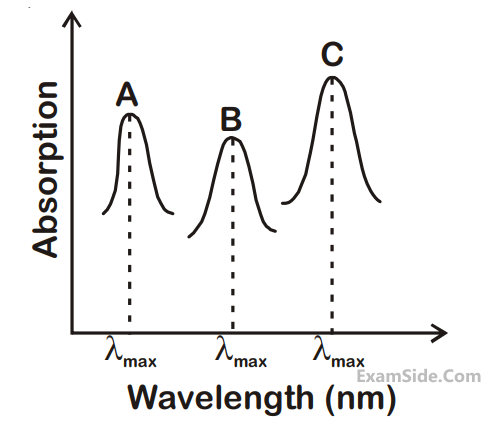
Simplified absorption spectra of three
complexes ((i), (ii) and (iii)) of Mn+ ion are
provided below; their $\lambda $max values are marked
as A, B and C respectively. The correct match
between the complexes and their $\lambda $max values is
(i) [M(NCS)6](–6 + n) (ii) [MF6](–6 + n) (iii) [M(NH3)6]n+
A.
A-(i), B-(ii), C-(iii)
B.
A-(ii), B-(iii), C-(i)
C.
A-(ii), B-(i), C-(iii)
D.
A-(iii), B-(i), C-(ii)
Correct Answer: D
Explanation:
Stronger the ligand greater is splitting of d orbitals and smaller will be wavelength of light absorbed.
iCON Education HYD, 79930 92826, 73309 7282614 Mar 2026
For octahedral Mn(II) and tetrahedral Ni(II)
complexes, consider the following statements:
(I) both the complexes can be high spin.
(II) Ni(II) complex can very rarely be low spin.
(III) with strong field ligands, Mn(II) complexes
can be low spin.
(IV)aqueous solution of Mn(II) ions is yellow in
colour.
The correct statements are :
A.
(I), (III) and (IV) only
B.
(I) and (II) only
C.
(II), (III) and (IV) only
D.
(I), (II) and (III) only
Correct Answer: D
Explanation:
(I) Under weak field ligand, octahedral Mn(II) and tetrahedral Ni(II) both the complexes are high spin
complex.
(II) Tetrahedral Ni(II) complex can very rarely be low spin because square planar (under strong ligand)
complexes of Ni(II) are low spin complexes.
(III)With strong field ligands Mn (II) complexes can be low spin because they have less number of unpaired
electron (unpaired electron = 1) While with weak field ligands Mn(II) complexes can be high spin
because they have more number of unpaired electron (unpaired electron = 5)
(IV) Aqueous solution of Mn(II) ions is pink in colour.
2020
Q261
JEE Mains
MCQ
iCON Education HYD, 79930 92826, 73309 7282614 Mar 2026
Consider that a d6 metal ion (M2+) forms a
complex with aqua ligands, and the spin only
magnetic moment of the complex is 4.90 BM.
The geometry and the crystal field stabilization
energy of the complex is
A.
tetrahedral and – 1.6 $\Delta $t
+ 1P
B.
octahedral and –2.4 $\Delta $0 + 2P
C.
tetrahedral and –0.6 $\Delta $t
D.
octahedral and –1.6 $\Delta $0
Correct Answer: C
Explanation:
Spin only magnetic moment = 4.9 = $\sqrt {n\left( {n + 2} \right)} $
iCON Education HYD, 79930 92826, 73309 7282614 Mar 2026
The correct order of the spin-only magnetic
moments of the following complexes is :
(I) [Cr(H2O)6]Br2 (II) Na4[Fe(CN)6]
(III) Na3[Fe(C2O4)3] ($\Delta $0 $>$ P)
(IV) (Et4N)2[CoCl4]
A.
(III) > (I) > (II) > (IV)
B.
(II) $ \approx $ (I) > (IV) > (III)
C.
(III) > (I) > (IV) > (II)
D.
(I) > (IV) > (III) > (II)
Correct Answer: D
Explanation:
(I) [Cr(H2O)6]Br2
H2O is weak field ligand so it can not pair up all the electrons.
Cr2+ : [Ar] 4s03d4 ($t_{2g}^3e{g^1}$)
Unpaired e– = 4
Magnetic moment = $\sqrt {24} $ = 4.89 BM
(II) Na4[Fe(CN)6]
CN- is strong field ligand so it pair up all the electrons.
Fe2+ = [Ar] 4s03d6 ($t_{2g}^6e{g^0}$)
Unpaired e– = 0
Magnetic moment = 0 BM
(III) Na3[Fe(C2O4)3]
As $\Delta $0 $>$ P, so pairing of electrons happens.
Fe3+ = [Ar] 4s03d5 ($t_{2g}^5e{g^0}$)
Unpaired e– = 1
Magnetic moment = $\sqrt 3 $ = 1.73 BM
(IV) (Et4N)2[CoCl4]
Cl-is weak field ligand so it can not pair up all the electrons.
Co2+ = [Ar] 4s03d7 ($e{g^4}t_{2g}^3$)
Unpaired e– = 3
Magnetic moment = $\sqrt {15} $ = 3.87 BM
Hence order of magnetic moment is
I > IV > III > II
2020
Q263
JEE Mains
MCQ
iCON Education HYD, 79930 92826, 73309 7282614 Mar 2026
The isomer(s) of [Co(NH3)4Cl2] that has/have
a Cl–Co–Cl angle of 90°, is/are :
A.
cis only
B.
cis and trans
C.
meridional and trans
D.
trans only
Correct Answer: A
Explanation:
[Co(NH3)4Cl2] has 2 geometrical isomers.
Among cis and trans isomers, cis isomer has Cl–Co–Cl angle of 90o.
2020
Q264
JEE Mains
MCQ
iCON Education HYD, 79930 92826, 73309 7282614 Mar 2026
Complex X of composition Cr(H2O)6Cln
has a spin only magnetic moment of 3.83
BM. It reacts with AgNO3 and shows
geometrical isomerism. The IUPAC
nomenclature of X is :
Spin only magnetic moment = $\sqrt {n\left( {n + 2} \right)} $ BM = 3.83
$ \Rightarrow $ n = 3
Chromium
in +3 oxidation state so molecular formula is
Cr(H2O)6Cln.
$ \therefore $ This formula have following isomers
(a) [Cr(H2O)6]Cl3 : react with AgNO3 but does
not show geometrical isomerism.
(b) [Cr(H2O)5Cl]Cl2.H2O react with AgNO3 but
does not show geometrical isomerism.
(c) [Cr(H2O)4Cl2]Cl.2H2O react with AgNO3 &
show geometrical isomerism.
(d) [Cr(H2O)3Cl3].3H2O does not react with
AgNO3 & show geometrical isomerism.
Compound will be
[Cr(H2O)4Cl2] Cl.2H2O
IUPAC NAME : Tetraaquadichlorido chromium(III) chloride dihydrate
2020
Q265
JEE Mains
MCQ
iCON Education HYD, 79930 92826, 73309 7282614 Mar 2026
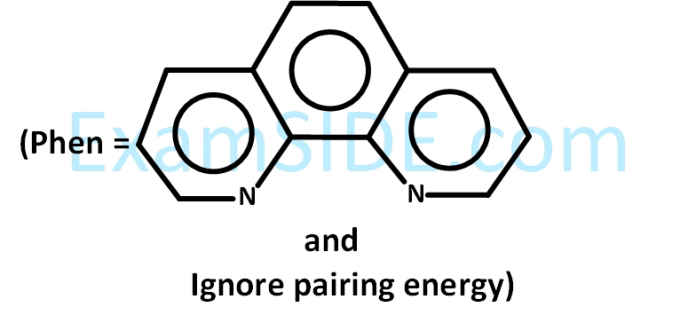
[Pd(F)(Cl)(Br)(I)]2– has n number of
geometrical isomers. Then, the spin-only
magnetic moment and crystal field stabilisation
energy [CFSE] of [Fe(CN)6]n–6, respectively,
are:
[Note : Ignore the pairing energy]
iCON Education HYD, 79930 92826, 73309 7282614 Mar 2026
The correct order of the calculated spin-only
magnetic moments of complexs (A) to (D) is:
(A) Ni(CO)4
(B) [Ni(H2O)6]Cl2
(C) Na2[Ni(CN)4]
(D) PdCl2(PPh3)2
A.
(C) < (D) < (B) < (A)
B.
(C) $ \approx $ (D) < (B) < (A)
C.
(A) $ \approx $ (C) $ \approx $ (D) < (B)
D.
(A) $ \approx $ (C) < (B) $ \approx $ (D)
Correct Answer: C
Explanation:
(A) Ni(CO)4
Ni = 3d84s2
CO is strong field ligand. So pairing of elections happens.
$ \therefore $ Number of unpaired electrons = 0
$ \therefore $ $\mu $spin = 0
(B) [Ni(H2O)6]Cl2
Ni+2 = 3d84s0
H2O is weak field ligand. So no pairing of electrons happens.
CN- is strong field ligand. So pairing of electrons happens.
Number of unpaired electron = 0
$ \therefore $ $\mu $spin = 0
(D) PdCl2(PPh3)2
Pd2+ = 4d8
This is dsp2 complex. And shape is square planar.
$ \therefore $ $\mu $spin = 0
2020
Q267
JEE Mains
MCQ
iCON Education HYD, 79930 92826, 73309 7282614 Mar 2026
Among (a) – (d) the complexes that can display
geometrical isomerism are :
(a) [Pt(NH3)3Cl]+
(b) [Pt(NH3)Cl5]–
(c) [Pt(NH3)2Cl(NO2)]
(d) [Pt(NH3)4ClBr]2+
A.
(a) and (b)
B.
(c) and (d)
C.
(d) and (a)
D.
(b) and (c)
Correct Answer: B
Explanation:
[Pt(NH3)2Cl(NO2)] and [Pt(NH3)4ClBr]2+ can display geometrical isomerism.
2020
Q268
JEE Mains
MCQ
iCON Education HYD, 79930 92826, 73309 7282614 Mar 2026
The complex that can show fac- and mer-isomers is :
A.
[CoCl2(en)2]
B.
[Pt(NH3)2Cl2]
C.
[Co(NH3)3(NO2)3]
D.
[Co(NH3)4Cl2]+
Correct Answer: C
Explanation:
[Ma3b3] type complex shows fac and mer
isomerism.
So [Co(NH3)3(NO2)3] is correct answer.
2020
Q269
JEE Mains
MCQ
iCON Education HYD, 79930 92826, 73309 7282614 Mar 2026
The number of possible optical isomers for the complexes MA2B2 with sp3 and dsp2 hydridized metal atom. respectively, is :
Note : A and B are unidentate netural and unidentate monoanionic ligands, respectively.
A.
0 and 2
B.
0 and 0
C.
0 and 1
D.
2 and 2
Correct Answer: B
Explanation:
(a) If the complex MA2B2 is sp3 hybridised then
the shape of this complex is tetrahedral this
structure is opticaly inactive due to the presence
of plane of symmetry.
(b) If the complex MA2B2 is dsp2 hybridised then
the shape of this complex is square planar.
Both isomers are optically inactive due to the
presence of plane of symmetry.
$ \therefore $ Total number of optical isomer is zero in both
the cases.
2020
Q270
JEE Mains
MCQ
iCON Education HYD, 79930 92826, 73309 7282614 Mar 2026
Among the statements(a)-(d) the incorrect ones are :
(a) Octahedral CO(III) complexes with strong fields ligands have very high magnetic moments.
(b) When $\Delta $0 < P, the d-electron configuration of Co(III) in an octahedral complex is $t_{eg}^4e_g^2$
(c) Wavelength of light absorbed by [Co(en)3]3+ is lower than that of [CoF6]3-
(d) If the $\Delta $0 for an octahedral complex of CO(III) is 18,000 cm-1, the $\Delta $t for its tetrahedral complex with the same ligand be 16,000 cm-1
A.
(a) and (b) only
B.
(b) and (c) only
C.
(c) and (d) only
D.
(a) and (d) only
Correct Answer: D
Explanation:
(a) Co3+ with strong field complex forms low
magnetic moment complex.
(b) If $\Delta $0 < P configuration of Co3+ will be $t_{eg}^4e_g^2$.
(c) Splitting power of ethylenediamine (en) is
greater than fluoride (F–) ligand therefore more
energy absorbed by [Co(en)3]3+ as compared to
[CoF6]3–.
So wave length of light absorbed by [Co(en)3]3+
is lower than that of [CoF6]3–
iCON Education HYD, 79930 92826, 73309 7282614 Mar 2026
Considering that $\Delta $0
> P, the magnetic moment (in BM) of [Ru(H2O)6]2+ would be _________.
Correct Answer: 0
Explanation:
Ru(44) : [Kr] 4d75s1
Ru+2 = [Kr]4d6
As $\Delta $0
> P,
$ \therefore $ Pairing of e–s will take place.
No. of unpaired e–s = 0
$ \therefore $ Magnetic moment = 0 B.M
2020
Q274
JEE Mains
Numerical
iCON Education HYD, 79930 92826, 73309 7282614 Mar 2026
The total number of coordination sites in ethylenediaminetetraacetate (EDTA4–) is _____.
Correct Answer: 6
Explanation:
[EDTA]4– is ethylenediaminetetraacetate anion.
It is a hexadentate ligand.
It has six co-ordination sites.
2020
Q275
JEE Mains
Numerical
iCON Education HYD, 79930 92826, 73309 7282614 Mar 2026
The oxidation states of iron atoms in
compounds (A), (B) and (C), respectively, are x,
y and z. The sum of x, y and z is ________.
Na4[Fe(CN)5(NOS)]
(A)
Na4[FeO4]
(B)
[Fe2(CO)9]
(C)
Correct Answer: 6
Explanation:
Na4[Fe(CN)5(NOS)]
Let the O.S. of Fe be x
OS of CN = –1
OS of NOS = –1
$ \therefore $ (+1)4 + x + (–1)5 + (–1)1 = 0
$ \Rightarrow $ x = +2
Na4[FeO4]
Let O.S. of Fe be y
(+1)4 + y + (–2)4 = 0
$ \Rightarrow $ y = +4
[Fe2(CO)9]
Let O.S. of Fe be z
2z + 0 × 9 = 0
$ \Rightarrow $ z = 0
so (x + y + z) = +2 + 4 + 0 = 6
2020
Q276
JEE Mains
Numerical
iCON Education HYD, 79930 92826, 73309 7282614 Mar 2026
Complexes (ML5) of metals Ni and Fe have
ideal square pyramidal and trigonal
bipyramidal grometries, respectively. The sum
of the 90°, 120° and 180° L-M-L angles in the
two complexes is ________.
Correct Answer: 20
Explanation:
$\angle $90o = 6
$\angle $120o = 3
$\angle $180o = 1
Total = 10
$\angle $90o = 8
$\angle $180o = 2
Total = 10
$ \therefore $ Total number of 180o, 90o and 120o L-M-L bond
angles = 10 + 10 = 20
2019
Q277
JEE Mains
MCQ
iCON Education HYD, 79930 92826, 73309 7282614 Mar 2026
The compound used in the treatment of lead poisoning is :
A.
desferrioxime B
B.
Cis-platin
C.
D-penicillamine
D.
EDTA
Correct Answer: D
Explanation:
EDTA is used in treatment of lead poisoning.
2019
Q278
JEE Mains
MCQ
iCON Education HYD, 79930 92826, 73309 7282614 Mar 2026
The coordination numbers of Co and Al in [Co(Cl)(en)2]Cl and K3[Al(C2O4)3], respectively, are :
(en = ethane-1, 2-diamine)
A.
3 and 3
B.
6 and 6
C.
5 and 3
D.
5 and 6
Correct Answer: D
Explanation:
Here in [Co(Cl)(en)2]Cl
'Cl' is monodentate so one coordinate linkage will be made with Co.
'en' is bidentate so two coordinate linkage will be made with Co. There are two 'en ' present so 4 coordinate linkage will be made with Co.
$ \therefore $ Total 5 coordinate linkage will be made with Co by Cl and en. So C.N. of Co is 5.
Here in K3[Al(C2O4)3]
C2O4-2 is bidentate so two coordinate linkage will be made with Al. There are three C2O4-2' present so 6 coordinate linkage will be made with Al.
$ \therefore $ So C.N. of Al is 6.
2019
Q279
JEE Mains
MCQ
iCON Education HYD, 79930 92826, 73309 7282614 Mar 2026
Complete removal of both the axial ligands (along the z-axis) from an octahedral complex leads to which of
the following splitting patterns? (relative orbital energies not on scale).
A.
B.
C.
D.
Correct Answer: A
Explanation:
The field becomes square planar and the order
of energy is
${d_{{x^2} - {y^2}}} > {d_{xy}} > {d_{{z^2}}} > {d_{zx}} = {d_{yz}}$
2019
Q280
JEE Mains
MCQ
iCON Education HYD, 79930 92826, 73309 7282614 Mar 2026
The complex ion that will lose its crystal field stabilization energy upon oxidation of its metal to +3 state is :
iCON Education HYD, 79930 92826, 73309 7282614 Mar 2026
The species that can have a trans-isomer is :
(en = ehane-1, 2-diamine, ox = oxalate)
A.
[Cr(en)2(ox)]+
B.
[Pt(en)Cl2]
C.
[Pt(en)2Cl2]2+
D.
[Zn(en)Cl2]
Correct Answer: C
Explanation:
2019
Q283
JEE Mains
MCQ
iCON Education HYD, 79930 92826, 73309 7282614 Mar 2026
Three complexes,
[CoCl(NH3)5]
2+(I),
[Co(NH3)5H2O]3+ (II) and
[Co(NH3)6]
3+(III)
absorb light in the visible region. The correct order of the wavelength of light absorbed by them is :
A.
(III) > (I) > (II)
B.
(III) > (II) > (I)
C.
(I) > (II) > (III)
D.
(II) > (I) > (III)
Correct Answer: C
Explanation:
As in a co-ordination compound, the strong field
ligand causes higher splitting of the d-orbitals
Also we know,
strength of ligand $ \propto $ ${1 \over {{\lambda _{absorbed}}}}$
Order of strength of ligand
NH3 > H2O > Cl-
Therefore decreasing order of wavelength
absorbed is (I) > (II) > (III)
2019
Q284
JEE Mains
MCQ
iCON Education HYD, 79930 92826, 73309 7282614 Mar 2026
The maximum possible denticities of a ligand
given below towards a common transition and
inner-transition metal ion, respectively, are :
A.
8 and 6
B.
8 and 8
C.
6 and 8
D.
6 and 6
Correct Answer: C
Explanation:
The maximum possible denticities of the given
ligand towards transition metal ion is 6.
The maximum possible denticities of the given
ligand
towards inner transition metal ion is 8.
2019
Q285
JEE Mains
MCQ
iCON Education HYD, 79930 92826, 73309 7282614 Mar 2026
The correct statements among I to III are :
(I) Valence bond theory cannot explain the
color exhibited by transition metal
complexes.
(II) Valence bond theory can predict
quantitatively the magnetic properties of
transtition metal complexes.
(III) Valence bond theory cannot distinguish
ligands as weak and strong field ones.
A.
(II) and (III) only
B.
(I) and (II) only
C.
(I), (II) and (III)
D.
(I) and (III) only
Correct Answer: D
Explanation:
To determine which statements are correct, let's analyze each one individually in the context of Valence Bond Theory (VBT) as it applies to transition metal complexes.
Statement (I):
"Valence bond theory cannot explain the color exhibited by transition metal complexes."
Analysis:
Color in Transition Metal Complexes:
The colors of transition metal complexes arise from electronic transitions between different energy levels of the d-orbitals, specifically d-d transitions.
These transitions occur when an electron absorbs light energy and moves from a lower-energy d-orbital to a higher-energy d-orbital.
Valence Bond Theory Limitations:
VBT focuses on the hybridization of atomic orbitals to form covalent bonds.
It does not account for the splitting of d-orbitals into different energy levels in the presence of ligands (known as crystal field splitting).
Therefore, VBT cannot explain the origin of color in these complexes because it doesn't address the electronic transitions responsible for color.
Conclusion:
Statement (I) is correct.
Statement (II):
"Valence bond theory can predict quantitatively the magnetic properties of transition metal complexes."
Analysis:
Magnetic Properties:
The magnetic behavior of a complex depends on the number of unpaired electrons in the metal ion.
Quantitative prediction requires calculating the magnetic moment, often using the formula:
VBT can provide a qualitative idea about the magnetic properties by indicating whether a complex is paramagnetic (unpaired electrons present) or diamagnetic (no unpaired electrons).
However, VBT does not offer the tools to quantitatively predict the exact magnetic moment.
Accurate quantitative predictions require more advanced theories like Crystal Field Theory (CFT) or Ligand Field Theory (LFT).
Conclusion:
Statement (II) is incorrect.
Statement (III):
"Valence bond theory cannot distinguish ligands as weak and strong field ones."
Analysis:
Weak and Strong Field Ligands:
Ligands are classified based on their ability to split the d-orbitals of the metal ion, influencing the pairing of electrons.
Strong field ligands cause a large splitting, often leading to low-spin complexes.
Weak field ligands cause small splitting, leading to high-spin complexes.
Valence Bond Theory Limitations:
VBT does not address the energy splitting of d-orbitals.
It assumes that all bonds are formed via overlap of orbitals without considering the effect of ligands on d-orbital energies.
Therefore, VBT cannot distinguish between weak and strong field ligands because it doesn't involve the spectrochemical series or orbital splitting concepts.
Conclusion:
Statement (III) is correct.
Final Answer:
Statements (I) and (III) are correct.
Statement (II) is incorrect.
Answer: Option D
(I) and (III) only
2019
Q286
JEE Mains
MCQ
iCON Education HYD, 79930 92826, 73309 7282614 Mar 2026
The one that will show optical activity is :
(en = ethane-1,2-diamine)
A.
B.
C.
D.
Correct Answer: C
Explanation:
2019
Q287
JEE Mains
MCQ
iCON Education HYD, 79930 92826, 73309 7282614 Mar 2026
The degenerate orbitals of [Cr(H2O)6]3+ are :
A.
dx2 and dxz
B.
dxz and dyz
C.
dyz and dz2
D.
dx2 - y2 and dxy
Correct Answer: B
Explanation:
Degenerate orbitals means orbitals of equal energy.
Cr3+ forms an
octahedral inner orbitals complex and its d orbital get splitted into two differnt energy level.
The two set of degenerate orbitals are
(1) dxy, dyz and
dxz
(2) dx2 - y2 and dz2
2019
Q288
JEE Mains
MCQ
iCON Education HYD, 79930 92826, 73309 7282614 Mar 2026
The compound that inhibits the growth of
tumors is :
A.
cis-[Pd(Cl)2(NH3)2]
B.
trans-[Pd(Cl)2(NH3)2]
C.
cis-[Pt(Cl)2(NH3)2]
D.
trans-[Pt(Cl)2(NH3)2]
Correct Answer: C
Explanation:
Cis-platin or cis-[Pt(Cl)2(NH3)2] is used as an anti-cancer drug.
2019
Q289
JEE Mains
MCQ
iCON Education HYD, 79930 92826, 73309 7282614 Mar 2026
The calculated spin-only magnetic moments
(BM) of the anionic and cationic species of
[Fe(H2O)6]2 and [Fe(CN)6], respectively, are :
A.
2.84 and 5.92
B.
4.9 and 0
C.
0 and 4.9
D.
0 and 5.92
Correct Answer: B
Explanation:
Compount is Fe(H2O)6]2 [Fe(CN)6]
Cation is Fe(H2O)6]2+
Anion is [Fe(CN)6]4-
2019
Q290
JEE Mains
MCQ
iCON Education HYD, 79930 92826, 73309 7282614 Mar 2026
The correct order of the spin-only magnetic moment of metal ions in the following low-spin
complexes, [V(CN)6]4–,[Fe(CN)6]4–, [Ru(NH3)6]3+, and [Cr(NH3)6]2+ , is :
A.
V2+ > Ru3+ > Cr2+ > Fe2+
B.
V2+ > Cr2+ > Ru3+ > Fe2+
C.
Cr2+ > V2+ > Ru3+ > Fe2+
D.
Cr2+ > Ru3+ > Fe2+ > V2+
Correct Answer: B
Explanation:
Here number of unpaired electrons = 3
$ \therefore $ Spin only magnetic moment ($\mu $) = $\sqrt {3\left( {3 + 2} \right)} = \sqrt {15} $ B.M
Note : Energy of t2g is less than eg. As electrons always go to the lower energy level orbitals first, that is why electrons goes to the t2g orbital first.
Here number of unpaired electrons = 0
$ \therefore $ Spin only magnetic moment ($\mu $) = 0 B.M
Note : (1) As CN- is a strong field ligand so Energy gap between eg and t2g orbital is very high.
(2) [Fe(CN)6]4– is an octahedral complex. And for octahedral complex Energy gap between eg and t2g orbital is called $\Delta $0 or Crystal Field splitting Energy.
(3) Energy required to pair up the electron in same orbital is called Pairing Energy(P).
(4) For strong field ligand, $\Delta $0 is very high and for weak field ligand, $\Delta $0 is very low.
(5) For strong field ligand, $\Delta $0 > P, so when electron gets energy, pairing of electrons happens as for pairing of electrons very low energy requied.
(6) For weak field ligand, $\Delta $0 < P, so when electron gets energy, pairing of electrons does not happens as the energy required to enter into the eg orbital is less than pairing energy. That is why electron go to eg orbital first.
(7) As CN- is a strong field ligand so pairing of electron occurs.
Here number of unpaired electrons = 1
$ \therefore $ Spin only magnetic moment ($\mu $) = $\sqrt {1\left( {1 + 2} \right)} = \sqrt {3} $ B.M
Note : (1) In [Ru(NH3)6]3+ complex, NH3 is a strong field ligand so Energy gap between eg and t2g orbital is very high. That is why pairing of electrons occurs.
Here number of unpaired electrons = 2
$ \therefore $ Spin only magnetic moment ($\mu $) = $\sqrt {2\left( {2 + 2} \right)} = \sqrt {8} $ B.M
$ \therefore $ Correct order of the spin-only magnetic moment of metal ions
V2+ > Cr2+ > Ru3+ > Fe2+
2019
Q291
JEE Mains
MCQ
iCON Education HYD, 79930 92826, 73309 7282614 Mar 2026
The following ligand is :
A.
hexadentate
B.
bidentate
C.
tetradentate
D.
tridentate
Correct Answer: C
Explanation:
Here two O- + two N = 4 donar atoms present which can donate total 4 lone pair of electrons.
$ \therefore $ It is tetradentate ligand.
2019
Q292
JEE Mains
MCQ
iCON Education HYD, 79930 92826, 73309 7282614 Mar 2026
The magnetic moment of an octahedral homoleptic Mn(II) complex is 5.9 BM. The suitable ligand for this complex is -
A.
CN$-$
B.
ethylenediamine
C.
NCS–
D.
CO
Correct Answer: C
Explanation:
Given, $\mu $ = 5.9 BM
$ \therefore $ n = number of unpaired electron = 5
For Mn+2 with 5 unpaired electronic configuration only possible when ligand is weak field ligand.
Here weak field ligand is NCS$-$.
2019
Q293
JEE Mains
MCQ
iCON Education HYD, 79930 92826, 73309 7282614 Mar 2026
The metal d-orbitals that are directly facing the ligands in K3[Co(CN)6] are -
A.
dx2$-$y2 and dz2
B.
dxy, dxz and dyz
C.
dxz, dyz and dz2
D.
dxy and dx2 $-$ y2
Correct Answer: A
Explanation:
Due to presence of strong field ligand (CN–) pairing occurs
in which two d-orbitals i.e., dx2–y2 and dz2 directly face the CN-
ligand.
2019
Q294
JEE Mains
MCQ
iCON Education HYD, 79930 92826, 73309 7282614 Mar 2026
Mn2(CO)10 is an organometallic compound due to the presence of -
A.
C–O bond
B.
Mn – Mn bond
C.
Mn – O bond
D.
Mn – C bond
Correct Answer: D
Explanation:
Compounds that contain at least one carbon-metal
bond are called organometallic compounds.
2019
Q295
JEE Mains
MCQ
iCON Education HYD, 79930 92826, 73309 7282614 Mar 2026
The pair of metal ions that can give a spin only magnetic moment of 3.9 BM for the complex [M(H2O)6]Cl2, is -
A.
V2+ and Fe2+
B.
V2+ and Co2+
C.
Co2+ and Fe2+
D.
Cr2+ and Mn2+
Correct Answer: B
Explanation:
Magnetic moment = $\sqrt {n\left( {n + 2} \right)} $ BM
H2O is weak field ligand so no pairing of electrons happens.
Fe2+ = t2g4eg2
Co2+ = t2g5eg2
V2+ = t2g3eg0
$ \therefore $ M is V, Co.
2019
Q296
JEE Mains
MCQ
iCON Education HYD, 79930 92826, 73309 7282614 Mar 2026
The coordination number of Th in K4[Th(C2O4)4(OH2)2] is :
(C2O${_4^{2 - }}$ = Oxalato)
A.
14
B.
10
C.
8
D.
6
Correct Answer: B
Explanation:
Oxalato (C2O42–) is a bidentate and H2O is unidentate
ligand.
4C2O42– creates 8 covalent bonds.
2H2O creates 2 covalent bonds.
$ \therefore $ Around Th 10 coordinate covalent bonds will be present.
2019
Q297
JEE Mains
MCQ
iCON Education HYD, 79930 92826, 73309 7282614 Mar 2026
The number of bridging CO ligand(s) and Co-Co bond(s) in Co2(CO)8, respectively are :
A.
2 and 0
B.
0 and 2
C.
4 and 0
D.
2 and 1
Correct Answer: D
Explanation:
2019
Q298
JEE Mains
MCQ
iCON Education HYD, 79930 92826, 73309 7282614 Mar 2026
Match the metals (column I) with the coordination compound(s)/enzyme(s) (column II)
(Column I) Metals
(Column II) Coordination compounds(s) enzyme(s)
(A)
Co
(i)
Wilkinson catalyst
(B)
Zn
(ii)
Chlorophyl
(C)
Rh
(iii)
Vitamin B12
(D)
Mg
(iv)
Carbonic anhydrase
A.
(A)-(iii); (B)-(iv); (C)-(i); (D)-(ii)
B.
(A)-(iv); (B)-(iii); (C)-(i); (D)-(ii)
C.
(A)-(i); (B)-(ii); (C)-(iii); (D)-(iv)
D.
(A)-(ii); (B)-(i); (C)-(iv); (D)-(iii)
Correct Answer: A
Explanation:
Co $ \to $ Vitamin B12
Zn $ \to $ Carbonic anhydrase
Rh $ \to $ Wilkinson catalyst
Mg $ \to $ Chlorophyll
2019
Q299
JEE Mains
MCQ
iCON Education HYD, 79930 92826, 73309 7282614 Mar 2026
A reaction of cobalt (III) chloride and ethylenediamine in a 1 : 2 mole ratio generates two isomeric products A (violet coloured) and B (green coloured). A can show optical activity, but B is optically inactive. What
type of isomers does A and B represcent?
A.
Ionisation isomers
B.
Linkage isomers
C.
Coordination isomers
D.
Geometrical isomers
Correct Answer: D
Explanation:
CoCl3
+ en $ \to $ [Co(en)2Cl2]Cl
1 : 2
A and B are Geometrical isomers.
2019
Q300
JEE Mains
MCQ
iCON Education HYD, 79930 92826, 73309 7282614 Mar 2026
The difference in the number of unpaired electrons of a metal ion in its high spin and low-spin octahedral complexes is two. The metal ion is :
A.
Mn2+
B.
Ni2+
C.
Co2+
D.
Fe2+
Correct Answer: C
Explanation:
$ \therefore $ The difference in the number of unpaired electrons = 3 - 1 = 2