Compounds Containing Nitrogen
Match List I with List II
| List I Isomeric pairs |
List II Type of isomers |
||
|---|---|---|---|
| A. | Propanamine and N-Methylethanamine | I. | Metamers |
| B. | Hexan-2-one and Hexan-3-one | II. | Positional isomers |
| C. | Ethanamide and Hydroxyethanimine | III. | Functional isomers |
| D. | o-nitrophenol and p-nitrophenol | IV. | Tautomers |
Choose the correct answer from the options given below :


Given below are two statements :


In the light of the above statements, choose the correct answer from the options given below:

Choose the correct colour of the product for the following reaction.


Given below are two statements:
Statement I : Pure Aniline and other arylamines are usually colourless.
Statement II : Arylamines get coloured on storage due to atmospheric reduction.
In the light of the above statements, choose the most appropriate answer from the options given below :
Increasing order of stability of the resonance structures is :

Choose the correct answer from the options given below :
Number of isomeric aromatic amines with molecular formula $\mathrm{C}_{8} \mathrm{H}_{11} \mathrm{~N}$, which can be synthesized by Gabriel Phthalimide synthesis is ____________.
Explanation:

How many of the transformations given below would result in aromatic amines?

Explanation:
Gabriel phthalimide synthesis cannot be used to prepare Aniline.

The Hinsberg reagent is


Which among the following is the strongest Bronsted base?


 is the strongest base among the given
compounds due to the maximum +I effect and the
lone pair of N is not in dynamic state so it can be
donated easily.
is the strongest base among the given
compounds due to the maximum +I effect and the
lone pair of N is not in dynamic state so it can be
donated easily.

Consider the above reaction, the compound 'A' is :


Which among the following represent reagent 'A'?


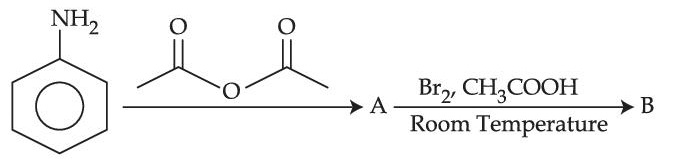
Consider the following reaction sequence:

The product 'B' is :


Given below are two statements: one is labelled as Assertion $\mathbf{A}$ and the other is labelled as Reason $\mathbf{R}$
Assertion A : Aniline on nitration yields ortho, meta & para nitro derivatives of aniline.
Reason $\mathrm{R}$ : Nitrating mixture is a strong acidic mixture.
In the light of the above statements, choose the correct answer from the options given below

Identify the correct statement for the below given transformation.


An organic compound $'\mathrm{A}'$ contains nitrogen and chlorine. It dissolves readily in water to give a solution that turns litmus red. Titration of compound $'\mathrm{A}'$ with standard base indicates that the molecular weight of $'\mathrm{A}'$ is $131 \pm 2$. When a sample of $'\mathrm{A}'$ is treated with aq. $\mathrm{NaOH}$, a liquid separates which contains $\mathrm{N}$ but not $\mathrm{Cl}$. Treatment of the obtained liquid with nitrous acid followed by phenol gives orange precipitate. The compound $'\mathrm{A}'$ is :


Match List I with List II.
| List I | List II | ||
|---|---|---|---|
| (A) | Benzenesulphonyl chloride | (I) | Test for primary amines |
| (B) | Hoffmann bromamide reaction | (II) | Anti Saytzeff |
| (C) | Carbylamine reaction | (III) | Hinsberg reagent |
| (D) | Hoffmann orientation | (IV) | Known reaction of Isocyanates. |
Choose the correct answer from the options given below:
The correct sequential order of the reagents for the given reaction is


The correct stability order of the following diazonium salt is


Given below are two statements : one is labelled as Assertion (A) and the other is labelled as Reason (R).
Assertion (A) : Experimental reaction of $\mathrm{CH}_{3} \mathrm{Cl}$ with aniline and anhydrous $\mathrm{AlCl}_{3}$ does not give $o$ and $p$-methylaniline.
Reason (R): The $-\mathrm{NH}_{2}$ group of aniline becomes deactivating because of salt formation with anhydrous $\mathrm{AlCl}_{3}$ and hence yields $m$-methyl aniline as the product.
In the light of the above statements, choose the most appropriate answer from the options given below :

An organic compound 'A' on reaction with NH3 followed by heating gives compound B. Which on further strong heating gives compound C (C8H5NO2). Compound C on sequential reaction with ethanolic KOH, alkyl chloride and hydrolysis with alkali gives a primary amine. The compound A is :


In Friedel-Crafts alkylation of aniline, one gets


Consider the above reactions, the product A and product B respectively are


With respect to the following reaction, consider the given statements :

(A) o-Nitroaniline and p-nitroaniline are the predominant products.
(B) p-Nitroaniline and m-nitroaniline are the predominant products.
(C) HNO3 acts as an acid.
(D) H2SO4 acts as an acid.
Choose the correct option.

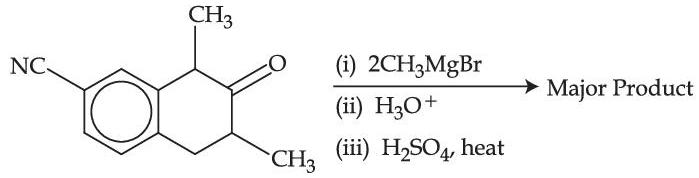
Identify the major product formed in the following sequence of reactions:


A primary aliphatic amine on reaction with nitrous acid in cold (273 K) and there after raising temperature of reaction mixture to room temperature (298 K), gives a/an
Decarboxylation of all six possible forms of diaminobenzoic acids C6H3(NH2)2COOH yields three products A, B and C. Three acids give a product 'A', two acids gives a product 'B' and one acid give a product 'C'. The melting point of product 'C' is

Given below are two statements :
Statement I : In Hofmann degradation reaction, the migration of only an alkyl group takes place from carbonyl carbon of the amide to the nitrogen atom.
Statement II : The group is migrated in Hofmann degradation reaction to electron deficient atom.
In the light of the above statements, choose the most appropriate answer from the options given below :
Which statement is NOT correct for p-toluenesulphonyl chloride?


The final product 'C' in the following series of reactions


Among the following structures, which will show the most stable enamine formation? (Where Me is $-$CH3)


Amongst the following, the major product of the given chemical reaction is


Which of the following ketone will NOT give enamine on treatment with secondary amines? [where t-Bu is $-$C(CH3)3]


The reaction of  with bromine and KOH gives RNH2 as the end product. Which one of the following is the intermediate product formed in this reation?


The conversion of propan-1-ol to n-butylamine involves the sequential addition of reagents. The correct sequential order of reagents is


The major product of the above reactions is :


The number of sp3 hybridised carbons in an acyclic neutral compound with molecular formula C4H5N is ___________.
Explanation:
$ \begin{aligned} \mathrm{DBE} & =(\mathrm{C}+1)-\left(\frac{\mathrm{H}+\mathrm{X}-\mathrm{N}}{2}\right) \\\\ & =4+1-\left(\frac{5-1}{2}\right)=5-2=3 \end{aligned} $
3 double bond equivalent are present in compound

Only 1 $s p^{3}$ hybridised carbon is there
(Keeping compound as acyclic)









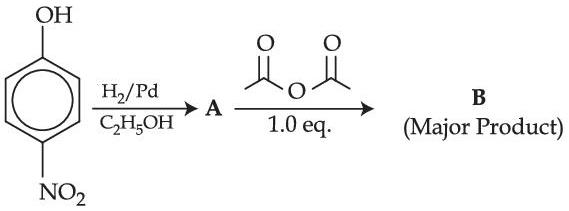


Choose the most appropriate match :


The major product in the above reaction is :


Consider the given reaction, identify 'X' and 'Y' :


Consider the above reaction and identify "Y"
