Compounds Containing Nitrogen
Identify the product A in the following reaction.


Given below are two statements :
Statement I : Piciric acid is 2,4,6 - trinitrotoluene.
Statement II : Phenol - 2,4 - disulphonic acid is treated with Conc. $\mathrm{HNO}_3$ to get picric acid.
In the light of the above statements, choose the most appropriate answer from the options given below :
Identify compound (Z) in the following reaction sequence.


Which of the following nitrogen containing compound does not give Lassaigne's test ?
Statement (I) : The $\mathrm{NH}_2$ group in Aniline is ortho and para directing and a powerful activating group.
Statement (II) : Aniline does not undergo Friedel-Craft's reaction (alkylation and acylation).
In the light of the above statements, choose the most appropriate answer from the options given below :
Statement (I) : Aminobenzene and aniline are same organic compounds.
Statement (II) : Aminobenzene and aniline are different organic compounds.
In the light of the above statements, choose the most appropriate answer from the options given below :
The azo-dye $(Y)$ formed in the following reactions is
Sulphanilic acid $+\mathrm{NaNO}_2+\mathrm{CH}_3 \mathrm{COOH} \rightarrow \mathrm{X}$.


Given below are two statements :
Statement I : Aniline reacts with con. $\mathrm{H}_2 \mathrm{SO}_4$, followed by heating at $453-473 \mathrm{~K}$ gives $\mathrm{p}$-aminobenzene sulphonic acid, which gives blood red colour in the 'Lassaigne's test'.
Statement II : In Friedel - Craft's alkylation and acylation reactions, aniline forms salt with the $\mathrm{AlCl}_3$ catalyst. Due to this, nitrogen of aniline aquires a positive charge and acts as deactivating group.
In the light of the above statements, choose the correct answer from the options given below :

The products A and B formed in the following reaction scheme are respectively


Following is a confirmatory test for aromatic primary amines. Identify reagent (A) and (B).


Which of the following reaction is correct?


The product A formed in the following reaction is


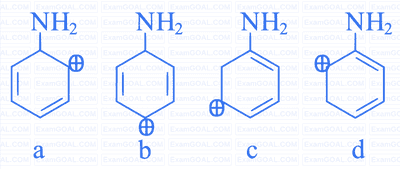
the arenium ion which is not involved in the bromination of Aniline is __________.


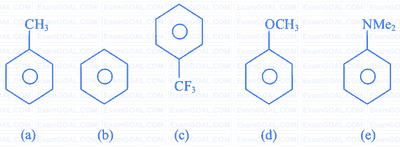
Number of compounds from the following which cannot undergo Friedel-Crafts reactions is: _________
toluene, nitrobenzene, xylene, cumene, aniline, chlorobenzene, $m$-nitroaniline, $m$-dinitrobenzene
Explanation:
Compounds which can not undergo Friedel Crafts reaction are

If $279 \mathrm{~g}$ of aniline is reacted with one equivalent of benzenediazonium chloride, the maximum amount of aniline yellow formed will be ________ g. (nearest integer)
(consider complete conversion).
Explanation:

Mole of aniline $=\frac{279}{93}=3 \mathrm{~mol}$
Mole of aniline yellow formed $=3 \mathrm{~mol}$
$\begin{gathered} \text { Mass }=3 \times 197 \\ =591 \mathrm{~g} \end{gathered}$
Number of amine compounds from the following giving solids which are soluble in $\mathrm{NaOH}$ upon reaction with Hinsberg's reagent is _________.

Explanation:
$-\mathrm{NH}_2$ group containing compound can give solid with Hinsberg's reagent, which is soluble in $\mathrm{NaOH}$ solution
 can give solid with Heinsberg reagent, which is soluble in NaOH solution.
An amine $(\mathrm{X})$ is prepared by ammonolysis of benzyl chloride. On adding p-toluenesulphonyl chloride to it the solution remains clear. Molar mass of the amine $(\mathrm{X})$ formed is _________ $\mathrm{g} \mathrm{mol}^{-1}$.
(Given molar mass in $\mathrm{gmol}^{-1} \mathrm{C}: 12, \mathrm{H}: 1, \mathrm{O}: 16, \mathrm{~N}: 14$)
Explanation:

Molar mass of amine $=287 \mathrm{~g} / \mathrm{mol}$
$9.3 \mathrm{~g}$ of pure aniline upon diazotisation followed by coupling with phenol gives an orange dye. The mass of orange dye produced (assume 100% yield/conversion) is ________ g. (nearest integer)
Explanation:
$\begin{aligned} & \text { Moles of aniline }=0.1 \\ & \text { Moles of dye }=0.1 \\ & \text { Mass of dye }=0.1 \times 198=19.8 \mathrm{~gm} \\ & \approx 20 \\ & \end{aligned}$
$\mathrm{X} \mathrm{~g}$ of ethanamine was subjected to reaction with $\mathrm{NaNO}_2 / \mathrm{HCl}$ followed by hydrolysis to liberate $\mathrm{N}_2$ and $\mathrm{HCl}$. The $\mathrm{HCl}$ generated was completely neutralised by 0.2 moles of $\mathrm{NaOH} . \mathrm{X}$ is _________ g.
Explanation:
$\begin{aligned} & \mathrm{HCl}+\mathrm{NaOH} \rightarrow \mathrm{NaCl}+\mathrm{H}_2 \mathrm{O} \\ & \mathrm{mol} \text { of } \mathrm{HCl}=0.2 \mathrm{~mol} \end{aligned}$
$\mathrm{CH}_3 \mathrm{CH}_2 \mathrm{NH}_2 \xrightarrow[+\mathrm{HCl}]{\mathrm{NaNO}_2} \mathrm{CH}_3 \mathrm{CH}_2 \mathrm{N}_2^{+} \mathrm{Cl}^{-} \xrightarrow{\mathrm{H}_2 \mathrm{O}} \mathrm{CH}_3 \mathrm{CH}_2 \mathrm{OH}+\mathrm{N}_2+\mathrm{HCl}$
$0.2 \mathrm{~mol} \mathrm{~HCl}$ would be generated by $0.2 \mathrm{~mol}$ $\mathrm{C}_2 \mathrm{H}_5 \mathrm{NH}_2$
$\mathrm{x}=0.2 \times 45=9 \mathrm{~g}$
$9.3 \mathrm{~g}$ of pure aniline is treated with bromine water at room temperature to give a white precipitate of the product '$\mathrm{P}$'. The mass of product '$\mathrm{P}$' obtained is $26.4 \mathrm{~g}$. The percentage yield is ________ %.
Explanation:

moles of aniline taken $=\frac{9.3}{93}=0.1$
$\% \text { yield }=\frac{26.4}{0.1 \times 330} \times 100=80 \%$
Phthalimide is made to undergo following sequence of reactions.

Total number of $\pi$ bonds present in product 'P' is/are ________.
Explanation:

Total number of $\pi$ bonds in P = 8
The number of the correct reaction(s) among the following is _______.

Explanation:
Only reaction in option (C) is correct.

Explanation:

A compound $(x)$ with molar mass $108 \mathrm{~g} \mathrm{~mol}^{-1}$ undergoes acetylation to give product with molar mass $192 \mathrm{~g} \mathrm{~mol}^{-1}$. The number of amino groups in the compound $(x)$ is ___________.
Explanation:

Gain in molecular weight after acylation with one $-\mathrm{NH}_2$ group is 42.
Total increase in molecular weight $=84$
$\therefore$ Number of amino group in $x=\frac{84}{42}=2$
The compound formed by the reaction of ethanal with semicarbazide contains _________ number of nitrogen atoms.
Explanation:

When ethanal reacts with semicarbazide, semi-carbazone is formed via condensation, number of nitrogen atoms present in product is 3.
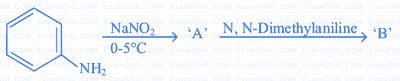
The product ' $\mathrm{B}$ ' is



Compound $\mathrm{A}$ from the following reaction sequence is:


Match List I with List II
1 - Bromopropane is reacted with reagents in List I to give product in List II
| LIST I - Reagent | LIST II - Product | ||
|---|---|---|---|
| A. | $\mathrm{KOH}$ (alc) | I. | Nitrile |
| B. | $\mathrm{KCN}$ (alc) | II. | Ester |
| C. | $\mathrm{AgNO_2}$ | III. | Alkene |
| D. | $\mathrm{H_3CCOOAg}$ | IV. | Nitroalkane |
Choose the correct answer from the options given below:
In the reaction given below

'B' is


The incorrect statement regarding the reaction given below is


'X' is


The major product 'P' formed in the given reaction is:


In the reaction given below:

The product 'X' is:


Isomeric amines with molecular formula C$_8$H$_{11}$N give the following tests
Isomer (P) $\Rightarrow$ Can be prepared by Gabriel phthalimide synthesis
Isomer (Q) $\Rightarrow$ Reacts with Hinsberg's reagent to give solid insoluble in NaOH
Isomer (R) $\Rightarrow$ Reacts with HONO followed by $\beta$-naphthol in NaOH to give red dye.
Isomers (P), (Q) and (R) respectively are


The product ($\mathrm{P}$) formed from the following multistep reaction is:


Match List I with List II:

| LIST I (Reagent) | LIST II (Product) | ||
|---|---|---|---|
| A. |  |
I. |  |
| B. | $\mathrm{HBF_4,\Delta}$ | II. |  |
| C. | $\mathrm{Cu,HCl}$ | III. |  |
| D. | $\mathrm{CuCN/KCN}$ | IV. |  |
Choose the correct answer from the options given below:


The major products A and B from the following reactions are:


The major product formed in the following reaction is


Compound $\mathrm{P}$ is neutral, $\mathrm{Q}$ gives effervescence with $\mathrm{NaHCO}_{3}$ while $\mathrm{R}$ reacts with Hinsbergs reagent to give solid soluble in $\mathrm{NaOH}$. Compound $\mathrm{P}$ is


In the following reaction, 'A' is


Consider the above reaction and identify the product B.




In the above conversion of compound $(\mathrm{X})$ to product $(\mathrm{Y})$, the sequence of reagents to be used will be:

Benzyl isocyanide can be obtained by :
A. 
B. 
C. 
D. 
Choose the correct answer from the options given below :


Reaction of propanamide with $\mathrm{Br_2/KOH(aq)}$ produces :
The major product 'P' for the following sequence of reactions is :


Match List I with List II
| List I | List II | ||
|---|---|---|---|
| Reaction | Reagents | ||
| (A) | Hoffmann Degradation | (I) | $\mathrm{Conc. KOH}$, $\Delta$ |
| (B) | Clemenson reduction | (II) | $\mathrm{CHCl_3,NaOH/H_3O}$$^ \oplus $ |
| (C) | Cannizaro reaction | (III) | $\mathrm{Br_2,NaOH}$ |
| (D) | Reimer-Tiemann Reaction | (IV) | $\mathrm{Zn-Hg/HCl}$ |
Choose the correct answer from the options given below :
Match List I with List II
| List I (Amines) | List II ($\mathrm{pK_b}$) | ||
|---|---|---|---|
| A. | Aniline | I. | 3.25 |
| B. | Ethanamine | II. | 3.00 |
| C. | N-Ethylethanamine | III. | 9.38 |
| D. | N, N-Diethylethanamine | IV. | 3.29 |
Choose the correct answer from the options given below :