Basics of Organic Chemistry
Identify the correct statements :
The presence of –NO2 group in benzene ring
A. activates the ring towards electrophilic substitutions.
B. deactivates the ring towards electrophilic substitutions.
C. activates the ring towards nucleophilic substitutions.
D. deactivates the ring towards nucleophilic substitutions.
Choose the correct answer from the options given below :
A and D Only
B and D Only
C and A Only
B and C Only
The cyclic cations having the same number of hyperconjugation are :

Choose the correct answer from the options given below :
B and C Only
A and B Only
A and C Only
A, C and D only


CORRECT order of stability for the following is
$\mathrm{CH}_2=\mathrm{CH}^{-}, \mathrm{CH}_3-\mathrm{CH}_2^{-}, \mathrm{CH} \equiv \mathrm{C}^{-}$
$\mathrm{CH} \equiv \mathrm{C}^{-}>\mathrm{CH}_3-\mathrm{CH}_2^{-}>\mathrm{CH}_2=\mathrm{CH}^{-}$
$\mathrm{CH}_2=\mathrm{CH}^{-}>\mathrm{CH} \equiv \mathrm{C}^{-}>\mathrm{CH}_3-\mathrm{CH}_2^{-}$
$\mathrm{CH} \equiv \mathrm{C}^{-}>\mathrm{CH}_2=\mathrm{CH}^{-}>\mathrm{CH}_3-\mathrm{CH}_2^{-}$
$\mathrm{CH}_3-\mathrm{CH}_2^{-}>\mathrm{CH}_2=\mathrm{CH}^{-}>\mathrm{CH} \equiv \mathrm{C}^{-}$
Given below are two statements :
Statement I : There are several conformers for n -butane. Out of those conformers,

Statement II : As the dihedral angle increases, torsional strain decreases from (X) to $(\mathrm{Y})$.
In the light of the above statements, choose the correct answer from the options given below
Statement I is false but Statement II is true
Both Statement I and Statement II are false
Statement I is true but Statement II is false
Both Statement I and Statement II are true
Find out the statements which are not true.
A. Resonating structures with more number of covalent bonds and lesser charge separation are more stable.
B. In electromeric effect, an unsaturated system shows +E effect with nucleophile and -E effect with electrophile.
C. Inductive effect is responsible for high melting point, boiling point and dipole moment of polar compounds.
D. The greater the number of alkyl groups attached to the doubly bonded carbon atoms, higher is the heat of hydrogenation.
E. Stability of carbanion increases with the increase in $\mathrm{s}-$ character of the carbon carrying the negative charge.
Choose the correct answer from the options given below :
A, D & E only
A, C & D only
B & D only
B, D & E only
$ \text { Arrange the following carbanions in the decreasing order of stability. } $

Choose the correct answer from the options given below :
I $>$ II $>$ IV $>$ V $>$ III
IV $>$ II $>$ I $>$ III $>$ V
$\mathrm{I}>\mathrm{IV}>\mathrm{II}>\mathrm{V}>\mathrm{III}$
IV $>$ I $>$ II $>$ V $>$ III
Given below are two statements :
Statement I : $\left(\mathrm{CH}_3\right)_3 \stackrel{\oplus}{\mathrm{C}}$ is more stable than $\stackrel{\oplus}{\mathrm{C}} \mathrm{H}_3$ as nine hyperconjugation interactions are possible in $\left(\mathrm{CH}_3\right)_3 \stackrel{\oplus}{\mathrm{C}}$.
Statement II : $\stackrel{\oplus}{\mathrm{C}}\mathrm{H}_3$ is less stable than $\left(\mathrm{CH}_3\right)_3 \stackrel{\oplus}{\mathrm{C}}$ as only three hyperconjugation interactions are possible in $\stackrel{\oplus}{\mathrm{C}} \mathrm{H}_3$.
In the light of the above statements, choose the correct answer from the options given below
Statement I is false but Statement II is true
Statement I is true but Statement II is false
Both Statement I and Statement II are true
Both Statement I and Statement II are false
Given below are two statements :
Statement I : Sublimation is used for the separation and purification of compounds with low melting point.
Statement II : The boiling point of a liquid increases as the external pressure is reduced. In the light of the above statements,
choose the correct answer from the options given below :
Both Statement I and Statement II are false
Statement I is true but Statement II is false
Both Statement I and Statement II are true
Statement I is false but Statement II is true
$ \text { The IUPAC name of the following compound is : } $

2-bromo-5-methylhexylpropanoate
n-propyl-1-bromo-4-methylhexanoate
n-propyl-2-bromo-5-methylheptanoate
2-bromo-5-methylpropanoate

Match List - I with List - II.
| List - I Pair of Compounds |
List - II Type of Isomers |
|---|---|
| A. 2-Methylpropene and but-1-ene | I. Stereoisomers |
| B. Cis-but-2-ene and trans-but-2-ene | II. Position isomers |
| C. 2-Butanol and diethyl ether | III. Chain isomers |
| D. But-1-ene and but-2-ene | IV. Functional group isomers |
Choose the correct answer from the options given below :
A-III, B-I, C-IV, D-II
A-II, B-I, C-IV, D-III
A-I, B-IV, C-III, D-II
A-III, B-I, C-II, D-IV

Given below are four compounds :
(a) n-propyl chloride (b) iso-propyl chloride
(c) sec-butyl chloride (d) neo-pentyl chloride
Percentage of carbon in the one which exhibits optical isomerism is :
46
40
52
56

$ \text { From the following, the least stable structure is : } $


Identify correct statements from the following :
A. Propanal and propanone are functional isomers.
B. Ethoxyethane and methoxypropane are metamers.
C. But-2-ene shows optical isomerism.
D. But-1-ene and but-2-ene are functional isomers.
E. Pentane and 2, 2-dimethyl propane are chain isomers.
Choose the correct answer from the options given below :
A, B and E only
A, B and C only
C, D and E only
B, C and D only

0.53 g of an organic compound $(\mathrm{x})$ when heated with excess of nitric acid (concentrated) and then with silver nitrate gave 0.75 g of silver bromide precipitate. 1.0 g of $(\mathrm{x})$ gave 1.32 g of $\mathrm{CO}_2$ gas on combustion. The percentage of hydrogen in the compound $(x)$ is $\_\_\_\_$ %. [Nearest Integer]
[Given: Molar mass in $\mathrm{g} \mathrm{mol}^{-1} \mathrm{H}: 1, \mathrm{C}: 12, \mathrm{Br}: 80, \mathrm{Ag}: 108, \mathrm{O}: 16$; Compound (x) : $\left.\mathrm{C}_{\mathrm{x}} \mathrm{H}_{\mathrm{y}} \mathrm{Br}_{\mathrm{z}}\right]$
Explanation:
From the given data, the compound is of type $C_xH_yBr_z$.
1) Percentage of bromine from AgBr precipitate
Molar mass of $\mathrm{AgBr} = 108 + 80 = 188\ \mathrm{g\,mol^{-1}}$
Moles of $\mathrm{AgBr}$ formed:
$n(\mathrm{AgBr})=\frac{0.75}{188}=0.003989\ \mathrm{mol}$
Each mole of $\mathrm{AgBr}$ contains 1 mole of Br, so
$n(\mathrm{Br})=0.003989\ \mathrm{mol}$
Mass of Br in $0.53\ \mathrm{g}$ of compound:
$m(\mathrm{Br})=0.003989\times 80=0.3191\ \mathrm{g}$
So, mass fraction of Br:
$\text{Br fraction}=\frac{0.3191}{0.53}=0.602$
Hence, in $1.0\ \mathrm{g}$ of compound:
$m(\mathrm{Br})=0.602\ \mathrm{g}$
2) Mass of carbon from $\mathrm{CO_2}$ on combustion
Given $1.0\ \mathrm{g}$ compound gives $1.32\ \mathrm{g\ CO_2}$.
Moles of $\mathrm{CO_2}$:
$n(\mathrm{CO_2})=\frac{1.32}{44}=0.03\ \mathrm{mol}$
Moles of carbon $= 0.03\ \mathrm{mol}$, so mass of carbon:
$m(\mathrm{C})=0.03\times 12=0.36\ \mathrm{g}$
3) Mass and percentage of hydrogen
In $1.0\ \mathrm{g}$ compound:
$m(\mathrm{H})=1.0-(0.602+0.36)=0.038\ \mathrm{g}$
Therefore, percentage of hydrogen:
$\%\,\mathrm{H}=\frac{0.038}{1.0}\times 100=3.8\%$
Nearest integer $= \boxed{4\%}$.
Given below are two statements :
Statement I : Vapours of the liquid with higher boiling point condense before vapours of the liquid with lower boiling points in fractional distillation.
Statement II : The vapours rising up in the fractionating column become richer in high boiling component of the mixture.
In the light of the above statements, choose the correct answer from the options given below :
Both Statement I and Statement II are true
Both Statement I and Statement II are false
Statement I is true but Statement II is false
Statement I is false but Statement II is true
$ \text { The total number of aromatic compounds/species from the following is } $

6
4
3
5


Shown below is the structure of methyl acetate with three different $\alpha, \beta$ and $\gamma$ carbon - oxygen bonds.

The correct order of bond lengths of these bonds is :
$ \alpha>\beta>\gamma $
$ \alpha<\beta<\gamma $
$ \alpha=\beta=\gamma $
$ \alpha<\beta=\gamma $


Given below are two statements :
Statement I : On the basis of inductive effect, the order of stability of alkyl carbanions is $\mathrm{CH}_3{ }^{-}>\mathrm{CH}_3-\mathrm{CH}_2{ }^{-}>\left(\mathrm{CH}_3\right)_2 \mathrm{CH}^{-}>\left(\mathrm{CH}_3\right)_3 \mathrm{C}^{-}$.
Statement II : Allyl and benzyl carbanions are more stabilised by inductive effect and not by resonance effect.
In the light of the above statements, choose the correct answer from the options given below :
Both Statement I and Statement II are correct
Both Statement I and Statement II are incorrect
Statement I is correct but Statement II is incorrect
Statement I is incorrect but Statement II is correct

$ \text { Match the LIST-I with LIST-II } $
| List-I Reaction |
List-I Mechanism |
||
|---|---|---|---|
| A. | Williamson Synthesis | I. | Electrophilic addition |
| B. | Friedel Craft Reaction | II. | Free radical substitution |
| C. | Bromination of vinyl benzene | III. | Nucleophilic substitution |
| D. | Chlorination of toluene in light | IV. | Electrophilic substitution |
Choose the correct answer from the options given below:
A-III, B-I, C-II, D-IV
A-III, B-IV, C-II, D-I
A-III, B-IV, C-I, D-II
A-I, B-III, C-IV, D-II
$ \text { Consider the following molecules/species : } $

$ \text { The correct order of carbon-oxygen double bond length is : } $
$ x>y>z $
$ \mathrm{y}>\mathrm{z}>x $
$ \mathrm{z}>x>\mathrm{y} $
$ x>\mathrm{z}>\mathrm{y} $


$ \text { The following structures are } $

enantiomers.
identical molecules.
diastereomers.
meso compounds.
$ \text { The descending order of acidity among the following compounds is : } $

Choose the correct answer from the options given below :
$ B>D>E>A>C $
$ \mathrm{D}>\mathrm{B}>\mathrm{E}>\mathrm{A}>\mathrm{C} $
$ C>A>B>D>E $
$ D>E>B>A>C $


$ \text { The strongest conjugate acid will result from : } $


Increasing order of electron withdrawing power of following functional groups is :
a. -CN
b. -COOH
c. $-\mathrm{NO}_2$
d. -I
$ \mathrm{c}<\mathrm{b}<\mathrm{d}<\mathrm{a} $
$ \mathrm{c}<\mathrm{a}<\mathrm{b}<\mathrm{d} $
$ \mathrm{a}<\mathrm{b}<\mathrm{c}<\mathrm{d} $
Given below are two statements :
Statement I : In  , the carbocation is stabilised by +R effect of –OCH3 group.
Statement II : In  , the carbanion is stabilised by –R effect of –NO2 group.
In the light of the above statements, choose the correct answer from the options given below :
Both Statement I and Statement II are true
Both Statement I and Statement II are false
Statement I is true but Statement II is false
Statement I is false but Statement II is true


In IUPAC nomenclature, the correct order of decreasing priority of functional group is :


For the given molecule, "x", the preferred site for the attack of the electrophile is :

Predominantly at "r"
"r" and "u"
"p" and "s"
Predominantly at "u"
Match the LIST-I with LIST-II
| LIST-I | LIST-II |
|---|---|
| A. Carbocation | I. Species that can supply a pair of electrons. |
| B. C-Free radical | II. Species that can receive a pair of electrons. |
| C. Nucleophile | III. sp2 hybridized carbon with empty p-orbital. |
| D. Electrophile | IV. sp2/sp3 hybridized carbon with one unpaired electron. |
Choose the correct answer from the options given below:
A-IV, B-II, C-III, D-I
A-II, B-III, C-I, D-IV
A-III, B-IV, C-I, D-II
A-III, B-IV, C-II, D-I


What is the correct IUPAC name of the compound?

1-Ethylcyclopent-2-en-3-ol
4-Ethylcyclopent-2-en-1-ol
1-Ethyl-3-hydroxycyclopent-2-ene
4-Ethyl-1-hydroxycyclopent-2-ene

The descending order of basicity of the following amines is :


(D) $ \mathrm{CH}_3 \mathrm{NH}_2$
(E) $\left(\mathrm{CH}_3\right)_2 \mathrm{NH}$
Choose the correct answer from the options given below :
E > A > D > C > B
E > D > A > B > C
E > D > B > A > C
B > E > D > A > C

The number of optically active products obtained from the complete ozonolysis of the given compound is :

4
0
2
1

Which of the following is the correct IUPAC name of given organic compound (X)?


The IUPAC name of the following compound is:


In which pairs, the first ion is more stable than the second?


The correct order of basicity for the following molecules is :


$ \text { What is the correct IUPAC name of } $
 ?
?

Given below are two statements :
Statement I : Hyperconjugation is not a permanent effect.
Statement II : In general, greater the number of alkyl groups attached to a positively charged Cation, greater is the hyperconjugation interaction and stabilization of the cation.
In the light of the above statements, choose the correct answer from the options given below
$ \text {Identify the correct statements from the following. } $
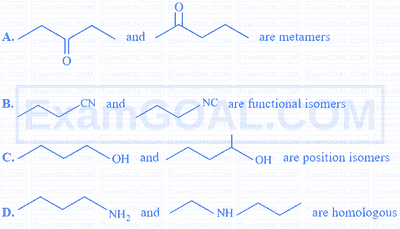
$ \text {Choose the correct answer from the options given below: } $

$ \text { The least acidic compound, among the following is: } $



Consider the following compound (X)

The most stable and least stable carbon radicals, respectively, produced by homolytic cleavage of corresponding $\mathrm{C}-\mathrm{H}$ bond are :

Designate whether each of the following compounds is aromatic or not aromatic.


Given below are two statements :
Statement (I): On nitration of m-xylene with $\mathrm{HNO}_3, \mathrm{H}_2 \mathrm{SO}_4$ followed by oxidation, 4-nitrobenzene-1,3-dicarboxylic acid is obtained as the major product.
Statement (II) : $-\mathrm{CH}_3$ group is o/p-directing while $-\mathrm{NO}_2$ group is m-directing group.
In the light of the above statements, choose the correct answer from the options given below :
Statement I is true but Statement II is false
Both Statement I and Statement II are true
Both Statement I and Statement II are false
Statement I is false but Statement II is true

Given below are two statements :
Statement (I): In partition chromatography, stationary phase is thin film of liquid present in the inert support.
Statement (II): In paper chromatography, the material of paper acts as a stationary phase.
In the light of the above statements, choose the correct answer from the options given below :
Statement I is true but Statement II is false
Statement I is false but Statement II is true
Both Statement I and Statement II are false
Both Statement I and Statement II are true
Match List - I with List - II.
| List - I (Structure) | List - II (IUPAC Name) |
|---|---|
(A)  |
(I) 4-Methylpent-1-ene |
| (B) (CH3)2C(C3H7)2 | (II) 3-Ethyl-5-methylheptane |
(C)  |
(III) 4,4-Dimethylheptane |
(D)  |
(IV) 2-Methyl-1,3-pentadiene |
Choose the correct answer from the options given below :
(A)-(II), (B)-(III), (C)-(IV), (D)-(I)
(A)-(II), (B)-(III), (C)-(I), (D)-(IV)
(A)-(III), (B)-(IV), (C)-(I), (D)-(II)
(A)-(III), (B)-(II), (C)-(I), (D)-(IV)


Total number of nucleophiles from the following is :

4
6
5
7
 primarily acts as an electrophile in reactions. It can readily accepts electron pairs from other molecules due to the partial positive charge on the carbonyl carbon atom.
 - It is not a nucleophile.
 and generally act as electrophile in reactions. The carbon in the $C=N$ double bond is electrophile and attacked by nucleophiles.
Given below are two statements:
Statement I: and
and  are isomeric compounds.
Statement II:  and
and  are functional group isomers.
In the light of the above statements, choose the correct answer from the options given below:
Statement I is false but Statement II is true
Both Statement I and Statement II are true
Statement I is true but Statement II is false
Both Statement I and Statement II are false


The correct order of stability of following carbocations is :


In the given structure, number of sp and $\mathrm{sp}^2$ hybridized carbon atoms present respectively are :


Identify correct statement/s :
(A) $-\mathrm{OCH}_3$ and $-\mathrm{NHCOCH}_3$ are activating group.
(B) $\quad-\mathrm{CN}$ and -OH are meta directing group.
(C) -CN and $-\mathrm{SO}_3 \mathrm{H}$ are meta directing group.
(D) Activating groups act as ortho - and para directing groups.
(E) Halides are activating groups.
Choose the correct answer from the options given below :