Question 1
Question: Two identical point masses $P$ and $Q$, suspended from two separate massless springs of spring constants $k_1$ and $k_2$, respectively, oscillate vertically. If their maximum speeds are the same, the ratio ($A_Q/A_P$) of the amplitude $A_Q$ of mass $Q$ to the amplitude $A_P$ of mass $P$ is.
Options:
A. $\sqrt{\frac{k_2}{k_1}}$
B. $\sqrt{\frac{k_1}{k_2}}$
C. $\frac{k_2}{k_1}$
D. $\frac{k_1}{k_2}$
Correct Answer: B
Year: NEET 2025
Solution (as given in the source): The maximum velocity $V$ for an oscillating mass is given by $V = A\omega$, where $A$ is amplitude and $\omega$ is angular frequency. Given $v_P = v_Q$, then $A_P\omega_P = A_Q\omega_Q$. This implies $\frac{A_Q}{A_P} = \frac{\omega_P}{\omega_Q}$. Since $\omega = \sqrt{\frac{k}{m}}$, then $\omega_P = \sqrt{\frac{k_1}{m}}$ and $\omega_Q = \sqrt{\frac{k_2}{m}}$. Substituting these into the ratio gives $\frac{A_Q}{A_P} = \frac{\sqrt{k_1/m}}{\sqrt{k_2/m}} = \sqrt{\frac{k_1}{k_2}}$.
Step Solution:
1. Recall the formula for maximum speed in SHM: $v_{max} = A\omega$.
2. Equate the maximum speeds of $P$ and $Q$: $A_P\omega_P = A_Q\omega_Q$, which rearranges to $\frac{A_Q}{A_P} = \frac{\omega_P}{\omega_Q}$.
3. Identify the angular frequency for a spring-mass system: $\omega = \sqrt{\frac{k}{m}}$.
4. Substitute the specific spring constants ($k_1, k_2$) and the same mass ($m$) into the ratio: $\frac{A_Q}{A_P} = \frac{\sqrt{k_1/m}}{\sqrt{k_2/m}}$.
5. Simplify the expression to find the final ratio: $\frac{A_Q}{A_P} = \sqrt{\frac{k_1}{k_2}}$.
Difficulty Level: Easy
Concept Name: Maximum speed in SHM and Angular Frequency of a Spring-Mass System.
Short cut solution: Since $v_{max} = A\sqrt{\frac{k}{m}}$ and $v_{max}$ and $m$ are constant, $A \propto \frac{1}{\sqrt{k}}$. Therefore, $\frac{A_Q}{A_P} = \sqrt{\frac{k_1}{k_2}}$.
Question 4
Question: The two-dimensional motion of a particle, described by $\vec{r} = (\hat{i} + 2\hat{j}) A \cos \omega t$ is a/an:
A. parabolic path
B. elliptical path
C. periodic motion
D. simple harmonic motion
Options:
A. B, C and D only
B. A, B and C only
C. A, C and D only
D. C and D only
Correct Answer: D
Year: NEET 2024 Re
Solution (as given in the source): From $\vec{r} = (\hat{i} + 2\hat{j}) A \cos \omega t$, we get $x = A \cos \omega t$ and $y = 2A \cos \omega t$. Thus, $y = 2x$, which represents a straight line path. By differentiating, the acceleration $\vec{a} = \frac{d^2\vec{r}}{dt^2} = -\omega^2\vec{r}$, confirming the motion is SHM and periodic.
Step Solution:
1. Separate the vector equation into components: $x = A \cos \omega t$ and $y = 2A \cos \omega t$.
2. Find the path equation by relating $y$ and $x$: $y/x = 2$, so $y = 2x$, which is a straight line.
3. Check for simple harmonic motion by calculating the second derivative: $\vec{a} = \frac{d^2\vec{r}}{dt^2} = -(\hat{i} + 2\hat{j}) \omega^2 A \cos \omega t$.
4. Confirm the SHM condition: $\vec{a} = -\omega^2\vec{r}$, which proves the motion is Simple Harmonic.
5. Conclude that since all SHM is periodic, the motion is both periodic and SHM.
Difficulty Level: Medium
Concept Name: Vector SHM and Path Identification.
Short cut solution: Any motion of the form $\vec{r} = (\text{Vector Constant}) \times \cos(\omega t)$ is SHM along a straight line defined by the vector constant.
Question 5
Question: If $x = 5 \sin(\pi t + \pi/3)$ m represents the motion of a particle executing simple harmonic motion, the amplitude and time period of motion, respectively, are.
Options:
A. 5cm, 2 s
B. 5m, 2 s
C. 5cm, 1 s
D. 5m, 1 s
Correct Answer: B
Year: NEET 2024
Solution (as given in the source): In the equation $x = 5 \sin(\pi t + \pi/3)$, the amplitude is the coefficient of the sine term, which is $5 \text{ m}$. The angular frequency $\omega = \pi$. Using $T = \frac{2\pi}{\omega}$, we get $T = \frac{2\pi}{\pi} = 2 \text{ s}$.
Step Solution:
1. Compare the given equation $x = 5 \sin(\pi t + \pi/3)$ with the standard SHM form $x = A \sin(\omega t + \phi)$.
2. Identify the Amplitude ($A$): From the comparison, $A = 5$. The unit specified in the equation is meters, so $A = 5 \text{ m}$.
3. Identify the Angular Frequency ($\omega$): The coefficient of $t$ is $\omega = \pi$.
4. Apply the time period formula: $T = \frac{2\pi}{\omega}$.
5. Calculate the final result: $T = \frac{2\pi}{\pi} = 2 \text{ s}$.
Difficulty Level: Easy
Concept Name: Standard Equation of SHM.
Short cut solution: Look at the coefficient of $t$; since it is $\pi$, and $T = \frac{2\pi}{\text{coeff of } t}$, $T = 2$. Match the amplitude $5$ and units (m) directly from the equation.
Question 7
Question: The $x - t$ graph of a particle performing simple harmonic motion is shown in the figure. The acceleration of the particle at $t = 2 \text{ s}$ is
Options:
A. $-\frac{\pi^2}{8} \text{ m s}^{-2}$
B. $\frac{\pi^2}{16} \text{ m s}^{-2}$
C. $-\frac{\pi^2}{16} \text{ m s}^{-2}$
D. $\frac{\pi^2}{8} \text{ m s}^{-2}$
Correct Answer: C
Year: NEET 2023
Solution (as given in the source): Position of particle as function of time $x = A \sin \omega t$.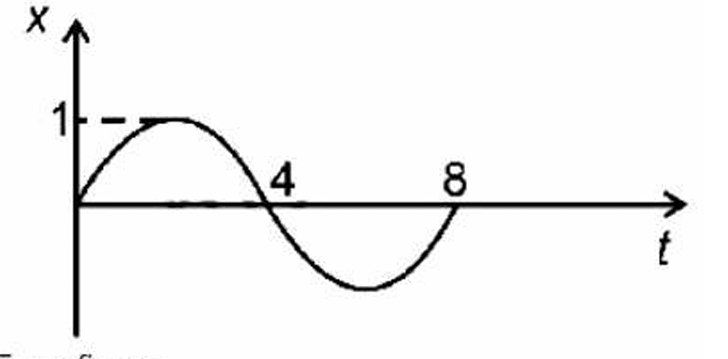
From figure, $A = 1$ and $T = 8 \text{ s}$, so $\omega = \frac{2\pi}{8} = \frac{\pi}{4}$. Thus $x = \sin(\frac{\pi}{4}t)$. Velocity $v = \frac{dx}{dt} = \frac{\pi}{4} \cos(\frac{\pi}{4}t)$ and acceleration $a = \frac{dv}{dt} = -\frac{\pi^2}{16} \sin(\frac{\pi}{4}t)$. At $t = 2 \text{ s}$, $a = -\frac{\pi^2}{16} \sin(\frac{\pi}{2}) = -\frac{\pi^2}{16} \text{ m/s}^2$.
Step Solution:
1. Determine Amplitude ($A$) and Time Period ($T$) from the graph: $A = 1 \text{ m}$ and $T = 8 \text{ s}$.
2. Calculate Angular Frequency ($\omega$): $\omega = \frac{2\pi}{T} = \frac{2\pi}{8} = \frac{\pi}{4} \text{ rad/s}$.
3. Identify the particle's position ($x$) at $t = 2 \text{ s}$: $x = 1 \sin(\frac{\pi}{4} \times 2) = \sin(\frac{\pi}{2}) = 1 \text{ m}$.
4. Apply the acceleration formula for SHM: $a = -\omega^2 x$.
5. Substitute the values: $a = -(\frac{\pi}{4})^2 \times (1) = -\frac{\pi^2}{16} \text{ m/s}^2$.
Difficulty Level: Medium
Concept Name: SHM Graph Analysis and Acceleration Formula.
Short cut solution: From the graph, at $t=2 \text{ s}$ (which is $1/4$ of the period $T=8 \text{ s}$), the particle is at its positive extreme $x = A$. Since $a = -\omega^2 x$, the acceleration is simply $-\omega^2 A = -(\frac{2\pi}{8})^2 \times 1 = -\frac{\pi^2}{16}$.
Question 13
Question: The phase difference between displacement and acceleration of a particle in a simple harmonic motion is:
Options:
A. $\frac{3\pi}{2} \text{ rad}$
B. $\pi/2 \text{ rad}$
C. zero
D. $\pi \text{ rad}$
Correct Answer: D
Year: 2020
Solution (as given in the source): Displacement equation $y = A \sin(\omega t + \phi)$. Velocity $v = \frac{dy}{dt} = A\omega \cos(\omega t + \phi)$. Acceleration $a = \frac{dv}{dt} = -A\omega^2 \sin(\omega t + \phi)$, which can be written as $a = A\omega^2 \sin(\omega t + \phi + \pi)$. Hence, the phase difference is $\pi$.
Step Solution:
1. Define displacement ($y$): $y = A \sin(\omega t + \phi)$.
2. Find velocity ($v$) by differentiating once: $v = A\omega \cos(\omega t + \phi)$.
3. Find acceleration ($a$) by differentiating velocity: $a = -A\omega^2 \sin(\omega t + \phi)$.
4. Rewrite acceleration using the trigonometric identity $-\sin\theta = \sin(\theta + \pi)$: $a = A\omega^2 \sin(\omega t + \phi + \pi)$.
5. Compare the phase angles: The difference between $(\omega t + \phi + \pi)$ and $(\omega t + \phi)$ is $\pi$.
Difficulty Level: Easy
Concept Name: Phase Relationship in SHM.
Short cut solution: In SHM, acceleration is defined by the property $a \propto -x$. A negative sign in a harmonic function mathematically represents a phase shift of exactly $180^\circ$ or $\pi$ radians.
Question 14
Question: The displacement of a particle executing simple harmonic motion is given by $y = A_0 + A \sin \omega t + B \cos \omega t$. Then the amplitude of its oscillation is given by
Options:
A. $A + B$
B. $A_0 + \sqrt{A^2 + B^2}$
C. $\sqrt{A^2 + B^2}$
D. $\sqrt{A_0^2 + (A + B)^2}$
Correct Answer: C
Year: NEET 2019
Solution (as given in the source): The equation is $y - A_0 = A \sin \omega t + B \cos \omega t$. This represents a superposition where the phase difference between the sine and cosine terms is $\pi/2$. Resultant Amplitude $= \sqrt{A^2 + B^2 + 2AB \cos(\pi/2)} = \sqrt{A^2 + B^2}$.
Step Solution:
1. Rewrite the equation to focus on the oscillatory part: $y' = y - A_0 = A \sin \omega t + B \cos \omega t$.
2. Note that $A_0$ is a constant shift in the mean position and does not affect amplitude.
3. Recognize the two components: $y_1 = A \sin \omega t$ and $y_2 = B \sin(\omega t + \pi/2)$.
4. Identify the phase difference ($\phi$): $\phi = \pi/2$.
5. Apply the vector addition formula for amplitude: $R = \sqrt{A^2 + B^2 + 2AB \cos(\pi/2)} = \sqrt{A^2 + B^2}$.
Difficulty Level: Medium
Concept Name: Superposition of SHMs.
Short cut solution: For any harmonic motion of the form $y = \text{constant} + A\sin\omega t + B\cos\omega t$, the resultant amplitude is always the square root of the sum of the squares of the coefficients: $\sqrt{A^2 + B^2}$.
Question 15
Question: Average velocity of a particle executing SHM in one complete vibration is.
Options:
A. zero
B. $\frac{A\omega}{2}$
C. $A\omega$
D. $\frac{A\omega^2}{2}$
Correct Answer: A.
Year: NEET 2019.
Solution (as given in the source): Since the displacement for a complete vibration is zero, therefore the average velocity will be zero.
Step Solution:
1. State the formula for average velocity: $v_{avg} = \frac{\text{Total Displacement}}{\text{Total Time}}$.
2. Identify the initial and final positions for one complete vibration: For a full cycle, the particle starts and ends at the same point.
3. Calculate Total Displacement: Displacement = Final Position - Initial Position = 0.
4. Substitute the displacement into the average velocity formula: $v_{avg} = \frac{0}{T}$.
5. Final result: $v_{avg} = 0$.
Difficulty Level: Easy
Concept Name: Definition of Average Velocity in Periodic Motion.
Short cut solution: In any periodic motion, the displacement after one full period ($T$) is always zero. Since average velocity depends on displacement, it is automatically zero for any full cycle.
Question 16
Question: The radius of circle, the period of revolution, initial position and
sense of revolution are indicated in the figure
Options:
A. $y(t) = 3 \cos\left(\frac{\pi t}{2}\right)$, where $y$ in m
B. $y(t) = -3 \cos 2\pi t$, where $y$ in m
C. $y(t) = 4 \sin\left(\frac{\pi t}{2}\right)$, where $y$ in m
D. $y(t) = 3 \cos\left(\frac{3\pi t}{2}\right)$, where $y$ in m
Correct Answer: A.
Year: NEET 2019.
Solution (as given in the source): Here $T = 4\text{ s}$, $A = 3\text{ m}$. Time period $T = \frac{2\pi}{\omega} \Rightarrow 4 = \frac{2\pi}{\omega} \Rightarrow \omega = \frac{\pi}{2}$. When the time is noted from the extreme position, So, $y = A \cos(\omega t) \Rightarrow y = 3 \cos\left(\frac{\pi}{2}t\right)$.
Step Solution:
1. Extract Amplitude ($A$) from the figure: The radius of the circle is $A = 3\text{ m}$.
2. Extract Time Period ($T$) from the figure: $T = 4\text{ s}$.
3. Calculate Angular Frequency ($\omega$): $\omega = \frac{2\pi}{T} = \frac{2\pi}{4} = \frac{\pi}{2} \text{ rad/s}$.
4. Identify the initial position: At $t = 0$, the particle starts at the positive extreme on the $y$-axis (top of the circle).
5. Formulate the projection equation: Starting at extreme means using the cosine function: $y(t) = A \cos(\omega t) = 3 \cos\left(\frac{\pi t}{2}\right)$.
Difficulty Level: Medium
Concept Name: Projection of Uniform Circular Motion on a Diameter.
Short cut solution: The radius (Amplitude) is 3, eliminating option C. The time period is 4, so $\omega = \frac{2\pi}{4} = 0.5\pi$. Only option A matches both $A = 3$ and $\omega = 0.5\pi$.
Question 17
Question: The distance covered by a particle undergoing SHM in one time period is (amplitude $= A$).
Options:
A. zero
B. $A$
C. $2A$
D. $4A$
Correct Answer: D.
Year: OD NEET 2019.
Solution (as given in the source): Let at $\Delta t = 0$ particle is at point $P$ and going towards point $Q$ for one time period $\Sigma = PQ + QP + PR + RP = A + A + A + A = 4A$.
Step Solution:
1. Understand the definition of distance in SHM: It is the total path length traveled, regardless of direction.
2. Break down one full cycle ($T$): The particle travels from the mean position to one extreme ($A$), back to mean ($A$), to the other extreme ($A$), and back to mean ($A$).
3. Identify the four segments of motion: Each segment covers a path length equal to the amplitude $A$.
4. Sum the lengths: Total Distance $= A + A + A + A$.
5. Final Result: $4A$.
Difficulty Level: Easy
Concept Name: Kinematics of SHM (Distance vs. Displacement).
Short cut solution: In one period, a particle completes one full oscillation. This involves moving through the amplitude four times (out-back-out-back), hence $4A$.
Question 18
Question: A pendulum is hung from the roof of a sufficiently high building and is moving freely to and fro like a simple harmonic oscillator. The acceleration of the bob of the pendulum is $20 \text{ m s}^{-2}$ at a distance of $5\text{ m}$ from the mean position. The time period of oscillation is.
Options:
A. $2\pi\text{ s}$
B. $\pi \text{ s}$
C. $2\text{ s}$
D. $1 \text{ s}$
Correct Answer: B
Year: NEET 2018
Solution (as given in the source): Magnitude of acceleration of a particle moving in a SHM is, $|a| = \omega^2 y$; where $y$ is displacement. $\Rightarrow 20 = \omega^2 (5) \Rightarrow \omega = 2 \text{ rad s}^{-1}$. $\therefore$ Time period of oscillation, $T = \frac{2\pi}{\omega} = \frac{2\pi}{2} = \pi \text{ s}$.
Step Solution:
1. Recall the acceleration-displacement relation for SHM: $a = \omega^2 x$.
2. Substitute the given values for acceleration ($a = 20$) and displacement ($x = 5$): $20 = \omega^2 \times 5$.
3. Solve for the square of angular frequency: $\omega^2 = \frac{20}{5} = 4$.
4. Find the angular frequency ($\omega$): $\omega = \sqrt{4} = 2 \text{ rad/s}$.
5. Calculate the Time Period ($T$) using $T = \frac{2\pi}{\omega}$: $T = \frac{2\pi}{2} = \pi \text{ s}$.
Difficulty Level: Easy
Concept Name: Acceleration-Displacement relationship in SHM.
Short cut solution: Since $a = \omega^2 x$, $\omega = \sqrt{a/x}$. Here $\omega = \sqrt{20/5} = 2$. Quickly apply $T = 2\pi/\omega$ to get $\pi$.
Question 20
Question: A particle executes linear simple harmonic motion with an amplitude of $3 \text{ cm}$. When the particle is at $2 \text{ cm}$ from the mean position, the magnitude of its velocity is equal to that of its acceleration. Then its time period in seconds is.
Options:
A. $\frac{\sqrt{5}}{2\pi}$
B. $\frac{4\pi}{\sqrt{5}}$
C. $2\pi\sqrt{3}$
D. $\sqrt{5}\pi$
Correct Answer: B
Year: 2017 NEET
Solution (as given in the source): Given, $A = 3 \text{ cm}, x = 2 \text{ cm}$. The velocity is $v = \omega\sqrt{A^2 - x^2}$ and magnitude of its acceleration is $a = \omega^2 x$. $\therefore \omega\sqrt{A^2 - x^2} = \omega^2 x \Rightarrow \omega^2 = \frac{A^2 - x^2}{x^2} = \frac{9 - 4}{4} = \frac{5}{4}$. $\omega = \frac{\sqrt{5}}{2}$. Time period, $T = \frac{2\pi}{\omega} = 2\pi \cdot \frac{2}{\sqrt{5}} = \frac{4\pi}{\sqrt{5}} \text{ s}$.
Step Solution:
1. Identify the formulas for velocity ($v$) and acceleration ($a$): $v = \omega\sqrt{A^2 - x^2}$ and $a = \omega^2 x$.
2. Set them equal as per the Question: $\omega\sqrt{A^2 - x^2} = \omega^2 x$.
3. Simplify the equation by dividing both sides by $\omega$ and squaring: $A^2 - x^2 = \omega^2 x^2$.
4. Substitute the given values ($A=3, x=2$) to find $\omega$: $3^2 - 2^2 = \omega^2(2^2) \Rightarrow 5 = 4\omega^2 \Rightarrow \omega = \frac{\sqrt{5}}{2}$.
5. Find the Time Period ($T$): $T = \frac{2\pi}{\omega} = \frac{2\pi}{(\sqrt{5}/2)} = \frac{4\pi}{\sqrt{5}} \text{ s}$.
Difficulty Level: Medium
Concept Name: Comparison of Kinematic Variables in SHM.
Short cut solution: Equating $v$ and $a$ directly gives $\omega = \frac{\sqrt{A^2 - x^2}}{x}$. Plugging in values: $\omega = \frac{\sqrt{9-4}}{2} = \frac{\sqrt{5}}{2}$. Then $T = \frac{2\pi}{\omega}$ leads immediately to option B.
Question 22
Question: A particle is executing SHM along a straight line. Its velocities at distances $x_1$ and $x_2$ from the mean position are $V_1$ and $V_2$ respectively. Its time period is.
Options:
A. $2\pi\sqrt{\frac{V_1^2 + V_2^2}{x_1^2 + x_2^2}}$
B. $2\pi\sqrt{\frac{V_1^2 - V_2^2}{x_1^2 - x_2^2}}$
C. $2\pi\sqrt{\frac{V_1^2 + V_2^2}{x_1^2 + x_2^2}}$
D. $2\pi\sqrt{\frac{x_2^2 - x_1^2}{V_1^2 - V_2^2}}$
Correct Answer: D
Year: 2015
Solution (as given in the source): Velocities are $V_1^2 = \omega^2(a^2 - x_1^2) \dots (i)$ and $V_2^2 = \omega^2(a^2 - x_2^2) \dots (ii)$. Subtracting $(ii)$ from $(i)$ gives $V_1^2 - V_2^2 = \omega^2(x_2^2 - x_1^2) \Rightarrow \omega = \sqrt{\frac{V_1^2 - V_2^2}{x_2^2 - x_1^2}}$. $\therefore T = 2\pi\sqrt{\frac{x_2^2 - x_1^2}{V_1^2 - V_2^2}}$.
Step Solution:
1. Write the velocity-displacement squared equations: $V_1^2 = \omega^2(A^2 - x_1^2)$ and $V_2^2 = \omega^2(A^2 - x_2^2)$.
2. Subtract the two equations to eliminate the amplitude $A$: $V_1^2 - V_2^2 = \omega^2[(A^2 - x_1^2) - (A^2 - x_2^2)]$.
3. Simplify the resulting expression: $V_1^2 - V_2^2 = \omega^2(x_2^2 - x_1^2)$.
4. Solve for the angular frequency ($\omega$): $\omega = \sqrt{\frac{V_1^2 - V_2^2}{x_2^2 - x_1^2}}$.
5. Invert $\omega$ and multiply by $2\pi$ for the Time Period ($T$): $T = 2\pi \sqrt{\frac{x_2^2 - x_1^2}{V_1^2 - V_2^2}}$.
Difficulty Level: Hard
Concept Name: General Velocity-Displacement Relation in SHM.
Short cut solution: Use Dimensional Analysis. The expression inside the square root must have dimensions of $[T^2]$, which is $[\text{Length}^2] / [\text{Velocity}^2]$. Only option D satisfies this dimensional requirement ($x^2/v^2$).
Question 23
Question: A particle is executing a simple harmonic motion. Its maximum acceleration is $\alpha$ and maximum velocity is $\beta$. Then, its time period of vibration will be.
Options:
A. $\frac{\beta^2}{\alpha}$
B. $\frac{2\pi\beta}{\alpha}$
C. $\frac{\beta^2}{\alpha^2}$
D. $\frac{\alpha}{\beta}$
Correct Answer: B.
Year: 2015.
Solution (as given in the source): If $A$ and $\omega$ be amplitude and angular frequency of vibration, then $\alpha = \omega^2 A \dots (i)$ and $\beta = \omega A \dots (ii)$. Dividing eqn. (i) by eqn. (ii), we get $\frac{\alpha}{\beta} = \frac{\omega^2 A}{\omega A} = \omega$. Time period of vibration $T = \frac{2\pi}{\omega} = \frac{2\pi}{\alpha/\beta} = \frac{2\pi\beta}{\alpha}$.
Step Solution:
1. Identify the formula for maximum acceleration: $\alpha = \omega^2 A$.
2. Identify the formula for maximum velocity: $\beta = \omega A$.
3. Divide $\alpha$ by $\beta$ to isolate angular frequency: $\frac{\alpha}{\beta} = \frac{\omega^2 A}{\omega A} = \omega$.
4. Substitute $\omega$ into the Time Period formula: $T = \frac{2\pi}{\omega}$.
5. Calculate the final result: $T = \frac{2\pi}{\alpha/\beta} = \frac{\mathbf{2\pi\beta}}{\mathbf{\alpha}}$.
Difficulty Level: Easy
Concept Name: Kinematics of SHM (Maximum Acceleration and Velocity relations).
Short cut solution: Since $T = 2\pi / \omega$ and $\omega = a_{max} / v_{max}$, then $T = 2\pi (v_{max} / a_{max}) = 2\pi\beta / \alpha$.
Question 24
Question: The oscillation of a body on a smooth horizontal surface is represented by the equation, $X = A \cos(\omega t)$ where $X = \text{displacement at time } t$, $\omega = \text{frequency of oscillation}$. Which one of the following graphs shows correctly the variation $a$ with $t$? Here $a = \text{acceleration at time } t$, $T = \text{time period}$.
Options:
A. 
B. 
C. 
D. 
Correct Answer: C.
Year: 2014.
Solution (as given in the source): Here, $X = A \cos\omega t$. Velocity, $v = \frac{dX}{dt} = \frac{d}{dt}(A \cos\omega t) = -A\omega \sin\omega t$. Acceleration, $a = \frac{dv}{dt} = \frac{d}{dt}(-A\omega \sin\omega t) = -A\omega^2 \cos\omega t$. Hence the variation of $a$ with $t$ is correctly shown by graph (c).
Step Solution:
1. Start with the given displacement equation: $X = A \cos(\omega t)$.
2. Find velocity ($v$) by differentiating displacement with respect to time: $v = \frac{dX}{dt} = -A\omega \sin(\omega t)$.
3. Find acceleration ($a$) by differentiating velocity: $a = \frac{dv}{dt} = -A\omega^2 \cos(\omega t)$.
4. Analyze the function: the acceleration graph must be a negative cosine function starting from $-A\omega^2$ at $t=0$.
5. Identify the correct graph matching this mathematical form, which is Graph C.
Difficulty Level: Medium
Concept Name: Calculus-based Kinematics and Graphical Representation of SHM.
Short cut solution: In SHM, acceleration is always $a = -\omega^2 X$. Since $X$ is a positive cosine wave ($A \cos\omega t$), acceleration must be its negative mirror image ($-A\omega^2 \cos\omega t$).
Question 25
Question: A particle of mass $m$ oscillates along x-axis according to equation $X = a \sin \omega t$. The nature of the graph between momentum and displacement of the particle is.
Options:
A. Circle
B. Hyperbola
C. Ellipse
D. Straight line passing through origin
Correct Answer: C.
Year: KN NEET 2013.
Solution (as given in the source): $x = a \sin\omega t \implies \frac{x}{a} = \sin\omega t \dots (i)$. Velocity $v = \frac{dx}{dt} = a\omega \cos\omega t \implies \frac{v}{a\omega} = \cos\omega t \dots (ii)$. Squaring and adding (i) and (ii), we get $\frac{x^2}{a^2} + \frac{v^2}{a^2\omega^2} = 1$. This is an equation of an ellipse. Momentum of the particle $= mv$. Therefore the nature of the graph between momentum and displacement is the same as velocity and displacement.
Step Solution:
1. Rearrange the displacement equation for sine: $\sin\omega t = \frac{x}{a}$.
2. Differentiate displacement to find velocity: $v = \frac{dx}{dt} = a\omega \cos\omega t$.
3. Rearrange the velocity equation for cosine: $\cos\omega t = \frac{v}{a\omega}$.
4. Apply the identity $\sin^2\theta + \cos^2\theta = 1$: $(\frac{x}{a})^2 + (\frac{v}{a\omega})^2 = 1$.
5. Relate to momentum ($p = mv$): Replacing $v$ with $p/m$ gives $\frac{x^2}{a^2} + \frac{p^2}{m^2a^2\omega^2} = 1$, which is the standard form of an ellipse.
Difficulty Level: Medium/Hard
Concept Name: Phase Space Representation and Geometric Equations of SHM.
Short cut solution: The relation between velocity ($v$) and displacement ($x$) in SHM is $\frac{x^2}{A^2} + \frac{v^2}{(A\omega)^2} = 1$. Since momentum $p$ is directly proportional to $v$, the graph of $p$ vs $x$ maintains this elliptical shape.
Question 27
Question: Two particles are oscillating along two close parallel straight lines side by side, with the same frequency and amplitudes. They pass each other, moving in opposite directions when their displacement is half of the amplitude. The mean positions of the two particles lie on a straight line perpendicular to the paths of the two particles. The phase difference is.
Options:
A. $\pi/6$
B. 0
C. $2\pi/3$
D. $\pi$
Correct Answer: C
Year: 2011 Mains
Solution (as given in the source): The time taken by the particle to travel from $x = 0$ to $x = A/2$ is $T/12$. The time taken by the particle to travel from $x = A$ to $x = A/2$ is $T/6$. Time difference $= T/6 + T/6 = T/3$. Phase difference, $\phi = \frac{2\pi}{T} \times \text{Time difference} = \frac{2\pi}{T} \times \frac{T}{3} = \frac{2\pi}{3}$.
Step Solution:
1. Set the displacement for both particles at $x = A/2$.
2. Use the SHM equation $x = A \sin \theta$ to find the phase angle for one particle: $A/2 = A \sin \theta \Rightarrow \theta = 30^\circ$ or $\pi/6$.
3. Since the particles are moving in opposite directions at the same point, one is moving toward the extreme ($\theta_1 = 30^\circ$) and the other is returning from the extreme ($\theta_2 = 180^\circ - 30^\circ = 150^\circ$).
4. Calculate the phase difference: $\Delta \phi = 150^\circ - 30^\circ = 120^\circ$.
5. Convert the degree measure to radians: $120^\circ \times (\pi/180^\circ) = \mathbf{2\pi/3}$.
Difficulty Level: Medium
Concept Name: Phase Difference and Reference Circle in SHM.
Short cut solution: When two particles meet at $A/2$ moving in opposite directions, their phase positions on a reference circle are $\pi/6$ and $5\pi/6$. The difference is $5\pi/6 - \pi/6 = 4\pi/6 = 2\pi/3$.
Question 30
Question: A simple pendulum performs simple harmonic motion about $X = 0$ with an amplitude $a$ and time period $T$. The speed of the pendulum at $x = a/2$ will be.
Options:
A. $\frac{\pi a}{T}$
B. $\frac{3\pi a}{2T}$
C. $\frac{\pi a\sqrt{3}}{T}$
D. $\frac{\pi a\sqrt{3}}{2T}$
Correct Answer: C
Year: 2009
Solution (as given in the source): For simple harmonic motion, $v = \omega \sqrt{a^2 - x^2}$. When $x = a/2$, $v = \omega \sqrt{a^2 - \frac{a^2}{4}} = \omega \sqrt{\frac{3a^2}{4}}$. As $\omega = \frac{2\pi}{T}$, $\therefore v = \frac{2\pi}{T} \cdot \frac{\sqrt{3}}{2}a \Rightarrow v = \frac{\pi\sqrt{3}a}{T}$.
Step Solution:
1. Recall the velocity formula for SHM: $v = \omega \sqrt{A^2 - x^2}$.
2. Substitute the given displacement $x = a/2$ into the formula: $v = \omega \sqrt{a^2 - (a/2)^2}$.
3. Simplify the expression under the square root: $v = \omega \sqrt{3a^2/4} = \omega \frac{a\sqrt{3}}{2}$.
4. Use the relation between angular frequency and time period: $\omega = 2\pi/T$.
5. Combine the terms to find the final velocity: $v = (2\pi/T) \times (a\sqrt{3}/2) = \frac{\pi a\sqrt{3}}{T}$.
Difficulty Level: Easy
Concept Name: Velocity-Displacement Relation in SHM.
Short cut solution: At half-amplitude ($x = A/2$), velocity is always $\frac{\sqrt{3}}{2}v_{max}$. Since $v_{max} = \frac{2\pi a}{T}$, the speed is $\frac{\sqrt{3}}{2} \times \frac{2\pi a}{T} = \frac{\pi a\sqrt{3}}{T}$.
Question 31
Question: Which one of the following equations of motion represents simple harmonic motion? Where $k, k_0, k_1$ and $a$ are all positive.
Options:
A. Acceleration $= -k(x + a)$
B. Acceleration $\mu = k(x + a)$
C. Acceleration $\mu = kx$
D. Acceleration $= -k_0x + k_1x^2$
Correct Answer: A
Year: 2009
Solution (as given in the source): (Source provides the correct option without a text-based derivation, but the principle is based on the restoring force condition).
Step Solution:
1. Identify the standard condition for SHM: The acceleration must be proportional to the negative of the displacement from a mean position ($a \propto -x$).
2. Examine Option A: $a = -k(x + a)$. This can be written as $a = -k[x - (-a)]$.
3. Recognize that this represents a restoring force where the mean position is shifted to $x = -a$.
4. Eliminate Options B and C: These show acceleration proportional to positive displacement, which represents an unstable repulsive force, not a restoring one.
5. Eliminate Option D: The inclusion of the $x^2$ term makes the force non-linear; while the motion may be periodic, it is not "Simple" Harmonic Motion.
Difficulty Level: Easy
Concept Name: General Equation and Definition of SHM.
Short cut solution: SHM requires the acceleration to be a negative linear function of displacement. Only option A ($a = -kx - ka$) provides a negative coefficient for the linear term $x$.
Question 32
Question: Two simple harmonic motions of angular frequency 100 and $1000 \text{ rad s}^{-1}$ have the same displacement amplitude. The ratio of their maximum acceleration is
Options:
A. $1 : 10^3$
B. $1 : 10^4$
C. $1 : 10$
D. $1 : 10^2$
Correct Answer: D
Year: 2008
Solution (as given in the source): Here, $\omega_1 = 100 \text{ rad s}^{-1}$; $\omega_2 = 1000 \text{ rad s}^{-1}$; $a_{max1} = \omega_1^2 A$; $a_{max2} = \omega_2^2 A$; $\therefore \frac{a_{max1}}{a_{max2}} = \frac{\omega_1^2}{\omega_2^2} = \frac{(100)^2}{(1000)^2} = \frac{1}{100}$.
Step Solution:
1. State the maximum acceleration formula for SHM: $a_{max} = \omega^2 A$.
2. Identify that amplitude ($A$) is the same for both motions.
3. Set up the ratio of the two accelerations: $\frac{a_{max1}}{a_{max2}} = \frac{\omega_1^2 A}{\omega_2^2 A} = \frac{\omega_1^2}{\omega_2^2}$.
4. Substitute the given values ($\omega_1 = 100$ and $\omega_2 = 1000$): $\frac{100^2}{1000^2}$.
5. Perform the final calculation: $\frac{10,000}{1,000,000} = \frac{1}{100}$, which is $1 : 10^2$.
Difficulty Level: Easy
Concept Name: Maximum Acceleration in SHM.
Short cut solution: Since $a_{max} \propto \omega^2$ (for constant $A$), the ratio is simply the square of the ratio of frequencies: $(100/1000)^2 = (1/10)^2 = 1/100$.
Question 33
Question: A particle executes simple harmonic oscillation with an amplitude $a$. The period of oscillation is $T$. The minimum time taken by the particle to travel half of the amplitude from the equilibrium position is
Options:
A. $T/8$
B. $T/12$
C. $T/2$
D. $T$
Correct Answer: B
Year: 2007
Solution (as given in the source): $x(t) = a \sin \omega t$ (from the equilibrium position); $x(t) = a/2$; $a/2 = a \sin(\omega t)$; $\Rightarrow \sin(\pi/6) = \sin(\omega t)$; or, $\pi/6 = \frac{2\pi t}{T}$ [$\because \omega = \frac{2\pi}{T}$] or $t = T/12$.
Step Solution:
1. Use the SHM displacement equation starting from equilibrium: $x = a \sin(\omega t)$.
2. Set the displacement to half-amplitude: $a/2 = a \sin(\omega t)$, which simplifies to $\sin(\omega t) = 1/2$.
3. Find the phase angle ($\theta$): $\omega t = \sin^{-1}(1/2) = \pi/6$.
4. Substitute the relation $\omega = 2\pi/T$ into the equation: $(2\pi/T)t = \pi/6$.
5. Isolate $t$ to find the time: $t = \frac{\pi/6}{2\pi} \times T = \frac{T}{12}$.
Difficulty Level: Easy
Concept Name: Phase and Time relationship in SHM.
Short cut solution: The phase change for $A/2$ is $30^\circ$. Since a full cycle of $360^\circ$ takes time $T$, $30^\circ$ takes $T \times (30/360) = T/12$.
Question 36
Question: The phase difference between the instantaneous velocity and acceleration of a particle executing simple harmonic motion is
Options:
A. $\pi$
B. $0.707\pi$
C. zero
D. $0.5\pi$
Correct Answer: D
Year: 2007
Solution (as given in the source): Let $y = A \sin \omega t$; $\frac{dy}{dt} = A\omega \cos \omega t = A\omega \sin(\omega t + \pi/2)$; Acceleration $= -A\omega^2 \sin \omega t$. The phase difference between acceleration and velocity is $\pi/2$.
Step Solution:
1. Represent instantaneous velocity ($v$): $v = A\omega \cos(\omega t)$.
2. Convert velocity to a sine function to identify phase: $v = A\omega \sin(\omega t + \pi/2)$.
3. Represent instantaneous acceleration ($a$): $a = -A\omega^2 \sin(\omega t)$.
4. Convert acceleration to a sine function: $a = A\omega^2 \sin(\omega t + \pi)$.
5. Find the difference between the phase constants: Phase of $a$ $(\pi)$ minus Phase of $v$ $(\pi/2)$ equals $\pi/2$ (or $0.5\pi$).
Difficulty Level: Easy
Concept Name: Phase Relationships between SHM Variables.
Short cut solution: In SHM, velocity leads displacement by $\pi/2$, and acceleration leads velocity by another $\pi/2$. Therefore, the phase difference between velocity and acceleration is always $90^\circ$ or $0.5\pi$.
Question 39
Question: A particle executing simple harmonic motion of amplitude 5cm has maximum speed of 31.4cm ∕ s. The frequency of its oscillation is.
Options:
A. 4 Hz
B. 3 Hz
C. 2 Hz
D. 1 Hz
Correct Answer: D
Year: 1996
Solution (as given in the source): $a = 5 \text{ cm}, v_{\max} = 31.4 \text{ cm/s}$. $v_{\max} = \omega a \Rightarrow 31.4 = 2\pi\nu \times 5 \Rightarrow 31.4 = 10 \times 3.14 \times \nu \Rightarrow \nu = 1 \text{ Hz}$.
Step Solution:
1. Identify given values: Amplitude ($A$) = 5 cm and Maximum speed ($v_{\max}$) = 31.4 cm/s.
2. Recall the maximum speed formula: $v_{\max} = \omega A$.
3. Substitute the relation between angular frequency and frequency: $\omega = 2\pi f$, so $v_{\max} = 2\pi f A$.
4. Plug in the known values: $31.4 = 2 \times 3.14 \times f \times 5$.
5. Solve for $f$: $31.4 = 31.4 \times f \Rightarrow f = 1 \text{ Hz}$.
Difficulty Level: Easy
Concept Name: Relationship between Maximum Speed and Frequency in SHM.
Short cut solution: Use the approximation $\pi \approx 3.14$. Since $v_{\max} = 31.4$ and $A = 5$, then $31.4 = (2\pi f)(5) = 10\pi f$. Because $10\pi$ is approximately 31.4, $f$ must be 1.
Question 41
Question: Which one of the following statements is true for the speed v and the acceleration a of a particle executing simple harmonic motion?
Options:
A. When v is maximum, a is maximum.
B. Value of a is zero, whatever may be the value of v
C. When v is zero, a is zero.
D. When v is maximum, a is zero.
Correct Answer: D
Year: 2003
Solution (as given in the source): In SHM $v = A \omega \sin(\omega t + \pi/2), a = A \omega^2 \sin(\omega t + \pi)$. From this we can easily find out that when v is maximum, then a is zero.
Step Solution:
1. State the velocity-displacement relation: $v = \omega\sqrt{A^2 - x^2}$.
2. State the acceleration-displacement relation: $a = -\omega^2 x$.
3. Identify where velocity is maximum: $v$ is maximum at the mean position ($x = 0$).
4. Calculate acceleration at the mean position: Substitute $x = 0$ into the acceleration formula to get $a = -\omega^2(0) = 0$.
5. Conclude the relationship: When velocity is at its maximum, the acceleration is zero.
Difficulty Level: Easy
Concept Name: Phase and Position Dependency of SHM Kinematics.
Short cut solution: In SHM, velocity and acceleration are $90^\circ$ out of phase. Mathematically, when one is at its peak (sine/cosine value of 1), the other is at its zero crossing.
Question 58
Question: A particle starts with S.H.M. from the mean position as shown in the figure. Its amplitude is A and its time period is T. At one time, its speed is half that of the maximum speed. What is this displacement?
Options:
A. $\frac{2A}{\sqrt{3}}$
B. $\frac{3A}{\sqrt{2}}$
C. $\frac{\sqrt{2}A}{3}$
D. $\frac{\sqrt{3}A}{2}$
Correct Answer: D
Year: 1996
Solution (as given in the source): Maximum velocity, $v_{\max} = A\omega$. According to question, $\frac{v_{\max}}{2} = \frac{A\omega}{2} = \omega \sqrt{A^2 - y^2}$. $\frac{A^2}{4} = A^2 - y^2 \Rightarrow y^2 = A^2 - \frac{A^2}{4} \Rightarrow y = \frac{\sqrt{3}A}{2}$.
Step Solution:
1. Define the velocity at any displacement $y$: $v = \omega\sqrt{A^2 - y^2}$.
2. Define the maximum velocity: $v_{\max} = \omega A$.
3. Set the condition $v = \frac{1}{2}v_{\max}$: $\omega\sqrt{A^2 - y^2} = \frac{\omega A}{2}$.
4. Square both sides to remove the radical: $A^2 - y^2 = \frac{A^2}{4}$.
5. Rearrange to solve for $y$: $y^2 = A^2 - \frac{A^2}{4} = \frac{3A^2}{4}$, which gives $y = \frac{\sqrt{3}A}{2}$.
Difficulty Level: Medium
Concept Name: Relationship between Instantaneous Velocity and Displacement in SHM.
Short cut solution: Use the phase angle $\theta$. If $v = v_{\max} \cos\theta$ and $v = v_{\max}/2$, then $\cos\theta = 1/2$, which means $\theta = 60^\circ$. The displacement is $y = A \sin\theta = A \sin(60^\circ) = \frac{\sqrt{3}A}{2}$.
Question 67
Question: A simple harmonic oscillator has an amplitude $A$ and time period $T$. The time required by it to travel from $x = A$ to $x = A/2$ is.
Options:
A. $T/6$
B. $T/4$
C. $T/3$
D. $T/2$
Correct Answer: A.
Year: 1992.
Solution (as given in the source): For S.H.M., $x = A \sin(\frac{2\pi}{T}t)$. When $x = A$, $A = A \sin(\frac{2\pi}{T}t)$, so $\sin(\frac{2\pi}{T}t) = 1 \Rightarrow t = T/4$. When $x = A/2$, $A/2 = A \sin(\frac{2\pi}{T}t)$, so $\sin(\frac{\pi}{6}) = \sin(\frac{2\pi}{T}t) \Rightarrow t = T/12$. Time taken to travel from $x = A$ to $x = A/2$ is $T/4 - T/12 = T/6$.
Step Solution:
1. Use the SHM equation for displacement from the mean position: $x = A \sin(\frac{2\pi}{T}t)$.
2. Find time $t_1$ to reach $x = A$: $A = A \sin(\frac{2\pi}{T}t_1) \Rightarrow \frac{2\pi}{T}t_1 = \frac{\pi}{2} \Rightarrow \mathbf{t_1 = \frac{T}{4}}$.
3. Find time $t_2$ to reach $x = A/2$: $\frac{A}{2} = A \sin(\frac{2\pi}{T}t_2) \Rightarrow \frac{2\pi}{T}t_2 = \frac{\pi}{6} \Rightarrow \mathbf{t_2 = \frac{T}{12}}$.
4. Subtract the times to find the interval between these two positions: $\Delta t = t_1 - t_2$.
5. Calculate the result: $\frac{T}{4} - \frac{T}{12} = \frac{3T - T}{12} = \mathbf{\frac{T}{6}}$.
Difficulty Level: Medium
Concept Name: Displacement-Time Relationship in SHM.
Short cut solution: The time from the mean position to $A$ is $T/4$, and the time from the mean position to $A/2$ is $T/12$. The time between them is simply $T/4 - T/12 = T/6$.
Question 68
Question: If a simple harmonic oscillator has got a displacement of $0.02\text{ m}$ and acceleration equal to $2.0 \text{ m s}^{-2}$ at any time, the angular frequency of the oscillator is equal to.
Options:
A. $10 \text{ rad s}^{-1}$
B. $0.1 \text{ rad s}^{-1}$
C. $100 \text{ rad s}^{-1}$
D. $1 \text{ rad s}^{-1}$
Correct Answer: A.
Year: 1992.
Solution (as given in the source): When a particle undergoes SHM, its acceleration is given by $a = \omega^2 x$. Given $a = 2$ and $x = 0.02$. Using these values, $\omega = \sqrt{\frac{a}{x}} = \sqrt{\frac{2}{0.02}} = 10 \text{ rad/s}$.
Step Solution:
1. Identify the acceleration formula for SHM: $a = \omega^2 x$.
2. Rearrange the formula to solve for angular frequency ($\omega$): $\omega = \sqrt{\frac{a}{x}}$.
3. Substitute the given values: $a = 2.0$ and $x = 0.02$.
4. Calculate the ratio: $\frac{2}{0.02} = \frac{200}{2} = 100$.
5. Take the square root for the final result: $\omega = \sqrt{100} = 10 \text{ rad/s}$.
Difficulty Level: Easy
Concept Name: Acceleration-Displacement Relation in SHM.
Short cut solution: Directly apply $\omega = \sqrt{a/x}$. Since $2 / 0.02 = 100$, the square root is 10.
Question 70
Question: A body is executing simple harmonic motion. When the displacements from the mean position is $4\text{cm}$ and $5\text{cm}$, the corresponding velocities of the body is $10 \text{ cm/sec}$ and $8 \text{ cm/sec}$. Then the timeperiod of the body is.
Options:
A. $2\pi \text{ sec}$
B. $\pi/2 \text{ sec}$
C. $\pi \text{ sec}$
D. $3\pi/2 \text{ sec}$
Correct Answer: C.
Year: 1991.
Solution (as given in the source): $v = \omega\sqrt{a^2 - x^2}$. Equations are $10 = \omega\sqrt{a^2 - 16}$ and $8 = \omega\sqrt{a^2 - 25}$. Squaring gives $\frac{100}{\omega^2} = a^2 - 16$ and $\frac{64}{\omega^2} = a^2 - 25$. Subtracting the equations gives $\frac{36}{\omega^2} = 9 \Rightarrow \omega = 2 \text{ rad/s}$. $T = \frac{2\pi}{\omega} = \frac{2\pi}{2} = \pi \text{ sec}$.
Step Solution:
1. Start with the velocity equation: $v^2 = \omega^2(A^2 - x^2)$.
2. Set up two equations for the two states: $100 = \omega^2(A^2 - 16)$ and $64 = \omega^2(A^2 - 25)$.
3. Subtract the second from the first to eliminate $A^2$: $100 - 64 = \omega^2[(A^2 - 16) - (A^2 - 25)] \Rightarrow \mathbf{36 = 9\omega^2}$.
4. Solve for angular frequency: $\omega^2 = 4 \Rightarrow \mathbf{\omega = 2 \text{ rad/s}}$.
5. Calculate the Time Period ($T$): $T = \frac{2\pi}{\omega} = \frac{2\pi}{2} = \mathbf{\pi \text{ s}}$.
Difficulty Level: Medium
Concept Name: Velocity-Displacement relationship in SHM.
Short cut solution: Use the specialized formula $\omega = \sqrt{\frac{v_1^2 - v_2^2}{x_2^2 - x_1^2}}$. Plugging in: $\sqrt{\frac{100 - 64}{25 - 16}} = \sqrt{\frac{36}{9}} = 2$. Thus, $T = \frac{2\pi}{2} = \pi$.