Question 49
Question: The correct IUPAC name of $\mathbf{K_2MnO_4}$ is [29-Jan-2024 Shift 2].
Options:
A. Potassium tetraoxopermanganate (VI)
B. Potassium tetraoxidomanganate (VI)
C. Dipotassium tetraoxidomanganate (VII)
D. Potassium tetraoxidomanganese (VI)
Correct Answer: B.
Year: 2024.
Solution (as Given in the Source): Solution:. (Note: The solution text in the source is blank, but the correct answer is provided as B).
Step Solution:
1. Identify the compound as an ionic salt with Potassium as the cation and $[MnO_4]^{2-}$ as the anionic coordination sphere.
2. Calculate the oxidation state of Manganese ($x$): $2(+1) + x + 4(-2) = 0$, which simplifies to $2 + x - 8 = 0$, resulting in $x = +6$.
3. Name the ligands: The four oxygen atoms are named "tetraoxido" (the modern IUPAC convention for oxo ligands).
4. Name the central metal: Since the coordination sphere is anionic, the metal name must end in "-ate", making it "manganate".
5. Combine the parts: Cation name + Ligand name + Metal name + (Oxidation State) results in Potassium tetraoxidomanganate (VI).
The difficulty level: Easy.
The Concept Name: IUPAC Nomenclature of Coordination Compounds.
Short cut solution: Calculate the oxidation state of Mn ($+6$); only options B and D feature (VI). Since the Manganese is part of an anionic complex, the suffix must be "-ate", immediately identifying B as correct over D.
Question 84
Question: The IUPAC name of $\mathbf{K_3[Co(C_2O_4)_3]}$ is :- [6-Apr-2023 shift 2].
Options:
A. Potassium trioxalatocobaltate(III)
B. Potassium tris(oxalato)cobalt(III)
C. Potassium tris(oxalato)cobaltate(III)
D. Potassium trioxalatocobalt(III)
Correct Answer: A.
Year: 2023.
Solution (as Given in the Source): IUPAC name of $K_3[Co(C_2O_4)_3]$ is Potassium trioxalatocobaltate(III).
Step Solution:
1. The compound consists of Potassium ions and the complex anion $[Co(C_2O_4)_3]^{3-}$.
2. Calculate the oxidation state of Cobalt ($x$): $3(+1) + x + 3(-2) = 0 \Rightarrow 3 + x - 6 = 0$, giving $x = +3$.
3. Identify the ligand: $C_2O_4^{2-}$ is oxalate. Since there are three, the prefix is "trioxalato".
4. Name the metal: As the complex is anionic, use the suffix "-ate", turning Cobalt into "cobaltate".
5. Final assembly: Potassium trioxalatocobaltate(III).
The difficulty level: Easy.
The Concept Name: IUPAC Nomenclature.
Short cut solution: Determine the oxidation state of Co ($+3$). Only A, B, and C have (III). Because it is an anionic complex, the name must end in "-ate", leaving A and C. "Trioxalato" is the standard naming for three oxalate ligands, confirming A.
Question 182
Question: Complex X of composition $\mathbf{Cr(H_2O)_6Cl_n}$ has a spin only magnetic moment of 3.83 BM. It reacts with $AgNO_3$ and shows geometrical isomerism. The IUPAC nomenclature of X is: [Jan. 09, 2020 (I)].
Options:
A. Hexaaqua chromium (III) chloride
B. Tetraaquadichlorido chromium (IV) chloride dihydrate
C. Dichloridotetraaqua chromium (IV) chloride dihydrate
D. Tetraaquadichlorido chromium(III) chloride dihydrate
Correct Answer: D.
Year: 2020.
Solution (as Given in the Source): $\mu = \sqrt{n(n+2)} B.M. = 3.83 B.M$. $n = 3$ ($n = \text{No. of unpaired } e^-$). Therefore, oxidation number of Cr should be $+3$. Hence complex is $Cr(H_2O)_6Cl_3$. Complex shows geometrical isomerism therefore formula of complex is $[Cr(H_2O)_4Cl_2]Cl \cdot 2H_2O$.
Step Solution:
1. Use the magnetic moment ($\mu = 3.83$) to find the number of unpaired electrons: $\sqrt{n(n+2)} \approx 3.83 \Rightarrow n = 3$.
2. Relate $n=3$ to the oxidation state: Chromium ($3d^5 4s^1$) with 3 unpaired electrons corresponds to $Cr^{3+}$ ($3d^3$ configuration).
3. Assess isomerism: A "Hexaaqua" complex ($[Cr(H_2O)_6]^{3+}$) cannot show geometrical isomerism, but a $[MA_4B_2]$ type complex ($[Cr(H_2O)_4Cl_2]^+$) can.
4. Determine the structural formula: To maintain the total stoichiometry of $Cr(H_2O)_6Cl_3$ while allowing isomerism, the formula must be $[Cr(H_2O)_4Cl_2]Cl \cdot 2H_2O$.
5. Name the complex: Tetraaquadichlorido chromium(III) chloride dihydrate.
The difficulty level: Medium.
The Concept Name: Magnetic Moment and Geometrical Isomerism.
Short cut solution: A magnetic moment of ~3.8 BM indicates 3 unpaired electrons, which identifies the metal as $Cr^{3+}$. Eliminate options B and C which use $Cr(IV)$. Since the complex shows geometrical isomerism, it cannot be "hexaaqua" (Option A), making D the only viable answer.
Question 186
Question: The IUPAC name of the complex $\mathbf{[Pt(NH_3)_2Cl(NH_2CH_3)]Cl}$ is: [Jan. 07, 2020 (I)].
Options:
A. Diamminechlorido(methanamine) platinum (II)chloride
B. Diammine (methanamine) chloridoplatinum(II)chloride
C. Diamminechlorido(aminomethane) platinum (II)chloride
D. Bisammine(methanamine) chlorido platinum(II)chloride
Correct Answer: A.
Year: 2020.
Solution (as Given in the Source): $[Pt(NH_3)_2Cl(NH_2CH_3)]Cl$ Diamine chlorido (methanamine) platinum (II) chloride.
Step Solution:
1. Identify Ligands: The ligands are ammine ($NH_3$), chlorido ($Cl^-$), and methanamine ($NH_2CH_3$).
2. Determine Oxidation State: Let Pt be $x$. $x + 2(0) + 1(-1) + 1(0) = +1$ (to balance the outer $Cl^-$). Thus, $x = +2$.
3. Alphabetical Order: Arrange ligands alphabetically: Ammine, then Chlorido, then Methanamine.
4. Name the Complex: Two ammine groups make it "diammine". The metal is "platinum" as the complex is cationic.
5. Final Name: Diamminechlorido(methanamine)platinum(II) chloride.
The difficulty level: Easy.
The Concept Name: IUPAC Nomenclature of Coordination Compounds.
Short cut solution: Calculate the oxidation state of Pt ($+2$). Check for alphabetical order of ligands; "ammine" (A) must come before "chlorido" (C), which immediately points to Option A.
Question 257
Question: Which of the following name formula combinations is not correct?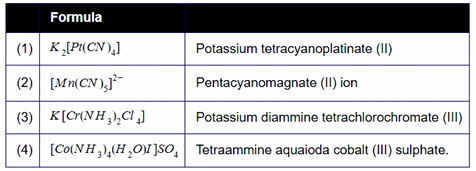
Options: (Note: The specific incorrect/correct pairs were not explicitly listed as a list in the source, but the answer key identifies Option 2 as the mismatch).
Correct Answer: 2 (referring to the incorrect pair involving $[Mn(CN)_5]^{2-}$).
Year: 2014.
Solution (as Given in the Source): Pentacyanomangnate (III) is the correct IUPAC name of $[Mn(CN)_5]^{2-}$.
Step Solution:
1. Analyze the Formula: The provided formula in the error was likely $[Mn(CN)_5]^{2-}$.
2. Identify Metal and Ligand: Central metal is Manganese (Mn) and there are 5 cyanide ($CN^-$) ligands.
3. Calculate Oxidation State ($x$): $x + 5(-1) = -2$.
4. Solve for $x$: $x - 5 = -2 \Rightarrow \mathbf{x = +3}$.
5. Assign Name: Since the complex is anionic, the metal is "manganate". Five ligands make it "pentacyano". Correct name: pentacyanomanganate(III).
The difficulty level: Medium.
The Concept Name: IUPAC Nomenclature.
Short cut solution: Verify the oxidation state of the metal in each formula-name pair. If the Roman numeral in the name does not match the calculated oxidation state of the metal in the formula, that pair is incorrect.
Question 272
Question: Which among the following will be named as dibromido bis (ethylenediamine) chromium (III) bromide? .
Options:
A. $[Cr(en)_3]Br_3$
B. $[Cr(en)_2Br_2]Br$
C. $[Cr(en)Br_4]$
D. $[Cr(en)Br_2]Br$
Correct Answer: B.
Year: 2012.
Solution (as Given in the Source): $[Cr(en)_2Br_2]Br$ dibromido bis(ethylenediamine) chromium (III) Bromide.
Step Solution:
1. Interpret the Name: "dibromido" = $2 \times Br^-$; "bis(ethylenediamine)" = $2 \times en$; "chromium (III)" = $Cr^{3+}$.
2. Assemble Coordination Sphere: The internal part of the complex is $[Cr(en)_2Br_2]$.
3. Calculate Sphere Charge: Charge = $+3 (Cr) + 2(0) (en) + 2(-1) (Br) = \mathbf{+1}$.
4. Balance with Anion: To neutralize the $+1$ charge of the complex, one bromide ($Br^-$) ion is required outside the brackets.
5. Final Formula: $[Cr(en)_2Br_2]Br$.
The difficulty level: Easy.
The Concept Name: Coordination Formula from IUPAC Name.
Short cut solution: The term "bis(ethylenediamine)" strictly implies two 'en' ligands ($en_2$). Only options A and B contain two or more 'en' groups. "dibromido" indicates two bromines inside the sphere, which is only found in Option B.
Question 287
Question: The IUPAC name for the complex $\mathbf{[Co(NO_2)(NH_3)_5]Cl_2}$ is : .
Options:
A. pentaammine nitrito-N-cobalt(II) chloride
B. pentaammine nitrito-N-cobalt(III) chloride
C. nitrito-N-pentaamminecobalt(III) chloride
D. nitrito-N-pentaamminecobalt(II) chloride.
Correct Answer: B.
Year: 2006.
Solution (as Given in the Source): $[Co(NO)_2(NH_3)_5]Cl_2$ Pentaamminenitrito-N-cobalt (III) chloride.
Step Solution:
1. Identify Ligands: The complex contains five ammine ($NH_3$) ligands and one nitrito-N ($NO_2^-$) ligand, where the nitro group is bonded through Nitrogen.
2. Calculate Oxidation State: Let the oxidation state of Co be $x$. The equation is $x + (1 \times -1) + (5 \times 0) = +2$ (to balance the two $Cl^-$ ions outside the sphere).
3. Solve for $x$: $x - 1 = 2 \Rightarrow \mathbf{x = +3}$.
4. Alphabetical Order: "Ammine" comes before "nitrito" alphabetically.
5. Final Assembly: Combine the parts: Pentaamminenitrito-N-cobalt(III) chloride.
The difficulty level: Easy.
The Concept Name: IUPAC Nomenclature of Coordination Compounds.
Short cut solution: Calculate the oxidation state ($+3$); this eliminates options A and D. Since "ammine" starts with 'a' and "nitrito" starts with 'n', ammine must be named first, identifying B as the correct choice.
Question 292
Question: The IUPAC name of the coordination compound $\mathbf{K_3[Fe(CN)_6]}$ is .
Options:
A. Tripotassium hexacyanoiron (II)
B. Potassium hexacyanoiron (II)
C. Potassium hexacyanoferrate(III)
D. Potassium hexacyanoferrate (II).
Correct Answer: C.
Year: 2005.
Solution (as Given in the Source): $K_3[Fe(CN)_6]$ is potassium hexacyanoferrate (III).
Step Solution:
1. Identify Ions: The compound consists of three Potassium ($K^+$) cations and one hexacyanoferrate ($[Fe(CN)_6]^{3-}$) complex anion.
2. Calculate Oxidation State: Let the oxidation state of Fe be $x$. The equation is $3(+1) + x + 6(-1) = 0$.
3. Solve for $x$: $3 + x - 6 = 0 \Rightarrow x - 3 = 0 \Rightarrow \mathbf{x = +3}$.
4. Name the Metal: Because the complex part is the anion, the Latin name for iron ("ferrum") is used with the suffix "-ate", becoming "ferrate".
5. Assemble Name: Cation name + Ligand prefix/name + Metal-ate(oxidation state) = Potassium hexacyanoferrate(III).
The difficulty level: Easy.
The Concept Name: IUPAC Nomenclature.
Short cut solution: Determine the oxidation state of Iron ($+3$). Only option C features both the (III) oxidation state and the correct "-ate" suffix required for an anionic complex sphere.