Question 1
Question: The number of molecules/ions that show linear geometry among the following is $\mathrm{SO}_{2}, \mathrm{BeCl}_{2}, \mathrm{CO}_{2}, \mathrm{N}_{3}^{-}, \mathrm{NO}_{2}, \mathrm{F}_{2}\mathrm{O}, \mathrm{XeF}_{2}, \mathrm{NO}_{2}^{+}, \mathrm{I}_{3}^{-}, \mathrm{O}_{3}$.
Options: Integer Type (No options provided in source).
Correct Answer: 6.
Year: JEE Main 2025 (Online) 22nd January Morning Shift.
Solution: Linear species are $\mathrm{Cl-Be-Cl}, \mathrm{O=C=O}, \mathrm{N=N=N}$ (and others based on VSEPR theory)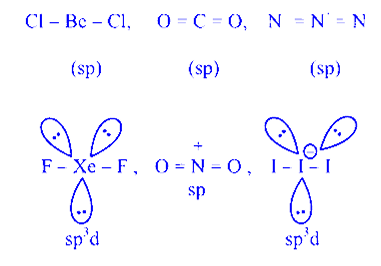 .
.
Step Solution:
1. Identify species with $sp$ hybridization: $\mathrm{BeCl}_{2}$ ($2$ bond pairs, $0$ lone pairs), $\mathrm{CO}_{2}$ ($2$ bond pairs, $0$ lone pairs), $\mathrm{NO}_{2}^{+}$ ($2$ bond pairs, $0$ lone pairs), and $\mathrm{N}_{3}^{-}$ ($2$ bond pairs, $0$ lone pairs).
2. Identify species with $sp^3d$ hybridization and 3 lone pairs: $\mathrm{XeF}_{2}$ ($2$ bond pairs, $3$ lone pairs) and $\mathrm{I}_{3}^{-}$ ($2$ bond pairs, $3$ lone pairs).
3. Exclude bent species: $\mathrm{SO}_{2}$ ($sp^2$, $1$ lone pair), $\mathrm{NO}_{2}$ ($sp^2$, $1$ odd electron), $\mathrm{F}_{2}\mathrm{O}$ ($sp^3$, $2$ lone pairs), and $\mathrm{O}_{3}$ ($sp^2$, $1$ lone pair).
4. Count the linear species identified in Steps 1 and 2: $\mathrm{BeCl}_{2}, \mathrm{CO}_{2}, \mathrm{N}_{3}^{-}, \mathrm{NO}_{2}^{+}, \mathrm{XeF}_{2}, \mathrm{I}_{3}^{-}$.
5. Total count = 6.
Difficulty Level: Medium.
Concept Name: VSEPR Theory and Molecular Geometry.
Shortcut Solution: Linear geometry occurs when the central atom has 2 bond pairs and 0 lone pairs ($sp$), or 2 bond pairs and 3 lone pairs ($sp^3d$).
Question 8
Question: The molecules having square pyramidal geometry are.
Options:
A. $\mathrm{BrF}_{5}$ & $\mathrm{PCl}_{5}$
B. $\mathrm{SbF}_{5}$ & $\mathrm{PCl}_{5}$
C. $\mathrm{BrF}_{5}$ & $\mathrm{XeOF}_{4}$
D. $\mathrm{SbF}_{5}$ & $\mathrm{XeOF}_{4}$.
Correct Answer: C.
Year: JEE Main 2025 (Online) 28th January Morning Shift.
Solution: $\mathrm{BrF}_{5}$: Square pyramidal; $\mathrm{XeOF}_{4}$: Square pyramidal; $\mathrm{SbF}_{5}$: Trigonal Bipyramidal; $\mathrm{PCl}_{5}$: Trigonal Bipyramidal.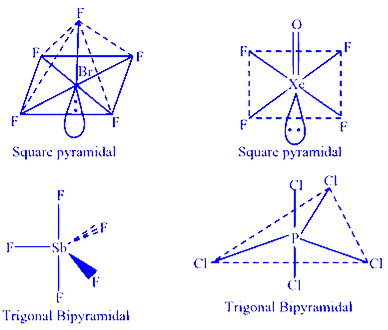
Step Solution:
1. Analyze $\mathrm{BrF}_{5}$: Bromine has 7 valence electrons; 5 are used for bonds with F, leaving 1 lone pair.
2. Calculate Steric Number (SN) for $\mathrm{BrF}_{5}$: $5$ bond pairs + $1$ lone pair = $6$; $sp^3d^2$ hybridization results in a square pyramidal shape.
3. Analyze $\mathrm{XeOF}_{4}$: Xenon has 8 valence electrons; 4 used for F bonds and 2 for the O double bond, leaving 1 lone pair.
4. Calculate SN for $\mathrm{XeOF}_{4}$: $5$ sigma domains ($4$ F + $1$ O) + $1$ lone pair = $6$; $sp^3d^2$ hybridization also results in a square pyramidal shape.
5. Compare with $\mathrm{PCl}_{5}$ and $\mathrm{SbF}_{5}$: Both have $5$ bond pairs and $0$ lone pairs ($sp^3d$), giving a Trigonal Bipyramidal geometry.
Difficulty Level: Easy.
Concept Name: VSEPR Theory.
Shortcut Solution: Both $\mathrm{BrF}_{5}$ and $\mathrm{XeOF}_{4}$ have 5 surrounding atoms and 1 lone pair on the central atom ($sp^3d^2$), which uniquely defines the square pyramidal shape.
Question 9
Question: Consider 'n' is the number of lone pair of electrons present in the equatorial position of the most stable structure of $\mathrm{ClF}_{3}$. The ions from the following with 'n' number of unpaired electrons are: A. $\mathrm{V}^{3+}$, B. $\mathrm{Ti}^{3+}$, C. $\mathrm{Cu}^{2+}$, D. $\mathrm{Ni}^{2+}$, E. $\mathrm{Ti}^{2+}$. Choose the correct answer from the options given below.
Options:
A. B and D Only
B. A, D and E Only
C. B and C Only
D. A and C Only.
Correct Answer: B.
Year: JEE Main 2025 (Online) 28th January Morning Shift.
Solution: No. of lone pairs present in equatorial plane $n = 2$. Unpaired $e^-$: (A) $\mathrm{V}^{3+}$: 2, (B) $\mathrm{Ti}^{3+}$: 1, (C) $\mathrm{Cu}^{2+}$: 1, (D) $\mathrm{Ni}^{2+}$: 2, (E) $\mathrm{Ti}^{2+}$: 2.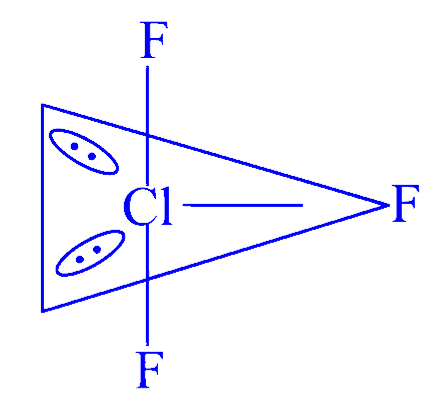
Step Solution:
1. Determine 'n' for $\mathrm{ClF}_{3}$: Chlorine has 7 valence electrons; 3 bond pairs + 2 lone pairs = SN 5 ($sp^3d$).
2. Identify 'n' value: In $sp^3d$, lone pairs occupy equatorial positions to minimize repulsion; thus, $n = 2$.
3. Find unpaired electrons in metal ions using $[Ar] 3d^x$: $\mathrm{V}^{3+}$ ($3d^2$) has 2; $\mathrm{Ti}^{3+}$ ($3d^1$) has 1; $\mathrm{Cu}^{2+}$ ($3d^9$) has 1.
4. Continue for remaining ions: $\mathrm{Ni}^{2+}$ ($3d^8$) has 2 unpaired electrons; $\mathrm{Ti}^{2+}$ ($3d^2$) has 2 unpaired electrons.
5. Select ions where unpaired electrons equal $n=2$: A, D, and E.
Difficulty Level: Medium.
Concept Name: VSEPR Theory and Electronic Configuration.
Shortcut Solution: $\mathrm{ClF}_{3}$ is a T-shaped molecule with 2 equatorial lone pairs; look for ions with $d^2$ or $d^8$ configurations as they possess exactly 2 unpaired electrons.
Question 11
Question: Among $\mathrm{SO}_{2}, \mathrm{NF}_{3}, \mathrm{NH}_{3}, \mathrm{XeF}_{2}, \mathrm{ClF}_{3}$ and $\mathrm{SF}_{4}$, the hybridization of the molecule with nonzero dipole moment and highest number of lone-pairs of electrons on the central atom is
Options:
A. $\mathrm{sp}^{3}$
B. $\mathrm{dsp}^{2}$
C. $\mathrm{sp}^{3}\mathrm{d}^{2}$
D. $\mathrm{sp}^{3}\mathrm{d}$
Correct Answer: D
Year: JEE Main 2025 (Online) 2nd April Morning Shift
Solution: Identify the number of lone pairs (LP) and dipole moment ($\mu$) for each:
$\mathrm{SO}_{2}$: 1 LP, $\mu \neq 0$.
$\mathrm{NF}_{3}$: 1 LP, $\mu \neq 0$.
$\mathrm{NH}_{3}$: 1 LP, $\mu \neq 0$.
$\mathrm{XeF}_{2}$: 3 LP, $\mu = 0$ (linear).
$\mathrm{ClF}_{3}$: 2 LP, $\mu \neq 0$ (T-shape).
$\mathrm{SF}_{4}$: 1 LP, $\mu \neq 0$ (See-saw).
The molecule with a non-zero dipole moment and the highest number of lone pairs (2) is $\mathrm{ClF}_{3}$, which has $\mathrm{sp}^{3}\mathrm{d}$ hybridization.
Step Solution:
1. Determine lone pairs for all: $\mathrm{SO}_{2}(1), \mathrm{NF}_{3}(1), \mathrm{NH}_{3}(1), \mathrm{XeF}_{2}(3), \mathrm{ClF}_{3}(2), \mathrm{SF}_{4}(1)$.
2. Check dipole moments: $\mathrm{XeF}_{2}$ is linear and symmetrical, so its dipole moment is zero.
3. Select the species with $\mu \neq 0$ and max lone pairs: $\mathrm{ClF}_{3}$ has 2 lone pairs and is polar.
4. Calculate Steric Number (SN) for $\mathrm{ClF}_{3}$: $3 \text{ bond pairs} + 2 \text{ lone pairs} = 5$.
5. A Steric Number of 5 corresponds to $\mathbf{sp^{3}d}$ hybridization.
Difficulty Level: Medium
Concept Name: VSEPR Theory and Dipole Moment
Short cut solution: Quickly identify that $\mathrm{XeF}_{2}$ is non-polar despite having 3 lone pairs; the next highest lone pair count is 2 for $\mathrm{ClF}_{3}$, which is $\mathrm{sp}^{3}\mathrm{d}$.
Question 12
Question: A molecule with the formula $\mathrm{AX}_{4}\mathrm{Y}$ has all it's elements from p-block. Element A is rarest, monoatomic, non-radioactive from its group and has the lowest ionization enthalpy value among A, X and Y. Elements X and Y have first and second highest electronegativity values respectively among all the known elements. The shape of the molecule is:
Options:
A. Pentagonal planar
B. Square pyramidal
C. Trigonal bipyramidal
D. Octahedral
Correct Answer: B
Year: JEE Main 2025 (Online) 2nd April Morning Shift
Solution:
X and Y are F and O (highest and second highest electronegativity).
A is Xenon (Xe) (rarest, monoatomic, non-radioactive p-block element with lowest IE).
The compound is $\mathrm{XeOF}_{4}$ with a square pyramidal shape.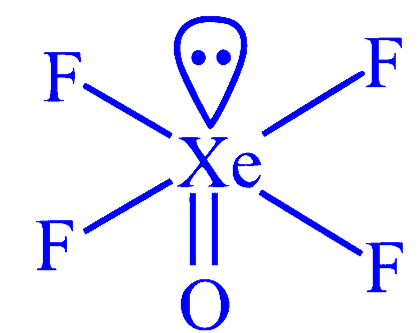
Step Solution:
1. Identify X and Y: Highest electronegativity = Fluorine (F); second highest = Oxygen (O).
2. Identify A: Rarest monoatomic p-block element is Xenon (Xe).
3. Determine the molecule: $\mathrm{XeOF}_{4}$ (Xenon oxytetrafluoride).
4. Calculate SN for Xe: 8 valence electrons; 4 used for F, 2 for O double bond = 1 lone pair. $5 \text{ sigma domains} + 1 \text{ lone pair} = 6$.
5. SN 6 with 1 lone pair results in a square pyramidal shape.
Difficulty Level: Medium
Concept Name: Periodic Properties and VSEPR Theory
Short cut solution: "Highest EN" and "Second Highest EN" immediately identifies F and O; "Rarest monoatomic" identifies Xe. $\mathrm{XeOF}_{4}$ is a classic square pyramidal example.
Question 13
Question: Which among the following molecules is (a) involved in $\mathrm{sp}^{3}\mathrm{d}$ hybridization, (b) has different bond lengths and (c) has lone pair of electrons on the central atom?
Options:
A. $\mathrm{XeF}_{4}$
B. $\mathrm{XeF}_{2}$
C. $\mathrm{PF}_{5}$
D. $\mathrm{SF}_{4}$
Correct Answer: D
Year: JEE Main 2025 (Online) 2nd April Evening Shift
Solution:
$\mathrm{XeF}_{4}$ is $\mathrm{sp}^{3}\mathrm{d}^{2}$.
$\mathrm{PF}_{5}$ has no lone pairs.
$\mathrm{XeF}_{2}$ has identical bond lengths in a linear shape.
$\mathrm{SF}_{4}$ is $\mathrm{sp}^{3}\mathrm{d}$ with 1 lone pair and non-identical axial/equatorial bond lengths.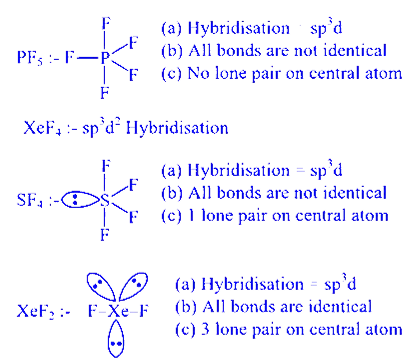
Step Solution:
1. Check hybridization: $\mathrm{SF}_{4}, \mathrm{XeF}_{2}$, and $\mathrm{PF}_{5}$ are $\mathrm{sp}^{3}\mathrm{d}$ (SN=5). $\mathrm{XeF}_{4}$ is $\mathrm{sp}^{3}\mathrm{d}^{2}$ (SN=6).
2. Check for lone pairs: $\mathrm{PF}_{5}$ has 0 lone pairs; $\mathrm{SF}_{4}$ (1), $\mathrm{XeF}_{2}$ (3).
3. Check bond lengths: In $\mathrm{sp}^{3}\mathrm{d}$, axial bonds are typically longer than equatorial bonds due to repulsion.
4. Evaluate $\mathrm{XeF}_{2}$: It is linear; both $\mathrm{Xe}-\mathrm{F}$ bonds are identical.
5. Evaluate $\mathrm{SF}_{4}$: It has a "See-saw" shape where axial and equatorial bond lengths are different.
Difficulty Level: Easy
Concept Name: VSEPR Theory and Hybridization
Short cut solution: Eliminate $\mathrm{PF}_{5}$ (no lone pair) and $\mathrm{XeF}_{4}$ (wrong hybridization). Between $\mathrm{XeF}_{2}$ and $\mathrm{SF}_{4}$, only $\mathrm{SF}_{4}$ has asymmetric bond lengths due to its See-saw geometry.
Question 17
Question: Given below are two statements:
Statement (I): For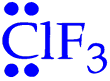 , all three possible structures may be drawn as follows [I, II, III].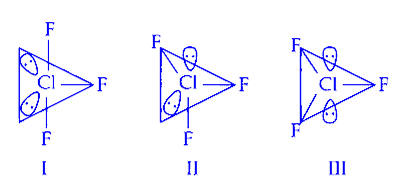
Statement (II): Structure III is most stable, as the orbitals having the lone pairs are axial, where the lp – bp repulsion is minimum.
In the light of the above statements, choose the most appropriate answer from the options given below.
Options:
A. Both Statement I and Statement II are correct
B. Both Statement I and Statement II are incorrect
C. Statement I is correct but Statement II is incorrect
D. Statement I is incorrect but Statement II is correct
Correct Answer: C
Year: JEE Main 2025 (Online) 4th April Evening Shift
Solution: Statement 1 is correct. Statement 2 is incorrect since in $\mathrm{sp}^{3}\mathrm{d}$ hybridization; lone pair cannot occupy axial position.
Step Solution:
1. Determine hybridization of $\mathrm{ClF}_3$: Chlorine has 7 valence electrons; 3 are used for bonds with F, leaving 4 electrons (2 lone pairs).
2. Calculate Steric Number (SN): 3 bond pairs + 2 lone pairs = 5, which corresponds to $\mathrm{sp}^{3}\mathrm{d}$ hybridization.
3. Identify Geometry: The geometry is Trigonal Bipyramidal.
4. Analyze Lone Pair Placement: According to VSEPR theory, lone pairs occupy equatorial positions to minimize repulsion at 90°.
5. Evaluate Statements: Statement I is true as it represents theoretical arrangements. Statement II is false because structure III (axial lone pairs) is the least stable due to maximum repulsion.
Difficulty Level: Medium
Concept Name: VSEPR Theory and Lone Pair positioning
Short cut solution: In $\mathrm{sp}^{3}\mathrm{d}$ hybridization, lone pairs always prefer equatorial positions to minimize $90^{\circ}$ repulsions; any statement claiming axial lone pairs are "most stable" is immediately false.
Question 18
Question: Match the List I with List II.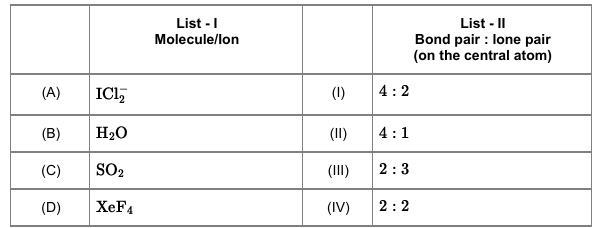
Options:
A. A-IV, B-III, C-II, D-I
B. A-III, B-IV, C-I, D-II
C. A-II, B-I, C-IV, D-III
D. A-III, B-IV, C-II, D-I
Correct Answer: D
Year: JEE Main 2025 (Online) 7th April Morning Shift
Solution: $\mathrm{XeF}_2$ (B.P:L.P = 2:3), $\mathrm{H}_2\mathrm{O}$ (B.P:L.P = 2:2), $\mathrm{SF}_4$ (B.P:L.P = 4:1), $\mathrm{XeF}_4$ (B.P:L.P = 4:2).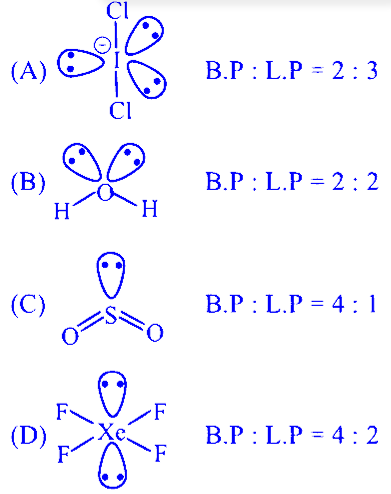
Step Solution:
1. Analyze $\mathrm{XeF}_2$: Xenon (8 valence $e^-$) has 2 bond pairs and 3 lone pairs (Ratio 3:2 matches A).
2. Analyze $\mathrm{H}_2\mathrm{O}$: Oxygen (6 valence $e^-$) has 2 bond pairs and 2 lone pairs (Ratio 2:2 matches B).
3. Analyze $\mathrm{SF}_4$: Sulfur (6 valence $e^-$) has 4 bond pairs and 1 lone pair (Ratio 1:4 matches C).
4. Analyze $\mathrm{XeF}_4$: Xenon (8 valence $e^-$) has 4 bond pairs and 2 lone pairs (Ratio 2:4 matches D).
5. Match according to the ratios: A-III, B-IV, C-II, D-I.
Difficulty Level: Easy
Concept Name: Lewis Structure and VSEPR Theory
Short cut solution: Identify $\mathrm{XeF}_2$ first (the only one with 3 lone pairs) to match A-III, which often narrows down the options significantly.
Question 20
Question: In $\mathrm{SO}_2$, $\mathrm{NO}_2^-$ and $\mathrm{N}_3^-$, the hybridizations at the central atom are respectively:
Options:
A. $\mathrm{sp}^2, \mathrm{sp}^2$ and $\mathrm{sp}^2$
B. $\mathrm{sp}, \mathrm{sp}^2$ and $\mathrm{sp}$
C. $\mathrm{sp}^2, \mathrm{sp}$ and $\mathrm{sp}$
D. $\mathrm{sp}^2, \mathrm{sp}^2$ and $\mathrm{sp}$
Correct Answer: D
Year: JEE Main 2025 (Online) 7th April Evening Shift
Solution: Hybridization is $\mathrm{sp}^2$ for $\mathrm{SO}_2$, $\mathrm{sp}^2$ for $\mathrm{NO}_2^-$ and $\mathrm{sp}$ for $\mathrm{N}_3^-$.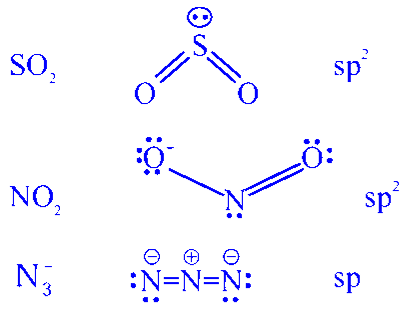
Step Solution:
1. For $\mathrm{SO}_2$: S has 6 valence $e^-$, forms 2 $\sigma$ bonds and has 1 lone pair. SN = 3, so $\mathrm{sp}^2$.
2. For $\mathrm{NO}_2^-$: N has 5 valence $e^-$ (+1 from charge = 6). It forms 2 $\sigma$ bonds and has 1 lone pair. SN = 3, so $\mathrm{sp}^2$.
3. For $\mathrm{N}_3^-$: Central N has 5 valence $e^-$ (+1 from charge = 6). It forms 2 $\sigma$ bonds and has 0 lone pairs (remaining 4 electrons form $\pi$ bonds). SN = 2, so $\mathrm{sp}$.
4. The sequence is $\mathrm{sp}^2, \mathrm{sp}^2, \mathrm{sp}$.
Difficulty Level: Easy
Concept Name: Steric Number and Hybridization
Short cut solution: $\mathrm{N}_3^-$ is isoelectronic with $\mathrm{CO}_2$ and is linear ($\mathrm{sp}$). Only options B and D end in $\mathrm{sp}$. Since $\mathrm{SO}_2$ is bent with a lone pair ($\mathrm{sp}^2$), D is the correct choice.
Question 23
Question: Number of compounds with one lone pair of electrons on central atom amongst following is $\mathrm{O}_{3}, \mathrm{H}_{2}\mathrm{O}, \mathrm{SF}_{4}, \mathrm{ClF}_{3}, \mathrm{NH}_{3}, \mathrm{BrF}_{5}, \mathrm{XeF}_{4}$ \_\_
Options: Integer Type (No options provided in source).
Correct Answer: 4
Year: 2024 (29th Jan Shift 1)
Solution: The source identifies the total count as 4.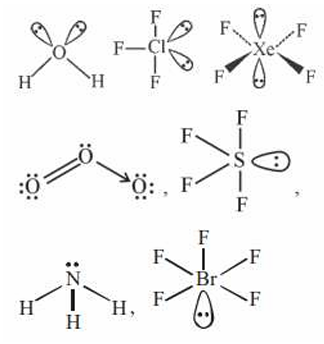
Step Solution:
1. Calculate lone pairs (LP) for each using valence electrons:
$\mathrm{O}_{3}$: Central oxygen has 6 valence $e^-$, 1 $\sigma$ bond, 1 double bond, and 1 lone pair.
$\mathrm{H}_{2}\mathrm{O}$: Oxygen has 6 valence $e^-$, 2 $\sigma$ bonds, and 2 lone pairs.
2. Analyze Halogen/Noble Gas compounds:
$\mathrm{SF}_{4}$: Sulfur has 6 valence $e^-$, 4 bonds, and 1 lone pair.
$\mathrm{ClF}_{3}$: Chlorine has 7 valence $e^-$, 3 bonds, and 2 lone pairs.
3. Analyze remaining species:
$\mathrm{NH}_{3}$: Nitrogen has 5 valence $e^-$, 3 bonds, and 1 lone pair.
$\mathrm{BrF}_{5}$: Bromine has 7 valence $e^-$, 5 bonds, and 1 lone pair.
$\mathrm{XeF}_{4}$: Xenon has 8 valence $e^-$, 4 bonds, and 2 lone pairs.
4. Identify species with exactly one lone pair: $\mathrm{O}_{3}, \mathrm{SF}_{4}, \mathrm{NH}_{3}, \mathrm{BrF}_{5}$.
5. Total count = 4.
Difficulty Level: Medium
Concept Name: VSEPR Theory (Lone Pair Calculation)
Short cut solution: Use the formula $LP = \frac{1}{2}[V - MA - c + a] - BP$, where $V$ is valence electrons and $BP$ is bond pairs. Quickly identify that $\mathrm{O}_{3}, \mathrm{SF}_{4}, \mathrm{NH}_{3},$ and $\mathrm{BrF}_{5}$ all have one lone pair based on their group valence and bond count.
Question 32
Question: The number of species from the following in which the central atom uses $sp^{3}$ hybrid orbitals in its bonding is $\mathrm{NH}_{3}, \mathrm{SO}_{2}, \mathrm{SiO}_{2}, \mathrm{BeCl}_{2}, \mathrm{CO}_{2}, \mathrm{H}_{2}\mathrm{O}, \mathrm{CH}_{4}, \mathrm{BF}_{3}$
Options: Integer Type (No options provided in source).
Correct Answer: 4
Year: 2024 (31st Jan Shift 1)
Solution: $\mathrm{NH}_{3} \to sp^{3}$, $\mathrm{SO}_{2} \to sp^{2}$, $\mathrm{SiO}_{2} \to sp^{3}$, $\mathrm{BeCl}_{2} \to sp$, $\mathrm{CO}_{2} \to sp$, $\mathrm{H}_{2}\mathrm{O} \to sp^{3}$, $\mathrm{CH}_{4} \to sp^{3}$, $\mathrm{BF}_{3} \to sp^{2}$.
Step Solution:
1. Determine Steric Number (SN) = (number of $\sigma$ bonds + number of lone pairs).
2. Evaluate first three: $\mathrm{NH}_{3}$ (3 bonds + 1 LP = 4, $sp^{3}$); $\mathrm{SO}_{2}$ (2 $\sigma$ bonds + 1 LP = 3, $sp^{2}$); $\mathrm{SiO}_{2}$ (each Si is bonded to 4 O atoms in a network, $sp^{3}$).
3. Evaluate middle two: $\mathrm{BeCl}_{2}$ (2 bonds + 0 LP = 2, $sp$); $\mathrm{CO}_{2}$ (2 bonds + 0 LP = 2, $sp$).
4. Evaluate final three: $\mathrm{H}_{2}\mathrm{O}$ (2 bonds + 2 LP = 4, $sp^{3}$); $\mathrm{CH}_{4}$ (4 bonds + 0 LP = 4, $sp^{3}$); $\mathrm{BF}_{3}$ (3 bonds + 0 LP = 3, $sp^{2}$).
5. Count $sp^{3}$ species: $\mathrm{NH}_{3}, \mathrm{SiO}_{2}, \mathrm{H}_{2}\mathrm{O}, \mathrm{CH}_{4}$ = 4.
Difficulty Level: Easy
Concept Name: Hybridization ($sp^{3}$ hybrid orbitals)
Short cut solution: Any molecule with a steric number of 4 uses $sp^{3}$ hybridization. Recognize tetrahedral-based geometries ($\mathrm{CH}_{4}, \mathrm{NH}_{3}, \mathrm{H}_{2}\mathrm{O}$) and the network structure of $\mathrm{SiO}_{2}$ to find the 4 species instantly.
Question 37
Question: The number of molecules/ion/s having trigonal bipyramidal shape is $\mathrm{PF}_{5}, \mathrm{BrF}_{5}, \mathrm{PCl}_{5}, [\mathrm{ICl}_{4}]^{-}, \mathrm{BF}_{3}, [\mathrm{Fe(CO)}_{5}]$.
Options: Integer Type (Answer provided in source is 3).
Correct Answer: 3
Year: 1-Feb-2024 Shift 1
Solution: $\mathrm{PF}_{5}, \mathrm{PCl}_{5}, [\mathrm{Fe(CO)}_{5}]$ are Trigonal bipyramidal. $\mathrm{BrF}_{5}$ is square pyramidal, $[\mathrm{ICl}_{4}]^{-}$ is square planar, and $\mathrm{BF}_{3}$ is Trigonal planar.,
Step Solution:
1. Analyze $\mathrm{PF}_{5}$: Phosphorus has 5 valence electrons; forms 5 bonds with Fluorine. Steric Number (SN) = 5 (0 lone pairs). Shape: Trigonal Bipyramidal.
2. Analyze $\mathrm{PCl}_{5}$: Similar to $\mathrm{PF}_{5}$, Phosphorus uses 5 valence electrons for 5 bonds. SN = 5. Shape: Trigonal Bipyramidal.
3. Analyze $[\mathrm{Fe(CO)}_{5}]$: Iron is the central metal bonded to 5 Carbonyl (CO) ligands. Shape: Trigonal Bipyramidal.
4. Evaluate others: $\mathrm{BrF}_{5}$ has 1 lone pair (Square Pyramidal); $[\mathrm{ICl}_{4}]^{-}$ has 2 lone pairs (Square Planar); $\mathrm{BF}_{3}$ has SN = 3 (Trigonal Planar).
5. Final Count: Only 3 species ($\mathrm{PF}_{5}, \mathrm{PCl}_{5}, [\mathrm{Fe(CO)}_{5}]$) fit the criteria.
Difficulty Level: Easy
Concept Name: VSEPR Theory and Molecular Geometry
Short cut solution: Look for molecules with a Steric Number of 5 and zero lone pairs ($AB_{5}$ type); $\mathrm{PF}_{5}$ and $\mathrm{PCl}_{5}$ are standard examples, and $[\mathrm{Fe(CO)}_{5}]$ is a well-known coordination compound with this geometry.
Question 46
Question: Match List I with List II: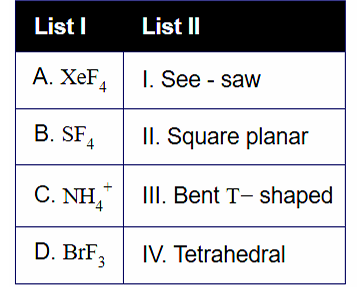
Options:
A. A-IV, B-III, C-II, D-I
B. A-II, B-I, C-III, D-IV
C. A-IV, B-I, C-II, D-III
D. A-II, B-I, C-IV, D-III,
Correct Answer: D
Year: 31-Jan-2023 Shift 1
Solution: (A) Square planar, (B) $\mathrm{SF}_{4}$ See-Saw, (C) $\mathrm{NH}_{3}$ Tetrahedral (electron geometry), (D) $\mathrm{BrF}_{3}$ Bent T-Shaped.
Step Solution:
1. Match (A): $[\mathrm{PtCl}_{4}]^{2-}$ is a $d^{8}$ complex with strong-field ligands, resulting in $dsp^{2}$ hybridization and Square Planar geometry (II).
2. Match (B): $\mathrm{SF}_{4}$ has 4 bond pairs and 1 lone pair. SN = 5 ($sp^{3}d$). Its shape is See-Saw (I).
3. Match (C): $\mathrm{NH}_{3}$ has 3 bond pairs and 1 lone pair. SN = 4. While its molecular shape is pyramidal, its parent electron geometry is Tetrahedral (IV).
4. Match (D): $\mathrm{BrF}_{3}$ has 3 bond pairs and 2 lone pairs. SN = 5 ($sp^{3}d$). Its shape is Bent T-Shaped (III).
5. Conclusion: The match is A-II, B-I, C-IV, D-III.
Difficulty Level: Easy
Concept Name: VSEPR Theory and Coordination Chemistry
Short cut solution: $\mathrm{SF}_{4}$ (See-Saw) and $\mathrm{BrF}_{3}$ (T-Shaped) are unique "distorted" shapes. Matching B-I and D-III immediately eliminates all options except D.
Question 47
Question: For $\mathrm{OF}_{2}$ molecule consider the following: (A) Number of lone pairs on oxygen is 2. (B) FOF angle is less than 104.5°. (C) Oxidation state of O is −2. (D) Molecule is bent 'V' shaped. (E) Molecular geometry is linear. Correct options are:
Options:
A. C, D, E only
B. B, E, A only
C. A, C, D only
D. A, B, D only
Correct Answer: D
Year: 30-Jan-2023 Shift 1
Solution: Two lone pairs on oxygen; Molecule is 'V' shaped; Bond angle is less than 104.5° ($102^{\circ}$); Oxidation State of 'O' is +2.
Step Solution:
1. Evaluate (A): Oxygen has 6 valence electrons; 2 used for bonds with F, leaving 2 lone pairs. (A is correct).
2. Evaluate (D) & (E): SN = 2 bonds + 2 lone pairs = 4 ($sp^{3}$). Geometry is Bent / V-shaped, not linear. (D is correct, E is incorrect).
3. Evaluate (C): Fluorine is more electronegative than Oxygen. In $\mathrm{OF}_{2}$, Oxygen has an oxidation state of +2. (C is incorrect).
4. Evaluate (B): In $\mathrm{H}_{2}\mathrm{O}$ the angle is $104.5^{\circ}$. In $\mathrm{OF}_{2}$, the highly electronegative Fluorine atoms pull the bonding electrons away from Oxygen, reducing bond-pair repulsion and making the angle smaller ($102^{\circ}$). (B is correct).
5. Final Selection: Statements A, B, and D are correct.
Difficulty Level: Medium
Concept Name: VSEPR Theory and Oxidation States
Short cut solution: Since Fluorine is the most electronegative element, Oxygen cannot be -2 in $\mathrm{OF}_{2}$ (Statement C is false). Eliminating options with 'C' leaves only B and D. Since $\mathrm{OF}_{2}$ is bent like water, it cannot be linear (E is false), leaving D as the only choice.
Question 48
Question: Match List I with List II.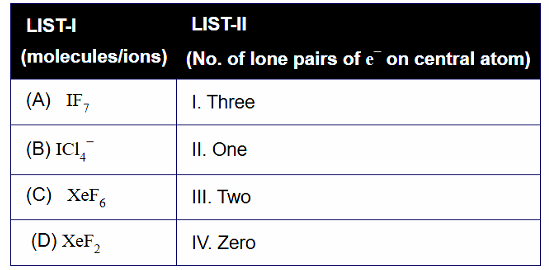
Options:
A. A-II, B-III, C-IV, D-I
B. A-IV, B-III, C-II, D-I
C. A-II, B-I, C-IV, D-III
D. A-IV, B-I, C-II, D-III.
Correct Answer: B.
Year: 30-Jan-2023 Shift 1.
Solution: The specific items for List I and List II are not detailed in the provided excerpt; however, the correct matching sequence is identified as A-IV, B-III, C-II, D-I.
Step Solution:
1. Identifying molecular geometries or hybridizations typically requires calculating the Steric Number (SN) for each species in List I.
2. Use the formula: $\text{SN} = \frac{1}{2}[\text{Valence electrons} + \text{Monovalent atoms} - \text{cationic charge} + \text{anionic charge}]$.
3. Match the calculated SN and the resulting VSEPR shape to the corresponding descriptors in List II.
4. Review the options to find the sequence where all four matches are correct.
5. Select option B as it represents the correct pairing provided by the source.
Difficulty Level: Medium.
Concept Name: VSEPR Theory and Molecular Geometry.
Shortcut Solution: In matching questions, identify the most unique or familiar molecule (e.g., a linear or tetrahedral species) first to eliminate incorrect options rapidly.
Question 49
Question: Amongst the following, the number of species having the linear shape is $\mathrm{XeF}_2, \mathrm{I}_3^+, \mathrm{C}_3\mathrm{O}_2, \mathrm{I}_3^-, \mathrm{CO}_2, \mathrm{SO}_2, \mathrm{BeCl}_2$ and $\mathrm{BCl}_2^-$.
Options: Integer Type (Answer provided in source is 5).
Correct Answer: 5.
Year: 31-Jan-2023 Shift 2.
Solution: The linear species identified include $\mathrm{BeCl}_2, \mathrm{CO}_2, \mathrm{XeF}_2, \mathrm{I}_3^-,$ and $\mathrm{C}_3\mathrm{O}_2$.
Step Solution:
1. Calculate hybridization for each: $\mathrm{BeCl}_2$ and $\mathrm{CO}_2$ are $sp$ hybridized with 0 lone pairs, resulting in linear geometry.
2. Analyze $\mathrm{XeF}_2$ and $\mathrm{I}_3^-$: Both have SN = 5 ($sp^3d$) with 3 lone pairs in equatorial positions, which makes the molecule linear.
3. Analyze Carbon suboxide ($\mathrm{C}_3\mathrm{O}_2$): This molecule has a continuous chain of double bonds ($\mathrm{O=C=C=C=O}$), making it linear.
4. Exclude non-linear species: $\mathrm{SO}_2$ and $\mathrm{I}_3^+$ are bent ($sp^2$ and $sp^3$ respectively with lone pairs), and $\mathrm{BCl}_2^-$ is also bent.
5. Total count of linear species = 5.
Difficulty Level: Medium.
Concept Name: Linear Geometry and VSEPR Theory.
Shortcut Solution: Memorize that $sp$ hybridization with 0 lone pairs and $sp^3d$ hybridization with 3 lone pairs always result in linear shapes.
Question 50
Question: The number of species from the following which have square pyramidal structure is $\mathrm{PF}_5, \mathrm{BrF}_4^-, \mathrm{IF}_5; \mathrm{BrF}_5, \mathrm{XeOF}_4, \mathrm{ICl}_4^-$.
Options: Integer Type (Answer provided in source is 3).
Correct Answer: 3.
Year: 6-Apr-2023 shift 1.
Solution: $\mathrm{IF}_5$, $\mathrm{BrF}_5$, and $\mathrm{XeOF}_4$ have a square pyramidal shape. $\mathrm{BrF}_4^-$ and $\mathrm{ICl}_4^-$ are square planar, and $\mathrm{PF}_5$ is trigonal bipyramidal.
Step Solution:
1. Analyze $\mathrm{IF}_5$ and $\mathrm{BrF}_5$: Both have 7 valence electrons + 5 monovalent fluorine atoms = 12 electrons, giving SN = 6 ($sp^3d^2$) with 1 lone pair. This results in a square pyramidal shape.
2. Analyze $\mathrm{XeOF}_4$: Xenon has 8 valence electrons; 4 used for F bonds and 2 for the oxygen double bond, leaving 1 lone pair. Total sigma domains (5) + 1 lone pair = SN 6, also resulting in a square pyramidal shape.
3. Analyze $\mathrm{ICl}_4^-$ and $\mathrm{BrF}_4^-$: Both have SN = 6 with 4 bond pairs and 2 lone pairs, resulting in square planar geometry.
4. Analyze $\mathrm{PF}_5$: SN = 5 with 0 lone pairs, resulting in trigonal bipyramidal geometry.
5. Total square pyramidal count = 3.
Difficulty Level: Medium.
Concept Name: VSEPR Theory and Square Pyramidal Shape.
Shortcut Solution: Square pyramidal shapes are typically found in $AB_5L$ types (Steric Number 6 with 1 lone pair), which immediately identifies $\mathrm{IF}_5, \mathrm{BrF}_5,$ and $\mathrm{XeOF}_4$.
Question 51
Question: The number of species having a square planar shape from the following is $\mathrm{XeF}_{4}, \mathrm{BrF}_{4}^{-}, [\mathrm{Cu}(\mathrm{NH}_{3})_{4}]^{2+}, [\mathrm{PtCl}_{4}]^{2-}$.
Options: Integer Type.
Correct Answer: 4.
Year: 6-Apr-2023 shift 2.
Solution: $\mathrm{XeF}_{4}, \mathrm{BrF}_{4}^{-1}, [\mathrm{Cu}(\mathrm{NH}_{3})_{4}]^{+2}, [\mathrm{PtCl}_{4}]^{-2}$ has square planar shape.
Step Solution:
1. Analyze $\mathrm{XeF}_{4}$: Xenon (8 valence $e^{-}$) forms 4 bonds and has 2 lone pairs. Steric Number (SN) = 6 ($sp^{3}d^{2}$). Geometry: Octahedral; Shape: Square Planar.
2. Analyze $\mathrm{BrF}_{4}^{-}$: Bromine (7 valence $e^{-}$) + 1 (negative charge) = 8. It forms 4 bonds with 2 lone pairs. SN = 6 ($sp^{3}d^{2}$). Shape: Square Planar.
3. Analyze $[\mathrm{Cu}(\mathrm{NH}_{3})_{4}]^{2+}$: Copper (II) is a $d^{9}$ system. With $\mathrm{NH}_{3}$ ligands, it undergoes $dsp^{2}$ hybridization (with one electron promoted or via Jahn-Teller distortion), resulting in Square Planar geometry.
4. Analyze $[\mathrm{PtCl}_{4}]^{2-}$: Platinum (II) is a $d^{8}$ system. Since it is a 5d transition metal, all ligands (including $\mathrm{Cl}^{-}$) cause $dsp^{2}$ hybridization, resulting in Square Planar geometry.
5. Count: All 4 listed species are square planar.
Difficulty Level: Hard.
Concept Name: VSEPR Theory and Coordination Chemistry (Crystal Field Theory).
Shortcut Solution: Square planar shapes are typical for $AB_{4}L_{2}$ types in VSEPR (like $\mathrm{XeF}_{4}$) and 4-coordinate $d^{8}/d^{9}$ complexes of heavy transition metals (like Pt).
Question 55
Question: The number of species from the following carrying a single lone pair on central atom Xenon is $\mathrm{XeF}_{5}^{+}, \mathrm{XeO}_{3}, \mathrm{XeO}_{2}\mathrm{F}_{2}, \mathrm{XeF}_{5}^{-}, \mathrm{XeO}_{3}\mathrm{F}_{2}, \mathrm{XeOF}_{4}, \mathrm{XeF}_{4}$.
Options: Integer Type.
Correct Answer: 4.
Year: 8-Apr-2023 shift 2.
Solution: The number of species is 4.
Step Solution:
1. $\mathrm{XeF}_{5}^{+}$: Xe has 8 valence $e^{-}$; $8 - 1 (\text{charge}) = 7$. Uses 5 for bonds, leaving 1 lone pair.
2. $\mathrm{XeO}_{3}$: 8 valence $e^{-}$. Uses 6 electrons for 3 double bonds (O), leaving 1 lone pair.
3. $\mathrm{XeO}_{2}\mathrm{F}_{2}$: 8 valence $e^{-}$. Uses 4 for O and 2 for F bonds, leaving 1 lone pair.
4. $\mathrm{XeOF}_{4}$: 8 valence $e^{-}$. Uses 2 for O and 4 for F bonds, leaving 1 lone pair.
5. Exclude others: $\mathrm{XeF}_{5}^{-}$ (2 LP), $\mathrm{XeO}_{3}\mathrm{F}_{2}$ (0 LP), and $\mathrm{XeF}_{4}$ (2 LP).
Difficulty Level: Medium.
Concept Name: VSEPR Theory (Lone Pair Calculation).
Shortcut Solution: Calculate lone pairs using $LP = \frac{1}{2} [V - \sum (\text{bonding electrons})]$. For these Xe compounds, those where 6 valence electrons are used in bonding leave exactly 1 lone pair ($8 - 6 = 2$ electrons).
Question 58
Question: The number of bent-shaped molecule/s from the following is $\mathrm{N}_{3}^{-}, \mathrm{NO}_{2}^{-}, \mathrm{I}_{3}^{-}, \mathrm{O}_{3}, \mathrm{SO}_{2}$.
Options: Integer Type.
Correct Answer: 3.
Year: 10-Apr-2023 shift 1.
Solution: $\mathrm{N}_{3}^{-}$ linear, $\mathrm{NO}_{2}^{-}$ bent, $\mathrm{I}_{3}^{-}$ linear (Ozone and $\mathrm{SO}_{2}$ are also bent).
Step Solution:
1. Analyze $\mathrm{N}_{3}^{-}$ and $\mathrm{I}_{3}^{-}$: $\mathrm{N}_{3}^{-}$ ($sp$ hybridization) and $\mathrm{I}_{3}^{-}$ ($sp^{3}d$ with 3 equatorial lone pairs) are both linear.
2. Analyze $\mathrm{NO}_{2}^{-}$: Nitrogen has 2 bond pairs and 1 lone pair ($sp^{2}$ hybridization), resulting in a bent shape.
3. Analyze $\mathrm{O}_{3}$: Central Oxygen has 2 bond pairs and 1 lone pair ($sp^{2}$ hybridization), resulting in a bent shape.
4. Analyze $\mathrm{SO}_{2}$: Sulfur has 2 bond pairs and 1 lone pair ($sp^{2}$ hybridization), resulting in a bent shape.
5. Total Count: $\mathrm{NO}_{2}^{-}, \mathrm{O}_{3},$ and $\mathrm{SO}_{2}$ are bent. Total = 3.
Difficulty Level: Easy.
Concept Name: VSEPR Theory and Molecular Geometry.
Shortcut Solution: Identify molecules with a Steric Number of 3 (2 bond pairs + 1 lone pair); these typically exhibit a bent or V-shaped geometry.
Question 59
Question: The sum of lone pairs present on the central atom of the interhalogen $\mathrm{IF}_5$ and $\mathrm{IF}_7$ is.
Options: Integer Type.
Correct Answer: 1.
Year: 10-Apr-2023 shift 1.
Solution: $\mathrm{IF}_5$ has 1 lone pair on the central atom, while $\mathrm{IF}_7$ has 0 lone pairs. The sum is $1 + 0 = 1$.
Step Solution:
1. Determine the valence electrons for Iodine (Group 17), which is 7.
2. Calculate lone pairs for $\mathrm{IF}_5$: It forms 5 bond pairs, using 5 electrons; the remaining 2 electrons form 1 lone pair.
3. Calculate lone pairs for $\mathrm{IF}_7$: It forms 7 bond pairs, using all 7 valence electrons; thus, it has 0 lone pairs.
4. Add the lone pairs from both molecules: $1 \text{ (from } \mathrm{IF}_5) + 0 \text{ (from } \mathrm{IF}_7) = 1$.
5. The final sum is 1.
Difficulty Level: Easy.
Concept Name: VSEPR Theory (Lone Pair Calculation).
Shortcut Solution: Recognize that $\mathrm{IF}_7$ is a rare case where the central atom uses all valence electrons for bonding (Pentagonal Bipyramidal), leaving zero lone pairs, so the total sum is just the lone pair count of $\mathrm{IF}_5$.
Question 60
Question: Match list I with list II. Choose correct answer from the options given below: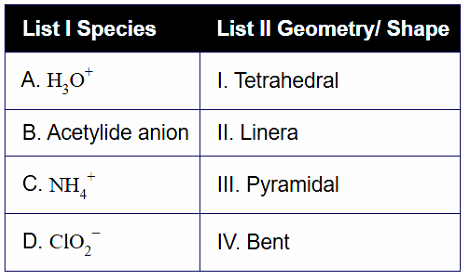
Options:
A. A-III, B-IV, C-I, D-II
B. A-III, B-IV, C-II, D-I
C. A-III, B-I, C-II, D-IV
D. A-III, B-II, C-I, D-IV.
Correct Answer: D.
Year: 11-Apr-2023 shift 1.
Solution: $\mathrm{H}_3\mathrm{O}^+$ is $sp^3$ hybridized and Pyramidal; Acetylide ($\overline{\mathrm{C}} \equiv \overline{\mathrm{C}}$) is $sp$ hybridized and Linear; $\mathrm{NH}_4^+$ is $sp^3$ hybridized and Tetrahedral; $\mathrm{ClO}_2^-$ is $sp^3$ hybridized and Bent.
Step Solution:
1. Analyze $\mathrm{H}_3\mathrm{O}^+$: Steric Number (SN) = 3 bond pairs + 1 lone pair = 4; geometry is Pyramidal (A-III).
2. Analyze Acetylide ion: The central carbon forms a triple bond and one lone pair (or C-C bond); it is Linear (B-II).
3. Analyze $\mathrm{NH}_4^+$: SN = 4 bond pairs + 0 lone pairs = 4; geometry is Tetrahedral (C-I).
4. Analyze $\mathrm{ClO}_2^-$: SN = 2 bond pairs + 2 lone pairs = 4; geometry is Bent (D-IV).
5. The correct matching sequence is A-III, B-II, C-I, D-IV.
Difficulty Level: Medium.
Concept Name: VSEPR Theory and Molecular Shapes.
Shortcut Solution: Identify the Acetylide ion as linear and $\mathrm{NH}_4^+$ as a perfect tetrahedron first; this usually narrows down the options to the correct answer (D) immediately.
Question 62
Question: The maximum number of lone pairs of electrons on the central atom from the following species is $\mathrm{ClO}_3^-$, $\mathrm{XeF}_4$, $\mathrm{SF}_4$ and $\mathrm{I}_3^-$.
Options: Integer Type.
Correct Answer: 3.
Year: 11-Apr-2023 shift 2.
Solution: $\mathrm{ClO}_3^-$ has 1 lone pair, $\mathrm{XeF}_4$ has 2 lone pairs, $\mathrm{SF}_4$ has 1 lone pair, and $\mathrm{I}_3^-$ has 3 lone pairs.
Step Solution:
1. Calculate for $\mathrm{ClO}_3^-$: Chlorine (7 valence $e^-$) uses 6 electrons for O-bonds (and gains 1 from negative charge), leaving 1 lone pair.
2. Calculate for $\mathrm{XeF}_4$: Xenon (8 valence $e^-$) uses 4 electrons for bonds, leaving 4 electrons as 2 lone pairs.
3. Calculate for $\mathrm{SF}_4$: Sulfur (6 valence $e^-$) uses 4 electrons for bonds, leaving 2 electrons as 1 lone pair.
4. Calculate for $\mathrm{I}_3^-$: The central Iodine (7 valence $e^-$ + 1 charge = 8) uses 2 electrons for bonds, leaving 6 electrons as 3 lone pairs.
5. The maximum number among these is 3.
Difficulty Level: Easy.
Concept Name: VSEPR Theory (Lone Pair Calculation).
Shortcut Solution: Remember that $\mathrm{I}_3^-$ is isoelectronic with $\mathrm{XeF}_2$ and is linear due to its 3 equatorial lone pairs, which is higher than the lone pairs in the other listed $sp^3$ and $sp^3d^2$ species.
Question 66
Question: $\mathrm{ClF}_5$ at room temperature is a:
Options:
A. Colourless liquid with square pyramidal geometry
B. Colourless gas with trigonal bipyramidal geometry
C. Colourless gas with square pyramidal geometry
D. Colourless liquid with trigonal bipyramidal geometry
Correct Answer: A
Year: 13-Apr-2023 shift 1
Solution: $\mathrm{ClF}_5$ is colourless liquid.
Step Solution:
1. Determine valence electrons of Chlorine (Central atom): Group 17, so 7 electrons.
2. Count surrounding atoms: There are 5 Fluorine atoms bonded to Chlorine.
3. Calculate lone pairs (LP): $LP = \frac{7 - 5}{2} = 1$ lone pair.
4. Determine Steric Number (SN): $5 \text{ bond pairs} + 1 \text{ lone pair} = 6$.
5. An SN of 6 with 1 lone pair corresponds to square pyramidal geometry ($sp^3d^2$); interhalogens like $\mathrm{ClF}_5$ and $\mathrm{BrF}_5$ are liquids at room temperature.
Difficulty Level: Medium
Concept Name: VSEPR Theory and Physical States of Interhalogens
Short cut solution: Interhalogens of the type $AX_5$ with 1 lone pair ($sp^3d^2$) always have a square pyramidal shape; $\mathrm{ClF}_5$ and $\mathrm{BrF}_5$ are notably colourless liquids.
Question 69
Question: Given below are two statements: Statement I: $\mathrm{SO}_2$ and $\mathrm{H}_2\mathrm{O}$ both possess V-shaped structure. Statement II: The bond angle of $\mathrm{SO}_2$ less than that of $\mathrm{H}_2\mathrm{O}$. In the light of the above statements, choose the most appropriate answer from the options given below:
Options:
A. Both Statements I and Statement II are incorrect
B. Both Statement I and Statements II are correct
C. Statement I is correct but Statement II is incorrect
D. Statements I is incorrect but Statement II is correct
Correct Answer: C
Year: 13-Apr-2023 shift 2
Solution: Both are bent in shape. Bond angle of $\mathrm{SO}_2 (sp^2)$ is greater than that of $\mathrm{H}_2\mathrm{O} (sp^3)$ due to higher repulsion of multiple bonds.
Step Solution:
1. Determine $\mathrm{H}_2\mathrm{O}$ geometry: Oxygen has 2 bond pairs and 2 lone pairs (SN=4, $sp^3$), resulting in a Bent/V-shape.
2. Determine $\mathrm{SO}_2$ geometry: Sulfur has 2 sigma bond pairs and 1 lone pair (SN=3, $sp^2$), resulting in a Bent/V-shape.
3. Compare bond angles: Theoretically, $sp^3$ bond angles are $\sim 109.5^\circ$ and $sp^2$ are $\sim 120^\circ$.
4. Account for lone pair repulsion: Water is $\sim 104.5^\circ$ due to 2 lone pairs; $\mathrm{SO}_2$ is $\sim 119^\circ$ due to 1 lone pair and multiple bond repulsion.
5. Conclusion: Since $119^\circ > 104.5^\circ$, Statement II is false.
Difficulty Level: Easy
Concept Name: VSEPR Theory and Bond Angle Comparison
Short cut solution: Both are V-shaped, but $\mathrm{SO}_2$ uses $sp^2$ hybridization ($\sim 120^\circ$) while $\mathrm{H}_2\mathrm{O}$ uses $sp^3$ ($\sim 109^\circ$); thus, the bond angle in $\mathrm{SO}_2$ must be greater.
Question 70
Question: Consider the following statements: (A) $\mathrm{NF}_3$ molecule has a trigonal planar structure. (B) Bond length of $\mathrm{N}_2$ is shorter than $\mathrm{O}_2$. (C) Isoelectronic molecules or ions have identical bond order. (D) Dipole moment of $\mathrm{H}_2\mathrm{S}$ is higher than that of water molecule. Choose the correct answer from the options given below:
Options:
A. (A) and (B) are correct
B. (C) and (D) are correct
C. (B) and (C) are correct
D. (A) and (D) are correct
Correct Answer: C
Year: 15-Apr-2023 shift 1
Solution: $\mathrm{N}_2$ (Bond Order=3), $\mathrm{O}_2$ (Bond Order=2). Bond Length: $\mathrm{N}_2 < \mathrm{O}_2$. Isoelectronic species have identical bond order.
Step Solution:
1. Evaluate (A): $\mathrm{NF}_3$ has 3 bond pairs and 1 lone pair ($sp^3$); it is pyramidal, not trigonal planar.
2. Evaluate (B): $\mathrm{N}_2$ has a triple bond (Bond Order 3); $\mathrm{O}_2$ has a double bond (Bond Order 2).
3. Relate BO to Bond Length: Higher bond order results in shorter bond length; thus, $\mathrm{N}_2$ is shorter than $\mathrm{O}_2$.
4. Evaluate (C): Isoelectronic species (same electron count) have the same Molecular Orbital configuration and thus the same Bond Order.
5. Evaluate (D): Water is more polar than $\mathrm{H}_2\mathrm{S}$ due to the higher electronegativity of Oxygen; thus, water's dipole moment is higher.
Difficulty Level: Medium
Concept Name: Bond Order, Bond Length, and Periodic Properties
Short cut solution: Eliminate (A) because $\mathrm{NF}_3$ is pyramidal (like $\mathrm{NH}_3$). Eliminate (D) because water is much more polar than $\mathrm{H}_2\mathrm{S}$. Statements (B) and (C) are fundamental principles of Molecular Orbital Theory.
Question 76
Question: Amongst $\mathrm{SF}_{4}, \mathrm{XeF}_{4}, \mathrm{CF}_{4}$ and $\mathrm{H}_{2} \mathrm{O}$, the number of species with two lone pairs of electrons is
Options: Integer Type
Correct Answer: 2
Year: 26-Jun-2022-Shift-2
Solution: Number of lone pair on central atom for $\mathrm{H}_{2}\mathrm{O}$ and $\mathrm{XeF}_{4}$ is equal to 2.
Step Solution:
1. Analyze $\mathrm{SF}_{4}$: Sulfur has 6 valence electrons; 4 used for bonds, leaving 1 lone pair.
2. Analyze $\mathrm{XeF}_{4}$: Xenon has 8 valence electrons; 4 used for bonds, leaving 2 lone pairs.
3. Analyze $\mathrm{CF}_{4}$: Carbon has 4 valence electrons; all 4 used for bonds, leaving 0 lone pairs.
4. Analyze $\mathrm{H}_{2}\mathrm{O}$: Oxygen has 6 valence electrons; 2 used for bonds, leaving 2 lone pairs.
5. Final Count: Two species ($\mathrm{XeF}_{4}$ and $\mathrm{H}_{2}\mathrm{O}$) have exactly two lone pairs.
Difficulty Level: Easy
Concept Name: VSEPR Theory (Lone Pair Calculation)
Short cut solution: Quickly determine lone pairs using $LP = \frac{1}{2}[V - B]$ for monovalent atoms. $\mathrm{XeF}_{4} = \frac{1}{2} = 2$; $\mathrm{H}_{2}\mathrm{O} = \frac{1}{2} = 2$.
Question 77
Question: Based upon VSEPR theory, match the shape (geometry) of the molecules in List-I with the molecules in List-II and select the most appropriate option.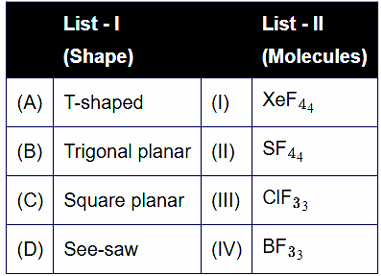
Options:
A. (A) − (I), (B) − (II), (C) − (III), (D) − (IV)
B. (A) - (III), (B) - (IV), (C) - (I), (D) - (II)
C. (A) − (III), (B) − (IV), (C) − (I), (D) − (I)
D. (A) − (IV), (B) − (III), (C) − (I), (D) − (II)
Correct Answer: B
Year: 27-Jun-2022-Shift-1
Solution: The match involves shapes such as T-shape and Trigonal planar.
Step Solution:
1. Identify common VSEPR shapes for interhalogens and group 13/15/16 compounds.
2. Molecules like $\mathrm{ClF}_{3}$ exhibit a T-shape due to $sp^{3}d$ hybridization with 2 lone pairs.
3. Molecules like $\mathrm{BF}_{3}$ exhibit a Trigonal planar geometry with $sp^{2}$ hybridization and 0 lone pairs.
4. Apply these standard VSEPR rules to the matching items in the lists.
5. Match according to the provided sequence: (A) - (III), (B) - (IV), (C) - (I), (D) - (II).
Difficulty Level: Medium
Concept Name: VSEPR Theory and Molecular Geometry
Short cut solution: In matching questions, identify the most distinctive shapes first, such as T-shape ($\mathrm{ClF}_{3}$) or Trigonal planar ($\mathrm{BF}_{3}$), to quickly eliminate incorrect matching options.
Question 78
Question: Identify the incorrect statement for $\mathrm{PCl}_{5}$ from the following.
Options:
A. In this molecule, orbitals of phosphorous are assumed to undergo $sp^{3}d$ hybridization.
B. The geometry of $\mathrm{PCl}_{5}$ is trigonal bipyramidal.
C. PCl has two axial bonds stronger than three equatorial bonds.
D. The three equatorial bonds of $\mathrm{PCl}_{5}$ lie in a plane.
Correct Answer: C
Year: 27-Jun-2022-Shift-2
Solution: In $\mathrm{PCl}_{5}$, all three equatorial bonds are in a plane, it has $sp^{3}d$ hybridization and trigonal bipyramidal geometry. Axial bonds are weaker than equatorial bonds.
Step Solution:
1. Analyze Hybridization: Phosphorus (Group 15) has 5 valence electrons. Bonded to 5 Cl atoms, it has a Steric Number of 5, resulting in $sp^{3}d$ hybridization.
2. Determine Geometry: A Steric Number of 5 with 0 lone pairs results in Trigonal Bipyramidal geometry.
3. Analyze Bonding Positions: There are 3 equatorial bonds lying in a plane ($120^{\circ}$ angles) and 2 axial bonds perpendicular to the plane ($90^{\circ}$ angles).
4. Evaluate Bond Strength: Axial bonds experience more repulsion from the three equatorial bond pairs at $90^{\circ}$, making them longer and weaker than the equatorial bonds.
5. Conclusion: Statement C is incorrect because it claims axial bonds are stronger.
Difficulty Level: Easy
Concept Name: Hybridization and Geometry of $\mathrm{PCl}_{5}$
Short cut solution: Remember that in trigonal bipyramidal ($sp^{3}d$) structures with identical ligands, axial bonds are always longer and weaker than equatorial bonds due to increased repulsion.
Question 80
Question: The hybridization of P exhibited in $\mathrm{PF}_{5}$ is $\mathrm{sp}^{x}\mathrm{d}^{y}$. The value of $y$ is __
Options: (Integer Type Question - No options provided in the source)
Correct Answer: 1
Year: 28-Jun-2022-Shift-1
Solution: $\mathrm{PF}_{5} \Rightarrow \mathrm{sp}^{3}\mathrm{d}$ hybridisation (5 sigma bonds, zero lone pair on central atom). Value of $y = 1$.
Step Solution:
1. Identify Valence Electrons: Phosphorus (Group 15) has 5 valence electrons.
2. Count Bond Pairs: There are 5 Fluorine atoms bonded to Phosphorus, so bond pairs (BP) = 5.
3. Calculate Lone Pairs: $\text{Lone Pairs (LP)} = \frac{5 - 5}{2} = 0$.
4. Determine Steric Number (SN): $\text{SN} = \text{BP} + \text{LP} = 5 + 0 = 5$.
5. Assign Hybridization: For $\text{SN} = 5$, the hybridization is $\mathrm{sp}^{3}\mathrm{d}^{1}$. Comparing this to $\mathrm{sp}^{x}\mathrm{d}^{y}$, the value of $y$ is 1.
Difficulty Level: Easy
Concept Name: Hybridization (Steric Number)
Short cut solution: $\mathrm{PF}_{5}$ is a standard $AB_{5}$ molecule with 5 sigma bonds and no lone pairs, which always corresponds to $\mathrm{sp}^{3}\mathrm{d}$ hybridization. Since $y$ is the power of 'd', $y = 1$.
Question 81
Question: In the structure of $\mathrm{SF}_{4}$, the lone pair of electrons on S is in
Options:
A. equatorial position and there are two lone pair - bond pair repulsions at $90^{\circ}$.
B. equatorial position and there are three lone pair - bond pair repulsions at $90^{\circ}$.
C. axial position and there are three lone pair - bond pair repulsion at $90^{\circ}$.
D. axial position and there are two lone pair - bond pair repulsion at $90^{\circ}$.
Correct Answer: A
Year: 28-Jun-2022-Shift-2
Solution: $\mathrm{SF}_{4} \to \mathrm{sp}^{3}\mathrm{d}$ hybridisation. The lone pair of electrons on S is in an equatorial position and there are two lone pair-bond pair repulsions at $90^{\circ}$.
Step Solution:
1. Find Hybridization: Sulfur (6 valence $e^{-}$) forms 4 bonds with F, leaving 2 electrons (1 lone pair). $\text{SN} = 4 \text{ BP} + 1 \text{ LP} = 5$. Hybridization is $\mathrm{sp}^{3}\mathrm{d}$.
2. Determine Geometry: $\mathrm{sp}^{3}\mathrm{d}$ corresponds to Trigonal Bipyramidal (TBP) geometry.
3. Position Lone Pair: In TBP, lone pairs occupy equatorial positions to minimize $90^{\circ}$ repulsions.
4. Count $90^{\circ}$ Repulsions: A lone pair at an equatorial position has two $90^{\circ}$ neighbors (the two axial Fluorine atoms).
5. Conclusion: The lone pair is in the equatorial position with two $90^{\circ}$ lp-bp repulsions.
Difficulty Level: Medium
Concept Name: VSEPR Theory (Lone Pair Positioning)
Short cut solution: In TBP ($\mathrm{sp}^{3}\mathrm{d}$), lone pairs always prefer the roomier equatorial positions. From the equatorial spot, the lone pair only "sees" the two axial atoms at a $90^{\circ}$ angle.
Question 83
Question: Consider the species $\mathrm{CH}_{4}, \mathrm{NH}_{4}^{+}$ and $\mathrm{BH}_{4}^{-}$. Choose the correct option with respect to these species.
Options:
A. They are isoelectronic and only two have tetrahedral structures.
B. They are isoelectronic and all have tetrahedral structures.
C. Only two are isoelectronic and all have tetrahedral structures.
D. Only two are isoelectronic and only two have tetrahedral structures.
Correct Answer: B
Year: 29-Jun-2022-Shift-2
Solution: All are tetrahedral and each have 10 electrons.
Step Solution:
1. Count electrons for $\mathrm{CH}_{4}$: $\text{Carbon (6)} + \text{4 Hydrogens (4)} = 10 \text{ electrons}$.
2. Count electrons for $\mathrm{NH}_{4}^{+}$: $\text{Nitrogen (7)} + \text{4 Hydrogens (4)} - 1 \text{ (positive charge)} = 10 \text{ electrons}$.
3. Count electrons for $\mathrm{BH}_{4}^{-}$: $\text{Boron (5)} + \text{4 Hydrogens (4)} + 1 \text{ (negative charge)} = 10 \text{ electrons}$.
4. Analyze Structures: All three central atoms have 4 bond pairs and 0 lone pairs.
5. Finalize Shape: A steric number of 4 with 0 lone pairs results in a Tetrahedral structure for all three.
Difficulty Level: Easy
Concept Name: Isoelectronic species and VSEPR Theory
Short cut solution: Since all three species have a central atom with 8 valence shell electrons (after accounting for charge) and 4 surrounding Hydrogen atoms, they are isoelectronic with Neon and share the same tetrahedral geometry.
Question 84
Question: Number of lone pair(s) of electrons on central atom and the shape $\mathrm{BrF}_3$ molecule respectively, are
Options:
A. 0, triangular planar.
B. 1, pyramidal.
C. 2, bent T-shape.
D. 1, bent T-shape.
Correct Answer: C
Year: 29-Jun-2022-Shift-2
Solution: Steric no. $= 5 (\mathrm{sp}^3\mathrm{d})$, lone pair $= 2$ Bent T shape.
Step Solution:
1. Identify central atom valence electrons: Bromine (Br) belongs to Group 17 and has 7 valence electrons.
2. Determine bond pairs: There are 3 Fluorine (F) atoms bonded to the central Br atom.
3. Calculate lone pairs (LP): $LP = \frac{Valence - Bonded}{2} = \frac{7 - 3}{2} = 2$.
4. Calculate Steric Number (SN): $SN = \text{Bond Pairs (3)} + \text{Lone Pairs (2)} = 5$.
5. Assign geometry and shape: SN 5 corresponds to $\mathrm{sp}^3\mathrm{d}$ hybridization (Trigonal Bipyramidal geometry). With 2 lone pairs occupying equatorial positions, the molecular shape is Bent T-shape.
Difficulty Level: Easy
Concept Name: VSEPR Theory and Molecular Geometry
Short cut solution: $\mathrm{BrF}_3$ is an $AB_3L_2$ type molecule. According to VSEPR theory, any molecule with 3 bond pairs and 2 lone pairs on the central atom ($sp^3d$) will always result in a T-shaped geometry.
Question 87
Question: The sum of number of lone pairs of electrons present on the central atoms of $\mathrm{XeO}_3$, $\mathrm{XeOF}_4$ and $\mathrm{XeF}_6$, is
Options: Integer Type (Answer provided in source is 3).
Correct Answer: 3
Year: 25-Jul-2022-Shift-2
Solution: lone pair on central atom = 1 for $\mathrm{XeO}_3$ ($\mathrm{sp}^3$); $\mathrm{XeOF}_4$ has five bond pairs and one lone pair ($\mathrm{sp}^3\mathrm{d}^2$); $\mathrm{XeF}_6$ has one lone pair.
Step Solution:
1. Analyze $\mathrm{XeO}_3$: Xenon (8 valence $e^-$) forms 3 double bonds with Oxygen (uses 6 electrons). $LP = \frac{8-6}{2} = 1$.
2. Analyze $\mathrm{XeOF}_4$: Xenon forms 1 double bond with O and 4 single bonds with F (uses $2+4=6$ electrons). $LP = \frac{8-6}{2} = 1$.
3. Analyze $\mathrm{XeF}_6$: Xenon forms 6 single bonds with F (uses 6 electrons). $LP = \frac{8-6}{2} = 1$.
4. Sum the lone pairs: $1 (\mathrm{XeO}_3) + 1 (\mathrm{XeOF}_4) + 1 (\mathrm{XeF}_6) = 3$.
5. Final value: 3.
Difficulty Level: Medium
Concept Name: VSEPR Theory (Lone Pair Calculation)
Short cut solution: In all three molecules, Xenon uses exactly 6 of its 8 valence electrons to form bonds (whether double or single), which consistently leaves 2 electrons, or exactly 1 lone pair, on the central atom in each case. $1 + 1 + 1 = 3$.
Question 88
Question: Match List-I with List-II :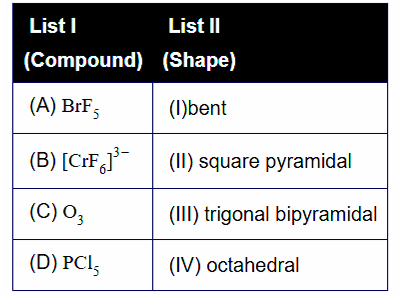
Options:
A. (A) − (I), (B) − (II), (C) − (II), (D) − (IV)
B. (A) − (IV), (B) − (II), (C) − (II), (D) − (I)
C. (A) − (II), (B) − (IV), (C) − (I), (D) − (III)
D. (A) − (II), (B) − (IV), (C) − (II), (D) − (I)
Correct Answer: C
Year: 26-Jul-2022-Shift-1
Solution: (A) $\mathrm{BrF}_5$ - square pyramidal; (B) $[\mathrm{CrF}_6]^{3-}$ - octahedral; (C) $\mathrm{O}_3$ - bent; (D) $\mathrm{PCl}_5$ - trigonal bipyramidal.
Step Solution:
1. Match (A): $\mathrm{BrF}_5$ has 5 bond pairs and 1 lone pair (SN=6), which corresponds to Square Pyramidal (II).
2. Match (B): $[\mathrm{CrF}_6]^{3-}$ is a coordination complex with 6 ligands, resulting in Octahedral geometry (IV).
3. Match (C): $\mathrm{O}_3$ (Ozone) has a central oxygen with 2 bond pairs and 1 lone pair (SN=3), giving a Bent shape (I).
4. Match (D): $\mathrm{PCl}_5$ has 5 bond pairs and 0 lone pairs (SN=5), resulting in Trigonal Bipyramidal geometry (III).
5. Conclusion: The correct matching sequence is (A)-II, (B)-IV, (C)-I, (D)-III, which is option C.
Difficulty Level: Medium
Concept Name: VSEPR Theory and Coordination Chemistry
Short cut solution: Identify the most familiar molecules first: $\mathrm{PCl}_5$ is a standard example of Trigonal Bipyramidal (D-III) and $\mathrm{O}_3$ is a standard Bent molecule (C-I). Matching these two immediately identifies option C as the only valid choice.
Question 94
Question: The number of molecule(s) or ion(s) from the following having nonplanar structure is $\mathrm{NO}_3^-$, $\mathrm{H}_2\mathrm{O}_2$, $\mathrm{BF}_3$, $\mathrm{PCl}_3$, $\mathrm{XeF}_4$, $\mathrm{SF}_4$, $\mathrm{XeO}_3$, $\mathrm{PH}_4^+$, $\mathrm{SO}_3$, $[\mathrm{Al}(\mathrm{OH})_4]^-$.
Options: Integer Type (Correct answer is 6).
Correct Answer: 6.
Year: 27-Jul-2022-Shift-2.
Solution:
$\mathrm{NO}_3^- \to$ Trigonal planar (Planar).
$\mathrm{H}_2\mathrm{O}_2 \to$ Open book (Non-planar).
$\mathrm{BF}_3 \to$ Trigonal planar (Planar).
$\mathrm{PCl}_3 \to$ Pyramidal (Non-planar).
$\mathrm{XeF}_4 \to$ Square planar (Planar).
$\mathrm{SF}_4 \to$ See-Saw (Non-planar).
$\mathrm{XeO}_3 \to$ Pyramidal (Non-planar).
$\mathrm{PH}_4^+ \to$ Tetrahedral (Non-planar).
$\mathrm{SO}_3 \to$ Trigonal planar (Planar).
$[\mathrm{Al}(\mathrm{OH})_4]^- \to$ Tetrahedral (Non-planar).
Step Solution:
1. Identify $sp^2$ species (Planar): $\mathrm{NO}_3^-$, $\mathrm{BF}_3$, and $\mathrm{SO}_3$ have 3 sigma domains and 0 lone pairs, making them Trigonal Planar.
2. Identify $sp^3d^2$ Square Planar species (Planar): $\mathrm{XeF}_4$ has 4 bond pairs and 2 lone pairs; these lone pairs cancel out, leaving a planar structure.
3. Identify $sp^3$ species (Non-planar): $\mathrm{PCl}_3$ and $\mathrm{XeO}_3$ (pyramidal), and $\mathrm{PH}_4^+$ and $[\mathrm{Al}(\mathrm{OH})_4]^-$ (tetrahedral) have a Steric Number (SN) of 4, which is 3D.
4. Identify other Non-planar species: $\mathrm{H}_2\mathrm{O}_2$ has an "open book" 3D geometry; $\mathrm{SF}_4$ ($sp^3d$ with 1 lone pair) has a 3D see-saw shape.
5. Final Count: $\mathrm{H}_2\mathrm{O}_2, \mathrm{PCl}_3, \mathrm{SF}_4, \mathrm{XeO}_3, \mathrm{PH}_4^+,$ and $[\mathrm{Al}(\mathrm{OH})_4]^-$. Total = 6.
Difficulty Level: Medium
Concept Name: Molecular Geometry and Planarity
Shortcut Solution: Any molecule with a tetrahedral base ($sp^3$) or a distorted trigonal bipyramid ($sp^3d$ see-saw/T-shape) is non-planar. Only $sp$ (linear), $sp^2$ (trigonal planar), and $sp^3d^2$ (square planar) can be planar.
Question 97
Question: Number of lone pairs of electrons in the central atom of $\mathrm{SCl}_2, \mathrm{O}_3, \mathrm{ClF}_3$ and $\mathrm{SF}_6$, respectively, are :
Options:
A. 0, 1, 2 and 2
B. 2, 1, 2 and 0
C. 1, 2, 2 and 0
D. 2, 1, 0 and 2.
Correct Answer: B.
Year: 29-Jul-2022-Shift-1.
Solution: The number of lone pair of electrons in the central atom of $\mathrm{SCl}_2, \mathrm{O}_3, \mathrm{ClF}_3$ and $\mathrm{SF}_6$ are 2, 1, 2 and 0 respectively.
Step Solution:
1. $\mathrm{SCl}_2$: Sulfur (6 valence $e^-$) forms 2 single bonds with Cl. $\text{Lone pairs} = \frac{6 - 2}{2} = 2$.
2. $\mathrm{O}_3$: Central Oxygen (6 valence $e^-$) forms 1 double bond and 1 coordinate/single bond (uses 4 bonding electrons). $\text{Lone pairs} = \frac{6 - 4}{2} = 1$.
3. $\mathrm{ClF}_3$: Chlorine (7 valence $e^-$) forms 3 single bonds with F. $\text{Lone pairs} = \frac{7 - 3}{2} = 2$.
4. $\mathrm{SF}_6$: Sulfur (6 valence $e^-$) forms 6 single bonds with F. $\text{Lone pairs} = \frac{6 - 6}{2} = 0$.
5. Result: The sequence is 2, 1, 2, 0.
Difficulty Level: Easy
Concept Name: VSEPR Theory (Lone Pair Calculation)
Shortcut Solution: $\mathrm{SF}_6$ uses all 6 valence electrons for bonding, so it must have 0 lone pairs. This immediately eliminates options A and D. Since $\mathrm{SCl}_2$ is bent like water, it has 2 lone pairs, confirming option B.
Question 98
Question: Consider, $\mathrm{PF}_5, \mathrm{BrF}_5, \mathrm{PCl}_3, \mathrm{SF}_6, [\mathrm{ICl}_4]^-, \mathrm{ClF}_3$ and $\mathrm{IF}_5$. Amongst the above molecule(s)/ion(s), the number of molecule(s)/ion(s) having $sp^3d^2$ hybridisation is.
Options: Integer Type (Correct answer is 4).
Correct Answer: 4.
Year: 29-Jul-2022-Shift-2.
Solution: The source confirms the answer is 4.
Step Solution:
1. $\mathrm{BrF}_5$ and $\mathrm{IF}_5$: Central halogen (7 valence $e^-$) + 5 monovalent F = 12 electrons. $\text{Steric Number (SN)} = \frac{12}{2} = 6$. Both are $sp^3d^2$.
2. $\mathrm{SF}_6$: Sulfur (6 valence $e^-$) + 6 monovalent F = 12 electrons. $\text{SN} = \frac{12}{2} = 6$. It is $sp^3d^2$.
3. $[\mathrm{ICl}_4]^-$: Iodine (7 valence $e^-$) + 4 monovalent Cl + 1 (negative charge) = 12 electrons. $\text{SN} = \frac{12}{2} = 6$. It is $sp^3d^2$.
4. $\mathrm{PF}_5$ and $\mathrm{ClF}_3$: $\mathrm{PF}_5$ (SN=5, $sp^3d$); $\mathrm{ClF}_3$ (SN=5, $sp^3d$).
5. Final Count: $\mathrm{BrF}_5, \mathrm{SF}_6, [\mathrm{ICl}_4]^-,$ and $\mathrm{IF}_5$. Total = 4.
Difficulty Level: Medium
Concept Name: Hybridization (Steric Number)
Shortcut Solution: Molecules with a Steric Number of 6 (6 bonds or 5 bonds/1 lone pair or 4 bonds/2 lone pairs) undergo $sp^3d^2$ hybridization. This applies to $\mathrm{SF}_6$, $AX_5$ interhalogens ($\mathrm{IF}_5, \mathrm{BrF}_5$), and the square planar $[\mathrm{ICl}_4]^-$.
Question 101
Question: Which of the following are isostructural pairs? (A) $\mathrm{SO}_4^{2-}$ and $\mathrm{CrO}_4^{2-}$, (B) $\mathrm{SiCl}_4$ and $\mathrm{TiCl}_4$, (C) $\mathrm{NH}_3$ and $\mathrm{NO}_3^-$, (D) $\mathrm{BCl}_3$ and $\mathrm{BrCl}_3$.
Options:
A. C and D only
B. A and B only
C. A and C only
D. B and C only
Correct Answer: B
Year: 24-Feb-2021 Shift 1
Solution: Isostructural means same structure.
Step Solution:
1. Analyze Pair A: $\mathrm{SO}_4^{2-}$ and $\mathrm{CrO}_4^{2-}$ both have 4 bond pairs and 0 lone pairs. Steric Number (SN) = 4, resulting in Tetrahedral geometry for both.
2. Analyze Pair B: $\mathrm{SiCl}_4$ and $\mathrm{TiCl}_4$ both have 4 bond pairs and 0 lone pairs. SN = 4, resulting in Tetrahedral geometry for both.
3. Analyze Pair C: $\mathrm{NH}_3$ (SN=4, 1 LP) is pyramidal, while $\mathrm{NO}_3^-$ (SN=3, 0 LP) is trigonal planar.
4. Analyze Pair D: $\mathrm{BCl}_3$ (SN=3, 0 LP) is trigonal planar, while $\mathrm{BrCl}_3$ (SN=5, 2 LP) is T-shaped.
5. Pairs A and B are isostructural.
Difficulty Level: Easy
Concept Name: VSEPR Theory and Isostructural species
Short cut solution: Identify molecules of the same $AB_4$ type with zero lone pairs; $\mathrm{SO}_4^{2-}/\mathrm{CrO}_4^{2-}$ and $\mathrm{SiCl}_4/\mathrm{TiCl}_4$ are all standard tetrahedral species.
Question 103
Question: The correct shape and $\mathrm{I-I-I}$ bond angles respectively in $\mathrm{I}_3^-$ ion are
Options:
A. distorted trigonal planar, $135^{\circ}$ and $90^{\circ}$
B. T-shaped, $180^{\circ}$ and $90^{\circ}$
C. Trigonal planar, $120^{\circ}$
D. Linear, $180^{\circ}$
Correct Answer: D
Year: 24-Feb-2021 Shift 2
Solution: Hybridisation of central $\mathrm{I}$ in $\mathrm{I}_3^-$ is $sp^3d$ with 3 lone pair and 2 bond pair. Shape: Linear; Bond angle: $180^{\circ}$.
Step Solution:
1. Valence Electrons: Central $\mathrm{I}$ has 7 valence electrons plus 1 from the negative charge = 8.
2. Bonds: It forms 2 single bonds with the two terminal iodine atoms, using 2 electrons.
3. Lone Pairs: The remaining 6 electrons form 3 lone pairs.
4. Steric Number: $2 \text{ bond pairs} + 3 \text{ lone pairs} = 5$, corresponding to $sp^3d$ hybridization.
5. Geometry: In $sp^3d$, 3 lone pairs occupy equatorial positions, making the molecular shape Linear with a bond angle of $180^{\circ}$.
Difficulty Level: Easy
Concept Name: VSEPR Theory and Hybridization
Short cut solution: $\mathrm{I}_3^-$ is isoelectronic with $\mathrm{XeF}_2$. Both possess 3 lone pairs and 2 bond pairs, which always results in a linear shape and $180^{\circ}$ angle.
Question 105
Question: The number of species below that have two lone pairs of electrons in their central atom is .......... (Round off to the nearest integer) $\mathrm{SF}_4, \mathrm{BF}_4^-, \mathrm{ClF}_3, \mathrm{AsF}_3, \mathrm{PCl}_5, \mathrm{BrF}_5, \mathrm{XeF}_4, \mathrm{SF}_6$.
Options: Integer Type (Answer provided in source is 2).
Correct Answer: 2
Year: 18-Mar-2021 Shift 2
Solution: Two lone pairs on central atom are present in $\mathrm{ClF}_3$ and $\mathrm{XeF}_4$.
Step Solution:
1. Analyze first group: $\mathrm{SF}_4$ (1 LP), $\mathrm{BF}_4^-$ (0 LP).
2. Analyze second group: $\mathrm{ClF}_3$ (7 val $e^-$, 3 bonds) = 2 lone pairs.
3. Analyze third group: $\mathrm{AsF}_3$ (1 LP), $\mathrm{PCl}_5$ (0 LP).
4. Analyze fourth group: $\mathrm{BrF}_5$ (1 LP).
5. Analyze fifth group: $\mathrm{XeF}_4$ (8 val $e^-$, 4 bonds) = 2 lone pairs; $\mathrm{SF}_6$ (0 LP).
Difficulty Level: Medium
Concept Name: VSEPR Theory (Lone Pair Calculation)
Short cut solution: Only $\mathrm{ClF}_3$ ($AB_3L_2$) and $\mathrm{XeF}_4$ ($AB_4L_2$) fit the description of having exactly two lone pairs on the central atom among the given choices.
Question 106
Question: Amongst the following, the linear species is.
Options:
A. $\mathrm{NO}_2$
B. $\mathrm{Cl}_2\mathrm{O}$
C. $\mathrm{O}_3$
D. $\mathrm{N}_3^-$
Correct Answer: D
Year: 17 Mar 2021 Shift 2
Solution: $\mathrm{N}_3^-$ is linear species. Others listed like $\mathrm{NO}_2$, $\mathrm{Cl}_2\mathrm{O}$, and $\mathrm{O}_3$ exhibit a bent or V-shape.
Step Solution:
1. Determine the Steric Number (SN) for the central atom of $\mathrm{N}_3^-$: The central Nitrogen atom forms two sigma bonds and has zero lone pairs.
2. An SN of 2 corresponds to $sp$ hybridization.
3. $sp$ hybridization in a molecule with no lone pairs on the central atom results in linear geometry.
4. Evaluate other options: $\mathrm{NO}_2$ and $\mathrm{O}_3$ are $sp^2$ hybridized (bent), and $\mathrm{Cl}_2\mathrm{O}$ is $sp^3$ hybridized (bent).
5. Therefore, only $\mathrm{N}_3^-$ is linear.
Difficulty Level: Easy
Concept Name: VSEPR Theory and Hybridization
Short cut solution: $\mathrm{N}_3^-$ is isoelectronic with $\mathrm{CO}_2$ (both have 16 valence electrons), and since $\mathrm{CO}_2$ is a well-known linear molecule, $\mathrm{N}_3^-$ must also be linear.
Question 107
Question: A central atom in a molecule has two lone pairs of electrons and forms three single bonds. The shape of this molecule is.
Options:
A. see-saw
B. planar triangular
C. T-shaped
D. trigonal pyramidal
Correct Answer: C
Year: 17 Mar 2021 Shift 1
Solution: For a molecule with 2 lone pairs and 3 bond pairs, the Steric Number is 5, resulting in an $AB_3L_2$ type. The hybridization is $sp^3d$, and the shape is T-shape.
Step Solution:
1. Calculate the total number of electron domains: 3 single bonds (bond pairs) + 2 lone pairs = 5 domains.
2. Determine hybridization: A steric number of 5 corresponds to $sp^3d$ hybridization.
3. Identify electron geometry: The parent geometry for $sp^3d$ is Trigonal Bipyramidal (TBP).
4. Apply VSEPR rules: To minimize repulsion, the 2 lone pairs must occupy equatorial positions.
5. Determine molecular shape: With lone pairs in equatorial positions, the remaining three bonds form a T-shaped geometry.
Difficulty Level: Easy
Concept Name: VSEPR Theory (Molecular Geometry)
Short cut solution: Any central atom with a steric number of 5 and exactly 2 lone pairs (like in $\mathrm{ClF}_3$) is always classified as T-shaped.
Question 108
Question: Given below are two statements: one is labelled as Assertion (A) and the other is labelled as Reason (R).
Assertion (A): The $\mathrm{H}-\mathrm{O}-\mathrm{H}$ bond angle in water molecule is $104.5^{\circ}$.
Reason (R): The lone pair - lone pair repulsion of electrons is higher than the bond pair - bond pair repulsion.
Options:
A. A is false but R is true.
B. Both A and R are true, but R is not the correct correct explanation of A.
C. A is true but R is false.
D. Both A and R are true, and R is the correct explanation of A.
Correct Answer: D
Year: 16 Mar 2021 Shift 1
Solution: Hybridization of 'O' in $\mathrm{H}_2\mathrm{O}$ is $sp^3$ with two lone pairs and two sigma bonds. The bond angle is reduced from the ideal $109.5^{\circ}$ to $104.5^{\circ}$ due to high repulsion between lone pairs.
Step Solution:
1. Determine hybridization: Oxygen in water has 2 sigma bonds and 2 lone pairs, giving a Steric Number of 4 ($sp^3$ hybridization).
2. Identify ideal angle: The ideal tetrahedral bond angle for $sp^3$ is $109.5^{\circ}$.
3. Apply VSEPR repulsion order: Lone pair-lone pair (LP-LP) repulsion is stronger than bond pair-bond pair (BP-BP) repulsion.
4. Evaluate effect on angle: The strong LP-LP repulsion compresses the $\mathrm{H}-\mathrm{O}-\mathrm{H}$ bond pairs.
5. Conclusion: This compression results in the observed smaller angle of $104.5^{\circ}$, making R the correct explanation for A.
Difficulty Level: Easy
Concept Name: VSEPR Theory (Electron Repulsion)
Short cut solution: Recall the VSEPR rule: LP-LP > LP-BP > BP-BP; water has two lone pairs, which explains why its angle is significantly smaller than the standard $109.5^{\circ}$ tetrahedral angle.
Question 114
Question: Match List-I with List-II:
List-I (Molecule/Ion): (a) $\mathrm{SF}_4$, (b) $\mathrm{IF}_5$, (c) $\mathrm{NO}_2^+$, (d) $\mathrm{NH}_4^+$
List-II (Hybridisation): (i) $sp^3d$, (ii) $sp^3d^2$, (iii) $sp$, (iv) $sp^3$ (Note: labels in source vary slightly in the matching options).
Options:
A. (a)-(i), (b)-(ii), (c)-(v) and (d)-(iii)
B. (a)-(ii), (b)-(i), (c)-(iv) and (d)-(v)
C. (a)-(iii), (b)-(i), (c)-(v) and (d)-(iv)
D. (a)-(iv), (b)-(iii), (c)-(ii) and (d)-(v)
Correct Answer: C
Year: 22 Jul 2021 Shift 2
Solution: (a) $\mathrm{SF}_4$ involves $sp^3d$ hybridisation. (b) $\mathrm{IF}_5$ involves $sp^3d^2$ hybridisation. (c) $\mathrm{NO}_2^+$ involves $sp$ hybridisation. (d) $\mathrm{NH}_4^+$ involves $sp^3$ hybridisation.
Step Solution:
1. Analyze $\mathrm{SF}_4$: Sulfur has 6 valence $e^-$; forms 4 bonds with F and has 1 lone pair. Steric Number (SN) = $4 + 1 = 5 \rightarrow$ $sp^3d$.
2. Analyze $\mathrm{IF}_5$: Iodine has 7 valence $e^-$; forms 5 bonds with F and has 1 lone pair. SN = $5 + 1 = 6 \rightarrow$ $sp^3d^2$.
3. Analyze $\mathrm{NO}_2^+$: Nitrogen has 5 valence $e^-$ minus 1 for positive charge = 4. It forms 2 double bonds with Oxygen. SN = $2 + 0 = 2 \rightarrow$ $sp$.
4. Analyze $\mathrm{NH}_4^+$: Nitrogen has 5 valence $e^-$ plus 4 from Hydrogen minus 1 for charge = 8. It forms 4 bonds with 0 lone pairs. SN = $4 + 0 = 4 \rightarrow$ $sp^3$.
5. Match the species to their calculated hybridizations.
Difficulty Level: Medium
Concept Name: Hybridization and Steric Number
Short cut solution: Identify the simplest geometries first: $\mathrm{NO}_2^+$ is isoelectronic with $\mathrm{CO}_2$ (linear, $sp$) and $\mathrm{NH}_4^+$ is a standard tetrahedron ($sp^3$). Matching these two usually identifies the correct option immediately.
Question 115
Question: The hybridisations of the atomic orbitals of nitrogen in $\mathrm{NO}_2^-$, $\mathrm{NO}_2^+$ and $\mathrm{NH}_4^+$ respectively are.
Options:
A. $sp^3$, $sp^2$ and $sp$
B. $sp$, $sp^2$ and $sp^3$
C. $sp^3$, $sp$ and $sp^2$
D. $sp^2$, $sp$ and $sp^3$
Correct Answer: D
Year: 20 Jul 2021 Shift 2
Solution: Hybridisation is determined by the number of $\sigma$ bonds and lone pairs on the nitrogen atom.
Step Solution:
1. For $\mathrm{NO}_2^-$: N (5 val $e^-$) + 1 (charge) = 6 electrons. 2 $\sigma$ bonds + 1 lone pair = SN 3. Hybridisation = $sp^2$.
2. For $\mathrm{NO}_2^+$: N (5 val $e^-$) - 1 (charge) = 4 electrons. 2 $\sigma$ bonds + 0 lone pairs = SN 2. Hybridisation = $sp$.
3. For $\mathrm{NH}_4^+$: N (5 val $e^-$) + 4 (H) - 1 (charge) = 8 electrons. 4 $\sigma$ bonds + 0 lone pairs = SN 4. Hybridisation = $sp^3$.
4. The sequence is $sp^2, sp, sp^3$.
Difficulty Level: Easy
Concept Name: Steric Number and Hybridization
Short cut solution: $\mathrm{NO}_2^+$ is linear ($sp$) and $\mathrm{NH}_4^+$ is tetrahedral ($sp^3$). Looking for a sequence where the middle term is $sp$ and the final term is $sp^3$ leads directly to option D.
Question 116
Question: The number of lone pairs of electrons on the central I atom in $\mathrm{I}_3^-$ is.
Options: Integer Type (Answer provided in source is 3).
Correct Answer: 3
Year: 20 Jul 2021 Shift 1
Solution: In $\mathrm{I}_3^-$, the number of lone pairs of electron on the central atom is 3.
Step Solution:
1. Valence Electrons: The central Iodine atom has 7 valence electrons.
2. Account for Charge: Add 1 electron for the negative charge ($7 + 1 = 8$ electrons).
3. Bonding: The central I atom is bonded to 2 other I atoms, using 2 electrons for the sigma bonds ($8 - 2 = 6$ electrons remaining).
4. Calculate Lone Pairs: These 6 remaining electrons form 3 lone pairs.
5. The Steric Number is 5 (2 bond pairs + 3 lone pairs), resulting in a linear shape.
Difficulty Level: Easy
Concept Name: VSEPR Theory (Lone Pair Calculation)
Short cut solution: $\mathrm{I}_3^-$ is isoelectronic with $\mathrm{XeF}_2$. Both have 2 bond pairs and 3 lone pairs on the central atom, which consistently results in a linear geometry.
Question 119
Question: The number of species having non-pyramidal shape among the following is (i) $\mathrm{SO}_{3}$ (ii) $\mathrm{NO}_{3}^{-}$ (iii) $\mathrm{PCl}_{3}$ (iv) $\mathrm{CO}_{3}^{2-}$.
Options: Integer Type.
Correct Answer: 3.
Year: 27 Aug 2021 Shift 2.
Solution: The structures of the given compounds are as follows: 3 molecules/ions i.e. (i), (ii) and (iv) have non-pyramidal shape.
Step Solution:
1. Analyze $\mathrm{SO}_{3}$: Sulfur has 6 valence electrons and forms 3 double bonds with oxygen with 0 lone pairs. Steric Number (SN) = 3, resulting in a Trigonal Planar (non-pyramidal) shape.
2. Analyze $\mathrm{NO}_{3}^{-}$: Nitrogen has 5 valence electrons + 1 (negative charge) = 6. It forms bonds with 3 oxygen atoms with 0 lone pairs. SN = 3, resulting in a Trigonal Planar (non-pyramidal) shape.
3. Analyze $\mathrm{PCl}_{3}$: Phosphorus has 5 valence electrons; it forms 3 bonds with Cl and has 1 lone pair. SN = 4, resulting in a Pyramidal shape.
4. Analyze $\mathrm{CO}_{3}^{2-}$: Carbon has 4 valence electrons + 2 (charge) = 6. It forms bonds with 3 oxygen atoms with 0 lone pairs. SN = 3, resulting in a Trigonal Planar (non-pyramidal) shape.
5. Final Count: $\mathrm{SO}_{3}$, $\mathrm{NO}_{3}^{-}$, and $\mathrm{CO}_{3}^{2-}$ are non-pyramidal. Total = 3.
Difficulty Level: Easy.
Concept Name: VSEPR Theory and Molecular Geometry.
Shortcut Solution: Pyramidal shapes require a Steric Number of 4 with 1 lone pair ($AB_{3}L$). Among the choices, only $\mathrm{PCl}_{3}$ fits this ($sp^{3}$ with 1 LP). The others are all $sp^{2}$ trigonal planar.
Question 126
Question: The compound that has the largest $\mathrm{H-M-H}$ bond angle $(\mathrm{M = N, S, C})$, is:
Options:
A. $\mathrm{H}_{2}\mathrm{O}$
B. $\mathrm{NH}_{3}$
C. $\mathrm{H}_{2}\mathrm{S}$
D. $\mathrm{CH}_{4}$.
Correct Answer: D.
Year: Sep. 05, 2020 (II).
Solution: $\mathrm{H}_{2}\mathrm{O} - 104.5^{\circ}$ ($sp^{3}$ with 2 lone pairs); $\mathrm{NH}_{3} - 107^{\circ}$ ($sp^{3}$ with 1 lone pair); $\mathrm{CH}_{4} - 109.5^{\circ}$ ($sp^{3}$); $\mathrm{H}_{2}\mathrm{S} - 92^{\circ}$ ($sp^{3}$ with 2 lone pairs). Lone pair-bond pair repulsion in $\mathrm{H}_{2}\mathrm{S}$ will increase because 'S' has lower electronegativity than 'O', leading to a smaller angle.
Step Solution:
1. Identify hybridization: All central atoms ($\mathrm{C, N, O, S}$) are $sp^{3}$ hybridized.
2. Check for lone pairs: $\mathrm{CH}_{4}$ has 0 lone pairs; $\mathrm{NH}_{3}$ has 1; $\mathrm{H}_{2}\mathrm{O}$ and $\mathrm{H}_{2}\mathrm{S}$ have 2.
3. Apply VSEPR: Lone pair-bond pair repulsion reduces the ideal tetrahedral angle ($109.5^{\circ}$).
4. Compare angles: $\mathrm{CH}_{4}$ (no LP) = $109.5^{\circ}$; $\mathrm{NH}_{3}$ (1 LP) $\approx 107^{\circ}$; $\mathrm{H}_{2}\mathrm{O}$ (2 LP) $\approx 104.5^{\circ}$.
5. Evaluate $\mathrm{H}_{2}\mathrm{S}$: Due to the lower electronegativity of S and its larger size, the bond pairs are further from the nucleus, allowing lone pairs to compress the angle more significantly ($\approx 92^{\circ}$). $\mathrm{CH}_{4}$ is the largest.
Difficulty Level: Easy.
Concept Name: VSEPR Theory and Electronegativity.
Shortcut Solution: Bond angle is inversely proportional to the number of lone pairs on the central atom. $\mathrm{CH}_{4}$ has zero lone pairs, so it maintains the largest (ideal tetrahedral) angle.
Question 127
Question: The molecule in which hybrid MOs involve only one d-orbital of the central atom is:
Options:
A. $[\mathrm{Ni}(\mathrm{CN})_{4}]^{2-}$
B. $\mathrm{BrF}_{5}$
C. $\mathrm{XeF}_{4}$
D. $[\mathrm{CrF}_{6}]^{3-}$.
Correct Answer: A.
Year: Sep. 04, 2020 (II).
Solution: (a) $[\mathrm{Ni}(\mathrm{CN})_{4}]^{2-} = dsp^{2}$; (b) $\mathrm{BrF}_{5} = sp^{3}d^{2}$; (c) $\mathrm{XeF}_{4} = sp^{3}d^{2}$; (d) $[\mathrm{CrF}_{6}]^{3-} = d^{2}sp^{3}$.
Step Solution:
1. Analyze $[\mathrm{Ni}(\mathrm{CN})_{4}]^{2-}$: $\mathrm{Ni}^{2+}$ ($d^{8}$) with strong-field $\mathrm{CN}^{-}$ ligands. Electrons pair up, leaving one $3d$ orbital vacant for hybridization. Hybridization = $dsp^{2}$ (1 d-orbital).
2. Analyze $\mathrm{BrF}_{5}$: Bromine has 7 valence electrons; 5 bonds + 1 lone pair = Steric Number 6. Hybridization = $sp^{3}d^{2}$ (2 d-orbitals).
3. Analyze $\mathrm{XeF}_{4}$: Xenon has 8 valence electrons; 4 bonds + 2 lone pairs = Steric Number 6. Hybridization = $sp^{3}d^{2}$ (2 d-orbitals).
4. Analyze $[\mathrm{CrF}_{6}]^{3-}$: $\mathrm{Cr}^{3+}$ ($d^{3}$) uses two vacant inner $d$ orbitals for 6 ligands. Hybridization = $d^{2}sp^{3}$ (2 d-orbitals).
5. Result: Only $[\mathrm{Ni}(\mathrm{CN})_{4}]^{2-}$ involves exactly one d-orbital.
Difficulty Level: Medium.
Concept Name: Hybridization and Coordination Chemistry.
Shortcut Solution: Square planar complexes of $d^{8}$ metals (like $\mathrm{Ni}^{2+}$) with strong ligands use $dsp^{2}$ hybridization, which by definition uses only one $d$ orbital ($d_{x^2-y^2}$). The others listed all require two d-orbitals to accommodate 5 or 6 electron domains.
Question 128
Question: If $\mathrm{AB}_4$ molecule is a polar molecule, a possible geometry of $\mathrm{AB}_4$ is:
Options:
A. Square pyramidal
B. Tetrahedral
C. Rectangular planar
D. Square planar
Correct Answer: A
Year: Sep. 02, 2020 (I)
Solution: For $\mathrm{AB}_4$ compound possible geometries include tetrahedral ($sp^3$) or square planar ($sp^3d^2$). Structure with $sp^3d^2$ hybridization is polar due to lone pair moment while in other possibilities molecules are non-polar. Square pyramidal can be polar due to lone pair moment as the bond pair moments will get cancelled out.
Step Solution:
1. Analyze symmetry: Polar molecules must have a non-zero net dipole moment ($\mu \neq 0$).
2. Evaluate Tetrahedral (B): A symmetrical $AB_4$ molecule ($sp^3$) has bond moments that cancel out, so $\mu = 0$ (non-polar).
3. Evaluate Square Planar (D): A symmetrical $AB_4$ molecule ($sp^3d^2$ with 2 lone pairs at $180^{\circ}$) has bond and lone pair moments that cancel, so $\mu = 0$ (non-polar).
4. Evaluate Square Pyramidal (A): In this geometry, the central atom is not in the same plane as all bonds, or lone pair moments are not opposed by identical vectors.
5. Conclusion: Because the Square Pyramidal geometry is unsymmetrical, it allows for a net dipole moment, making it a possible geometry for a polar $\mathrm{AB}_4$ species.
Difficulty Level: Medium
Concept Name: Dipole Moment and Molecular Symmetry
Short cut solution: Symmetrical geometries like tetrahedral and square planar always result in non-polar molecules if the ligands are identical. Square pyramidal is inherently unsymmetrical, leading to polarity.
Question 129
Question: The shape/ structure of $[\mathrm{XeF}_5]^-$ and $\mathrm{XeO}_3\mathrm{F}_2$, respectively, are:
Options:
A. pentagonal planar and trigonal bipyramidal
B. octahedral and square pyramidal
C. trigonal bipyramidal and pentagonal planar
D. trigonal bipyramidal and trigonal bipyramidal
Correct Answer: A
Year: Sep. 02, 2020 (II)
Solution: (i) $\mathrm{XeF}_5^-$ Steric No. = Bond pair + Lone Pair $= (5 + 2) = 7$. So, hybridisation is $sp^3d^3$ and structure is pentagonal planar. (ii) $\mathrm{XeO}_3\mathrm{F}_2$ Steric No. $= 5$. So, hybridisation is $sp^3d$ and structure is trigonal bipyramidal.
Step Solution:
1. For $[\mathrm{XeF}_5]^-$: Xenon (8 valence $e^-$) + 1 ($e^-$ from charge) = 9. 5 electrons are used for Xe-F bonds, leaving 4 electrons (2 lone pairs).
2. Calculate Steric Number (SN) for $[\mathrm{XeF}_5]^-: 5 \text{ bond pairs} + 2 \text{ lone pairs} = 7$. Hybridization is $sp^3d^3$, and the molecular shape is Pentagonal Planar.
3. For $\mathrm{XeO}_3\mathrm{F}_2$: Xenon (8 valence $e^-$) uses 6 electrons for 3 double bonds with Oxygen and 2 electrons for 2 single bonds with Fluorine.
4. Calculate SN for $\mathrm{XeO}_3\mathrm{F}_2$: 5 sigma domains ($3\text{O} + 2\text{F}$) + 0 lone pairs = 5.
5. A steric number of 5 with 0 lone pairs corresponds to $sp^3d$ hybridization and Trigonal Bipyramidal geometry.
Difficulty Level: Medium
Concept Name: VSEPR Theory and Steric Number
Short cut solution: $[\mathrm{XeF}_5]^-$ is a classic example of $AX_5L_2$ ($sp^3d^3$), which is always pentagonal planar. $\mathrm{XeO}_3\mathrm{F}_2$ has 5 sigma domains and no lone pairs, which is always trigonal bipyramidal.
Question 130
Question: The molecular geometry of $\mathrm{SF}_6$ is octahedral. What is the geometry of $\mathrm{SF}_4$ (including lone pair(s) of electrons, if any)?
Options:
A. Tetrahedral
B. Trigonal bipyramidal
C. Pyramidal
D. Square planar
Correct Answer: B
Year: Sep. 02, 2020 (II)
Solution: $\mathrm{SF}_4$: Bond pair = 4, Lone pair = 1, Steric number = 5. So, hybridisation is $sp^3d$. Geometry is trigonal bipyramidal but shape is "See Saw".
Step Solution:
1. Determine valence electrons of Sulfur: Group 16, so there are 6 valence electrons.
2. Count bonds: Sulfur forms 4 bonds with Fluorine atoms, using 4 electrons.
3. Calculate lone pairs: $6 - 4 = 2$ electrons remain, which equals 1 lone pair.
4. Calculate Steric Number (SN): $4 \text{ bond pairs} + 1 \text{ lone pair} = 5$.
5. According to VSEPR theory, a steric number of 5 (hybridization $sp^3d$) corresponds to a Trigonal Bipyramidal geometry.
Difficulty Level: Easy
Concept Name: VSEPR Theory (Geometry vs. Shape)
Short cut solution: The term "geometry" (unlike "shape") includes lone pairs. For any molecule with 5 electron domains (4 bonds + 1 lone pair), the geometry is always Trigonal Bipyramidal.
Question 132
Question: The structure of $\mathrm{PCl}_5$ in the solid state is:
Options:
A. tetrahedral $\big [ \mathrm { P C l } _ { 4 } \big ] ^ { + }$ and octahedral $\big [ \mathrm { P C l } _ { 6 } \big ] ^ { - }$
B. square planar $\left[ \mathrm { P C l } _ { 4 } \right] ^ { + }$ and octahedral $\big [ \mathrm { P C l } _ { 6 } \big ] ^ { - }$
C. square pyramidal
D. trigonal bipyramidal
Correct Answer: A
Year: Sep. 05, 2020 (I)
Solution: $2 \mathrm { P C l } _ { 5 } ( \mathrm { s } ) \longrightarrow [ \mathrm { P C l } _ { 4 } ] ^ { + } [ \mathrm { P C l } _ { 6 } ] ^ { - }$ Tetrahedral Octahedral.
Step Solution:
1. Recognize that $\mathrm{PCl}_5$ undergoes auto-ionization in the solid state to form an ionic lattice.
2. Determine the cation: One Cl atom is lost to form $[\mathrm{PCl}_4]^+$.
3. Analyze $[\mathrm{PCl}_4]^+$: Phosphorus has 5 valence electrons $-1$ (charge) $= 4$. It forms 4 bonds with zero lone pairs ($\text{Steric Number (SN)} = 4$), resulting in a tetrahedral geometry.
4. Determine the anion: The lost Cl atom is gained by another molecule to form $[\mathrm{PCl}_6]^-$.
5. Analyze $[\mathrm{PCl}_6]^-$: Phosphorus has 5 valence electrons $+1$ (charge) $= 6$. It forms 6 bonds with zero lone pairs ($\text{SN} = 6$), resulting in an octahedral geometry.
Difficulty Level: Medium
Concept Name: Solid State Ionization and VSEPR Theory
Short cut solution: In the solid state, $\mathrm{PCl}_5$ is not a single molecule but an ionic solid composed of $sp^3$ (tetrahedral) and $sp^3d^2$ (octahedral) ions.
Question 137
Question: The correct statement about $\mathrm{ICl}_5$ and $\mathrm{ICl}_4^-$ is :
Options:
A. both are isostructural.
B. $\mathrm{ICl}_5$ is trigonal bipyramidal and $\mathrm{ICl}_4^-$ is tetrahedral.
C. $\mathrm{ICl}_5$ is square pyramidal and $\mathrm{ICl}_4^-$ is tetrahedral.
D. $\mathrm{ICl}_5$ is square pyramidal and $\mathrm{ICl}_4^-$ is square planar.
Correct Answer: D
Year: April 8, 2019 (II)
Solution: $\mathrm{ICl}_5$ is $sp^3d^2$ hybridised (5bp, 1lp) Square pyramidal. $\mathrm{ICl}_4^-$ is $sp^3d^2$ hybridised (4bp, 2lp) Square planar.
Step Solution:
1. Analyze $\mathrm{ICl}_5$: Iodine (7 valence electrons) forms 5 bonds with Chlorine, leaving 2 electrons (1 lone pair).
2. Calculate SN for $\mathrm{ICl}_5$: $5 \text{ bond pairs} + 1 \text{ lone pair} = 6$ ($sp^3d^2$). This results in a square pyramidal shape.
3. Analyze $\mathrm{ICl}_4^-$: Iodine (7 valence electrons) $+ 1$ (charge) $= 8$. It forms 4 bonds with Chlorine, leaving 4 electrons (2 lone pairs).
4. Calculate SN for $\mathrm{ICl}_4^-$: $4 \text{ bond pairs} + 2 \text{ lone pairs} = 6$ ($sp^3d^2$).
5. Determine shape for $\mathrm{ICl}_4^-$: In an octahedral base ($sp^3d^2$), 2 lone pairs occupy opposite positions to minimize repulsion, leaving a square planar shape.
Difficulty Level: Easy
Concept Name: VSEPR Theory and Molecular Geometry
Short cut solution: $\mathrm{ICl}_5$ is $AX_5L$ (Square Pyramidal) and $\mathrm{ICl}_4^-$ is $AX_4L_2$ (Square Planar). Both use $sp^3d^2$ hybridization but have different shapes due to the number of lone pairs.
Question 138
Question: The ion that has $sp^3d^2$ hybridisation for the central atom, is:
Options:
A. $\big [ \mathrm { I C l } _ { 4 } \big ] ^ { - }$
B. $[\mathrm{ICl}_2]^-$
C. $[\mathrm{IF}_6]^-$
D. $[\mathrm{BrF}_2]^-$
Correct Answer: A
Year: April 8, 2019 (II)
Solution: The source identifies option A as the correct species having $sp^3d^2$ hybridization.
Step Solution:
1. Calculate SN for $[\mathrm{ICl}_4]^-$: Iodine has 7 valence electrons $+ 1$ (charge) $= 8$.
2. Count domains: 4 Chlorine atoms provide 4 bond pairs; 8 valence electrons $- 4$ for bonds $= 4$ electrons (2 lone pairs).
3. Sum domains: $4 \text{ bond pairs} + 2 \text{ lone pairs} = 6$.
4. Assign Hybridization: A Steric Number of 6 corresponds to $sp^3d^2$.
5. Check others: $[\mathrm{ICl}_2]^-$ and $[\mathrm{BrF}_2]^-$ have SN $= 5$ ($sp^3d$); $[\mathrm{IF}_6]^-$ has SN $= 7$ ($sp^3d^3$).
Difficulty Level: Easy
Concept Name: Hybridization and Steric Number
Short cut solution: Look for a species with a total of 6 electron domains. Iodine with 4 bonds and 2 lone pairs ($[ICl_4]^-$) is a standard example of $sp^3d^2$ hybridization.
Question 144
Question: Which of the following conversions involves change in both shape and hybridisation?
Options:
A. $\mathrm{H}_{2}\mathrm{O} \to \mathrm{H}_{3}\mathrm{O}^{+}$
B. $\mathrm{B F}_{3} \to \mathrm{B F}_{4}^{-}$
C. $\mathrm{C H}_{4} \to \mathrm{C}_{2}\mathrm{H}_{6}$
D. $\mathrm{N H}_{3} \to \mathrm{N H}_{4}^{+}$
Correct Answer: B
Year: Online April 16, 2018
Solution: $\mathrm{B F}_{3}$ (Trigonal planar) $\longrightarrow \mathrm{B F}_{4}^{-}$ (Tetrahedral).
Step Solution:
1. Analyze $\mathbf{BF_{3}}$: Boron has 3 valence electrons; 3 bond pairs + 0 lone pairs = Steric Number (SN) 3. Hybridization is $\mathbf{sp^{2}}$ and shape is Trigonal Planar.
2. Analyze $\mathbf{BF_{4}^{-}}$: Boron has 3 valence electrons + 1 (from negative charge) = 4; 4 bond pairs + 0 lone pairs = SN 4.
3. Identify new state: An SN of 4 corresponds to $\mathbf{sp^{3}}$ hybridization and Tetrahedral shape.
4. Compare others: In $\mathrm{NH}_{3} \to \mathrm{NH}_{4}^{+}$ and $\mathrm{H}_{2}\mathrm{O} \to \mathrm{H}_{3}\mathrm{O}^{+}$, the central atom is already $sp^{3}$ and remains $sp^{3}$.
5. Conclusion: Only the $\mathrm{BF}_{3} \to \mathrm{BF}_{4}^{-}$ conversion changes both hybridization ($sp^{2}$ to $sp^{3}$) and shape.
Difficulty Level: Easy
Concept Name: Hybridization and Molecular Geometry
Short cut solution: Neutral Group 13 halides ($\mathrm{BX}_{3}$) are always $sp^{2}$ (trigonal planar); adding a halide ion to form $[\mathrm{BX}_{4}]^{-}$ always forces them into $sp^{3}$ (tetrahedral).
Question 145
Question: The incorrect geometry is represented by
Options:
A. $\mathrm{N F}_{3} -$ trigonal planar
B. $\mathrm{B F}_{3} -$ trigonal planar
C. $\mathrm{A s F}_{5} -$ trigonal bipyramidal
D. $\mathrm{H}_{2}\mathrm{O} -$ bent
Correct Answer: A
Year: Online April 16, 2018
Solution: $\mathrm{N F}_{3}$ has trigonal pyramidal geometry. $\mathrm{N}$ atom has one lone pair and three bond pairs of electrons. The electron pair geometry is tetrahedral and molecular geometry is trigonal pyramidal.
Step Solution:
1. Evaluate $\mathbf{NF_{3}}$: Nitrogen has 5 valence electrons. It uses 3 for bonds with $\mathrm{F}$, leaving 2 electrons (1 lone pair).
2. Calculate SN: 3 bond pairs + 1 lone pair = 4. Hybridization is $\mathbf{sp^{3}}$.
3. Determine shape: For $sp^{3}$ with 1 lone pair, the molecular shape is Trigonal Pyramidal, not planar.
4. Verify B: $\mathrm{BF}_{3}$ has 3 bonds and 0 lone pairs ($sp^{2}$), which is correctly Trigonal Planar.
5. Verify C & D: $\mathrm{AsF}_{5}$ ($sp^{3}d$, 0 LP) is Trigonal Bipyramidal and $\mathrm{H}_{2}\mathrm{O}$ ($sp^{3}$, 2 LP) is Bent.
Difficulty Level: Easy
Concept Name: VSEPR Theory and Molecular Geometry
Short cut solution: $\mathrm{NF}_{3}$ is isostructural with $\mathrm{NH}_{3}$. Since ammonia is pyramidal, $\mathrm{NF}_{3}$ must also be pyramidal, making the "planar" description incorrect.
Question 146
Question: Identify the pair in which the geometry of the species is T-shape and square pyramidal, respectively
Options:
A. $\mathrm{I C l}_{2}^{-}$ and $\mathrm{I C l}_{5}$
B. $\mathrm{I O}_{3}^{-}$ and $\mathrm{I O}_{2}\mathrm{F}_{2}^{-}$
C. $\mathrm{C l F}_{3}$ and $\mathrm{I O}_{4}$
D. $\mathrm{X e O F}_{2}$ and $\mathrm{X e O F}_{4}$
Correct Answer: D
Year: Online April 15, 2018 (I)
Solution: $\mathrm{XeOF}_{2}$ is T-shape and $\mathrm{XeOF}_{4}$ is square pyramidal.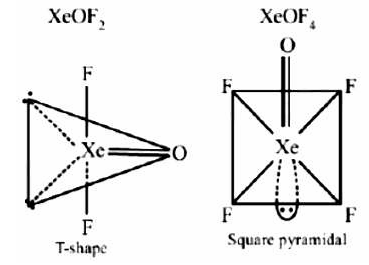
Step Solution:
1. Analyze $\mathbf{XeOF_{2}}$: Xenon has 8 valence electrons. It forms 2 bonds with $\mathrm{F}$ and 1 double bond with $\mathrm{O}$, using 4 electrons and leaving 2 lone pairs.
2. Calculate SN for $\mathbf{XeOF_{2}}$: 3 sigma domains + 2 lone pairs = 5 ($sp^{3}d$). With 2 lone pairs in equatorial positions, the shape is T-shape.
3. Analyze $\mathbf{XeOF_{4}}$: Xenon forms 4 bonds with $\mathrm{F}$ and 1 double bond with $\mathrm{O}$, using 6 electrons and leaving 1 lone pair.
4. Calculate SN for $\mathbf{XeOF_{4}}$: 5 sigma domains + 1 lone pair = 6 ($sp^{3}d^{2}$). The shape is Square Pyramidal.
5. Conclusion: The pair in option D matches the required T-shape and Square Pyramidal geometries.
Difficulty Level: Medium
Concept Name: VSEPR Theory and Molecular Geometry
Short cut solution: $\mathrm{XeOF}_{2}$ ($AX_{3}L_{2}$) is a classic T-shaped molecule and $\mathrm{XeOF}_{4}$ ($AX_{5}L$) is a classic square pyramidal molecule; both are well-known Noble Gas compounds with these specific geometries.
Question 147
Question: The decreasing order of bond angles in $\mathrm{BF}_{3}, \mathrm{NH}_{3}, \mathrm{PF}_{3}$ and $\mathrm{I}_{3}^{-}$ is:
Options:
A. $\mathrm{I}_{3}^{-}>\mathrm{BF}_{3}>\mathrm{NH}_{3}>\mathrm{PF}_{3}$
B. $\mathrm{BF}_{3}>\mathrm{I}_{3}^{-}>\mathrm{PF}_{3}>\mathrm{NH}_{3}$
C. $\mathrm{BF}_{3}>\mathrm{NH}_{3}>\mathrm{PF}_{3}>\mathrm{I}_{3}^{-}$
D. $\mathrm{I}_{3}^{-}>\mathrm{NH}_{3}>\mathrm{PF}_{3}>\mathrm{BF}_{3}$
Correct Answer: A
Year: Online April 15, 2018 (I)
Solution: B is $sp^2$, bond angle=$120^{\circ}$. N is $sp^3$ with 1lp, bond angle=$107^{\circ}$. P is $sp^3$ with 1lp; when central atom size increases, bond angle decreases, $\therefore \mathrm{NH}_{3}>\mathrm{PF}_{3}$. I is $sp^3d$ (linear), bond angle=$180^{\circ}$. Decreasing order of bond angle is $\mathrm{I}_{3}^{-}>\mathrm{BF}_{3}>\mathrm{NH}_{3}>\mathrm{PF}_{3}$.
Step Solution:
1. Analyze $\mathrm{I}_{3}^{-}$: Central Iodine has 2 bond pairs and 3 lone pairs. Steric Number (SN) = 5 ($sp^3d$). Geometry: Linear; Bond angle = $180^{\circ}$.
2. Analyze $\mathrm{BF}_{3}$: Boron has 3 bond pairs and 0 lone pairs. SN = 3 ($sp^2$). Geometry: Trigonal Planar; Bond angle = $120^{\circ}$.
3. Analyze $\mathrm{NH}_{3}$: Nitrogen has 3 bond pairs and 1 lone pair. SN = 4 ($sp^3$). Shape: Pyramidal; Bond angle $\approx$ $107^{\circ}$.
4. Analyze $\mathrm{PF}_{3}$: Phosphorus has 3 bond pairs and 1 lone pair. As the central atom size increases from N to P, bond pair-bond pair repulsion decreases, resulting in an angle smaller than $107^{\circ}$.
5. Final Order: $180^{\circ} (\mathrm{I}_{3}^{-}) > 120^{\circ} (\mathrm{BF}_{3}) > 107^{\circ} (\mathrm{NH}_{3}) > \text{Pyramidal } (\mathrm{PF}_{3})$.
Difficulty Level: Medium
Concept Name: VSEPR Theory and Bond Angles
Short cut solution: Quickly identify the linear ion ($\mathrm{I}_{3}^{-}$, $180^{\circ}$) and trigonal planar molecule ($\mathrm{BF}_{3}$, $120^{\circ}$) as having the largest angles; then use the trend that larger central atoms in pyramidal molecules lead to smaller bond angles to rank $\mathrm{NH}_{3}$ over $\mathrm{PF}_{3}$.
Question 152
Question: $\mathbf{sp}^{3}\mathbf{d}^{2}$ Hybridisation is not displayed by:
Options:
A. $\mathrm{BrF}_{5}$
B. $\mathrm{SF}_{6}$
C. $[\mathrm{CrF}_{6}]^{3-}$
D. $\mathrm{PF}_{5}$
Correct Answer: D
Year: Online April 8, 2017
Solution: The source identifies $\mathrm{PF}_{5}$ as the species that does not utilize $sp^3d^2$ hybridization.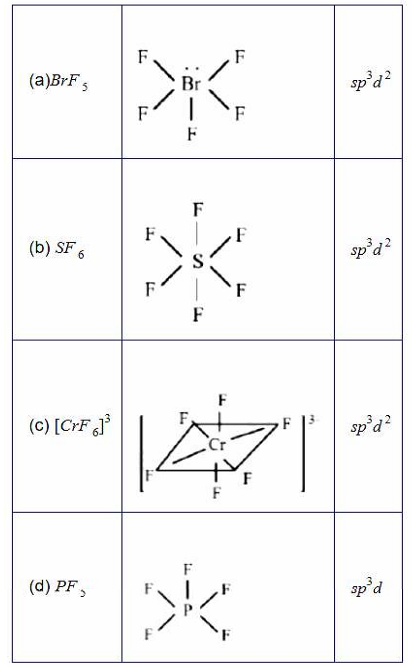
Step Solution:
1. Evaluate $\mathrm{BrF}_{5}$: Bromine (7 valence electrons) forms 5 bonds + 1 lone pair. SN = 6, which corresponds to $sp^3d^2$.
2. Evaluate $\mathrm{SF}_{6}$: Sulfur (6 valence electrons) forms 6 bonds + 0 lone pairs. SN = 6, which corresponds to $sp^3d^2$.
3. Evaluate $[\mathrm{CrF}_{6}]^{3-}$: This is an octahedral coordination complex. Coordination number 6 typically involves $d^2sp^3$ or $sp^3d^2$ hybridization.
4. Evaluate $\mathrm{PF}_{5}$: Phosphorus (5 valence electrons) forms 5 bonds + 0 lone pairs. SN = 5.
5. Conclusion: A steric number of 5 corresponds to $sp^3d$ hybridization, not $sp^3d^2$.
Difficulty Level: Easy
Concept Name: Hybridization and Steric Number
Short cut solution: Standard $AB_{5}$ molecules with no lone pairs, like $\mathrm{PF}_{5}$, always utilize $sp^3d$ hybridization.
Question 153
Question: The group having triangular planar structures is :
Options:
A. $\mathrm{BF}_{3}, \mathrm{NF}_{3}, \mathrm{CO}_{3}^{2-}$
B. $\mathrm{CO}_{3}^{2-}, \mathrm{NO}_{3}^{-}, \mathrm{SO}_{3}$
C. $\mathrm{NH}_{3}, \mathrm{SO}_{3}, \mathrm{CO}_{3}^{2-}$
D. $\mathrm{NCl}_{3}, \mathrm{BCl}_{3}, \mathrm{SO}_{3}$
Correct Answer: B
Year: Online April 9, 2017
Solution: The source identifies Option B as the correct group.
Step Solution:
1. Analyze $\mathrm{CO}_{3}^{2-}$: Carbon has 4 valence electrons + 2 (charge) = 6. 3 sigma bonds + 0 lone pairs = SN 3 ($sp^2$). Shape: Trigonal Planar.
2. Analyze $\mathrm{NO}_{3}^{-}$: Nitrogen has 5 valence electrons + 1 (charge) = 6. 3 sigma bonds + 0 lone pairs = SN 3 ($sp^2$). Shape: Trigonal Planar.
3. Analyze $\mathrm{SO}_{3}$: Sulfur has 6 valence electrons. 3 sigma bonds + 0 lone pairs = SN 3 ($sp^2$). Shape: Trigonal Planar.
4. Exclude others: $\mathrm{NH}_{3}$ and $\mathrm{NF}_{3}$ have 1 lone pair on the central atom, giving them a pyramidal shape.
5. Result: All three species in group B are isostructural with a triangular planar geometry.
Difficulty Level: Easy
Concept Name: VSEPR Theory and Isostructural Species
Short cut solution: Triangular planar geometry requires exactly 3 electron domains (3 bond pairs and 0 lone pairs). $\mathrm{CO}_{3}^{2-}, \mathrm{NO}_{3}^{-},$ and $\mathrm{SO}_{3}$ are all classic $sp^2$ examples with no lone pairs on the central atom.
Question 156
Question: The species in which the N atom is in a state of sp hybridisation is :
Options:
A. $\mathrm{NO}_3^-$
B. $\mathrm{NO}_2$
C. $\mathrm{NO}_2^+$
D. $\mathrm{NO}_2^-$
Correct Answer: C
Year: 2016
Solution: Hybridisation (H) = [No. of valence electrons of central atom + No. of monovalent atoms attached to it + (−ve charge if any) − (+ ve charge if any)] / 2. For $\mathrm{NO}_2^+$, H = $\frac{1}{2}[5+0-1] = 2$, which is sp hybridisation.
Step Solution:
1. Identify valence electrons for Nitrogen (N), which is 5.
2. For $\mathrm{NO}_2^+$, account for the positive charge by subtracting one electron ($5 - 1 = 4$).
3. Calculate the Steric Number: Since there are no monovalent atoms, $\text{SN} = \frac{4 \text{ electrons}}{2} = 2$.
4. A Steric Number of 2 corresponds to sp hybridization.
5. For comparison, $\mathrm{NO}_3^-$ and $\mathrm{NO}_2^-$ have a Steric Number of 3, resulting in $\mathrm{sp}^2$ hybridization.
Difficulty Level: Easy
Concept Name: Hybridization and Steric Number
Short cut solution: $\mathrm{NO}_2^+$ is isoelectronic with $\mathrm{CO}_2$ (16 valence electrons), which is a well-known linear molecule with sp hybridization.
Question 157
Question: The group of molecules having identical shape is:
Options:
A. $\mathrm{PCl}_5, \mathrm{IF}_5, \mathrm{XeO}_2\mathrm{F}_2$
B. $\mathrm{BF}_3, \mathrm{PCl}_3, \mathrm{XeO}_3$
C. $\mathrm{SF}_4, \mathrm{XeF}_4, \mathrm{CCl}_4$
D. $\mathrm{ClF}_3, \mathrm{XeOF}_2, \mathrm{XeF}_3^+$
Correct Answer: D
Year: Online April 9, 2016
Solution: $\mathrm{ClF}_3$ hybridisation = $3 + \frac{1}{2} = 5$ ($\mathrm{sp}^3\mathrm{d}$). $\mathrm{XeOF}_2$ hybridisation = $3 + \frac{1}{2} = 5$ ($\mathrm{sp}^3\mathrm{d}$). $\mathrm{XeF}_3^+$ hybridisation = $3 + \frac{1}{2}[8 - 3 - 1] = 5$ ($\mathrm{sp}^3\mathrm{d}$). All molecules have $\mathrm{sp}^3\mathrm{d}$ hybridisation and 2 lone pairs, hence all have identical (T-shape).
Step Solution:
1. Determine Steric Number (SN) for $\mathrm{ClF}_3$: 3 bonds + 2 lone pairs = 5. Shape = T-shape.
2. Determine SN for $\mathrm{XeOF}_2$: 3 sigma bonds (1 O, 2 F) + 2 lone pairs = 5. Shape = T-shape.
3. Determine SN for $\mathrm{XeF}_3^+$: 3 bonds + 2 lone pairs = 5. Shape = T-shape.
4. Observe that all three species are of the $AB_3L_2$ type.
5. Confirm that $AB_3L_2$ species always possess a T-shaped molecular geometry.
Difficulty Level: Medium
Concept Name: VSEPR Theory and Molecular Geometry
Short cut solution: Identify the $AX_3L_2$ pattern. $\mathrm{ClF}_3$ is a standard T-shaped reference; check if the others in the same option also have 3 sigma domains and 2 lone pairs.
Question 158
Question: The bond angle $\mathrm{H}-\mathrm{X}-\mathrm{H}$ is the greatest in the compound:
Options:
A. $\mathrm{PH}_3$
B. $\mathrm{CH}_4$
C. $\mathrm{NH}_3$
D. $\mathrm{H}_2\mathrm{O}$
Correct Answer: B
Year: Online April 10, 2016
Solution: More the number of lone pairs on the central atom, the greater is the contraction caused in the angle between bond pairs. In $\mathrm{CH}_4$ there is no lone pair of electrons, hence the bond angle is greatest.
Step Solution:
1. Analyze $\mathrm{CH}_4$: 4 bond pairs and 0 lone pairs. The angle is the ideal tetrahedral $109.5^{\circ}$.
2. Analyze $\mathrm{NH}_3$: 3 bond pairs and 1 lone pair. Repulsion reduces the angle to $107^{\circ}$.
3. Analyze $\mathrm{H}_2\mathrm{O}$: 2 bond pairs and 2 lone pairs. Repulsion further reduces the angle to $104.5^{\circ}$.
4. Analyze $\mathrm{PH}_3$: 3 bond pairs and 1 lone pair. Due to the larger size of the central atom and lower electronegativity, the angle is even smaller, approximately $94^{\circ}$.
5. Comparison: $109.5^{\circ} > 107^{\circ} > 104.5^{\circ} > 94^{\circ}$.
Difficulty Level: Easy
Concept Name: VSEPR Theory (Lone Pair Repulsion)
Short cut solution: The bond angle decreases as the number of lone pairs increases. $\mathrm{CH}_4$ has zero lone pairs, making it the only molecule in the list that maintains the full tetrahedral angle of $109.5^{\circ}$.
Question 170
Question: Which one of the following molecules is polar?
Options:
A. $\mathrm{XeF}_4$
B. $\mathrm{IF}_5$
C. $\mathrm{SbF}_5$
D. $\mathrm{CF}_4$
Correct Answer: B
Year: Online April 9, 2013
Solution: The geometry of $\mathbf{IF_5}$ is square pyramide with an unsymmetric charge distribution, therefore this molecule is polar.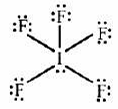
Step Solution:
1. Determine valence electrons of Iodine (I): 7 electrons.
2. Count bonds and lone pairs: $\mathrm{IF}_5$ has 5 bond pairs and 1 lone pair ($\frac{7-5}{2} = 1$).
3. Calculate Steric Number (SN): $5 + 1 = 6$, which corresponds to $\mathrm{sp}^3\mathrm{d}^2$ hybridization.
4. Identify Shape: The molecular shape is Square Pyramidal.
5. Evaluate Polarity: Due to the presence of a single lone pair and the unsymmetrical square pyramidal arrangement, the bond dipoles do not cancel out ($\mu \neq 0$).
Difficulty Level: Medium
Concept Name: Dipole Moment and Molecular Symmetry
Short cut solution: Symmetrical $AB_n$ molecules like $\mathrm{XeF}_4$ (Square Planar), $\mathrm{CF}_4$ (Tetrahedral), and $\mathrm{SbF}_5$ (Trigonal Bipyramidal) have zero net dipole moments. $\mathrm{IF}_5$ is an $AX_5L$ type, which is inherently unsymmetrical and polar.
Question 172
Question: The shape of $\mathrm{IF}_6^-$ is:
Options:
A. Trigonally distorted octahedron
B. Pyramidal
C. Octahedral
D. Square antiprism
Correct Answer: A
Year: Online April 23, 2013
Solution: The structure of $\mathrm{IF}_6^-$ is distorted octahedral. This is due to presence of a "weak" lone pair.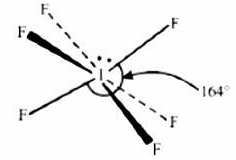
Step Solution:
1. Determine valence electrons of Iodine: 7 electrons $+ 1$ from the negative charge $= 8$.
2. Count domains: There are 6 Iodine-Fluorine bonds.
3. Calculate lone pairs: $\frac{8 - 6}{2} = 1$ lone pair.
4. Determine Steric Number: $6 \text{ bond pairs} + 1 \text{ lone pair} = 7$.
5. Assign Shape: A Steric Number of 7 with 1 lone pair ($AX_6L$) results in a distorted octahedral (trigonally distorted octahedron) shape.
Difficulty Level: Medium
Concept Name: VSEPR Theory (Distorted Octahedral Shape)
Short cut solution: Any $AX_6L$ species (like $\mathrm{XeF}_6$ or $\mathrm{IF}_6^-$) involving a central atom with 7 electron pairs will not be a perfect octahedron; the lone pair always causes a "distorted" octahedral geometry.
Question 173
Question: In which of the following sets, all the given species are isostructural?
Options:
A. $\mathrm{CO}_2, \mathrm{NO}_2, \mathrm{ClO}_2, \mathrm{SiO}_2$
B. $\mathrm{PCl}_3, \mathrm{AlCl}_3, \mathrm{BCl}_3, \mathrm{SbCl}_3$
C. $\mathrm{BF}_3, \mathrm{NF}_3, \mathrm{PF}_3, \mathrm{AlF}_3$
D. $\mathrm{BF}_4^-, \mathrm{CCl}_4, \mathrm{NH}_4^+, \mathrm{PCl}_4^+$
Correct Answer: D
Year: Online April 25, 2013
Solution: All have tetrahedral structure.
Step Solution:
1. Analyze Steric Numbers for Set D: Calculate the Steric Number (Bond Pairs + Lone Pairs) for each central atom.
2. $\mathrm{BF}_4^-$: $4 \text{ bonds} + 0 \text{ lone pairs} = 4$ ($\mathrm{sp}^3$).
3. $\mathrm{CCl}_4$ and $\mathrm{NH}_4^+$: Both have $4 \text{ bonds} + 0 \text{ lone pairs} = 4$ ($\mathrm{sp}^3$).
4. $\mathrm{PCl}_4^+$: $4 \text{ bonds} + 0 \text{ lone pairs} = 4$ ($\mathrm{sp}^3$).
5. Conclusion: Since all species have a Steric Number of 4 and zero lone pairs, they all share a tetrahedral geometry.
Difficulty Level: Easy
Concept Name: Isostructural Species and VSEPR Theory
Short cut solution: Look for the $AB_4$ pattern where the central atom has 8 electrons (after adjusting for charge) and forms 4 bonds. These are always isostructural and tetrahedral.
Question 185
Question: In which of the following pairs, the two species are not isostructural?
Options:
A. $\mathrm{CO}_3^{2-}$ and $\mathrm{NO}_3^-$
B. $\mathrm{PCl}_4^+$ and $\mathrm{SiCl}_4$
C. $\mathrm{PF}_5$ and $\mathrm{BrF}_5$
D. $\mathrm{AlF}_6^{3-}$ and $\mathrm{SF}_6$
Correct Answer: C
Year: 2012
Solution: $\mathrm{PF}_5$ is trigonal bipyramidal; $\mathrm{BrF}_5$ is square pyramidal (distorted).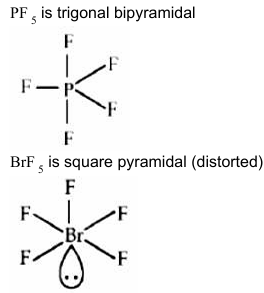
Step Solution:
1. Analyze $\mathrm{PF}_5$: Phosphorus (5 valence electrons) forms 5 bonds with Fluorine. Steric Number (SN) = 5 ($sp^3d$), resulting in Trigonal Bipyramidal geometry.
2. Analyze $\mathrm{BrF}_5$: Bromine (7 valence electrons) forms 5 bonds and has 1 lone pair. SN = 6 ($sp^3d^2$), resulting in Square Pyramidal geometry.
3. Check Pair A: $\mathrm{CO}_3^{2-}$ and $\mathrm{NO}_3^-$ both have 3 sigma bonds and 0 lone pairs. SN = 3 ($sp^2$), making both Trigonal Planar.
4. Check Pair B: $\mathrm{PCl}_4^+$ and $\mathrm{SiCl}_4$ both have 4 sigma bonds and 0 lone pairs. SN = 4 ($sp^3$), making both Tetrahedral.
5. Check Pair D: $\mathrm{AlF}_6^{3-}$ and $\mathrm{SF}_6$ both have 6 sigma bonds and 0 lone pairs. SN = 6 ($sp^3d^2$), making both Octahedral.
Difficulty Level: Easy
Concept Name: Isostructural species and VSEPR Theory
Short cut solution: Quickly determine the Steric Number (Bond pairs + Lone pairs). $\mathrm{PF}_5$ has 5 electron domains, while $\mathrm{BrF}_5$ has 6; thus, they cannot have the same structure.
Question 186
Question: The formation of molecular complex $\mathrm{BF}_3 - \mathrm{NH}_3$ results in a change in hybridisation of boron
Options:
A. from $sp^2$ to $dsp^2$
B. from $sp^2$ to $sp^3$
C. from $sp^3$ to $sp^2$
D. from $sp^3$ to $sp^3d$
Correct Answer: B
Year: Online May 12, 2012
Solution: In $\mathrm{BF}_3$, B is $sp^2$ hybridized with one empty $p_z$ orbital. The empty $p_z$ orbital of $\mathrm{BF}_3$ can be filled by lone pair of molecules such as $\mathrm{NH}_3$. When this occurs a tetrahedral molecule or ion is formed which is $sp^3$ hybridized.
Step Solution:
1. Original state: Boron in $\mathrm{BF}_3$ has 3 bond pairs and 0 lone pairs. SN = 3, which corresponds to $sp^2$ hybridization.
2. Bond formation: $\mathrm{NH}_3$ donates its lone pair of electrons into the empty p-orbital of Boron to form a coordinate covalent bond.
3. New configuration: In the $\mathrm{BF}_3 - \mathrm{NH}_3$ adduct, Boron is now bonded to four atoms (3 F and 1 N).
4. Calculate new SN: SN = 4 bond pairs + 0 lone pairs = 4.
5. Final Hybridization: A Steric Number of 4 corresponds to $sp^3$ hybridization and tetrahedral geometry.
Difficulty Level: Easy
Concept Name: Hybridization change in Adduct formation
Short cut solution: Boron moves from being bonded to 3 atoms ($sp^2$, trigonal planar) to 4 atoms ($sp^3$, tetrahedral) upon receiving the lone pair from $\mathrm{NH}_3$.
Question 187
Question: Which of the following has the square planar structure?
Options:
A. $\mathrm{XeF}_4$
B. $\mathrm{NH}_4^+$
C. $\mathrm{BF}_4^-$
D. $\mathrm{CCl}_4$
Correct Answer: A
Year: Online May 19, 2012
Solution: X eF 4 has square pyramidal structure, while NH 4 +, BF − and CCl 4 have tetrahedral structure. (Note: While the source solution contains a typo stating "square pyramidal," it correctly identifies $\mathrm{XeF}_4$ as the answer for the square planar structure; standard theory and source confirm $\mathrm{XeF}_4$ is square planar.)
Step Solution:
1. Analyze $\mathrm{XeF}_4$: Xenon has 8 valence electrons; 4 used for single bonds with Fluorine, leaving 4 electrons as 2 lone pairs.
2. Determine Steric Number: SN = 4 bond pairs + 2 lone pairs = 6.
3. Assign Hybridization and Shape: SN 6 corresponds to $sp^3d^2$ hybridization. The 2 lone pairs occupy opposite axial positions to minimize repulsion, leaving a Square Planar shape.
4. Evaluate $\mathrm{NH}_4^+$ and $\mathrm{CCl}_4$: Both have 4 bond pairs and 0 lone pairs. SN = 4 ($sp^3$), resulting in Tetrahedral geometry.
5. Evaluate $\mathrm{BF}_4^-$: Boron (3 valence $e^-$) + 1 (from negative charge) = 4. With 4 bonds and 0 lone pairs, SN = 4 ($sp^3$), resulting in Tetrahedral geometry.
Difficulty Level: Easy
Concept Name: VSEPR Theory and Molecular Shapes
Short cut solution: $\mathrm{XeF}_4$ is a classic $AX_4L_2$ molecule. The presence of two lone pairs in an octahedral electron geometry always results in a square planar molecular shape.
Question 188
Question: Among the following species which two have trigonal bipyramidal shape? (I) $\mathrm{NI}_{3}$ (II) $\mathrm{I}_{3}^{-}$ (III) $\mathrm{SO}_{3}^{2-}$ (IV) $\mathrm{NO}_{3}^{-}$ [Note: The source solution indicates the question likely intended to ask for the "same shape" among the listed pyramidal species].
Options:
A. I and III
B. III and IV
C. I and IV
D. II and III
Correct Answer: A
Year: Online May 26, 2012
Solution: Hence, $\mathrm{NI}_{3}$ and $\mathrm{SO}_{3}^{2-}$ have same shape.
Step Solution:
1. Analyze $\mathrm{NI}_{3}$: Nitrogen (5 valence $e^{-}$) forms 3 bonds with Iodine, leaving 1 lone pair. Steric Number (SN) = 4 ($sp^{3}$); Shape: Pyramidal.
2. Analyze $\mathrm{I}_{3}^{-}$: Central Iodine (7 valence $e^{-} + 1$ charge) = 8 electrons. Forms 2 bonds with 3 lone pairs. SN = 5 ($sp^{3}d$); Shape: Linear.
3. Analyze $\mathrm{SO}_{3}^{2-}$: Sulfur (6 valence $e^{-} + 2$ charge) = 8 electrons. Forms 3 sigma bonds with Oxygen, leaving 1 lone pair. SN = 4 ($sp^{3}$); Shape: Pyramidal.
4. Analyze $\mathrm{NO}_{3}^{-}$: Nitrogen (5 valence $e^{-} + 1$ charge) = 6 electrons. Forms 3 sigma bonds with zero lone pairs. SN = 3 ($sp^{2}$); Shape: Trigonal Planar.
5. Conclusion: Both (I) $\mathrm{NI}_{3}$ and (III) $\mathrm{SO}_{3}^{2-}$ have a pyramidal shape.
Difficulty Level: Medium
Concept Name: VSEPR Theory and Molecular Geometry
Short cut solution: Identify the $AB_{3}L$ type species. Both $\mathrm{NI}_{3}$ and $\mathrm{SO}_{3}^{2-}$ possess 3 bond pairs and 1 lone pair, leading to an identical pyramidal structure.
Question 197
Question: In which of the following molecules/ions are all the bonds not equal?
Options:
A. $\mathrm{XeF}_{4}$
B. $\mathrm{BF}_{4}^{-}$
C. $\mathrm{SF}_{4}$
D. $\mathrm{SiF}_{4}$
Correct Answer: C
Year: 2006
Solution: In $\mathrm{SF}_{4}$ the hybridisation is $sp^{3}d$ and the shape of molecule is [See-saw].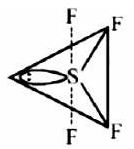
Step Solution:
1. Analyze $\mathrm{SF}_{4}$: Sulfur (6 valence electrons) forms 4 bonds with Fluorine, leaving 1 lone pair. SN = 5.
2. Identify Hybridization: A Steric Number of 5 corresponds to $sp^{3}d$ hybridization and Trigonal Bipyramidal (TBP) geometry.
3. Identify Molecular Shape: With one lone pair occupying an equatorial position, the shape is See-saw.
4. Evaluate Bond Lengths: In TBP/See-saw geometry, the axial and equatorial positions are not equivalent; axial bonds experience more repulsion from equatorial bond pairs.
5. Conclusion: Axial bonds in $\mathrm{SF}_{4}$ are longer and weaker than the equatorial bonds, making the bonds non-equal.
Difficulty Level: Medium
Concept Name: VSEPR Theory (Axial and Equatorial Bonds)
Short cut solution: Species with $sp^{3}d$ hybridization (like $\mathrm{SF}_{4}$ or $\mathrm{PCl}_{5}$) typically have unequal axial and equatorial bond lengths unless they are perfectly symmetrical.
Question 198
Question: The decreasing values of bond angles from $\mathrm{NH}_{3}(106^{\circ})$ to $\mathrm{SbH}_{3}(101^{\circ})$ down group-15 of the periodic table is due to
Options:
A. decreasing lp-bp repulsion
B. decreasing electronegativity
C. increasing bp-bp repulsion
D. increasing p-orbital character in $sp^{3}$
Correct Answer: B
Year: 2006
Solution: The bond angle decreases on moving down the group due to decrease in bond pair-bond pair repulsion... Note: This can also be explained due to decrease in electronegativity from N to Bi.
Step Solution:
1. Observe the trend: Moving down Group 15 (N to Sb), the central atom increases in size and its electronegativity decreases.
2. Evaluate electron density: With lower electronegativity, the bonding electron pairs are pulled less strongly towards the central atom.
3. Analyze repulsion: This movement of bonding electrons away from the central atom decreases the bond pair-bond pair repulsion.
4. Evaluate lone pair effect: As bond pair repulsion decreases, the lone pair on the central atom can compress the $\mathrm{H}-\mathrm{M}-\mathrm{H}$ angle more effectively.
5. Conclusion: This results in a continuous decrease in bond angle from $107^{\circ}$ ($\mathrm{NH}_{3}$) down to approximately $91^{\circ}$ ($\mathrm{SbH}_{3}$).
Difficulty Level: Easy
Concept Name: Periodic Trends and Electronegativity
Short cut solution: In a series of similar molecules, the bond angle is directly proportional to the electronegativity of the central atom; as electronegativity decreases down the group, the bond angle also decreases.
Question 203
Question: The correct order of bond angles (smallest first) in $\mathrm{H}_2\mathrm{S}, \mathrm{NH}_3, \mathrm{BF}_3$ and $\mathrm{SiH}_4$ is
Options:
A. $\mathrm{H}_2\mathrm{S} < \mathrm{NH}_3 < \mathrm{SiH}_4 < \mathrm{BF}_3$
B. $\mathrm{NH}_3 < \mathrm{H}_2\mathrm{S} < \mathrm{SiH}_4 < \mathrm{BF}_3$
C. $\mathrm{H}_2\mathrm{S} < \mathrm{SiH}_4 < \mathrm{NH}_3 < \mathrm{BF}_3$
D. $\mathrm{H}_2\mathrm{S} < \mathrm{NH}_3 < \mathrm{BF}_3 < \mathrm{SiH}_4$
Correct Answer: A.
Year: 2004.
Solution: The source identifies Option A as the correct order.
Step Solution:
1. Analyze $\mathrm{H}_2\mathrm{S}$: Sulfur (Group 16) has 2 bond pairs and 2 lone pairs. Due to its low electronegativity and large size, lone pair-lone pair repulsion is high, reducing the angle to approximately $92^\circ$.
2. Analyze $\mathrm{NH}_3$: Nitrogen has 3 bond pairs and 1 lone pair ($sp^3$ hybridized). Repulsion reduces the angle from the ideal $109.5^\circ$ to $107^\circ$.
3. Analyze $\mathrm{SiH}_4$: Silicon (Group 14) has 4 bond pairs and 0 lone pairs. It is perfectly tetrahedral with an angle of $109.5^\circ$ [Similar to $\mathrm{CH}_4$ in 152].
4. Analyze $\mathrm{BF}_3$: Boron has 3 bond pairs and 0 lone pairs ($sp^2$ hybridized). It is trigonal planar with a bond angle of $120^\circ$.
5. Final Order: $92^\circ (\mathrm{H}_2\mathrm{S}) < 107^\circ (\mathrm{NH}_3) < 109.5^\circ (\mathrm{SiH}_4) < 120^\circ (\mathrm{BF}_3)$.
Difficulty Level: Medium.
Concept Name: VSEPR Theory and Bond Angles.
Shortcut Solution: Remember that $sp^2$ (planar, $120^\circ$) is always larger than $sp^3$ (tetrahedral base). Among $sp^3$ molecules, the angle decreases as the number of lone pairs increases ($\mathrm{SiH}_4$ (0) > $\mathrm{NH}_3$ (1) > $\mathrm{H}_2\mathrm{S}$ (2)).
Question 204
Question: The states of hybridization of boron and oxygen atoms in boric acid $(\mathrm{H}_3\mathrm{BO}_3)$ are respectively
Options:
A. $sp^3$ and $sp^2$
B. $sp^2$ and $sp^3$
C. $sp^2$ and $sp^2$
D. $sp^3$ and $sp^3$
Correct Answer: B.
Year: 2004.
Solution: The source identifies Option B as the correct answer.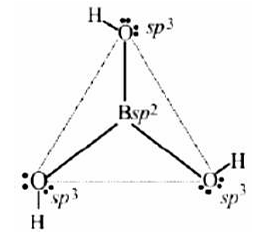
Step Solution:
1. Analyze Boron: In $\mathrm{H}_3\mathrm{BO}_3$, Boron is bonded to three $-\mathrm{OH}$ groups. It has 3 valence electrons and forms 3 sigma bonds with no lone pairs.
2. Assign Boron Hybridization: A Steric Number (SN) of 3 corresponds to $sp^2$ hybridization.
3. Analyze Oxygen: Each Oxygen atom is bonded to one Boron atom and one Hydrogen atom (2 sigma bonds) and retains 2 lone pairs.
4. Assign Oxygen Hybridization: A Steric Number of 4 (2 bonds + 2 lone pairs) corresponds to $sp^3$ hybridization.
5. Conclusion: The hybridization is $sp^2$ for Boron and $sp^3$ for Oxygen.
Difficulty Level: Easy.
Concept Name: Hybridization and Lewis Structure.
Shortcut Solution: Boron in stable, neutral oxyacids is typically trigonal planar ($sp^2$), and any oxygen atom forming two single bonds (like in water or alcohols) is $sp^3$ hybridized.
Question 205
Question: Which one of the following has the regular tetrahedral structure?
Options:
A. $\mathrm{BF}_4^-$
B. $\mathrm{SF}_4$
C. $\mathrm{XeF}_4$
D. $[\mathrm{Ni}(\mathrm{CN})_4]^{2-}$
Correct Answer: A.
Year: 2004.
Solution: $\mathrm{XeF}_4$ ($sp^3d^2$, square planar), $[\mathrm{Ni}(\mathrm{CN})_4]^{2-}$ ($dsp^2$, square planar), $\mathrm{BF}_4^-$ ($sp^3$, tetrahedral), $\mathrm{SF}_4$ ($sp^3d$, see-saw shaped).
Step Solution:
1. Analyze $\mathrm{BF}_4^-$: Boron has 3 valence electrons + 1 from the negative charge = 4. It forms 4 bonds with Fluorine with 0 lone pairs. SN = 4, resulting in a Tetrahedral structure.
2. Analyze $\mathrm{SF}_4$: Sulfur (6 valence $e^-$) forms 4 bonds, leaving 1 lone pair. SN = 5 ($sp^3d$), resulting in a See-saw shape.
3. Analyze $\mathrm{XeF}_4$: Xenon (8 valence $e^-$) forms 4 bonds, leaving 2 lone pairs. SN = 6 ($sp^3d^2$). Geometry: Octahedral; Shape: Square Planar.
4. Analyze $[\mathrm{Ni}(\mathrm{CN})_4]^{2-}$: Nickel (II) with strong field ligands undergoes $dsp^2$ hybridization, resulting in a Square Planar structure.
5. Conclusion: Only $\mathrm{BF}_4^-$ has a regular tetrahedral structure.
Difficulty Level: Easy.
Concept Name: VSEPR Theory and Molecular Geometry.
Shortcut Solution: A "regular" tetrahedral structure requires a Steric Number of 4 with exactly 0 lone pairs. Only $\mathrm{BF}_4^-$ (isoelectronic with $\mathrm{CH}_4$ and $\mathrm{SiF}_4$) meets this criteria.
Question 206
Question: The maximum number of $90^{\circ}$ angles between bond pair bond pair of electrons is observed in
Options:
A. $dsp^{2}$ hybridization
B. $sp^{3}d$ hybridization
C. $dsp^{3}$ hybridization
D. $sp^{3}d^{2}$ hybridization
Correct Answer: D
Year: 2004
Solution: $dsp^{2}$ hybridisation Number of $90^{\circ}$ angle between bonds-4; $sp^{3}d$ or $dsp^{3}$ hybridisation Number of $90^{\circ}$ angle between bonds-6; $sp^{3}d^{2}$ Hybridisation Number of $90^{\circ}$ angle between bonds-12.
Step Solution:
1. Analyze $dsp^{2}$: This corresponds to square planar geometry where all 4 bonds are in a plane; there are exactly 4 right angles between adjacent bonds.
2. Analyze $sp^{3}d$ / $dsp^{3}$: This corresponds to trigonal bipyramidal geometry. The 2 axial bonds are at $90^{\circ}$ to the 3 equatorial bonds ($2 \times 3 = 6$). Total = 6.
3. Analyze $sp^{3}d^{2}$: This corresponds to octahedral geometry.
4. Calculate for $sp^{3}d^{2}$: Each of the 2 axial bonds is at $90^{\circ}$ to the 4 equatorial bonds ($2 \times 4 = 8$ angles). Additionally, there are 4 right angles between the 4 equatorial bonds in their plane.
5. Sum: $8 + 4 = 12$ total $90^{\circ}$ angles.
The difficulty level: Medium
The Concept Name: Hybridization and Molecular Geometry
Short cut solution: Octahedral geometry ($sp^{3}d^{2}$) is the most symmetrical high-coordination shape, containing 3 mutually perpendicular planes, which inherently provides the maximum number of right angles (12).
Question 208
Question: Which one of the following pairs of molecules will have permanent dipole moments for both members?
Options:
A. $\mathrm{NO}_{2}$ and $\mathrm{CO}_{2}$
B. $\mathrm{NO}_{2}$ and $\mathrm{O}_{3}$
C. $\mathrm{SiF}_{4}$ and $\mathrm{CO}_{2}$
D. $\mathrm{SiF}_{4}$ and $\mathrm{NO}_{2}$
Correct Answer: B
Year: 2003
Solution: Both $\mathrm{NO}_{2}$ and $\mathrm{O}_{3}$ have angular shape and hence will have net dipole moment.
Step Solution:
1. Evaluate $\mathrm{CO}_{2}$: It is a linear molecule ($O=C=O$) where individual bond dipoles are equal and opposite, cancelling the net dipole moment ($\mu = 0$).
2. Evaluate $\mathrm{SiF}_{4}$: It has a regular tetrahedral structure where the four identical bond dipoles cancel out due to symmetry ($\mu = 0$).
3. Evaluate $\mathrm{NO}_{2}$: It has a bent/angular shape due to the presence of lone pairs/unpaired electrons on Nitrogen, leading to a non-zero dipole moment ($\mu \neq 0$).
4. Evaluate $\mathrm{O}_{3}$: Ozone has a bent structure (due to resonance and a lone pair on the central oxygen), preventing the bond dipoles from cancelling ($\mu \neq 0$).
5. Conclusion: Only the pair $\mathrm{NO}_{2}$ and $\mathrm{O}_{3}$ consists of two polar members.
The difficulty level: Easy
The Concept Name: Dipole Moment and Molecular Symmetry
Short cut solution: Eliminate any option containing highly symmetrical molecules like $\mathrm{CO}_{2}$ (linear) or $\mathrm{SiF}_{4}$ (tetrahedral), as these always have zero net dipole moments. This leaves B as the only viable choice.
Question 209
Question: Which one of the following compounds has the smallest bond angle in its molecule?
Options:
A. $\mathrm{OH}_{2}$
B. $\mathrm{SH}_{2}$
C. $\mathrm{NH}_{3}$
D. $\mathrm{SO}_{2}$
Correct Answer: B
Year: 2003
Solution: In $\mathrm{H}_{2}\mathrm{S}$, due to low electronegativity of sulphur the l.p. − l.p. repulsion is more than b.p. − b.p. repulsion and hence the bond angle is minimum.
Step Solution:
1. Analyze $\mathrm{SO}_{2}$: It is $sp^{2}$ hybridized with 1 lone pair; its bond angle is approximately $119^{\circ}$.
2. Analyze $\mathrm{NH}_{3}$: It is $sp^{3}$ hybridized with 1 lone pair; lone pair-bond pair repulsion reduces the angle to approximately $107^{\circ}$.
3. Analyze $\mathrm{OH}_{2}$: It is $sp^{3}$ hybridized with 2 lone pairs; the high lone pair-lone pair repulsion reduces the angle to $104.5^{\circ}$.
4. Analyze $\mathrm{SH}_{2}$: It also has 2 lone pairs, but Sulfur is less electronegative and larger than Oxygen.
5. Compare $\mathrm{OH}_{2}$ and $\mathrm{SH}_{2}$: Because Sulfur is less electronegative, the bonding electrons are further from the central atom, allowing the lone pairs to compress the bond angle much more significantly to approximately $92^{\circ}$.
The difficulty level: Medium
The Concept Name: VSEPR Theory and Electronegativity
Short cut solution: Among molecules with the same number of lone pairs, the bond angle decreases as the electronegativity of the central atom decreases. Since S is less electronegative than O, the angle in $\mathrm{H}_{2}\mathrm{S}$ is smaller than in $\mathrm{H}_{2}\mathrm{O}$.
Question 210
Question: The pair of species having identical shapes for molecules of both species is
Options:
A. $\mathrm{XeF}_2, \mathrm{CO}_2$
B. $\mathrm{BF}_3, \mathrm{PCl}_3$
C. $\mathrm{PF}_5, \mathrm{IF}_5$
D. $\mathrm{CF}_4, \mathrm{SF}_4$
Correct Answer: A
Year: 2003
Solution: Both $\mathrm{XeF}_2$ and $\mathrm{CO}_2$ have a linear structure. $\mathrm{F}-\mathrm{Xe}-\mathrm{F}$ and $\mathrm{O}=\mathrm{C}=\mathrm{O}$.
Step Solution:
1. Analyze $\mathrm{XeF}_2$: Xenon has 8 valence electrons. It forms 2 bonds with Fluorine, leaving 6 electrons as 3 lone pairs.
2. Determine Steric Number (SN) for $\mathrm{XeF}_2$: $\text{SN} = 2 \text{ bond pairs} + 3 \text{ lone pairs} = 5$ ($sp^3d$). In this geometry, 3 lone pairs occupy equatorial positions, resulting in a Linear shape.
3. Analyze $\mathrm{CO}_2$: Carbon has 4 valence electrons. it forms 2 double bonds with Oxygen and has 0 lone pairs.
4. Determine SN for $\mathrm{CO}_2$: $\text{SN} = 2 \text{ sigma domains} = 2$ ($sp$). This results in a Linear shape.
5. Conclusion: Since both molecules are linear, they have identical shapes.
Difficulty Level: Easy
Concept Name: VSEPR Theory and Molecular Shapes
Short cut solution: $\mathrm{XeF}_2$ is isoelectronic with the triiodide ion ($\mathrm{I}_3^-$) and $\mathrm{CO}_2$ is the most common example of a linear $sp$ molecule; both have a bond angle of $180^{\circ}$.
Question 211
Question: In which of the following species the interatomic bond angle is $109^{\circ} 28'$?
Options:
A. $\mathrm{NH}_3, \mathrm{BF}_4^-$
B. $\mathrm{NH}_4^+, \mathrm{BF}_3$
C. $\mathrm{NH}_3, \mathrm{BF}_4$
D. $\mathrm{NH}_2^-, \mathrm{BF}_3$
Correct Answer: A
Year: 2002
Solution: In $\mathrm{NH}_3$ and $\mathrm{BF}_4^-$, the hybridisation is $sp^3$ and the bond angle is almost $109^{\circ} 28'$.
Step Solution:
1. Identify Hybridization for $\mathrm{NH}_3$: Nitrogen has 3 bond pairs and 1 lone pair ($\text{SN} = 4$), which is $sp^3$ hybridized.
2. Evaluate $\mathrm{NH}_3$ angle: The ideal $sp^3$ angle is $109^{\circ} 28'$; however, due to lone pair repulsion, the source notes it is "almost" this value (typically $107^{\circ}$).
3. Identify Hybridization for $\mathrm{BF}_4^-$: Boron (3 valence electrons) + 1 (from negative charge) = 4. It forms 4 bonds with 0 lone pairs ($\text{SN} = 4$), which is $sp^3$ hybridized.
4. Evaluate $\mathrm{BF}_4^-$ angle: Because it has 4 identical bonds and 0 lone pairs, it is a perfect tetrahedron with an angle of $109^{\circ} 28'$.
5. Result: Both species use $sp^3$ orbitals, aligning with the tetrahedral angle mentioned in the query.
Difficulty Level: Easy
Concept Name: Hybridization and Bond Angles
Short cut solution: The angle $109^{\circ} 28'$ is the signature of a tetrahedral ($sp^3$) arrangement. $\mathrm{BF}_4^-$ is a regular tetrahedron, and $\mathrm{NH}_3$ is its closely related pyramidal derivative.
Question 212
Question: Hybridisation of the underline atom changes in: (Note: The underlined atoms are $\mathrm{Al}$ in $\mathrm{AlH}_3$, $\mathrm{O}$ in $\mathrm{H}_2\mathrm{O}$, and $\mathrm{N}$ in $\mathrm{NH}_3$).
Options:
A. $\mathrm{AlH}_3$ changes to $\mathrm{AlH}_4^-$
B. $\mathrm{H}_2\mathrm{O}$ changes to $\mathrm{H}_3\mathrm{O}^+$
C. $\mathrm{NH}_3$ changes to $\mathrm{NH}_4^+$
D. in all cases
Correct Answer: A
Year: 2002
Solution: $\text{Hybridisation} = \frac{1}{2} [\text{Valence } e^- + \text{Monovalent atoms} - \text{Cation charge} + \text{Anion charge}]$. Hybridisation changes only in option (a).
Step Solution:
1. Analyze $\mathrm{AlH}_3 \rightarrow \mathrm{AlH}_4^-$: $\mathrm{AlH}_3$ SN = $\frac{1}{2}[3+3] = 3$ ($sp^2$); $\mathrm{AlH}_4^-$ SN = $\frac{1}{2}[3+4+1] = 4$ ($sp^3$). The hybridization changes.
2. Analyze $\mathrm{H}_2\mathrm{O} \rightarrow \mathrm{H}_3\mathrm{O}^+$: $\mathrm{H}_2\mathrm{O}$ SN = $\frac{1}{2}[6+2] = 4$ ($sp^3$); $\mathrm{H}_3\mathrm{O}^+$ SN = $\frac{1}{2}[6+3-1] = 4$ ($sp^3$). No change.
3. Analyze $\mathrm{NH}_3 \rightarrow \mathrm{NH}_4^+$: $\mathrm{NH}_3$ SN = $\frac{1}{2}[5+3] = 4$ ($sp^3$); $\mathrm{NH}_4^+$ SN = $\frac{1}{2}[5+4-1] = 4$ ($sp^3$). No change.
4. Check Boron/Nitrogen types: $\mathrm{NH}_3$ and $\mathrm{H}_2\mathrm{O}$ already have lone pairs and $sp^3$ hybridization; protonation simply converts a lone pair into a bond pair.
5. Conclusion: Only the Aluminum conversion involves a shift from trigonal planar ($sp^2$) to tetrahedral ($sp^3$).
Difficulty Level: Easy
Concept Name: Hybridization (Steric Number Calculation)
Short cut solution: Neutral Group 13 species ($\mathrm{AlH}_3, \mathrm{BF}_3$) are always $sp^2$. When they form an octet-complete anion ($\mathrm{AlH}_4^-, \mathrm{BF}_4^-$), they must shift to $sp^3$. Group 15 and 16 species are already $sp^3$ due to their lone pairs.