iCON Education HYD, 79930 92826, 73309 7282610 Mar 2026
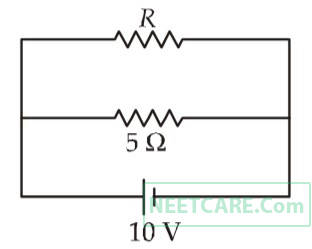
In the circuit, shown the galvanometer $G$ of resistance $60 \Omega$ is shunted by a resistance $r=0.02 \Omega$. The current through $R$ is nearly $1 \mathrm{~A}$. The value of resistance $R$ (in ohm) is nearly
A.
1.00 $\Omega$
B.
5.00 $\Omega$
C.
11.0 $\Omega$
D.
6.0 $\Omega$
Correct Answer: B
Explanation:
Here, resistance of the galvanometer
$R_G=60\Omega$
When the galvanometer is shunted by a resistance r, its effective resistance
iCON Education HYD, 79930 92826, 73309 7282610 Mar 2026
In the adjoining circuit diagram, the
readings of ammeter and voltmeter are 2 A
and 120 V, respectively. If the value of R is
75$\Omega$, then the voltmeter resistance will be
iCON Education HYD, 79930 92826, 73309 7282610 Mar 2026
Assertion Terminal voltage of a cell is greater
than emf of cell during charging of the cell.
Reason The emf of a cell is always greater
than its terminal voltage.
A.
Both Assertion and Reason are correct, Reason is the correct explanation of Assertion
B.
Both Assertion and Reason are correct but Reason is not the correct explanation of Assertion
C.
Assertion is correct and Reason is incorrect
D.
Assertion is incorrect and Reason is correct
Correct Answer: C
Explanation:
During charging, $E=V+i r$ (due to reversed current). In case of charging emf of a cell is less than its terminal voltage while in case of discharging emf is greater than terminal voltage.
2018
Q54
AIIMS
MCQ
iCON Education HYD, 79930 92826, 73309 7282610 Mar 2026
Assertion Bulb generally get fused when
they are switched on or off.
Reason When we switch on or off, a circuit
current changes in it rapidly.
A.
Both Assertion and Reason are correct, Reason is the correct explanation of Assertion
B.
Both Assertion and Reason are correct but Reason is not the correct explanation of Assertion
C.
Assertion is correct and Reason is incorrect
D.
Assertion is incorrect and Reason is correct
Correct Answer: D
Explanation:
Switching results in high decay/growth rate
of current which results in a high. Current when
bulb is turned off (due to back emf). So, a bulb is
must likely to get fused when it is just turned off.
2017
Q55
NEET
MCQ
iCON Education HYD, 79930 92826, 73309 7282610 Mar 2026
A potentiometer is an accurate and versatile device to make electrical measurements of EMF because the method involves
A.
potential gradients
B.
a condition of no current flow through the galvanometer
C.
a combination of cells, galvanometer and resistances
D.
cells
Correct Answer: B
Explanation:
A potentiometer is an accurate and versatile device to make electrical measurements of E.M.F. because the method involves zero deflection without any current in galvanometer.
2017
Q56
NEET
MCQ
iCON Education HYD, 79930 92826, 73309 7282610 Mar 2026
The resistance of a wire is 'R' ohm. If it is melted and stretched to 'n' times its original length. its new resistance will be
iCON Education HYD, 79930 92826, 73309 7282610 Mar 2026
A cylindrical conductor AB of non-uniform
area of cross-section carries a current of 5A.
The radius of the conductor at one end A is
0.5 cm. The current density at the other end of
the conductor is half of the value at A. The
radius of the conductor at the end B is nearly
iCON Education HYD, 79930 92826, 73309 7282610 Mar 2026
Two batteries, one of emf $18 \mathrm{~V}$ and internal resistance $2 \Omega$ and the other of emf $12 \mathrm{~V}$ and internal resistance $1 \Omega$ are connected as shown. The voltmeter $V$ will record a reading of
A.
14 V
B.
15 V
C.
18 V
D.
30 V
Correct Answer: A
Explanation:
It is clear that the two cells oppose each other hence the effective emf in closed circuit is $18-12=6 \mathrm{~V}$ and net resistance is $1+2=3 \Omega$ (because in the closed circuit the internal resistance of two cells are in series)
The current in circuit will be in direction of arrow shown in figure
$\begin{aligned}
I & =\frac{\text { effective emf }}{\text { total resistance }} \\\\
& =6 / 3=2 \mathrm{~A}
\end{aligned}$
The potential difference across V will be
same as the terminal voltage of either cell
Since, current is drawn from the cell of $18 \mathrm{~V}$ hence
iCON Education HYD, 79930 92826, 73309 7282610 Mar 2026
Assertion : A potentiometer is preferred over that of a voltmeter for measurement of emf of a cell.
Reason : Potentiometer does not draw any current from the cell.
A.
Both assertion and reason are true and reason is the correct explanation of assertion
B.
Both assertion and reason are true but reason is not the correct explanation of assertion
C.
Assertion is true but reason is false
D.
Both assertion and reason are false.
Correct Answer: A
Explanation:
When a voltmeter is connected across the two terminals of a cell, it draws a small current from the cell, so it measures terminal potential difference between the two terminals of the cell, which is always less than the emf of the cell on the other hand, when a potentiometer is used for the measurement of emf of cell, it does not draw any current from the cell. Hence, it accurately measures the emf of cell. Thus, a potentiometer is preferred over a voltmeter.
2016
Q61
NEET
MCQ
iCON Education HYD, 79930 92826, 73309 7282610 Mar 2026
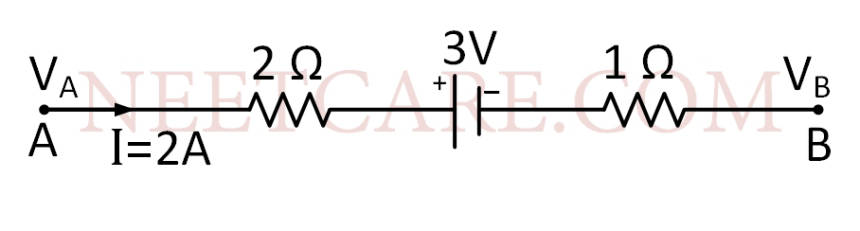
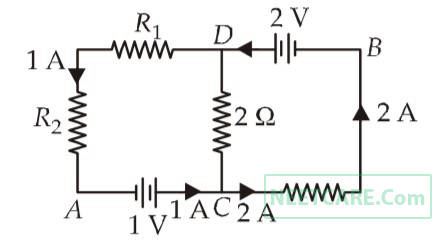
The potential difference (VA $-$ VB) between the points A and B in the given figure is
A.
$-$ 3V
B.
+3 V
C.
+6 V
D.
+9 V
Correct Answer: D
Explanation:
On applying KVL in the circuit, the potential difference between the two points can be obtained.
iCON Education HYD, 79930 92826, 73309 7282610 Mar 2026
A filament bulb (500 W, 100 V) is to be used in a 230 V main supply. When a resistance R is connected in series, it works perfectly and the bulb consumes 500 W. The value of R is
iCON Education HYD, 79930 92826, 73309 7282610 Mar 2026
The charge flowing through a resistance R varies with time t is Q = at $-$ bt2, where $a$ and $b$ are positive constants. The total heat produced in R is
A.
${{{a^3}R} \over {2b}}$
B.
${{{a^3}R} \over {b}}$
C.
${{{a^3}R} \over {6b}}$
D.
${{{a^3}R} \over {3b}}$
Correct Answer: C
Explanation:
Given: Charge Q = at – bt2
$ \therefore $ Current $i = {{\partial Q} \over {\partial t}} = a - 2bt$
$\left\{ {for\,i = 0 \Rightarrow t = {a \over {2b}}} \right\}$
From joule's law of heating, heat produced dH = i2Rdt
iCON Education HYD, 79930 92826, 73309 7282610 Mar 2026
A potentiometer wire is 100 cm long and a constant potential difference is maintained across it. Two cells are connected in series first to support one another and then in opposite direction. The balance points are obtained at 50 cm and 10 cm from the positive end of the wire in the two cases. The ratio of emf's is
A.
3 : 4
B.
3 : 2
C.
5 : 1
D.
5 : 4
Correct Answer: B
Explanation:
When two cells are connected in series i.e., E1 + E2 the balance point is at 50 cm. And when two cells are connected in opposite direction i.e., E1 – E2 the balance point is at 10 cm. According to principle of potential
iCON Education HYD, 79930 92826, 73309 7282610 Mar 2026
A circuit contains an ammeter, a battery of 30 V and a resistance 40.8 ohm all connected in series. If the ammeter has a coil of resistance 480 ohm and a shunt of 20 ohm, the reading in the ammeter will be
iCON Education HYD, 79930 92826, 73309 7282610 Mar 2026
A potentiometer wire of length L and a resistance r are connected in series with a battery of e.m.f. E0 and a resistance r1. An unknown e.m.f. E is balanced at a length $l$ of the potentiometer wire. The e.m.f. E will be given by
iCON Education HYD, 79930 92826, 73309 7282610 Mar 2026
Across a metallic conductor of non-uniform cross section a constant potential difference is applied. The quantity which remains constant along the conductor is
A.
drift velocity
B.
electric field
C.
current density
D.
current
Correct Answer: D
Explanation:
The area of cross section of conductor is non uniform so current density will be different but the flow of electrons will be uniform so current will be constant.
2015
Q69
NEET
MCQ
iCON Education HYD, 79930 92826, 73309 7282610 Mar 2026
A potentiometer wire has length 4 m and resistance 8 $\Omega $. The resistance that must be connected in series with the wire and an accumulator of e.m.f. 2 V, so as to get a potential gradient 1 mV per cm on the wire is
A.
44 $\Omega $
B.
48 $\Omega $
C.
32 $\Omega $
D.
40 $\Omega $
Correct Answer: C
Explanation:
Total potential difference across potentiometer wire
iCON Education HYD, 79930 92826, 73309 7282610 Mar 2026
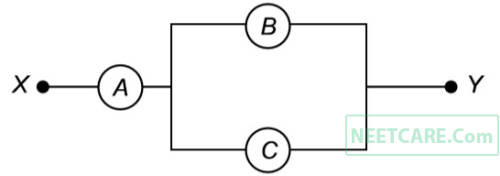
A, B and C are voltmeters of resistance R, 1.5 R and 3R respectively as shown in the figure. When some potential difference is applied between X and Y, the voltmeter readings are VA, VB and VC respectively, Then
A.
VA = VB $ \ne $ VC
B.
VA $ \ne $ VB $ \ne $ VC
C.
VA = VB = VC
D.
VA $ \ne $ VB = VC
Correct Answer: C
Explanation:
Effective resistance of B & C = (1.5R)(3R)/(1.5R + 3R) = R
In series sequence voltage across A = voltage across B & C
Now B & C are parallel, so VB = VC,
$ \therefore $ VA = VB = VC
2014
Q71
NEET
MCQ
iCON Education HYD, 79930 92826, 73309 7282610 Mar 2026
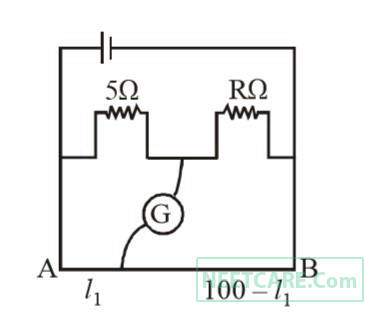
The resistances in the two arms of the meter bridge are 5 $\Omega $ and R$\Omega $ respectively. When the resistance R is shunted with an equal resistance, the new balance point is at 1.6$l$1. The resistance R is
iCON Education HYD, 79930 92826, 73309 7282610 Mar 2026
Two cities are 150 km apart. Electric power is sent from one city to another city through copper wires. The fall of potential per km is 8 volt and the average resistance per km is 0.5 $\Omega $. The power loss in the wire is
A.
19.2 W
B.
19.2 kW
C.
19.2 J
D.
12.2 kW
Correct Answer: B
Explanation:
Total voltage drop across the wire : V = 150 × 8= 1200 volt
Total resistance of wire, (R) = 150 × 0.5 = 75 $\Omega $
Hence, current through wire I = V/R
$ \Rightarrow $ I = 1200/75 =16 A
Finally the power loss will be, P = I2R = (16)2 × 75
= 19200 W or 19.2 kW
2014
Q73
NEET
MCQ
iCON Education HYD, 79930 92826, 73309 7282610 Mar 2026
A potentiometer circuit has been set up for finding the internal resistance of a given cell. The main battery, used across the potentiometer wire, has an emf of 2.0 V and a negligible internal resistance. The potentiometer wire itself is 4 m long. When the resistance R, connected across the given cell, has values of (i) infinity, (ii) 9.5 $\Omega $
the balancing lengths on the potentiometer wire are found to be 3 m and 2.85 m, respectively. The value of internal resistance of the cell is
iCON Education HYD, 79930 92826, 73309 7282610 Mar 2026
Ten identical cells connected in series are needed to heat a wire of length one meter and radius 'r' by 10oC in time 't'. How many cells will be required to heat the wire of length two meter of the same radius by the same temperature in time 't' ?
A.
20
B.
30
C.
40
D.
10
Correct Answer: A
Explanation:
Let $\rho $ be resistivity of the material of the wire and r be radius of the wire.
Let n cells each of emf $\varepsilon $ are connected in series to heat the same wire of length 2 m, by the same temperature $\Delta $T (= 10°C) in the same time t.
iCON Education HYD, 79930 92826, 73309 7282610 Mar 2026
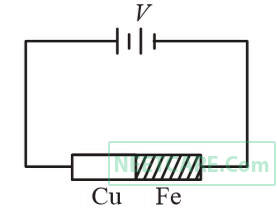
Two rods are joined end to end, as shown. Both have a cross-sectional area of 0.01 cm2. Each is 1 meter long. One rod is of copper with a resistivity of 1.7 $ \times $ 10$-$6 ohm-centimeter, the other is of iron with a resistivity of 10$-$5 ohm-centimeter.
How much voltage is required to produce a current of 1 ampere in the rods?
From ohm’s law V = RI = (1.7 × 10–6 × 10–2 + 10–5 × 10⁻²) $ \div $ 0.01 × 10⁻⁴ volt
= 0.117 volt ($ \because $ I = 1A)
2013
Q76
NEET
MCQ
iCON Education HYD, 79930 92826, 73309 7282610 Mar 2026
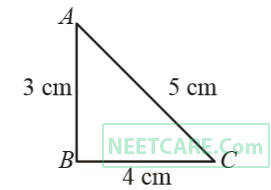
A 12 cm wire is given a shape of a right angled triangle ABC having sides 3 cm, 4 cm and 5 cm as shown in the figure. The resistance between two ends (AB, BC, CA) of the respective sides are measuread one by one ratio
iCON Education HYD, 79930 92826, 73309 7282610 Mar 2026
The resistances of the four arms P, Q, R and S in a Wheatstone's bridge are 10 ohm, 30 ohm, 30 ohm and 90 ohm, respectively. The e.m.f. and internal resistance of the cell are 7 volt and 5 ohm respectively. If the galvanometer resistance is 50 ohm, the current drawn from the celll will be
A.
0.1 A
B.
2.0 A
C.
1.0 A
D.
0.2 A
Correct Answer: D
Explanation:
From the question, total resistance of Wheatstone bridge is: (40) × (120)/(40 + 120) = 30$\Omega $
Now the current through the cell is: = 7V/(5+30)$\Omega $ = (1/5)A = 0.2A
2013
Q78
NEET
MCQ
iCON Education HYD, 79930 92826, 73309 7282610 Mar 2026
A wire of resistance 4 $\Omega $ is stretched to twice its original length. The resistance of stretched wire would be
A.
8 $\Omega $
B.
16 $\Omega $
C.
2 $\Omega $
D.
4 $\Omega $
Correct Answer: B
Explanation:
Resistance of a wire,
$R = \rho {l \over A} = 4\Omega $ ...(i)
When wire is stretched twice, its new length be $l'$. Then
$l' = 2l$
On stretching volume of the wire remains constant.
$ \therefore lA = l'A'$ where A' is the new cross-sectional area
iCON Education HYD, 79930 92826, 73309 7282610 Mar 2026
A cell having an emf $\varepsilon $ and internal resistance r is connected across a variable external resistance R. As the resistance R is increased, the plot of potential difference V across R is given by
A.
B.
C.
D.
Correct Answer: C
Explanation:
Current in the circuit, $I = {\varepsilon \over {R + r}}$
iCON Education HYD, 79930 92826, 73309 7282610 Mar 2026
In the circuit shown the cells A and B have negligible resistances. For VA = 12 V, R1 = 500 $\Omega $ and R = 100 $\Omega $ the galvanometer (G) shows no deflection. The value of Vs is
A.
4 V
B.
2 V
C.
12 V
D.
6 V
Correct Answer: B
Explanation:
Since the galvanometer shows no deflection so current will flow as shown in the figure.
iCON Education HYD, 79930 92826, 73309 7282610 Mar 2026
If voltage across a bulb rated 220 volt-100 watt drops by 2.5% of its rated value, the percentage of the rated value by which the power would decrease is
iCON Education HYD, 79930 92826, 73309 7282610 Mar 2026
A ring is made of a wire having a resistance R0 = 12 $\Omega $. Find the points A and B, as shown in the figure, at which a current carrying conductor should be connected so that the resistance R of the sub circuit between these point is equal to ${8 \over 3}\Omega $.
iCON Education HYD, 79930 92826, 73309 7282610 Mar 2026
A thermocouple of negligible resistance
produces an e.m.f. of 40 µV/ºC in the linear range
of temperature. A galvanometer of resistance 10
ohm whose sensitivity is 1 µA/division, is
employed with the thermocouple. The smallest
value of temperature difference that can be
detected by the system will be
A.
1ºC
B.
0.5 ºC
C.
0.1ºC
D.
0.25ºC
Correct Answer: D
Explanation:
For minimum deflection of 1 division
required current = 1 µA
$ \Rightarrow $ Voltage required = IR = (1µA) (10) = 10 µV
$ \therefore $ 40 µV ≡ 1ºC
$ \Rightarrow $ 10 µV ≡ ${1 \over 4}$ ºC = 0.25ºC
2011
Q87
NEET
MCQ
iCON Education HYD, 79930 92826, 73309 7282610 Mar 2026
A current of 2 A flows through a 2 $\Omega $ resistor when connected across a battery a 2 $\Omega $ resistor when connected across a battery. The same battery supplies a current of 0.5 A when connected across a 9 $\Omega $ resistor. The internal resistance of the battery is
A.
0.5 $\Omega $
B.
1/3 $\Omega $
C.
1/4 $\Omega $
D.
1 $\Omega $
Correct Answer: B
Explanation:
Let $\varepsilon $ be the emf and r be internal resistance of the battery.
iCON Education HYD, 79930 92826, 73309 7282610 Mar 2026
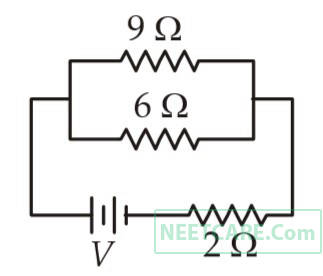
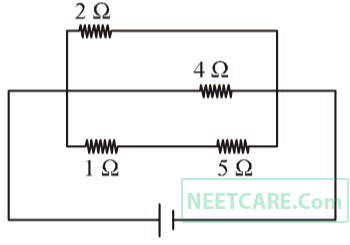
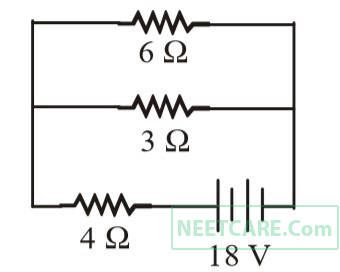
If power dissipated in the 9 $\Omega $ resistor in the circuit shown is 36 watt, the potential difference across the 2 $\Omega $ resistor is
A.
4 volt
B.
8 volt
C.
10 volt
D.
2 volt
Correct Answer: C
Explanation:
We have,
$P = {{{V^2}} \over R}$
$ \Rightarrow 36 = {{{V^2}} \over 9}$
$ \Rightarrow V = 18$
Current passing through the 9$\Omega $ resistor is
${i_1} = {V \over R} = {{18} \over 9} = 2A$
The 9$\Omega $ and 6$\Omega $ resistors are in parallel, therefore
${i_1} = {6 \over {9 + 6}} \times i$
where i is the current delivered by the battery.
$ \therefore i = {{2 \times 15} \over 6} = 5A$
Thus, potential difference across 2$\Omega $ resistor is
V = iR = 5 × 2 = 10V
2010
Q89
NEET
MCQ
iCON Education HYD, 79930 92826, 73309 7282610 Mar 2026
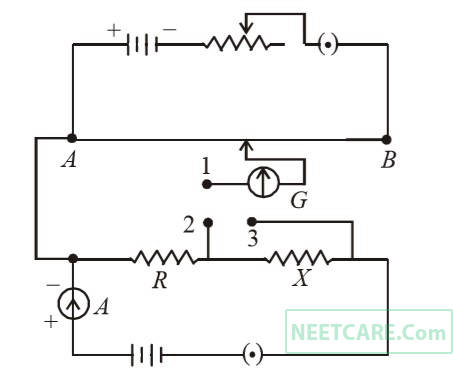
A potentiometer circuit is set up as shown. The potential gradient, across the potentiometer wire, is k volt/cm and the ammeter, present in the circuit, reads 1.0 A when two way key is switched off. The balance points, when the key between the terminals (i) 1 and 2 (ii) 1 and 3, is plugged in, are found to be at length $l$1 cm and $l$2 cm respectively. The magnitudes, of the resistors R and X, in ohms, are then, equal, respectively, to
A.
$k({l_2} - {l_1})$ and $k{l_2}$
B.
$k{l_1}$ and $k({l_2} - {l_1})$
C.
$k\left( {{l_2} - {l_1}} \right)$ and $k{l_1}$
D.
$k{l_1}$ and $k{l_2}$
Correct Answer: B
Explanation:
(i) When key between the terminals 1 and 2 is plugged in,
P.D. across R = IR = $k l_1$
$ \Rightarrow $ R =$ k l_1$ as I = 1A
(ii) When key between terminals 1 and 3 is plugged in,
P.D. across (X + R) = I(X + R) = $k l_2$
$ \Rightarrow $ X + R = $k l_2$
$ \therefore $ X = $k (l_2 – l_1)$
$ \therefore $ R = $kl_1$ and X = $k (l_2 – l_1)$
2010
Q90
NEET
MCQ
iCON Education HYD, 79930 92826, 73309 7282610 Mar 2026
Consider the following two statements.
(A) Kirchoff's junction law follows from the conservation of charge.
(B) Kirchhoff's loop law follows from the conservation of energy.
Which of the following is correct?
A.
Both (A) and (B) are wrong
B.
(A) is correct and (B) is wrong
C.
(A) is wrong and (B) is correct
D.
Both (A) and (B) are correct
Correct Answer: D
Explanation:
Kirchhoff’s junction law or Kirchhoff’s first law is based on the conservation of charge.
Kirchhoff’s loop law or Kirchhoff’s second law is based on the conservation of energy.
Hence both statements (A) and (B) are correct.
2009
Q91
NEET
MCQ
iCON Education HYD, 79930 92826, 73309 7282610 Mar 2026
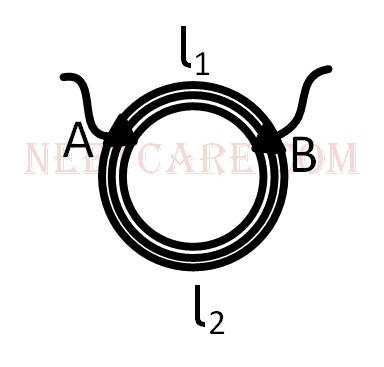
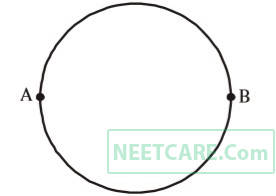
A wire of resistance 12 ohms per meter is bent to form a complete circle of radius 10 cm. The resistance between its two diametrically opposite points, A and B as shown in the figure is
A.
$3\,\Omega $
B.
$6\pi \,\Omega $
C.
$6\,\Omega $
D.
$0.6\pi \,\Omega $
Correct Answer: D
Explanation:
The resistance of length 2$\pi $R is 12$\Omega $. Hence the resistance of length $\pi $R is 6$\Omega $. Thus two resistances of 6$\Omega $ can be represented as shown in fig.
iCON Education HYD, 79930 92826, 73309 7282610 Mar 2026
The mean free path of electrons in a metal is 4 $ \times $ 10$-$8 m. The electric field which can give on an average 2 eV energy to an electron in the metal will be in units V/m
iCON Education HYD, 79930 92826, 73309 7282610 Mar 2026
A student measures the terminal potential difference (V) of a cell (of emf $\varepsilon $ and internal resistance r) as a function of the current (I) flowing through it. The slope, and intercept, of the graph between V and I, then respectively, equal
A.
$-$ r and $\varepsilon $
B.
r and $-$ $\varepsilon $
C.
$-$ $\varepsilon $ and r
D.
$\varepsilon $ and $-$ r
Correct Answer: A
Explanation:
The terminal potential difference of a cell is given by V + Ir = $\varepsilon $
V = VA – VB
$ \Rightarrow $ V = $\varepsilon $ – Ir
$ \Rightarrow {{dV} \over {dI}} = - r$, Also for, i = 0 then V = $\varepsilon $
iCON Education HYD, 79930 92826, 73309 7282610 Mar 2026
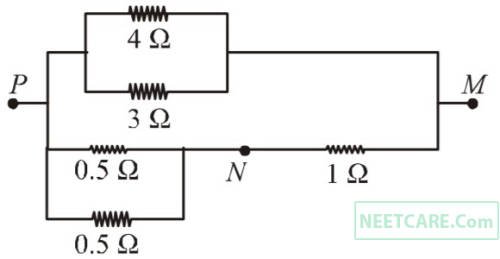
In the circuit shown, the current through the 4 $\Omega $ resistor is 1 amp when the points P and M are connected to a d.c. voltage source. The potential difference betwen the points M and N is
A.
0.5 volt
B.
3.2 volt
C.
1.5 volt
D.
1.0 volt
Correct Answer: B
Explanation:
As the P.D. between 4 $\Omega $ and 3 $\Omega $ (in parallel), are the same,
Length increases by 0.1, resistance increases, area decreases by 0.1, then also resistance will increase. Total increase in resistance is approximately 1.2 times, due to increase in length and decrease in area. But specific resistance does not change.
2008
Q97
NEET
MCQ
iCON Education HYD, 79930 92826, 73309 7282610 Mar 2026
A cell can be balanced against 110 cm and 100 cm of potentiometer wire, respectively with and without being short circuited through a resistance of 10 $\Omega $. Its internal resistance is
A.
2.0 ohm
B.
zero
C.
1.0 ohm
D.
0.5 ohm
Correct Answer: C
Explanation:
Here $E > {{ER} \over {R + r}}$, hence the lengths 110 cm and 100 cm are interchanged.
Without being short-circuited through R, only the battery E is balanced.
iCON Education HYD, 79930 92826, 73309 7282610 Mar 2026
An electric kettle takes 4 A current at 220 V. How much time will it take to boil 1 kg of water from temperature 20oC ? The temperature of boiling water is 100oC
A.
12.6 min
B.
4.2 min
C.
6.3 min
D.
8.4 min
Correct Answer: C
Explanation:
Power = 220 V × 4 A = 880 watts. = 880 J/s. Heat needed to raise the temperature of 1 kg water through 80°C