Vector Algebra
If $\mathbf{a}$ and $\mathbf{b}$ are two vectors such that $\mathbf{a}=2 \hat{\mathbf{i}}+2 \hat{\mathbf{j}}+p \hat{\mathbf{k}}$, $|\mathbf{b}|=7, \mathbf{a} \cdot \mathbf{b}=4$ and $|\mathbf{a} \times \mathbf{b}|=5 \sqrt{17}$, then $p=$
$\pm 5$
$\pm 6$
$\pm 1$
$\pm 3$

In a $\triangle A B C, D$ and $E$ divide the sides $B C$ and $C A$ in the ratio $2: 1$ respectively. If $P$ is the point of intersection of $A D$ and $B E$, then the ratio in which $P$ divides $A D$ is
$2: 1$
$3: 4$
$4: 3$
$1: 2$

If the points with position vectors $\hat{\mathbf{i}}-2 \hat{\mathbf{j}}+3 \hat{\mathbf{k}}, 2 \hat{\mathbf{i}}+3 \hat{\mathbf{j}}-4 \hat{\mathbf{k}},-3 \hat{\mathbf{i}}+\hat{\mathbf{j}}-5 \hat{\mathbf{k}}$ and $a \hat{\mathbf{i}}-2 \hat{\mathbf{j}}+4 \hat{\mathbf{k}}$ are coplanar, then $a=$
$\frac{-4}{19}$
$\frac{42}{19}$
$\frac{-49}{19}$
$\frac{4}{19}$
Let $\mathbf{a}$ be a vector in the plane containing vectors $\mathbf{b}=\hat{\mathbf{i}}+2 \hat{\mathbf{j}}+\hat{\mathbf{k}}$ and $\mathbf{c}=2 \hat{\mathbf{i}}-\hat{\mathbf{j}}+\hat{\mathbf{k}}$. If $\mathbf{a}$ is perpendicular to $\hat{\mathbf{i}}+\hat{\mathbf{j}}+3 \hat{\mathbf{k}}$ and its projection on $\mathbf{b}$ is $3 \sqrt{6}$, then $|\mathbf{a}|^2=$
186
36
128
264
Let $\mathbf{a}=\hat{\mathbf{i}}+\hat{\mathbf{j}}+\hat{\mathbf{k}}, \mathbf{b}=\hat{\mathbf{i}}-2 \hat{\mathbf{j}}+\hat{\mathbf{k}}, \mathbf{c}=\hat{\mathbf{i}}+3 \hat{\mathbf{j}}-2 \hat{\mathbf{k}}$, $\mathbf{d}=2 \hat{\mathbf{i}}+\hat{\mathbf{j}}-\hat{\mathbf{k}}$ be four vectors and let $l=\mathbf{b} \cdot \mathbf{c}$ and $m=\mathbf{c} \cdot \mathbf{a}$. Then, $[m \mathbf{b}+l \mathbf{a} \mathbf{b d}]=$
79
-63
0
1
a, b, c are non-coplanar vectors. If $\mathbf{a}+3 \mathbf{b}+4 \mathbf{c}=x(\mathbf{a}-2 \mathbf{b}+3 \mathbf{c})+y(\mathbf{a}+5 \mathbf{b}-2 \mathbf{c}) +z(6 \mathbf{a}+14 \mathbf{b}+4 \mathbf{c}) \text {, then } x+y+z=$
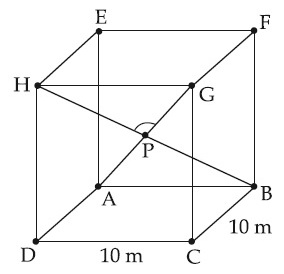
Three vectors of magnitudes $a, 2 a, 3 a$ are along the directions of the diagonals of 3 adjacent faces of a cube that meet in a point. Then, the magnitude of the sum of those diagonals is
If $\mathbf{a}$ is collinear with $\mathbf{b}=3 \hat{i}+6 \hat{j}+6 \hat{k}$ and $\mathbf{a} \cdot \mathbf{b}=27$, then $|\mathbf{a}|=$
Let $a, b$ and $c$ be unit vectors such that $a$ is perpendicular to the plane containing $\mathbf{b}$ and $\mathbf{c}$ and angle between $\mathbf{b}$ and $\mathbf{c}$ is $\frac{\pi}{3}$. Then, $|\mathbf{a}+\mathbf{b}+\mathbf{c}|=$
Let $\mathbf{F}=2 \hat{i}+2 \hat{j}+5 \hat{k}, A=(1,2,5), B=(-1,-2,-3)$ and $\mathbf{B A} \times \mathbf{F}=4 \hat{i}+6 \hat{j}+2 \lambda \hat{k}$, then $\lambda=$
$O A B C$ is a tetrahedron. If $D, E$ are the mid-points of $O A$ and $B C$ respectively, then $\mathbf{D E}=$

If $\mathbf{a}+\mathbf{b}+\mathbf{c}=0$ and $|\mathbf{a}|=7,|\mathbf{b}|=5,|\mathbf{c}|=3$ then the angle between $\mathbf{b}$ and $\mathbf{c}$ is
If $P$ and $Q$ are two points on the curve $y=2^{x+2}$ in the rectangular cartesian coordinate system such that $\mathbf{O P} \cdot \hat{i}=-1, \mathrm{OQ} \cdot \hat{i}=2$, then $\mathrm{OQ}-4 \mathrm{OP}=$
In quadrilateral $A B C D, \mathbf{A B}=\mathbf{a}, \mathbf{B C}=\mathbf{b}$. $\mathbf{D A}=\mathbf{a}-\mathbf{b}, M$ is the mid-point of $B C$ and $X$ is a point on DM such that, $\mathbf{D X}=\frac{4}{5}$ DM. Then, the points $A, X$ and $C$.

The vectors $3 \mathbf{a}-5 \mathbf{b}$ and $2 \mathbf{a}+\mathbf{b}$ are mutually perpendicular and the vectors $a+4 b$ and $-\mathbf{a}+\mathbf{b}$ are also mutually perpendicular, then the acute angle between $\mathbf{a}$ and $\mathbf{b}$ is
Let $\mathbf{a}=x \hat{i}+y \hat{j}+z \hat{k}$ and $x=2 y$. If $|\mathbf{a}|=5 \sqrt{2}$ and a makes an angle of $135^{\circ}$ with the Z-axis, then $\mathbf{a}=$
Let $\mathbf{a}, \mathbf{b}, \mathbf{c}$ be the position vectors of the vertices of a $\triangle A B C$. Through the vertices, lines are drawn parallel to the sides to form the $\Delta A^{\prime} B^{\prime} C^{\prime}$. Then, the centroid of $\Delta A^{\prime} B^{\prime} C^{\prime}$ is

$\widehat u$ and $\widehat v$ are two non-collinear unit vectors such that $\left| {{{\widehat u + \widehat v} \over 2} + \widehat u \times \widehat v} \right| = 1$. Then the value of $|\widehat u \times \widehat v|$ is equal to
$\overrightarrow a \times \{ (\overrightarrow r - \overrightarrow b ) \times \overrightarrow a \} + \overrightarrow b \times \{ (\overrightarrow r - \overrightarrow c ) \times \overrightarrow b \} + \overrightarrow c \times \{ (\overrightarrow r - \overrightarrow a ) \times \overrightarrow c \} = \overrightarrow 0 $, then $\overrightarrow r $ is equal to :
such that $\left| {2\overrightarrow a + 3\overrightarrow b } \right| = \left| {3\overrightarrow a + \overrightarrow b } \right|$ and the angle between $\overrightarrow a $ and $\overrightarrow b $ is 60$^\circ$. If ${1 \over 8}\overrightarrow a $ is a unit vector, then $\left| {\overrightarrow b } \right|$ is equal to :
$(2 + a + b)\widehat i + (a + 2b + c)\widehat j - (b + c)\widehat k,(1 + b)\widehat i + 2b\widehat j - b\widehat k$ and $(2 + b)\widehat i + 2b\widehat j + (1 - b)\widehat k$, $a,b,c, \in R$
be co-planar. Then which of the following is true?


If $\overrightarrow r $ $\times$ $\overrightarrow a $ = $\overrightarrow r $ $\times$ $\overrightarrow b $, $\overrightarrow r $ . ($\widehat i$ + 2$\widehat j$ + $\widehat k$) = $-$3, then $\overrightarrow r $ . (2$\widehat i$ $-$ 3$\widehat j$ + $\widehat k$) is equal to :
$\overrightarrow r $ . $\left( {\alpha \widehat i + 2\widehat j + \widehat k} \right)$ = 3 and $\overrightarrow r \,.\,\left( {2\widehat i + 5\widehat j - \alpha \widehat k} \right)$ = $-$1, $\alpha$ $\in$ R, then the
value of $\alpha$ + ${\left| {\overrightarrow r } \right|^2}$ is equal to :

$\overrightarrow a \times \left( {\overrightarrow a \times \left( {\overrightarrow a \times \left( {\overrightarrow a \times \overrightarrow b } \right)} \right)} \right)$ is equal to :
Explanation:
$\overrightarrow b = \widehat i + 2\widehat j - \widehat k$
$\overrightarrow c = 3\widehat i + 2\widehat j - \widehat k$
$\overrightarrow v = x\overrightarrow a + y\overrightarrow b $
$\overrightarrow v \left( {3\widehat i + 2\widehat j - \widehat k} \right) = 0$
$\overrightarrow v .\widehat a = 19$
$\overrightarrow v = \lambda \overrightarrow c \times \left( {\overrightarrow a \times \overrightarrow b } \right)$
$\overrightarrow v = \lambda \left[ {\left( {\overrightarrow c .\overrightarrow b } \right)\overrightarrow a - \left( {\overrightarrow c .\overrightarrow a } \right)\overrightarrow b } \right]$
$ = \lambda [(3 + 4 + 1)\left( {2\widehat i - \widehat j + 2\widehat k} \right) - \left( {{{6 - 2 - 2} \over 2}} \right)\left( {\widehat i + 2\widehat j + \widehat k} \right)$
$ = \lambda [16\widehat i - 8\widehat j + 16\widehat k - 2\widehat i - 4\widehat j + 2\widehat k]$
$\overrightarrow v = \lambda \left[ {14\widehat i - 12\widehat j + 18\widehat k} \right]$
$\lambda [14\widehat i - 12\widehat j + 18\widehat k].{{\left( {2\widehat i - \widehat j + 2\widehat k} \right)} \over {\sqrt {4 + 1 + 4} }} = 19$
$\lambda {{[28 + 12 + 36]} \over 3} = 19$
$\lambda \left( {{{76} \over 3}} \right) = 19$
$4\lambda = 3 \Rightarrow \lambda = {3 \over 4}$
$|2{v^2}| = {\left| {2 \times {3 \over 4}(14\widehat i - 12\widehat j + 18\widehat k)} \right|^2}$
${9 \over 4} \times 4{\left( {7\widehat i - 6\widehat j + 9\widehat k} \right)^2}$
$ = 9(49 + 36 + 81)$
$ = 9(166)$
$ = 1494$
Explanation:
$1 + 15 + \alpha \beta = 0 \Rightarrow \alpha \beta = - 16$ .... (1)
Also,
${\left| {\overrightarrow b \, \times \overrightarrow c } \right|^2} = 75 \Rightarrow (10 + {\beta ^2})14 - {(5 - 3\beta )^2} = 75$
$\Rightarrow$ 5$\beta$2 + 30$\beta$ + 40 = 0
$\Rightarrow$ $\beta$ = $-$4, $-$2
$\Rightarrow$ $\alpha$ = 4, 8
$ \Rightarrow \left| {\overrightarrow a } \right|_{\max }^2 = {(26 + {\alpha ^2})_{\max }} = 90$
Explanation:
$\overrightarrow b = (2 - \lambda )\widehat i + 6\widehat j - 2\widehat k$
${{\overrightarrow a \,.\,\overrightarrow b } \over {|\overrightarrow b |}} = 1,\overrightarrow a \,.\,\overrightarrow b = 12 - \lambda $
$\left( {\overrightarrow a \,.\,\overrightarrow b } \right) = |\overrightarrow b {|^2}$
$\lambda$2 $-$ 24$\lambda$ + 144 = $\lambda$2 $-$ 4$\lambda$ + 4 + 40
20$\lambda$ = 100 $\Rightarrow$ $\lambda$ = 5
Explanation:
$\overrightarrow b = (3,\beta , - \alpha )$
$\overrightarrow c = ( - \alpha , - 2,1);\alpha ,\beta \in I$
$\overrightarrow a \,.\,\overrightarrow b = - 1 \Rightarrow 3 - \alpha \beta - \alpha \beta = - 1$
$ \Rightarrow \alpha \beta = 2$
Possible value of
$\alpha $ and $\beta $
$\matrix{ 1 & 2 \cr 2 & 1 \cr { - 1} & { - 2} \cr { - 2} & { - 1} \cr } $
$\overrightarrow b \,.\,\overrightarrow c = 10$
$ \Rightarrow - 3\alpha - 2\beta - \alpha = 10$
$ \Rightarrow 2\alpha + \beta + 5 = 0$
$\therefore$ $\alpha$ = $-$2; $\beta$ = $-$1
$[\overrightarrow a \,\overrightarrow b \,\overrightarrow c ] = \left| {\matrix{ 1 & 2 & { - 1} \cr 3 & { - 1} & 2 \cr 2 & { - 2} & 1 \cr } } \right|$
$ = 1( - 1 + 4) - 2(3 - 4) - 1( - 6 + 2)$
$ = 3 + 2 + 4 = 9$
Explanation:
Take Dot with $\overrightarrow c $
$\left( {\overrightarrow a \times \overrightarrow b } \right).\,\overrightarrow c = {\left| {\overrightarrow c } \right|^2} = 2$
Projection of $\overrightarrow b $ or $\overrightarrow a \times \overrightarrow c = l$
${{\left| {\overrightarrow b \,.\,(\overrightarrow a \times \overrightarrow c )} \right|} \over {|\overrightarrow a \times \overrightarrow c |}} = l$
$\therefore$ $l = {2 \over {\sqrt 6 }} \Rightarrow {l^2} = {4 \over 6}$
$3{l^2} = 2$
Explanation:
$ \therefore $ $\left( {\overrightarrow a + 3\overrightarrow b } \right)\,.\,\left( {7\overrightarrow a - 5\overrightarrow b } \right) = 0$
$ \Rightarrow $ $7{\left| {\overrightarrow a } \right|^2} - 15{\left| {\overrightarrow b } \right|^2} + 16\overrightarrow a \,.\,\overrightarrow b = 0$ ....(1)
Also, $\left( {\overrightarrow a - 4\overrightarrow b } \right)\,.\,\left( {7\overrightarrow a - 2\overrightarrow b } \right) = 0$
$ \Rightarrow $ $7{\left| {\overrightarrow a } \right|^2} + 8{\left| {\overrightarrow b } \right|^2} - 30\overrightarrow a \,.\,\overrightarrow b = 0$ .....(2)
Equation (1) × 30
$210{\left| {\overrightarrow a } \right|^2} - 450{\left| {\overrightarrow b } \right|^2} + 480\overrightarrow a \,.\,\overrightarrow b = 0$ ....(3)
Equation (2) × 16
$112{\left| {\overrightarrow a } \right|^2} + 128{\left| {\overrightarrow b } \right|^2} - 480\overrightarrow a \,.\,\overrightarrow b = 0$ .....(4)
from (3) & (4)
$322{\left| {\overrightarrow a } \right|^2} = 322{\left| {\overrightarrow b } \right|^2}$
$ \Rightarrow $ ${\left| {\overrightarrow a } \right|^2} = {\left| {\overrightarrow b } \right|^2}$
$ \Rightarrow $ $\left| {\overrightarrow a } \right| = \left| {\overrightarrow b } \right|$
From equation (2),
$15\left| {\overrightarrow a } \right| = 30\overrightarrow a .\overrightarrow b $
$ \Rightarrow $ $15{\left| {\overrightarrow a } \right|^2} = 30\left| {\overrightarrow a } \right|.\left| {\overrightarrow b } \right|\cos \theta $
$\cos \theta = {{15} \over {30}} = {1 \over 2}$
$\therefore$ $\theta = 60^\circ $
Explanation:
$\overrightarrow q = \widehat i + 2\widehat j + \widehat k$
Now, $(\overrightarrow p + \overrightarrow q ) \times (\overrightarrow p - \overrightarrow q ) = \left| {\matrix{ {\widehat i} & {\widehat j} & {\widehat k} \cr 3 & 5 & 2 \cr 1 & 1 & 0 \cr } } \right|$
$ = - 2\widehat i - 2\widehat j - 2\widehat k$
$ \Rightarrow \overrightarrow r = \pm \sqrt 3 {{\left( {(\overrightarrow p + \overrightarrow q ) \times (\overrightarrow p - \overrightarrow q )} \right)} \over {\left| {(\overrightarrow p + \overrightarrow q ) \times (\overrightarrow p - \overrightarrow q )} \right|}} = \pm {{\sqrt 3 \left( { - 2\widehat i - 2\widehat j - 2\widehat k} \right)} \over {\sqrt {{2^2} + {2^2} + {2^2}} }}$
$\overrightarrow r = \pm \left( { - \widehat i - \widehat j - \widehat k} \right)$
According to question
$\overrightarrow r = \alpha \widehat i + \beta \widehat j + \gamma \widehat k$
So, |$\alpha$| = 1, |$\beta$| = 1, |$\gamma$| = 1
$\Rightarrow$ $\left| \alpha \right| + \left| \beta \right| + \left| \gamma \right|$ = 3
Explanation:

$\left| {\overrightarrow {{V_1}} } \right| = \left| {\overrightarrow {{V_2}} } \right|$
$3{P^2} + 1 = 4 + {(P + 1)^2}$
$2{P^2} - 2P - 4 = 0 \Rightarrow {P^2} - P - 2 = 0$
$P = 2, - 1$ (rejected)
$\cos \theta = {{\overrightarrow {{V_1}} .\overrightarrow {{V_2}} } \over {\left| {\overrightarrow {{V_1}} } \right|\left| {\overrightarrow {{V_2}} } \right|}} = {{2\sqrt 3 P + (P + 1)} \over {\sqrt {{{(P + 1)}^2} + 4} \sqrt {3{P^2} + 1} }}$
$\cos \theta = {{4\sqrt 3 + 3} \over {\sqrt {13} \sqrt {13} }} = {{4\sqrt 3 + 3} \over {13}}$
$\tan \theta = {{\sqrt {112 - 24\sqrt 3 } } \over {4\sqrt 3 + 3}} = {{6\sqrt 3 - 2} \over {4\sqrt 3 + 3}} = {{\alpha \sqrt 3 - 2} \over {4\sqrt 3 + 3}}$
$ \Rightarrow \alpha = 6$
Explanation:
$ \Rightarrow \left| {\overrightarrow a + \overrightarrow b + \overrightarrow c } \right| = \sqrt 3 \overrightarrow a .(\overrightarrow a + \overrightarrow b + \overrightarrow c ) = \left| {\overrightarrow a + \overrightarrow b + \overrightarrow c } \right|\cos \theta $
$ \Rightarrow 1 = \sqrt 3 \cos \theta $
$ \Rightarrow \cos 2\theta = - {1 \over 3}$
$ \Rightarrow 36{\cos ^2}2\theta = 4$
Explanation:
$L = {{(\overrightarrow a - \overrightarrow c ).(\overrightarrow b \times \overrightarrow d )} \over {|b \times d|}}$
$\therefore$ $\overrightarrow a - \overrightarrow c = ((\alpha + 4)\widehat i + 2\widehat j + 3\widehat k)$
${{\overrightarrow b \times \overrightarrow d } \over {|b \times d|}} = {{(2\widehat i + 2\widehat j + \widehat k)} \over 3}$
$\therefore$ $((\alpha + 4)\widehat i + 2\widehat j + 3\widehat k).{{(2\widehat i + 2\widehat j + \widehat k)} \over 3} = 9$
or $\alpha$ = 6