iCON Education HYD, 79930 92826, 73309 7282614 Mar 2026
Let $\overrightarrow a = \widehat i + \widehat j - \widehat k$ and $\overrightarrow c = 2\widehat i - 3\widehat j + 2\widehat k$. Then the number of vectors $\overrightarrow b $ such that $\overrightarrow b \times \overrightarrow c = \overrightarrow a $ and $|\overrightarrow b | \in $ {1, 2, ........, 10} is :
A.
0
B.
1
C.
2
D.
3
Correct Answer: A
Explanation:
$\overrightarrow a = \widehat i + \widehat j - \widehat k$
$\overrightarrow c = 2\widehat i - 3\widehat j + 2\widehat k$
Now, $\overrightarrow b \times \overrightarrow c = \overrightarrow a $
$\overrightarrow c \,.\,(\overrightarrow b \times \overrightarrow c ) = \overrightarrow c \,.\,\overrightarrow a $
$\overrightarrow c \,.\,\overrightarrow a = 0$
$ \Rightarrow (\widehat i + \widehat j - \widehat k)(2\widehat i - 3\widehat j + 2\widehat k) = 0$
$ = 2 - 3 - 2 = 0$
$ \Rightarrow - 3 = 0$ (Not possible)
$\Rightarrow$ No possible value of $\overrightarrow b $ is possible.
2022
Q152
JEE Mains
MCQ
iCON Education HYD, 79930 92826, 73309 7282614 Mar 2026
If $\overrightarrow a \,.\,\overrightarrow b = 1,\,\overrightarrow b \,.\,\overrightarrow c = 2$ and $\overrightarrow c \,.\,\overrightarrow a = 3$, then the value of $\left[ {\overrightarrow a \times \left( {\overrightarrow b \times \overrightarrow c } \right),\,\overrightarrow b \times \left( {\overrightarrow c \times \overrightarrow a } \right),\,\overrightarrow c \times \left( {\overrightarrow b \times \overrightarrow a } \right)} \right]$ is :
A.
0
B.
$ - 6\overrightarrow a \,.\,\left( {\overrightarrow b \times \overrightarrow c } \right)$
C.
$ - 12\overrightarrow c \,.\,\left( {\overrightarrow a \times \overrightarrow b } \right)$
D.
$ - 12\overrightarrow b \,.\,\left( {\overrightarrow c \times \overrightarrow a } \right)$
Correct Answer: A
Explanation:
$\because$ $\overrightarrow a \times \left( {\overrightarrow b \times \overrightarrow c } \right) = 3\overrightarrow b - \overrightarrow c = \overrightarrow u $
$\overrightarrow b \times \left( {\overrightarrow c \times \overrightarrow a } \right) = \overrightarrow c - 2\overrightarrow a = \overrightarrow v $
$\overrightarrow c \times \left( {\overrightarrow b \times \overrightarrow a } \right) = 3\overrightarrow b - 2\overrightarrow a = \overrightarrow w $
$\therefore$ $\overrightarrow u + \overrightarrow v = \overrightarrow w $
So, vectors $\overrightarrow u $, $\overrightarrow v $ and $\overrightarrow w $ are coplanar, hence their Scalar triple product will be zero.
2022
Q153
JEE Mains
MCQ
iCON Education HYD, 79930 92826, 73309 7282614 Mar 2026
Let $\overrightarrow a = {a_1}\widehat i + {a_2}\widehat j + {a_3}\widehat k$ ${a_i} > 0$, $i = 1,2,3$ be a vector which makes equal angles with the coordinate axes OX, OY and OZ. Also, let the projection of $\overrightarrow a $ on the vector $3\widehat i + 4\widehat j$ be 7. Let $\overrightarrow b $ be a vector obtained by rotating $\overrightarrow a $ with 90$^\circ$. If $\overrightarrow a $, $\overrightarrow b $ and x-axis are coplanar, then projection of a vector $\overrightarrow b $ on $3\widehat i + 4\widehat j$ is equal to:
$\overrightarrow b = - 2r\widehat i + r\widehat j + r\widehat k$
$\overrightarrow b = r( - 2\widehat i + \widehat j + \widehat k)$
Now $\left| {\overrightarrow a } \right| = \left| {\overrightarrow b } \right|$
$5\sqrt 3 = \left| r \right|\sqrt b \Rightarrow \left| r \right| = {5 \over {\sqrt 2 }}$
$\Rightarrow$ Projection of $\overrightarrow b $ on $3\widehat i + 4\widehat j = \left| {{{\overrightarrow b \,.\,\left( {3\widehat i + 4\widehat j} \right)} \over {\sqrt {{3^2} + {4^2}} }}} \right|$
iCON Education HYD, 79930 92826, 73309 7282614 Mar 2026
Let $\widehat a$ and $\widehat b$ be two unit vectors such that $|(\widehat a + \widehat b) + 2(\widehat a \times \widehat b)| = 2$. If $\theta$ $\in$ (0, $\pi$) is the angle between $\widehat a$ and $\widehat b$, then among the statements :
(S1) : $2|\widehat a \times \widehat b| = |\widehat a - \widehat b|$
(S2) : The projection of $\widehat a$ on ($\widehat a$ + $\widehat b$) is ${1 \over 2}$
A.
Only (S1) is true.
B.
Only (S2) is true.
C.
Both (S1) and (S2) are true.
D.
Both (S1) and (S2) are false.
Correct Answer: C
Explanation:
$\left| {\widehat a + \widehat b + 2(\widehat a \times \widehat b)} \right| = 2,\,\theta \in (0,\,\pi )$
$ \Rightarrow {\left| {\widehat a + \widehat b + 2(\widehat a \times \widehat b)} \right|^2} = 4$
where $\theta$ is angle between $\widehat a$ and $\widehat b$.
$\therefore$ $2\left| {\widehat a \times \widehat b} \right| = \sqrt 3 = \left| {\widehat a - \widehat b} \right|$
(S1) is correct.
And projection of $\widehat a$ on $(\widehat a + \widehat b) = \left| {{{\widehat a\,.\,(\widehat a + \widehat b)} \over {\left| {\widehat a + \widehat b} \right|}}} \right| = {1 \over 2}$
(S2) is correct.
2022
Q155
JEE Mains
MCQ
iCON Education HYD, 79930 92826, 73309 7282614 Mar 2026
Let $\widehat a$, $\widehat b$ be unit vectors. If $\overrightarrow c $ be a vector such that the angle between $\widehat a$ and $\overrightarrow c $ is ${\pi \over {12}}$, and $\widehat b = \overrightarrow c + 2\left( {\overrightarrow c \times \widehat a} \right)$, then ${\left| {6\overrightarrow c } \right|^2}$ is equal to :
iCON Education HYD, 79930 92826, 73309 7282614 Mar 2026
Let $\vec{a}$ and $\vec{b}$ be two vectors such that $|\vec{a}+\vec{b}|^{2}=|\vec{a}|^{2}+2|\vec{b}|^{2}, \vec{a} \cdot \vec{b}=3$ and $|\vec{a} \times \vec{b}|^{2}=75$. Then $|\vec{a}|^{2}$ is equal to __________.
or $|\vec{a}|^{2}+|\vec{b}|^{2}+2 \vec{a} \cdot \vec{b}=|\vec{a}|^{2}+2|\vec{b}|^{2}$
$\therefore|\vec{b}|^{2}=6$
Now $|\vec{a} \times \vec{b}|^{2}=|\vec{a}|^{2}|\vec{b}|^{2}-(\vec{a} \cdot \vec{b})^{2}$
$
75=|\vec{a}|^{2} \cdot 6-9
$
$\therefore|\vec{a}|^{2}=14$
2022
Q157
JEE Mains
Numerical
iCON Education HYD, 79930 92826, 73309 7282614 Mar 2026
Let $\overrightarrow a $, $\overrightarrow b $, $\overrightarrow c $ be three non-coplanar vectors such that $\overrightarrow a $ $\times$ $\overrightarrow b $ = 4$\overrightarrow c $, $\overrightarrow b $ $\times$ $\overrightarrow c $ = 9$\overrightarrow a $ and $\overrightarrow c $ $\times$ $\overrightarrow a $ = $\alpha$$\overrightarrow b $, $\alpha$ > 0. If $\left| {\overrightarrow a } \right| + \left| {\overrightarrow b } \right| + \left| {\overrightarrow c } \right| = {1 \over {36}}$, then $\alpha$ is equal to __________.
Correct Answer: 36
Explanation:
Given,
$\overrightarrow a \times \overrightarrow b = 4\,.\,\overrightarrow c $ ..... (i)
$\overrightarrow b \times \overrightarrow c = 9\,.\,\overrightarrow a $ ..... (ii)
$\overrightarrow c \times \overrightarrow a = \alpha \,.\,\overrightarrow b $ .... (iii)
Taking dot products with $\overrightarrow c ,\overrightarrow a ,\overrightarrow b $ we get
$\overrightarrow a \,.\,\overrightarrow b = \overrightarrow b \,.\,\overrightarrow c = \overrightarrow c \,.\,\overrightarrow a = 0$
Hence,
(i) $ \Rightarrow |\overrightarrow a |\,.\,|\overrightarrow b | = 4\,.\,|\overrightarrow c |$ ..... (iv)
(ii) $ \Rightarrow |\overrightarrow b |\,.\,|\overrightarrow c | = 9\,.\,|\overrightarrow a |$ ..... (v)
(iii) $ \Rightarrow |\overrightarrow c |\,.\,|\overrightarrow a | = \alpha \,.\,|\overrightarrow b |$ .... (vi)
Multiplying (iv), (v) and (vi)
$ \Rightarrow |\overrightarrow a |\,.\,|\overrightarrow b |\,.\,|\overrightarrow c | = 36\alpha $ ..... (vii)
Dividing (vii) by (iv) $ \Rightarrow |\overrightarrow c {|^2} = 9\alpha \Rightarrow |\overrightarrow c | = 3\sqrt \alpha $ ..... (viii)
Dividing (vii) by (v) $ \Rightarrow |\overrightarrow a {|^2} = 4\alpha \Rightarrow |\overrightarrow a | = 2\sqrt \alpha $
Dividing (viii) by (vi) $ \Rightarrow |\overrightarrow b {|^2} = 36 \Rightarrow |\overrightarrow b | = 6$
iCON Education HYD, 79930 92826, 73309 7282614 Mar 2026
Let $\overrightarrow a = \widehat i - 2\widehat j + 3\widehat k$, $\overrightarrow b = \widehat i + \widehat j + \widehat k$ and $\overrightarrow c $ be a vector such that $\overrightarrow a + \left( {\overrightarrow b \times \overrightarrow c } \right) = \overrightarrow 0 $ and $\overrightarrow b \,.\,\overrightarrow c = 5$. Then the value of $3\left( {\overrightarrow c \,.\,\overrightarrow a } \right)$ is equal to _________.
iCON Education HYD, 79930 92826, 73309 7282614 Mar 2026
If $\overrightarrow a = 2\widehat i + \widehat j + 3\widehat k$, $\overrightarrow b = 3\widehat i + 3\widehat j + \widehat k$ and $\overrightarrow c = {c_1}\widehat i + {c_2}\widehat j + {c_3}\widehat k$ are coplanar vectors and $\overrightarrow a \,.\,\overrightarrow c = 5$, $\overrightarrow b \bot \overrightarrow c $, then $122({c_1} + {c_2} + {c_3})$ is equal to ___________.
iCON Education HYD, 79930 92826, 73309 7282614 Mar 2026
Let $\overrightarrow b = \widehat i + \widehat j + \lambda \widehat k$, $\lambda$ $\in$ R. If $\overrightarrow a $ is a vector such that $\overrightarrow a \times \overrightarrow b = 13\widehat i - \widehat j - 4\widehat k$ and $\overrightarrow a \,.\,\overrightarrow b + 21 = 0$, then $\left( {\overrightarrow b - \overrightarrow a } \right).\,\left( {\widehat k - \widehat j} \right) + \left( {\overrightarrow b + \overrightarrow a } \right).\,\left( {\widehat i - \widehat k} \right)$ is equal to _____________.
Correct Answer: 14
Explanation:
Let $\overrightarrow a = x\widehat i = y\widehat j + z\widehat k$
So, $\left| {\matrix{
{\widehat i} & {\widehat j} & {\widehat k} \cr
x & y & z \cr
1 & 1 & \lambda \cr
} } \right| = \widehat i(\lambda y - z) + \widehat j(z - \lambda x) + \widehat k(x - y)$
$ \Rightarrow \lambda y - z = 13,\,z - \lambda x = - 1,\,x - y = - 4$
So, $\overrightarrow b - \overrightarrow a = 3\widehat i - \widehat j + 10\widehat k$
and $\overrightarrow b + \overrightarrow a = - \widehat i + 3\widehat j - 4\widehat k$
$ \Rightarrow \left( {\overrightarrow b - \overrightarrow a } \right)\,.\,\left( {\widehat k - \widehat j} \right) + \left( {\overrightarrow b + \overrightarrow a } \right)\,.\,\left( {\widehat i - \widehat k} \right) = 11 + 3 = 14$
2022
Q161
JEE Mains
Numerical
iCON Education HYD, 79930 92826, 73309 7282614 Mar 2026
Let $\theta$ be the angle between the vectors $\overrightarrow a $ and $\overrightarrow b $, where $|\overrightarrow a | = 4,$ $|\overrightarrow b | = 3$ and $\theta \in \left( {{\pi \over 4},{\pi \over 3}} \right)$. Then ${\left| {\left( {\overrightarrow a - \overrightarrow b } \right) \times \left( {\overrightarrow a + \overrightarrow b } \right)} \right|^2} + 4{\left( {\overrightarrow a \,.\,\overrightarrow b } \right)^2}$ is equal to __________.
Correct Answer: 576
Explanation:
${\left| {\left( {\overrightarrow a - \overrightarrow b } \right) \times \left( {\overrightarrow a + \overrightarrow b } \right)} \right|^2} + 4{\left( {\overrightarrow a \,.\,\overrightarrow b } \right)^2}$
$ \Rightarrow {\left| {\overrightarrow a \times \overrightarrow a + \overrightarrow a \times \overrightarrow b - \overrightarrow b \times \overrightarrow a - \overrightarrow b \times \overrightarrow b } \right|^2} + 4{\left( {\overrightarrow a \,.\,\overrightarrow b } \right)^2}$
$ \Rightarrow {\left| {2\left( {\overrightarrow a \times \overrightarrow b } \right)} \right|^2} + 4{\left( {\overrightarrow a \,.\,\overrightarrow b } \right)^2}$
$ \Rightarrow 4{\left( {\overrightarrow a \times \overrightarrow b } \right)^2} + {\left( {\overrightarrow a \,.\,\overrightarrow b } \right)^2}$
$ \Rightarrow 4{\left| {\overrightarrow a } \right|^2}{\left| {\overrightarrow b } \right|^2} = 4\,.\,16\,.\,9 = 576$
2021
Q162
JEE Mains
MCQ
iCON Education HYD, 79930 92826, 73309 7282614 Mar 2026
Let $\overrightarrow a ,\overrightarrow b ,\overrightarrow c $ three vectors mutually perpendicular to each other and have same magnitude. If a vector ${ \overrightarrow r } $ satisfies.
$\overrightarrow a \times \{ (\overrightarrow r - \overrightarrow b ) \times \overrightarrow a \} + \overrightarrow b \times \{ (\overrightarrow r - \overrightarrow c ) \times \overrightarrow b \} + \overrightarrow c \times \{ (\overrightarrow r - \overrightarrow a ) \times \overrightarrow c \} = \overrightarrow 0 $, then $\overrightarrow r $ is equal to :
A.
${1 \over 3}(\overrightarrow a + \overrightarrow b + \overrightarrow c )$
B.
${1 \over 3}(2\overrightarrow a + \overrightarrow b - \overrightarrow c )$
C.
${1 \over 2}(\overrightarrow a + \overrightarrow b + \overrightarrow c )$
D.
${1 \over 2}(\overrightarrow a + \overrightarrow b + 2\overrightarrow c )$
Correct Answer: C
Explanation:
Suppose $\overrightarrow r = x\overrightarrow a + y\overrightarrow b + 2\overrightarrow c $
and $\left| {\overrightarrow a } \right| = \left| {\overrightarrow b } \right| = \left| {\overrightarrow c } \right| = k$
$\overrightarrow a \times \{ (\overrightarrow r - \overrightarrow b ) \times \overrightarrow a \} + \overrightarrow b \times \{ (\overrightarrow r - \overrightarrow c ) \times \overrightarrow b \} + \overrightarrow c \times \{ (\overrightarrow r - \overrightarrow a ) \times \overrightarrow c \} = \overrightarrow 0 $
$ \Rightarrow {k^2}(\overrightarrow r - \overrightarrow b ) - {k^2}x\overrightarrow a + {k^2}(\overrightarrow r - \overrightarrow c ) - {k^2}y\overrightarrow b + {k^2}(\overrightarrow r - \overrightarrow a ) - {k^2}z\overrightarrow c = \overrightarrow 0 $
$ \Rightarrow 3\overrightarrow r -(\overrightarrow a + \overrightarrow b + \overrightarrow c ) - \overrightarrow r = \overrightarrow 0 $
$ \Rightarrow \overrightarrow r = {{\overrightarrow a + \overrightarrow b + \overrightarrow c } \over 2}$
2021
Q163
JEE Mains
MCQ
iCON Education HYD, 79930 92826, 73309 7282614 Mar 2026
Let $\overrightarrow a $ and $\overrightarrow b $ be two vectors such that $\left| {2\overrightarrow a + 3\overrightarrow b } \right| = \left| {3\overrightarrow a + \overrightarrow b } \right|$ and the angle between $\overrightarrow a $ and $\overrightarrow b $ is 60$^\circ$. If ${1 \over 8}\overrightarrow a $ is a unit vector, then $\left| {\overrightarrow b } \right|$ is equal to :
A.
4
B.
6
C.
5
D.
8
Correct Answer: C
Explanation:
${\left| {3\overrightarrow a + \overrightarrow b } \right|^2} = {\left| {2\overrightarrow a + 3\overrightarrow b } \right|^2}$
$\left( {3\overrightarrow a + \overrightarrow b } \right).\left( {3\overrightarrow a + \overrightarrow b } \right) = \left( {2\overrightarrow a + 3\overrightarrow b } \right).\left( {2\overrightarrow a + 3\overrightarrow b } \right)$
$9\overrightarrow a .\,\overrightarrow a + 6\overrightarrow a \,.\,\overrightarrow b + \overrightarrow b \,.\,\overrightarrow b = 4\overrightarrow a \,.\,\overrightarrow a + 12\overrightarrow a \,.\,\overrightarrow b + 9\overrightarrow b \,.\,\overrightarrow b $
$5{\left| {\overrightarrow a } \right|^2} - 6\overrightarrow a \,.\,\overrightarrow b = 8{\left| {\overrightarrow b } \right|^2}$
$5{(8)^2} - 6.8\,.\,\left| {\overrightarrow b } \right|\cos 60^\circ = 8{\left| {\overrightarrow b } \right|^2}$ $\because$ $\left( \matrix{
{1 \over 8}\left| {\overrightarrow a } \right| = 1 \hfill \cr
\Rightarrow \left| {\overrightarrow a } \right| = 8 \hfill \cr} \right)$
$40 - 3\left| {\overrightarrow b } \right| = {\left| {\overrightarrow b } \right|^2}$
$ \Rightarrow {\left| {\overrightarrow b } \right|^2} + 3\left| {\overrightarrow b } \right| - 40 = 0$
$\left| {\overrightarrow b } \right| = - 8$, $\left| {\overrightarrow b } \right| = 5$
(rejected)
2021
Q164
JEE Mains
MCQ
iCON Education HYD, 79930 92826, 73309 7282614 Mar 2026
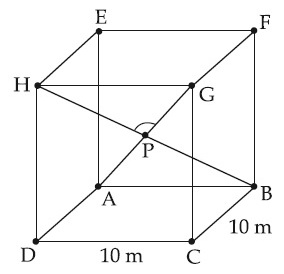
A hall has a square floor of dimension 10 m $\times$ 10 m (see the figure) and vertical walls. If the angle GPH between the diagonals AG and BH is ${\cos ^{ - 1}}{1 \over 5}$, then the height of the hall (in meters) is :
iCON Education HYD, 79930 92826, 73309 7282614 Mar 2026
Let $\overrightarrow a = \widehat i + \widehat j + \widehat k$ and $\overrightarrow b = \widehat j - \widehat k$. If $\overrightarrow c $ is a vector such that $\overrightarrow a \times \overrightarrow c = \overrightarrow b $ and $\overrightarrow a .\overrightarrow c = 3$, then $\overrightarrow a .(\overrightarrow b \times \overrightarrow c )$ is equal to :
A.
$-$2
B.
$-$6
C.
6
D.
2
Correct Answer: A
Explanation:
$\left| {\overrightarrow a } \right| = \sqrt 3 $; $\overrightarrow a .\overrightarrow c = 3$; $\overrightarrow a \times \overrightarrow b = - 2\widehat i + \widehat j + \widehat k$, $\overrightarrow a \times \overrightarrow c = \overrightarrow b $
Cross with $\overrightarrow a $,
$\overrightarrow a \times (\overrightarrow a \times \overrightarrow c ) = \overrightarrow a \times \overrightarrow b $
$ \Rightarrow (\overrightarrow a .\overrightarrow c )\overrightarrow a - {a^2}\overrightarrow c = \overrightarrow a \times \overrightarrow b $
$ \Rightarrow 3\overrightarrow a - 3\overrightarrow c = - 2\widehat i + \widehat j + \widehat k$
$ \Rightarrow 3\widehat i + 3\widehat j + 3\widehat k - 3\overrightarrow c = - 2\widehat i + \widehat j + \widehat k$
$\therefore$ $\overrightarrow a .(\overrightarrow b \times \overrightarrow c ) = (\overrightarrow a \times \overrightarrow b ).\overrightarrow c = {{ - 10} \over 3} + {2 \over 3} + {2 \over 3} = - 2$
2021
Q166
JEE Mains
MCQ
iCON Education HYD, 79930 92826, 73309 7282614 Mar 2026
Let $\overrightarrow a $, $\overrightarrow b $ and $\overrightarrow c $ be three vectors such that $\overrightarrow a $ = $\overrightarrow b $ $\times$ ($\overrightarrow b $ $\times$ $\overrightarrow c $). If magnitudes of the vectors $\overrightarrow a $, $\overrightarrow b $ and $\overrightarrow c $ are $\sqrt 2 $, 1 and 2 respectively and the angle between $\overrightarrow b $ and $\overrightarrow c $ is $\theta \left( {0 < \theta < {\pi \over 2}} \right)$, then the value of 1 + tan$\theta$ is equal to :
A.
$\sqrt 3 + 1$
B.
2
C.
1
D.
${{\sqrt 3 + 1} \over {\sqrt 3 }}$
Correct Answer: B
Explanation:
$\overrightarrow a = \left( {\overrightarrow b .\,\overrightarrow c } \right)\overrightarrow b - \left( {\overrightarrow b \,.\,\overrightarrow b } \right)\overrightarrow c $
$ = 1.2\cos \theta \overrightarrow b - \overrightarrow c $
$ \Rightarrow \overrightarrow a = 2\cos \theta \overrightarrow b - \overrightarrow c $
${\left| {\overrightarrow a } \right|^2} = {(2\cos \theta )^2} + {2^2} - 2.2\cos \theta \overrightarrow b \,.\,\overrightarrow c $
iCON Education HYD, 79930 92826, 73309 7282614 Mar 2026
Let $\overrightarrow a = \widehat i + \widehat j + 2\widehat k$ and $\overrightarrow b = - \widehat i + 2\widehat j + 3\widehat k$. Then the vector product $\left( {\overrightarrow a + \overrightarrow b } \right) \times \left( {\left( {\overrightarrow a \times \left( {\left( {\overrightarrow a - \overrightarrow b } \right) \times \overrightarrow b } \right)} \right) \times \overrightarrow b } \right)$ is equal to :
A.
$5(34\widehat i - 5\widehat j + 3\widehat k)$
B.
$7(34\widehat i - 5\widehat j + 3\widehat k)$
C.
$7(30\widehat i - 5\widehat j + 7\widehat k)$
D.
$5(30\widehat i - 5\widehat j + 7\widehat k)$
Correct Answer: B
Explanation:
$\overrightarrow a = \widehat i + \widehat j + 2\widehat k$
$\overrightarrow b = - \widehat i + 2\widehat j + 3\widehat k$
$\overrightarrow a + \overrightarrow b = 3\widehat j + 5\widehat k;\overrightarrow a.\overrightarrow b = - 1 + 2 + 6 = 7$
$\left( {\left( {\overrightarrow a \times \left( {\left( {\overrightarrow a - \overrightarrow b } \right) \times \overrightarrow b } \right)} \right) \times \overrightarrow b } \right)$
$\left( {\left( {\overrightarrow a \times \left( {\overrightarrow a \times \overrightarrow b - \overrightarrow b \times \overrightarrow b } \right)} \right) \times \overrightarrow b } \right)$
$\left( {\overrightarrow a \times \left( {\overrightarrow a \times \overrightarrow b - 0} \right)} \right) \times \overrightarrow b $
$\left( {\overrightarrow a \times \left( {\overrightarrow a \times \overrightarrow b } \right)} \right) \times \overrightarrow b $
$\left( {\left( {\overrightarrow a .\overrightarrow b } \right)\overrightarrow a - \left( {\overrightarrow a .\overrightarrow a } \right)\overrightarrow b } \right) \times \overrightarrow b $
$\left( {\overrightarrow a .\overrightarrow b } \right)\overrightarrow a \times \overrightarrow b - \left( {\overrightarrow a .\overrightarrow a } \right)\left( {\overrightarrow b \times \overrightarrow b } \right)$
$\left( {\overrightarrow a .\overrightarrow b } \right)\left( {\overrightarrow a \times \overrightarrow b } \right)$
$\overrightarrow a \times \overrightarrow b = \left| {\matrix{
i & j & k \cr
1 & 1 & 2 \cr
{ - 1} & 2 & 3 \cr
} } \right| = - \widehat i - 5\widehat j + 3\widehat k$
iCON Education HYD, 79930 92826, 73309 7282614 Mar 2026
Let a, b and c be distinct positive numbers. If the vectors $a\widehat i + a\widehat j + c\widehat k,\widehat i+\widehat k$ and $c\widehat i + c\widehat j + b\widehat k$ are co-planar, then c is equal to :
A.
${2 \over {{1 \over a} + {1 \over b}}}$
B.
${{a + b} \over 2}$
C.
${1 \over a} + {1 \over b}$
D.
$\sqrt {ab} $
Correct Answer: D
Explanation:
Because vectors are coplanar
Hence, $\left| {\matrix{
a & a & c \cr
1 & 0 & 1 \cr
c & c & b \cr
} } \right| = 0$
$ \Rightarrow {c^2} = ab \Rightarrow c = \sqrt {ab} $
2021
Q169
JEE Mains
MCQ
iCON Education HYD, 79930 92826, 73309 7282614 Mar 2026
If $\left| {\overrightarrow a } \right| = 2,\left| {\overrightarrow b } \right| = 5$ and $\left| {\overrightarrow a \times \overrightarrow b } \right|$ = 8, then $\left| {\overrightarrow a .\,\overrightarrow b } \right|$ is equal to :
A.
6
B.
4
C.
3
D.
5
Correct Answer: A
Explanation:
$\left| {\overrightarrow a } \right| = 2,\left| {\overrightarrow b } \right| = 5$
$\left| {\overrightarrow a \times \overrightarrow b } \right| = \left| {\overrightarrow a } \right|\left| {\overrightarrow b } \right|\sin \theta = \pm 8$
$\sin \theta = \pm \,{4 \over 5}$
$\therefore$ $\overrightarrow a .\,\overrightarrow b = \left| {\overrightarrow a } \right|\left| {\overrightarrow b } \right|\cos \theta $
iCON Education HYD, 79930 92826, 73309 7282614 Mar 2026
Let a vector ${\overrightarrow a }$ be coplanar with vectors $\overrightarrow b = 2\widehat i + \widehat j + \widehat k$ and $\overrightarrow c = \widehat i - \widehat j + \widehat k$. If ${\overrightarrow a}$ is perpendicular to $\overrightarrow d = 3\widehat i + 2\widehat j + 6\widehat k$, and $\left| {\overrightarrow a } \right| = \sqrt {10} $. Then a possible value of $[\matrix{
{\overrightarrow a } & {\overrightarrow b } & {\overrightarrow c } \cr
} ] + [\matrix{
{\overrightarrow a } & {\overrightarrow b } & {\overrightarrow d } \cr
} ] + [\matrix{
{\overrightarrow a } & {\overrightarrow c } & {\overrightarrow d } \cr
} ]$ is equal to :
A.
$-$42
B.
$-$40
C.
$-$29
D.
$-$38
Correct Answer: A
Explanation:
$\overrightarrow a = \lambda \overrightarrow b + \mu \overrightarrow c = \widehat i(2\lambda + \mu ) + \widehat j(\lambda - \mu ) + \widehat k(\lambda + \mu )$
$[\overrightarrow a \overrightarrow b \overrightarrow c ]$ = 0
$[\overrightarrow a \overrightarrow b \overrightarrow c ] + [\overrightarrow a \overrightarrow b \overrightarrow d ] + [\overrightarrow a \overrightarrow c \overrightarrow d ] = [\overrightarrow a \overrightarrow b + \overrightarrow c \overrightarrow d ]$
iCON Education HYD, 79930 92826, 73309 7282614 Mar 2026
Let three vectors $\overrightarrow a $, $\overrightarrow b $ and $\overrightarrow c $ be such that $\overrightarrow a \times \overrightarrow b = \overrightarrow c $, $\overrightarrow b \times \overrightarrow c = \overrightarrow a $ and $\left| {\overrightarrow a } \right| = 2$. Then which one of the following is not true?
A.
$\overrightarrow a \times \left( {(\overrightarrow b + \overrightarrow c ) \times (\overrightarrow b \times \overrightarrow c )} \right) = \overrightarrow 0 $
B.
Projection of $\overrightarrow a $ on $(\overrightarrow b \times \overrightarrow c )$ is 2
C.
$\left[ {\matrix{
{\overrightarrow a } & {\overrightarrow b } & {\overrightarrow c } \cr
} } \right] + \left[ {\matrix{
{\overrightarrow c } & {\overrightarrow a } & {\overrightarrow b } \cr
} } \right] = 8$
D.
${\left| {3\overrightarrow a + \overrightarrow b - 2\overrightarrow c } \right|^2} = 51$
Correct Answer: D
Explanation:
(1) $\overrightarrow a \times \left( {(\overrightarrow b + \overrightarrow c ) \times (\overrightarrow b \times \overrightarrow c )} \right)$
$ = \overrightarrow a ( - \overrightarrow b \times \overrightarrow c + \overrightarrow c \times \overrightarrow b ) = - 2\left( {\overrightarrow a \times (\overrightarrow b \times \overrightarrow c )} \right)$
$ = - 2(\overrightarrow a \times \overrightarrow a ) = \overrightarrow 0 $
(2) Projection of $\overrightarrow a $ on $\overrightarrow b \times \overrightarrow c $
$ = {{\overrightarrow a \,.\,(\overrightarrow b \times \overrightarrow c )} \over {\left| {\overrightarrow b \times \overrightarrow c } \right|}} = {{\overrightarrow a .\overrightarrow a } \over {\left| {\overrightarrow a } \right|}} = \left| {\overrightarrow a } \right| = 2$
(3) $\left[ {\overrightarrow a \overrightarrow b \overrightarrow c } \right] + \left[ {\overrightarrow c \overrightarrow a \overrightarrow b } \right] = 2\left[ {\overrightarrow a \overrightarrow b \overrightarrow c } \right] = 2\overrightarrow a .(\overrightarrow b \times \overrightarrow c )$
$ = 2\overrightarrow a .\overrightarrow a = 2{\left| {\overrightarrow a } \right|^2} = 8$
(4) $\overrightarrow a \times \overrightarrow b = \overrightarrow c $ and $\overrightarrow b \times \overrightarrow c = \overrightarrow a $
$ \Rightarrow \overrightarrow a ,\overrightarrow b ,\overrightarrow c $ are mutually $ \bot $ vectors.
$\therefore$ $\left| {\overrightarrow a \times \overrightarrow b } \right| = \left| {\overrightarrow c } \right| \Rightarrow \left| {\overrightarrow a } \right|\left| {\overrightarrow b } \right| = \left| {\overrightarrow c } \right| \Rightarrow \left| {\overrightarrow b } \right| = {{\left| {\overrightarrow c } \right|} \over 2}$
Also, $\left| {\overrightarrow b \times \overrightarrow c } \right| = \left| {\overrightarrow a } \right| \Rightarrow \left| {\overrightarrow b } \right|\left| {\overrightarrow c } \right| = 2 \Rightarrow \left| {\overrightarrow c } \right| = 2$ & $\left| {\overrightarrow b } \right| = 1$
${\left| {3\overrightarrow a + \overrightarrow b - 2\overrightarrow c } \right|^2} = (3\overrightarrow a + \overrightarrow b - 2\overrightarrow c ).(3\overrightarrow a + \overrightarrow b - 2\overrightarrow c )$
$ = 9{\left| {\overrightarrow a } \right|^2} + {\left| {\overrightarrow b } \right|^2} + 4{\left| {\overrightarrow c } \right|^2}$
$ = (9 \times 4) + 1 + (4 \times 4)$
$ = 36 + 1 + 16 = 53$
2021
Q173
JEE Mains
MCQ
iCON Education HYD, 79930 92826, 73309 7282614 Mar 2026
In a triangle ABC, if $\left| {\overrightarrow {BC} } \right| = 3$, $\left| {\overrightarrow {CA} } \right| = 5$ and $\left| {\overrightarrow {BA} } \right| = 7$, then the projection of the vector $\overrightarrow {BA} $ on $\overrightarrow {BC} $ is equal to :
iCON Education HYD, 79930 92826, 73309 7282614 Mar 2026
Let $\overrightarrow a = 2\widehat i + \widehat j - 2\widehat k$ and $\overrightarrow b = \widehat i + \widehat j$. If $\overrightarrow c $ is a vector such that $\overrightarrow a .\,\overrightarrow c = \left| {\overrightarrow c } \right|,\left| {\overrightarrow c - \overrightarrow a } \right| = 2\sqrt 2 $ and the angle between $(\overrightarrow a \times \overrightarrow b )$ and $\overrightarrow c $ is ${\pi \over 6}$, then the value of $\left| {\left( {\overrightarrow a \times \overrightarrow b } \right) \times \overrightarrow c } \right|$ is :
A.
${2 \over 3}$
B.
4
C.
3
D.
${3 \over 2}$
Correct Answer: D
Explanation:
$\left| {\overrightarrow a } \right| = 3 = a;\overrightarrow a \,.\,\overrightarrow c = c$
Now, $\left| {\overrightarrow c - \overrightarrow a } \right| = 2\sqrt 2 $
$ \Rightarrow {c^2} + {a^2} - 2\overrightarrow c \,.\,\overrightarrow a = 8$
$ \Rightarrow {c^2} + 9 - 2(c) = 8$
$ \Rightarrow {c^2} - 2c + 1 = 0 \Rightarrow c = 1 = \left| {\overrightarrow c } \right|$
Also, $\overrightarrow a \times \overrightarrow b = 2\widehat i - 2\widehat j + \widehat k$
Given, $(\overrightarrow a \times \overrightarrow b ) = \left| {\overrightarrow a \times \overrightarrow b } \right|\left| {\overrightarrow c } \right|\sin {\pi \over 6}$
$ = (3)(1)(1/2)$
$ = 3/2$
2021
Q175
JEE Mains
MCQ
iCON Education HYD, 79930 92826, 73309 7282614 Mar 2026
Let $\overrightarrow a $ and $\overrightarrow b $ be two non-zero vectors perpendicular to each other and $|\overrightarrow a | = |\overrightarrow b |$. If $|\overrightarrow a \times \overrightarrow b | = |\overrightarrow a |$, then the angle between the vectors $\left( {\overrightarrow a + \overrightarrow b + \left( {\overrightarrow a \times \overrightarrow b } \right)} \right)$ and ${\overrightarrow a }$ is equal to :
$\overrightarrow a $ is perpendicular to $\overrightarrow b $
$ \therefore $ $\overrightarrow a $ . $\overrightarrow b $ = 0
Given, | $\overrightarrow a $ $\times$ $\overrightarrow b $ | = | $\overrightarrow a $ |
and | $\overrightarrow a $ | = | $\overrightarrow b $ |
$ \therefore $ | $\overrightarrow a $ $\times$ $\overrightarrow b $ | = | $\overrightarrow a $ | = | $\overrightarrow b $ | = k(assume)
Now, angle between $\overrightarrow a $ and ($\overrightarrow a $ + $\overrightarrow b $ + ($\overrightarrow a $ $\times$ $\overrightarrow b $))
$\cos \theta = {{\overrightarrow a ((\overrightarrow a + \overrightarrow b + (\overrightarrow a \times \overrightarrow b ))} \over {|\overrightarrow a |.|\overrightarrow a + \overrightarrow b + (\overrightarrow a \times \overrightarrow b )|}}$
$ = {{|\overrightarrow a {|^2} + \,\overrightarrow a .\,\overrightarrow b + \overrightarrow a (\overrightarrow a \times \overrightarrow b )} \over {|\overrightarrow a |.|\overrightarrow a + \overrightarrow b + (\overrightarrow a \times \overrightarrow b )|}}$
[Note $\overrightarrow a .(\overrightarrow a \times \overrightarrow b ) = [\overrightarrow a \overrightarrow a \overrightarrow b ] = 0$]
$ = {{|\overrightarrow a {|^2} + 0 + 0} \over {|\overrightarrow a |.|\overrightarrow a + \overrightarrow b + (\overrightarrow a \times \overrightarrow b )|}}$
Now, $|\overrightarrow a + \overrightarrow b + (\overrightarrow a \times \overrightarrow b ){|^2}$
$ = |\overrightarrow a {|^2} + |\overrightarrow a {|^2} + |\overrightarrow a \times \overrightarrow b {|^2} + $
$2\overrightarrow a .\overrightarrow b + 2\overrightarrow b .(\overrightarrow a \times \overrightarrow b ) + 2\overrightarrow a .(\overrightarrow a \times \overrightarrow b )$
$ = {k^2} + {k^2} + {k^2}$
$ \therefore $ $|\overrightarrow a + \overrightarrow b + (\overrightarrow a \times \overrightarrow b ){|^2} = 3{k^2}$
$ \Rightarrow |\overrightarrow a + \overrightarrow b + (\overrightarrow a \times \overrightarrow b )| = \sqrt 3 k$
iCON Education HYD, 79930 92826, 73309 7282614 Mar 2026
In a triangle ABC, if $|\overrightarrow {BC} | = 8,|\overrightarrow {CA} | = 7,|\overrightarrow {AB} | = 10$, then the projection of the vector $\overrightarrow {AB} $ on $\overrightarrow {AC} $ is equal to :
A.
${{25} \over 4}$
B.
${{127} \over 20}$
C.
${{85} \over 14}$
D.
${{115} \over 16}$
Correct Answer: C
Explanation:
$|\overrightarrow a | = 8,|\overrightarrow b | = 7,|\overrightarrow c | = 10$
Projection of $\overrightarrow {AB} $ on $\overrightarrow {AC} $
iCON Education HYD, 79930 92826, 73309 7282614 Mar 2026
A vector $\overrightarrow a $ has components 3p and 1 with respect to a rectangular cartesian system. This system is rotated through a certain angle about the origin in the counter clockwise sense. If, with respect to new system, $\overrightarrow a $ has components p + 1 and $\sqrt {10} $, then the value of p is equal to :
A.
1
B.
$ - {5 \over 4}$
C.
${4 \over 5}$
D.
$-$1
Correct Answer: D
Explanation:
${\left| {\overrightarrow a } \right|_{old}} = {\left| {\overrightarrow a } \right|_{new}}$
(3p)2 + 1 = (p + 1)2 + 10
$ \Rightarrow $ 9p2 $-$ p2 $-$ 2p $-$ 10 = 0
$ \Rightarrow $ 8p2 $-$ 2p $-$ 10 = 0
$ \Rightarrow $ 4p2 $-$ p $-$ 5 = 0
$ \Rightarrow $ 4p2 $-$ 5p + 4p $-$ 5 = 0
$ \Rightarrow $ (4p $-$ 5) (p + 1) = 0
$ \Rightarrow $ p = ${5 \over 4}$, $-$ 1
2021
Q178
JEE Mains
MCQ
iCON Education HYD, 79930 92826, 73309 7282614 Mar 2026
Let O be the origin. Let $\overrightarrow {OP} = x\widehat i + y\widehat j - \widehat k$ and $\overrightarrow {OQ} = - \widehat i + 2\widehat j + 3x\widehat k$, x, y$\in$R, x > 0, be such that $\left| {\overrightarrow {PQ} } \right| = \sqrt {20} $ and the vector $\overrightarrow {OP} $ is perpendicular $\overrightarrow {OQ} $. If $\overrightarrow {OR} $ = $3\widehat i + z\widehat j - 7\widehat k$, z$\in$R, is coplanar with $\overrightarrow {OP} $ and $\overrightarrow {OQ} $, then the value of x2 + y2 + z2 is equal to :
iCON Education HYD, 79930 92826, 73309 7282614 Mar 2026
Let $\overrightarrow a $ = 2$\widehat i$ $-$ 3$\widehat j$ + 4$\widehat k$ and $\overrightarrow b $ = 7$\widehat i$ + $\widehat j$ $-$ 6$\widehat k$.
If $\overrightarrow r $ $\times$ $\overrightarrow a $ = $\overrightarrow r $ $\times$ $\overrightarrow b $, $\overrightarrow r $ . ($\widehat i$ + 2$\widehat j$ + $\widehat k$) = $-$3, then $\overrightarrow r $ . (2$\widehat i$ $-$ 3$\widehat j$ + $\widehat k$) is equal to :
A.
10
B.
8
C.
13
D.
12
Correct Answer: D
Explanation:
$\overrightarrow a = (2, - 3,4)$, $\overrightarrow b = (7,1, - 6)$
$\overrightarrow r \times \overrightarrow a - \overrightarrow r \times \overrightarrow b = 0$
$\overrightarrow r \times (\overrightarrow a - \overrightarrow b ) = 0$
$\overrightarrow r = \lambda (\overrightarrow a - \overrightarrow b )$
$\overrightarrow r = \lambda ( - 5\widehat i - 4\widehat j + 10\widehat k)$
iCON Education HYD, 79930 92826, 73309 7282614 Mar 2026
Let $\overrightarrow a $ = $\widehat i$ + 2$\widehat j$ $-$ 3$\widehat k$ and $\overrightarrow b = 2\widehat i$ $-$ 3$\widehat j$ + 5$\widehat k$. If $\overrightarrow r $ $\times$ $\overrightarrow a $ = $\overrightarrow b $ $\times$ $\overrightarrow r $,
$\overrightarrow r $ . $\left( {\alpha \widehat i + 2\widehat j + \widehat k} \right)$ = 3 and $\overrightarrow r \,.\,\left( {2\widehat i + 5\widehat j - \alpha \widehat k} \right)$ = $-$1, $\alpha$ $\in$ R, then the
value of $\alpha$ + ${\left| {\overrightarrow r } \right|^2}$ is equal to :
A.
13
B.
11
C.
9
D.
15
Correct Answer: D
Explanation:
Given $\overrightarrow r $ $\times$ $\overrightarrow a $ = $\overrightarrow b $ $\times$ $\overrightarrow r $
$ \Rightarrow $ $\overrightarrow r \times \overrightarrow a = - \overrightarrow r \times \overrightarrow b $
$\overrightarrow r \times (\overrightarrow a + \overrightarrow b ) = 0$
$\overrightarrow r ||(\overrightarrow a + \overrightarrow b )$
$\overrightarrow r = \lambda (\overrightarrow a + \overrightarrow b )$
$(\overrightarrow a + \overrightarrow b = 3\widehat i - \widehat j + 2\widehat k)$
$ \because $ $\overrightarrow r \,.\,(2\widehat i + 5\widehat j - \alpha \widehat k) = - 1$
$\overrightarrow r = 3\widehat i - \widehat j + 2\widehat k$
$\alpha + |\overrightarrow r {|^2} = 1 + 14 = 15$
2021
Q181
JEE Mains
MCQ
iCON Education HYD, 79930 92826, 73309 7282614 Mar 2026
Let a vector $\alpha \widehat i + \beta \widehat j$ be obtained by rotating the vector $\sqrt 3 \widehat i + \widehat j$ by an angle 45$^\circ$ about the origin in counterclockwise direction in the first quadrant. Then the area of triangle having vertices ($\alpha$, $\beta$), (0, $\beta$) and (0, 0) is equal to :
A.
${1 \over {\sqrt 2 }}$
B.
${1 \over 2}$
C.
1
D.
2${\sqrt 2 }$
Correct Answer: B
Explanation:
($\alpha$, $\beta$) $ \equiv $ (2 cos 75$^\circ$, 2 sin 75$^\circ$)
Area = ${1 \over 2}$ (2 cos 75$^\circ$) (2 sin 75$^\circ$)
= sin(150$^\circ$) = ${1 \over 2}$ square unit
2021
Q182
JEE Mains
MCQ
iCON Education HYD, 79930 92826, 73309 7282614 Mar 2026
If vectors $\overrightarrow {{a_1}} = x\widehat i - \widehat j + \widehat k$ and $\overrightarrow {{a_2}} = \widehat i + y\widehat j + z\widehat k$ are collinear, then a possible unit vector parallel to the vector $x\widehat i + y\widehat j + z\widehat k$ is :
Let ${\lambda ^2} = 1$, possible unit vector $ = {{\widehat i - \widehat j + \widehat k} \over {\sqrt 3 }}$
2021
Q183
JEE Mains
MCQ
iCON Education HYD, 79930 92826, 73309 7282614 Mar 2026
If $\overrightarrow a $ and $\overrightarrow b $ are perpendicular, then $\overrightarrow a \times \left( {\overrightarrow a \times \left( {\overrightarrow a \times \left( {\overrightarrow a \times \overrightarrow b } \right)} \right)} \right)$ is equal to :
A.
${1 \over 2}|\overrightarrow a {|^4}\overrightarrow b $
B.
$\overrightarrow 0 $
C.
$\overrightarrow a \times \overrightarrow b $
D.
$|\overrightarrow a {|^4}\overrightarrow b $
Correct Answer: D
Explanation:
$\overrightarrow a \,.\,\overrightarrow b = 0$
$\overrightarrow a \times (\overrightarrow a \times \overrightarrow b ) = (\overrightarrow a \,.\,\overrightarrow b )\overrightarrow a - (\overrightarrow a \,.\,\overrightarrow a )\overrightarrow b = - |\overrightarrow a {|^2}\overrightarrow b $
Now, $\overrightarrow a \times (\overrightarrow a \times ( - |\overrightarrow a {|^2}\overrightarrow b ))$
$ = - |\overrightarrow a {|^2}(\overrightarrow a \times (\overrightarrow a \times \overrightarrow b ))$
$ = - |\overrightarrow a {|^2}( - |\overrightarrow a {|^2}\overrightarrow b ) = |\overrightarrow a {|^4}\overrightarrow b $
2021
Q184
JEE Mains
Numerical
iCON Education HYD, 79930 92826, 73309 7282614 Mar 2026
Let $\overrightarrow a = 2\widehat i - \widehat j + 2\widehat k$ and $\overrightarrow b = \widehat i + 2\widehat j - \widehat k$. Let a vector $\overrightarrow v $ be in the plane containing $\overrightarrow a $ and $\overrightarrow b $. If $\overrightarrow v $ is perpendicular to the vector $3\widehat i + 2\widehat j - \widehat k$ and its projection on $\overrightarrow a $ is 19 units, then ${\left| {2\overrightarrow v } \right|^2}$ is equal to _____________.
Correct Answer: 1494
Explanation:
$\overrightarrow a = 2\widehat i - \widehat j + 2\widehat k$
$\overrightarrow b = \widehat i + 2\widehat j - \widehat k$
$\overrightarrow c = 3\widehat i + 2\widehat j - \widehat k$
$\overrightarrow v = x\overrightarrow a + y\overrightarrow b $
$\overrightarrow v \left( {3\widehat i + 2\widehat j - \widehat k} \right) = 0$
$\overrightarrow v .\widehat a = 19$
$\overrightarrow v = \lambda \overrightarrow c \times \left( {\overrightarrow a \times \overrightarrow b } \right)$
$\overrightarrow v = \lambda \left[ {\left( {\overrightarrow c .\overrightarrow b } \right)\overrightarrow a - \left( {\overrightarrow c .\overrightarrow a } \right)\overrightarrow b } \right]$
iCON Education HYD, 79930 92826, 73309 7282614 Mar 2026
Let $\overrightarrow a = \widehat i + 5\widehat j + \alpha \widehat k$, $\overrightarrow b = \widehat i + 3\widehat j + \beta \widehat k$ and $\overrightarrow c = - \widehat i + 2\widehat j - 3\widehat k$ be three vectors such that, $\left| {\overrightarrow b \times \overrightarrow c } \right| = 5\sqrt 3 $ and ${\overrightarrow a }$ is perpendicular to ${\overrightarrow b }$. Then the greatest amongst the values of ${\left| {\overrightarrow a } \right|^2}$ is _____________.
Correct Answer: 90
Explanation:
Since, $\overrightarrow a .\,\overrightarrow b = 0$
iCON Education HYD, 79930 92826, 73309 7282614 Mar 2026
If the projection of the vector $\widehat i + 2\widehat j + \widehat k$ on the sum of the two vectors $2\widehat i + 4\widehat j - 5\widehat k$ and $ - \lambda \widehat i + 2\widehat j + 3\widehat k$ is 1, then $\lambda$ is equal to __________.
Correct Answer: 5
Explanation:
$\overrightarrow a = \widehat i + 2\widehat j + \widehat k$
$\overrightarrow b = (2 - \lambda )\widehat i + 6\widehat j - 2\widehat k$
${{\overrightarrow a \,.\,\overrightarrow b } \over {|\overrightarrow b |}} = 1,\overrightarrow a \,.\,\overrightarrow b = 12 - \lambda $
$\left( {\overrightarrow a \,.\,\overrightarrow b } \right) = |\overrightarrow b {|^2}$
iCON Education HYD, 79930 92826, 73309 7282614 Mar 2026
Let $\overrightarrow a = \widehat i - \alpha \widehat j + \beta \widehat k$, $\overrightarrow b = 3\widehat i + \beta \widehat j - \alpha \widehat k$ and $\overrightarrow c = -\alpha \widehat i - 2\widehat j + \widehat k$, where $\alpha$ and $\beta$ are integers. If $\overrightarrow a \,.\,\overrightarrow b = - 1$ and $\overrightarrow b \,.\,\overrightarrow c = 10$, then $\left( {\overrightarrow a \, \times \overrightarrow b } \right).\,\overrightarrow c $ is equal to ___________.
iCON Education HYD, 79930 92826, 73309 7282614 Mar 2026
Let $\overrightarrow a = \widehat i + \widehat j + \widehat k,\overrightarrow b $ and $\overrightarrow c = \widehat j - \widehat k$ be three vectors such that $\overrightarrow a \times \overrightarrow b = \overrightarrow c $ and $\overrightarrow a \,.\,\overrightarrow b = 1$. If the length of projection vector of the vector $\overrightarrow b $ on the vector $\overrightarrow a \times \overrightarrow c $ is l, then the value of 3l2 is equal to _____________.
Correct Answer: 2
Explanation:
$\overrightarrow a \times \overrightarrow b = \overrightarrow c $
Take Dot with $\overrightarrow c $
$\left( {\overrightarrow a \times \overrightarrow b } \right).\,\overrightarrow c = {\left| {\overrightarrow c } \right|^2} = 2$
Projection of $\overrightarrow b $ or $\overrightarrow a \times \overrightarrow c = l$
${{\left| {\overrightarrow b \,.\,(\overrightarrow a \times \overrightarrow c )} \right|} \over {|\overrightarrow a \times \overrightarrow c |}} = l$
iCON Education HYD, 79930 92826, 73309 7282614 Mar 2026
If $\left( {\overrightarrow a + 3\overrightarrow b } \right)$ is perpendicular to $\left( {7\overrightarrow a - 5\overrightarrow b } \right)$ and $\left( {\overrightarrow a - 4\overrightarrow b } \right)$ is perpendicular to $\left( {7\overrightarrow a - 2\overrightarrow b } \right)$, then the angle between $\overrightarrow a $ and $\overrightarrow b $ (in degrees) is _______________.
Correct Answer: 60
Explanation:
$\left( {\overrightarrow a + 3\overrightarrow b } \right) \bot \left( {7\overrightarrow a - 5\overrightarrow b } \right)$
$ \therefore $ $\left( {\overrightarrow a + 3\overrightarrow b } \right)\,.\,\left( {7\overrightarrow a - 5\overrightarrow b } \right) = 0$
$ \Rightarrow $ $7{\left| {\overrightarrow a } \right|^2} - 15{\left| {\overrightarrow b } \right|^2} + 16\overrightarrow a \,.\,\overrightarrow b = 0$ ....(1)
Also, $\left( {\overrightarrow a - 4\overrightarrow b } \right)\,.\,\left( {7\overrightarrow a - 2\overrightarrow b } \right) = 0$
$ \Rightarrow $ $7{\left| {\overrightarrow a } \right|^2} + 8{\left| {\overrightarrow b } \right|^2} - 30\overrightarrow a \,.\,\overrightarrow b = 0$ .....(2)
Equation (1) × 30
$210{\left| {\overrightarrow a } \right|^2} - 450{\left| {\overrightarrow b } \right|^2} + 480\overrightarrow a \,.\,\overrightarrow b = 0$ ....(3)
Equation (2) × 16
$112{\left| {\overrightarrow a } \right|^2} + 128{\left| {\overrightarrow b } \right|^2} - 480\overrightarrow a \,.\,\overrightarrow b = 0$ .....(4)
from (3) & (4)
$322{\left| {\overrightarrow a } \right|^2} = 322{\left| {\overrightarrow b } \right|^2}$
$ \Rightarrow $ ${\left| {\overrightarrow a } \right|^2} = {\left| {\overrightarrow b } \right|^2}$
$ \Rightarrow $ $\left| {\overrightarrow a } \right| = \left| {\overrightarrow b } \right|$
From equation (2),
$15\left| {\overrightarrow a } \right| = 30\overrightarrow a .\overrightarrow b $
$ \Rightarrow $ $15{\left| {\overrightarrow a } \right|^2} = 30\left| {\overrightarrow a } \right|.\left| {\overrightarrow b } \right|\cos \theta $
$\cos \theta = {{15} \over {30}} = {1 \over 2}$
$\therefore$ $\theta = 60^\circ $
2021
Q190
JEE Mains
Numerical
iCON Education HYD, 79930 92826, 73309 7282614 Mar 2026
Let $\overrightarrow p = 2\widehat i + 3\widehat j + \widehat k$ and $\overrightarrow q = \widehat i + 2\widehat j + \widehat k$ be two vectors. If a vector $\overrightarrow r = (\alpha \widehat i + \beta \widehat j + \gamma \widehat k)$ is perpendicular to each of the vectors ($(\overrightarrow p + \overrightarrow q )$ and $(\overrightarrow p - \overrightarrow q )$, and $\left| {\overrightarrow r } \right| = \sqrt 3 $, then $\left| \alpha \right| + \left| \beta \right| + \left| \gamma \right|$ is equal to _______________.
Correct Answer: 3
Explanation:
$\overrightarrow p = 2\widehat i + 3\widehat j + \widehat k$ (Given )
iCON Education HYD, 79930 92826, 73309 7282614 Mar 2026
For p > 0, a vector ${\overrightarrow v _2} = 2\widehat i + (p + 1)\widehat j$ is obtained by rotating the vector ${\overrightarrow v _1} = \sqrt 3 p\widehat i + \widehat j$ by an angle $\theta$ about origin in counter clockwise direction. If $\tan \theta = {{\left( {\alpha \sqrt 3 - 2} \right)} \over {\left( {4\sqrt 3 + 3} \right)}}$, then the value of $\alpha$ is equal to _____________.
iCON Education HYD, 79930 92826, 73309 7282614 Mar 2026
Let $\overrightarrow a $, $\overrightarrow b $, $\overrightarrow c $ be three mutually perpendicular vectors of the same magnitude and equally inclined at an angle $\theta$, with the vector $\overrightarrow a $ + $\overrightarrow b $ + $\overrightarrow c $. Then 36cos22$\theta$ is equal to ___________.
Correct Answer: 4
Explanation:
${\left| {\overrightarrow a + \overrightarrow b + \overrightarrow c } \right|^2} = {\left| {\overrightarrow a } \right|^2} + {\left| {\overrightarrow b } \right|^2} + {\left| {\overrightarrow c } \right|^2} + 2(\overrightarrow a \,.\,\overrightarrow b + \overrightarrow a \,.\,\overrightarrow c + \overrightarrow b \,.\,\overrightarrow c ) = 3$
$ \Rightarrow \left| {\overrightarrow a + \overrightarrow b + \overrightarrow c } \right| = \sqrt 3 \overrightarrow a .(\overrightarrow a + \overrightarrow b + \overrightarrow c ) = \left| {\overrightarrow a + \overrightarrow b + \overrightarrow c } \right|\cos \theta $
$ \Rightarrow 1 = \sqrt 3 \cos \theta $
$ \Rightarrow \cos 2\theta = - {1 \over 3}$
$ \Rightarrow 36{\cos ^2}2\theta = 4$
2021
Q193
JEE Mains
Numerical
iCON Education HYD, 79930 92826, 73309 7282614 Mar 2026
If the shortest distance between the lines $\overrightarrow {{r_1}} = \alpha \widehat i + 2\widehat j + 2\widehat k + \lambda (\widehat i - 2\widehat j + 2\widehat k)$, $\lambda$ $\in$ R, $\alpha$ > 0 and $\overrightarrow {{r_2}} = - 4\widehat i - \widehat k + \mu (3\widehat i - 2\widehat j - 2\widehat k)$, $\mu$ $\in$ R is 9, then $\alpha$ is equal to ____________.
Correct Answer: 6
Explanation:
If $\overrightarrow r = \overrightarrow a + \lambda \overrightarrow b $ and $\overrightarrow r = \overrightarrow c + \lambda \overrightarrow d $ then shortest distance between two lines is
$L = {{(\overrightarrow a - \overrightarrow c ).(\overrightarrow b \times \overrightarrow d )} \over {|b \times d|}}$
$\therefore$ $\overrightarrow a - \overrightarrow c = ((\alpha + 4)\widehat i + 2\widehat j + 3\widehat k)$
${{\overrightarrow b \times \overrightarrow d } \over {|b \times d|}} = {{(2\widehat i + 2\widehat j + \widehat k)} \over 3}$
iCON Education HYD, 79930 92826, 73309 7282614 Mar 2026
Let $\overrightarrow x $ be a vector in the plane containing vectors $\overrightarrow a = 2\widehat i - \widehat j + \widehat k$ and $\overrightarrow b = \widehat i + 2\widehat j - \widehat k$. If the vector $\overrightarrow x $ is perpendicular to $\left( {3\widehat i + 2\widehat j - \widehat k} \right)$ and its projection on $\overrightarrow a $ is ${{17\sqrt 6 } \over 2}$, then the value of $|\overrightarrow x {|^2}$ is equal to __________.
Correct Answer: 486
Explanation:
Let, $\overrightarrow x = k(\overrightarrow a + \lambda \overrightarrow b )$
$\overrightarrow x$ is perpendicular to $3\widehat i + 2\widehat j - \widehat k$
iCON Education HYD, 79930 92826, 73309 7282614 Mar 2026
If $\overrightarrow a = \alpha \widehat i + \beta \widehat j + 3\widehat k$,
$\overrightarrow b = - \beta \widehat i - \alpha \widehat j - \widehat k$ and
$\overrightarrow c = \widehat i - 2\widehat j - \widehat k$
such that $\overrightarrow a \,.\,\overrightarrow b = 1$ and $\overrightarrow b \,.\,\overrightarrow c = - 3$, then ${1 \over 3}\left( {\left( {\overrightarrow a \times \overrightarrow b } \right)\,.\,\overrightarrow c } \right)$ is equal to _____________.
Correct Answer: 2
Explanation:
$\overrightarrow a .\overrightarrow b = 1 \Rightarrow - \alpha \beta - \alpha \beta - 3 = 1$
$ \Rightarrow \alpha \beta = - 2$ .... (i)
$\overrightarrow b .\overrightarrow c = - 3 \Rightarrow - \beta + 2\alpha + 1 = - 3$
iCON Education HYD, 79930 92826, 73309 7282614 Mar 2026
Let $\overrightarrow c $ be a vector perpendicular to the vectors, $\overrightarrow a $ = $\widehat i$ + $\widehat j$ $-$ $\widehat k$ and $\overrightarrow b $ = $\widehat i$ + 2$\widehat j$ + $\widehat k$. If $\overrightarrow c \,.\,\left( {\widehat i + \widehat j + 3\widehat k} \right)$ = 8 then the value of $\overrightarrow c $ . $\left( {\overrightarrow a \times \overrightarrow b } \right)$ is equal to __________.
$ \therefore $ $\overrightarrow c = 6\widehat i - 4\widehat j + 2\widehat k$
$\overrightarrow c \,.\,(\overrightarrow a \times \overrightarrow b ) = [\overrightarrow c \overrightarrow a \overrightarrow b ] = \left| {\matrix{
6 & { - 4} & 2 \cr
1 & 1 & { - 1} \cr
1 & 2 & 1 \cr
} } \right|$
$ \Rightarrow $ 18 + 8 + 2 = 28
2021
Q197
JEE Mains
Numerical
iCON Education HYD, 79930 92826, 73309 7282614 Mar 2026
Let $\overrightarrow a = \widehat i + \alpha \widehat j + 3\widehat k$ and $\overrightarrow b = 3\widehat i - \alpha \widehat j + \widehat k$. If the area of the parallelogram whose adjacent sides are represented by the vectors $\overrightarrow a $ and $\overrightarrow b $ is $8\sqrt 3 $ square units, then $\overrightarrow a $ . $\overrightarrow b $ is equal to __________.
Correct Answer: 2
Explanation:
$\overrightarrow a = \widehat i + \alpha \widehat j + 3\widehat k$
$\overrightarrow b = 3\widehat i - \alpha \widehat j + \widehat k$
Area of parallelogram = $\left| {\overrightarrow a \times \overrightarrow b } \right|$
$ \therefore $ $\overrightarrow a = \widehat i + \alpha \widehat j + 3\widehat k$
$\overrightarrow b = 3\widehat i - \alpha \widehat j + \widehat k$
$\overrightarrow a \,.\,\overrightarrow b = 3 - {\alpha ^2} + 3$
$ = 6 - {\alpha ^2}$
$ = 6 - 4$
$ = 2$
2021
Q198
JEE Mains
Numerical
iCON Education HYD, 79930 92826, 73309 7282614 Mar 2026
Let $\overrightarrow a = \widehat i + 2\widehat j - \widehat k$, $\overrightarrow b = \widehat i - \widehat j$ and $\overrightarrow c = \widehat i - \widehat j - \widehat k$ be three given vectors. If $\overrightarrow r $ is a vector such that $\overrightarrow r \times \overrightarrow a = \overrightarrow c \times \overrightarrow a $ and $\overrightarrow r .\,\overrightarrow b = 0$, then $\overrightarrow r .\,\overrightarrow a $ is equal to __________.
Correct Answer: 12
Explanation:
Given, $\overrightarrow a = \widehat i + 2\widehat j - \widehat k$,
$\overrightarrow b = \widehat i - \widehat j$,
$\overrightarrow c = \widehat i - \widehat j - \widehat k$
$\overrightarrow r \times \overrightarrow a = \overrightarrow c \times \overrightarrow a $
$ \Rightarrow \overrightarrow r \times \overrightarrow a - \overrightarrow c \times \overrightarrow a = 0$
$ \Rightarrow (\overrightarrow r - \overrightarrow c ) \times \overrightarrow a = 0$
$\therefore$ $\overrightarrow r - \overrightarrow c = \lambda \overrightarrow a $
$ \Rightarrow \overrightarrow r = \lambda \overrightarrow a + \overrightarrow c $
$ \Rightarrow \overrightarrow r \,.\,\overrightarrow b = \lambda \overrightarrow a \,.\,\overrightarrow b + \overrightarrow c \,.\,\overrightarrow b $ (taking dot with $\overrightarrow b $)
$ \Rightarrow 0 = \lambda \overrightarrow a \,.\,\overrightarrow b + \overrightarrow c \,.\,\overrightarrow b $ [$\because$ $\overrightarrow r \,.\,\overrightarrow b = 0$]
$ \Rightarrow \lambda (\widehat i + 2\widehat j - \widehat k)\,.\,(\widehat i - \widehat j) + (\widehat i - \widehat j - \widehat k)\,.\,(\widehat i - \widehat j) = 0$
$ \Rightarrow \lambda (1 - 2) + 2 = 0$
$ \Rightarrow \lambda = 2$
$\therefore$ $\overrightarrow r = 2\overrightarrow a + \overrightarrow c $
$ \Rightarrow \overrightarrow r \,.\,\overrightarrow a = 2\overrightarrow a \,.\,\overrightarrow a + \overrightarrow c \,.\,\overrightarrow a $ [taking dot with ${\overrightarrow a }$]
$ = 2{\left| {\overrightarrow a } \right|^2} + \overrightarrow a \,.\,\overrightarrow c $
$ = 2(1 + 4 + 1) + (1 - 2 + 1)$
$ \Rightarrow \overrightarrow r \,.\,\overrightarrow a = 12$
2021
Q199
JEE Mains
Numerical
iCON Education HYD, 79930 92826, 73309 7282614 Mar 2026
Let three vectors $\overrightarrow a ,\overrightarrow b $ and $\overrightarrow c $ be such that $\overrightarrow c $ is coplanar with $\overrightarrow a $ and $\overrightarrow b $,
$\overrightarrow a .\overrightarrow c $ = 7 and
$\overrightarrow b $ is perpendicular to $\overrightarrow c $, where $\overrightarrow a = - \widehat i + \widehat j + \widehat k$ and $\overrightarrow b = 2\widehat i + \widehat k$ , then the value of $2{\left| {\overrightarrow a + \overrightarrow b + \overrightarrow c } \right|^2}$ is _____.
Correct Answer: 75
Explanation:
$\overrightarrow c = \lambda (\overrightarrow b \times (\overrightarrow a \times \overrightarrow b ))$
$ = \lambda ((\overrightarrow b \,.\,\overrightarrow b )\overrightarrow a - (\overrightarrow b \,.\,\overrightarrow a )\overrightarrow b )$
$ = \lambda (5( - \widehat i + \widehat j + \widehat k) + 2\widehat i + \widehat k)$
iCON Education HYD, 79930 92826, 73309 7282614 Mar 2026
If the volume of a parallelopiped, whose coterminus edges are given by the vectors $\overrightarrow a = \widehat i + \widehat j + n\widehat k$, $\overrightarrow b = 2\widehat i + 4\widehat j - n\widehat k$ and $\overrightarrow c = \widehat i + n\widehat j + 3\widehat k$ ($n \ge 0$), is 158 cu. units, then :
A.
n = 7
B.
$\overrightarrow b .\overrightarrow c = 10$
C.
$\overrightarrow a .\overrightarrow c = 17$
D.
n = 9
Correct Answer: B
Explanation:
We know, Volume(V) = $\left[ {\overrightarrow a \overrightarrow b \overrightarrow c } \right]$