JEE Mains
2026
MCQ
Let P be a point in the plane of the vectors $\overrightarrow{AB}=3\hat{i} + \hat{j} - \hat{k}$ and $\overrightarrow{AC}=\hat{i} - \hat{j} + 3\hat{k}$ such that P is equidistant from the lines AB and AC. If $|\overrightarrow{AP}| = \frac{\sqrt{5}}{2}$, then the area of the triangle ABP is :
JEE Mains
2026
MCQ
For three unit vectors $\vec{a}, \vec{b}, \vec{c}$ satisfying
$ |\vec{a}-\vec{b}|^2+|\vec{b}-\vec{c}|^2+|\vec{c}-\vec{a}|^2=9 \text { and }|2 \vec{a}+k \vec{b}+k \vec{c}|=3 \text {, } $
the positive value of k is :
JEE Mains
2026
MCQ
Let $\vec{a}=2 \hat{\mathrm{i}}-\hat{\mathrm{j}}-\hat{\mathrm{k}}, \vec{b}=\hat{\mathrm{i}}+3 \hat{\mathrm{j}}-\hat{\mathrm{k}}$ and $\vec{c}=2 \hat{\mathrm{i}}+\hat{\mathrm{j}}+3 \hat{\mathrm{k}}$. Let $\vec{v}$ be the vector in the plane of the vectors $\vec{a}$ and $\vec{b}$, such that the length of its projection on the vector $\vec{c}$ is $\frac{1}{\sqrt{14}}$. Then $|\vec{v}|$ is equal to
JEE Mains
2026
MCQ
Let $\vec{a}=2 \hat{\mathrm{i}}-5 \hat{\mathrm{j}}+5 \hat{\mathrm{k}}$ and $\vec{b}=\hat{\mathrm{i}}-\hat{\mathrm{j}}+3 \hat{\mathrm{k}}$. If $\vec{c}$ is a vector such that $2(\vec{a} \times \vec{c})+3(\vec{b} \times \vec{c})=\overrightarrow{0}$ and $(\vec{a}-\vec{b}) \cdot \vec{c}=-97$, then $|\vec{c} \times \hat{\mathrm{k}}|^2$ is equal to
JEE Mains
2026
MCQ
Let $\vec{a}=2 \hat{\mathrm{i}}+\hat{\mathrm{j}}-2 \hat{\mathrm{k}}, \vec{b}=\hat{\mathrm{i}}+\hat{\mathrm{j}}$ and $\vec{c}=\vec{a} \times \vec{b}$. Let $\vec{d}$ be a vector such that $|\vec{d}-\vec{a}|=\sqrt{11},|\vec{c} \times \vec{d}|=3$ and the angle between $\vec{c}$ and $\vec{d}$ is $\frac{\pi}{4}$. Then $\vec{a} \cdot \vec{d}$ is equal to
JEE Mains
2026
MCQ
Let the lines $\mathrm{L}_1: \vec{r}=\hat{\mathrm{i}}+2 \hat{\mathrm{j}}+3 \hat{\mathrm{k}}+\lambda(2 \hat{\mathrm{i}}+3 \hat{\mathrm{j}}+4 \hat{\mathrm{k}}), \lambda \in \mathbb{R}$ and $\mathrm{L}_2: \vec{r}=(4 \hat{\mathrm{i}}+\hat{\mathrm{j}})+\mu(5 \hat{\mathrm{i}}+2 \hat{\mathrm{j}}+\hat{\mathrm{k}}), \mu \in \mathbb{R}$, intersect at the point R . Let P and Q be the points lying on lines $L_1$ and $L_2$, respectively, such that $|\overrightarrow{\mathrm{PR}}|=\sqrt{29}$ and $|\overrightarrow{\mathrm{PQ}}|=\sqrt{\frac{47}{3}}$. If the point P lies in the first octant, then $27(\mathrm{QR})^2$ is equal to
JEE Mains
2026
MCQ
Let $\vec{a}, \vec{b}, \vec{c}$ be three vectors such that $\vec{a} \times \vec{b}=2(\vec{a} \times \vec{c})$. If $|\vec{a}|=1,|\vec{b}|=4,|\vec{c}|=2$, and the angle between $\vec{b}$ and $\vec{c}$ is $60^{\circ}$, then $|\vec{a} \cdot \vec{c}|$ is equal to
JEE Mains
2026
MCQ
Let $\vec{a}=\hat{\mathrm{i}}-2 \hat{\mathrm{j}}+3 \hat{\mathrm{k}}, \vec{b}=2 \hat{\mathrm{i}}+\hat{\mathrm{j}}-\hat{\mathrm{k}}, \vec{c}=\lambda \hat{\mathrm{i}}+\hat{\mathrm{j}}+\hat{\mathrm{k}}$ and $\vec{v}=\vec{a} \times \vec{b}$. If $\vec{v} \cdot \vec{c}=11$ and the length of the projection of $\vec{b}$ on $\vec{c}$ is $p$, then $9 p^2$ is equal to
JEE Mains
2026
MCQ
Let $\overrightarrow{\mathrm{a}}=-\hat{i}+\hat{j}+2 \hat{k}, \overrightarrow{\mathrm{~b}}=\hat{i}-\hat{j}-3 \hat{k}, \overrightarrow{\mathrm{c}}=\overrightarrow{\mathrm{a}} \times \overrightarrow{\mathrm{b}}$ and $\overrightarrow{\mathrm{d}}=\overrightarrow{\mathrm{c}} \times \overrightarrow{\mathrm{a}}$. Then $(\vec{a}-\vec{b}) \cdot \vec{d}$ is equal to :
JEE Mains
2026
MCQ
Let $\vec{a}=2 \hat{i}-\hat{j}+\hat{k}$ and $\vec{b}=\lambda \hat{j}+2 \hat{k}, \lambda \in \boldsymbol{Z}$ be two vectors. Let $\vec{c}=\vec{a} \times \vec{b}$ and $\vec{d}$ be a vector of magnitude 2 in $y z$-plane. If $|\vec{c}|=\sqrt{53}$, then the maximum possible value of $(\vec{c} \cdot \vec{d})^2$ is equal to :
JEE Mains
2026
MCQ
Let $\overrightarrow{\mathrm{AB}}=2 \hat{i}+4 \hat{j}-5 \hat{k}$ and $\overrightarrow{\mathrm{AD}}=\hat{i}+2 \hat{j}+\lambda \hat{k}, \lambda \in \mathbb{R}$. Let the projection of the vector $\vec{v}=\hat{i}+\hat{j}+\hat{k}$ on the diagonal $\overrightarrow{\mathrm{AC}}$ of the parallelogram ABCD be of length one unit. If $\alpha, \beta$, where $\alpha>\beta$, be the roots of the equation $\lambda^2 x^2-6 \lambda x+5=0$, then $2 \alpha-\beta$ is equal to
JEE Mains
2026
MCQ
For a triangle $A B C$, let $\vec{p}=\overrightarrow{B C}, \vec{q}=\overrightarrow{C A}$ and $\vec{r}=\overrightarrow{B A}$. If $|\vec{p}|=2 \sqrt{3},|\vec{q}|=2$ and $\cos \theta=\frac{1}{\sqrt{3}}$, where $\theta$ is the angle between $\vec{p}$ and $\vec{q}$, then $|\vec{p} \times(\vec{q}-3 \vec{r})|^2+3|\vec{r}|^2$ is equal to :
JEE Mains
2026
MCQ
Let $\overrightarrow{\mathrm{a}}=-\hat{i}+2 \hat{j}+2 \hat{k}, \overrightarrow{\mathrm{~b}}=8 \hat{i}+7 \hat{j}-3 \hat{k}$ and $\overrightarrow{\mathrm{c}}$ be a vector such that $\overrightarrow{\mathrm{a}} \times \overrightarrow{\mathrm{c}}=\overrightarrow{\mathrm{b}}$. If $\vec{c} \cdot(\hat{i}+\hat{j}+\hat{k})=4$, then $|\vec{a}+\vec{c}|^2$ is equal to :
JEE Mains
2026
MCQ
Let $(\alpha, \beta, \gamma)$ be the co-ordinates of the foot of the perpendicular drawn from the point $(5,4,2)$ on the line $\overrightarrow{\mathrm{r}}=(-\hat{i}+3 \hat{j}+\hat{k})+\lambda(2 \hat{i}+3 \hat{j}-\hat{k})$.
Then the length of the projection of the vector $\alpha \hat{i}+\beta \hat{j}+\gamma \hat{k}$ on the vector $6 \hat{i}+2 \hat{j}+3 \hat{k}$ is :
JEE Mains
2026
MCQ
Let $\overrightarrow{\mathrm{c}}$ and $\overrightarrow{\mathrm{d}}$ be vectors such that $|\overrightarrow{\mathrm{c}}+\overrightarrow{\mathrm{d}}|=\sqrt{29}$ and $\overrightarrow{\mathrm{c}} \times(2 \hat{i}+3 \hat{j}+4 \hat{k})=(2 \hat{i}+3 \hat{j}+4 \hat{k}) \times \overrightarrow{\mathrm{d}}$. If $\lambda_1, \lambda_2\left(\lambda_1>\lambda_2\right)$ are the possible values of $(\vec{c}+\vec{d}) \cdot(-7 \hat{i}+2 \hat{j}+3 \hat{k})$, then the equation $\mathrm{K}^2 x^2+\left(\mathrm{K}^2-5 \mathrm{~K}+\lambda_1\right) x y+\left(3 \mathrm{~K}+\frac{\lambda_2}{2}\right) y^2-8 x+12 y+\lambda_2=0$ represents a circle, for K equal to :
JEE Mains
2026
MCQ
Let $\overrightarrow{\mathrm{a}}=4 \hat{i}-\hat{j}+3 \hat{k}, \overrightarrow{\mathrm{~b}}=10 \hat{i}+2 \hat{j}-\hat{k}$ and a vector $\overrightarrow{\mathrm{c}}$ be such that $2(\overrightarrow{\mathrm{a}} \times \overrightarrow{\mathrm{b}})+3(\overrightarrow{\mathrm{~b}} \times \overrightarrow{\mathrm{c}})=\overrightarrow{0}$.
If $\overrightarrow{\mathrm{a}} \cdot \overrightarrow{\mathrm{c}}=15$, then $\overrightarrow{\mathrm{c}} \cdot(\hat{i}+\hat{j}-3 \hat{k})$ is equal to :
JEE Mains
2026
MCQ
Let $\overrightarrow{\mathrm{a}}=2 \hat{i}+3 \hat{j}+3 \hat{k}$ and $\overrightarrow{\mathrm{b}}=6 \hat{i}+3 \hat{j}+3 \hat{k}$. Then the square of the area of the triangle with adjacent sides determined by the vectors $(2 \vec{a}+3 \vec{b})$ and $(\vec{a}-\vec{b})$ is :
JEE Mains
2026
MCQ
Let $O$ be the origin, $\overrightarrow{O P}=\vec{a}$ and $\overrightarrow{O Q}=\vec{b}$. If $R$ is the point on $\overrightarrow{O P}$ such that $\overrightarrow{O P}=5 \overrightarrow{O R}$, and $M$ is the point such that $\overrightarrow{O Q}=5 \overrightarrow{R M}$, then $\overrightarrow{P M}$ is equal to :
JEE Mains
2026
MCQ
Let $\vec{a}=\sqrt{7} \hat{i}+\hat{j}-\hat{k}$ and $\vec{b}=\hat{j}+2 \hat{k}$. If $\vec{r}$ is a vector such that $\vec{r} \times \vec{a}+\vec{a} \times \vec{b}=\overrightarrow{0}$ and $\vec{r} \cdot \vec{a}=0$, then $|3 \vec{r}|^2$ is equal to:
JEE Mains
2026
MCQ
Let $\hat{u}$ and $\hat{v}$ be unit vectors inclined at an acute angle such that $|\hat{u} \times \hat{v}|=\frac{\sqrt{3}}{2}$. If $\overrightarrow{\mathrm{A}}=\lambda \hat{u}+\hat{v}+(\hat{u} \times \hat{v})$, then $\lambda$ is equal to:
JEE Mains
2026
MCQ
Let the vectors $\vec{a} = -\hat{i} + \hat{j} + 3\hat{k}$ and $\vec{b} = \hat{i} + 3\hat{j} + \hat{k}$. For some $\lambda, \mu \in \mathbb{R}$, let $\vec{c} = \lambda \vec{a} + \mu \vec{b}$.
If $\vec{c} \cdot (3\hat{i} - 6\hat{j} + 2\hat{k}) = 10$ and $\vec{c} \cdot (\hat{i} + \hat{j} + \hat{k}) = -2$, then $|\vec{c}|^2$ is equal to :
JEE Mains
2026
MCQ
Two adjacent sides of a parallelogram PQRS are given by $\overrightarrow{PQ} = \hat{j} + \hat{k}$ and $\overrightarrow{PS} = \hat{i} - \hat{j}$. If the side PS is rotated about the point P by an acute angle $\alpha$ in the plane of the parallelogram so that it becomes perpendicular to the side PQ, then $\sin^2\left(\frac{5\alpha}{2}\right) - \sin^2\left(\frac{\alpha}{2}\right)$ is equal to:
JEE Mains
2026
MCQ
If $\vec{a}$ and $\vec{b}$ are two vectors such that $|\vec{a}|=2$ and $|\vec{b}|=3$, then the maximum value of $3|(3 \vec{a}+2 \vec{b})|+4|(3 \vec{a}-2 \vec{b})|$ is :
JEE Mains
2025
MCQ
Let $ \vec{a} = \hat{i} + 2\hat{j} + \hat{k} $ and $ \vec{b} = 2\hat{i} + \hat{j} - \hat{k} $. Let $ \hat{c} $ be a unit vector in the plane of the vectors $ \vec{a} $ and $ \vec{b} $ and be perpendicular to $ \vec{a} $. Then such a vector $ \hat{c} $ is:
JEE Mains
2025
MCQ
Let $ \vec{a} $ and $ \vec{b} $ be the vectors of the same magnitude such that
$ \frac{|\vec{a} + \vec{b}| + |\vec{a} - \vec{b}|}{|\vec{a} + \vec{b}| - |\vec{a} - \vec{b}|} = \sqrt{2} + 1. $ Then $ \frac{|\vec{a} + \vec{b}|^2}{|\vec{a}|^2} $ is :
JEE Mains
2025
MCQ
Let the angle $\theta, 0<\theta<\frac{\pi}{2}$ between two unit vectors $\hat{a}$ and $\hat{b}$ be $\sin ^{-1}\left(\frac{\sqrt{65}}{9}\right)$. If the vector $\vec{c}=3 \hat{a}+6 \hat{b}+9(\hat{a} \times \hat{b})$, then the value of $9(\vec{c} \cdot \hat{a})-3(\vec{c} \cdot \hat{b})$ is
JEE Mains
2025
MCQ
Consider two vectors
$\vec{u}=3 \hat{i}-\hat{j}$ and $\vec{v}=2 \hat{i}+\hat{j}-\lambda \hat{k}, \lambda>0$. The angle between them is given by $\cos ^{-1}\left(\frac{\sqrt{5}}{2 \sqrt{7}}\right)$.
Let $\vec{v}=\vec{v}_1+\overrightarrow{v_2}$, where $\vec{v}_1$ is parallel to $\vec{u}$ and $\overrightarrow{v_2}$ is perpendicular to $\vec{u}$. Then the value $\left|\overrightarrow{v_1}\right|^2+\left|\overrightarrow{v_2}\right|^2$ is equal to
JEE Mains
2025
MCQ
Let $\overrightarrow{\mathrm{a}}=2 \hat{i}-3 \hat{j}+\hat{k}, \quad \overrightarrow{\mathrm{~b}}=3 \hat{i}+2 \hat{j}+5 \hat{k}$ and a vector $\overrightarrow{\mathrm{c}}$ be such that $(\vec{a}-\vec{c}) \times \vec{b}=-18 \hat{i}-3 \hat{j}+12 \hat{k}$ and $\vec{a} \cdot \vec{c}=3$. If $\vec{b} \times \vec{c}=\vec{d}$, then $|\vec{a} \cdot \vec{d}|$ is equal to :
JEE Mains
2025
MCQ
If $\overrightarrow{\mathrm{a}}$ is a nonzero vector such that its projections on the vectors $2 \hat{i}-\hat{j}+2 \hat{k}, \hat{i}+2 \hat{j}-2 \hat{k}$ and $\hat{k}$ are equal, then a unit vector along $\overrightarrow{\mathrm{a}}$ is :
JEE Mains
2025
MCQ
Let $ \hat{a} $ be a unit vector perpendicular to the vectors $ \vec{b} = \hat{i} - 2\hat{j} + 3\hat{k} $ and $ \vec{c} = 2\hat{i} + 3\hat{j} - \hat{k} $, and $ \hat{a} $ makes an angle of $ \cos^{-1} \left( -\frac{1}{3} \right) $ with the vector $ \hat{i} + \hat{j} + \hat{k} $. If $ \hat{a} $ makes an angle of $ \frac{\pi}{3} $ with the vector $ \hat{i} + \alpha\hat{j} + \hat{k} $, then the value of $ a $ is:
JEE Mains
2025
MCQ
Let $\vec{a}=\hat{i}+2 \hat{j}+\hat{k}$ and $\vec{b}=2 \hat{i}+7 \hat{j}+3 \hat{k}$. Let $\mathrm{L}_1 : \overrightarrow{\mathrm{r}}=(-\hat{i}+2 \hat{j}+\hat{k})+\lambda \vec{a}, \mathrm{\lambda} \in \mathbf{R}$ and $\mathrm{L}_2: \overrightarrow{\mathrm{r}}=(\hat{j}+\hat{k})+\mu \vec{b}, \mu \in \mathrm{R}$ be two lines. If the line $\mathrm{L}_3$ passes through the point of intersection of $\mathrm{L}_1$ and $L_y$ and is parallel to $\vec{a}+\vec{b}$, then $L_3$ passes through the point :
JEE Mains
2025
MCQ
Let $ \vec{a} = 2\hat{i} - \hat{j} + 3\hat{k}, \ \vec{b} = 3\hat{i} - 5\hat{j} + \hat{k} $ and $ \vec{c} $ be a vector such that $ \vec{a} \times \vec{c} = \vec{a} \times \vec{b} = \vec{c} \times \vec{b} $ and $ (\vec{a} + \vec{c}) \cdot (\vec{b} + \vec{c}) = 168 $. Then the maximum value of $|\vec{c}|^2$ is :
JEE Mains
2025
MCQ
If the components of $\vec{a}=\alpha \hat{i}+\beta \hat{j}+\gamma \hat{k}$ along and perpendicular to $\vec{b}=3 \hat{i}+\hat{j}-\hat{k}$ respectively, are $\frac{16}{11}(3 \hat{i}+\hat{j}-\hat{k})$ and $\frac{1}{11}(-4 \hat{i}-5 \hat{j}-17 \hat{k})$, then $\alpha^2+\beta^2+\gamma^2$ is equal to :
JEE Mains
2025
MCQ
Let $A, B, C$ be three points in xy-plane, whose position vector are given by $\sqrt{3} \hat{i}+\hat{j}, \hat{i}+\sqrt{3} \hat{j}$ and $a \hat{i}+(1-a) \hat{j}$ respectively with respect to the origin O . If the distance of the point C from the line bisecting the angle between the vectors $\overrightarrow{\mathrm{OA}}$ and $\overrightarrow{\mathrm{OB}}$ is $\frac{9}{\sqrt{2}}$, then the sum of all the possible values of $a$ is :
JEE Mains
2025
MCQ
Let the position vectors of three vertices of a triangle be $4 \vec{p}+\vec{q}-3 \vec{r},-5 \vec{p}+\vec{q}+2 \vec{r}$ and $2 \vec{p}-\vec{q}+2 \vec{r}$. If the position vectors of the orthocenter and the circumcenter of the triangle are $\frac{\vec{p}+\vec{q}+\vec{r}}{4}$ and $\alpha \vec{p}+\beta \vec{q}+\gamma \vec{r}$ respectively, then $\alpha+2 \beta+5 \gamma$ is equal to :
JEE Mains
2025
MCQ
Let $\overrightarrow{\mathrm{a}}=3 \hat{i}-\hat{j}+2 \hat{k}, \overrightarrow{\mathrm{~b}}=\overrightarrow{\mathrm{a}} \times(\hat{i}-2 \hat{k})$ and $\overrightarrow{\mathrm{c}}=\overrightarrow{\mathrm{b}} \times \hat{k}$. Then the projection of $\overrightarrow{\mathrm{c}}-2 \hat{j}$ on $\vec{a}$ is :
JEE Mains
2025
MCQ
Let $\vec{a}=\hat{i}+2 \hat{j}+3 \hat{k}, \vec{b}=3 \hat{i}+\hat{j}-\hat{k}$ and $\vec{c}$ be three vectors such that $\vec{c}$ is coplanar with $\vec{a}$ and $\vec{b}$. If the vector $\vec{C}$ is perpendicular to $\vec{b}$ and $\vec{a} \cdot \vec{c}=5$, then $|\vec{c}|$ is equal to
JEE Mains
2025
MCQ
Let the point A divide the line segment joining the points $\mathrm{P}(-1,-1,2)$ and $\mathrm{Q}(5,5,10)$ internally in the ratio $r: 1(r>0)$. If O is the origin and $(\overrightarrow{\mathrm{OQ}} \cdot \overrightarrow{\mathrm{OA}})-\frac{1}{5}|\overrightarrow{\mathrm{OP}} \times \overrightarrow{\mathrm{OA}}|^2=10$, then the value of r is :
JEE Mains
2025
MCQ
Let the position vectors of the vertices $\mathrm{A}, \mathrm{B}$ and C of a tetrahedron ABCD be $\hat{\mathbf{i}}+2 \hat{\mathbf{j}}+\hat{\mathrm{k}}, \hat{\mathrm{i}}+3 \hat{\mathrm{j}}-2 \hat{k}$ and $2 \hat{i}+\hat{j}-\hat{k}$ respectively. The altitude from the vertex $D$ to the opposite face $A B C$ meets the median line segment through $A$ of the triangle $A B C$ at the point $E$. If the length of $A D$ is $\frac{\sqrt{110}}{3}$ and the volume of the tetrahedron is $\frac{\sqrt{805}}{6 \sqrt{2}}$, then the position vector of E is
JEE Mains
2025
MCQ
Let the arc $A C$ of a circle subtend a right angle at the centre $O$. If the point $B$ on the arc $A C$, divides the arc $A C$ such that $\frac{\text { length of } \operatorname{arc} A B}{\text { length of } \operatorname{arc} B C}=\frac{1}{5}$, and $\overrightarrow{O C}=\alpha \overrightarrow{O A}+\beta \overrightarrow{O B}$, then $\alpha+\sqrt{2}(\sqrt{3}-1) \beta$ is equal to
JEE Mains
2025
MCQ
Let $\vec{a}$ and $\vec{b}$ be two unit vectors such that the angle between them is $\frac{\pi}{3}$. If $\lambda \vec{a}+2 \vec{b}$ and $3 \vec{a}-\lambda \vec{b}$ are perpendicular to each other, then the number of values of $\lambda$ in $[-1,3]$ is :
JEE Mains
2024
MCQ
Between the following two statements:
Statement I : Let $\vec{a}=\hat{i}+2 \hat{j}-3 \hat{k}$ and $\vec{b}=2 \hat{i}+\hat{j}-\hat{k}$. Then the vector $\vec{r}$ satisfying $\vec{a} \times \vec{r}=\vec{a} \times \vec{b}$ and $\vec{a} \cdot \vec{r}=0$ is of magnitude $\sqrt{10}$.
Statement II : In a triangle $A B C, \cos 2 A+\cos 2 B+\cos 2 C \geq-\frac{3}{2}$.
JEE Mains
2024
MCQ
Let $\vec{a}=2 \hat{i}+\alpha \hat{j}+\hat{k}, \vec{b}=-\hat{i}+\hat{k}, \vec{c}=\beta \hat{j}-\hat{k}$, where $\alpha$ and $\beta$ are integers and $\alpha \beta=-6$. Let the values of the ordered pair $(\alpha, \beta)$, for which the area of the parallelogram of diagonals $\vec{a}+\vec{b}$ and $\vec{b}+\vec{c}$ is $\frac{\sqrt{21}}{2}$, be $\left(\alpha_1, \beta_1\right)$ and $\left(\alpha_2, \beta_2\right)$. Then $\alpha_1^2+\beta_1^2-\alpha_2 \beta_2$ is equal to
JEE Mains
2024
MCQ
Let three vectors ,$\overrightarrow{\mathrm{a}}=\alpha \hat{i}+4 \hat{j}+2 \hat{k}, \overrightarrow{\mathrm{b}}=5 \hat{i}+3 \hat{j}+4 \hat{k}, \overrightarrow{\mathrm{c}}=x \hat{i}+y \hat{j}+z \hat{k}$ form a triangle such that $\vec{c}=\vec{a}-\vec{b}$ and the area of the triangle is $5 \sqrt{6}$. If $\alpha$ is a positive real number, then $|\vec{c}|^2$ is equal to:
JEE Mains
2024
MCQ
Let $\overrightarrow{O A}=2 \vec{a}, \overrightarrow{O B}=6 \vec{a}+5 \vec{b}$ and $\overrightarrow{O C}=3 \vec{b}$, where $O$ is the origin. If the area of the parallelogram with adjacent sides $\overrightarrow{O A}$ and $\overrightarrow{O C}$ is 15 sq. units, then the area (in sq. units) of the quadrilateral $O A B C$ is equal to:
JEE Mains
2024
MCQ
Let $\overrightarrow{\mathrm{a}}=4 \hat{i}-\hat{j}+\hat{k}, \overrightarrow{\mathrm{b}}=11 \hat{i}-\hat{j}+\hat{k}$ and $\overrightarrow{\mathrm{c}}$ be a vector such that $(\overrightarrow{\mathrm{a}}+\overrightarrow{\mathrm{b}}) \times \overrightarrow{\mathrm{c}}=\overrightarrow{\mathrm{c}} \times(-2 \overrightarrow{\mathrm{a}}+3 \overrightarrow{\mathrm{b}})$.
If $(2 \vec{a}+3 \vec{b}) \cdot \vec{c}=1670$, then $|\vec{c}|^2$ is equal to:
JEE Mains
2024
MCQ
Let $\overrightarrow{\mathrm{a}}=\hat{i}+2 \hat{j}+3 \hat{k}, \overrightarrow{\mathrm{b}}=2 \hat{i}+3 \hat{j}-5 \hat{k}$ and $\overrightarrow{\mathrm{c}}=3 \hat{i}-\hat{j}+\lambda \hat{k}$ be three vectors. Let $\overrightarrow{\mathrm{r}}$ be a unit vector along $\vec{b}+\vec{c}$. If $\vec{r} \cdot \vec{a}=3$, then $3 \lambda$ is equal to:
JEE Mains
2024
MCQ
The set of all $\alpha$, for which the vectors $\vec{a}=\alpha t \hat{i}+6 \hat{j}-3 \hat{k}$ and $\vec{b}=t \hat{i}-2 \hat{j}-2 \alpha t \hat{k}$ are inclined at an obtuse angle for all $t \in \mathbb{R}$, is
JEE Mains
2024
MCQ
Let $\vec{a}=2 \hat{i}+\hat{j}-\hat{k}, \vec{b}=((\vec{a} \times(\hat{i}+\hat{j})) \times \hat{i}) \times \hat{i}$. Then the square of the projection of $\vec{a}$ on $\vec{b}$ is:
JEE Mains
2024
MCQ
Let $\overrightarrow{\mathrm{a}}=6 \hat{i}+\hat{j}-\hat{k}$ and $\overrightarrow{\mathrm{b}}=\hat{i}+\hat{j}$. If $\overrightarrow{\mathrm{c}}$ is a is vector such that $|\overrightarrow{\mathrm{c}}| \geq 6, \overrightarrow{\mathrm{a}} \cdot \overrightarrow{\mathrm{c}}=6|\overrightarrow{\mathrm{c}}|,|\overrightarrow{\mathrm{c}}-\overrightarrow{\mathrm{a}}|=2 \sqrt{2}$ and the angle between $\vec{a} \times \vec{b}$ and $\vec{c}$ is $60^{\circ}$, then $|(\vec{a} \times \vec{b}) \times \vec{c}|$ is equal to:
JEE Mains
2024
MCQ
Let $\vec{a}=2 \hat{i}+5 \hat{j}-\hat{k}, \vec{b}=2 \hat{i}-2 \hat{j}+2 \hat{k}$ and $\vec{c}$ be three vectors such that $(\vec{c}+\hat{i}) \times(\vec{a}+\vec{b}+\hat{i})=\vec{a} \times(\vec{c}+\hat{i})$. If $\vec{a} \cdot \vec{c}=-29$, then $\vec{c} \cdot(-2 \hat{i}+\hat{j}+\hat{k})$ is equal to:
JEE Mains
2024
MCQ
Consider three vectors $\vec{a}, \vec{b}, \vec{c}$. Let $|\vec{a}|=2,|\vec{b}|=3$ and $\vec{a}=\vec{b} \times \vec{c}$. If $\alpha \in\left[0, \frac{\pi}{3}\right]$ is the angle between the vectors $\vec{b}$ and $\vec{c}$, then the minimum value of $27|\vec{c}-\vec{a}|^2$ is equal to:
JEE Mains
2024
MCQ
If $\mathrm{A}(1,-1,2), \mathrm{B}(5,7,-6), \mathrm{C}(3,4,-10)$ and $\mathrm{D}(-1,-4,-2)$ are the vertices of a quadrilateral ABCD, then its area is :
JEE Mains
2024
MCQ
For $\lambda>0$, let $\theta$ be the angle between the vectors $\vec{a}=\hat{i}+\lambda \hat{j}-3 \hat{k}$ and $\vec{b}=3 \hat{i}-\hat{j}+2 \hat{k}$. If the vectors $\vec{a}+\vec{b}$ and $\vec{a}-\vec{b}$ are mutually perpendicular, then the value of (14 cos $\theta)^2$ is equal to
JEE Mains
2024
MCQ
Let $\vec{a}=\hat{i}+\hat{j}+\hat{k}, \vec{b}=2 \hat{i}+4 \hat{j}-5 \hat{k}$ and $\vec{c}=x \hat{i}+2 \hat{j}+3 \hat{k}, x \in \mathbb{R}$.
If $\vec{d}$ is the unit vector in the direction of $\vec{b}+\vec{c}$ such that $\vec{a} \cdot \vec{d}=1$, then $(\vec{a} \times \vec{b}) \cdot \vec{c}$ is equal to
JEE Mains
2024
MCQ
Let a unit vector which makes an angle of $60^{\circ}$ with $2 \hat{i}+2 \hat{j}-\hat{k}$ and an angle of $45^{\circ}$ with $\hat{i}-\hat{k}$ be $\vec{C}$. Then $\vec{C}+\left(-\frac{1}{2} \hat{i}+\frac{1}{3 \sqrt{2}} \hat{j}-\frac{\sqrt{2}}{3} \hat{k}\right)$ is:
JEE Mains
2024
MCQ
Let $\overrightarrow{\mathrm{a}}=-5 \hat{i}+\hat{j}-3 \hat{k}, \overrightarrow{\mathrm{b}}=\hat{i}+2 \hat{j}-4 \hat{k}$ and
$\overrightarrow{\mathrm{c}}=(((\overrightarrow{\mathrm{a}} \times \overrightarrow{\mathrm{b}}) \times \hat{i}) \times \hat{i}) \times \hat{i}$. Then $\vec{c} \cdot(-\hat{i}+\hat{j}+\hat{k})$ is equal to :
JEE Mains
2024
MCQ
Let $\vec{a}=3 \hat{i}+\hat{j}-2 \hat{k}, \vec{b}=4 \hat{i}+\hat{j}+7 \hat{k}$ and $\vec{c}=\hat{i}-3 \hat{j}+4 \hat{k}$ be three vectors. If a vectors $\vec{p}$ satisfies $\vec{p} \times \vec{b}=\vec{c} \times \vec{b}$ and $\vec{p} \cdot \vec{a}=0$, then $\vec{p} \cdot(\hat{i}-\hat{j}-\hat{k})$ is equal to
JEE Mains
2024
MCQ
The distance of the point $Q(0,2,-2)$ form the line passing through the point $P(5,-4, 3)$ and perpendicular to the lines $\vec{r}=(-3 \hat{i}+2 \hat{k})+\lambda(2 \hat{i}+3 \hat{j}+5 \hat{k}), \lambda \in \mathbb{R}$ and $\vec{r}=(\hat{i}-2 \hat{j}+\hat{k})+\mu(-\hat{i}+3 \hat{j}+2 \hat{k}), \mu \in \mathbb{R}$ is :
JEE Mains
2024
MCQ
Let $\vec{a}=\hat{i}+\alpha \hat{j}+\beta \hat{k}, \alpha, \beta \in \mathbb{R}$. Let a vector $\vec{b}$ be such that the angle between $\vec{a}$ and $\vec{b}$ is $\frac{\pi}{4}$ and $|\vec{b}|^2=6$. If $\vec{a} \cdot \vec{b}=3 \sqrt{2}$, then the value of $\left(\alpha^2+\beta^2\right)|\vec{a} \times \vec{b}|^2$ is equal to
JEE Mains
2024
MCQ
Let $\vec{a}$ and $\vec{b}$ be two vectors such that $|\vec{b}|=1$ and $|\vec{b} \times \vec{a}|=2$. Then $|(\vec{b} \times \vec{a})-\vec{b}|^2$ is equal to
JEE Mains
2024
MCQ
Let $\overrightarrow{\mathrm{a}}=\mathrm{a}_1 \hat{i}+\mathrm{a}_2 \hat{j}+\mathrm{a}_3 \hat{k}$ and $\overrightarrow{\mathrm{b}}=\mathrm{b}_1 \hat{i}+\mathrm{b}_2 \hat{j}+\mathrm{b}_3 \hat{k}$ be two vectors such that $|\overrightarrow{\mathrm{a}}|=1, \vec{a} \cdot \vec{b}=2$ and $|\vec{b}|=4$. If $\vec{c}=2(\vec{a} \times \vec{b})-3 \vec{b}$, then the angle between $\vec{b}$ and $\vec{c}$ is equal to:
JEE Mains
2024
MCQ
Let a unit vector $\hat{u}=x \hat{i}+y \hat{j}+z \hat{k}$ make angles $\frac{\pi}{2}, \frac{\pi}{3}$ and $\frac{2 \pi}{3}$ with the vectors $\frac{1}{\sqrt{2}} \hat{i}+\frac{1}{\sqrt{2}} \hat{k}, \frac{1}{\sqrt{2}} \hat{j}+\frac{1}{\sqrt{2}} \hat{k}$ and $\frac{1}{\sqrt{2}} \hat{i}+\frac{1}{\sqrt{2}} \hat{j}$ respectively. If $\vec{v}=\frac{1}{\sqrt{2}} \hat{i}+\frac{1}{\sqrt{2}} \hat{j}+\frac{1}{\sqrt{2}} \hat{k}$ then $|\hat{u}-\vec{v}|^2$ is equal to
JEE Mains
2024
MCQ
Let $\overrightarrow{O A}=\vec{a}, \overrightarrow{O B}=12 \vec{a}+4 \vec{b} \text { and } \overrightarrow{O C}=\vec{b}$, where O is the origin. If S is the parallelogram with adjacent sides OA and OC, then $\mathrm{{{area\,of\,the\,quadrilateral\,OA\,BC} \over {area\,of\,S}}}$ is equal to _________.
JEE Mains
2024
MCQ
Let $\vec{a}, \vec{b}$ and $\vec{c}$ be three non-zero vectors such that $\vec{b}$ and $\vec{c}$ are non-collinear. If $\vec{a}+5 \vec{b}$ is collinear with $\vec{c}, \vec{b}+6 \vec{c}$ is collinear with $\vec{a}$ and $\vec{a}+\alpha \vec{b}+\beta \vec{c}=\overrightarrow{0}$, then $\alpha+\beta$ is equal to
JEE Mains
2024
MCQ
Let the position vectors of the vertices $\mathrm{A}, \mathrm{B}$ and $\mathrm{C}$ of a triangle be $2 \hat{i}+2 \hat{j}+\hat{k}, \hat{i}+2 \hat{j}+2 \hat{k}$ and $2 \hat{i}+\hat{j}+2 \hat{k}$ respectively. Let $l_1, l_2$ and $l_3$ be the lengths of perpendiculars drawn from the ortho center of the triangle on the sides $\mathrm{AB}, \mathrm{BC}$ and $\mathrm{CA}$ respectively, then $l_1^2+l_2^2+l_3^2$ equals:
JEE Mains
2024
MCQ
The position vectors of the vertices $\mathrm{A}, \mathrm{B}$ and $\mathrm{C}$ of a triangle are $2 \hat{i}-3 \hat{j}+3 \hat{k}, 2 \hat{i}+2 \hat{j}+3 \hat{k}$ and $-\hat{i}+\hat{j}+3 \hat{k}$ respectively. Let $l$ denotes the length of the angle bisector $\mathrm{AD}$ of $\angle \mathrm{BAC}$ where $\mathrm{D}$ is on the line segment $\mathrm{BC}$, then $2 l^2$ equals :
JEE Mains
2024
MCQ
Let $\overrightarrow{\mathrm{a}}=\hat{i}+2 \hat{j}+\hat{k}, $
$\overrightarrow{\mathrm{b}}=3(\hat{i}-\hat{j}+\hat{k})$.
Let $\overrightarrow{\mathrm{c}}$ be the vector such that $\overrightarrow{\mathrm{a}} \times \overrightarrow{\mathrm{c}}=\overrightarrow{\mathrm{b}}$ and $\vec{a} \cdot \vec{c}=3$.
Then $\vec{a} \cdot((\vec{c} \times \vec{b})-\vec{b}-\vec{c})$ is equal to :
JEE Mains
2023
MCQ
Let $S$ be the set of all $(\lambda, \mu)$ for which the vectors $\lambda \hat{i}-\hat{j}+\hat{k}, \hat{i}+2 \hat{j}+\mu \hat{k}$ and $3 \hat{i}-4 \hat{j}+5 \hat{k}$, where $\lambda-\mu=5$, are coplanar, then $\sum\limits_{(\lambda, \mu) \in S} 80\left(\lambda^2+\mu^2\right)$ is equal to :
JEE Mains
2023
MCQ
Let $\mathrm{ABCD}$ be a quadrilateral. If $\mathrm{E}$ and $\mathrm{F}$ are the mid points of the diagonals $\mathrm{AC}$ and $\mathrm{BD}$ respectively and $(\overrightarrow{A B}-\overrightarrow{B C})+(\overrightarrow{A D}-\overrightarrow{D C})=k \overrightarrow{F E}$, then $k$ is equal to :
JEE Mains
2023
MCQ
Let $|\vec{a}|=2,|\vec{b}|=3$ and the angle between the vectors $\vec{a}$ and $\vec{b}$ be $\frac{\pi}{4}$. Then $|(\vec{a}+2 \vec{b}) \times(2 \vec{a}-3 \vec{b})|^{2}$ is equal to :
JEE Mains
2023
MCQ
Let for a triangle $\mathrm{ABC}$,
$\overrightarrow{\mathrm{AB}}=-2 \hat{i}+\hat{j}+3 \hat{k}$
$\overrightarrow{\mathrm{CB}}=\alpha \hat{i}+\beta \hat{j}+\gamma \hat{k}$
$\overrightarrow{\mathrm{CA}}=4 \hat{i}+3 \hat{j}+\delta \hat{k}$
If $\delta > 0$ and the area of the triangle $\mathrm{ABC}$ is $5 \sqrt{6}$, then $\overrightarrow{C B} \cdot \overrightarrow{C A}$ is equal to
JEE Mains
2023
MCQ
Let $\vec{a}=\hat{i}+4 \hat{j}+2 \hat{k}, \vec{b}=3 \hat{i}-2 \hat{j}+7 \hat{k}$ and $\vec{c}=2 \hat{i}-\hat{j}+4 \hat{k}$. If a vector $\vec{d}$ satisfies $\vec{d} \times \vec{b}=\vec{c} \times \vec{b}$ and $\vec{d} \cdot \vec{a}=24$, then $|\vec{d}|^{2}$ is equal to :
JEE Mains
2023
MCQ
Let $a, b, c$ be three distinct real numbers, none equal to one. If the vectors $a \hat{i}+\hat{\mathrm{j}}+\hat{\mathrm{k}}, \hat{\mathrm{i}}+b \hat{j}+\hat{\mathrm{k}}$ and $\hat{\mathrm{i}}+\hat{\mathrm{j}}+c \hat{\mathrm{k}}$ are coplanar, then $\frac{1}{1-a}+\frac{1}{1-b}+\frac{1}{1-c}$ is equal to :
JEE Mains
2023
MCQ
Let $\lambda \in \mathbb{Z}, \vec{a}=\lambda \hat{i}+\hat{j}-\hat{k}$ and $\vec{b}=3 \hat{i}-\hat{j}+2 \hat{k}$. Let $\vec{c}$ be a vector such that $(\vec{a}+\vec{b}+\vec{c}) \times \vec{c}=\overrightarrow{0}, \vec{a} \cdot \vec{c}=-17$ and $\vec{b} \cdot \vec{c}=-20$. Then $|\vec{c} \times(\lambda \hat{i}+\hat{j}+\hat{k})|^{2}$ is equal to :
JEE Mains
2023
MCQ
If four distinct points with position vectors $\vec{a}, \vec{b}, \vec{c}$ and $\vec{d}$ are coplanar, then $[\vec{a} \,\,\vec{b} \,\,\vec{c}]$ is equal to :
JEE Mains
2023
MCQ
For any vector $\vec{a}=a_{1} \hat{i}+a_{2} \hat{j}+a_{3} \hat{k}$, with $10\left|a_{i}\right|<1, i=1,2,3$, consider the following statements :
(A): $\max \left\{\left|a_{1}\right|,\left|a_{2}\right|,\left|a_{3}\right|\right\} \leq|\vec{a}|$
(B) : $|\vec{a}| \leq 3 \max \left\{\left|a_{1}\right|,\left|a_{2}\right|,\left|a_{3}\right|\right\}$
JEE Mains
2023
MCQ
Let $\vec{a}$ be a non-zero vector parallel to the line of intersection of the two planes described by $\hat{i}+\hat{j}, \hat{i}+\hat{k}$ and $\hat{i}-\hat{j}, \hat{j}-\hat{k}$. If $\theta$ is the angle between the vector $\vec{a}$ and the vector $\vec{b}=2 \hat{i}-2 \hat{j}+\hat{k}$ and $\vec{a} \cdot \vec{b}=6$, then the ordered pair $(\theta,|\vec{a} \times \vec{b}|)$ is equal to :
JEE Mains
2023
MCQ
Let $\vec{a}=2 \hat{i}+7 \hat{j}-\hat{k}, \vec{b}=3 \hat{i}+5 \hat{k}$ and $\vec{c}=\hat{i}-\hat{j}+2 \hat{k}$. Let $\vec{d}$ be a vector which is perpendicular to both $\vec{a}$ and $\vec{b}$, and $\vec{c} \cdot \vec{d}=12$. Then $(-\hat{i}+\hat{j}-\hat{k}) \cdot(\vec{c} \times \vec{d})$ is equal to :
JEE Mains
2023
MCQ
If the points $\mathrm{P}$ and $\mathrm{Q}$ are respectively the circumcenter and the orthocentre of a $\triangle \mathrm{ABC}$, then $\overrightarrow{\mathrm{PA}}+\overrightarrow{\mathrm{PB}}+\overrightarrow{\mathrm{PC}}$ is
equal to :
JEE Mains
2023
MCQ
Let O be the origin and the position vector of the point P be $ - \widehat i - 2\widehat j + 3\widehat k$. If the position vectors of the points A, B and C are $ - 2\widehat i + \widehat j - 3\widehat k,2\widehat i + 4\widehat j - 2\widehat k$ and $ - 4\widehat i + 2\widehat j - \widehat k$ respectively, then the projection of the vector $\overrightarrow {OP} $ on a vector perpendicular to the vectors $\overrightarrow {AB} $ and $\overrightarrow {AC} $ is :
JEE Mains
2023
MCQ
An arc PQ of a circle subtends a right angle at its centre O. The mid point of the arc PQ is R. If $\overrightarrow {OP} = \overrightarrow u ,\overrightarrow {OR} = \overrightarrow v $, and $\overrightarrow {OQ} = \alpha \overrightarrow u + \beta \overrightarrow v $, then $\alpha ,{\beta ^2}$ are the roots of the equation :
JEE Mains
2023
MCQ
Let the vectors $\vec{u}_{1}=\hat{i}+\hat{j}+a \hat{k}, \vec{u}_{2}=\hat{i}+b \hat{j}+\hat{k}$ and $\vec{u}_{3}=c \hat{i}+\hat{j}+\hat{k}$ be coplanar. If the vectors $\vec{v}_{1}=(a+b) \hat{i}+c \hat{j}+c \hat{k}, \vec{v}_{2}=a \hat{i}+(b+c) \hat{j}+a \hat{k}$ and $\vec{v}_{3}=b \hat{i}+b \hat{j}+(c+a) \hat{k}$ are also coplanar, then $6(\mathrm{a}+\mathrm{b}+\mathrm{c})$ is equal to :
JEE Mains
2023
MCQ
The area of the quadrilateral $\mathrm{ABCD}$ with vertices $\mathrm{A}(2,1,1), \mathrm{B}(1,2,5), \mathrm{C}(-2,-3,5)$ and $\mathrm{D}(1,-6,-7)$ is equal to :
JEE Mains
2023
MCQ
If the points with position vectors $\alpha \hat{i}+10 \hat{j}+13 \hat{k}, 6 \hat{i}+11 \hat{j}+11 \hat{k}, \frac{9}{2} \hat{i}+\beta \hat{j}-8 \hat{k}$ are collinear, then $(19 \alpha-6 \beta)^{2}$ is equal to :
JEE Mains
2023
MCQ
Let the vectors $\vec{a}, \vec{b}, \vec{c}$ represent three coterminous edges of a parallelopiped of volume V. Then the volume of the parallelopiped, whose coterminous edges are represented by $\vec{a}, \vec{b}+\vec{c}$ and $\vec{a}+2 \vec{b}+3 \vec{c}$ is equal to :
JEE Mains
2023
MCQ
The sum of all values of $\alpha$, for which the points whose position vectors are $\hat{i}-2 \hat{j}+3 \hat{k}, 2 \hat{i}-3 \hat{j}+4 \hat{k},(\alpha+1) \hat{i}+2 \hat{k}$ and $9 \hat{i}+(\alpha-8) \hat{j}+6 \hat{k}$ are coplanar, is equal to :
JEE Mains
2023
MCQ
Let the position vectors of the points A, B, C and D be
$5 \hat{i}+5 \hat{j}+2 \lambda \hat{k}, \hat{i}+2 \hat{j}+3 \hat{k},-2 \hat{i}+\lambda \hat{j}+4 \hat{k}$ and $-\hat{i}+5 \hat{j}+6 \hat{k}$. Let the set $S=\{\lambda \in \mathbb{R}$ :
the points A, B, C and D are coplanar $\}$.
Then $\sum_\limits{\lambda \in S}(\lambda+2)^{2}$ is equal to :
JEE Mains
2023
MCQ
Let $\vec{a}=2 \hat{i}+3 \hat{j}+4 \hat{k}, \vec{b}=\hat{i}-2 \hat{j}-2 \hat{k}$ and $\vec{c}=-\hat{i}+4 \hat{j}+3 \hat{k}$.
If $\vec{d}$ is a vector perpendicular to both $\vec{b}$ and $\vec{c}$, and $\vec{a} \cdot \vec{d}=18$, then $|\vec{a} \times \vec{d}|^{2}$ is equal to :
JEE Mains
2023
MCQ
Let $\vec{a}=5 \hat{i}-\hat{j}-3 \hat{k}$ and $\vec{b}=\hat{i}+3 \hat{j}+5 \hat{k}$ be two vectors. Then which one of the following statements is TRUE ?
JEE Mains
2023
MCQ
Let $\vec{a}=2 \hat{i}-7 \hat{j}+5 \hat{k}, \vec{b}=\hat{i}+\hat{k}$ and $\vec{c}=\hat{i}+2 \hat{j}-3 \hat{k}$ be three given vectors. If $\overrightarrow{\mathrm{r}}$ is a vector such that $\vec{r} \times \vec{a}=\vec{c} \times \vec{a}$ and $\vec{r} \cdot \vec{b}=0$, then $|\vec{r}|$ is equal to :
JEE Mains
2023
MCQ
Let $\vec{a}=\hat{i}+2 \hat{j}+3 \hat{k}, \vec{b}=\hat{i}-\hat{j}+2 \hat{k}$ and $\vec{c}=5 \hat{i}-3 \hat{j}+3 \hat{k}$ be three vectors. If $\vec{r}$ is a vector such
that, $\vec{r} \times \vec{b}=\vec{c} \times \vec{b}$ and $\vec{r} \cdot \vec{a}=0$, then $25|\vec{r}|^{2}$ is equal to :
JEE Mains
2023
MCQ
Let $\vec{a}=2 \hat{i}+\hat{j}+\hat{k}$, and $\vec{b}$ and $\vec{c}$ be two nonzero vectors such that $|\vec{a}+\vec{b}+\vec{c}|=|\vec{a}+\vec{b}-\vec{c}|$ and $\vec{b} \cdot \vec{c}=0$. Consider the following two statements:
(A) $|\vec{a}+\lambda \vec{c}| \geq|\vec{a}|$ for all $\lambda \in \mathbb{R}$.
(B) $\vec{a}$ and $\vec{c}$ are always parallel.
Then,
JEE Mains
2023
MCQ
Let $\lambda \in \mathbb{R}, \vec{a}=\lambda \hat{i}+2 \hat{j}-3 \hat{k}, \vec{b}=\hat{i}-\lambda \hat{j}+2 \hat{k}$.
If $((\vec{a}+\vec{b}) \times(\vec{a} \times \vec{b})) \times(\vec{a}-\vec{b})=8 \hat{i}-40 \hat{j}-24 \hat{k}$,
then $|\lambda(\vec{a}+\vec{b}) \times(\vec{a}-\vec{b})|^2$ is equal to :
JEE Mains
2023
MCQ
Let $\vec{a}$ and $\vec{b}$ be two vectors, Let $|\vec{a}|=1,|\vec{b}|=4$ and $\vec{a} \cdot \vec{b}=2$. If $\vec{c}=(2 \vec{a} \times \vec{b})-3 \vec{b}$, then the value of $\vec{b} \cdot \vec{c}$ is :
JEE Mains
2023
MCQ
If $\overrightarrow a ,\overrightarrow b ,\overrightarrow c $ are three non-zero vectors and $\widehat n$ is a unit vector perpendicular to $\overrightarrow c $ such that $\overrightarrow a = \alpha \overrightarrow b - \widehat n,(\alpha \ne 0)$ and $\overrightarrow b \,.\overrightarrow c = 12$, then $\left| {\overrightarrow c \times (\overrightarrow a \times \overrightarrow b )} \right|$ is equal to :
JEE Mains
2023
MCQ
Let a unit vector $\widehat{O P}$ make angles $\alpha, \beta, \gamma$ with the positive directions of the co-ordinate axes $\mathrm{OX}$, $\mathrm{OY}, \mathrm{OZ}$ respectively, where $\beta \in\left(0, \frac{\pi}{2}\right)$. If $\widehat{\mathrm{OP}}$ is perpendicular to the plane through points $(1,2,3),(2,3,4)$ and $(1,5,7)$, then which one of the following is true?
JEE Mains
2023
MCQ
If $\overrightarrow a = \widehat i + 2\widehat k,\overrightarrow b = \widehat i + \widehat j + \widehat k,\overrightarrow c = 7\widehat i - 3\widehat j + 4\widehat k,\overrightarrow r \times \overrightarrow b + \overrightarrow b \times \overrightarrow c = \overrightarrow 0 $ and $\overrightarrow r \,.\,\overrightarrow a = 0$. Then $\overrightarrow r \,.\,\overrightarrow c $ is equal to :
JEE Mains
2023
MCQ
Let $\overrightarrow a = 4\widehat i + 3\widehat j$ and $\overrightarrow b = 3\widehat i - 4\widehat j + 5\widehat k$. If $\overrightarrow c $ is a vector such that $\overrightarrow c .\left( {\overrightarrow a \times \overrightarrow b } \right) + 25 = 0,\overrightarrow c \,.(\widehat i + \widehat j + \widehat k) = 4$, and projection of $\overrightarrow c $ on $\overrightarrow a $ is 1, then the projection of $\overrightarrow c $ on $\overrightarrow b $ equals :
JEE Mains
2023
MCQ
If the vectors $\overrightarrow a = \lambda \widehat i + \mu \widehat j + 4\widehat k$, $\overrightarrow b = - 2\widehat i + 4\widehat j - 2\widehat k$ and $\overrightarrow c = 2\widehat i + 3\widehat j + \widehat k$ are coplanar and the projection of $\overrightarrow a $ on the vector $\overrightarrow b $ is $\sqrt {54} $ units, then the sum of all possible values of $\lambda + \mu $ is equal to :
JEE Mains
2023
MCQ
Let $\overrightarrow a = - \widehat i - \widehat j + \widehat k,\overrightarrow a \,.\,\overrightarrow b = 1$ and $\overrightarrow a \times \overrightarrow b = \widehat i - \widehat j$. Then $\overrightarrow a - 6\overrightarrow b $ is equal to :
JEE Mains
2023
MCQ
If the four points, whose position vectors are $3\widehat i - 4\widehat j + 2\widehat k,\widehat i + 2\widehat j - \widehat k, - 2\widehat i - \widehat j + 3\widehat k$ and $5\widehat i - 2\alpha \widehat j + 4\widehat k$ are coplanar, then $\alpha$ is equal to :
JEE Mains
2023
MCQ
The vector $\overrightarrow a = - \widehat i + 2\widehat j + \widehat k$ is rotated through a right angle, passing through the y-axis in its way and the resulting vector is $\overrightarrow b $. Then the projection of $3\overrightarrow a + \sqrt 2 \overrightarrow b $ on $\overrightarrow c = 5\widehat i + 4\widehat j + 3\widehat k$ is :
JEE Mains
2023
MCQ
Let $\overrightarrow a $, $\overrightarrow b $ and $\overrightarrow c $ be three non zero vectors such that $\overrightarrow b $ . $\overrightarrow c $ = 0 and $\overrightarrow a \times (\overrightarrow b \times \overrightarrow c ) = {{\overrightarrow b - \overrightarrow c } \over 2}$. If $\overrightarrow d $ be a vector such that $\overrightarrow b \,.\,\overrightarrow d = \overrightarrow a \,.\,\overrightarrow b $, then $(\overrightarrow a \times \overrightarrow b )\,.\,(\overrightarrow c \times \overrightarrow d )$ is equal to
JEE Mains
2023
MCQ
Let $\overrightarrow \alpha = 4\widehat i + 3\widehat j + 5\widehat k$ and $\overrightarrow \beta = \widehat i + 2\widehat j - 4\widehat k$. Let ${\overrightarrow \beta _1}$ be parallel to $\overrightarrow \alpha $ and ${\overrightarrow \beta _2}$ be perpendicular to $\overrightarrow \alpha $. If $\overrightarrow \beta = {\overrightarrow \beta _1} + {\overrightarrow \beta _2}$, then the value of $5{\overrightarrow \beta _2}\,.\left( {\widehat i + \widehat j + \widehat k} \right)$ is :
JEE Mains
2023
MCQ
Let PQR be a triangle. The points A, B and C are on the sides QR, RP and PQ respectively such that
${{QA} \over {AR}} = {{RB} \over {BP}} = {{PC} \over {CQ}} = {1 \over 2}$. Then ${{Area(\Delta PQR)} \over {Area(\Delta ABC)}}$ is equal to :
JEE Mains
2023
MCQ
Let $\overrightarrow u = \widehat i - \widehat j - 2\widehat k,\overrightarrow v = 2\widehat i + \widehat j - \widehat k,\overrightarrow v .\,\overrightarrow w = 2$ and $\overrightarrow v \times \overrightarrow w = \overrightarrow u + \lambda \overrightarrow v $. Then $\overrightarrow u .\,\overrightarrow w $ is equal to :
JEE Mains
2022
MCQ
Let $\vec{a}, \vec{b}, \vec{c}$ be three coplanar concurrent vectors such that angles between any two of them is same. If the product of their magnitudes is 14 and
$(\vec{a} \times \vec{b}) \cdot(\vec{b} \times \vec{c})+(\vec{b} \times \vec{c}) \cdot(\vec{c} \times \vec{a})+(\vec{c} \times \vec{a}) \cdot(\vec{a} \times \vec{b})=168$, then $|\vec{a}|+|\vec{b}|+|\vec{c}|$ is equal to :
JEE Mains
2022
MCQ
Let $\overrightarrow{\mathrm{a}}=3 \hat{i}+\hat{j}$ and $\overrightarrow{\mathrm{b}}=\hat{i}+2 \hat{j}+\hat{k}$. Let $\overrightarrow{\mathrm{c}}$ be a vector satisfying $\overrightarrow{\mathrm{a}} \times(\overrightarrow{\mathrm{b}} \times \overrightarrow{\mathrm{c}})=\overrightarrow{\mathrm{b}}+\lambda \overrightarrow{\mathrm{c}}$. If $\overrightarrow{\mathrm{b}}$ and $\overrightarrow{\mathrm{c}}$ are non-parallel, then the value of $\lambda$ is :
JEE Mains
2022
MCQ
Let $\hat{a}$ and $\hat{b}$ be two unit vectors such that the angle between them is $\frac{\pi}{4}$. If $\theta$ is the angle between the vectors $(\hat{a}+\hat{b})$ and $(\hat{a}+2 \hat{b}+2(\hat{a} \times \hat{b}))$, then the value of $164 \,\cos ^{2} \theta$ is equal to :
JEE Mains
2022
MCQ
Let S be the set of all a $\in R$ for which the angle between the vectors $
\vec{u}=a\left(\log _{e} b\right) \hat{i}-6 \hat{j}+3 \hat{k}$ and $\vec{v}=\left(\log _{e} b\right) \hat{i}+2 \hat{j}+2 a\left(\log _{e} b\right) \hat{k}$, $(b>1)$ is acute. Then S is equal to :
JEE Mains
2022
MCQ
Let the vectors $\vec{a}=(1+t) \hat{i}+(1-t) \hat{j}+\hat{k}, \vec{b}=(1-t) \hat{i}+(1+t) \hat{j}+2 \hat{k}$ and $\vec{c}=t \hat{i}-t \hat{j}+\hat{k}, t \in \mathbf{R}$ be such that for $\alpha, \beta, \gamma \in \mathbf{R}, \alpha \vec{a}+\beta \vec{b}+\gamma \vec{c}=\overrightarrow{0} \Rightarrow \alpha=\beta=\gamma=0$. Then, the set of all values of $t$ is :
JEE Mains
2022
MCQ
Let a vector $\vec{a}$ has magnitude 9. Let a vector $\vec{b}$ be such that for every $(x, y) \in \mathbf{R} \times \mathbf{R}-\{(0,0)\}$, the vector $(x \vec{a}+y \vec{b})$ is perpendicular to the vector $(6 y \vec{a}-18 x \vec{b})$. Then the value of $|\vec{a} \times \vec{b}|$ is equal to :
JEE Mains
2022
MCQ
Let $\vec{a}=\alpha \hat{i}+\hat{j}+\beta \hat{k}$ and $\vec{b}=3 \hat{i}-5 \hat{j}+4 \hat{k}$ be two vectors, such that $\vec{a} \times \vec{b}=-\hat{i}+9 \hat{j}+12 \hat{k}$. Then the projection of $\vec{b}-2 \vec{a}$ on $\vec{b}+\vec{a}$ is equal to :
JEE Mains
2022
MCQ
$
\text { Let } \vec{a}=2 \hat{i}-\hat{j}+5 \hat{k} \text { and } \vec{b}=\alpha \hat{i}+\beta \hat{j}+2 \hat{k} \text {. If }((\vec{a} \times \vec{b}) \times \hat{i}) \cdot \hat{k}=\frac{23}{2} \text {, then }|\vec{b} \times 2 \hat{j}|
$ is equal to :
JEE Mains
2022
MCQ
Let $\overrightarrow{\mathrm{a}}=\alpha \hat{i}+\hat{j}-\hat{k}$ and $\overrightarrow{\mathrm{b}}=2 \hat{i}+\hat{j}-\alpha \hat{k}, \alpha>0$. If the projection of $\overrightarrow{\mathrm{a}} \times \overrightarrow{\mathrm{b}}$ on the vector $-\hat{i}+2 \hat{j}-2 \hat{k}$ is 30, then $\alpha$ is equal to :
JEE Mains
2022
MCQ
Let $\vec{a}=\hat{i}-\hat{j}+2 \hat{k}$ and let $\vec{b}$ be a vector such that $\vec{a} \times \vec{b}=2 \hat{i}-\hat{k}$ and $\vec{a} \cdot \vec{b}=3$. Then the projection of $\vec{b}$ on the vector $\vec{a}-\vec{b}$ is :
JEE Mains
2022
MCQ
Let $\mathrm{ABC}$ be a triangle such that $\overrightarrow{\mathrm{BC}}=\overrightarrow{\mathrm{a}}, \overrightarrow{\mathrm{CA}}=\overrightarrow{\mathrm{b}}, \overrightarrow{\mathrm{AB}}=\overrightarrow{\mathrm{c}},|\overrightarrow{\mathrm{a}}|=6 \sqrt{2},|\overrightarrow{\mathrm{b}}|=2 \sqrt{3}$ and $\vec{b} \cdot \vec{c}=12$. Consider the statements :
$(\mathrm{S} 1):|(\overrightarrow{\mathrm{a}} \times \overrightarrow{\mathrm{b}})+(\overrightarrow{\mathrm{c}} \times \overrightarrow{\mathrm{b}})|-|\vec{c}|=6(2 \sqrt{2}-1)$
$(\mathrm{S} 2): \angle \mathrm{ACB}=\cos ^{-1}\left(\sqrt{\frac{2}{3}}\right)$
Then
JEE Mains
2022
MCQ
Let a vector $\overrightarrow c $ be coplanar with the vectors $\overrightarrow a = - \widehat i + \widehat j + \widehat k$ and $\overrightarrow b = 2\widehat i + \widehat j - \widehat k$. If the vector $\overrightarrow c $ also satisfies the conditions $\overrightarrow c \,.\,\left[ {\left( {\overrightarrow a + \overrightarrow b } \right) \times \left( {\overrightarrow a \times \overrightarrow b } \right)} \right] = - 42$ and $\left( {\overrightarrow c \times \left( {\overrightarrow a - \overrightarrow b } \right)} \right)\,.\,\widehat k = 3$, then the value of $|\overrightarrow c {|^2}$ is equal to :
JEE Mains
2022
MCQ
Let A, B, C be three points whose position vectors respectively are
$\overrightarrow a = \widehat i + 4\widehat j + 3\widehat k$
$\overrightarrow b = 2\widehat i + \alpha \widehat j + 4\widehat k,\,\alpha \in R$
$\overrightarrow c = 3\widehat i - 2\widehat j + 5\widehat k$
If $\alpha$ is the smallest positive integer for which $\overrightarrow a ,\,\overrightarrow b ,\,\overrightarrow c $ are noncollinear, then the length of the median, in $\Delta$ABC, through A is :
JEE Mains
2022
MCQ
Let $\overrightarrow a = \alpha \widehat i + 3\widehat j - \widehat k$, $\overrightarrow b = 3\widehat i - \beta \widehat j + 4\widehat k$ and $\overrightarrow c = \widehat i + 2\widehat j - 2\widehat k$ where $\alpha ,\,\beta \in R$, be three vectors. If the projection of $\overrightarrow a $ on $\overrightarrow c $ is ${{10} \over 3}$ and $\overrightarrow b \times \overrightarrow c = - 6\widehat i + 10\widehat j + 7\widehat k$, then the value of $\alpha + \beta $ is equal to :
JEE Mains
2022
MCQ
Let $\overrightarrow a = \alpha \widehat i + 2\widehat j - \widehat k$ and $\overrightarrow b = - 2\widehat i + \alpha \widehat j + \widehat k$, where $\alpha \in R$. If the area of the parallelogram whose adjacent sides are represented by the vectors $\overrightarrow a $ and $\overrightarrow b $ is $\sqrt {15({\alpha ^2} + 4)} $, then the value of $2{\left| {\overrightarrow a } \right|^2} + \left( {\overrightarrow a \,.\,\overrightarrow b } \right){\left| {\overrightarrow b } \right|^2}$ is equal to :
JEE Mains
2022
MCQ
Let $\overrightarrow a $ be a vector which is perpendicular to the vector $3\widehat i + {1 \over 2}\widehat j + 2\widehat k$. If $\overrightarrow a \times \left( {2\widehat i + \widehat k} \right) = 2\widehat i - 13\widehat j - 4\widehat k$, then the projection of the vector $\overrightarrow a $ on the vector $2\widehat i + 2\widehat j + \widehat k$ is :
JEE Mains
2022
MCQ
Let $\overrightarrow a $ and $\overrightarrow b $ be the vectors along the diagonals of a parallelogram having area $2\sqrt 2 $. Let the angle between $\overrightarrow a $ and $\overrightarrow b $ be acute, $|\overrightarrow a | = 1$, and $|\overrightarrow a \,.\,\overrightarrow b | = |\overrightarrow a \times \overrightarrow b |$. If $\overrightarrow c = 2\sqrt 2 \left( {\overrightarrow a \times \overrightarrow b } \right) - 2\overrightarrow b $, then an angle between $\overrightarrow b $ and $\overrightarrow c $ is :
JEE Mains
2022
MCQ
Let $\overrightarrow a = \widehat i + \widehat j - \widehat k$ and $\overrightarrow c = 2\widehat i - 3\widehat j + 2\widehat k$. Then the number of vectors $\overrightarrow b $ such that $\overrightarrow b \times \overrightarrow c = \overrightarrow a $ and $|\overrightarrow b | \in $ {1, 2, ........, 10} is :
JEE Mains
2022
MCQ
If $\overrightarrow a \,.\,\overrightarrow b = 1,\,\overrightarrow b \,.\,\overrightarrow c = 2$ and $\overrightarrow c \,.\,\overrightarrow a = 3$, then the value of $\left[ {\overrightarrow a \times \left( {\overrightarrow b \times \overrightarrow c } \right),\,\overrightarrow b \times \left( {\overrightarrow c \times \overrightarrow a } \right),\,\overrightarrow c \times \left( {\overrightarrow b \times \overrightarrow a } \right)} \right]$ is :
JEE Mains
2022
MCQ
Let $\overrightarrow a = {a_1}\widehat i + {a_2}\widehat j + {a_3}\widehat k$ ${a_i} > 0$, $i = 1,2,3$ be a vector which makes equal angles with the coordinate axes OX, OY and OZ. Also, let the projection of $\overrightarrow a $ on the vector $3\widehat i + 4\widehat j$ be 7. Let $\overrightarrow b $ be a vector obtained by rotating $\overrightarrow a $ with 90$^\circ$. If $\overrightarrow a $, $\overrightarrow b $ and x-axis are coplanar, then projection of a vector $\overrightarrow b $ on $3\widehat i + 4\widehat j$ is equal to:
JEE Mains
2022
MCQ
Let $\widehat a$ and $\widehat b$ be two unit vectors such that $|(\widehat a + \widehat b) + 2(\widehat a \times \widehat b)| = 2$. If $\theta$ $\in$ (0, $\pi$) is the angle between $\widehat a$ and $\widehat b$, then among the statements :
(S1) : $2|\widehat a \times \widehat b| = |\widehat a - \widehat b|$
(S2) : The projection of $\widehat a$ on ($\widehat a$ + $\widehat b$) is ${1 \over 2}$
JEE Mains
2022
MCQ
Let $\widehat a$, $\widehat b$ be unit vectors. If $\overrightarrow c $ be a vector such that the angle between $\widehat a$ and $\overrightarrow c $ is ${\pi \over {12}}$, and $\widehat b = \overrightarrow c + 2\left( {\overrightarrow c \times \widehat a} \right)$, then ${\left| {6\overrightarrow c } \right|^2}$ is equal to :
JEE Mains
2021
MCQ
Let $\overrightarrow a ,\overrightarrow b ,\overrightarrow c $ three vectors mutually perpendicular to each other and have same magnitude. If a vector ${ \overrightarrow r } $ satisfies.
$\overrightarrow a \times \{ (\overrightarrow r - \overrightarrow b ) \times \overrightarrow a \} + \overrightarrow b \times \{ (\overrightarrow r - \overrightarrow c ) \times \overrightarrow b \} + \overrightarrow c \times \{ (\overrightarrow r - \overrightarrow a ) \times \overrightarrow c \} = \overrightarrow 0 $, then $\overrightarrow r $ is equal to :
JEE Mains
2021
MCQ
Let $\overrightarrow a $ and $\overrightarrow b $ be two vectors
such that $\left| {2\overrightarrow a + 3\overrightarrow b } \right| = \left| {3\overrightarrow a + \overrightarrow b } \right|$ and the angle between $\overrightarrow a $ and $\overrightarrow b $ is 60$^\circ$. If ${1 \over 8}\overrightarrow a $ is a unit vector, then $\left| {\overrightarrow b } \right|$ is equal to :
JEE Mains
2021
MCQ
A hall has a square floor of dimension 10 m $\times$ 10 m (see the figure) and vertical walls. If the angle GPH between the diagonals AG and BH is ${\cos ^{ - 1}}{1 \over 5}$, then the height of the hall (in meters) is :
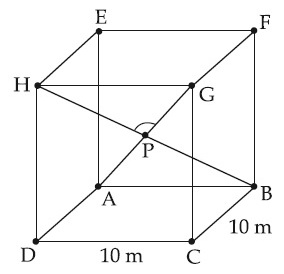
JEE Mains
2021
MCQ
Let $\overrightarrow a = \widehat i + \widehat j + \widehat k$ and $\overrightarrow b = \widehat j - \widehat k$. If $\overrightarrow c $ is a vector such that $\overrightarrow a \times \overrightarrow c = \overrightarrow b $ and $\overrightarrow a .\overrightarrow c = 3$, then $\overrightarrow a .(\overrightarrow b \times \overrightarrow c )$ is equal to :
JEE Mains
2021
MCQ
Let $\overrightarrow a $, $\overrightarrow b $ and $\overrightarrow c $ be three vectors such that $\overrightarrow a $ = $\overrightarrow b $ $\times$ ($\overrightarrow b $ $\times$ $\overrightarrow c $). If magnitudes of the vectors $\overrightarrow a $, $\overrightarrow b $ and $\overrightarrow c $ are $\sqrt 2 $, 1 and 2 respectively and the angle between $\overrightarrow b $ and $\overrightarrow c $ is $\theta \left( {0 < \theta < {\pi \over 2}} \right)$, then the value of 1 + tan$\theta$ is equal to :
JEE Mains
2021
MCQ
Let $\overrightarrow a = \widehat i + \widehat j + 2\widehat k$ and $\overrightarrow b = - \widehat i + 2\widehat j + 3\widehat k$. Then the vector product $\left( {\overrightarrow a + \overrightarrow b } \right) \times \left( {\left( {\overrightarrow a \times \left( {\left( {\overrightarrow a - \overrightarrow b } \right) \times \overrightarrow b } \right)} \right) \times \overrightarrow b } \right)$ is equal to :
JEE Mains
2021
MCQ
Let a, b and c be distinct positive numbers. If the vectors $a\widehat i + a\widehat j + c\widehat k,\widehat i+\widehat k$ and $c\widehat i + c\widehat j + b\widehat k$ are co-planar, then c is equal to :
JEE Mains
2021
MCQ
If $\left| {\overrightarrow a } \right| = 2,\left| {\overrightarrow b } \right| = 5$ and $\left| {\overrightarrow a \times \overrightarrow b } \right|$ = 8, then $\left| {\overrightarrow a .\,\overrightarrow b } \right|$ is equal to :
JEE Mains
2021
MCQ
Let the vectors
$(2 + a + b)\widehat i + (a + 2b + c)\widehat j - (b + c)\widehat k,(1 + b)\widehat i + 2b\widehat j - b\widehat k$ and $(2 + b)\widehat i + 2b\widehat j + (1 - b)\widehat k$, $a,b,c, \in R$
be co-planar. Then which of the following is true?
JEE Mains
2021
MCQ
Let a vector ${\overrightarrow a }$ be coplanar with vectors $\overrightarrow b = 2\widehat i + \widehat j + \widehat k$ and $\overrightarrow c = \widehat i - \widehat j + \widehat k$. If ${\overrightarrow a}$ is perpendicular to $\overrightarrow d = 3\widehat i + 2\widehat j + 6\widehat k$, and $\left| {\overrightarrow a } \right| = \sqrt {10} $. Then a possible value of $[\matrix{
{\overrightarrow a } & {\overrightarrow b } & {\overrightarrow c } \cr
} ] + [\matrix{
{\overrightarrow a } & {\overrightarrow b } & {\overrightarrow d } \cr
} ] + [\matrix{
{\overrightarrow a } & {\overrightarrow c } & {\overrightarrow d } \cr
} ]$ is equal to :
JEE Mains
2021
MCQ
Let three vectors $\overrightarrow a $, $\overrightarrow b $ and $\overrightarrow c $ be such that $\overrightarrow a \times \overrightarrow b = \overrightarrow c $, $\overrightarrow b \times \overrightarrow c = \overrightarrow a $ and $\left| {\overrightarrow a } \right| = 2$. Then which one of the following is not true?
JEE Mains
2021
MCQ
In a triangle ABC, if $\left| {\overrightarrow {BC} } \right| = 3$, $\left| {\overrightarrow {CA} } \right| = 5$ and $\left| {\overrightarrow {BA} } \right| = 7$, then the projection of the vector $\overrightarrow {BA} $ on $\overrightarrow {BC} $ is equal to :
JEE Mains
2021
MCQ
Let $\overrightarrow a = 2\widehat i + \widehat j - 2\widehat k$ and $\overrightarrow b = \widehat i + \widehat j$. If $\overrightarrow c $ is a vector such that $\overrightarrow a .\,\overrightarrow c = \left| {\overrightarrow c } \right|,\left| {\overrightarrow c - \overrightarrow a } \right| = 2\sqrt 2 $ and the angle between $(\overrightarrow a \times \overrightarrow b )$ and $\overrightarrow c $ is ${\pi \over 6}$, then the value of $\left| {\left( {\overrightarrow a \times \overrightarrow b } \right) \times \overrightarrow c } \right|$ is :
JEE Mains
2021
MCQ
Let $\overrightarrow a $ and $\overrightarrow b $ be two non-zero vectors perpendicular to each other and $|\overrightarrow a | = |\overrightarrow b |$. If $|\overrightarrow a \times \overrightarrow b | = |\overrightarrow a |$, then the angle between the vectors $\left( {\overrightarrow a + \overrightarrow b + \left( {\overrightarrow a \times \overrightarrow b } \right)} \right)$ and ${\overrightarrow a }$ is equal to :
JEE Mains
2021
MCQ
In a triangle ABC, if $|\overrightarrow {BC} | = 8,|\overrightarrow {CA} | = 7,|\overrightarrow {AB} | = 10$, then the projection of the vector $\overrightarrow {AB} $ on $\overrightarrow {AC} $ is equal to :
JEE Mains
2021
MCQ
A vector $\overrightarrow a $ has components 3p and 1 with respect to a rectangular cartesian system. This system is rotated through a certain angle about the origin in the counter clockwise sense. If, with respect to new system, $\overrightarrow a $ has components p + 1 and $\sqrt {10} $, then the value of p is equal to :
JEE Mains
2021
MCQ
Let O be the origin. Let $\overrightarrow {OP} = x\widehat i + y\widehat j - \widehat k$ and $\overrightarrow {OQ} = - \widehat i + 2\widehat j + 3x\widehat k$, x, y$\in$R, x > 0, be such that $\left| {\overrightarrow {PQ} } \right| = \sqrt {20} $ and the vector $\overrightarrow {OP} $ is perpendicular $\overrightarrow {OQ} $. If $\overrightarrow {OR} $ = $3\widehat i + z\widehat j - 7\widehat k$, z$\in$R, is coplanar with $\overrightarrow {OP} $ and $\overrightarrow {OQ} $, then the value of x2 + y2 + z2 is equal to :
JEE Mains
2021
MCQ
Let $\overrightarrow a $ = 2$\widehat i$ $-$ 3$\widehat j$ + 4$\widehat k$ and $\overrightarrow b $ = 7$\widehat i$ + $\widehat j$ $-$ 6$\widehat k$.
If $\overrightarrow r $ $\times$ $\overrightarrow a $ = $\overrightarrow r $ $\times$ $\overrightarrow b $, $\overrightarrow r $ . ($\widehat i$ + 2$\widehat j$ + $\widehat k$) = $-$3, then $\overrightarrow r $ . (2$\widehat i$ $-$ 3$\widehat j$ + $\widehat k$) is equal to :
JEE Mains
2021
MCQ
Let $\overrightarrow a $ = $\widehat i$ + 2$\widehat j$ $-$ 3$\widehat k$ and $\overrightarrow b = 2\widehat i$ $-$ 3$\widehat j$ + 5$\widehat k$. If $\overrightarrow r $ $\times$ $\overrightarrow a $ = $\overrightarrow b $ $\times$ $\overrightarrow r $,
$\overrightarrow r $ . $\left( {\alpha \widehat i + 2\widehat j + \widehat k} \right)$ = 3 and $\overrightarrow r \,.\,\left( {2\widehat i + 5\widehat j - \alpha \widehat k} \right)$ = $-$1, $\alpha$ $\in$ R, then the
value of $\alpha$ + ${\left| {\overrightarrow r } \right|^2}$ is equal to :
JEE Mains
2021
MCQ
Let a vector $\alpha \widehat i + \beta \widehat j$ be obtained by rotating the vector $\sqrt 3 \widehat i + \widehat j$ by an angle 45$^\circ$ about the origin in counterclockwise direction in the first quadrant. Then the area of triangle having vertices ($\alpha$, $\beta$), (0, $\beta$) and (0, 0) is equal to :
JEE Mains
2021
MCQ
If vectors $\overrightarrow {{a_1}} = x\widehat i - \widehat j + \widehat k$ and $\overrightarrow {{a_2}} = \widehat i + y\widehat j + z\widehat k$ are collinear, then a possible unit vector parallel to the vector $x\widehat i + y\widehat j + z\widehat k$ is :
JEE Mains
2021
MCQ
If $\overrightarrow a $ and $\overrightarrow b $ are perpendicular, then
$\overrightarrow a \times \left( {\overrightarrow a \times \left( {\overrightarrow a \times \left( {\overrightarrow a \times \overrightarrow b } \right)} \right)} \right)$ is equal to :
JEE Mains
2020
MCQ
If the volume of a parallelopiped, whose
coterminus edges are given by the
vectors $\overrightarrow a = \widehat i + \widehat j + n\widehat k$,
$\overrightarrow b = 2\widehat i + 4\widehat j - n\widehat k$ and
$\overrightarrow c = \widehat i + n\widehat j + 3\widehat k$ ($n \ge 0$), is 158 cu. units, then :
JEE Mains
2020
MCQ
Let x0 be the point of Local maxima of $f(x) = \overrightarrow a .\left( {\overrightarrow b \times \overrightarrow c } \right)$, where
$\overrightarrow a = x\widehat i - 2\widehat j + 3\widehat k$, $\overrightarrow b = - 2\widehat i + x\widehat j - \widehat k$, $\overrightarrow c = 7\widehat i - 2\widehat j + x\widehat k$. Then the value of
$\overrightarrow a .\overrightarrow b + \overrightarrow b .\overrightarrow c + \overrightarrow c .\overrightarrow a $ at x = x0 is :
JEE Mains
2020
MCQ
Let a, b c $ \in $ R be such that a2
+ b2
+ c2
= 1. If
$a\cos \theta = b\cos \left( {\theta + {{2\pi } \over 3}} \right) = c\cos \left( {\theta + {{4\pi } \over 3}} \right)$,
where
${\theta = {\pi \over 9}}$, then the angle between the vectors
$a\widehat i + b\widehat j + c\widehat k$ and $b\widehat i + c\widehat j + a\widehat k$ is :
JEE Mains
2020
MCQ
The lines
$\overrightarrow r = \left( {\widehat i - \widehat j} \right) + l\left( {2\widehat i + \widehat k} \right)$ and
$\overrightarrow r = \left( {2\widehat i - \widehat j} \right) + m\left( {\widehat i + \widehat j + \widehat k} \right)$
JEE Mains
2020
MCQ
Let $\overrightarrow a = \widehat i - 2\widehat j + \widehat k$ and $\overrightarrow b = \widehat i - \widehat j + \widehat k$ be two
vectors. If $\overrightarrow c $ is a vector such that $\overrightarrow b \times \overrightarrow c = \overrightarrow b \times \overrightarrow a $ and $\overrightarrow c .\overrightarrow a = 0$, then $\overrightarrow c .\overrightarrow b $ is equal to
JEE Mains
2020
MCQ
Let the volume of a parallelopiped whose
coterminous edges are given by
$\overrightarrow u = \widehat i + \widehat j + \lambda \widehat k$, $\overrightarrow v = \widehat i + \widehat j + 3\widehat k$ and
$\overrightarrow w = 2\widehat i + \widehat j + \widehat k$ be 1 cu. unit. If $\theta $ be the angle between the
edges $\overrightarrow u $ and $\overrightarrow w $ , then cos$\theta $ can be :
JEE Mains
2020
MCQ
Let $\overrightarrow a $
, $\overrightarrow b $
and $\overrightarrow c $
be three unit vectors such that
$\overrightarrow a + \vec b + \overrightarrow c = \overrightarrow 0 $. If $\lambda = \overrightarrow a .\vec b + \vec b.\overrightarrow c + \overrightarrow c .\overrightarrow a $ and
$\overrightarrow d = \overrightarrow a \times \vec b + \vec b \times \overrightarrow c + \overrightarrow c \times \overrightarrow a $, then the ordered pair, $\left( {\lambda ,\overrightarrow d } \right)$ is equal to :
JEE Mains
2020
MCQ
A vector $\overrightarrow a = \alpha \widehat i + 2\widehat j + \beta \widehat k\left( {\alpha ,\beta \in R} \right)$ lies in the plane of the vectors, $\overrightarrow b = \widehat i + \widehat j$ and $\overrightarrow c = \widehat i - \widehat j + 4\widehat k$. If $\overrightarrow a $ bisects the angle between $\overrightarrow b $ and $\overrightarrow c $, then:
JEE Mains
2019
MCQ
Let $\alpha $ $ \in $ R and the three vectors
$\overrightarrow a = \alpha \widehat i + \widehat j + 3\widehat k$, $\overrightarrow b = 2\widehat i + \widehat j - \alpha \widehat k$
and $\overrightarrow c = \alpha \widehat i - 2\widehat j + 3\widehat k$.
Then the set
S = {$\alpha $ :
$\overrightarrow a $ ,
$\overrightarrow b $ and
$\overrightarrow c $ are coplanar} :
JEE Mains
2019
MCQ
Let $\overrightarrow a = 3\widehat i + 2\widehat j + 2\widehat k$ and $\overrightarrow b = \widehat i + 2\widehat j - 2\widehat k$ be two vectors. If a vector perpendicular to both the vectors
$\overrightarrow a + \overrightarrow b $ and $\overrightarrow a - \overrightarrow b $ has the magnitude 12 then one such vector is :
JEE Mains
2019
MCQ
If the volume of parallelopiped formed by the vectors $\widehat i + \lambda \widehat j + \widehat k$, $\widehat j + \lambda \widehat k$ and $\lambda \widehat i + \widehat k$ is minimum, then $\lambda $ is
equal to :
JEE Mains
2019
MCQ
The distance of the point having position vector $ - \widehat i + 2\widehat j + 6\widehat k$
from the straight line passing through the point
(2, 3, – 4) and parallel to the vector, $6\widehat i + 3\widehat j - 4\widehat k$ is :
JEE Mains
2019
MCQ
Let A (3, 0, –1), B(2, 10, 6) and C(1, 2, 1) be the vertices of a triangle and M be the midpoint of AC. If G
divides BM in the ratio, 2 : 1, then cos ($\angle $GOA) (O being the origin) is equal to :
JEE Mains
2019
MCQ
If a unit vector $\overrightarrow a $ makes angles $\pi $/3 with $\widehat i$ , $\pi $/ 4
with $\widehat j$ and $\theta $$ \in $(0, $\pi $) with $\widehat k$, then a value of $\theta $
is :-
JEE Mains
2019
MCQ
Let $\overrightarrow \alpha = 3\widehat i + \widehat j$ and $\overrightarrow \beta = 2\widehat i - \widehat j + 3 \widehat k$
. If $\overrightarrow \beta = {\overrightarrow \beta _1} - \overrightarrow {{\beta _2}} $,
where ${\overrightarrow \beta _1}$
is parallel to $\overrightarrow \alpha $ and $\overrightarrow {{\beta _2}} $
is perpendicular
to $\overrightarrow \alpha $ , then ${\overrightarrow \beta _1} \times \overrightarrow {{\beta _2}} $
is equal to
JEE Mains
2019
MCQ
Let $\mathop a\limits^ \to = 3\mathop i\limits^ \wedge + 2\mathop j\limits^ \wedge + x\mathop k\limits^ \wedge $ and $\mathop b\limits^ \to = \mathop i\limits^ \wedge - \mathop j\limits^ \wedge + \mathop k\limits^ \wedge $
, for some real x. Then $\left| {\mathop a\limits^ \to \times \mathop b\limits^ \to } \right|$ = r
is possible if :
JEE Mains
2019
MCQ
Let $\overrightarrow a $, $\overrightarrow b $ and $\overrightarrow c $ be three unit vectors, out of which vectors $\overrightarrow b $ and $\overrightarrow c $ are non-parallel. If $\alpha $ and $\beta $ are the angles which vector $\overrightarrow a $ makes with vectors $\overrightarrow b $ and $\overrightarrow c $ respectively and $\overrightarrow a $ $ \times $ ($\overrightarrow b $ $ \times $ $\overrightarrow c $) = ${1 \over 2}\overrightarrow b $, then $\left| {\alpha - \beta } \right|$ is equal to :
JEE Mains
2019
MCQ
The sum of the distinct real values of $\mu $, for which the vectors, $\mu \widehat i + \widehat j + \widehat k,$ $\widehat i + \mu \widehat j + \widehat k,$ $\widehat i + \widehat j + \mu \widehat k$ are co-planar, is :
JEE Mains
2019
MCQ
Let $\sqrt 3 \widehat i + \widehat j,$ $\widehat i + \sqrt 3 \widehat j$ and $\beta \widehat i + \left( {1 - \beta } \right)\widehat j$ respectively be the position vectors of the points A, B and C with respect to the origin O. If the distance of C from the bisector of the acute angle between OA and OB is ${3 \over {\sqrt 2 }}$, then the sum of all possible values of $\beta $ is :
JEE Mains
2019
MCQ
Let $\overrightarrow a = \widehat i + 2\widehat j + 4\widehat k,$ $\overrightarrow b = \widehat i + \lambda \widehat j + 4\widehat k$ and $\overrightarrow c = 2\widehat i + 4\widehat j + \left( {{\lambda ^2} - 1} \right)\widehat k$ be coplanar vectors. Then the non-zero vector $\overrightarrow a \times \overrightarrow c $ is :
JEE Mains
2019
MCQ
If $\overrightarrow \alpha $ = $\left( {\lambda - 2} \right)\overrightarrow a + \overrightarrow b $ and $\overrightarrow \beta = \left( {4\lambda - 2} \right)\overrightarrow a + 3\overrightarrow b $ be two given vectors $\overrightarrow a $ and $\overrightarrow b $ are non-collinear. The value of $\lambda $ for which vectors $\overrightarrow \alpha $ and $\overrightarrow \beta $ are collinear, is -
JEE Mains
2019
MCQ
Let $\overrightarrow a = 2\widehat i + {\lambda _1}\widehat j + 3\widehat k,\,\,$ $\overrightarrow b = 4\widehat i + \left( {3 - {\lambda _2}} \right)\widehat j + 6\widehat k,$ and $\overrightarrow c = 3\widehat i + 6\widehat j + \left( {{\lambda _3} - 1} \right)\widehat k$ be three vectors such that $\overrightarrow b = 2\overrightarrow a $ and $\overrightarrow a $ is perpendicular to $\overrightarrow c $. Then a possible value of $\left( {{\lambda _1},{\lambda _2},{\lambda _3}} \right)$ is :
JEE Mains
2019
MCQ
Let $\overrightarrow a = \widehat i + \widehat j + \sqrt 2 \widehat k,$ $\overrightarrow b = {b_1}\widehat i + {b_2}\widehat j + \sqrt 2 \widehat k$, $\overrightarrow c = 5\widehat i + \widehat j + \sqrt 2 \widehat k$ be three vectors such that the projection vector of $\overrightarrow b $ on $\overrightarrow a $ is $\overrightarrow a $.
If $\overrightarrow a + \overrightarrow b $ is perpendicular to $\overrightarrow c $ , then $\left| {\overrightarrow b } \right|$ is equal to :
JEE Mains
2019
MCQ
Let $\overrightarrow a $ = $\widehat i - \widehat j$, $\overrightarrow b $ = $\widehat i + \widehat j + \widehat k$ and $\overrightarrow c $
be a vector such that $\overrightarrow a $ × $\overrightarrow c $ + $\overrightarrow b $ = $\overrightarrow 0 $
and $\overrightarrow a $ . $\overrightarrow c $ = 4, then |$\overrightarrow c $|2 is equal to :
JEE Mains
2018
MCQ
Let $\overrightarrow a = \widehat i + \widehat j + \widehat k,\overrightarrow c = \widehat j - \widehat k$ and a vector $\overrightarrow b $ be such that $\overrightarrow a \times \overrightarrow b = \overrightarrow c $ and $\overrightarrow a .\overrightarrow b = 3.$ Then $\left| {\overrightarrow b } \right|$ equals :
JEE Mains
2018
MCQ
Let $\overrightarrow u $ be a vector coplanar with the vectors $\overrightarrow a = 2\widehat i + 3\widehat j - \widehat k$ and $\overrightarrow b = \widehat j + \widehat k$. If $\overrightarrow u $ is perpendicular to $\overrightarrow a $ and $\overrightarrow u .\overrightarrow b = 24$, then ${\left| {\overrightarrow u } \right|^2}$ is equal to
JEE Mains
2018
MCQ
If the position vectors of the vertices A, B and C of a $\Delta $ ABC are respectively $4\widehat i + 7\widehat j + 8\widehat k,$ $2\widehat i + 3\widehat j + 4\widehat k,$ and $2\widehat i + 5\widehat j + 7\widehat k,$ then the position vectors of the point, where the bisector of $\angle $A meets BC is :
JEE Mains
2018
MCQ
If $\overrightarrow a ,\,\,\overrightarrow b ,$ and $\overrightarrow C $ are unit vectors such that $\overrightarrow a + 2\overrightarrow b + 2\overrightarrow c = \overrightarrow 0 ,$ then $\left| {\overrightarrow a \times \overrightarrow c } \right|$ is equal to :
JEE Mains
2017
MCQ
If the vector $\overrightarrow b = 3\widehat j + 4\widehat k$ is written as the
sum of a vector $\overrightarrow {{b_1}} ,$ paralel to $\overrightarrow a = \widehat i + \widehat j$ and a vector $\overrightarrow {{b_2}} ,$ perpendicular to $\overrightarrow a ,$ then $\overrightarrow {{b_1}} \times \overrightarrow {{b_2}} $ is equal to :
JEE Mains
2017
MCQ
The area (in sq. units) of the parallelogram whose diagonals are along the vectors $8\widehat i - 6\widehat j$ and $3\widehat i + 4\widehat j - 12\widehat k,$ is :
JEE Mains
2017
MCQ
Let $\overrightarrow a = 2\widehat i + \widehat j -2 \widehat k$ and $\overrightarrow b = \widehat i + \widehat j$.
Let $\overrightarrow c $ be a vector such that $\left| {\overrightarrow c - \overrightarrow a } \right| = 3$,
$\left| {\left( {\overrightarrow a \times \overrightarrow b } \right) \times \overrightarrow c } \right| = 3$ and the angle between $\overrightarrow c $ and $\overrightarrow a \times \overrightarrow b$ is $30^\circ $.
Then $\overrightarrow a .\overrightarrow c $ is equal to :
JEE Mains
2016
MCQ
Let ABC be a triangle whose circumcentre is at P. If the position vectors of A, B, C and P are $\overrightarrow a ,\overrightarrow b ,\overrightarrow c $ and ${{\overrightarrow a + \overrightarrow b + \overrightarrow c } \over 4}$ respectively, then the position vector of the orthocentre of this triangle, is :
JEE Mains
2016
MCQ
In a triangle ABC, right angled at the vertex A, if the position vectors of A, B and C are respectively 3$\widehat i$ + $\widehat j$ $-$ $\widehat k$, $-$$\widehat i$ + 3$\widehat j$ + p$\widehat k$ and 5$\widehat i$ + q$\widehat j$ $-$ 4$\widehat k$, then the point (p, q) lies
on a line :
JEE Mains
2016
MCQ
Let $\overrightarrow a ,\overrightarrow b $ and $\overrightarrow c $ be three unit vectors such that $\overrightarrow a \times \left( {\overrightarrow b \times \overrightarrow c } \right) = {{\sqrt 3 } \over 2}\left( {\overrightarrow b + \overrightarrow c } \right).$ If ${\overrightarrow b }$ is not parallel to ${\overrightarrow c },$ then the angle between ${\overrightarrow a }$ and ${\overrightarrow b }$ is:
JEE Mains
2015
MCQ
Let $\overrightarrow a ,\overrightarrow b $ and $\overrightarrow c $ be three non-zero vectors such that no two of them are collinear and
$\left( {\overrightarrow a \times \overrightarrow b } \right) \times \overrightarrow c = {1 \over 3}\left| {\overrightarrow b } \right|\left| {\overrightarrow c } \right|\overrightarrow a .$ If $\theta $ is the angle between vectors $\overrightarrow b $ and ${\overrightarrow c }$ , then a value of sin $\theta $ is :
JEE Mains
2014
MCQ
If $\left[ {\overrightarrow a \times \overrightarrow b \,\,\,\,\overrightarrow b \times \overrightarrow c \,\,\,\,\overrightarrow c \times \overrightarrow a } \right] = \lambda {\left[ {\overrightarrow a\,\,\,\,\,\,\,\, \overrightarrow b \,\,\,\,\,\,\,\,\overrightarrow c } \right]^2}$ then $\lambda $ is equal to :
JEE Mains
2013
MCQ
If the vectors $\overrightarrow {AB} = 3\widehat i + 4\widehat k$ and $\overrightarrow {AC} = 5\widehat i - 2\widehat j + 4\widehat k$ are the sides of a triangle $ABC,$ then the length of the median through $A$ is :
JEE Mains
2012
MCQ
Let $\overrightarrow a $ and $\overrightarrow b $ be two unit vectors. If the vectors $\,\overrightarrow c = \widehat a + 2\widehat b$ and $\overrightarrow d = 5\widehat a - 4\widehat b$ are perpendicular to each other, then the angle between $\overrightarrow a $ and $\overrightarrow b $ is :
JEE Mains
2012
MCQ
Let $ABCD$ be a parallelogram such that $\overrightarrow {AB} = \overrightarrow q ,\overrightarrow {AD} = \overrightarrow p $ and $\angle BAD$ be an acute angle. If $\overrightarrow r $ is the vector that coincide with the altitude directed from the vertex $B$ to the side $AD,$ then $\overrightarrow r $ is given by :
JEE Mains
2011
MCQ
The vectors $\overrightarrow a $ and $\overrightarrow b $ are not perpendicular and $\overrightarrow c $ and $\overrightarrow d $ are two vectors satisfying $\overrightarrow b \times \overrightarrow c = \overrightarrow b \times \overrightarrow d $ and $\overrightarrow a .\overrightarrow d = 0\,\,.$ Then the vector $\overrightarrow d $ is equal to :
JEE Mains
2011
MCQ
If $\overrightarrow a = {1 \over {\sqrt {10} }}\left( {3\widehat i + \widehat k} \right)$ and $\overrightarrow b = {1 \over 7}\left( {2\widehat i + 3\widehat j - 6\widehat k} \right),$ then the value
of $\left( {2\overrightarrow a - \overrightarrow b } \right)\left[ {\left( {\overrightarrow a \times \overrightarrow b } \right) \times \left( {\overrightarrow a + 2\overrightarrow b } \right)} \right]$ is :
JEE Mains
2011
MCQ
Let $\overrightarrow a $, $\overrightarrow b $, $\overrightarrow c $ be three non-zero vectors which are pairwise non-collinear. If $\overrightarrow a+3 \overrightarrow b$ is collinear with $\overrightarrow c$ and $\overrightarrow b+2 \overrightarrow c$ is collinear with $\overrightarrow a$, then $\overrightarrow a+\overrightarrow b+6 \overrightarrow c$ is :
JEE Mains
2010
MCQ
If the vectors $\overrightarrow a = \widehat i - \widehat j + 2\widehat k,\,\,\,\,\,\overrightarrow b = 2\widehat i + 4\widehat j + \widehat k\,\,\,$ and $\,\overrightarrow c = \lambda \widehat i + \widehat j + \mu \widehat k$ are mutually orthogonal, then $\,\left( {\lambda ,\mu } \right)$ is equal to :
JEE Mains
2010
MCQ
Let $\overrightarrow a = \widehat j - \widehat k$ and $\overrightarrow c = \widehat i - \widehat j - \widehat k.$ Then the vector $\overrightarrow b $ satisfying $\overrightarrow a \times \overrightarrow b + \overrightarrow c = \overrightarrow 0 $ and $\overrightarrow a .\overrightarrow b = 3$ :
JEE Mains
2009
MCQ
If $\overrightarrow u ,\overrightarrow v ,\overrightarrow w $ are non-coplanar vectors and $p,q$ are real numbers, then the equality $\left[ {3\overrightarrow u \,\,p\overrightarrow v \,\,p\overrightarrow w } \right] - \left[ {p\overrightarrow v \,\,\overrightarrow w \,\,q\overrightarrow u } \right] - \left[ {2\overrightarrow w \,\,q\overrightarrow v \,\,q\overrightarrow u } \right] = 0$ holds for :
JEE Mains
2008
MCQ
The vector $\overrightarrow a = \alpha \widehat i + 2\widehat j + \beta \widehat k$ lies in the plane of the vectors
$\overrightarrow b = \widehat i + \widehat j$ and $\overrightarrow c = \widehat j + \widehat k$ and bisects the angle between $\overrightarrow b $ and $\overrightarrow c $.Then which one of the following gives possible values of $\alpha $ and $\beta $ ?
JEE Mains
2008
MCQ
The non-zero vectors are ${\overrightarrow a ,\overrightarrow b }$ and ${\overrightarrow c }$ are related by ${\overrightarrow a = 8\overrightarrow b }$ and ${\overrightarrow c = - 7\overrightarrow b \,\,.}$ Then the angle between ${\overrightarrow a }$ and ${\overrightarrow c }$ is :
JEE Mains
2007
MCQ
If $\widehat u$ and $\widehat v$ are unit vectors and $\theta $ is the acute angle between them, then $2\widehat u \times 3\widehat v$ is a unit vector for :
JEE Mains
2007
MCQ
Let $\overrightarrow a = \widehat i + \widehat j + \widehat k,\overrightarrow b = \widehat i - \widehat j + 2\widehat k$ and $\overrightarrow c = x\widehat i + \left( {x - 2} \right)\widehat j - \widehat k\,\,.$ If the vectors $\overrightarrow c $ lies in the plane of $\overrightarrow a $ and $\overrightarrow b $, then $x$ equals :
JEE Mains
2006
MCQ
If $\left( {\overrightarrow a \times \overrightarrow b } \right) \times \overrightarrow c = \overrightarrow a \times \left( {\overrightarrow b \times \overrightarrow c } \right)$ where ${\overrightarrow a ,\overrightarrow b }$ and ${\overrightarrow c }$ are any three vectors such that $\overrightarrow a .\overrightarrow b \ne 0,\,\,\overrightarrow b .\overrightarrow c \ne 0$ then ${\overrightarrow a }$ and ${\overrightarrow c }$ are :
JEE Mains
2006
MCQ
The values of a, for which the points $A, B, C$ with position vectors $2\widehat i - \widehat j + \widehat k,\,\,\widehat i - 3\widehat j - 5\widehat k$ and $a\widehat i - 3\widehat j + \widehat k$ respectively are the vertices of a right angled triangle with $C = {\pi \over 2}$ are :
JEE Mains
2005
MCQ
Let $a, b$ and $c$ be distinct non-negative numbers. If the vectors $a\widehat i + a\widehat j + c\widehat k,\,\,\widehat i + \widehat k$ and $c\widehat i + c\widehat j + b\widehat k$ lie in a plane, then $c$ is :
JEE Mains
2005
MCQ
Let $\overrightarrow a \,\, = \,\,\widehat i - \widehat k,\,\,\,\,\,\overrightarrow b \,\,\, = \,\,\,x\widehat i + \widehat j\,\,\, + \,\,\,\left( {1 - x} \right)\widehat k$ and $\overrightarrow c \,\, = \,\,y\widehat i + x\widehat j + \left( {1 + x - y} \right)\widehat k.$ Then $\left[ {\overrightarrow a ,\overrightarrow b ,\overrightarrow c } \right]$ depends on :
JEE Mains
2005
MCQ
If $\overrightarrow a ,\overrightarrow b ,\overrightarrow c $ are non coplanar vectors and $\lambda $ is a real number then
$\left[ {\lambda \left( {\overrightarrow a + \overrightarrow b } \right)\,\,\,\,\,\,\,\,{\lambda ^2}\overrightarrow b \,\,\,\,\,\,\,\,\lambda \overrightarrow c } \right] = \left[ {\overrightarrow a \,\,\,\,\,\,\,\,\overrightarrow b + \overrightarrow c \,\,\,\,\,\,\,\,\overrightarrow b } \right]$ for :
JEE Mains
2005
MCQ
If $C$ is the mid point of $AB$ and $P$ is any point outside $AB,$ then :
JEE Mains
2005
MCQ
For any vector ${\overrightarrow a }$ , the value of ${\left( {\overrightarrow a \times \widehat i} \right)^2} + {\left( {\overrightarrow a \times \widehat j} \right)^2} + {\left( {\overrightarrow a \times \widehat k} \right)^2}$ is equal to :
JEE Mains
2004
MCQ
Let $\overrightarrow a ,\overrightarrow b $ and $\overrightarrow c $ be non-zero vectors such that $\left( {\overrightarrow a \times \overrightarrow b } \right) \times \overrightarrow c = {1 \over 3}\left| {\overrightarrow b } \right|\left| {\overrightarrow c } \right|\overrightarrow a \,\,.$ If $\theta $ is the acute angle between the vectors ${\overrightarrow b }$ and ${\overrightarrow c },$ then $sin\theta $ equals :
JEE Mains
2004
MCQ
Let $\overrightarrow a ,\overrightarrow b $ and $\overrightarrow c $ be three non-zero vectors such that no two of these are collinear. If the vector $\overrightarrow a + 2\overrightarrow b $ is collinear with $\overrightarrow c $ and $\overrightarrow b + 3\overrightarrow c $ is collinear with $\overrightarrow a $ ($\lambda $ being some non-zero scalar) then $\overrightarrow a + 2\overrightarrow b + 6\overrightarrow c $ equals to :
JEE Mains
2004
MCQ
A particle acted on by constant forces $4\widehat i + \widehat j - 3\widehat k$ and $3\widehat i + \widehat j - \widehat k$ is displaced from the point $\widehat i + 2\widehat j + 3\widehat k$ to the point $\,5\widehat i + 4\widehat j + \widehat k.$ The total work done by the forces is :
JEE Mains
2004
MCQ
Let $\overrightarrow u ,\overrightarrow v ,\overrightarrow w $ be such that $\left| {\overrightarrow u } \right| = 1,\,\,\,\left| {\overrightarrow v } \right|2,\,\,\,\left| {\overrightarrow w } \right|3.$ If the projection ${\overrightarrow v }$ along ${\overrightarrow u }$ is equal to that of ${\overrightarrow w }$ along ${\overrightarrow u }$ and ${\overrightarrow v },$ ${\overrightarrow w }$ are perpendicular to each other then $\left| {\overrightarrow u - \overrightarrow v + \overrightarrow w } \right|$ equals :
JEE Mains
2004
MCQ
If ${\overrightarrow a ,\overrightarrow b ,\overrightarrow c }$ are non-coplanar vectors and $\lambda $ is a real number, then the vectors ${\overrightarrow a + 2\overrightarrow b + 3\overrightarrow c ,\,\,\lambda \overrightarrow b + 4\overrightarrow c }$ and $\left( {2\lambda - 1} \right)\overrightarrow c $ are non coplanar for :
JEE Mains
2003
MCQ
$\overrightarrow a \,,\overrightarrow b \,,\overrightarrow c $ are $3$ vectors, such that
$\overrightarrow a + \overrightarrow b + \overrightarrow c = 0$ , $\left| {\overrightarrow a } \right| = 1\,\,\,\left| {\overrightarrow b } \right| = 2,\,\,\,\left| {\overrightarrow c } \right| = 3,$,
then ${\overrightarrow a .\overrightarrow b + \overrightarrow b .\overrightarrow c + \overrightarrow c .\overrightarrow a }$ is equal to :
JEE Mains
2003
MCQ
A tetrahedron has vertices at $O(0,0,0), A(1,2,1) B(2,1,3)$ and $C(-1,1,2).$ Then the angle between the faces $OAB$ and $ABC$ will be :
JEE Mains
2003
MCQ
If $\overrightarrow u \,,\overrightarrow v $ and $\overrightarrow w $ are three non-coplanar vectors, then $\,\left( {\overrightarrow u + \overrightarrow v - \overrightarrow w } \right).\left( {\overrightarrow u - \overrightarrow v } \right) \times \left( {\overrightarrow v - \overrightarrow w} \right)$ equals :
JEE Mains
2003
MCQ
If $\left| {\matrix{
a & {{a^2}} & {1 + {a^3}} \cr
b & {{b^2}} & {1 + {b^3}} \cr
c & {{c^2}} & {1 + {c^3}} \cr
} } \right| = 0$ and vectors $\left( {1,a,{a^2}} \right),\,\,$
$\left( {1,b,{b^2}} \right)$ and $\left( {1,c,{c^2}} \right)\,$ are non-coplanar, then the product $abc$ equals :
JEE Mains
2003
MCQ
Consider points $A, B, C$ and $D$ with position
vectors $7\widehat i - 4\widehat j + 7\widehat k,\widehat i - 6\widehat j + 10\widehat k, - \widehat i - 3\widehat j + 4\widehat k$ and $5\widehat i - \widehat j + 5\widehat k$ respectively. Then $ABCD$ is a :
JEE Mains
2003
MCQ
Let $\overrightarrow u = \widehat i + \widehat j,\,\overrightarrow v = \widehat i - \widehat j$ and $\overrightarrow w = \widehat i + 2\widehat j + 3\widehat k\,\,.$ If $\widehat n$ is a unit vector such that $\overrightarrow u .\widehat n = 0$ and $\overrightarrow v .\widehat n = 0\,\,,$ then $\left| {\overrightarrow w .\widehat n} \right|$ is equal to :
JEE Mains
2003
MCQ
The vectors $\overrightarrow {AB} = 3\widehat i + 4\widehat k\,\,\& \,\,\overrightarrow {AC} = 5\widehat i - 2\widehat j + 4\widehat k$ are the sides of triangle $ABC.$ The length of the median through $A$ is :
JEE Mains
2003
MCQ
If $\overrightarrow a \times \overrightarrow b = \overrightarrow b \times \overrightarrow c = \overrightarrow c \times \overrightarrow a $ then $\overrightarrow a + \overrightarrow b + \overrightarrow c = $
JEE Mains
2002
MCQ
If $\overrightarrow a \,\,,\,\,\overrightarrow b \,\,,\,\,\overrightarrow c $ are vectors such that $\left[ {\overrightarrow a \,\overrightarrow b \,\overrightarrow c } \right] = 4$ then $\left[ {\overrightarrow a \, \times \overrightarrow b \,\,\overrightarrow b \times \,\overrightarrow c \,\,\overrightarrow c \, \times \overrightarrow a } \right] = $
JEE Mains
2002
MCQ
If the vectors $\overrightarrow c ,\overrightarrow a = x\widehat i + y\widehat j + z\widehat k$ and $\widehat b = \widehat j$ are such that $\overrightarrow a ,\overrightarrow c $ and $\overrightarrow b $ form a right handed system then ${\overrightarrow c }$ is :
JEE Mains
2002
MCQ
If the vectors $\overrightarrow{\mathbf{a}}, \overrightarrow{\mathbf{b}}$ and $\overrightarrow{\mathbf{c}}$ from the sides $B C, C A$ and $A B$ respectively of a triangle $A B C$, then :
JEE Mains
2002
MCQ
If $\left| {\overrightarrow a } \right| = 4,\left| {\overrightarrow b } \right| = 2$ and the angle between ${\overrightarrow a }$ and ${\overrightarrow b }$ is $\pi /6$ then ${\left( {\overrightarrow a \times \overrightarrow b } \right)^2}$ is equal to :
JEE Mains
2002
MCQ
$\overrightarrow a = 3\widehat i - 5\widehat j$ and $\overrightarrow b = 6\widehat i + 3\widehat j$ are two vectors and $\overrightarrow c $ is a vector such that $\overrightarrow c = \overrightarrow a \times \overrightarrow b $ then $\left| {\overrightarrow a } \right|:\left| {\overrightarrow b } \right|:\left| {\overrightarrow c } \right|$ =
JEE Mains
2002
MCQ
If $\left| {\overrightarrow a } \right| = 5,\left| {\overrightarrow b } \right| = 4,\left| {\overrightarrow c } \right| = 3$ thus what will be the value of $\left| {\overrightarrow a .\overrightarrow b + \overrightarrow b .\overrightarrow c + \overrightarrow c .\overrightarrow a } \right|,$ given that $\overrightarrow a + \overrightarrow b + \overrightarrow c = 0$ :