2020
Q501
JEE Mains
MCQ
iCON Education HYD, 79930 92826, 73309 72826
14 Mar 2026
The following system of linear equations
B.
infinitely many solutions, (x, y, z) satisfying
y = 2z
C.
infinitely many solutions, (x, y, z) satisfying
x = 2z
D.
only the trivial solution
Show Answer
Correct Answer: C
Explanation:
Given
2020
Q502
JEE Mains
MCQ
iCON Education HYD, 79930 92826, 73309 72826
14 Mar 2026
If the matrices A = $\left[ {\matrix{
1 & 1 & 2 \cr
1 & 3 & 4 \cr
1 & { - 1} & 3 \cr
} } \right]$,
Show Answer
Correct Answer: A
Explanation:
A = $\left[ {\matrix{
1 & 1 & 2 \cr
1 & 3 & 4 \cr
1 & { - 1} & 3 \cr
} } \right]$
2020
Q503
JEE Mains
MCQ
iCON Education HYD, 79930 92826, 73309 72826
14 Mar 2026
If for some $\alpha $ and $\beta $ in R, the intersection of the
following three places3 , then $\alpha $ + $\beta $ is equal to :
Show Answer
Correct Answer: C
Explanation:
For planes to intersect on a line there should be infinite solution of the
given system of equations.
z = 0
2020
Q504
JEE Mains
MCQ
iCON Education HYD, 79930 92826, 73309 72826
14 Mar 2026
If $A = \left( {\matrix{
2 & 2 \cr
9 & 4 \cr
} } \right)$ and $I = \left( {\matrix{
1 & 0 \cr
0 & 1 \cr
} } \right)$ then 10A–1 is
equal to :
Show Answer
Correct Answer: C
Explanation:
According to Cayley Hamilton equation
2
– 18 = 0
2
– 6$\lambda $ – 10 = 0
2
– 6A– 10 = 0
–1 (A2 ) – 6A–1 A – 10A–1 = 0
–1 = 0
–1 = A – 6I
2020
Q505
JEE Mains
MCQ
iCON Education HYD, 79930 92826, 73309 72826
14 Mar 2026
The system of linear equations
A.
a unique solution when $\lambda $ = –8
B.
no solution when $\lambda $ = 2
C.
infinitely many solutions when $\lambda $ = 2
D.
no solution when $\lambda $ = 8
Show Answer
Correct Answer: B
Explanation:
$\Delta $ = $\left| {\matrix{
\lambda & 2 & 2 \cr
{2\lambda } & 3 & 5 \cr
4 & \lambda & 6 \cr
} } \right|$
2
– 12)
2
– 24$\lambda $ + 40 + 4$\lambda $2
– 24
2
– 6$\lambda $ + 16
x = $\left| {\matrix{
5 & 2 & 2 \cr
8 & 3 & 5 \cr
{10} & 2 & 6 \cr
} } \right|$
2020
Q506
JEE Mains
MCQ
iCON Education HYD, 79930 92826, 73309 72826
14 Mar 2026
For which of the following ordered pairs ($\mu $, $\delta $),
the system of linear equations
Show Answer
Correct Answer: B
Explanation:
For inconsistent system we need
x = $\left| {\matrix{
1 & 2 & 3 \cr
\mu & 4 & 5 \cr
\delta & 4 & 4 \cr
} } \right|$
2020
Q507
JEE Mains
MCQ
iCON Education HYD, 79930 92826, 73309 72826
14 Mar 2026
Let A = [aij ] and B = [bij ] be two 3 × 3 real matrices such that bij = (3)(i+j-2) aji , where i, j = 1, 2, 3.
If the determinant of B is 81, then the determinant of A is:
Show Answer
Correct Answer: C
Explanation:
|B| = $\left| {\matrix{
{{b_{11}}} & {{b_{12}}} & {{b_{13}}} \cr
{{b_{21}}} & {{b_{22}}} & {{b_{23}}} \cr
{{b_{31}}} & {{b_{32}}} & {{b_{33}}} \cr
} } \right|$
6 .|A|
6 .|A| = 81
2020
Q508
JEE Mains
MCQ
iCON Education HYD, 79930 92826, 73309 72826
14 Mar 2026
Let $\alpha $ be a root of the equation x2 + x + 1 = 0 and the 31 is equal to
Show Answer
Correct Answer: D
Explanation:
x2 + x + 1 = 0
2 = ${1 \over 3}\left[ {\matrix{
3 & 0 & 0 \cr
0 & 0 & 3 \cr
0 & 3 & 0 \cr
} } \right]$ = $\left[ {\matrix{
1 & 0 & 0 \cr
0 & 0 & 1 \cr
0 & 1 & 0 \cr
} } \right]$
4 = $\left[ {\matrix{
1 & 0 & 0 \cr
0 & 1 & 0 \cr
0 & 0 & 1 \cr
} } \right]$ = I
31 = A28 A3 = A3
2020
Q509
JEE Mains
MCQ
iCON Education HYD, 79930 92826, 73309 72826
14 Mar 2026
If the system of linear equations
A.
${1 \over a},{1 \over b},{1 \over c}$ are in A.P.
Show Answer
Correct Answer: A
Explanation:
For non-zero solution
2020
Q510
JEE Advanced
MSQ
iCON Education HYD, 79930 92826, 73309 72826
14 Mar 2026
Let M be a 3 $ \times $ 3 invertible matrix with real entries and let I denote the 3 $ \times $ 3 identity matrix. If M$-$1 = adj(adj M), then which of the following statements is/are ALWAYS TRUE?
Show Answer
Correct Answer: B,C,D
Explanation:
It is given that matrix M be a 3 $ \times $ 3 invertible matrix, such that$-$1 = adj(adj M) $ \Rightarrow $ M$-$1 = |M| Mn$-$2 A}$-$1 M = |M|M2 $ \Rightarrow $ M2 |M| = I .....(i)2 |M|) = det(I) = 13 |M|2 = 1 $ \Rightarrow $ |M| = 1 .....(ii)2 = I$-$1 = M2 = M2 (adj M)2 = I
2020
Q511
JEE Advanced
Numerical
iCON Education HYD, 79930 92826, 73309 72826
14 Mar 2026
The trace of a square matrix is defined to be the sum of its diagonal entries. If A is a 2 $ \times $ 2 matrix such that the trace of A is 3 and the trace of A3 is $-$18, then the value of the determinant of A is .............
Show Answer
Correct Answer: 5
Explanation:
Let a square matrix 'A' of order 2 $ \times $ 2, such that tr (A) = 3, is
2020
Q512
TS-EAMCET
MCQ
iCON Education HYD, 79930 92826, 73309 72826
20 May 2026
Let $I$ be a unit matrix of order 6 . Let $A=\left(a_{i j}\right)$ be a square matrix of order 6 such that $a_{i j}=\left\{\begin{array}{l}1, \text { if } i+j=7 \\ 0, \text { if } i+j \neq 7\end{array}\right.$ then $\left(A(\operatorname{adj} A) A^{-1}\right) A^2=$
Show Answer
Correct Answer: C
Explanation:
Given that,
$ a_{i j}= \begin{cases}1, & \text { if } i+j=7 \\ 0, & \text { if } i+j \neq 7\end{cases} $
Now, $\left(A(\operatorname{adj} A) A^{-1}\right) A^2$
$ \begin{array}{lrr} =\left(A(\operatorname{Adj} A) A^{-1}\right) A^2 & \\ =\left((|A| I) A^{-1}\right) A^2 & {[\because A \operatorname{adj} A=|A| I]} \\ =-1\left(A^{-1} A\right) A & {[\because|A|=-1]} \\ =-I A & {\left[\because A^{-1} A=I\right]} \\ =-A & \end{array} $
2020
Q513
TS-EAMCET
MCQ
iCON Education HYD, 79930 92826, 73309 72826
20 May 2026
Let $a, b, c \notin\{0,1\}$. If the system of equations
$ \begin{aligned} & \Pi_1 \equiv x+a y+a z=0 \\ & \Pi_2 \equiv b x+y+b z=0 \\ & \Pi_3 \equiv c x+c y+z=0 \end{aligned} $
has a non-trivial solution, then the system of equations $\Pi_1=a, \Pi_2=b, \Pi_3=c$ has
B.
infinite number of solutions
D.
unique solution only when $a=b=c$
Show Answer
Correct Answer: D
Explanation:
Given system of equations has a non-trivial solution
$ \begin{aligned} & \Pi_1 \equiv x+a y+a z=0 \\ & \Pi_2 \equiv b x+y+b z=0 \\ & \Pi_3 \equiv c x+c y+z=0 \end{aligned} $
It can be written as $A X=0$
Where, $A=\left[\begin{array}{lll}1 & a & a \\ b & 1 & b \\ c & c & 1\end{array}\right]$
So, the system has non-trivial solutions hence it has infinitely many solutions or unique solutions.
$ \therefore \quad|A|=0 $
Now, let the system has infinitely many solutions
So, let $y=t ; t \in \mathbf{R}$
Then from Eqs. (i) and (ii), we get
$ x+a z=-a t \Rightarrow b x+b z=-t $
Solving these, we get
$ z=\frac{t(1-a b)}{b(a-1)}, x=\frac{a}{b} t \frac{(1-b)}{(1-a)} $
Hence, if $a \neq b \neq c$, then
$ \begin{aligned} & x=\frac{a}{b} t \frac{(1-b)}{(1-a)}, y=t \\ & z=\frac{t}{b} \frac{(1-a b)}{(a-1)}, t \in \mathbf{R} \end{aligned} $
If $a=b=c$
Let $y=t_1, z=t_2, t_1, t_2 \in \mathbf{R}$
Then by Eq. (i)
$ x=-a\left(t_1+t_2\right) $
So, the system of equations has unique solution.
2020
Q514
TS-EAMCET
MCQ
iCON Education HYD, 79930 92826, 73309 72826
20 May 2026
$A$ is a singular matrix of order five. $B$ is another matrix having the rank $\rho(B)$ equal to the $\operatorname{rank} \rho(A)$ and $B$ has a non-zero minor of order 3. Then which one of the following is true?
A.
$B$ is a $4 \times 4$ matrix
B.
$\rho(A)=\rho(B)=4$, irrespective of the order of $B$
C.
$\rho(A)=\rho(B)=3$, when all the fourth order minors of $A$ are zero
Show Answer
Correct Answer: C
Explanation:
Given that, Rank of matrix $A=$ rank of matrix $B$
$ f(A)=f(B) \text { and } f(B)=3 $
∴ Order of matrix $B \geq$ Rank of matrix $B$.
2020
Q515
TS-EAMCET
MCQ
iCON Education HYD, 79930 92826, 73309 72826
20 May 2026
If $a$ and $b$ are any two real numbers, then
$ \left|\begin{array}{ccc} 2 a-2 b-4 & 4 a & 4 a \\ 4 & 2-b-a & 4 \\ 2 b & 2 b & b-a-2 \end{array}\right|= $
A.
$4\left[(a+b)^3+8(a+b)^2+16(a+b)+8\right]$
C.
$2\left[(a+b)^3+6(a+b)^2+12(a+b)+8\right]$
Show Answer
Correct Answer: C
Explanation:
$ \begin{aligned} &\text { We have, }\\ &\begin{aligned} &\left|\begin{array}{ccc} 2 a-2 b-4 & 4 a & 4 a \\ 4 & 2-b-a & 4 \\ 2 b & 2 b & b-a-2 \end{array}\right| \\ &= 2\left|\begin{array}{ccc} a-b-2 & 2 a & 2 a \\ 4 & 2-b-a & 4 \\ 2 b & 2 b & b-a-2 \end{array}\right| \\ &= 2\left|\begin{array}{ccc} -(a+b+2) & 0 & 2 a \\ a+b+2 & -(a+b+2) & 4 \\ 0 & a+b+2 & b-a-2 \end{array}\right| \\ & C_1 \rightarrow C_1-C_2 \text { and } C_2 \rightarrow C_2-C_3 \end{aligned} \end{aligned} $
$ \begin{aligned} & =2(a+b+2)^2\left|\begin{array}{ccc} -1 & 0 & 2 a \\ 1 & -1 & 4 \\ 0 & 1 & b-a-2 \end{array}\right| \\ & =2(a+b+2)^2(-1(-b+a+2-4)+2 a(1) \\ & =2(a+b+2)^2(a+b+2)=2(a+b+2)^3 \\ & =2\left[(a+b)^3+6(a+b)^2+12(a+b)+8\right] \end{aligned} $
2020
Q516
TS-EAMCET
MCQ
iCON Education HYD, 79930 92826, 73309 72826
20 May 2026
Let $A=\left[\begin{array}{ccc}2 & -2 & -4 \\ -1 & 3 & 4 \\ 1 & -2 & x\end{array}\right]$ and $A^2=A$. If $r$ is the rank of $A$, then $r+x=$
Show Answer
Correct Answer: D
Explanation:
We have,
$ \begin{aligned} A & =\left[\begin{array}{ccc} 2 & -2 & -4 \\ -1 & 3 & 4 \\ 1 & -2 & x \end{array}\right] \\ A^2 & =\left[\begin{array}{ccc} 2 & -2 & -4 \\ -1 & 3 & 4 \\ 1 & -2 & x \end{array}\right]\left[\begin{array}{ccc} 2 & -2 & -4 \\ -1 & 3 & 4 \\ 1 & -2 & x \end{array}\right] \\ A^2 & =\left[\begin{array}{ccc} 2 & -2 & -16-4 x \\ -1 & 3 & 16+4 x \\ 4+x & -8-2 x & -12+x^2 \end{array}\right] \end{aligned} $
Given, $A^2=A$
$ \begin{array}{ll} \because & 4+x=1 \Rightarrow x=-3 \\ \therefore & A=\left[\begin{array}{ccc} 2 & -2 & -4 \\ -1 & 3 & 4 \\ 1 & -2 & -3 \end{array}\right] \\ & |A|=2(-9+8)+2(3-4)-4(2-3) \\ & =-2-2+4=0 \end{array} $
Rank of $A=2 \Rightarrow r+x=2-3=-1$
2020
Q517
TS-EAMCET
MCQ
iCON Education HYD, 79930 92826, 73309 72826
20 May 2026
Let $a, b, c, d \in \mathbf{R}$ be such that $a d-b c \neq 0$ and $e$ be a positive number other than 1 .
If $x^a y^b=e^m, x^c y^d=e^n, \Delta_1=\left|\begin{array}{ll}m & b \\ n & d\end{array}\right|, \Delta_2=\left|\begin{array}{cc}a & m \\ c & n\end{array}\right|$ and $\Delta_3=\left|\begin{array}{ll}a & b \\ c & d\end{array}\right|$, then the values of $x$ and $y$ are respectively.
A.
$e^{\frac{\Delta_1}{\Delta_3}}, e^{\frac{\Delta_2}{\Delta_3}}$
B.
$e^{\frac{\Delta_3}{\Delta_2}}, e^{\frac{\Delta_1}{\Delta_2}}$
C.
$e^{\frac{-\Delta_1}{\Delta_3}}, e^{\frac{-\Delta_2}{\Delta_3}}$
D.
$e^{\frac{\Delta_2}{\Delta_1}}, e^{\frac{\Delta_3}{\Delta_1}}$
Show Answer
Correct Answer: A
Explanation:
$ \begin{aligned} &\text { We have, }\\ &\begin{aligned} \Delta_1 & =\left|\begin{array}{ll} m & b \\ n & d \end{array}\right|=m d-b n \\ \Delta_2 & =\left|\begin{array}{ll} a & m \\ c & n \end{array}\right|=a n-m c \\ \Delta_3 & =\left|\begin{array}{ll} a & b \\ c & d \end{array}\right|=a d-b c \\ x^a y^b & =e^m, x^c y^d=e^n \\ y & =\left(\frac{e^m}{x^a}\right)^{1 / b} \text { and } y=\left(\frac{e^n}{x^c}\right)^{1 / d} \end{aligned} \end{aligned} $
$ \begin{aligned} & \therefore & \frac{e^{m / b}}{x^{a / b}} & =\frac{e^{n / d}}{x^{c / d}} \\ \Rightarrow & & x^{c / d-a / b} & =e^{n / d-m / b} \\ \Rightarrow & & x & =\left(e^{n / d-m / b}\right)^{\frac{1}{c}-\frac{a}{b}} \\ \Rightarrow & & x & =e^{\left(\frac{b n-m d}{b d} \times \frac{b d}{b c-a d}\right)} \\ \Rightarrow & & x & =e^{\frac{b n-m d}{b c-a d}} \\ \Rightarrow & & x & =e^{\frac{m d-b n}{a d-b c}}=e^{\frac{\Delta_1}{\Delta_3}} \end{aligned} $
Putting the value of $x$ in $y=\frac{e^{m / b}}{x^{a / b}}$ we get $\quad y=e^{\frac{a n-m c}{a d-b c}}=e^{\frac{\Delta_2}{\Delta_3}}$
2020
Q518
TS-EAMCET
MCQ
iCON Education HYD, 79930 92826, 73309 72826
20 May 2026
Let $A=\left[\begin{array}{ccc}1 & 4 & 2 \\ 2 & -1 & 4 \\ -3 & 7 & -6\end{array}\right]$ and $B=\left[b_{i j}\right]_{3 \times 3}$ with $b_{11}=2$, $b_{13}=-2, b_{12}=0$ is such that $A B=\left[\begin{array}{ccc}2 & 14 & -4 \\ 4 & 1 & -8 \\ -6 & 15 & 12\end{array}\right]$, then $|B|+\operatorname{trace}(B)=$
Show Answer
Correct Answer: A
Explanation:
We have, $A=\left[\begin{array}{ccc}1 & 4 & 2 \\ 2 & -1 & 4 \\ -3 & 7 & -6\end{array}\right]$ and
$ \begin{aligned} & B=\left[\begin{array}{lll} b_{11} & b_{12} & b_{13} \\ b_{21} & b_{22} & b_{23} \\ b_{31} & b_{32} & b_{33} \end{array}\right]=\left[\begin{array}{ccc} 2 & 0 & -2 \\ b_{21} & b_{22} & b_{23} \\ b_{31} & b_{32} & b_{33} \end{array}\right] \\ & \therefore A B=\left[\begin{array}{ccc} 1 & 4 & 2 \\ 2 & -1 & 4 \\ -3 & 7 & -6 \end{array}\right]\left[\begin{array}{ccc} 2 & 0 & -2 \\ b_{21} & b_{22} & b_{23} \\ b_{31} & b_{32} & b_{33} \end{array}\right] \end{aligned} $
$ =\left[\begin{array}{cc} 2+4 b_{21}+2 b_{31} & 0+4 b_{22}+2 b_{32} \\ 4-b_{21}+4 b_{31} & 0+b_{22}+4 b_{32} \\ -6+7 b_{21}-6 b_{31} & 0+7 b_{22}-6 b_{32} \\ & -2+4 b_{23}+2 b_{33} \\ & -4-b_{23}+4 b_{33} \\ & 6+7 b_{23}-6 b_{33} \end{array}\right] $
$ =\left[\begin{array}{ccc} 2 & 14 & -4 \\ 4 & 1 & -8 \\ -6 & 15 & 12 \end{array}\right] $
On solving above equal matrices with corresponding elements, we get
$ \begin{aligned} & b_{21}=b_{31}=0, b_{22}=3, b_{32}=1, b_{23}=0 \\ & \text { and } b_{33}=-1 \\ & \therefore B=\left[\begin{array}{ccc} 2 & 0 & -2 \\ 0 & 3 & 0 \\ 0 & 1 & -1 \end{array}\right] \\ & \therefore|B|=2(-3-0)+(-2)(0-0)=-6 \\ & \text { and Trace }(B)=2+3-1=4 \\ & \therefore|B|+\operatorname{trace}(B)=-6+4=-2 \end{aligned} $
2020
Q519
TS-EAMCET
MCQ
iCON Education HYD, 79930 92826, 73309 72826
20 May 2026
A is a $m \times n$ matrix of rank 4 . If A contains an $m$ th order non singular sub matrix and $A^T A$ is a $7 \times 7$ matrix, then the number of rows of $A$ is
Show Answer
Correct Answer: D
Explanation:
Given, $A$ is $m \times n$ matrix of rank 4
$A$ contains $m$ th order of non-singular sub matrix.
$A$ is non-singular matrix
$\therefore A$ is a square matrix of order $M$
∴ Rank of $A$ is $M$
∴ order of $A=4$ [rank of $A=4$ ]
Hence, rows of $A=4$.
2020
Q520
TS-EAMCET
MCQ
iCON Education HYD, 79930 92826, 73309 72826
20 May 2026
If $C$ and $D$ are two $n \times n$ non-singular matrices over the set of real number $\mathbf{R}$ such that $C D=-D C$, then $n$ is
A.
a natural number of the form $3 k+5, k \in \mathbf{N}$
Show Answer
Correct Answer: C
Explanation:
Given, $C$ and $D$ are non-singular matrix of order $n$
$ \quad \begin{aligned} \because\,\,\,\,\,\,\, |C| & \neq 0,|D| \neq 0 \\ C D & =-D C \\ |C D| & =|-D C| \\ |C||D| & =(-1)^n|D||C| \\ 1 & =(-1)^n \end{aligned} $
$\therefore n$ is even integer.
2020
Q521
TS-EAMCET
MCQ
iCON Education HYD, 79930 92826, 73309 72826
20 May 2026
If $A, B$ are two non singular matrices of order $3,|B|=k$, a positive integer, then match the items of list-I with the items of list-II.
$
$
A.
$\quad\left|k^{-1} A^{-1}\right|$
I.
$
B.
$\left|\operatorname{Adj}\left(A^{-1}\right)\right|$
II.
$
C.
$B A B^{-1}=I, \Rightarrow B A^k B^{-1}=$
III.
$
D.
$\quad \operatorname{Adj}\left(\operatorname{Adj}\left(A^{-1}\right)\right)=$
IV.
$
V.
$
$ \text { The correct match is } $
Show Answer
Correct Answer: A
Explanation:
It is given that the matrices $A$ and $B$ are non-singular of order 3 and $|B|=k, a$ positive integer, so
$ \begin{aligned} \left|k^{-1} A^{-1}\right|=\left(k^{-1}\right)^3\left|A^{-1}\right| & =\frac{1}{k^3|A|} \\ & {\left[\because\left|A^{-1}\right|=\frac{1}{|A|}\right] } \end{aligned} $
$ \begin{gathered} =\frac{1}{|B|^3|A|} \\ \because\left|\operatorname{adj}\left(A^{-1}\right)\right|=\left|A^{-1}\right|^{3-1}=\left|A^{-1}\right|^2=\frac{1}{|A|^2} \end{gathered} $
$\left[\because|\operatorname{adj}(A)|=|A|^{n-1}\right.$, where $n$ is the order of matrix $A$ ]
Now, since it is given that $B A B^{-1}=I$
$ \begin{aligned} & \Rightarrow \quad A B^{-1}=B^{-1} \\ & \therefore B A^k B^{-1}=B A^{k-1}\left(A B^{-1}\right)=B A^{k-1} B^{-1} \\ & =B A^{k-2}\left(A B^{-1}\right)=B A^{k-2} B^{-1} \\ & \therefore B A^k B^{-1}=B A B^{-1}=I \\ & \text { and }, B \frac{\operatorname{adj}(B)}{|B|}=B B^{-1}=I \end{aligned} $
Therefore, $B A^k B^{-1}=B \frac{\operatorname{adj}(B)}{|B|}$, if
$ B A B^{-1}=I $
Now, the adj $\left(\operatorname{adj}\left(A^{-1}\right)\right)$
$ =\left|A^{-1}\right|^{3-2}\left(A^{-1}\right) $
$\left[\because \operatorname{adj}(\operatorname{adj} A)=|A|^{n-2} A\right.$ where $n$ is the order of matrix $A$ ]
$ =\frac{1}{|A|}\left(A^{-1}\right) $
2020
Q522
TS-EAMCET
MCQ
iCON Education HYD, 79930 92826, 73309 72826
20 May 2026
All the real values of $p, q$ so that the system of equations
$ 2 x+p y+6 z=8, x+2 y+q z=5 $
and $\quad x+y+3 z=4$
may have no solution are
Show Answer
Correct Answer: C
Explanation:
We have,
$ \begin{array}{r} 2 x+p y+6 z=8 \\ x+2 y+q z=5 \\ x+y+3 z=4 \end{array} $
Now, if we express above equation in matrix form, We have,
$ A X=B $
Where,
$ A=\left[\begin{array}{lll} 2 & p & 6 \\ 1 & 2 & q \\ 1 & 1 & 3 \end{array}\right], B=\left[\begin{array}{l} 8 \\ 5 \\ 4 \end{array}\right], X=\left[\begin{array}{l} x \\ y \\ z \end{array}\right] $
For no solution $|A|=0$
$ \begin{aligned} & \Rightarrow \quad\left|\begin{array}{lll} 2 & p & 6 \\ 1 & 2 & q \\ 1 & 1 & 3 \end{array}\right|=0 \\ & \Rightarrow \quad 2(6-q)-p(3-q)+6(1-2)=0 \\ & \Rightarrow \quad 12-2 q-3 p+p q-6=0 \\ & \Rightarrow \quad 3 p+2 q-p q-6=0 \\ & \Rightarrow \quad 3 p-6+2 q-p q=0 \\ & \Rightarrow \quad 3(p-2)-q(p-2)=0 \\ & \Rightarrow \quad(p-2)(3-q)=0 \Rightarrow \\ & \vec{p}=2,3 \end{aligned} $
But for $p=2$ equations $2 x+p y+6 z=8$ and $x+y+3 z=4$ are same.
So, $p \neq 2, q=3$
2020
Q523
TS-EAMCET
MCQ
iCON Education HYD, 79930 92826, 73309 72826
20 May 2026
If $p$ and $q$ are two distinct real values of $\lambda$ for which the system of equations
$ \begin{array}{r} (\lambda-1) x+(3 \lambda+1) y+2 \lambda z=0 \\ (\lambda-1) x+(4 \lambda-2) y+(\lambda+3) z=0 \\ 2 x+(3 \lambda+1) y+3(\lambda-1) z=0 \end{array} $
has non-zero solution, then $p^2+q^2-p q=$
Show Answer
Correct Answer: B
Explanation:
We have,
$ \begin{array}{r} (\lambda-1) x+(3 \lambda+1) y+2 \lambda z=0 \\ (\lambda-1) x+(4 \lambda-2) y+(\lambda+3) z=0 \\ 2 x+(3 \lambda+1) y+3(\lambda-1) z=0 \end{array} $
Now, it can be express as $\quad A X=0$
where, $A=\left[\begin{array}{ccc}\lambda-1 & 3 \lambda+1 & 2 \lambda \\ \lambda-1 & 4 \lambda-2 & \lambda+3 \\ 2 & 3 \lambda+1 & 3(\lambda-1)\end{array}\right]$ and $X=\left[\begin{array}{c}x \\ y \\ z\end{array}\right]$
For non-zero solution $|A|=0$
$ \left[\begin{array}{ccc} \lambda-1 & 3 \lambda+1 & 2 \lambda \\ \lambda-1 & 4 \lambda-2 & \lambda+3 \\ 2 & 3 \lambda+1 & 3(\lambda-1) \end{array}\right]=0 $
On applying $R_2 \rightarrow R_2-R_1, R_3 \rightarrow R_3-R_1$,
$ \left[\begin{array}{ccc} \lambda-1 & 3 \lambda+1 & 2 \lambda \\ 0 & \lambda-3 & -\lambda+3 \\ -\lambda+3 & 0 & \lambda-3 \end{array}\right]=0 $
$ \begin{aligned} & \Rightarrow(\lambda-1)\left[(\lambda-3)^2\right]+(-\lambda+3)((3 \lambda+1) \\ & \quad(-\lambda+3)-2 \lambda(\lambda-3))=0 \\ & \Rightarrow(\lambda-1)(\lambda-3)^2-(\lambda-3) \\ & \quad[(\lambda-3)(-3 \lambda-1-2 \lambda))=0 \\ & \Rightarrow(\lambda-3)^2[\lambda-1+5 \lambda+1]=0 \\ & \Rightarrow(\lambda-3)^2(6 \lambda)=0 \Rightarrow \lambda=3,0 \\ & \therefore p=3, q=0 \\ & \therefore p^2+q^2-p q=9+0-0=9 \end{aligned} $
2020
Q524
BITSAT
MCQ
iCON Education HYD, 79930 92826, 73309 72826
11 Jun 2026
An ordered pair ($\alpha$, $\beta$) for which the system of linear $(1 + \alpha )x + \beta y + z = 2$, $\alpha x + (1 + \beta )y + z = 3$, $\alpha x + \beta y + 2z = 2$ has a unique solution.
Show Answer
Correct Answer: C
Explanation:
We have,
$(1 + \alpha )x + \beta y + z = 2$
$\alpha x + (1 + \beta )y + z = 3$
$\alpha x + \beta y + 2z = 2$
For unique solution $\left| {\matrix{
{1 + \alpha } & \beta & 1 \cr
\alpha & {1 + \beta } & 1 \cr
\alpha & \beta & 2 \cr
} } \right| \ne 0$
Apply R1 $\to$ R1 - R2 and R2 $\to$ R2 - R3 , we get
$\left| {\matrix{
1 & { - 1} & 0 \cr
0 & 1 & { - 1} \cr
\alpha & \beta & 2 \cr
} } \right| \ne 0$
Expanding along R1 , we get
$1(2 + \beta ) + 1(0 + \alpha ) \ne 0$
$ = \alpha + \beta + 2 \ne 0$
Only option (c) satisfied above equation.
2020
Q525
BITSAT
MCQ
iCON Education HYD, 79930 92826, 73309 72826
11 Jun 2026
Consider matrix $A = \left[ {\matrix{
2 & 1 \cr
1 & 2 \cr
} } \right]$, if ${A^{ - 1}} = \alpha I + \beta A$, where $\alpha$, $\beta$ $ \notin $ R, then ($\alpha$ + $\beta$) is equal to (where A$-$1 denotes the inverse of matrix A)
Show Answer
Correct Answer: A
Explanation:
We have,
$A = \left[ {\matrix{
2 & 1 \cr
1 & 2 \cr
} } \right]$
We know that, $\left| {A \to \lambda I} \right| = 0$
$\left| {\left[ {\matrix{
2 & 1 \cr
1 & 2 \cr
} } \right] - \left[ {\matrix{
\lambda & 0 \cr
0 & \lambda \cr
} } \right]} \right| = 0$
$ = \left| {\matrix{
{2 - \lambda } & 1 \cr
1 & {2 - \lambda } \cr
} } \right| = 0$
$ \Rightarrow {(2 - \lambda )^2} - 1 = 0$
$ \Rightarrow 4 - 4\lambda + {\lambda ^2} - 1 = 0$
$ \Rightarrow {\lambda ^2} - 4\lambda + 3 = 0$
$\therefore$ ${A^2} - 4A + 3I = 0$
Multiply by A$-$1 , we get
$A - 4I + 3{A^{ - 1}} = 0$
$ \Rightarrow {A^{ - 1}} = {{ - 1} \over 3}A + {4 \over 3}I$
$\therefore$ $\alpha = - {1 \over 3}$ and $\beta = {4 \over 3}$
$\alpha + \beta = - {1 \over 3} + {4 \over 3} = {3 \over 3} = 1$
2019
Q526
JEE Mains
MCQ
iCON Education HYD, 79930 92826, 73309 72826
14 Mar 2026
A value of $\theta \in \left( {0,{\pi \over 3}} \right)$, for which
C.
${{7\pi } \over {24}}$
D.
${{7\pi } \over {36}}$
Show Answer
Correct Answer: B
Explanation:
$\left| {\matrix{
{1 + {{\cos }^2}\theta } & {{{\sin }^2}\theta } & {4\cos 6\theta } \cr
{{{\cos }^2}\theta } & {1 + {{\sin }^2}\theta } & {4\cos 6\theta } \cr
{{{\cos }^2}\theta } & {{{\sin }^2}\theta } & {1 + 4\cos 6\theta } \cr
} } \right| = 0$1 $ \to $ R1 - R2 , R2 $ \to $ R2 - R3 2 $ \to $ C2 + C1
2019
Q527
JEE Mains
MCQ
iCON Education HYD, 79930 92826, 73309 72826
14 Mar 2026
If $B = \left[ {\matrix{
5 & {2\alpha } & 1 \cr
0 & 2 & 1 \cr
\alpha & 3 & { - 1} \cr
} } \right]$ is the inverse of a 3 × 3 matrix A, then the sum of all values of $\alpha $ for which
det(A) + 1 = 0, is :
Show Answer
Correct Answer: D
Explanation:
Given |A| + 1 = 0
2019
Q528
JEE Mains
MCQ
iCON Education HYD, 79930 92826, 73309 72826
14 Mar 2026
If A is a symmetric matrix and B is a skew-symmetric matrix such that A + B = $\left[ {\matrix{
2 & 3 \cr
5 & { - 1} \cr
} } \right]$, then AB is equal
to :
A.
$\left[ {\matrix{
4 & { - 2} \cr
1 & { - 4} \cr
} } \right]$
B.
$\left[ {\matrix{
{ - 4} & { - 2} \cr
{ - 1} & 4 \cr
} } \right]$
C.
$\left[ {\matrix{
{ - 4} & 2 \cr
1 & 4 \cr
} } \right]$
D.
$\left[ {\matrix{
4 & { - 2} \cr
{ - 1} & { - 4} \cr
} } \right]$
Show Answer
Correct Answer: D
Explanation:
$A + B = \left[ {\matrix{
2 & 3 \cr
5 & { - 1} \cr
} } \right] = P(say)$
2019
Q529
JEE Mains
MCQ
iCON Education HYD, 79930 92826, 73309 72826
14 Mar 2026
Let $\lambda $ be a real number for which the system of linear equations x + y + z = 6, 4x + $\lambda $y – $\lambda $z = $\lambda $ – 2,
3x + 2y – 4z = – 5 has infinitely many solutions. Then $\lambda $ is a root of the quadratic equation:
A.
$\lambda $2 + $\lambda $ - 6 = 0
B.
$\lambda $2 - $\lambda $ - 6 = 0
C.
$\lambda $2 - 3$\lambda $ - 4 = 0
D.
$\lambda $2 + 3$\lambda $ - 4 = 0
Show Answer
Correct Answer: B
Explanation:
$\Delta = 0$
2019
Q530
JEE Mains
MCQ
iCON Education HYD, 79930 92826, 73309 72826
14 Mar 2026
The sum of the real roots of the equation
Show Answer
Correct Answer: B
Explanation:
x(-3x $ \times $ (x + 2) - 2x(x - 3)) + (– 6) (2(x + 2) + 3 (x – 3)) + (–1) (4x + 3 (–3x))3 + 30x –30 + 5x = 03 – 7x + 6 = 0
2019
Q531
JEE Mains
MCQ
iCON Education HYD, 79930 92826, 73309 72826
14 Mar 2026
If the system of linear equations
Show Answer
Correct Answer: A
Explanation:
x + y + z = 5
2019
Q532
JEE Mains
MCQ
iCON Education HYD, 79930 92826, 73309 72826
14 Mar 2026
If ${\Delta _1} = \left| {\matrix{
x & {\sin \theta } & {\cos \theta } \cr
{ - \sin \theta } & { - x} & 1 \cr
{\cos \theta } & 1 & x \cr
} } \right|$ and
A.
${\Delta _1} - {\Delta _2}$ = x (cos 2$\theta $ – cos 4$\theta $)
B.
${\Delta _1} + {\Delta _2}$ = - 2x3
C.
${\Delta _1} + {\Delta _2}$ = – 2(x3 + x –1)
D.
${\Delta _1} - {\Delta _2}$ = - 2x3
Show Answer
Correct Answer: B
Explanation:
${\Delta _1} = \left| {\matrix{
x & {\sin \theta } & {\cos \theta } \cr
{ - \sin \theta } & { - x} & 1 \cr
{\cos \theta } & 1 & x \cr
} } \right|$2 –1) – sin$\theta $(–xsin$\theta $ – cos$\theta $) + cos$\theta $(–sin$\theta $+ xcos$\theta $)3 – x + xsin2 $\theta $ + sin$\theta $cos$\theta $ – cos$\theta $sin$\theta $
+ xcos2 $\theta $3 – x + x = –x3
2019
Q533
JEE Mains
MCQ
iCON Education HYD, 79930 92826, 73309 72826
14 Mar 2026
If the system of equations 2x + 3y – z = 0, x + ky
– 2z = 0 and 2x – y + z = 0 has a non-trival solution
(x, y, z), then ${x \over y} + {y \over z} + {z \over x} + k$
is equal to :-
Show Answer
Correct Answer: C
Explanation:
Given 2x + 3y – z = 0,
2019
Q534
JEE Mains
MCQ
iCON Education HYD, 79930 92826, 73309 72826
14 Mar 2026
The total number of matricesT A = 3I3 is :-
Show Answer
Correct Answer: B
Explanation:
Given AT A = 3I3
2 = 3, 6y2 = 3
2019
Q535
JEE Mains
MCQ
iCON Education HYD, 79930 92826, 73309 72826
14 Mar 2026
If $\left[ {\matrix{
1 & 1 \cr
0 & 1 \cr
} } \right]\left[ {\matrix{
1 & 2 \cr
0 & 1 \cr
} } \right]$$\left[ {\matrix{
1 & 3 \cr
0 & 1 \cr
} } \right]$....$\left[ {\matrix{
1 & {n - 1} \cr
0 & 1 \cr
} } \right] = \left[ {\matrix{
1 & {78} \cr
0 & 1 \cr
} } \right]$,
A.
$\left[ {\matrix{
1 & { 0} \cr
{12} & 1 \cr
} } \right]$
B.
$\left[ {\matrix{
1 & { 0} \cr
{13} & 1 \cr
} } \right]$
C.
$\left[ {\matrix{
1 & { - 13} \cr
0 & 1 \cr
} } \right]$
D.
$\left[ {\matrix{
1 & { - 12} \cr
0 & 1 \cr
} } \right]$
Show Answer
Correct Answer: C
Explanation:
Given
2019
Q536
JEE Mains
MCQ
iCON Education HYD, 79930 92826, 73309 72826
14 Mar 2026
Let $\alpha $ and $\beta $ be the roots of the equation
x2 + x + 1 = 0. Then for y $ \ne $ 0 in R,
Show Answer
Correct Answer: C
Explanation:
$\alpha $ and $\beta $ are the roots of the equation
x2 + x + 1 = 0.
1 $ \to $ C1 + C2 + C3
2 $ \to $ R2 - R1
3 $ \to $ R3 - R1
2 ) = y3
2019
Q537
JEE Mains
MCQ
iCON Education HYD, 79930 92826, 73309 72826
14 Mar 2026
Let the number 2,b,c be in an A.P. and
Show Answer
Correct Answer: B
Explanation:
2, b, c are in AP.
2 = C2 - C1
3 = C3 - C1
3
3 $ \in $ [2, 16]
3 $ \in $ [1, 8]
2019
Q538
JEE Mains
MCQ
iCON Education HYD, 79930 92826, 73309 72826
14 Mar 2026
The greatest value of c $ \in $ R for which the system
of linear equations
Show Answer
Correct Answer: C
Explanation:
If the system of equations has non-trivial
solutions, then
2 ) + c(-c - c2 ) - c(c2 + c) = 0
2 ) = 0
2 (1 - 2c) = 0
2019
Q539
JEE Mains
MCQ
iCON Education HYD, 79930 92826, 73309 72826
14 Mar 2026
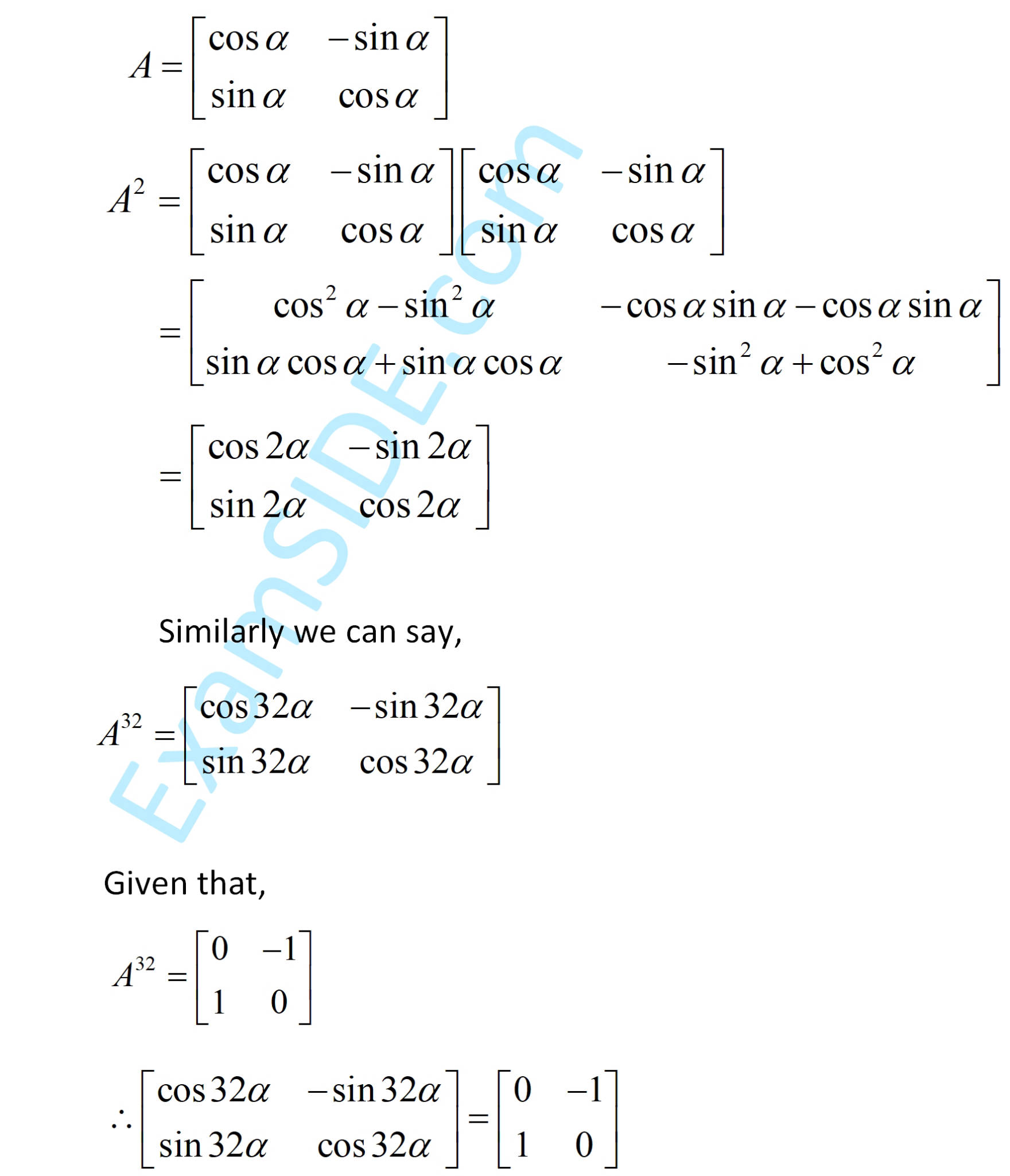
Let $A = \left( {\matrix{
{\cos \alpha } & { - \sin \alpha } \cr
{\sin \alpha } & {\cos \alpha } \cr
} } \right)$, ($\alpha $ $ \in $ R)
Show Answer
Correct Answer: D
Explanation:
From here sin 32$\alpha $ = 1 and cos 32$\alpha $ = 0
$ \therefore $ 32$\alpha $ = 2n$\pi $ + ${\pi \over 2}$
$ \Rightarrow $ $\alpha $ = ${\pi \over {64}} + {{n\pi } \over {16}}$
Putting n = 0, $\alpha $ = ${\pi \over {64}}$
2019
Q540
JEE Mains
MCQ
iCON Education HYD, 79930 92826, 73309 72826
14 Mar 2026
The set of all values of $\lambda $ for which the system of linear equations
B.
contains more than two elements
D.
contains exactly two elements
Show Answer
Correct Answer: C
Explanation:
$\left| {\matrix{
{\lambda - 1} & 2 & 2 \cr
1 & {2 - \lambda } & 1 \cr
1 & 1 & 1 \cr
} } \right| = 0$
2019
Q541
JEE Mains
MCQ
iCON Education HYD, 79930 92826, 73309 72826
14 Mar 2026
If A = $\left[ {\matrix{
1 & {\sin \theta } & 1 \cr
{ - \sin \theta } & 1 & {\sin \theta } \cr
{ - 1} & { - \sin \theta } & 1 \cr
} } \right]$;
A.
$\left( {{3 \over 2},3} \right]$
B.
$\left( {0,{3 \over 2}} \right]$
C.
$\left[ {{5 \over 2},4} \right)$
D.
$\left( {1,{5 \over 2}} \right]$
Show Answer
Correct Answer: A
Explanation:
$\left| A \right| = \left| {\matrix{
1 & {\sin \theta } & 1 \cr
{ - \sin \theta } & 1 & {\sin \theta } \cr
{ - 1} & { - \sin \theta } & 1 \cr
} } \right|$
2 $\theta $)
2 $\theta $ < ${1 \over 2}$
2019
Q542
JEE Mains
MCQ
iCON Education HYD, 79930 92826, 73309 72826
14 Mar 2026
Let P = $\left[ {\matrix{
1 & 0 & 0 \cr
3 & 1 & 0 \cr
9 & 3 & 1 \cr
} } \right]$ and Q = [qij ] be two 3 $ \times $ 3 matrices such that Q – P5 = I3 .
Show Answer
Correct Answer: D
Explanation:
$P = \left[ {\matrix{
1 & 0 & 0 \cr
3 & 1 & 0 \cr
9 & 3 & 1 \cr
} } \right]$
2019
Q543
JEE Mains
MCQ
iCON Education HYD, 79930 92826, 73309 72826
14 Mar 2026
An ordered pair ($\alpha $, $\beta $) for which the system of linear equations
Show Answer
Correct Answer: D
Explanation:
For unique solution
2019
Q544
JEE Mains
MCQ
iCON Education HYD, 79930 92826, 73309 72826
14 Mar 2026
If $\left| {\matrix{
{a - b - c} & {2a} & {2a} \cr
{2b} & {b - c - a} & {2b} \cr
{2c} & {2c} & {c - a - b} \cr
} } \right|$
2 , x $ \ne $ 0,
Show Answer
Correct Answer: A
Explanation:
$\left| {\matrix{
{a - b - c} & {2a} & {2a} \cr
{2b} & {b - c - a} & {2b} \cr
{2c} & {2c} & {c - a - b} \cr
} } \right|$
1 $ \to $ R1 + R2 + R3
2
2019
Q545
JEE Mains
MCQ
iCON Education HYD, 79930 92826, 73309 72826
14 Mar 2026
Let A and B be two invertible matrices of order 3 $ \times $ 3. If det(ABAT ) = 8 and det(AB–1 ) = 8,
–1 BT ) is equal to :
Show Answer
Correct Answer: C
Explanation:
${\left| A \right|^2}.\left| B \right| = 8$
$-$1 . BT ) $ = {1 \over 4} \times {1 \over 4} = {1 \over {16}}$
2019
Q546
JEE Mains
MCQ
iCON Education HYD, 79930 92826, 73309 72826
14 Mar 2026
If the system of linear equations
Show Answer
Correct Answer: A
Explanation:
P1 : 2x + 2y + 3z = a
2 : 3x $-$ y + 5z = b
3 : x $-$ 3y + 2z = c
1 + P3 = P2 $ \Rightarrow $ a + c = b
2019
Q547
JEE Mains
MCQ
iCON Education HYD, 79930 92826, 73309 72826
14 Mar 2026
Let A = $\left( {\matrix{
0 & {2q} & r \cr
p & q & { - r} \cr
p & { - q} & r \cr
} } \right).$ If AAT = I3 , then $\left| p \right|$ is :
A.
${1 \over {\sqrt 2 }}$
B.
${1 \over {\sqrt 5 }}$
C.
${1 \over {\sqrt 6 }}$
D.
${1 \over {\sqrt 3 }}$
Show Answer
Correct Answer: A
Explanation:
A is orthogonal matrix
2 + p2 + p2 = 1
2019
Q548
JEE Mains
MCQ
iCON Education HYD, 79930 92826, 73309 72826
14 Mar 2026
Let A = $\left[ {\matrix{
2 & b & 1 \cr
b & {{b^2} + 1} & b \cr
1 & b & 2 \cr
} } \right]$ where b > 0.
Show Answer
Correct Answer: D
Explanation:
A = $\left[ {\matrix{
2 & b & 1 \cr
b & {{b^2} + 1} & b \cr
1 & b & 2 \cr
} } \right]$ (b > 0)
2 + 2 $-$ b2 ) $-$ b(2b $-$ b) + 1(b2 $-$ b2 $-$ 1)
2 + 2) $-$ b2 $-$ 1
2 + 3
2019
Q549
JEE Mains
MCQ
iCON Education HYD, 79930 92826, 73309 72826
14 Mar 2026
The number of values of $\theta $ $ \in $ (0, $\pi $) for which the system of linear equations
Show Answer
Correct Answer: A
Explanation:
$\left| {\matrix{
1 & 3 & 7 \cr
{ - 1} & 4 & 7 \cr
{\sin 3\theta } & {\cos 2\theta } & 2 \cr
} } \right| = 0$
3 $\theta $ ) $-$ 14 (1 $-$ 2 sin2 $\theta $) = 0
3 $\theta $ + 28 sin2 $\theta $ = 0
2 $\theta $ + 4 sin $\theta $] = 0 sin$\theta $,
2 $\theta $ + 6 sin $\theta $ $-$ 2 sin $\theta $ $-$ 3 = 0
2019
Q550
JEE Mains
MCQ
iCON Education HYD, 79930 92826, 73309 72826
14 Mar 2026
If the system of equations
Show Answer
Correct Answer: A
Explanation:
$D = \left| {\matrix{
1 & 1 & 1 \cr
1 & 2 & 3 \cr
1 & 3 & \alpha \cr
} } \right| = \left| {\matrix{
1 & 1 & 1 \cr
0 & 1 & 2 \cr
0 & 2 & {\alpha - 1} \cr
} } \right|$