2021
JEE Mains
MCQ
iCON Education HYD, 79930 92826, 73309 72826
JEE Main 2021 (Online) 24th February Morning Shift
If f : R $ \to $ R is a function defined by f(x)= [x - 1] $\cos \left( {{{2x - 1} \over 2}} \right)\pi $, where [.] denotes the greatest
integer function, then f is :
A.
continuous for every real x
B.
discontinuous at all integral values of x except at x = 1
C.
discontinuous only at x = 1
D.
continuous only at x = 1
Show Answer
Practice Quiz
Correct Answer: A
Explanation:
Given, $f(x) = [x - 1]\cos \left( {{{2x - 1} \over 2}} \right)\pi $ where [ . ] is greatest integer function and f : R $\to$ R $\because$ It is a greatest integer function then we need to check its continuity at x $\in$ I except these it is continuous. Let, x = n where n $\in$ I Then LHL = $\mathop {\lim }\limits_{x \to {n^ - }} [x - 1]\cos \left( {{{2x - 1} \over 2}} \right)\pi $ $ = (n - 2)\cos \left( {{{2x - 1} \over 2}} \right)\pi = 0$ RHL = $\mathop {\lim }\limits_{x \to {n^ + }} [x - 1]\cos \left( {{{2x - 1} \over 2}} \right)\pi $ $ = (n - 1)\cos \left( {{{2x - 1} \over 2}} \right)\pi = 0$ and f(n) = 0 Here, $\mathop {\lim }\limits_{x \to {n^ - }} f(x) = \mathop {\lim }\limits_{x \to {n^ + }} f(x) = f(n)$ $\therefore$ It is continuous at every integers. Therefore, the given function is continuous for all real x.
2021
JEE Mains
Numerical
iCON Education HYD, 79930 92826, 73309 72826
JEE Main 2021 (Online) 1st September Evening Shift
Let $f(x) = {x^6} + 2{x^4} + {x^3} + 2x + 3$, x $\in$ R. Then the natural number n for which $\mathop {\lim }\limits_{x \to 1} {{{x^n}f(1) - f(x)} \over {x - 1}} = 44$ is __________.
Show Answer
Practice Quiz
Correct Answer: 7
Explanation:
$f(x) = {x^6} + 2{x^4} + {x^3} + 2x + 3$ $\mathop {\lim }\limits_{x \to 1} {{{x^n}f(1) - f(x)} \over {x - 1}} = 44$ $\mathop {\lim }\limits_{x \to 1} {{9{x^n} - ({x^6} + 2{x^4} + {x^3} + 2x + 3)} \over {x - 1}} = 44$ $\mathop {\lim }\limits_{x \to 1} {{9n{x^{n - 1}} - (6{x^5} + 8{x^3} + 3{x^2} + 2)} \over 1} = 44$ $\Rightarrow$ 9n $-$ (19) = 44 $\Rightarrow$ 9n = 63 $\Rightarrow$ n = 7
2021
JEE Mains
Numerical
iCON Education HYD, 79930 92826, 73309 72826
JEE Main 2021 (Online) 1st September Evening Shift
Let [t] denote the greatest integer $\le$ t. The number of points where the function $f(x) = [x]\left| {{x^2} - 1} \right| + \sin \left( {{\pi \over {[x] + 3}}} \right) - [x + 1],x \in ( - 2,2)$ is not continuous is _____________.
Show Answer
Practice Quiz
Correct Answer: 2
Explanation:
$f(x) = [x]\left| {{x^2} - 1} \right| + \sin \left( {{\pi \over {[x] + 3}}} \right) - [x + 1]$ $f\left( x \right) = \left\{ {\matrix{
{ - 2\left| {{x^2} - 1} \right| + 1,} & { - 2 < x < - 1} \cr
{ - \left| {{x^2} - 1} \right| + 1,} & { - 1 \le x < 0} \cr
{\sin {\pi \over 3} + 1,} & {0 \le x < 1} \cr
{\left| {{x^2} - 1} \right| + {1 \over {\sqrt 2 }} - 2,} & {1 \le x < 2} \cr
} } \right.$
$ \therefore $ at x = -1, $\mathop {\lim }\limits_{x \to - {1^ - }} f\left( x \right) = 1$ and $\mathop {\lim }\limits_{x \to - {1^ + }} f\left( x \right) = 1$
Hence continuous at x = –1
Similarly check at x = 0,
$\mathop {\lim }\limits_{x \to {0^ - }} f\left( x \right) = - 1$ and $\mathop {\lim }\limits_{x \to {0^ + }} f\left( x \right) = 1 + {{\sqrt 3 } \over 2}$
So, f(x) discontinuous
and at x = 0
$\mathop {\lim }\limits_{x \to {1^ - }} f\left( x \right) = 1 + {{\sqrt 3 } \over 2}$ and $\mathop {\lim }\limits_{x \to {1^ + }} f\left( x \right) = {1 \over {\sqrt 2 }} - 2$
So, f(x) discontinuous
and at x = 1
Hence 2 points of discontinuity.
2021
JEE Mains
Numerical
iCON Education HYD, 79930 92826, 73309 72826
JEE Main 2021 (Online) 26th August Morning Shift
Let a, b $\in$ R, b $\in$ 0, Define a function $f(x) = \left\{ {\matrix{
{a\sin {\pi \over 2}(x - 1),} & {for\,x \le 0} \cr
{{{\tan 2x - \sin 2x} \over {b{x^3}}},} & {for\,x > 0} \cr
} } \right.$. If f is continuous at x = 0, then 10 $-$ ab is equal to ________________.
Show Answer
Practice Quiz
Correct Answer: 14
Explanation:
$f(x) = \left\{ {\matrix{
{a\sin {\pi \over 2}(x - 1),} & {for\,x \le 0} \cr
{{{\tan 2x - \sin 2x} \over {b{x^3}}},} & {for\,x > 0} \cr
} } \right.$ For continuity at '0' $\mathop {\lim }\limits_{x \to {0^ + }} f(x) = f(0)$ $ \Rightarrow \mathop {\lim }\limits_{x \to {0^ + }} {{\tan 2x - \sin 2x} \over {b{x^3}}} = - a$ $ \Rightarrow \mathop {\lim }\limits_{x \to {0^ + }} {{{{8{x^3}} \over 3} + {{8{x^3}} \over {3!}}} \over {b{x^3}}} = - a$ $ \Rightarrow 8\left( {{1 \over 3} + {1 \over {3!}}} \right) = - ab$ $ \Rightarrow 4 = - ab$ $ \Rightarrow 10 - ab = 14$
2021
JEE Mains
Numerical
iCON Education HYD, 79930 92826, 73309 72826
JEE Main 2021 (Online) 27th July Morning Shift
Let $f:[0,3] \to R$ be defined by $f(x) = \min \{ x - [x],1 + [x] - x\} $ where [x] is the greatest integer less than or equal to x. Let P denote the set containing all x $\in$ [0, 3] where f i discontinuous, and Q denote the set containing all x $\in$ (0, 3) where f is not differentiable. Then the sum of number of elements in P and Q is equal to ______________.
Show Answer
Practice Quiz
Correct Answer: 5
Explanation:
1 $-$ {x} = 1 $-$ x; 0 $\le$ x < 1
Non differentiable at
$x = {1 \over 2},1,{3 \over 2},2,{5 \over 2}$
2021
JEE Mains
Numerical
iCON Education HYD, 79930 92826, 73309 72826
JEE Main 2021 (Online) 25th July Evening Shift
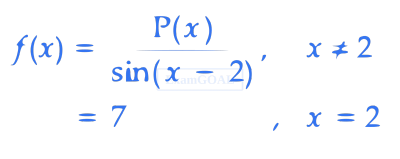
Consider the function
where P(x) is a polynomial such that P'' (x) is always a constant and P(3) = 9. If f(x) is continuous at x = 2, then P(5) is equal to _____________.
Show Answer
Practice Quiz
Correct Answer: 39
Explanation:
$f(x) = \left\{ {\matrix{
{{{P(x)} \over {\sin (x - 2)}},} & {x \ne 2} \cr
{7,} & {x = 2} \cr
} } \right.$ P''(x) = const. $\Rightarrow$ P(x) is a 2 degree polynomial f(x) is cont. at x = 2 f(2+ ) = f(2$-$ ) $\mathop {\lim }\limits_{x \to {2^ + }} {{P(x)} \over {\sin (x - 2)}} = 7$ $\mathop {\lim }\limits_{x \to {2^ + }} {{(x - 2)(ax + b)} \over {\sin (x - 2)}} = 7 \Rightarrow 2a + b = 7$ P(x) = (x $-$ 2)(ax + b) P(3) = (3 $-$ 2)(3a + b) = 9 $\Rightarrow$ 3a + b = 9 a = 2, b = 3 P(5) = (5 $-$ 2)(2.5 + 3) = 3.13 = 39
2021
JEE Mains
Numerical
iCON Education HYD, 79930 92826, 73309 72826
JEE Main 2021 (Online) 22th July Evening Shift
Let f : R $\to$ R be a function defined as $f(x) = \left\{ {\matrix{
{3\left( {1 - {{|x|} \over 2}} \right)} & {if} & {|x|\, \le 2} \cr
0 & {if} & {|x|\, > 2} \cr
} } \right.$ Let g : R $\to$ R be given by $g(x) = f(x + 2) - f(x - 2)$. If n and m denote the number of points in R where g is not continuous and not differentiable, respectively, then n + m is equal to ______________.
Show Answer
Practice Quiz
Correct Answer: 4
Explanation:
$f(x) = \left\{ {\matrix{
{3\left( {{{1 - \left| x \right|} \over 2}} \right)} & {if\,\left| x \right| \le 2} \cr
0 & {if\,\left| x \right| > 2} \cr
} } \right.$
$g(x) = f(x + 2) - f(x - 2)$
$f(x) = \left\{ {\matrix{
{0,} & {x < - 2} \cr
{{3 \over 2}(1 + x),} & { - 2 \le x < 0} \cr
{{3 \over 2}(1 - x),} & {0 \le x < 2} \cr
{0,} & {x > 2} \cr
} } \right.$
$f(x + 2) = \left\{ {\matrix{
{0,} & {x < - 4} \cr
{{3 \over 2}( 3 + x),} & { - 4 \le x < - 2} \cr
{{3 \over 2}( - 1 - x),} & { - 2 \le x < 0} \cr
{0,} & {x > 4} \cr
} } \right.$
$f(x - 2) = \left\{ {\matrix{
{0,} & {x < 0} \cr
{{3 \over 2}(x - 1),} & {0 \le x < 2} \cr
{{3 \over 2}( - 1 - x),} & {2 \le x < 4} \cr
{0,} & {x > 4} \cr
} } \right.$
$g(x) = f(x + 2) + f(x - 2)$
$ = \left\{ {\matrix{
{{{3x} \over 2} + 6,} & { - 4 \le x \le 2} \cr
{ - {{3x} \over 2},} & { - 2 < x < 2} \cr
{{{3x} \over 2} - 6,} & {2 \le x \le 4} \cr
{0,} & {\left| x \right| > 4} \cr
} } \right.$
So, n = 0 and m = 4
$\therefore$ m + n = 4
2021
JEE Mains
Numerical
iCON Education HYD, 79930 92826, 73309 72826
JEE Main 2021 (Online) 20th July Evening Shift
Let a function g : [ 0, 4 ] $\to$ R be defined as $g(x) = \left\{ {\matrix{
{\mathop {\max }\limits_{0 \le t \le x} \{ {t^3} - 6{t^2} + 9t - 3),} & {0 \le x \le 3} \cr
{4 - x,} & {3 < x \le 4} \cr
} } \right.$, then the number of points in the interval (0, 4) where g(x) is NOT differentiable, is ____________.
Show Answer
Practice Quiz
Correct Answer: 1
Explanation:
$f(x) = {x^3} - 6{x^2} + 9x - 3$ $f(x) = 3{x^2} - 12x + 9 = 3(x - 1)(x - 3)$ $f(1) = 1$, $f(3) = 3$ $g(x) = \left[ {\matrix{
{f(9x)} & {0 \le x \le 1} \cr
0 & {1 \le x \le 3} \cr
{ - 1} & {3 < x \le 4} \cr
} } \right.$ g(x) is continuous $g'(x) = \left[ {\matrix{
{3(x - 1)(x - 3)} & {0 \le x \le 1} \cr
0 & {1 \le x \le 3} \cr
{ - 1} & {3 < x \le 4} \cr
} } \right.$ g(x) is non-differentiable at x = 3
2021
JEE Mains
Numerical
iCON Education HYD, 79930 92826, 73309 72826
JEE Main 2021 (Online) 20th July Evening Shift
If $\mathop {\lim }\limits_{x \to 0} {{\alpha x{e^x} - \beta {{\log }_e}(1 + x) + \gamma {x^2}{e^{ - x}}} \over {x{{\sin }^2}x}} = 10,\alpha ,\beta ,\gamma \in R$, then the value of $\alpha$ + $\beta$ + $\gamma$ is _____________.
Show Answer
Practice Quiz
Correct Answer: 3
Explanation:
$\mathop {\lim }\limits_{x \to 0} {{\alpha x\left( {1 + x + {{{x^2}} \over x}} \right) - \beta \left( {x - {{{x^2}} \over 2} + {{{x^3}} \over 3}} \right) + \gamma {x^2}(1 - x)} \over {{x^3}}}$ $\mathop {\lim }\limits_{x \to 0} {{x(\alpha - \beta ) + {x^2}\left( {\alpha + {\beta \over 2} + \gamma } \right) + {x^3}\left( {{\alpha \over 2} - {\beta \over 3} - \gamma } \right)} \over {{x^3}}} = 10$ For limit to exist $\alpha - \beta = 0,\alpha + {\beta \over 2} + \gamma = 0$${\alpha \over 2} - {\beta \over 3} - \gamma = 10$ ..... (i) $\beta = \alpha ,\gamma = - 3{\alpha \over 2}$ Put in (i) ${\alpha \over 2} - {\alpha \over 3} + {{3\alpha } \over 2} = 10$ ${\alpha \over 6} + {{3\alpha } \over 2} = 10 \Rightarrow {{\alpha + 9\alpha } \over 6} = 10$ $ \Rightarrow \alpha = 6$ $\alpha$ = 6, $\beta$ = 6, $\gamma$ = $-$9 $\alpha$ + $\beta$ + $\gamma$ = 3
2021
JEE Mains
Numerical
iCON Education HYD, 79930 92826, 73309 72826
JEE Main 2021 (Online) 20th July Morning Shift
If the value of $\mathop {\lim }\limits_{x \to 0} {(2 - \cos x\sqrt {\cos 2x} )^{\left( {{{x + 2} \over {{x^2}}}} \right)}}$ is equal to ea , then a is equal to __________.
Show Answer
Practice Quiz
Correct Answer: 3
Explanation:
$\mathop {\lim }\limits_{x \to 0} {(2 - \cos x\sqrt {\cos 2x} )^{{{x + 2} \over {{x^2}}}}}$ form : 1$\infty$ $ = {e^{\mathop {\lim }\limits_{x \to 0} \left( {{{1 - \cos x\sqrt {\cos 2x} } \over {{x^2}}}} \right) \times (x + 2)}}$ Now, $\mathop {\lim }\limits_{x \to 0} {{1 - \cos x\sqrt {\cos 2x} } \over {{x^2}}} = \mathop {\lim }\limits_{x \to 0} {{\sin x\sqrt {\cos 2x} - \cos x \times {1 \over {2\sqrt {\cos 2x} }} \times ( - 2sin2x)} \over {2x}}$ (by L' Hospital Rule) $\mathop {\lim }\limits_{x \to 0} {{\sin x\cos 2x + \sin 2x.\cos x} \over {2x}} = {1 \over 2} + 1 = {3 \over 2}$ So, ${e^{\mathop {\lim }\limits_{x \to 0} \left( {{{1 - \cos x\sqrt {\cos 2x} } \over {{x^2}}}} \right)(x + 2)}}$ $ = {e^{{3 \over 2} \times 2}} = {e^3}$ $\Rightarrow$ a = 3
2021
JEE Mains
Numerical
iCON Education HYD, 79930 92826, 73309 72826
JEE Main 2021 (Online) 18th March Evening Shift
Let f : R $ \to $ R satisfy the equation f(x + y) = f(x) . f(y) for all x, y $\in$R and f(x) $\ne$ 0 for any x$\in$R. If the function f is differentiable at x = 0 and f'(0) = 3, then $\mathop {\lim }\limits_{h \to 0} {1 \over h}(f(h) - 1)$ is equal to ____________.
Show Answer
Practice Quiz
Correct Answer: 3
Explanation:
Given, $f(x + y) = f(x)\,.\,f(y)\,\forall x,y \in R$
$\therefore$ $f(x) = {a^x} \Rightarrow f'(x) = {a^x}\,.\,\log (a)$
Now, $f'(0) = \log (a) \Rightarrow 3 = \log (a) \Rightarrow a = {e^3}$
$\therefore$ $f(x) = {({e^3})^x} = {e^{3x}}$
$\therefore$ $f(h) = {e^{3h}}$
Now, $\mathop {\lim }\limits_{h \to 0} \left( {{{f(h) - 1} \over h}} \right) = \mathop {\lim }\limits_{h \to 0} \left( {{{{e^{3h}} - 1} \over h}} \right)$
$ = \mathop {\lim }\limits_{h \to 0} \left( {{{{e^{3h}} - 1} \over {3h}} \times 3} \right) = 3 \times 1 = 3$
2021
JEE Mains
Numerical
iCON Education HYD, 79930 92826, 73309 72826
JEE Main 2021 (Online) 17th March Morning Shift
If the function $f(x) = {{\cos (\sin x) - \cos x} \over {{x^4}}}$ is continuous at each point in its domain and $f(0) = {1 \over k}$, then k is ____________.
Show Answer
Practice Quiz
Correct Answer: 6
Explanation:
$\mathop {\lim }\limits_{x \to 0} f\left( x \right) = \mathop {\lim }\limits_{x \to 0} {{\cos \left( {\sin x} \right) - \cos x} \over {{x^4}}}$
$ \Rightarrow $ ${1 \over k} = \mathop {\lim }\limits_{x \to 0} {{2\sin \left( {{{\sin x + x} \over 2}} \right)\sin \left( {{{x - \sin x} \over 2}} \right)} \over {{x^4}}}$
= $\mathop {\lim }\limits_{x \to 0} {{2\sin \left( {{{x + \sin x} \over 2}} \right)} \over {\left( {{{x + \sin x} \over 2}} \right)}} \times {{\sin \left( {{{x - \sin x} \over 2}} \right)} \over {\left( {{{x - \sin x} \over 2}} \right)}} \times {{{x^2} - {{\sin }^2}x} \over {4{x^4}}}$
= $\mathop {\lim }\limits_{x \to 0} 2 \times 1 \times \left( {{{x + \sin x} \over x}} \right)\left( {{{x - \sin x} \over {{x^3}}}} \right) \times {1 \over 4}$
= $\mathop {\lim }\limits_{x \to 0} 2 \times 1 \times \left( {{{1 + \cos x} \over 1}} \right)\left( {{{1 - \cos x} \over {3{x^2}}}} \right) \times {1 \over 4}$
= $\mathop {\lim }\limits_{x \to 0} 2 \times 1 \times \left( {{{1 + 1} \over 1}} \right)\left( {{{1 - \cos x} \over {3{x^2}}}} \right) \times {1 \over 4}$
= $\mathop {\lim }\limits_{x \to 0} 2 \times 1 \times \left( {{{1 + 1} \over 1}} \right)\left( {{{1 + \sin x} \over {6x}}} \right) \times {1 \over 4}$
= $2 \times 2 \times {1 \over 6} \times {1 \over 4}$ = ${1 \over 6}$
2021
JEE Mains
Numerical
iCON Education HYD, 79930 92826, 73309 72826
JEE Main 2021 (Online) 16th March Evening Shift
Let f : R $ \to $ R and g : R $ \to $ R be defined as $f(x) = \left\{ {\matrix{
{x + a,} & {x < 0} \cr
{|x - 1|,} & {x \ge 0} \cr
} } \right.$ and $g(x) = \left\{ {\matrix{
{x + 1,} & {x < 0} \cr
{{{(x - 1)}^2} + b,} & {x \ge 0} \cr
} } \right.$, where a, b are non-negative real numbers. If (gof) (x) is continuous for all x $\in$ R, then a + b is equal to ____________.
Show Answer
Practice Quiz
Correct Answer: 1
Explanation:
$g[f(x)] = \left[ {\matrix{
{f(x) + 1} & {f(x) < 0} \cr
{{{(f(x) - 1)}^2} + b} & {f(x) \ge 0} \cr
} } \right.$ $g[f(x)] = \left[ {\matrix{
{x + a + 1} & {x + a < 0\& x < 0} \cr
{|x - 1| + 1} & {|x - 1| < 0\& x \ge 0} \cr
{{{(x + a - 1)}^2} + b} & {x + a \ge 0\& x < 0} \cr
{{{(|x - 1| - 1)}^2} + b} & {|x - 1| \ge 0\& x \ge 0} \cr
} } \right.$ $g[f(x)] = \left[ {\matrix{
{x + a + 1} & {x \in ( - \infty , - a)\& x \in ( - \infty ,0)} \cr
{|x - 1| + 1} & {x \in \phi } \cr
{{{(x + a - 1)}^2} + b} & {x \in [ - a,\infty )\& x \in [0,\infty )} \cr
{{{(|x - 1| - 1)}^2} + b} & {x \in R\& x \in [0,\infty )} \cr
} } \right.$ $g[f(x)] = \left[ {\matrix{
{x + a + 1} & {x \in ( - \infty , - a)} \cr
{{{(x + a - 1)}^2} + b} & {x \in [ - a,0)} \cr
{{{(|x - 1| - 1)}^2} + b} & {x \in [0,\infty )} \cr
} } \right.$ g(f(x)) is continuous.
At x = $-$a
-a + a + 1 = (-a + a - 1)2 + b
$ \Rightarrow $ 1 = b + 1
$ \Rightarrow $ b = 0
at x = 0
(a $-$1)2 + b = (|0 - 1| - 1)2 + b
$ \Rightarrow $ (a $-$1)2 + b = b
$ \Rightarrow $ a = 1 $ \Rightarrow $ a + b = 1
2021
JEE Mains
Numerical
iCON Education HYD, 79930 92826, 73309 72826
JEE Main 2021 (Online) 16th March Morning Shift
If $\mathop {\lim }\limits_{x \to 0} {{a{e^x} - b\cos x + c{e^{ - x}}} \over {x\sin x}} = 2$, then a + b + c is equal to ____________.
Show Answer
Practice Quiz
Correct Answer: 4
Explanation:
$\mathop {\lim }\limits_{x \to 0} {{\left\{ {a\left( {1 + x + {{{x^2}} \over {2!}} + .....} \right) - b\left( {1 - {{{x^2}} \over {2!}} + {{{x^4}} \over {4!}}......} \right) + c\left( {1 - x + {{{x^2}} \over {2!}}......} \right)} \right\}} \over {x\left( {x - {{{x^3}} \over {3!}} + .....} \right)}} = 2$ $ \therefore $ $\mathop {\lim }\limits_{x \to 0} {{(a - b + c) + x(a - c) + {x^2}\left( {{a \over 2} + {b \over 2} + {c \over 2}} \right) + ....} \over {{x^2}\left( {1 - {{{x^2}} \over 6}....} \right)}} = 2$ For this limit to exist
a $-$ b + c = 0 & a $-$ c = 0 & ${a \over 2} + {b \over 2} + {c \over 2} = 2$ $ \Rightarrow $ a + b + c = 4
2021
JEE Mains
Numerical
iCON Education HYD, 79930 92826, 73309 72826
JEE Main 2021 (Online) 25th February Evening Shift
A function f is defined on [$-$3, 3] as $f(x) = \left\{ {\matrix{
{\min \{ |x|,2 - {x^2}\} ,} & { - 2 \le x \le 2} \cr
{[|x|],} & {2 < |x| \le 3} \cr
} } \right.$ where [x] denotes the greatest integer $ \le $ x. The number of points, where f is not differentiable in ($-$3, 3) is ___________.
Show Answer
Practice Quiz
Correct Answer: 5
Explanation:
Points of non-differentiability in ($-$3, 3) are at x = $-$2, $-$1, 0, 1, 2.
i.e. 5 points.
2021
JEE Mains
Numerical
iCON Education HYD, 79930 92826, 73309 72826
JEE Main 2021 (Online) 25th February Evening Shift
If $\mathop {\lim }\limits_{x \to 0} {{ax - ({e^{4x}} - 1)} \over {ax({e^{4x}} - 1)}}$ exists and is equal to b, then the value of a $-$ 2b is __________.
Show Answer
Practice Quiz
Correct Answer: 5
Explanation:
$\mathop {\lim }\limits_{x \to 0} {{ax - \left( {{e^{4x}} - 1} \right)} \over {ax\left( {{e^{4x}} - 1} \right)}}$ Applying L' Hospital Rule $\mathop {\lim }\limits_{x \to 0} {{a - 4{e^{4x}}} \over {a\left( {{e^{4x}} - 1} \right) + ax\left( {4{e^{4x}}} \right)}}$
This is ${{a - 4} \over 0}$.
limit exist only when $a - 4 = 0$ $ \Rightarrow $ a = 4 Applying L' Hospital Rule $\mathop {\lim }\limits_{x \to 0} {{ - 16{e^{4x}}} \over {a\left( {4{e^{4x}}} \right) + a\left( {4{e^{4x}}} \right) + ax\left( {16{e^{4x}}} \right)}}$ = ${{ - 16} \over {4a + 4a}} = {{ - 16} \over {32}} = - {1 \over 2} = b$ $a - 2b = 4 - 2\left( {{{ - 1} \over 2}} \right) = 4 + 1 = 5$
2021
JEE Mains
Numerical
iCON Education HYD, 79930 92826, 73309 72826
JEE Main 2021 (Online) 25th February Morning Shift
The number of points, at which the function f(x) = | 2x + 1 | $-$ 3| x + 2 | + | x2 + x $-$ 2 |, x$\in$R is not differentiable, is __________.
Show Answer
Practice Quiz
Correct Answer: 2
Explanation:
$f(x) = |2x + 1| - 3|x + 2| + |{x^2} + x - 2|$ $f(x) = \left\{ {\matrix{
{{x^2} - 7;} & {x > 1} \cr
{ - {x^2} - 2x - 3;} & { - {1 \over 2} < x < 1} \cr
{ - {x^2} - 6x - 5;} & { - 2 < x < {{ - 1} \over 2}} \cr
{{x^2} + 2x + 3;} & {x < - 2} \cr
} } \right.$ $ \therefore $ $f'(x) = \left\{ {\matrix{
{2x;} & {x > 1} \cr
{2x - 3;} & { - {1 \over 2} < x < 1} \cr
{ - 2x - 6;} & { - 2 < x < {{ - 1} \over 2}} \cr
{2x + 2;} & {x < - 2} \cr
} } \right.$ Check at 1, $-$2 and ${{ - 1} \over 2}$ Non. differentiable at x = 1 and ${{ - 1} \over 2}$
2021
JEE Mains
Numerical
iCON Education HYD, 79930 92826, 73309 72826
JEE Main 2021 (Online) 24th February Morning Shift
$\mathop {\lim }\limits_{n \to \infty } \tan \left\{ {\sum\limits_{r = 1}^n {{{\tan }^{ - 1}}\left( {{1 \over {1 + r + {r^2}}}} \right)} } \right\}$ is equal to ______.
Show Answer
Practice Quiz
Correct Answer: 1
Explanation:
${\tan ^{ - 1}}\left( {{1 \over {1 + r + {r^2}}}} \right)$ $ = {\tan ^{ - 1}}\left( {{{r + 1 - r} \over {1 + r(r + 1)}}} \right)$ $ = {\tan ^{ - 1}}(r + 1) - {\tan ^{ - 1}}r$ $ \therefore $ $\sum\limits_{r = 1}^n {\left( {{{\tan }^{ - 1}}(r + 1) - {{\tan }^{ - 1}}(r)} \right)} $ $ = {\tan ^{ - 1}}(2) - {\tan ^{ - 1}}(1) + ta{n^{ - 1}}(3) - {\tan ^1}(2) + ta{n^{ - 1}}(n + 1) - {\tan ^{ - 1}}(n)$ $ = {\tan ^{ - 1}}(n + 1) - {\tan ^{ - 1}}(1)$ $ = {\tan ^{ - 1}}\left( {{{n + 1 - 1} \over {1 + (n + 1)1}}} \right)$ $ = {\tan ^{ - 1}}\left( {{n \over {n + 2}}} \right)$ $\mathop {\lim }\limits_{n \to \infty } \tan \left( {\sum\limits_{r = 1}^n {{{\tan }^{ - 1}}\left( {{1 \over {1 + r + {r^2}}}} \right)} } \right)$ $ = \mathop {\lim }\limits_{x \to \infty } \tan \left( {{{\tan }^{ - 1}}\left( {{n \over {n + 2}}} \right)} \right)$ $ = \mathop {\lim }\limits_{x \to \infty } {n \over {n + 2}}$ $ = 1$
2020
JEE Mains
MCQ
iCON Education HYD, 79930 92826, 73309 72826
JEE Main 2020 (Online) 6th September Evening Slot
Let f : R $ \to $ R be a function defined by f(x) = max {x, x2 }. Let S denote the set of all points in R, where f is not differentiable.
Then :
Show Answer
Practice Quiz
Correct Answer: A
Explanation:
From graph you can see,
(1) when x < 0 then y = x
2 is greater than y = x. That is why for f(x) that curved part is chosen.
(2) when 0 $ \le $ x < 1 then y = x is greater than y = x
2 . That is why for f(x) part of that straight line is chosen.
(3) when x $ \ge $ 1 then y = x
2 is greater than y = x. That is why for f(x) that curved part is chosen.
Here on the graph of f(x) there is two sharp corner at x = 0 and x = 1. As we know no function is differentiable at the sharp corner. So f(x) is not differentiable at those two sharp corner.
2020
JEE Mains
MCQ
iCON Education HYD, 79930 92826, 73309 72826
JEE Main 2020 (Online) 6th September Evening Slot
For all twice differentiable functions f : R $ \to $ R,
with f(0) = f(1) = f'(0) = 0
A.
f''(x) $ \ne $ 0, at every point x $ \in $ (0, 1)
B.
f''(x) = 0, for some x $ \in $ (0, 1)
D.
f''(x) = 0, at every point x $ \in $ (0, 1)
Show Answer
Practice Quiz
Correct Answer: B
Explanation:
f : R $ \to $ R, with f(0) = f(1) = 0
and f'(0) = 0
$ \because $ f(x) is differentiable and continuous
and f(0) = f(1) = 0
Applying Rolle’s theorem in [0, 1] for function f(x)
f'(c) = 0, c $ \in $ (0, 1)
Now again
$ \because $ f'(c) = 0, f'(0) = 0
again applying Rolles theorem in [0, c] for function f'(x)
f''(c1 ) = 0 for some c1 $ \in $ (0, c) $ \in $ (0, 1)
2020
JEE Mains
MCQ
iCON Education HYD, 79930 92826, 73309 72826
JEE Main 2020 (Online) 5th September Evening Slot
$\mathop {\lim }\limits_{x \to 0} {{x\left( {{e^{\left( {\sqrt {1 + {x^2} + {x^4}} - 1} \right)/x}} - 1} \right)} \over {\sqrt {1 + {x^2} + {x^4}} - 1}}$
B.
is equal to $\sqrt e $.
Show Answer
Practice Quiz
Correct Answer: C
Explanation:
$\mathop {\lim }\limits_{x \to 0} {{x\left( {{e^{\left( {\sqrt {1 + {x^2} + {x^4}} - 1} \right)/x}} - 1} \right)} \over {\sqrt {1 + {x^2} + {x^4}} - 1}}$
= $\mathop {\lim }\limits_{x \to 0} {{x\left[ {{e^{{{\left( {\sqrt {1 + {x^2} + {x^4}} - 1} \right)\left( {\sqrt {1 + {x^2} + {x^4}} + 1} \right)} \over {x\left( {\sqrt {1 + {x^2} + {x^4}} + 1} \right)}}}} - 1} \right] \times \left( {\sqrt {1 + {x^2} + {x^4}} + 1} \right)} \over {\left( {\sqrt {1 + {x^2} + {x^4}} - 1} \right)\left( {\sqrt {1 + {x^2} + {x^4}} + 1} \right)}}$
= $\mathop {\lim }\limits_{x \to 0} {{x\left[ {{e^{{{\left( {1 + {x^2} + {x^4}} \right) - 1} \over {x\left( {\sqrt {1 + {x^2} + {x^4}} + 1} \right)}}}} - 1} \right] \times \left( {\sqrt {1 + {x^2} + {x^4}} + 1} \right)} \over {\left( {1 + {x^2} + {x^4} - 1} \right)}}$
= $\mathop {\lim }\limits_{x \to 0} {{\left[ {{e^{{{{x^2} + {x^4}} \over {x\left( {\sqrt {1 + 0 + 0} + 1} \right)}}}} - 1} \right] \times \left( {\sqrt {1 + 0 + 0} + 1} \right)} \over {x + {x^3}}}$
= $2\mathop {\lim }\limits_{x \to 0} {{\left[ {{e^{{{{x^2} + {x^4}} \over {2x}}}} - 1} \right]} \over {x + {x^3}}}$
= $2\mathop {\lim }\limits_{x \to 0} {{\left[ {{e^{{{x + {x^3}} \over 2}}} - 1} \right]} \over {{{x + {x^3}} \over 2} \times 2}}$
= $2 \times {1 \over 2} \times 1$
= 1
Note : As from formula, $\mathop {\lim }\limits_{x \to 0} {{\left[ {{e^{{{x + {x^3}} \over 2}}} - 1} \right]} \over {{{x + {x^3}} \over 2}}}$ = 1
2020
JEE Mains
MCQ
iCON Education HYD, 79930 92826, 73309 72826
JEE Main 2020 (Online) 5th September Morning Slot
If the function $f\left( x \right) = \left\{ {\matrix{
{{k_1}{{\left( {x - \pi } \right)}^2} - 1,} & {x \le \pi } \cr
{{k_2}\cos x,} & {x > \pi } \cr
} } \right.$ is twice differentiable, then the ordered pair (k1 , k2 ) is equal to :
A.
$\left( {{1 \over 2},-1} \right)$
D.
$\left( {{1 \over 2},1} \right)$
Show Answer
Practice Quiz
Correct Answer: D
Explanation:
Given, $f\left( x \right) = \left\{ {\matrix{
{{k_1}{{\left( {x - \pi } \right)}^2} - 1,} & {x \le \pi } \cr
{{k_2}\cos x,} & {x > \pi } \cr
} } \right.$
Differentiating one time,
$f'\left( x \right) = \left\{ {\matrix{
{2{k_1}\left( {x - \pi } \right),} & {x \le \pi } \cr
{ - {k_2}\sin x,} & {x > \pi } \cr
} } \right.$
Differentiating one more time,
$f''\left( x \right) = \left\{ {\matrix{
{2{k_1},} & {x \le \pi } \cr
{ - {k_2}\cos x,} & {x > \pi } \cr
} } \right.$
As f''(x) is differentiable so
f''($\pi $+ ) = f''($\pi $- )
$ \Rightarrow $ -k2 (-1) = 2k1
$ \Rightarrow $ 2k1 = k2
$ \therefore $ (k1 , k2 ) = $\left( {{1 \over 2},1} \right)$
2020
JEE Mains
MCQ
iCON Education HYD, 79930 92826, 73309 72826
JEE Main 2020 (Online) 5th September Morning Slot
If $\alpha $ is positive root of the equation, p(x) = x2 - x - 2 = 0, then
$\mathop {\lim }\limits_{x \to {\alpha ^ + }} {{\sqrt {1 - \cos \left( {p\left( x \right)} \right)} } \over {x + \alpha - 4}}$ is equal to :
Show Answer
Practice Quiz
Correct Answer: C
Explanation:
${x^2} - x - 2 = 0$ roots are 2 & $-$1 $ \Rightarrow $ $\alpha $ = 2 (given $\alpha$ is positive) Now $ \mathop {\lim }\limits_{x \to {2^ + }} {{\sqrt {1 - \cos ({x^2} - x - 2)} } \over {(x - 2)}}$ $ = \mathop {\lim }\limits_{x \to {2^ + }} {{\sqrt {2{{\sin }^2}{{({x^2} - x - 2)} \over 2}} } \over {(x - 2)}}$ $ = \mathop {\lim }\limits_{x \to {2^ + }} {{\sqrt 2 \sin \left( {{{(x - 2)(x + 1)} \over 2}} \right)} \over {(x - 2)}}$ $ = {3 \over {\sqrt 2 }}$
2020
JEE Mains
MCQ
iCON Education HYD, 79930 92826, 73309 72826
JEE Main 2020 (Online) 4th September Evening Slot
Let $f:\left( {0,\infty } \right) \to \left( {0,\infty } \right)$ be a differentiable function such that f(1) = e and $\mathop {\lim }\limits_{t \to x} {{{t^2}{f^2}(x) - {x^2}{f^2}(t)} \over {t - x}} = 0$. If f(x) = 1, then x is equal to :
Show Answer
Practice Quiz
Correct Answer: A
Explanation:
$\mathop {\lim }\limits_{t \to x} {{{t^2}{f^2}(x) - {x^2}{f^2}(t)} \over {t - x}} = 0$
(Using L'Hospital's Rule) $ \Rightarrow \mathop {\lim }\limits_{t \to x} {{2t{f^2}(x) - 2{x^2}f(t).f'(t)} \over 1} = 0$
$ \Rightarrow $ 2xf2 (x) - 2x2 .f(x).f'(x) = 0
$ \Rightarrow $ 2xf(x){f(x) - xf'(x)} = 0
[x $ \ne $ 0, f(x) $ \ne $ 0 as given function $f:\left( {0,\infty } \right) \to \left( {0,\infty } \right)$ only takes positive value as input and output]
$ \Rightarrow f(x) = xf'(x) $
$\Rightarrow {{f'(x)} \over {f(x)}} = {1 \over x}$ Integrating w.r.t x, we get $ \Rightarrow ln\,f(x) = ln\,x + ln\,C$ $ \Rightarrow f(x) = Cx$ $ \because $ f(1) = e $ \Rightarrow C = e;\,so\,f(x) = ex$ When f(x) = 1 = ex $ \Rightarrow x = {1 \over e}$
2020
JEE Mains
MCQ
iCON Education HYD, 79930 92826, 73309 72826
JEE Main 2020 (Online) 4th September Evening Slot
The function $f(x) = \left\{ {\matrix{
{{\pi \over 4} + {{\tan }^{ - 1}}x,} & {\left| x \right| \le 1} \cr
{{1 \over 2}\left( {\left| x \right| - 1} \right),} & {\left| x \right| > 1} \cr
} } \right.$ is :
A.
continuous on R–{–1} and differentiable on R–{–1, 1}
B.
both continuous and differentiable on R–{1}
C.
both continuous and differentiable on R–{–1}
D.
continuous on R–{1} and differentiable on R–{–1, 1}
Show Answer
Practice Quiz
Correct Answer: D
Explanation:
$f\left( x \right) = \left\{ {\matrix{
{{\pi \over 4} + {{\tan }^{ - 1}}x,} & {x \in \left[ { - 1,1} \right]} \cr
{{1 \over 2}\left( {x - 1} \right),} & {x > 1} \cr
{{1 \over 2}\left( { - x - 1} \right),} & {x < - 1} \cr
} } \right.$
At x = 1
L.H.L = $\mathop {\lim }\limits_{x \to {1^ - }} \left( {{\pi \over 4} + {{\tan }^{ - 1}}x} \right)$ = ${{\pi \over 4} + {\pi \over 4}}$ = ${{\pi \over 2}}$
f(1) = ${{\pi \over 4} + {{\tan }^{ - 1}}x}$ = ${{\pi \over 4} + {\pi \over 4}}$ = ${{\pi \over 2}}$
R.H.L = $\mathop {\lim }\limits_{x \to {1^ + }} \left( {{1 \over 2}\left( {x - 1} \right)} \right)$ = 0
As L.H.L $ \ne $ R.H.L so function is discontinuous $ \Rightarrow $ non differentiable.
At x = -1
L.H.L = $\mathop {\lim }\limits_{x \to - {1^ - }} \left( {{1 \over 2}\left( { - x - 1} \right)} \right)$ = ${{1 \over 2}\left( { - \left( { - 1} \right) - 1} \right)}$ = 0
f(-1) = ${\pi \over 4} + {\tan ^{ - 1}}\left( { - 1} \right)$ = ${\pi \over 4} - {\pi \over 4}$ = 0
R.H.L = $\mathop {\lim }\limits_{x \to - {1^ + }} \left( {{\pi \over 4} + {{\tan }^{ - 1}}x} \right)$ = ${\pi \over 4} + {\tan ^{ - 1}}\left( { - 1} \right)$ = ${\pi \over 4} - {\pi \over 4}$ = 0
As L.H.L = f(-1) = R.H.L so function is continuous.
$f'\left( x \right) = \left\{ {\matrix{
{{1 \over {1 + {x^2}}},} & {x \in \left[ { - 1,1} \right]} \cr
{{1 \over 2},} & {x > 1} \cr
{ - {1 \over 2},} & {x < - 1} \cr
} } \right.$
For differentiability at x = –1
L.H.D = ${ - {1 \over 2}}$
R.H.D. = ${{1 \over 2}}$
So, non differentiable at x = –1
2020
JEE Mains
MCQ
iCON Education HYD, 79930 92826, 73309 72826
JEE Main 2020 (Online) 3rd September Evening Slot
$\mathop {\lim }\limits_{x \to a} {{{{\left( {a + 2x} \right)}^{{1 \over 3}}} - {{\left( {3x} \right)}^{{1 \over 3}}}} \over {{{\left( {3a + x} \right)}^{{1 \over 3}}} - {{\left( {4x} \right)}^{{1 \over 3}}}}}$ ($a$ $ \ne $ 0) is equal to :
A.
$\left( {{2 \over 9}} \right){\left( {{2 \over 3}} \right)^{{1 \over 3}}}$
B.
$\left( {{2 \over 3}} \right){\left( {{2 \over 9}} \right)^{{1 \over 3}}}$
C.
${\left( {{2 \over 3}} \right)^{{4 \over 3}}}$
D.
${\left( {{2 \over 9}} \right)^{{4 \over 3}}}$
Show Answer
Practice Quiz
Correct Answer: B
Explanation:
L = $\mathop {\lim }\limits_{x \to a} {{{{\left( {a + 2x} \right)}^{{1 \over 3}}} - {{\left( {3x} \right)}^{{1 \over 3}}}} \over {{{\left( {3a + x} \right)}^{{1 \over 3}}} - {{\left( {4x} \right)}^{{1 \over 3}}}}}$
$= \mathop {\lim }\limits_{h \to 0} {{{{(a + 2(a + h))}^{1/3}} - {{(3(a + h))}^{1/3}}} \over {{{(3a + a + h)}^{1/3}} - {{(4(a + h))}^{1/3}}}}$ = $\mathop {\lim }\limits_{h \to 0} {{{{(3a)}^{1/3}}{{\left( {1 + {{2h} \over {3a}}} \right)}^{1/3}} - {{(3a)}^{1/3}}{{\left( {1 + {h \over a}} \right)}^{1/3}}} \over {{{(4a)}^{1/3}}{{\left( {1 + {h \over {4a}}} \right)}^{1/3}} - {{(4a)}^{1/3}}{{\left( {1 + {h \over a}} \right)}^{1/3}}}}$ = $\mathop {\lim }\limits_{h \to 0} \left( {{{{3^{1/3}}} \over {{4^{1/3}}}}} \right)\left[ {{{\left( {1 + {{2h} \over {9a}}} \right) - \left( {1 + {h \over {3a}}} \right)} \over {\left( {1 + {h \over {12a}}} \right) - \left( {1 + {h \over {3a}}} \right)}}} \right]$ $ = {\left( {{3 \over 4}} \right)^{1/3}}{{\left( {{2 \over 9} - {1 \over 3}} \right)} \over {\left( {{1 \over {12}} - {1 \over 3}} \right)}} = {\left( {{3 \over 4}} \right)^{1/3}}\left( {{{8 - 12} \over {3 - 12}}} \right)$ $ = {\left( {{3 \over 4}} \right)^{1/3}}\left( {{{ - 4} \over { - 9}}} \right) = {{{4^{1 - {1 \over 3}}}} \over {{3^{2 - {1 \over 3}}}}} = {{{4^{2/3}}} \over {{3^{5/3}}}}$ $ = {{{{(8 \times 2)}^{1/3}}} \over {{{(27 \times 9)}^{1/3}}}} = {2 \over 3}{\left( {{2 \over 9}} \right)^{1/3}}$
2020
JEE Mains
MCQ
iCON Education HYD, 79930 92826, 73309 72826
JEE Main 2020 (Online) 3rd September Morning Slot
Let [t] denote the greatest integer
$ \le $ t. If for some
$\lambda $ $ \in $ R - {1, 0}, $\mathop {\lim }\limits_{x \to 0} \left| {{{1 - x + \left| x \right|} \over {\lambda - x + \left[ x \right]}}} \right|$ = L, then L is
equal to :
Show Answer
Practice Quiz
Correct Answer: B
Explanation:
Here $\mathop {\lim }\limits_{x \to 0} \left| {{{1 - x + \left| x \right|} \over {\lambda - x + [x]}}} \right| = L$ Here L.H.L. $\mathop {\lim }\limits_{h \to 0^-} \left| {{{1 + h + h} \over {\lambda + h - 1}}} \right| = \left| {{1 \over {\lambda - 1}}} \right|$ R.H.L. = $\mathop {\lim }\limits_{h \to 0^+} \left| {{{1 - h + h} \over {\lambda + h + 0}}} \right| = \left| {{1 \over \lambda }} \right|$ $ \because $ Limit exists. Hence L.H.L. = R.H.L. $ \Rightarrow $ $\left| {\lambda - 1} \right| = \left| \lambda \right|$ $ \Rightarrow $ $\lambda = {1 \over 2}$
$ \therefore $ L = ${1 \over {\left| \lambda \right|}}$ = 2
2020
JEE Mains
MCQ
iCON Education HYD, 79930 92826, 73309 72826
JEE Main 2020 (Online) 2nd September Evening Slot
$\mathop {\lim }\limits_{x \to 0} {\left( {\tan \left( {{\pi \over 4} + x} \right)} \right)^{{1 \over x}}}$ is equal to :
Show Answer
Practice Quiz
Correct Answer: D
Explanation:
$\mathop {\lim }\limits_{x \to 0} {\left( {\tan \left( {{\pi \over 4} + x} \right)} \right)^{{1 \over x}}}$
This is 1$\infty $ form.
= ${e^{\mathop {\lim }\limits_{x \to 0} \left[ {\tan \left( {{\pi \over 4} + x} \right) - 1} \right] \times {1 \over x}}}$
= ${e^{\mathop {\lim }\limits_{x \to 0} \left[ {{{1 + \tan x} \over {1 - \tan x}} - 1} \right] \times {1 \over x}}}$
= ${e^{\mathop {\lim }\limits_{x \to 0} \left[ {{{2\tan x} \over {x\left( {1 - \tan x} \right)}}} \right]}}$
= ${e^{2\mathop {\lim }\limits_{x \to 0} \left[ {{{\tan x} \over x} \times {1 \over {\left( {1 - \tan x} \right)}}} \right]}}$
= ${e^{2\mathop {\lim }\limits_{x \to 0} \left[ {1 \times {1 \over {\left( {1 - 0} \right)}}} \right]}}$
= e2
2020
JEE Mains
MCQ
iCON Education HYD, 79930 92826, 73309 72826
JEE Main 2020 (Online) 2nd September Morning Slot
If a function f(x) defined by
$f\left( x \right) = \left\{ {\matrix{
{a{e^x} + b{e^{ - x}},} & { - 1 \le x < 1} \cr
{c{x^2},} & {1 \le x \le 3} \cr
{a{x^2} + 2cx,} & {3 < x \le 4} \cr
} } \right.$
be continuous for some $a$, b, c $ \in $ R and f'(0) + f'(2) = e, then the value of of $a$ is :
A.
${e \over {{e^2} - 3e - 13}}$
B.
${1 \over {{e^2} - 3e + 13}}$
C.
${e \over {{e^2} - 3e + 13}}$
D.
${e \over {{e^2} + 3e + 13}}$
Show Answer
Practice Quiz
Correct Answer: C
Explanation:
Given function,
$f\left( x \right) = \left\{ {\matrix{
{a{e^x} + b{e^{ - x}},} & { - 1 \le x < 1} \cr
{c{x^2},} & {1 \le x \le 3} \cr
{a{x^2} + 2cx,} & {3 < x \le 4} \cr
} } \right.$
For continuity at x = 1
$\mathop {\lim }\limits_{x \to {1^ - }} f\left( x \right) = \mathop {\lim }\limits_{x \to {1^ + }} f\left( x \right)$
$ \Rightarrow $ $ae + b{e^{ - 1}} = c$
$ \Rightarrow $ b = ce - $a$e2 .....(1)
For continuity at x = 3
$\mathop {\lim }\limits_{x \to {3^ - }} f\left( x \right) = \mathop {\lim }\limits_{x \to {3^ + }} f\left( x \right)$
$ \Rightarrow $ 9c = 9a + 6c
$ \Rightarrow $ c = 3a .......(2)
Also given, f'(0) + f'(2) = e
$ \Rightarrow $ (aex
– bex
)x=0 + (2cx )x=2 = e
$ \Rightarrow $ a – b + 4c = e ........(3)
From (1), (2) & (3)
a – 3ae + ae2
+ 12a = e
$ \Rightarrow $ a(e2
+ 13 – 3e) = e
$ \Rightarrow $ a = ${e \over {{e^2} - 3e + 13}}$
2020
JEE Mains
MCQ
iCON Education HYD, 79930 92826, 73309 72826
JEE Main 2020 (Online) 9th January Evening Slot
Let [t] denote the greatest integer $ \le $ t
and $\mathop {\lim }\limits_{x \to 0} x\left[ {{4 \over x}} \right] = A$. Then the function,
f(x) = [x2 ]sin($\pi $x) is discontinuous, when x is
equal to :
Show Answer
Practice Quiz
Correct Answer: A
Explanation:
A = $\mathop {\lim }\limits_{x \to 0} x\left[ {{4 \over x}} \right]$
= $\mathop {\lim }\limits_{x \to 0} x\left( {{4 \over x} - \left\{ {{4 \over x}} \right\}} \right)$
= $\mathop {\lim }\limits_{x \to 0} \left( {4 - \left\{ {{4 \over x}} \right\}} \right)$
= 4
Now, when x = $\sqrt {A + 1} $ = $\sqrt 5 $, f(x) = [x2 ]sin($\pi $x) is discontinuous at this non integer point.
But at x = 2, 3 and 5, f(x) is continuous.
2020
JEE Mains
MCQ
iCON Education HYD, 79930 92826, 73309 72826
JEE Main 2020 (Online) 9th January Morning Slot
If $f(x) = \left\{ {\matrix{
{{{\sin (a + 2)x + \sin x} \over x};} & {x < 0} \cr
{b\,\,\,\,\,\,\,\,\,\,\,\,\,\,\,\,\,\,\,\,\,\,\,\,\,\,\,\,\,\,\,\,;} & {x = 0} \cr
{{{{{\left( {x + 3{x^2}} \right)}^{{1 \over 3}}} - {x^{ {1 \over 3}}}} \over {{x^{{4 \over 3}}}}};} & {x > 0} \cr
} } \right.$
is continuous at x = 0, then a + 2b is equal to :
Show Answer
Practice Quiz
Correct Answer: A
Explanation:
f(0- ) = $\mathop {\lim }\limits_{x \to {0^ - }} {{\sin \left( {a + 2} \right)x + \sin x} \over x}$
= $\mathop {\lim }\limits_{x \to {0^ - }} {{\sin \left( {a + 2} \right)x} \over {\left( {a + 2} \right)x}} \times \left( {a + 2} \right)$ + $\mathop {\lim }\limits_{x \to {0^ - }} {{\sin x} \over x}$
= $\left( {a + 2} \right)$ + 1
= $\left( {a + 3} \right)$
f(0+ ) = $\mathop {\lim }\limits_{x \to {0^ + }} {{{{\left( {x + 3{x^2}} \right)}^{{1 \over 3}}} - {x^{{1 \over 3}}}} \over {{x^{{4 \over 3}}}}}$
= $\mathop {\lim }\limits_{x \to {0^ + }} {{{{\left( {1 + 3x} \right)}^{{1 \over 3}}} - 1} \over {{x^{{1 \over 3}}}}}$
= $\mathop {\lim }\limits_{x \to {0^ + }} {{1 + x - 1} \over x}$
= 1
And f(0) = b
As f(x) is continuous at x = 0, then
f(0- ) = f(0) = f(0+ )
$ \Rightarrow $ $a + 3$ = b = 1
$ \therefore $ $a$ = -2 and b = 1
$ \therefore $ $a$ + 2b = -2 + 2 = 0
2020
JEE Mains
MCQ
iCON Education HYD, 79930 92826, 73309 72826
JEE Main 2020 (Online) 9th January Morning Slot
Let ƒ be any function continuous on [a, b] and
twice differentiable on (a, b). If for all x $ \in $ (a, b),
ƒ'(x) > 0 and ƒ''(x) < 0, then for any c $ \in $ (a, b),
${{f(c) - f(a)} \over {f(b) - f(c)}}$ is greater than :
B.
${{b - c} \over {c - a}}$
C.
${{b + a} \over {b - a}}$
D.
${{c - a} \over {b - c}}$
Show Answer
Practice Quiz
Correct Answer: D
Explanation:
It is clear from graph that, slope of AC $>$ slope of CB
$ \Rightarrow $ ${{f\left( c \right) - f\left( a \right)} \over {c - a}}$ $>$ ${{f\left( b \right) - f\left( c \right)} \over {b - c}}$
$ \Rightarrow $ ${{f\left( c \right) - f\left( a \right)} \over {f\left( b \right) - f\left( c \right)}}$ $ > {{c - a} \over {b - c}}$
2020
JEE Mains
MCQ
iCON Education HYD, 79930 92826, 73309 72826
JEE Main 2020 (Online) 8th January Evening Slot
Let S be the set of all functions ƒ : [0,1] $ \to $ R,
which are continuous on [0,1] and differentiable
on (0,1). Then for every ƒ in S, there exists a
c $ \in $ (0,1), depending on ƒ, such that
A.
$\left| {f(c) - f(1)} \right| < \left| {f'(c)} \right|$
B.
$\left| {f(c) + f(1)} \right| < \left( {1 + c} \right)\left| {f'(c)} \right|$
C.
$\left| {f(c) - f(1)} \right| < \left( {1 - c} \right)\left| {f'(c)} \right|$
Show Answer
Practice Quiz
Correct Answer: D
Explanation:
If we consider the case where f(x) is a constant function, then its derivative f'(x) is equal to 0 for all x in the interval (0,1).
Therefore, if we substitute this into the expressions provided in Options A, B and C, we would have :
Option A : |f(c) - f(1)| < |f'(c)| would become |constant - constant| < |0|, which is 0 < 0. This is not true.
Option B : |f(c) + f(1)| < (1 + c)|f'(c)| would become |constant + constant| < (1 + c)$ \times $0, which is a positive number < 0. This is not true.
Option C : |f(c) - f(1)| < (1 - c)|f'(c)| would become |constant - constant| < (1 - c)$ \times $0, which is 0 < 0. This is not true.
Hence, for the case where f(x) is a constant function, none of the options A, B and C are correct.
So, the correct answer would be Option D : None.
2020
JEE Mains
MCQ
iCON Education HYD, 79930 92826, 73309 72826
JEE Main 2020 (Online) 8th January Morning Slot
$\mathop {\lim }\limits_{x \to 0} {\left( {{{3{x^2} + 2} \over {7{x^2} + 2}}} \right)^{{1 \over {{x^2}}}}}$ is equal to
Show Answer
Practice Quiz
Correct Answer: C
Explanation:
Given $\mathop {\lim }\limits_{x \to 0} {\left( {{{3{x^2} + 2} \over {7{x^2} + 2}}} \right)^{{1 \over {{x^2}}}}}$
Putting x = 0 we get 1$\infty $ form.
$ \therefore $ ${e^{\mathop {\lim }\limits_{x \to 0} {1 \over {{x^2}}}\left[ {{{3{x^2} + 2} \over {7{x^2} + 2}} - 1} \right]}}$
= ${e^{\mathop {\lim }\limits_{x \to 0} {1 \over {{x^2}}}\left[ {{{ - 4{x^2}} \over {7{x^2} + 2}}} \right]}}$
= e-4/2
= e-2 = ${1 \over {{e^2}}}$
2020
JEE Mains
Numerical
iCON Education HYD, 79930 92826, 73309 72826
JEE Main 2020 (Online) 6th September Morning Slot
Let f : R $ \to $ R be defined as
$f\left( x \right) = \left\{ {\matrix{
{{x^5}\sin \left( {{1 \over x}} \right) + 5{x^2},} & {x < 0} \cr
{0,} & {x = 0} \cr
{{x^5}\cos \left( {{1 \over x}} \right) + \lambda {x^2},} & {x > 0} \cr
} } \right.$
The value of $\lambda $ for which f ''(0) exists, is _______.
Show Answer
Practice Quiz
Correct Answer: 5
Explanation:
If g(x) = x5 sin$\left( {{1 \over x}} \right)$
and h(x) = x5 cos$\left( {{1 \over x}} \right)$
then g''(0) = 0 and h''(0) = 0
So, f''(0+
) = g''(0+
) + 10 = 10
and f''(0– ) = h''(0– ) + 2$\lambda $ = f''(0+ )
$ \Rightarrow $ 2$\lambda $ = 10
$ \Rightarrow $ $\lambda $ = 5
2020
JEE Mains
Numerical
iCON Education HYD, 79930 92826, 73309 72826
JEE Main 2020 (Online) 5th September Morning Slot
Let $f(x) = x.\left[ {{x \over 2}} \right]$, for -10< x < 10, where [t] denotes the greatest integer function. Then the number of points of discontinuity of f is equal to _____.
Show Answer
Practice Quiz
Correct Answer: 8
Explanation:
$x \in ( - 10,10)$ $ \Rightarrow $ ${x \over 2} \in ( - 5,5) \to 9$ integers check continuity at x = 0 $\left. {\matrix{
f & {(0) = } & 0 \cr
f & {({0^ + }) = } & 0 \cr
f & {({0^ - }) = } & 0 \cr
} } \right\}continuous\,at\,x = 0$ function will be discontinuous when ${x \over 2} = \pm 4, \pm 3, \pm 2, \pm 1$
For example checking continuity at x = 4 $\left. {\matrix{
f & {(4) = } & 4 \cr
f & {({4^ + }) = } & 4 \cr
f & {({4^ - }) = } & 3 \cr
} } \right\}discontinuous\,at\,x = 4$
$ \therefore $ 8 points of discontinuity.
2020
JEE Mains
Numerical
iCON Education HYD, 79930 92826, 73309 72826
JEE Main 2020 (Online) 4th September Morning Slot
Suppose a differentiable function f(x) satisfies the identity f(x+y) = f(x) + f(y) + xy2 + x2 y, for all real x and y.
$\mathop {\lim }\limits_{x \to 0} {{f\left( x \right)} \over x} = 1$, then f'(3) is equal to ______.
Show Answer
Practice Quiz
Correct Answer: 10
Explanation:
Given, f(x + y) = f(x) + f(y) + xy2 + x2 y ...(1) differentiating partially with respect to x, f'(x+y) = f'(x) + 0 + y2 + y(2x) [y = constant] Put x = 0 and y = x $ \therefore $ f'(x) = f'(0) + x2 ....(2) putting x = y = 0 at equation (1), f(0) = 2f(0) $ \Rightarrow $ f(0) = 0 Given, $\mathop {\lim }\limits_{x \to 0} {{f(x)} \over x} = 1$ This is in $ \frac{0}{0} $ form, so we can apply L' hospital rule. $\mathop {\lim }\limits_{x \to 0} {{f'(x)} \over 1} = 1$ $ \Rightarrow f'(0) = 1$ Putting value of f'(0) at equation (2), we get f'(x) = 1 + x2 $ \therefore $ f'(3) = 1 + 32 = 10
2020
JEE Mains
Numerical
iCON Education HYD, 79930 92826, 73309 72826
JEE Main 2020 (Online) 3rd September Morning Slot
If $\mathop {\lim }\limits_{x \to 0} \left\{ {{1 \over {{x^8}}}\left( {1 - \cos {{{x^2}} \over 2} - \cos {{{x^2}} \over 4} + \cos {{{x^2}} \over 2}\cos {{{x^2}} \over 4}} \right)} \right\}$ = 2-k
then the value of k is _______ .
Show Answer
Practice Quiz
Correct Answer: 8
Explanation:
$\mathop {\lim }\limits_{x \to 0} \left\{ {{1 \over {{x^8}}}\left( {1 - \cos {{{x^2}} \over 2} - \cos {{{x^2}} \over 4} + \cos {{{x^2}} \over 2}\cos {{{x^2}} \over 4}} \right)} \right\} = {2^{ - k}}$
$ \Rightarrow $ $\mathop {\lim }\limits_{x \to 0} {{\left( {1 - \cos {{{x^2}} \over 2}} \right)} \over {4{{\left( {{{{x^2}} \over 2}} \right)}^2}}}{{\left( {1 - \cos {{{x^2}} \over 4}} \right)} \over {16{{\left( {{{{x^2}} \over 4}} \right)}^2}}} $ = ${2^{ - k}}$
$ \Rightarrow $ $\mathop {\lim }\limits_{x \to 0} {{2{{\sin }^2}{{{x^2}} \over 4}} \over {16{{\left( {{{{x^2}} \over 4}} \right)}^2}}} \times {{2{{\sin }^2}{{{x^2}} \over 8}} \over {64{{\left( {{{{x^2}} \over 8}} \right)}^2}}}$ = 2-k
$ \Rightarrow $ $ {1 \over 8} \times {1 \over {32}} = {2^{ - k}}$
$ \Rightarrow $ 2-8 = 2-k
$ \Rightarrow $ k = 8
2020
JEE Mains
Numerical
iCON Education HYD, 79930 92826, 73309 72826
JEE Main 2020 (Online) 2nd September Morning Slot
If $\mathop {\lim }\limits_{x \to 1} {{x + {x^2} + {x^3} + ... + {x^n} - n} \over {x - 1}}$ = 820,
(n $ \in $ N) then
the value of n is equal to _______.
Show Answer
Practice Quiz
Correct Answer: 40
Explanation:
$\mathop {\lim }\limits_{x \to 1} {{x + {x^2} + {x^3} + ... + {x^n} - n} \over {x - 1}}$ = 820
As it is $\left( {{0 \over 0}} \right)$ form, Apply L'Hospital's Rule.
$\mathop {\lim }\limits_{x \to 1} \left( {{{1 + 2x + 3{x^2} + ... + n{x^{n - 1}}} \over 1}} \right)$ = 820
$ \Rightarrow $ 1 + 2 + 3 + .....+ n = 820
$ \Rightarrow $ ${{n\left( {n + 1} \right)} \over 2}$ = 820
$ \Rightarrow $ n2 + n – 1640 = 0
$ \Rightarrow $ (n – 40)(n + 41) = 0
Since n $ \in $ N, so n = 40.
2020
JEE Mains
Numerical
iCON Education HYD, 79930 92826, 73309 72826
JEE Main 2020 (Online) 7th January Evening Slot
If the function ƒ defined on $\left( { - {1 \over 3},{1 \over 3}} \right)$ by
f(x) = $\left\{ {\matrix{
{{1 \over x}{{\log }_e}\left( {{{1 + 3x} \over {1 - 2x}}} \right),} & {when\,x \ne 0} \cr
{k,} & {when\,x = 0} \cr
} } \right.$
is continuous, then
k is equal to_______.
Show Answer
Practice Quiz
Correct Answer: 5
Explanation:
$\mathop {\lim }\limits_{x \to 0} f\left( x \right)$
= $\mathop {\lim }\limits_{x \to 0} \left( {{{\ln \left( {1 + 3x} \right)} \over x} - {{\ln \left( {1 - 2x} \right)} \over x}} \right)$
= $\mathop {\lim }\limits_{x \to 0} \left( {3{{\ln \left( {1 + 3x} \right)} \over {3x}} - \left( { - 2} \right){{\ln \left( {1 - 2x} \right)} \over { - 2x}}} \right)$
= 3 + 2 = 5
f(x) is continuous
$ \therefore $ $\mathop {\lim }\limits_{x \to 0} f\left( x \right)$ = f(0)
So f(0) = 5 = k
2020
JEE Mains
Numerical
iCON Education HYD, 79930 92826, 73309 72826
JEE Main 2020 (Online) 7th January Morning Slot
Let S be the set of points where the function, ƒ(x) = |2-|x-3||, x $ \in $ R is not differentiable. Then $\sum\limits_{x \in S} {f(f(x))} $ is equal to_____.
Show Answer
Practice Quiz
Correct Answer: 3
Explanation:
f(x) is non-differentiable at x = 1, 3, 5
$ \therefore $ S is {1, 3, 5}
$\sum\limits_{x \in S} {f(f(x))} $
= f(f(1)) + f(f(3)) + f(f (5))
= f(0) + f(2) + f(0)
= 1 + 1 + 1 = 3
2020
JEE Mains
Numerical
iCON Education HYD, 79930 92826, 73309 72826
JEE Main 2020 (Online) 7th January Morning Slot
$\mathop {\lim }\limits_{x \to 2} {{{3^x} + {3^{3 - x}} - 12} \over {{3^{ - x/2}} - {3^{1 - x}}}}$ is equal to_______.
Show Answer
Practice Quiz
Correct Answer: 36
Explanation:
$\mathop {\lim }\limits_{x \to 2} {{{3^x} + {3^{3 - x}} - 12} \over {{3^{ - x/2}} - {3^{1 - x}}}}$
let 3x/2 = t
= $\mathop {\lim }\limits_{t \to 3} {{{t^2} + {{27} \over {{t^2}}} - 12} \over {{1 \over t} - {3 \over {{t^2}}}}}$
= $\mathop {\lim }\limits_{t \to 3} {{\left( {{t^2} - 9} \right)\left( {{t^2} - 3} \right)} \over {t - 3}}$
= $\mathop {\lim }\limits_{t \to 3} \left( {t + 3} \right)\left( {{t^2} - 3} \right)$
= 6 $ \times $ 6
= 36
2019
JEE Mains
MCQ
iCON Education HYD, 79930 92826, 73309 72826
JEE Main 2019 (Online) 12th April Evening Slot
Let f(x) = 5 – |x – 2| and g(x) = |x + 1|, x $ \in $ R. If f(x) attains maximum value at $\alpha $ and g(x) attains
minimum value at $\beta $, then
$\mathop {\lim }\limits_{x \to -\alpha \beta } {{\left( {x - 1} \right)\left( {{x^2} - 5x + 6} \right)} \over {{x^2} - 6x + 8}}$ is equal to :
Show Answer
Practice Quiz
Correct Answer: A
Explanation:
From f(x) = 5 - | x - 2 |
maximum value of f(x) is at x = 2
From g(x) = | x + 1 |
minimum value of g(x) is at x = -1
$ \therefore $ $\alpha \beta $ = - 2
$ \Rightarrow $ $\mathop {\lim }\limits_{x \to 2} {{(x - 1)(x - 2)(x - 3)} \over {(x - 2)(x - 4)}}$
$ \Rightarrow $ ${{(2 - 1)(2 - 3)} \over {(2 - 4)}} = {1 \over 2}$
2019
JEE Mains
MCQ
iCON Education HYD, 79930 92826, 73309 72826
JEE Main 2019 (Online) 12th April Evening Slot
$\mathop {\lim }\limits_{x \to 0} {{x + 2\sin x} \over {\sqrt {{x^2} + 2\sin x + 1} - \sqrt {{{\sin }^2}x - x + 1} }}$ is :
Show Answer
Practice Quiz
2019
JEE Mains
MCQ
iCON Education HYD, 79930 92826, 73309 72826
JEE Main 2019 (Online) 12th April Morning Slot
If $\alpha $ and $\beta $ are the roots of the equation 375x2
– 25x – 2 = 0, then $\mathop {\lim }\limits_{n \to \infty } \sum\limits_{r = 1}^n {{\alpha ^r}} + \mathop {\lim }\limits_{n \to \infty } \sum\limits_{r = 1}^n {{\beta ^r}} $ is equal to :
Show Answer
Practice Quiz
Correct Answer: B
Explanation:
$\alpha $ and $\beta $ are the two root of 375x2 - 25x - 2 = 0
Both of the roots are lie in (-1, 1) hence sum of given series is finite
$\mathop {\lim }\limits_{n \to \infty } \left( {{\alpha \over {1 - \alpha }} + {\beta \over {1 - \beta }}} \right) = {{\alpha (1 - \beta ) + \beta (1 - \alpha )} \over {(1 - \alpha )(1 - \beta )}}$
$ \Rightarrow {{\left( {\alpha + \beta } \right) - 2\alpha \beta } \over {1 - (\alpha + \beta ) + \alpha \beta }} = {{25 - 2( - 2)} \over {375 - 25 - 2}} = {{29} \over {348}}$
2019
JEE Mains
MCQ
iCON Education HYD, 79930 92826, 73309 72826
JEE Main 2019 (Online) 10th April Evening Slot
If $\mathop {\lim }\limits_{x \to 1} {{{x^2} - ax + b} \over {x - 1}} = 5$, then a + b is equal to :
Show Answer
Practice Quiz
Correct Answer: C
Explanation:
$\mathop {\lim }\limits_{x \to 1} {{{x^2} - ax + b} \over {x - 1}} = 5$
$ \Rightarrow $ ${(1)^2} - a(1) + b = 0$
$ \Rightarrow $$1 - a + b = 0$
$ \Rightarrow $$a - b = 1\,\,......(1)$
Now 'L' hospital rule
2x - a = 5
$ \Rightarrow $2 - a = 5 ($ \because $ x = 1)
$ \Rightarrow $ a = - 3
By putting a = -3 in (1)
$ \Rightarrow $ b = -4
$ \therefore $ a + b = -7
2019
JEE Mains
MCQ
iCON Education HYD, 79930 92826, 73309 72826
JEE Main 2019 (Online) 10th April Morning Slot
If$f(x) = \left\{ {\matrix{
{{{\sin (p + 1)x + \sin x} \over x}} & {,x < 0} \cr
q & {,x = 0} \cr
{{{\sqrt {x + {x^2}} - \sqrt x } \over {{x^{{\raise0.5ex\hbox{$\scriptstyle 3$}
\kern-0.1em/\kern-0.15em
\lower0.25ex\hbox{$\scriptstyle 2$}}}}}}} & {,x > 0} \cr
} } \right.$
is continuous at x = 0, then the ordered pair (p, q) is equal to
A.
$\left( { - {3 \over 2}, - {1 \over 2}} \right)$
B.
$\left( { - {1 \over 2},{3 \over 2}} \right)$
C.
$\left( { - {3 \over 2}, {1 \over 2}} \right)$
D.
$\left( { {5 \over 2}, {1 \over 2}} \right)$
Show Answer
Practice Quiz
Correct Answer: C
Explanation:
$f(x) = \left\{ {\matrix{
{{{\sin (p + 1)x + \sin x} \over x}} & {x < 0} \cr
q & {x = 0} \cr
{{{\sqrt {{x^2} + x} - \sqrt x } \over {{x^{{3 \over 2}}}}}} & {x > 0} \cr
} } \right.$
is continuous at x = 0
So f(0– ) = f(0) = f (0+ ) ... (1)
$f({0^ - }) = \mathop {lt}\limits_{h \to 0} f(0 - h)$
$ \Rightarrow \mathop {lt}\limits_{h \to 0} {{\sin (p + 1)( - h) + \sin ( - h)} \over { - h}}$
$ \Rightarrow \mathop {lt}\limits_{h \to 0} \left[ {{{ - \sin (p + 1)h} \over { - h}} + {{\sinh } \over h}} \right]$
$ \Rightarrow \mathop {\lim }\limits_{h \to 0} {{\sin (p + 1)h} \over {h(p + 1)}} \times (p + 1) + \mathop {\lim }\limits_{h \to 0} {{\sinh } \over h}$
= (p + 1) + 1 = p + 2 ...... (2)
Now $f({0^ + }) = \mathop {\lim }\limits_{h \to 0} (0 + h) = \mathop {\lim }\limits_{h \to 0} {{\sqrt {{h^2} + h} - \sqrt h } \over {{h^{3/2}}}}$
$ \Rightarrow \mathop {\lim }\limits_{h \to 0} {{{{(h)}^{{1 \over 2}}}\left[ {\sqrt {h + 1} - 1} \right]} \over {h\left( {{h^{{1 \over 2}}}} \right)}}$
$ \Rightarrow \mathop {\lim }\limits_{h \to 0} {{\sqrt {h + 1} - 1} \over h} \times {{\sqrt {h + 1} + 1} \over {\sqrt {h + 1} + 1}}$
$ \Rightarrow \mathop {\lim }\limits_{h \to 0} {{h + 1 - 1} \over {h\left( {\sqrt {h + 1} + 1} \right)}}$
$ \Rightarrow \mathop {\lim }\limits_{h \to 0} {1 \over {\sqrt {h + 1} + 1}} = {1 \over {1 + 1}} = {1 \over 2}$ ..... (3)
Now, from equation (1)
f(0– ) = f(0) = f(0+ )
p + 2 = q = 1/2
So, $q = {1 \over 2}$ and $p = {1 \over 2} - 2 = {{ - 3} \over 2}$
$(p,q) \equiv \left( { - {3 \over 2},{1 \over 2}} \right)$
2019
JEE Mains
MCQ
iCON Education HYD, 79930 92826, 73309 72826
JEE Main 2019 (Online) 10th April Morning Slot
Let f : R $ \to $ R be differentiable at c $ \in $ R and f(c) = 0. If g(x) = |f(x)| , then at x = c, g is :
A.
differentiable if f '(c) = 0
B.
differentiable if f '(c) $ \ne $ 0
D.
not differentiable if f '(c) = 0
Show Answer
Practice Quiz
Correct Answer: A
Explanation:
$g'(c) = \mathop {\lim }\limits_{x \to c} {{g(x) - g(c)} \over {x - c}}$
$ \Rightarrow g'(c) = \mathop {\lim }\limits_{x \to c} {{\left| {f(x)} \right| - \left| {f(c)} \right|} \over {x - c}}$
$ \therefore $ f(c) = 0
$ \Rightarrow g'(c) = \mathop {\lim }\limits_{x \to c} {{\left| {f(x)} \right|} \over {x - c}}$
$ \Rightarrow g'(c) = \mathop {\lim }\limits_{x \to c} {{f(x)} \over {x - c}}$ if f(x) > 0
and $g'(c) = \mathop {\lim }\limits_{x \to c} {{ - f(x)} \over {x - c}}$ if f(x) < 0
$ \Rightarrow g'(c) = f'(c) = - f'(c)$
$ \Rightarrow $ 2f'(c) = 0
$ \Rightarrow $ f'(c) = 0
2019
JEE Mains
MCQ
iCON Education HYD, 79930 92826, 73309 72826
JEE Main 2019 (Online) 10th April Morning Slot
If $\mathop {\lim }\limits_{x \to 1} {{{x^4} - 1} \over {x - 1}} = \mathop {\lim }\limits_{x \to k} {{{x^3} - {k^3}} \over {{x^2} - {k^2}}}$, then k is :
Show Answer
Practice Quiz
Correct Answer: B
Explanation:
If $\mathop {\lim }\limits_{x \to 1} {{{x^4} - 1} \over {x - 1}} = \mathop {\lim }\limits_{x \to K} \left( {{{{x^3} - {k^3}} \over {{x^2} - {k^2}}}} \right)$
L·H·S·
$\mathop {Lt}\limits_{x \to 1} {{{x^4} - 1} \over {x - 1}} = \left( {{0 \over 0}form} \right)$
$ \Rightarrow \mathop {Lt}\limits_{x \to 1} {{4{x^3}} \over 1} = 4$
Now, $\mathop {\lim }\limits_{x \to K} \left( {{{{x^3} - {k^3}} \over {{x^2} - {k^2}}}} \right)$ = 4
$ \Rightarrow \mathop {\lim }\limits_{x \to K} {{3{x^2}} \over {2x}} = 4$
$ \Rightarrow {3 \over 2}k = 4 \Rightarrow k = {8 \over 3}$
2019
JEE Mains
MCQ
iCON Education HYD, 79930 92826, 73309 72826
JEE Main 2019 (Online) 9th April Evening Slot
If $f(x) = [x] - \left[ {{x \over 4}} \right]$ ,x $ \in $
4
, where [x] denotes the
greatest integer function, then
A.
Both $\mathop {\lim }\limits_{x \to 4 - } f(x)$ and $\mathop {\lim }\limits_{x \to 4 + } f(x)$ exist but are not
equal
B.
f is continuous at x = 4
C.
$\mathop {\lim }\limits_{x \to 4 + } f(x)$ exists but $\mathop {\lim }\limits_{x \to 4 - } f(x)$ does not exist
D.
$\mathop {\lim }\limits_{x \to 4 - } f(x)$ exists but $\mathop {\lim }\limits_{x \to 4 + } f(x)$ does not exist
Show Answer
Practice Quiz
Correct Answer: B
Explanation:
$f(x) = [x] - \left[ {{x \over 4}} \right]$
Here check continuty at x = 4
LHL = $\mathop {\lim }\limits_{x \to {4^ - }} f\left( x \right)$
= $\mathop {\lim }\limits_{x \to {4^ - }} \left[ x \right] - \left[ {{x \over 4}} \right]$
= $\mathop {\lim }\limits_{h \to 0} \left[ {4 - h} \right] - \left[ {{{4 - h} \over 4}} \right]$
= 3 - 0 = 3
h $ \to $ 0 means h > 0 (very small positive value)
So 4 - h = 3.something (means less than 4)
$ \therefore $ [4 - h] = [3.something] = 3
and $\left[ {{{4 - h} \over 4}} \right]$ = [0.something] = 0
RHL = $\mathop {\lim }\limits_{x \to {4^ + }} f\left( x \right)$
= $\mathop {\lim }\limits_{x \to {4^ + }} \left[ x \right] - \left[ {{4 \over x}} \right]$
= $\mathop {\lim }\limits_{h \to 0} \left[ {4 + h} \right] - \left[ {{{4 + h} \over 4}} \right]$
= 4 - 1 = 3
Here [4 + h] = [4.something] = 4
and $\left[ {{{4 + h} \over 4}} \right]$ = [1.something] = 1
And f(4) = $\left[ 4 \right] - \left[ {{4 \over 4}} \right]$ = 4 - 1 = 3
As LHL = RHL = f(4)
$ \therefore $ f is continuous at x = 4.