iCON Education HYD, 79930 92826, 73309 7282611 Jun 2026
The smallest positive integral value of n such that ${\left[ {{{1 + \sin {\pi \over 8} + i\cos {\pi \over 8}} \over {1 + \sin {\pi \over 8} - i\cos {\pi \over 8}}}} \right]^n}$ is purely imaginary, is equal to
iCON Education HYD, 79930 92826, 73309 7282614 Mar 2026
Let n denote the number of solutions of the equation z2 + 3$\overline z $ = 0, where z is a complex number. Then the value of $\sum\limits_{k = 0}^\infty {{1 \over {{n^k}}}} $ is equal to :
iCON Education HYD, 79930 92826, 73309 7282614 Mar 2026
If z and $\omega$ are two complex numbers such that $\left| {z\omega } \right| = 1$ and $\arg (z) - \arg (\omega ) = {{3\pi } \over 2}$, then $\arg \left( {{{1 - 2\overline z \omega } \over {1 + 3\overline z \omega }}} \right)$ is :
(Here arg(z) denotes the principal argument of complex number z)
A.
${\pi \over 4}$
B.
$ - {{3\pi } \over 4}$
C.
$ - {\pi \over 4}$
D.
${{3\pi } \over 4}$
Correct Answer: B
Explanation:
As $\left| {z\omega } \right| = 1$
$\Rightarrow$ If $\left| z \right| = r$, then $\left| \omega \right| = {1 \over r}$
iCON Education HYD, 79930 92826, 73309 7282614 Mar 2026
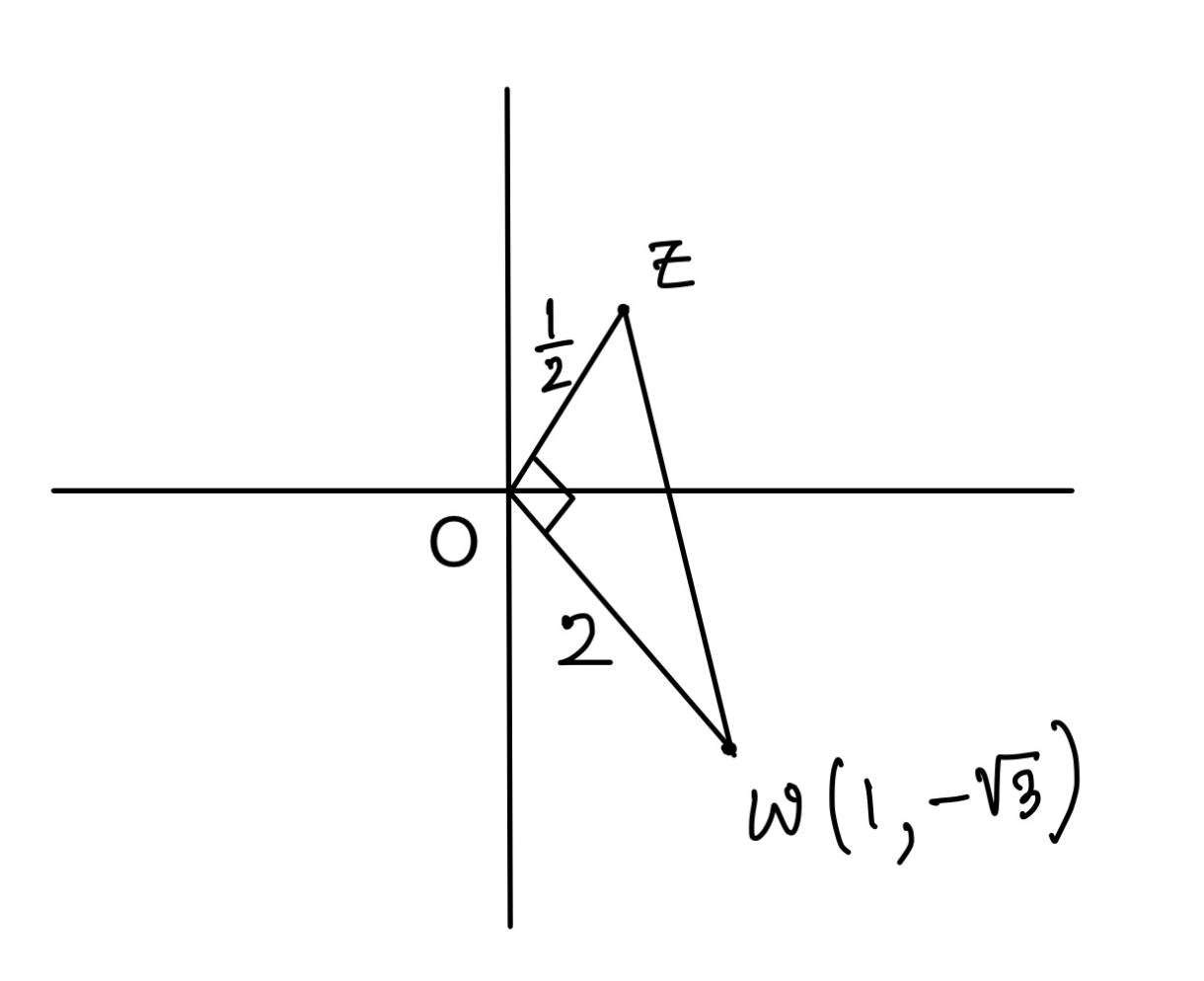
Let a complex number be w = 1 $-$ ${\sqrt 3 }$i. Let another complex number z be such that |zw| = 1 and arg(z) $-$ arg(w) = ${\pi \over 2}$. Then the area of the triangle with vertices origin, z and w is equal to :
iCON Education HYD, 79930 92826, 73309 7282614 Mar 2026
If the equation $a|z{|^2} + \overline {\overline \alpha z + \alpha \overline z } + d = 0$ represents a circle where a, d are real constants then which of the following condition is correct?
A.
|$\alpha$|2 $-$ ad $\ne$ 0
B.
|$\alpha$|2 $-$ ad > 0 and a$\in$R $-$ {0}
C.
|$\alpha$|2 $-$ ad $ \ge $ 0 and a$\in$R
D.
$\alpha$ = 0, a, d$\in$R+
Correct Answer: B
Explanation:
$a|z{|^2} + \alpha \overline z + \overline \alpha z + d = 0$
iCON Education HYD, 79930 92826, 73309 7282614 Mar 2026
Let S1, S2 and S3 be three sets defined as
S1 = {z$\in$C : |z $-$ 1| $ \le $ $\sqrt 2 $}
S2 = {z$\in$C : Re((1 $-$ i)z) $ \ge $ 1}
S3 = {z$\in$C : Im(z) $ \le $ 1}
Then the set S1 $\cap$ S2 $\cap$ S3 :
A.
has exactly three elements
B.
is a singleton
C.
has infinitely many elements
D.
has exactly two elements
Correct Answer: C
Explanation:
Let, z = x + iy
S1 $ \equiv $ (x $-$ 1)2 + y2 $ \le $ 2 ..... (1)
S2 $ \equiv $ x + y $ \ge $ 1 ..... (2)
S3 $\equiv$ y $ \le $ 1 .... (3)
$ \Rightarrow $ S1 $\cap$ S2 $\cap$ S3 has infinitely many elements.
2021
Q313
JEE Mains
MCQ
iCON Education HYD, 79930 92826, 73309 7282614 Mar 2026
The area of the triangle with vertices A(z), B(iz) and C(z + iz) is :
A.
1
B.
${1 \over 2}$| z |2
C.
${1 \over 2}$| z + iz |2
D.
${1 \over 2}$
Correct Answer: B
Explanation:
Each side length = |z|
Area of $\Delta$ = ${1 \over 2}$ (area of square)
= ${1 \over 2}$|z|2
2021
Q314
JEE Mains
MCQ
iCON Education HYD, 79930 92826, 73309 7282614 Mar 2026
The least value of |z| where z is complex number which satisfies the inequality $\exp \left( {{{(|z| + 3)(|z| - 1)} \over {||z| + 1|}}{{\log }_e}2} \right) \ge {\log _{\sqrt 2 }}|5\sqrt 7 + 9i|,i = \sqrt { - 1} $, is equal to :
$t \in ( - \infty , - 2) \cup [3,\infty )$ But t $ \ge $ 0
$ \therefore $ $t \in [3,\infty )$
2021
Q315
JEE Mains
MCQ
iCON Education HYD, 79930 92826, 73309 7282614 Mar 2026
Let a complex number z, |z| $\ne$ 1,
satisfy ${\log _{{1 \over {\sqrt 2 }}}}\left( {{{|z| + 11} \over {{{(|z| - 1)}^2}}}} \right) \le 2$. Then, the largest value of |z| is equal to ____________.
iCON Education HYD, 79930 92826, 73309 7282614 Mar 2026
If $\alpha$, $\beta$ $\in$ R are such that 1 $-$ 2i (here i2 = $-$1) is a root of z2 + $\alpha$z + $\beta$ = 0, then ($\alpha$ $-$ $\beta$) is equal to :
A.
$-$7
B.
7
C.
3
D.
$-$3
Correct Answer: A
Explanation:
1 $-$ 2i is the root of the equation. So other root is 1 $+$ 2i
$ \therefore $ Sum of roots = 1 $-$ 2i + 1 $+$ 2i = 2 = -$\alpha $
iCON Education HYD, 79930 92826, 73309 7282614 Mar 2026
Let the lines (2 $-$ i)z = (2 + i)$\overline z $ and (2 $+$ i)z + (i $-$ 2)$\overline z $ $-$ 4i = 0, (here i2 = $-$1) be normal to a circle C. If the line iz + $\overline z $ + 1 + i = 0 is tangent to this circle C, then its radius is :
A.
${3 \over {2\sqrt 2 }}$
B.
$3\sqrt 2 $
C.
${1 \over {2\sqrt 2 }}$
D.
${3 \over {\sqrt 2 }}$
Correct Answer: A
Explanation:
$(2 - i)z = (2 + i)\overline z $
$ \Rightarrow (2 - i)(x + iy) = (2 + i)(x - iy)$
$ \Rightarrow 2x - ix + 2iy + y = 2x + ix - 2 - iy + y$
$ \Rightarrow 2ix - 4iy = 0$
${L_1}:x - 2y = 0$
$ \Rightarrow (2 + i)z + (i - 2)\overline z - 4i = 0$
iCON Education HYD, 79930 92826, 73309 7282614 Mar 2026
If for the complex numbers z satisfying | z $-$ 2 $-$ 2i | $\le$ 1, the maximum value of | 3iz + 6 | is attained at a + ib, then a + b is equal to ______________.
iCON Education HYD, 79930 92826, 73309 7282614 Mar 2026
A point z moves in the complex plane such that $\arg \left( {{{z - 2} \over {z + 2}}} \right) = {\pi \over 4}$, then the minimum value of ${\left| {z - 9\sqrt 2 - 2i} \right|^2}$ is equal to _______________.
locus is a circle with center (0, 2) & radius = $2\sqrt 2 $
min. value = ${(AP)^2} = {(OP - OA)^2}$
$ = {\left( {9\sqrt 2 - 2\sqrt 2 } \right)^2}$
$ = {\left( {7\sqrt 2 } \right)^2} = 98$
2021
Q320
JEE Mains
Numerical
iCON Education HYD, 79930 92826, 73309 7282614 Mar 2026
Let z1 and z2 be two complex numbers such that $\arg ({z_1} - {z_2}) = {\pi \over 4}$ and z1, z2 satisfy the equation | z $-$ 3 | = Re(z). Then the imaginary part of z1 + z2 is equal to ___________.
iCON Education HYD, 79930 92826, 73309 7282614 Mar 2026
If the real part of the complex number $z = {{3 + 2i\cos \theta } \over {1 - 3i\cos \theta }},\theta \in \left( {0,{\pi \over 2}} \right)$ is zero, then the value of sin23$\theta$ + cos2$\theta$ is equal to _______________.
iCON Education HYD, 79930 92826, 73309 7282614 Mar 2026
The equation of a circle is Re(z2) + 2(Im(z))2 + 2Re(z) = 0, where z = x + iy. A line which passes through the center of the given circle and the vertex of the parabola, x2 $-$ 6x $-$ y + 13 = 0, has y-intercept equal to ______________.
Correct Answer: 1
Explanation:
Equation of circle is (x2 $-$ y2) + 2y2 + 2x = 0
x2 + y2 + 2x = 0
Centre : ($-$1, 0)
Parabola : x2 $-$ 6x $-$ y + 13 = 0
(x $-$ 3)2 = y $-$ 4
Vertex : (3, 4)
Equation of line $ \equiv y - 0 = {{4 - 0} \over {3 + 1}}(x + 1)$
$y = x + 1$
y-intercept = 1
2021
Q325
JEE Mains
Numerical
iCON Education HYD, 79930 92826, 73309 7282614 Mar 2026
Let $S = \left\{ {n \in N\left| {{{\left( {\matrix{
0 & i \cr
1 & 0 \cr
} } \right)}^n}\left( {\matrix{
a & b \cr
c & d \cr
} } \right) = \left( {\matrix{
a & b \cr
c & d \cr
} } \right)\forall a,b,c,d \in R} \right.} \right\}$, where i = $\sqrt { - 1} $. Then the number of 2-digit numbers in the set S is _____________.
Correct Answer: 11
Explanation:
Let $X = \left( {\matrix{
a & b \cr
c & d \cr
} } \right)$ & $A = {\left( {\matrix{
0 & i \cr
1 & 0 \cr
} } \right)^n}$
iCON Education HYD, 79930 92826, 73309 7282614 Mar 2026
Let z and $\omega$ be two complex numbers such that $\omega = z\overline z - 2z + 2,\left| {{{z + i} \over {z - 3i}}} \right| = 1$ and Re($\omega$) has minimum value. Then, the minimum value of n $\in$ N for which $\omega$n is real, is equal to ______________.
Correct Answer: 4
Explanation:
Let z = x + iy
| z + i | = | z $-$ 3i |
$ \Rightarrow $ y = 1
Now
$\omega$ = x2 + y2 $-$ 2x $-$ 2iy + 2
$\omega$ = x2 + 1 $-$ 2x $-$ 2i + 2
Re($\omega$) = x2 $-$ 2x + 3
Re($\omega$) = (x $-$ 1)2 + 2
Re($\omega$)min at x = 1 $ \Rightarrow $ z = 1 + i
iCON Education HYD, 79930 92826, 73309 7282614 Mar 2026
If the least and the largest real values of a, for which the equation z + $\alpha $|z – 1| + 2i = 0
(z $ \in $ C and i = $\sqrt { - 1} $) has a solution, are p and q respectively; then 4(p2 + q2) is equal to __________.
iCON Education HYD, 79930 92826, 73309 7282614 Mar 2026
Let $\theta_1, \theta_2, \ldots, \theta_{10}$ be positive valued angles (in radian) such that $\theta_1+\theta_2+\cdots+\theta_{10}=2 \pi$. Define the complex numbers $z_1=e^{i \theta_1}, z_k=z_{k-1} e^{i \theta_k}$ for $k=2,3, \ldots, 10$, where $i=\sqrt{-1}$. Consider the statements $P$ and $Q$ given below:
$\because$ Length of direct ditance $\le$ length of arc
i.e. | z2 $-$ z1 | = length of line AB $\le$ length of arc AB.
| z3 $-$ z2 | = length of line BC $\le$ length of arc BC.
$\therefore$ Sum of length of these 10 lines $\le$ sum of length of arcs (i.e. 2$\pi$) (because $\theta$1 + $\theta$2 + $\theta$3 + .... + $\theta$10 = 2$\pi$ (given)
iCON Education HYD, 79930 92826, 73309 7282614 Mar 2026
For any complex number w = c + id, let $\arg (w) \in ( - \pi ,\pi ]$, where $i = \sqrt { - 1} $. Let $\alpha$ and $\beta$ be real numbers such that for all complex numbers z = x + iy satisfying $\arg \left( {{{z + \alpha } \over {z + \beta }}} \right) = {\pi \over 4}$, the ordered pair (x, y) lies on the circle ${x^2} + {y^2} + 5x - 3y + 4 = 0$, Then which of the following statements is (are) TRUE?
A.
$\alpha$ = $-$1
B.
$\alpha$$\beta$ = 4
C.
$\alpha$$\beta$ = $-$4
D.
$\beta$ = 4
Correct Answer: B,D
Explanation:
Circle ${x^2} + {y^2} + 5x - 3y + 4 = 0$ cuts the real axis (X-axis) at ($-$4, 0), ($-$1, 0).
$\arg \left( {{{z + \alpha } \over {z + \beta }}} \right) = {\pi \over 4}$ implies z is on arc and ($-$ $\alpha$, 0) and ($-$ $\beta$, 0) subtend ${\pi \over 4}$ on z.
iCON Education HYD, 79930 92826, 73309 7282620 May 2026
Let $Z_1, Z_2$ and $Z_3$ be three non zero complex numbers such that $a=\left|Z_1\right|, b=\left|Z_2\right|$ and $c=\left|Z_3\right|$, if the determinant $\left|\begin{array}{lll}a & b & c \\ b & c & a \\ c & a & b\end{array}\right|=0$, then
A.
$\left|Z_1\right|=\left|Z_2\right|=\left|Z_3\right|=a b c$
$\left|Z_1\right|+\left|Z_2\right|+\left|Z_3\right|=a b c$
D.
$\left|Z_1-Z_2\right|=\left|Z_2-Z_3\right|$
Correct Answer: B
Explanation:
$\begin{array}{left}
\left|\begin{array}{aligned}
a & b & c \\
b & c & a \\
c & a & b
\end{array}\right|=a\left(b c-a^2\right)-b\left(b^2-a c\right)+c\left(a b-c^2\right) \\
\Rightarrow a b c-a^3-b^3+a b c+a b c-c^3=0 \\
\Rightarrow 3 a b c-a^3-b^3-c^3=0 \\
\Rightarrow a^3+b^3+c^3-3 a b c=0 \\
\Rightarrow (a+b+c)=0
\end{array}$
iCON Education HYD, 79930 92826, 73309 7282620 May 2026
If $z_1=2+3 i$ and $z_2=3+2 i$, where $i=\sqrt{-1}$, then $\left[\begin{array}{cc}z_1 & z_2 \\ -\bar{z}_2 & \bar{z}_1\end{array}\right]\left[\begin{array}{cc}\bar{z}_1 & -z_2 \\ \bar{z}_2 & z_1\end{array}\right]$ is equal to
iCON Education HYD, 79930 92826, 73309 7282620 May 2026
If $1, \alpha_1, \alpha_2, \alpha_3$ and $\alpha_4$ are the roots of $z^5-1=0$ and $\omega$ is a cube root of units, then $(\omega-1)\left(\omega-\alpha_1\right)\left(\omega-\alpha_2\right)\left(\omega-\alpha_3\right)\left(\omega-\alpha_4\right)+\omega$ is equal to
A.
0
B.
$-$1
C.
$-$2
D.
1
Correct Answer: C
Explanation:
$\because 1, \alpha_1, \alpha_2, \alpha_3, \alpha_4$ are the roots of $z^5-1=0$
iCON Education HYD, 79930 92826, 73309 7282614 Mar 2026
Let z = x + iy be a non-zero complex number
such that ${z^2} = i{\left| z \right|^2}$, where i = $\sqrt { - 1} $ , then z lies
on the :
A.
line, y = –x
B.
real axis
C.
line, y = x
D.
imaginary axis
Correct Answer: C
Explanation:
Given z = x + iy
and ${z^2} = i{\left| z \right|^2}$
$ \Rightarrow $ (x + iy)2
= i(x2 + y2)
$ \Rightarrow $ x2 - y2 + 2ixy = i(x2 + y2) + 0
Comparing both side we get,
x2 - y2 = 0
$ \Rightarrow $ x2 = y2
and 2xy = (x2 + y2)
$ \Rightarrow $ (x - y)2 = 0
$ \Rightarrow $ x = y
$ \therefore $ z lies on line x = y
2020
Q349
JEE Mains
MCQ
iCON Education HYD, 79930 92826, 73309 7282614 Mar 2026
The region represented by {z = x + iy $ \in $ C : |z| – Re(z) $ \le $ 1} is also given by the inequality :
{z = x + iy $ \in $ C : |z| – Re(z) $ \le $ 1}