Circle
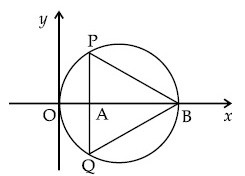
Let $P$ be any point on the circle $x^2+y^2-2 x-1=0$ and $C$ be its centre. Let $A B$ be the chord of contact of $P$ with respect to the circle $x^2+y^2-2 x=0$. Then, the locus of the circumcentre of the $\triangle C A B$ is
$2 x^2+2 y^2-4 x+1=0$
$x^2+y^2-4 x+2=0$
$x^2+y^2-4 x+1=0$
$2 x^2+2 y^2-4 x+3=0$

If a circle $C$ passing through $(4,0)$ touches the circle $x^2+y^2+4 x-6 y-12=0$ externally at the point $(1$, -1 ), then the radius of $C$ is
$\sqrt{12}$
4
$\sqrt{3}$
5

If the circles $C_1: x^2+y^2+2 x+4 y-20=0$, $C_2: x^2+y^2+6 x-8 y+9=0$ have $n$ common tangents and the length of the tangent drawn from the centre of similitude to the circle $C_2$ is $l$, then $\frac{l}{n^2}=$
$4 \sqrt{39}$
$\sqrt{39}$
$\frac{\sqrt{39}}{4}$
$2 \sqrt{39}$

If the common chord of the circles $x^2+y^2+4 y=0$ and $x^2+y^2-4 x-5=0$ is the diameter of the circle $S=0$, then the abscissa of the centre of the circle $S=0$ is
$\frac{-13}{8}$
$\frac{3}{8}$
$\frac{3}{4}$
$\frac{-13}{4}$

The locus of mid-points of points of intersection of $x \cos \theta+y \sin \theta=1$ with the coordinate axes is
The radius of the circle having. $3 x-4 y+4=0$ and $6 x-8 y-7=0$ as its tangents is
A circle is such that $(x-2) \cos \theta+(y-2) \sin \theta=1$ touches it for all values of $\theta$. Then, the circle is
The least distance of the point $(10,7)$ from the circle $x^2+y^2-4 x-2 y-20=0$ is
Suppose that the $x$-coordinates of the points $A$ and $B$ satisfy $x^2+2 x-a^2=0$ and their $y$-coordinates satisfy $y^2+4 y-b^2=0$. Then, the equation of the circle with $A B$ as its diameter is
The radical centre of the three circles $x^2+y^2-1=0, x^2+y^2-8 x+15=0$ and $x^2+y^2+10 y+24=0$ is
For any real number $t$, the point $\left(\frac{8 t}{1+t^2}, \frac{4\left(1-t^2\right)}{1+t^2}\right)$ lies on a / an
The area of the circle passing through the points $(5, \pm 2),(1,2)$ is

The ratio of the largest and shortest distances from the point $(2,-7)$ to the circle $x^2+y^2-14 x-10 y-151=0$ is

A circle has its centre in the first quadrant and passes through $(2,3)$. If this circle makes intercepts of length 3 and 4 respectively on $x=2$ and $y=3$, its equation is
The image of the point $(3,4)$ with respect to the radical axis of the circles $x^2+y^2+8 x+2 y+10=0$ and $x^2+y^2+7 x+3 y+10=0$ is
The locus of centers of the circles, possessing the same area and having $3 x-4 y+4=0$ and $6 x-8 y-7=0$ as their common tangent, is
For any two non-zero real numbers $a$ and $b$ if this line $\frac{x}{a}+\frac{y}{b}=1$ is a tangent to the circle $x^2+y^2=1$, then which of the following is true?
The length of the intercept on the line $4 x-3 y-10=0$ by the circle $x^2+y^2-2 x+4 y-20=0$ is
The pole of the line $\frac{x}{a}+\frac{y}{b}=1$ with respect to the circle $x^2+y^2=c^2$ is
If the tangent at the point $P$ on the circle $x^2+y^2+6 x+6 y=2$ meets the straight line $5 x-2 y+6=0$ at a point $Q$ on the $Y$-axis, then the length of $P Q$ is

The locus of the mid-point of the chord if contact of tangents drawn from points lying on the straight line $4x - 5y = 20$ to the circle ${x^2} + {y^2} = 9$ is
$A = \{ (x,y) \in Z \times Z:{(x - 2)^2} + {y^2} \le 4\} $
$B = \{ (x,y) \in Z \times Z:{x^2} + {y^2} \le 4\} $
$C = \{ (x,y) \in Z \times Z:{(x - 2)^2} + {(y - 2)^2} \le 4\} $
If the total number of relation from A $\cap$ B to A $\cap$ C is 2p, then the value of p is :

C1 : x2 + y2 + 2y $-$ 5 = 0 at two points P and Q such that PQ is a diameter of C1. Then the diameter of C is :


Then the minimum value of |r| such that $A \cup B \subseteq C$ is equal to


x2 + y2 $-$ 10x $-$ 10y + 41 = 0
x2 + y2 $-$ 22x $-$ 10y + 137 = 0
Circle M : x2 + y2 = 1
Circle N : x2 + y2 $-$ 2x = 0
Circle O : x2 + y2 $-$ 2x $-$ 2y + 1 = 0
Circle P : x2 + y2 $-$ 2y = 0
If the centre of circle M is joined with centre of the circle N, further center of circle N is joined with centre of the circle O, centre of circle O is joined with the centre of circle P and lastly, centre of circle P is joined with centre of circle M, then these lines form the sides of a :


x2 + y2 $-$ 10x $-$ 10y + 41 = 0 and
x2 + y2 $-$ 16x $-$ 10y + 80 = 0
x2 + y2 + ax + 2ay + c = 0, (a < 0) be 2${\sqrt 2 }$ and 2${\sqrt 5 }$, respectively. Then the shortest distance from origin to a tangent to this circle which is perpendicular to the line x + 2y = 0, is equal to :
(x $-$ 1)2 + (y $-$ 1)2 = 1 such that (PA)2 + (PB)2 have maximum value, then the points, P, A and B lie on :

Explanation:

Radius = $\sqrt {1 + 4 - 1} = 2$
$AB = \sqrt {{3^2} + {2^2}} = \sqrt {13} $
In $\Delta$ABP
$A{P^2} = A{B^2} - B{P^2} = 13 - 4 = 9$
AP = 3
AQ = AP = 3
Let $\angle$ABP = $\theta$, $\angle$BAP = 90$-$ $\theta$
In $\Delta$ABP, tan$\theta$ = 3/2
$\sin \theta = {3 \over {\sqrt {13} }}$, $\cos \theta = {2 \over {\sqrt {13} }}$
In $\Delta$ARP,
$\cos (90 - \theta ) = {{AR} \over {AP}} \Rightarrow AR = 3\sin \theta $
In $\Delta$BRP,
$\cos \theta = {{BR} \over {BP}}$
$ \Rightarrow BR = 2\cos \theta = {{Area\,(\Delta APQ)} \over {Area\,(\Delta BPQ)}} = {{{1 \over 2} \times PQ \times AR} \over {{1 \over 2} \times PQ \times BR}}$
$ = {{AR} \over {RB}} = {{3\sin \theta } \over {2\cos \theta }} = {9 \over 4}$
$ \Rightarrow 8\left( {{{Area\,(\Delta APQ)} \over {Area\,(\Delta BPQ)}}} \right) = 18$
circles (x $-$ 1)2 + (y $-$ 1)2 = 1
and (x $-$ 9)2 + (y $-$ 1)2 = 4, without intercepting a chord on either circle, then the sum of all the integral values of $\alpha$ is ___________.
Explanation:

Both centers should lie on either side of the line as well as line can be tangent to circle.
(3 + 4 $-$ $\alpha$) . (27 + 4 $-$ $\alpha$) < 0
(7 $-$ $\alpha$) . (31 $-$ $\alpha$) < 0 $\Rightarrow$ $\alpha$ $\in$ (7, 31) ....... (1)
d1 = distance of (1, 1) from line
d2 = distance of (9, 1) from line
${d_1} \ge {r_1} \Rightarrow {{|7 - \alpha |} \over 5} \ge 1 \Rightarrow \alpha \in ( - \infty ,2] \cup [12,\infty )$ .... (2)
${d_2} \ge {r_2} \Rightarrow {{|31 - \alpha |} \over 5} \ge 2 \Rightarrow \alpha \in ( - \infty ,21] \cup [41,\infty )$ ....(3)
(1) $\cap$ (2) $\cap$ (3) $\Rightarrow$ $\alpha$ $\in$ [12, 21]
Sum of integers = 165
Explanation:

$ \Rightarrow \cos \theta = {3 \over 5},\sin \theta = {4 \over 5}$
Now using parametric form
${{x - 1} \over {\cos \theta }} = {{y - 2} \over {\sin \theta }} = \pm \,5$
(x, y) = (1 + 5cos$\theta$, 2 + 5sin$\theta$)
($\alpha$, $\beta$) = (4, 6)
(x, y) = ($\gamma$, $\delta$) = (1 $-$ 5cos$\theta$, 2 $-$ 5sin$\theta$)
($\gamma$, s) = ($-$2, $-$2)
$\Rightarrow$ |($\alpha$ + $\beta$) ($\gamma$ + $\delta$)| = | 10x $-$ 4 | = 40
Explanation:
Since, $r \in (0,5]$
So, $0 < 2{p^2} - 2p - 19 \le 100$
$ \Rightarrow p \in \left[ {{{1 - \sqrt {239} } \over 2},{{1 - \sqrt {39} } \over 2}} \right) \cup \left( {{{1 + \sqrt {39} } \over 2},{{1 + \sqrt {239} } \over 2}} \right]$
so, number of integral values of p2 is 61.
Explanation:
A(0, 0), B(1, 0), C(0, 1), D(1, 1)
(PA)2 + (PB)2 + (PC)2 + (PD)2 = 18
${x^2} + {y^2} + {x^2} + {(y - 1)^2} + {(x - 1)^2} + {y^2} + {(x - 1)^2} + {(y - 1)^2}$ = 18
$ \Rightarrow 4({x^2} + {y^2}) - 4y - 4x = 14$
$ \Rightarrow {x^2} + {y^2} - x - y - {7 \over 2} = 0$
$d = 2\sqrt {{1 \over 4} + {1 \over 4} + {7 \over 2}} $
$ \Rightarrow {d^2} = 16$
x2 + y2 $-$ 10x $-$ 10y + 41 = 0
x2 + y2 $-$ 24x $-$ 10y + 160 = 0 is ___________.
Explanation:
Centre (5, 5), r1 = 3
${S_2}:{(x - 12)^2} + {(y - 5)^2} = 9$
Centre (12, 5), r2 = 3

So (P1P2)min = 1
Explanation:
Given
PA = 3PB
PA2 = 9PB2
$ \Rightarrow $ (h $-$ 5)2 + k2 = 9[(h + 5)2 + k2]
$ \Rightarrow $ 8h2 + 8k2 + 100h + 200 = 0
$ \therefore $ Locus
${x^2} + {y^2} + \left( {{{25} \over 2}} \right)x + 25 = 0$
$ \therefore $ $c \equiv \left( {{{ - 25} \over 4},0} \right)$
$ \therefore $ ${r^2} = {\left( {{{ - 25} \over 4}} \right)^2} - 25$
$ = {{625} \over {16}} - 25$
$ = {{225} \over {16}}$
$ \therefore $ $4{r^2} = 4 \times {{225} \over {16}} = {{225} \over 4} = 56.25$
After Round of 4r2 = 56
Explanation:
Explanation:
Let centre O2 (2, 1) of required circle and its radius being r.

Distance between (1, 3) and (2, 1) is $\sqrt 5 $
$ \therefore $ ${\left( {\sqrt 5 } \right)^2} + {(2)^2} = {r^2}$
$ \Rightarrow r = 3$