Area Under The Curves
If the area of the region $S=\left\{(x, y): 2 y-y^{2} \leq x^{2} \leq 2 y, x \geq y\right\}$ is equal to $\frac{n+2}{n+1}-\frac{\pi}{n-1}$, then the natural number $n$ is equal to ___________.
Explanation:
$ S=\left\{(x, y): 2 y-y^2 \leq x^2 \leq 2 y, x \geq y\right\} $
Here, we have three curves
$ \begin{aligned} &2 y-y^2 =x^2 ..........(i)\\\\ &x^2 =2 y ..........(2)\\\\ &\text {and}~~ x = y ...........(3) \end{aligned} $

From Eq. (i),
$ x^2+y^2-2 y=0 $
$\Rightarrow x^2+(y-1)^2=1$ is a circle with centre $(0,1)$ and radius is 1.
Intersection points of Equations (i) and (iii) are,
$ \begin{array}{rlrl} & 2 x-x^2 =x^2 \\\\ &\Rightarrow 2 x^2 =2 x \\\\ &\Rightarrow x(x-1) =0 \\\\ &\Rightarrow x =0,1 \\\\ & \text { When, } x=0 \text {, then } y=0 \\\\ & \text { and when } x=1 \text {, then } y=1 \end{array} $
$\therefore$ Required points are $(0,0)$ and $(1,1)$.
Also, intersection points of (ii) and (iii)
$ \begin{aligned} & \quad x^2=2 x \\\\ & \Rightarrow x(x-2)=0 \\\\ & \Rightarrow x=0,2 \\\\ & \text { When, } x=0 \text {, then } y=0 \\\\ & \text { and when } x=2 \text {, then } y=2 \\\\ & \therefore \text { Required points are }(0,0) \text { and }(2,2) \end{aligned} $
$\therefore$ Required area $=$ Area of triangle - Area of part I - Area of part II
$ =\frac{1}{2} \times 2 \times 2-\int\limits_0^2 \frac{x^2}{2}-\left(\frac{\pi}{4}-\frac{1}{2}\right) $
$ \begin{aligned} & =2-\frac{1}{2}\left(\frac{x^3}{3}\right)_0^2-\frac{\pi}{4}+\frac{1}{2} \\\\ & =2-\frac{1}{2} \times \frac{8}{3}-\frac{\pi}{4}+\frac{1}{2} \\\\ & =\frac{7}{6}-\frac{\pi}{4} \\\\ & =\frac{5+2}{5+1}-\frac{\pi}{5-1} \\\\ & \therefore n =5 \end{aligned} $
Let $A$ be the area bounded by the curve $y=x|x-3|$, the $x$-axis and the ordinates $x=-1$ and $x=2$. Then $12 A$ is equal to ____________.
Explanation:

$=\int\limits_{-1}^{2}\left|3 x-x^{2}\right|$
$A=\int\limits_{-1}^{0} x^{2}-3 x d x+\int\limits_{0}^{2} 3 x-x^{2} d x$
$\left.\left.=\frac{x^{3}}{3}-\frac{3 x^{2}}{2}\right]_{-1}^{0}+\frac{3 x^{2}}{2}-\frac{x^{3}}{3}\right]_{0}^{2}$
$=0-\left(\frac{-1}{3}-\frac{3}{2}\right)+\left(6-\frac{8}{3}\right)-0$
$=\frac{31}{6}$
$\therefore 12 A=62$
$\left\{(x, y):|2 x-1| \leq y \leq\left|x^{2}-x\right|, 0 \leq x \leq 1\right\}$ be $\mathrm{A}$.
Then $(6 \mathrm{~A}+11)^{2}$ is equal to
Explanation:
$ \begin{aligned} & x-x^{2}=2 x-1 \\\\ & x^{2}+x-1=0 \\\\ & x=\frac{-1+\sqrt{5}}{2} \end{aligned} $

Area $=2($ area of $B C E)$
$A=2 \int_{\frac{1}{2}}^{\frac{\sqrt{5}-1}{2}}\left(x-x^{2}\right)-(2 x-1) d x$
$=2 \int_{\frac{1}{2}}^{\frac{\sqrt{5}-1}{2}} (1-x-x^{2}) d x=\left.2\left(x-\frac{x^{2}}{2}-\frac{x^{3}}{3}\right)\right|_{\frac{1}{2}} ^{]_{5}^{\frac{\sqrt{5}-1}{2}}}$
$ \begin{aligned} =2\left\{\left(\frac{\sqrt{5}-1}{2}-\frac{1}{2}\right)-\left\{\left(\frac{\sqrt{5}-1}{2}\right)^{2}\right.\right. & \left.-\frac{1}{4}\right\} \frac{1}{2} \\\\ & \left.-\left[\left(\frac{\sqrt{5}-1}{2}\right)^{3}-\frac{1}{8}\right] \frac{1}{3}\right\} \end{aligned} $
$ A=\frac{-11+5 \sqrt{5}}{6} $
$\Rightarrow(6 A+11)^{2}=125$
Let for $x \in \mathbb{R}$,
$ f(x)=\frac{x+|x|}{2} \text { and } g(x)=\left\{\begin{array}{cc} x, & x<0 \\ x^{2}, & x \geq 0 \end{array}\right. \text {. } $
Then area bounded by the curve $y=(f \circ g)(x)$ and the lines $y=0,2 y-x=15$ is equal to __________.
Explanation:
$g(x)=\left[\begin{array}{cc}x^{2} & x \geq 0 \\ x & x<0\end{array}\right.$
$f(x)=f[g(x)]=\left[\begin{array}{cl}g(x), & g(x) \geq 0 \\ 0, & g(x)<0\end{array}\right.$
$\operatorname{fog}(x)=\left[\begin{array}{cc}x^{2}, & x \geq 0 \\ 0, & x<0\end{array}\right.$
$2 y-x=15$

$\mathrm{A}=\int_{0}^{3}\left(\frac{\mathrm{x}+15}{2}-\mathrm{x}^{2}\right) \mathrm{dx}+\frac{1}{2} \times \frac{15}{2} \times 15$
= $\frac{x^{2}}{4}+\frac{15 x}{2}-\left.\frac{x^{3}}{3}\right|_{0} ^{3}+\frac{225}{4}$
$=\frac{9}{4}+\frac{45}{2}-9+\frac{225}{4}=\frac{99-36+225}{4}$
$=\frac{288}{4}=72$
$\left\{(x, y): y \geq x^2, y \geq(1-x)^2, y \leq 2 x(1-x)\right\}$.
Then $540 \mathrm{~A}$ is equal to :
Explanation:

$y = {x^2}$ and $y = 2x(1 - x)$
$ \Rightarrow {x^2} = 2x - 2{x^2}$
$ \Rightarrow x = 0,x = {2 \over 3}$
Now,
$y = {(1 - x)^2}$ and $y = 2x(1 - x)$
$ \Rightarrow 1 + {x^2} - 2x = 2x - 2{x^2}$
$ \Rightarrow 3{x^2} - 4x + 1 = 0$
$x = 1,x = {1 \over 3}$
$\therefore$ $A = \int\limits_{{1 \over 3}}^{{2 \over 3}} {(2x - 2{x^2})dx - \left\{ {\int\limits_{{1 \over 3}}^{{1 \over 2}} {{{(1 - x)}^2}dx + \int\limits_{{1 \over 2}}^{{2 \over 3}} {{x^2}dx} } } \right\}} $
= $\left( {{x^2} - {{2{x^3}} \over 3}} \right)_{{1 \over 3}}^{{2 \over 3}} - \left\{ {\left( {{{{{\left( {x - 1} \right)}^3}} \over 3}} \right)_{{1 \over 3}}^{{1 \over 2}} + \left( {{{{x^3}} \over 3}} \right)_{{1 \over 2}}^{{2 \over 3}}} \right\}$
$ = {5 \over {108}}$
$\therefore$ $540A = 25$
Let $\alpha$ be the area of the larger region bounded by the curve $y^{2}=8 x$ and the lines $y=x$ and $x=2$, which lies in the first quadrant. Then the value of $3 \alpha$ is equal to ___________.
Explanation:

${A_1} = \int\limits_0^2 {2\sqrt 2 \sqrt x - xdx} $
$ = \left. {2\sqrt 2 \times {2 \over 3}\,.\,{x^{{3 \over 2}}} - {{{x^2}} \over 2}} \right]_0^2$
$ = {{4\sqrt 2 } \over 3} \times 2\sqrt 2 - 2$
$ = {{16} \over 3} - 2 = {{10} \over 3}$
${A_2} = \left. {\int\limits_2^8 {2\sqrt 2 \sqrt x - xdx = {{4\sqrt 2 } \over 3}\,.\,{x^{{3 \over 2}}} - {{{x^2}} \over 2}} } \right]_2^8$
$ = {{4\sqrt 2 } \over 3}(16\sqrt 2 - 2\sqrt 2 ) - 30$
$ = {{112} \over 3} - 30 = {{22} \over 3}$
${A_2} > {A_1} \Rightarrow 3\alpha = 22$
If the area enclosed by the parabolas $\mathrm{P_1:2y=5x^2}$ and $\mathrm{P_2:x^2-y+6=0}$ is equal to the area enclosed by $\mathrm{P_1}$ and $\mathrm{y=\alpha x,\alpha > 0}$, then $\alpha^3$ is equal to ____________.
Explanation:
$ \begin{aligned} & \text { Area between } P_{1} \text { and } P_{2} \quad \text { [Say } \left.A_{1}\right] \\\\ & =\int\limits_{-2}^{2}\left(x^{2}+6\right)-\frac{5}{2} x^{2} d x \\\\ & =2 \int\limits_{0}^{2}\left(6-\frac{3}{2} x^{2}\right) d x=2\left[6 x-\frac{x^{3}}{2}\right]_{0}^{2}=16 \end{aligned} $
$ \begin{aligned} & a x=\frac{5}{2} x^2 \Rightarrow x=0, \frac{2 a}{5} \\\\ & \text { Area between } P_1 \text { and } y=a x \quad \text { [Say } A_2 \text { ] } \\\\ & =\int\limits_0^{\frac{2 \alpha}{5}} a x-\frac{5}{2} x^2 d x \\\\ & \left.=\frac{a x^2}{2}-\frac{5}{6} x^3\right]_0^{\frac{2 a}{5}}: \frac{2 a^3}{75} \\\\ & A_1=A_2 \Rightarrow \frac{2 a^3}{75}=16 \\\\ & a^3=600 \end{aligned} $
If the area of the region bounded by the curves $y^2-2y=-x,x+y=0$ is A, then 8 A is equal to __________
Explanation:
$ \begin{aligned} & y^{2}-2 y=-x \\\\ & x+y=0 \end{aligned} $

Area $=\int_{0}^{3}\left(2 y-y^{2}\right)-(-y) d y$
$ =\int_{0}^{3}\left(3 y-y^{2}\right) d y $
$ \begin{aligned} & \left.=\frac{3 y^{2}}{2}-\frac{y^{3}}{3}\right]_{0}^{3} \\\\ & =\frac{27}{2}-9 \\\\ & =\frac{27-18}{2}=\frac{9}{2}=A \end{aligned} $
$8 A=\frac{9}{2} \times 8=36$ sq. units
The area (in sq units) of the region bounded by the circle $x^2+y^2=64$, positive $X$-axis and the line $y=\sqrt{3} x$ is
$16 \pi / 3$
$8 \pi / 3$
$64 \pi / 3$
$32 \pi / 3$

The area (in sq units) of the region bounded by the curve $y=|\sin 2 x|$ and the $X$-axis in $[0,2 \pi]$ is
0
3
4
1
Area of the region bounded by the curve $y=2-x-3 x^2$, the $X$-axis, the $Y$-axis and the line $x=-2$ is
2
$\frac{44}{27}$
$\frac{9}{2}$
5

The area (in sq units) bounded by the curve $y=2 x-x^2$ and the line $y=-x$ is
The area of the region bounded by the parabola $y=x^2+1$ and lines $y=x+1, y=0, x=\frac{1}{2}$ and $x=2$ is

Let the functions $f: R \rightarrow R$ and $g: R \rightarrow R$ be defined by $f(x)=e^{x-1}-e^{-|x-1|}$ and $g(x)=\frac{1}{2}\left(e^{x-1}+e^{1-x}\right)$. Then, the area of the region in the first quadrant bounded by the curves $y=f(x), y=g(x)$ and $x=0$ is.

The area of the region
$\left\{(x, y):|x-1| \leq y \leq \sqrt{5-x^{2}}\right\}$ is equal to :

The area enclosed by the curves $y=\log _{e}\left(x+\mathrm{e}^{2}\right), x=\log _{e}\left(\frac{2}{y}\right)$ and $x=\log _{\mathrm{e}} 2$, above the line $y=1$ is:

The area of the region enclosed by $y \leq 4 x^{2}, x^{2} \leq 9 y$ and $y \leq 4$, is equal to :

Consider a curve $y=y(x)$ in the first quadrant as shown in the figure. Let the area $\mathrm{A}_{1}$ is twice the area $\mathrm{A}_{2}$. Then the normal to the curve perpendicular to the line $2 x-12 y=15$ does NOT pass through the point.


The area of the smaller region enclosed by the curves $y^{2}=8 x+4$ and $x^{2}+y^{2}+4 \sqrt{3} x-4=0$ is equal to

The area bounded by the curves $y=\left|x^{2}-1\right|$ and $y=1$ is

The odd natural number a, such that the area of the region bounded by y = 1, y = 3, x = 0, x = ya is ${{364} \over 3}$, is equal to :
The area of the region given by
$A=\left\{(x, y): x^{2} \leq y \leq \min \{x+2,4-3 x\}\right\}$ is :

Let the locus of the centre $(\alpha, \beta), \beta>0$, of the circle which touches the circle $x^{2}+(y-1)^{2}=1$ externally and also touches the $x$-axis be $\mathrm{L}$. Then the area bounded by $\mathrm{L}$ and the line $y=4$ is:


The area enclosed by y2 = 8x and y = $\sqrt2$ x that lies outside the triangle formed by y = $\sqrt2$ x, x = 1, y = 2$\sqrt2$, is equal to:

The area of the bounded region enclosed by the curve
$y = 3 - \left| {x - {1 \over 2}} \right| - |x + 1|$ and the x-axis is :

The area of the region S = {(x, y) : y2 $\le$ 8x, y $\ge$ $\sqrt2$x, x $\ge$ 1} is

The area of the region bounded by y2 = 8x and y2 = 16(3 $-$ x) is equal to:

The area bounded by the curve y = |x2 $-$ 9| and the line y = 3 is :

The area of the region enclosed between the parabolas y2 = 2x $-$ 1 and y2 = 4x $-$ 3 is

Let the area enclosed by the x-axis, and the tangent and normal drawn to the curve $4{x^3} - 3x{y^2} + 6{x^2} - 5xy - 8{y^2} + 9x + 14 = 0$ at the point ($-$2, 3) be A. Then 8A is equal to ______________.
Explanation:

$ \begin{aligned} & \text { Area }=\frac{1}{2}\left(\frac{31}{2}-4\right) \times 3=\frac{85}{4} \\\\ & 8 \mathrm{~A}=170 \end{aligned} $
If for some $\alpha$ > 0, the area of the region $\{ (x,y):|x + \alpha | \le y \le 2 - |x|\} $ is equal to ${3 \over 2}$, then the area of the region $\{ (x,y):0 \le y \le x + 2\alpha ,\,|x| \le 1\} $ is equal to ____________.
Explanation:

Point A is the intersection of y = x + $\alpha$ and y = 2 $-$ x lines.
$\therefore$ $y = 2 - y + \alpha $
$ \Rightarrow 2y = 2 + \alpha $
$ \Rightarrow y = {{2 + \alpha } \over 2}$
and $x = 2 - {{2 + \alpha } \over 2} = {{2 - \alpha } \over 2}$
$\therefore$ Point $A = \left( {{{2 - \alpha } \over 2},{{2 + \alpha } \over 2}} \right)$
$\therefore$ AN = y-coordinate of point $A = {{2 + \alpha } \over 2}$
Point B is the intersection of $y = 2 + x$ and $y = - x - \alpha $ lines.
$\therefore$ $y = 2 - y - \alpha $
$ \Rightarrow 2y = 2 - \alpha $
$ \Rightarrow y = {{2 - \alpha } \over 2}$
$\therefore$ $x = {{2 - \alpha } \over 2} - 2 = {{2 - \alpha - 4} \over 2} = {{ - \alpha - 2} \over 2}$
$\therefore$ Point $B = \left( {{{ - \alpha - 2} \over 2},{{2 - \alpha } \over 2}} \right)$
$\therefore$ $BM = y - $coordinate of point $B = {{2 - \alpha } \over 2}$
Area of the common region $BRAE$
$ = \Delta CDE - \left( {\Delta BCR + \Delta ARD} \right)$
$ = {1 \over 2} \times 4 \times 2 - \left( {{1 \over 2}( - \alpha + 2) \times BM + {1 \over 2} \times (2 + \alpha ) \times AN} \right)$
$ = 4 - \left( {{1 \over 2} \times (2 - \alpha ) \times {{(2 - \alpha )} \over 2} + {1 \over 2} \times (2 + \alpha ) \times {{2 + \alpha } \over 2}} \right)$
$ = 4 - \left[ {{{{{(2 - \alpha )}^2}} \over 4} + {{{{(2 + \alpha )}^2}} \over 4}} \right]$
Given, $4 - \left[ {{{{{(2 - \alpha )}^2}} \over 4} + {{{{(2 + \alpha )}^2}} \over 4}} \right] = {3 \over 2}$
$ \Rightarrow {{{{(2 - \alpha )}^2}} \over 4} + {{{{(2 + \alpha )}^2}} \over 4} = {5 \over 2}$
$ \Rightarrow {(2 - \alpha )^2} + {(2 + \alpha )^2} = 10$
$ \Rightarrow 4 + {\alpha ^2} - 4\alpha + 4 + {\alpha ^2} + 4\alpha = 10$
$ \Rightarrow 2{\alpha ^2} + 8 = 10$
$ \Rightarrow 2{\alpha ^2} = 2$
$ \Rightarrow {\alpha ^2} = 1$
$ \Rightarrow \alpha = \, \pm \,1$
Given that $\alpha > 0$ so accepted value of $\alpha = + \,1$.
Now, $0 \le y \le x + 2\alpha $ and $|x| \le 1$
$ \Rightarrow 0 \le y \le x + 2$ and $ - 1 \le x \le 1$

Area of $ABCD = {1 \over 2}(1 + 3) \times (1 - ( - 1))$
$ = {1 \over 2} \times 4 \times 2$
$ = 4$ sq. unit
For real numbers a, b (a > b > 0), let
Area $\left\{ {(x,y):{x^2} + {y^2} \le {a^2}\,and\,{{{x^2}} \over {{a^2}}} + {{{y^2}} \over {{b^2}}} \ge 1} \right\} = 30\pi $
and
Area $\left\{ {(x,y):{x^2} + {y^2} \le {b^2}\,and\,{{{x^2}} \over {{a^2}}} + {{{y^2}} \over {{b^2}}} \le 1} \right\} = 18\pi $
Then, the value of (a $-$ b)2 is equal to ___________.
Explanation:
and $\frac{x^{2}}{a^{2}}+\frac{y^{2}}{b^{2}} \geq 1$ is exterior of ellipse

$\therefore$ Area $=\pi a^{2}-\pi a b=30 \pi$
Similarly $x^{2}+y^{2} \geq b^{2}$ and $\frac{x^{2}}{a^{2}}+\frac{y^{2}}{b^{2}} \leq 1$ gives
$\pi a b-\pi b^{2}=18 \pi$
By (1) and (2), $\frac{a}{b}=\frac{5}{3} \Rightarrow a=\frac{5 b}{3}$
$\Rightarrow \pi \cdot \frac{25 b^{2}}{9}-\pi \cdot \frac{5 b^{2}}{3}=30 \pi$
$\Rightarrow\left(\frac{25}{9}-\frac{5}{3}\right) b^{2}=30$
$\Rightarrow \frac{10}{9} b^{2}=30 \Rightarrow b^{2}=27$
and $a^{2}=\frac{25}{9} \cdot 27=75$
$(a-b)^{2}=(5 \sqrt{3}-3 \sqrt{3})^{2}=3 \cdot 4=12$
If the area of the region $\left\{ {(x,y):{x^{{2 \over 3}}} + {y^{{2 \over 3}}} \le 1,\,x + y \ge 0,\,y \ge 0} \right\}$ is A, then ${{256A} \over \pi }$ is equal to __________.
Explanation:

$\therefore$ Area of shaded region
$ = \int\limits_{ - {{\left( {{1 \over 2}} \right)}^{{3 \over 2}}}}^0 {\left( {{{\left( {1 - {x^{{2 \over 3}}}} \right)}^{{3 \over 2}}} + x} \right)dx + \int\limits_0^1 {{{\left( {1 - {x^{{2 \over 3}}}} \right)}^{{3 \over 2}}}dx} } $
$ = \int\limits_{ - {{\left( {{1 \over 2}} \right)}^{{3 \over 2}}}}^0 {{{\left( {1 - {x^{{2 \over 3}}}} \right)}^{{3 \over 2}}}dx + \int\limits_{ - {{\left( {{1 \over 2}} \right)}^{{3 \over 2}}}}^0 {xdx} } $
Let $x = {\sin ^3}\theta $
$\therefore$ $dx = 3{\sin ^2}\theta \cos \theta d\theta $
$ = \int\limits_{ - {\pi \over 4}}^{{\pi \over 2}} {3{{\sin }^2}\theta {{\cos }^4}\theta d\theta + \left( {0 + {1 \over {16}}} \right)} $
$ = {{9\pi } \over {64}} + {1 \over {16}} - {1 \over {16}} = {{36\pi } \over {256}} = A$
$\therefore$ ${{256A} \over \pi } = 36$
${A_1} = \left\{ {(x,y):|x| \le {y^2},|x| + 2y \le 8} \right\}$ and
${A_2} = \left\{ {(x,y):|x| + |y| \le k} \right\}$. If 27 (Area A1) = 5 (Area A2), then k is equal to :
Explanation:

Required area (above x-axis)
${A_1} = 2\int\limits_0^4 {\left( {{{8 - x} \over 2} - \sqrt x } \right)dx} $
$ = 2\left( {16 - {{16} \over 4} - {8 \over {3/2}}} \right) = {{40} \over 3}$
and ${A_2} = 4\left( {{1 \over 2}\,.\,{k^2}} \right) = 2{k^2}$

$\therefore$ $27\,.\,{{40} \over 3} = 5\,.\,(2{k^2})$
$\Rightarrow$ k = 6
The area (in sq. units) of the region enclosed between the parabola y2 = 2x and the line x + y = 4 is __________.
Explanation:

The required area $ = \int_{ - 4}^2 {\left( {4 - y - {{{y^2}} \over 2}} \right)dy} $
$ = \left[ {4y - {{{y^2}} \over 2} - {{{y^3}} \over 6}} \right]_{ - 4}^2$
$ = 18$ square units
Let S be the region bounded by the curves y = x3 and y2 = x. The curve y = 2|x| divides S into two regions of areas R1, R2. If max {R1, R2} = R2, then ${{{R_2}} \over {{R_1}}}$ is equal to ______________.
Explanation:

$C_{1}: y=x^{3}$
$C_{2}: y^{2}=x$
and $C_{3}=y=2|x|$
$C_{1}$ and $C_{2}$ intersect at $(1,1)$
$C_{2}$ and $C_{3}$ intersect at $\left(\frac{1}{4}, \frac{1}{2}\right)$
Clearly $R_{1}=\int_{0}^{1 / 4}(\sqrt{x}-2 x) d x=\frac{2}{3}\left(\frac{1}{8}\right)-\frac{1}{16}=\frac{1}{48}$
and $R_{1}+R_{2}=\int_{0}^{1}\left(\sqrt{x}-x^{3}\right) d x=\frac{2}{3}-\frac{1}{4}=\frac{5}{12}$
So, $\frac{R_{1}+R_{2}}{R_{1}}=\frac{5 / 12}{1 / 48} \Rightarrow 1+\frac{R_{2}}{R_{1}}=20$
$\Rightarrow \frac{R_{2}}{R_{1}}=19$
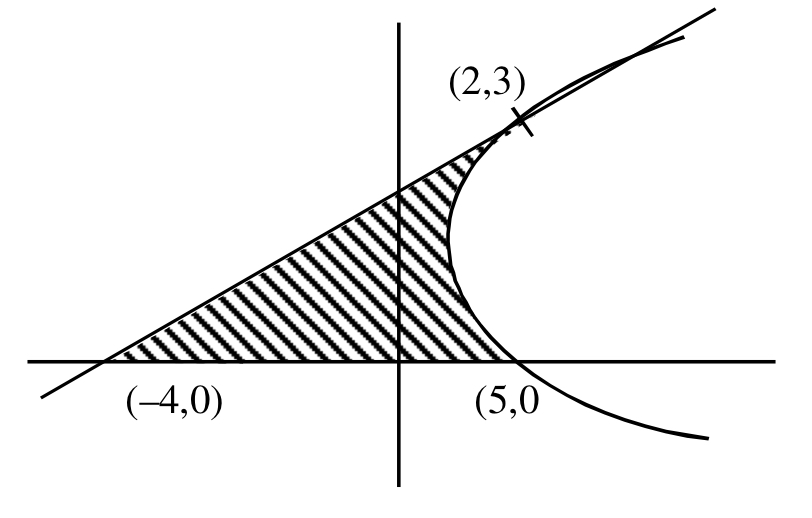
What is the area enclosed by the parabola described by ${(y - 2)^2} = (x - 1)$, its tangent line at the point (2, 3), and the X-axis?

The area enclosed by the curves $y = \sin x + \cos x$ and $y = |\cos x - \sin x|$ over the interval $\left[ {0,{\pi \over 2}} \right]$ is



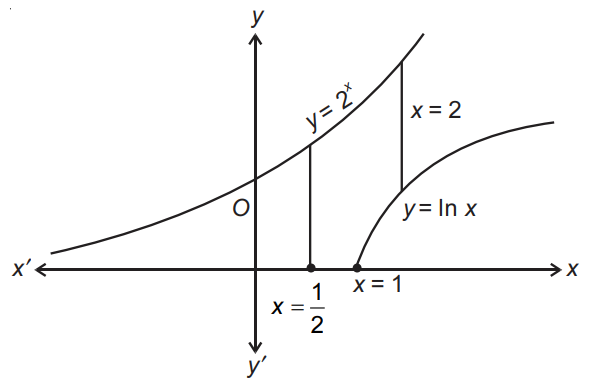
$R = \left\{ {(x,y):\max \{ 0,{{\log }_e}x\} \le y \le {2^x},{1 \over 2} \le x \le 2} \right\}$ is ,
$\alpha {({\log _e}2)^{ - 1}} + \beta ({\log _e}2) + \gamma $, then the value of ${(\alpha + \beta - 2\lambda )^2}$ is equal to :


Explanation:

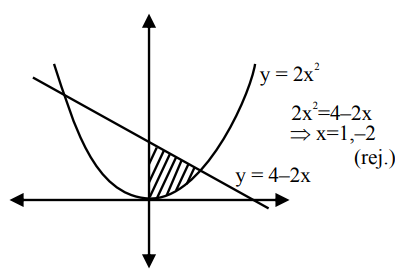
According to the question,
${1 \over 2}\int_0^{3/2} {(1 + 4x - {x^2})dx = \int_0^{3/2} {mx\,dx} } $
$ \Rightarrow {1 \over 2}\left[ {\left( {x + 2{x^2} - {{{x^3}} \over 3}} \right)} \right]_0^{3/2} = {m \over 2}[x]_0^{3/2} \Rightarrow {3 \over 2} + {9 \over 2} - {9 \over 8} = {{9m} \over 4}$
$\Rightarrow$ m = 39/18 $\Rightarrow$ 12m = 26
Explanation:
Point = (2, $-$20) & ($-$1, 7)
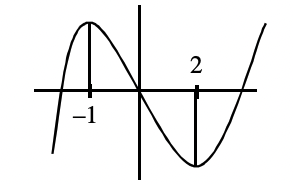
$A = \int\limits_{ - 1}^0 {(2{x^3} - 3{x^2} - 12x)dx + \int\limits_0^2 {(12x + 3{x^2} - 2{x^3})\,dx} } $
$A = \left( {{{{x^4}} \over 2} - {x^3} - 6{x^2}} \right)_{ - 1}^0 + \left( {6{x^2} + {x^3} - {{{x^4}} \over 2}} \right)_0^2$
4A = 114
Explanation:

For A & B
3x2 = 6x + 24 $\Rightarrow$ x2 $-$ 2x $-$ 8 = 0
$\Rightarrow$ x = $-$2, 4
Area $ = \int\limits_{ - 2}^4 {\left( {{3 \over 2}x + 6 - {3 \over 4}{x^2}} \right)dx} $
$ = \left[ {{{3{x^2}} \over 4} + 6x - {{{x^3}} \over 4}} \right]_{ - 2}^4 = 27$