Haloalkanes and Haloarenes
The final product A, formed in the following multistep reaction sequence is :


Given below are two statements : one is labelled as Assertion (A) and the other is labelled as Reason (R).
Assertion (A) : $\mathrm{CH}_2=\mathrm{CH}-\mathrm{CH}_2-\mathrm{Cl}$ is an example of allyl halide.
Reason (R) : Allyl halides are the compounds in which the halogen atom is attached to $\mathrm{sp}^2$ hybridised carbon atom.
In the light of the above statements, choose the most appropriate answer from the options given below :

Alkyl halide is converted into alkyl isocyanide by reaction with
Given below are two statements : one is labelled as Assertion A and the other is labelled as Reason R :
Assertion A : Aryl halides cannot be prepared by replacement of hydroxyl group of phenol by halogen atom.
Reason R : Phenols react with halogen acids violently.
In the light of the above statements, choose the most appropriate from the options given below :

Identify B formed in the reaction.
$\mathrm{Cl}-\left(\mathrm{CH}_2\right)_4-\mathrm{Cl} \xrightarrow{\text { excess } \mathrm{NH}_3} \mathrm{~A} \xrightarrow{\mathrm{NaOH}} \mathrm{B}+\mathrm{H}_2 \mathrm{O}+\mathrm{NaCl}$


Which among the following halide/s will not show $\mathrm{S_N 1}$ reaction:
(A) $\mathrm{H}_2 \mathrm{C}=\mathrm{CH}-\mathrm{CH}_2 \mathrm{Cl}$
(B) $\mathrm{CH}_3-\mathrm{CH}=\mathrm{CH}-\mathrm{Cl}$
(C) 
(D) 
Choose the most appropriate answer from the options given below :
The correct statement regarding nucleophilic substitution reaction in a chiral alkyl halide is ;

The ratio of number of oxygen atoms to bromine atoms in the product Q is _________ $\times 10^{-1}$.
Explanation:

Number of O-atoms $=3$
Number of $\mathrm{Br}$-atoms $=2$
$\begin{aligned} \text { Required ratio } & =\frac{3}{2}=1.5 \\ & =15 \times 10^{-1} \end{aligned}$
The number of halobenzenes from the following that can be prepared by Sandmeyer's reaction is _________

Explanation:
Only II and III can be prepared from Sandmeyer’s reaction.

The total number of hydrogen atoms in product A and product B is _________.
Explanation:

Total number of hydrogen atom in A and B is 10
2-chlorobutane $+\mathrm{Cl}_2 \rightarrow \mathrm{C}_4 \mathrm{H}_8 \mathrm{Cl}_2$ (isomers)
Total number of optically active isomers shown by $\mathrm{C}_4 \mathrm{H}_8 \mathrm{Cl}_2$, obtained in the above reaction is _________.
Explanation:


In the following reaction 'X' is


Compound from the following that will not produce precipitate on reaction with $\mathrm{AgNO}_{3}$ is :


Find out the correct statement from the options given below for the above 2 reactions.

Identify the correct order of reactivity for the following pairs towards the respective mechanism

Choose the correct answer from the options given below:
The pair from the following pairs having both compounds with net non-zero dipole moment is
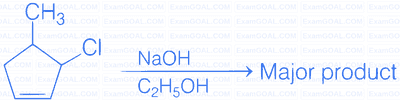
Major product '$\mathrm{P}$' formed in the following reaction is:


The correct order of reactivity of following haloarenes towards nucleophilic substitution with aqueous $\mathrm{NaOH}$ is :

Choose the correct answer from the options given below:
Choose the halogen which is most reactive towards $\mathrm{S}_{\mathrm{N}} 1$ reaction in the given compounds (A, B, C & D)


For the reaction

The correct statement is

The correct order of melting points of dichlorobenzenes is


Decreasing order towards SN 1 reaction for the following compounds is:


Match List I with List II
| List I | List II | ||
|---|---|---|---|
| A. |  |
I. | Fittig reaction |
| B. |  |
II. | Wurtz Fittig reaction |
| C. |  |
III. | Finkelstein reaction |
| D. | $\mathrm{C_5H_5C1+NaI\to C_2H_5I+NaCl}$ | IV. | Sandemyer reaction |
Choose the correct answer from the options given below :


Identify the correct order for the given property for following compounds.

Choose the correct answer from the option given below :
The isomeric deuterated bromide with molecular formula $\mathrm{C_4H_8DBr}$ having two chiral carbon atoms is

The compound which will have the lowest rate towards nucleophilic aromatic substitution on treatment with OH$^-$ is


Assertion A : Hydrolysis of an alkyl chloride is a slow reaction but in the presence of NaI, the rate of the hydrolysis increases.
Reason R : I$^{-}$ is a good nucleophile as well as a good leaving group.
In the light of the above statements, choose the correct answer from the options given below
Number of moles of AgCl formed in the following reaction is _____________

Explanation:

Circled Cl will get precipitated
Compound 'A' undergoes following sequence of reactions to give compound 'B'.
The correct structure and chirality of compound 'B' is
[where Et is $\left.-\mathrm{C}_{2} \mathrm{H}_{5}\right]$


Which among the following pairs of the structures will give different products on ozonolysis? (Consider the double bonds in the structures are rigid and not delocalized.)


Considering the above reactions, the compound 'A' and compound 'B' respectively are :


The major product in the given reaction is


Major product '$\mathrm{B}$' of the following reaction sequence is :


The stable carbocation formed in the above reaction is

Two isomers (A) and (B) with Molar mass 184 g/mol and elemental composition C, 52.2%; H, 4.9% and Br 42.9% gave benzoic acid and p-bromobenzoic acid, respectively on oxidation with KMnO4. Isomer 'A' is optically active and gives a pale yellow precipitate when warmed with alcoholic AgNO3. Isomer 'A' and 'B' are, respectively


In the given conversion the compound A is :


In the above reaction 'A' is


The major product (P) in the reaction

is


Which one of the following compounds is inactive towards SN1 reaction?


The major product of the following reaction is :


Halogenation of which one of the following will yield m-substituted product with respect to methyl group as a major product?


The major product in the reaction


In the given reaction sequence, the major product 'C' is :


In the presence of sunlight, benzene reacts with Cl2 to give product, X. The number of hydrogens in X is _____________.
Explanation:

Total number of hydrogens are 6.
The major product of the following reaction contains ____________ bromine atom(s).

Explanation:

Here only carbon 12th and 13th is not taking part in the resonance. All other carbons are taking part in resonance and lone pair of O is also taking part in the resonance.
As because of resonance stability of compound increases Br will not attack to any carbon which is taking part in the resonance and decrease the stability of compound.
So, Br can only attack 12th carbon or 13th carbon atom but 12th carbon is a alpha carbon and it can easily donate H+ ion and add Br- ion and increase stability.

Consider the above reaction. The number of $\pi$ electrons present in the product 'P' is __________.
Explanation:

The given reaction undergoes nucleophilic substitution by SN2 mechanism at room temperature
$\therefore $ No. of $\pi$ electrons present in $\mathrm{P}=2$

The compounds B and C respectively are :-