Haloalkanes and Haloarenes
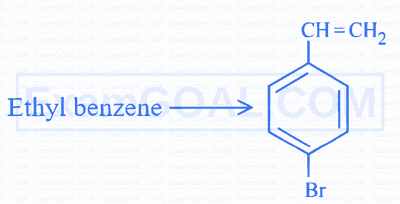
Consider the above reaction
A. The reaction proceeds through a more stable radical intermediate.
B. The role of peroxide is to generate ${H^ \bullet }$ (Hydrogen radical).
C. During this reaction, benzene is formed as a byproduct.
D. 1-Bromo-2-phenylethane is formed as the minor product.
E. The same reaction in absence of peroxide proceeds via carbocation intermediate.
Identify the correct statements. Choose the correct answer from the options given below :
A & E Only
A, B & D Only
A, C & E Only
C, D & E Only
Consider the following reactions giving major product. Identify the correct reaction.


Given below are two statements :
Statement I : ' $\mathrm{C}-\mathrm{Cl}$ ' bond is stronger in $\mathrm{CH}_2=\mathrm{CH}-\mathrm{Cl}$ than $\mathrm{CH}_3-\mathrm{CH}_2-\mathrm{Cl}$
Statement II : The given optically active molecule,  on
on
hydrolysis gives a solution that can rotate the plane polarized light.
In the light of the above statements, choose the correct answer from the options given below
Statement I is false but Statement II is true
Statement I is true but Statement II is false
Both Statement I and Statement II are true
Both Statement I and Statement II are false


Match the List-I with List-II
| List-I Chloro derivative | List-II Example |
|---|---|
| A. Vinyl Chloride | I. CH$_2$ = CH - CH$_2$Cl |
| B. Benzyl Chloride | II. CH$_3$ - CH(Cl)CH$_3$ |
| C. Alkyl Chloride | III. CH$_2$ = CHCl |
| D. Allyl Chloride | IV.  |
Choose the correct answer from the options given below :
A-III, B-IV, C-I, D-II
A-IV, B-I, C-III, D-II
A-III, B-IV, C-II, D-I
A-I, B-II, C-IV, D-III
$ \text { Consider the following compounds } $

$ \text { Arrange these compounds in the increasing order of reactivity with nitrating mixture. } $
$c < b < a$
$\mathrm{b}<\mathrm{c}<\mathrm{a}$
$\mathrm{c}<\mathrm{a}<\mathrm{b}$
$\mathrm{b}<\mathrm{a}<\mathrm{c}$
As compared with chlorocyclohexane, which of the following statements correctly apply to chlorobenzene?
A. The magnitude of negative charge is more on chlorine atom.
B. The $\mathrm{C}-\mathrm{Cl}$ bond has partial double bond character.
C. $\mathrm{C}-\mathrm{Cl}$ bond is less polar.
D. $\mathrm{C}-\mathrm{Cl}$ bond is longer due to repulsion between delocalised electrons of the aromatic ring and lone pairs of electrons of chlorine.
E. The $\mathrm{C}-\mathrm{Cl}$ bond is formed using $\mathrm{sp}^2$ hybridised orbital of carbon.
Choose the correct answer from the options given below :
B, C and E Only
A, C and E Only
B, C and D Only
A, D and E Only
The correct order of the rate of reaction of the following reactants with nucleophile by $\mathrm{S}_{\mathrm{N}} 1$ mechanism is :
(Given : Structures I and II are rigid)

I $<$ II $<$ III $<$ IV
II $<$ I $<$ III $<$ IV
III $<$ I $<$ II $<$ IV
IV $<$ III $<$ II $<$ I
The correct order of reactivity of $\mathrm{CH}_3 \mathrm{Br}$ in methanol with the following nucleophiles is
$\mathrm{F}^{-}, \mathrm{I}^{-}, \mathrm{C}_2 \mathrm{H}_5 \mathrm{O}^{-}$and $\mathrm{C}_6 \mathrm{H}_5 \mathrm{O}^{-}$
$\mathrm{I}^{-}>\mathrm{C}_2 \mathrm{H}_5 \mathrm{O}^{-}>\mathrm{C}_6 \mathrm{H}_5 \mathrm{O}^{-}>\mathrm{F}^{-}$
$\mathrm{I}^{-}>\mathrm{F}^{-}>\mathrm{C}_6 \mathrm{H}_5 \mathrm{O}^{-}>\mathrm{C}_2 \mathrm{H}_5 \mathrm{O}^{-}$
$\mathrm{I}^{-}>\mathrm{C}_6 \mathrm{H}_5 \mathrm{O}^{-}>\mathrm{F}^{-}>\mathrm{C}_2 \mathrm{H}_5 \mathrm{O}^{-}$
$\mathrm{I}^{-}>\mathrm{C}_2 \mathrm{H}_5 \mathrm{O}^{-}>\mathrm{F}^{-}>\mathrm{C}_6 \mathrm{H}_5 \mathrm{O}^{-}$
The correct order of the rate of the reaction for the following reaction with respect to nucleophiles is :
${CH_3Br + Nu^- \longrightarrow CH_3Nu + Br^-}$
${ClO_4^- > CH_3COO^- > OH^- > PhO^-}$
${OH^- > PhO^- > CH_3COO^- > ClO_4^-}$
${CH_3COO^- > PhO^- > OH^- > ClO_4^-}$
${PhO^- > OH^- > CH_3COO^- > ClO_4^-}$
The correct order of reactivity of the following benzyl halides towards reaction with KCN is :

a > b > c > d
b > a > d > c
b > a > c > d
a > b > d > c
Consider all the structural isomers with molecular formula $\mathrm{C}_5 \mathrm{H}_{11} \mathrm{Br}$ are separately treated with $\mathrm{KOH}(\mathrm{aq})$ to give respective substitution products, without any rearrangement. The number of products which can exhibit optical isomerism from these is $\_\_\_\_$。
Explanation:


As per the language given and considering the condition we are going with answer 3 and considering both active isomers we will be giving 6 too.
Given below are two statements :
Statement I : Due to increase in van der Waals forces, the order of boiling points is $\mathrm{CH}_3 \mathrm{CH}_2 \mathrm{CH}_2 \mathrm{I}>\mathrm{CH}_3 \mathrm{CH}_2 \mathrm{I}>\mathrm{CH}_3 \mathrm{I}$.
$ \text { Statement II : } $
In the light of the above statements, choose the correct answer from the options given below :
Both Statement I and Statement II are true
Both Statement I and Statement II are false
Statement I is true but Statement II is false
Statement I is false but Statement II is true


Given below are two statements :
Statement I : 3-phenylpropene reacts with HBr and gives secondary alkyl bromide having a chiral carbon atom as the major product.
Statement II : Aryl chlorides and aryl cyanides can be prepared by Sandmeyer reaction as well as Gattermann reaction.
In the light of the above statements, choose the correct answer from the options given below
Both Statement I and Statement II are true
Both Statement I and Statement II are false
Statement I is true but Statement II is false
Statement I is false but Statement II is true

$ \text { Match the LIST-I with LIST-II } $
| $ \begin{gathered} \text { List-I } \\ \text { Name of reaction } \end{gathered} $ |
$ \begin{gathered} \text { List-II } \\ \text { Reagent or catalyst used } \end{gathered} $ |
||
|---|---|---|---|
| A. | Finkelstein reaction | I. | $\mathrm{SbF}_3$ |
| B. | Swarts reaction | II. | Na, dry ether |
| C. | Sandmeyer's reaction | III. | NaI |
| D. | Fittig reaction | IV. | $\mathrm{Cu}_2 \mathrm{Cl}_2$ |
Choose the correct answer from the options given below :
A-I, B-IV, C-III, D-III
A-III, B-I, C-IV, D-II
A-IV, B-II, C-I, D-III
A-I, B-III, C-II D-IV
Correct statements regarding alkyl halides (R–X) among the following are :
A. Alcohol being less polar solvent as compared to water, alcoholic KOH favours elimination reaction with R–X.
B. Order of reactivity towards SN1 mechanism is C6H5–CH2–Cl > C6H5–CHCl–C6H5.
C. Non substituted aryl halides exhibit properties similar to alkyl halides.
D. Vinyl chloride is an example of haloalkene and allyl chloride is an example of haloalkyne.
E. R–Cl can be prepared by reacting R–OH with SOCl2 but Ar–Cl cannot be prepared by reacting Ar–OH with SOCl2.
Choose the correct answer from the options given below :
A, B and C Only
B and D Only
A and E Only
D and E Only
Given below are two statements :
Statement (I) : Benzyl chloride reacts faster in $S_N1$ mechanism than ethyl chloride.
Statement (II) : Ethyl carbocation intermediate is less stabilized by hyperconjugation than benzyl carbocation by resonance.
In the light of the above statements, choose the correct answer from the options given below :
Both Statement I and Statement II are true
Both Statement I and Statement II are false
Statement I is true but Statement II is false
Statement I is false but Statement II is true
RMgI when treated with ice cold water liberated a gas which occupied $1.4 \mathrm{dm}^3 / \mathrm{g}$ at STP. The gas produced is further reacted with iodine in presence of $\mathrm{HIO}_3$ to give compound $(\mathrm{X})$. Compound $(\mathrm{X})$ in presence of Na and dry ether produced compound $(\mathrm{Y})$. Molar mass of compound $(\mathrm{Y})$ is $\_\_\_\_$ $\mathrm{g} \mathrm{mol}^{-1}$. (Nearest integer)
Explanation:

Given that the gas produced by treating RMgI with ice-cold water occupies a volume of $1.4 \, \mathrm{dm}^3$ per gram at STP.
At STP, one mole of any gas occupies $22.4 \, \mathrm{dm}^3$. So, the molar mass of the gas can be calculated as:
$ \text{Molar mass} = \frac{22.4}{1.4} \approx 16 $
This shows that the gas produced is methane, $\mathrm{CH_4}$.

The methane formed reacts with iodine in the presence of $\mathrm{HIO_3}$ to form methyl iodide ($\mathrm{CH_3I}$), which is compound $(\mathrm{X})$.
When $\mathrm{CH_3I}$ is treated with sodium metal in dry ether, a coupling reaction (Wurtz reaction) occurs, forming ethane ($\mathrm{C_2H_6}$), which is compound $(\mathrm{Y})$.
The molar mass of ethane is:
$ \text{Molar mass of } \mathrm{C_2H_6} = (2 \times 12) + (6 \times 1) = 30 \, \mathrm{g \, mol^{-1}} $

'P' is


Choose the correct set of reagents for the following conversion.

Which one of the following reactions will not lead to the desired ether formation in major proportion?
(iso- $\mathrm{Bu} \Rightarrow$ isobutyl, sec $-\mathrm{Bu} \Rightarrow$ sec-butyl, $\mathrm{nPr} \Rightarrow \mathrm{n}$-propyl, $ { }^{\mathrm{t}} \mathrm{Bu} \Rightarrow \text { tert-butyl, } \mathrm{Et} \Rightarrow \text { ethyl) } $


Consider the following molecule(X).

The major product formed when the given molecule $(X)$ is treated with $\mathrm{HBr}(1 \mathrm{eq})$ is :


Given below are two statements :
Statement (I) : Alcohols are formed when alkyl chlorides are treated with aqueous potassium hydroxide by elimination reaction.
Statement (II) : In alcoholic potassium hydroxide, alkyl chlorides form alkenes by abstracting the hydrogen from the $\beta$-carbon.
In the light of the above statements, choose the most appropriate answer from the options given below :

$ \text {In the following series of reactions identify the major products } \mathrm{A} \& \mathrm{~B} \text { respectively } $



Which among the following halides will generate the most stable carbocation in the nucleophilic substitution reaction?


The major product of the following reaction is:

6-Phenylhepta-3,5-diene
6-Phenylhepta-2,4-diene
2-Phenylhepta-2,4-diene
2-Phenylhepta-2,5-diene

The products A and B in the following reactions, respectively are
$\mathrm{A} \stackrel{\mathrm{Ag}-\mathrm{NO}_2}{\longleftrightarrow} \mathrm{CH}_3-\mathrm{CH}_2-\mathrm{CH}_2-\mathrm{Br} \xrightarrow{\mathrm{AgCN}} \mathrm{B}$
The structure of the major product formed in the following reaction is :


Given below are two statements:
Statement I: The conversion proceeds well in the less polar medium.
$\mathrm{CH}_3-\mathrm{CH}_2-\mathrm{CH}_2-\mathrm{CH}_2-\mathrm{Cl} \xrightarrow{\mathrm{HO}^{-}} \mathrm{CH}_3-\mathrm{CH}_2-\mathrm{CH}_2-\mathrm{CH}_2-\mathrm{OH}+\mathrm{Cl}^{(-)}$
Statement II: The conversion proceeds well in the more polar medium.

In the light of the above statements, choose the correct answer from the options given below


Following are the four molecules "P", "Q", "R" and "S".
Which one among the four molecules will react with $\mathrm{H}-\mathrm{Br}_{(\mathrm{aq})}$ at the fastest rate?


Identify the products [A] and [B], respectively in the following reaction:


The ascending order of relative rate of solvolysis of following compounds is :


Propane molecule on chlorination under photochemical condition gives two di-chloro products, " $x$ " and " $y$ ". Amongst " $x$ " and " $y$ ", " $x$ " is an optically active molecule. How many tri-chloro products (consider only structural isomers) will be obtained from " x " when it is further treated with chlorine under the photochemical condition?


The maximum number of RBr producing 2-methylbutane by above sequence of reactions is __________ . (Consider the structural isomers only)

Given below are two statements :
Statement I : $\quad \mathrm{CH}_3-\mathrm{O}-\mathrm{CH}_2-\mathrm{Cl}$ will undergo $\mathrm{S}_{\mathrm{N}} 1$ reaction though it is a primary halide.
Statement II :  will not undergo $\mathrm{S}_{\mathrm{N}} 2$ reaction very easily though it is a primary halide.
In the light of the above statements, choose the most appropriate answer from the options given below :


Consider the above sequence of reactions. 151 g of 2-bromopentane is made to react. Yield of major product P is $80 \%$ whereas Q is $100 \%$.
Mass of product Q obtained is________ g.
(Given molar mass in $\mathrm{g} \mathrm{mol}^{-1} \mathrm{H}: 1, \mathrm{C}: 12, \mathrm{O}: 16, \mathrm{Br}: 80$ )
Explanation:

$\begin{aligned} & \text { Molecular mass of } \mathrm{Q}=230 \mathrm{~g} \mathrm{~mol}^{-1} \\ & \begin{aligned} \text { Mass of } \mathrm{Q} & =0.8 \times 230 \\ & =184 \mathrm{~g} \end{aligned} \end{aligned}$
Consider the following sequence of reactions:

11.25 mg of chlorobenzene will produce ___________$\times 10^{-1} \mathrm{mg}$ of product B.
(Consider the reactions result in complete conversion.)
[Given molar mass of $\mathrm{C}, \mathrm{H}, \mathrm{O}, \mathrm{N}$ and Cl as $12,1,16,14$ and $35.5 \mathrm{~g} \mathrm{~mol}^{-1}$ respectively]
Explanation:

$\begin{aligned} & \frac{11.25 \times 10^{-3}}{112.5}=\frac{x \times 10^{-1} \times 10^{-3}}{93} \\ & x \times 10^{-1}=93 \times 0.1 \\ & x=93 \mathrm{mg} \end{aligned}$
Given below are two statements : one is labelled as Assertion (A) and the other is labelled as Reason (R).
Assertion (A) : $\mathrm{S}_{\mathrm{N}} 2$ reaction of $\mathrm{C}_6 \mathrm{H}_5 \mathrm{CH}_2 \mathrm{Br}$ occurs more readily than the $\mathrm{S}_{\mathrm{N}} 2$ reaction of $\mathrm{CH}_3 \mathrm{CH}_2 \mathrm{Br}$.
Reason (R) : The partially bonded unhybridized p-orbital that develops in the trigonal bipyramidal transition state is stabilized by conjugation with the phenyl ring.
In the light of the above statements, choose the most appropriate answer from the options given below :
In the following sequence of reaction, the major products B and C respectively are :


Which among the following compounds will undergo fastest SN2 reaction.


 , it will undergo SN2 reaction fastest.
Identify the major product in the following reaction.


Product P is


 , double bond is in resonance with the ring, thus, more stable.
$\mathrm{CH}_3-\mathrm{CH}_2-\mathrm{CH}_2-\mathrm{Br}+\mathrm{NaOH} \xrightarrow{\mathrm{C}_2 \mathrm{H}_5 \mathrm{OH}} \text { Product 'A' }$

Consider the above reactions, identify product B and product C.

Find out the major product formed from the following reaction. $[\mathrm{Me}:-\mathrm{CH}_3]$


Identify B and C and how are A and C related?


Identify the correct set of reagents or reaction conditions '$X$' and '$Y$' in the following set of transformation.


Assertion (A) : Haloalkanes react with KCN to form alkyl cyanides as a main product while with $\mathrm{AgCN}$ form isocyanide as the main product.
Reason (R) : $\mathrm{KCN}$ and $\mathrm{AgCN}$ both are highly ionic compounds.
In the light of the above statements, choose the most appropriate answer from the options given below :
Identify A and B in the following reaction sequence.


The product (C) in the below mentioned reaction is :
$\mathrm{CH}_3-\mathrm{CH}_2-\mathrm{CH}_2-\mathrm{Br} \xrightarrow[\Delta]{\mathrm{KOH}_{(\text {alc) }}} \mathrm{A} \xrightarrow{\mathrm{HBr}} \mathrm{B} \xrightarrow[\mathrm{KOH}_{(\mathrm{aq})}]{\Delta} \mathrm{C}$

Given below are two statements:
Statement - I: High concentration of strong nucleophilic reagent with secondary alkyl halides which do not have bulky substituents will follow $\mathrm{S}_{\mathrm{N}}{ }^2$ mechanism.
Statement - II: A secondary alkyl halide when treated with a large excess of ethanol follows $\mathrm{S}_{\mathrm{N}}{ }^1$ mechanism.
In the light of the above statements, choose the most appropriate from the options given below:
Example of vinylic halide is :


