Chemical Bonding & Molecular Structure
266 Questions
Start JEE Mains Test
2022
Q151
JEE Mains
Numerical
14 Mar 2026
The hybridization of P exhibited in PF5 is spxdy. The value of y is __________.
Correct Answer: 1
Explanation:
$\mathrm{PF}_5 \Rightarrow \mathrm{sp}^3 \mathrm{~d}$ hybridisation
(5 sigma bonds, zero lone pair on central atom)
Value of $y=1$
(5 sigma bonds, zero lone pair on central atom)
Value of $y=1$
2022
Q152
JEE Mains
Numerical
14 Mar 2026
Amongst SF4, XeF4, CF4 and H2O, the number of species with two lone pairs of electrons is _____________.
Correct Answer: 1
Explanation:

2022
Q153
JEE Mains
Numerical
14 Mar 2026
Amongst BeF2, BF3, H2O, NH3, CCl4 and HCl, the number of molecules with non-zero net dipole moment is ____________.
Correct Answer: 3
Explanation:
$\mathrm{BeF}_2, \mathrm{BF}_3$ and $\mathrm{CCl}_4 \Rightarrow \mu_{\mathrm{net}}=0$
$\mathrm{H}_2 \mathrm{O}, \mathrm{NH}_3$ and $\mathrm{HCl} \Rightarrow \mu_{\mathrm{net}} \neq 0$
$\mathrm{H}_2 \mathrm{O}, \mathrm{NH}_3$ and $\mathrm{HCl} \Rightarrow \mu_{\mathrm{net}} \neq 0$
2021
Q154
JEE Mains
MCQ
14 Mar 2026
Number of paramagnetic oxides among the following given oxides is ____________.
Li2O, CaO, Na2O2, KO2, MgO and K2O
Li2O, CaO, Na2O2, KO2, MgO and K2O
A.
1
B.
2
C.
3
D.
0
2021
Q155
JEE Mains
MCQ
14 Mar 2026
Match List - I with List - II :

Choose the most appropriate answer from the options given below :
Choose the most appropriate answer from the options given below :
A.
(a)-(iv), (b)-(i), (c)-(ii), (d)-(iii)
B.
(a)-(iii), (b)-(iv), (c)-(ii), (d)-(i)
C.
(a)-(iii), (b)-(ii), (c)-(iv), (d)-(i)
D.
(a)-(iv), (b)-(ii), (c)-(i), (d)-(iii)


2021
Q156
JEE Mains
MCQ
14 Mar 2026
Match items of List-I with those of List-II :
Choose the most appropriate answer from the options given below :
| List - I (Property) |
List - II (Example) |
||
|---|---|---|---|
| (a) | Diamagnetism | (i) | MnO |
| (b) | Ferrimagnetism | (ii) | ${O_2}$ |
| (c) | Paramagnetism | (iii) | NaCl |
| (d) | Antiferromagnetism | (iv) | $F{e_3}{O_4}$ |
Choose the most appropriate answer from the options given below :
A.
(a)-(ii), (b)-(i), (c)-(iii), (d)-(iv)
B.
(a)-(i), (b)-(iii), (c)-(iv), (d)-(ii)
C.
(a)-(iii), (b)-(iv), (c)-(ii), (d)-(i)
D.
(a)-(iv), (b)-(ii), (c)-(i), (d)-(iii)
2021
Q157
JEE Mains
MCQ
14 Mar 2026
The bond order and magnetic behaviour of $O_2^ - $ ion are respectively :
A.
1.5 and paramagnetic
B.
1.5 and diamagnetic
C.
2 and diamagnetic
D.
1 and paramagnetic
2021
Q158
JEE Mains
MCQ
14 Mar 2026
In the following the correct bond order sequence is :
A.
$O_2^{2 - } > O_2^ + > O_2^ - > {O_2}$
B.
$O_2^ + > O_2^ - > O_2^{2 - } > {O_2}$
C.
$O_2^ + > {O_2} > O_2^ - > O_2^{2 - }$
D.
${O_2} > O_2^ - > O_2^{2 - } > O_2^ + $
2021
Q159
JEE Mains
MCQ
14 Mar 2026
Identify the species having one $\pi$-bond and maximum number of canonical forms from the following :
A.
SO3
B.
O2
C.
SO2
D.
CO$_3^{2 - }$

2021
Q160
JEE Mains
MCQ
14 Mar 2026
Match List-I with List-II :
Choose the correct answer from the options given below :
| List-I (Species) |
List-II (Hybrid Orbitals) |
||
|---|---|---|---|
| (a) | $S{F_4}$ | (i) | $s{p^3}{d^2}$ |
| (b) | $I{F_5}$ | (ii) | ${d^2}s{p^3}$ |
| (c) | $NO_2^ + $ | (iii) | $s{p^3}d$ |
| (d) | $NH_4^ + $ | (iv) | $s{p^3}$ |
| (v) | $sp$ |
Choose the correct answer from the options given below :
A.
(a)-(i), (b)-(ii), (c)-(v) and (d)-(iii)
B.
(a)-(ii), (b)-(i), (c)-(iv) and (d)-(v)
C.
(a)-(iii), (b)-(i), (c)-(v) and (d)-(iv)
D.
(a)-(iv), (b)-(iii), (c)-(ii) and (d)-(v)
2021
Q161
JEE Mains
MCQ
14 Mar 2026
The hybridisations of the atomic orbitals of nitrogen in NO$_2^ - $, NO$_2^ + $ and NH$_4^ + $ respectively are.
A.
sp3, sp2 and sp
B.
sp, sp2 and sp3
C.
sp3, sp and sp2
D.
sp2, sp and sp3


2021
Q162
JEE Mains
MCQ
14 Mar 2026
Amongst the following, the linear species is :
A.
O3
B.
Cl2O
C.
N$_3^ - $
D.
NO2

2021
Q163
JEE Mains
MCQ
14 Mar 2026
A central atom in a molecule has two lone pairs of electrons and forms three single bonds. The shape of this molecule is :
A.
trigonal pyramidal
B.
T-shaped
C.
see-saw
D.
planar triangular

2021
Q164
JEE Mains
MCQ
14 Mar 2026
Given below are two statements : one is labeled as Assertion A and the other is labelled as Reason R :
Assertion A : The H$-$O$-$H bond angle in water molecule is 104.5$^\circ$.
Reason R : The lone pair - lone pair repulsion of electrons is higher than the bond pair - bond pair repulsion.
In the light of the above statements, choose the correct answer from the options given below :
Assertion A : The H$-$O$-$H bond angle in water molecule is 104.5$^\circ$.
Reason R : The lone pair - lone pair repulsion of electrons is higher than the bond pair - bond pair repulsion.
In the light of the above statements, choose the correct answer from the options given below :
A.
Both A and R are true, and R is the correct explanation of A
B.
A is true but R is false
C.
A is false but R is true
D.
Both A and R are true, but R is not the correct explanation of A

2021
Q165
JEE Mains
MCQ
14 Mar 2026
Match List - I with List - II.
Choose the correct answer from the options given below :
| List - I (Molecule) | List - II (Bond order) | ||
|---|---|---|---|
| (a) | $N{e_2}$ | (i) | 1 |
| (b) | ${N_2}$ | (ii) | 2 |
| (c) | ${F_2}$ | (iii) | 0 |
| (d) | ${O_2}$ | (iv) | 3 |
Choose the correct answer from the options given below :
A.
(a) $ \to $ (i), (b) $ \to $ (ii), (c) $ \to $ (iii), (d) $ \to $ (iv)
B.
(a) $ \to $ (iv), (b) $ \to $ (iii), (c) $ \to $ (ii), (d) $ \to $ (i)
C.
(a) $ \to $ (iii), (b) $ \to $ (iv), (c) $ \to $ (i), (d) $ \to $ (ii)
D.
(a) $ \to $ (ii), (b) $ \to $ (i), (c) $ \to $ (iv), (d) $ \to $ (iii)
2021
Q166
JEE Mains
MCQ
14 Mar 2026
Given below are two statements : one is labelled as Assertion A and the other is labelled as Reason R.
Assertion A : Dipole-dipole interactions are the only non-covalent interactions, resulting in hydrogen bond formation.
Reason R : Fluorine is the most electronegative element and hydrogen bonds in HF are symmetrical.
In the light of the above statements, choose the most appropriate answer from the options given below :
Assertion A : Dipole-dipole interactions are the only non-covalent interactions, resulting in hydrogen bond formation.
Reason R : Fluorine is the most electronegative element and hydrogen bonds in HF are symmetrical.
In the light of the above statements, choose the most appropriate answer from the options given below :
A.
Both A and R are true and R is the correct explanation of A
B.
A is true but R is false
C.
A is false but R is true
D.
Both A and R are true but R is NOT the correct explanation of A
2021
Q167
JEE Mains
MCQ
14 Mar 2026
Which among the following species has unequal bond lengths?
A.
XeF4
B.
BF$_4^ - $
C.
SiF4
D.
SF4


2021
Q168
JEE Mains
MCQ
14 Mar 2026
According to molecular orbital theory, the species among the following that does not exist is :
A.
${O_2}^{2 - }$
B.
$B{e_2}$
C.
$H{e_2}^ - $
D.
$H{e_2}^ + $
2021
Q169
JEE Mains
MCQ
14 Mar 2026
The correct set from the following in which both pairs are in correct order of melting point is :
A.
LiCl > LiF ; NaCl > MgO
B.
LiCl > LiF ; MgO > NaCl
C.
LiF > LiCl ; NaCl > MgO
D.
LiF > LiCl ; MgO > NaCl
2021
Q170
JEE Mains
MCQ
14 Mar 2026
The correct shape and $I - I - I$ bond angles respectively in $I_3^ - $ ion are :
A.
Linear; 180$^\circ$
B.
T-shaped; 180$^\circ$ and 90$^\circ$
C.
Trigonal planar; 120$^\circ$
D.
Distorted trigonal planar; 135$^\circ$ and 90$^\circ$


2021
Q171
JEE Mains
MCQ
14 Mar 2026
Which of the following are isostructural pairs ?
A. $SO_4^{2 - }$ and $CrO_4^{2 - }$
B. SiCl4, and TiCl4
C. NH3 and NO3-
D. BCl3 and BrCl3
A. $SO_4^{2 - }$ and $CrO_4^{2 - }$
B. SiCl4, and TiCl4
C. NH3 and NO3-
D. BCl3 and BrCl3
A.
B and C only
B.
C and D only
C.
A and B only
D.
A and C only

 If number of sigma bond ($\sigma $), co-ordinate bond and lone pair are same for given pairs, they are isostructural.
2021
Q172
JEE Mains
Numerical
14 Mar 2026
The spin-only magnetic moment value of $B_2^ + $ species is _____________ $\times$ 10$-$2 BM. (Nearest integer) [Given : $\sqrt 3 $ = 1.73]
Correct Answer: 173
Explanation:
$B_2^ + \Rightarrow \sigma _{1s}^2\sigma _{1s}^{*2}\sigma _{2s}^2\sigma _{2s}^{*2}\pi _{2py}^1 \simeq \pi _{2pz}^0$
It has one unpaired electron.
Spin - only magnetic moment = $\mu $
= $\sqrt {n\left( {n + 1} \right)} $
n = Number of unpaired electrons
$= \sqrt {1(1 + 2)} = \sqrt 3 $ BM
= 1.73 BM
= 1.73 $\times$ 10$-$2 BM
It has one unpaired electron.
Spin - only magnetic moment = $\mu $
= $\sqrt {n\left( {n + 1} \right)} $
n = Number of unpaired electrons
$= \sqrt {1(1 + 2)} = \sqrt 3 $ BM
= 1.73 BM
= 1.73 $\times$ 10$-$2 BM
2021
Q173
JEE Mains
Numerical
14 Mar 2026
According to molecular orbital theory, the number of unpaired electron(s) in $O_2^{2 - }$ is :
Correct Answer: 0
Explanation:
Molecular orbital configuration of $O_2^{2 - }$ is
$\sigma _{1s}^2\sigma _{1s}^{*2}\sigma _{2s}^2\sigma _{2s}^{*2}\left( {\pi 2p_x^2 = \pi 2p_y^2} \right)\left( {\pi _{2px}^{*2} = \pi _{2py}^{*2}} \right)$
Zero unpaired electron
$\sigma _{1s}^2\sigma _{1s}^{*2}\sigma _{2s}^2\sigma _{2s}^{*2}\left( {\pi 2p_x^2 = \pi 2p_y^2} \right)\left( {\pi _{2px}^{*2} = \pi _{2py}^{*2}} \right)$
Zero unpaired electron
2021
Q174
JEE Mains
Numerical
14 Mar 2026
The number of hydrogen bonded water molecule(s) associated with stoichiometry CuSO4.5H2O is ____________.
Correct Answer: 1
Explanation:

One hydrogen bonded H2O molecule
2021
Q175
JEE Mains
Numerical
14 Mar 2026
The number of species having non-pyramidal shape among the following is ___________.
(A) SO3
(B) NO$_3^ - $
(C) PCl3
(D) CO$_3^{2 - }$
(A) SO3
(B) NO$_3^ - $
(C) PCl3
(D) CO$_3^{2 - }$
Correct Answer: 3
Explanation:

Hence, non-pyramidal species are SO3, NO$_3^{- }$ and CO$_3^{2 - }$.
2021
Q176
JEE Mains
Numerical
14 Mar 2026
AB3 is an interhalogen T-shaped molecule. The number of lone pairs of electrons on A is __________. (Integer answer)
Correct Answer: 2
Explanation:
T-shaped molecule means 3 sigma bond and 2 lone pairs of electron on central atom.

2021
Q177
JEE Mains
Numerical
14 Mar 2026
The total number of electrons in all bonding molecular orbitals of $O_2^{2 - }$ is ______________.
(Round off to the nearest integer)
(Round off to the nearest integer)
Correct Answer: 10
Explanation:
Nb = No of electrons in bonding molecular orbital
Na $=$ No of electrons in anti bonding molecular orbital
(1) $\,\,\,\,$ upto 14 electrons, molecular orbital configuration is

Here Na = Anti bonding electron $=$ 4 and Nb = 10
(2) $\,\,\,\,$ After 14 electrons to 20 electrons molecular orbital configuration is - - -

Here Na = 10
and Nb = 10
In O atom 8 electrons present, so in O2, 8 $ \times $ 2 = 16 electrons present.
Then in $O_2^ + $ no of electrons = 15
in $O_2^ - $ no of electrons = 17
in $O_2^{2 - }$ no of electrons = 18
Molecular orbital configuration of O $_2^{2 - }$ (18 electrons) is
${\sigma _{1{s^2}}}\,\sigma _{1{s^2}}^ * \,{\sigma _{2{s^2}}}\,\sigma _{2{s^2}}^ * \,{\sigma _{2p_z^2}}\,{\pi _{2p_x^2}}\, = \,{\pi _{2p_y^2}}\,\pi _{2p_x^2}^ * \, = \,\pi _{2p_y^2}^ * $
$\therefore\,\,\,\,$ Nb = 10
and Na = 8
Na $=$ No of electrons in anti bonding molecular orbital
(1) $\,\,\,\,$ upto 14 electrons, molecular orbital configuration is
Here Na = Anti bonding electron $=$ 4 and Nb = 10
(2) $\,\,\,\,$ After 14 electrons to 20 electrons molecular orbital configuration is - - -
Here Na = 10
and Nb = 10
In O atom 8 electrons present, so in O2, 8 $ \times $ 2 = 16 electrons present.
Then in $O_2^ + $ no of electrons = 15
in $O_2^ - $ no of electrons = 17
in $O_2^{2 - }$ no of electrons = 18
Molecular orbital configuration of O $_2^{2 - }$ (18 electrons) is
${\sigma _{1{s^2}}}\,\sigma _{1{s^2}}^ * \,{\sigma _{2{s^2}}}\,\sigma _{2{s^2}}^ * \,{\sigma _{2p_z^2}}\,{\pi _{2p_x^2}}\, = \,{\pi _{2p_y^2}}\,\pi _{2p_x^2}^ * \, = \,\pi _{2p_y^2}^ * $
$\therefore\,\,\,\,$ Nb = 10
and Na = 8
2021
Q178
JEE Mains
Numerical
14 Mar 2026
The difference between bond orders of CO and NO$^ \oplus $ is ${x \over 2}$ where x = _____________. (Round off to the Nearest Integer)
Correct Answer: 0
Explanation:
Bond order of CO = 3
Bond order of NO+ = 3
Difference = 0 = ${x \over 2}$
$ \Rightarrow $ x = 0
Note :
(1) $\,$ Bond order $ = {1 \over 2}$ [Nb $-$ Na]
Nb = No of electrons in bending molecular orbital
Na $=$ No of electrons in anti bonding molecular orbital
(4) $\,\,\,\,$ upto 14 electrons, molecular orbital configuration is
Here Na = Anti bonding electron $=$ 4 and Nb = 10
(5) $\,\,\,\,$ After 14 electrons to 20 electrons molecular orbital configuration is - - -
Here Na = 10
and Nb = 10
(A) CO has 14 electrons.
Moleculer orbital configuration of CO is
${\sigma _{1{s^2}}}\,\sigma _{1{s^2}}^ * \,\,{\sigma _{2{s^2}}}\,\,\sigma _{2{s^2}}^ * \,\,{\pi _{2p_x^2}} =\,{\pi _{2p_y^2}}\,{\sigma _{2p_z^2}}$
$\therefore$ Nb = 10
Na = 4
$\therefore\,\,\,\,$ BO = ${1 \over 2}$ [ 10 $-$ 4] = 3
(B) NO+ has 14 electrons.
Moleculer orbital configuration of NO+ is
${\sigma _{1{s^2}}}$ $\sigma _{1{s^2}}^ * $ ${\sigma _{2{s^2}}}\,\sigma _{2{s^2}}^ * \,\,{\sigma _{2p_z^2}}\,\,{\pi _{2p_x^2}}\,\, = \,\,{\pi _{2p_y^2}}$
$\therefore$ Nb = 10
Na = 4
$\therefore\,\,\,\,$ BO = ${1 \over 2}$ [ 10 $-$ 4] = 3
Bond order of NO+ = 3
Difference = 0 = ${x \over 2}$
$ \Rightarrow $ x = 0
Note :
(1) $\,$ Bond order $ = {1 \over 2}$ [Nb $-$ Na]
Nb = No of electrons in bending molecular orbital
Na $=$ No of electrons in anti bonding molecular orbital
(4) $\,\,\,\,$ upto 14 electrons, molecular orbital configuration is
Here Na = Anti bonding electron $=$ 4 and Nb = 10
(5) $\,\,\,\,$ After 14 electrons to 20 electrons molecular orbital configuration is - - -
Here Na = 10
and Nb = 10
(A) CO has 14 electrons.
Moleculer orbital configuration of CO is
${\sigma _{1{s^2}}}\,\sigma _{1{s^2}}^ * \,\,{\sigma _{2{s^2}}}\,\,\sigma _{2{s^2}}^ * \,\,{\pi _{2p_x^2}} =\,{\pi _{2p_y^2}}\,{\sigma _{2p_z^2}}$
$\therefore$ Nb = 10
Na = 4
$\therefore\,\,\,\,$ BO = ${1 \over 2}$ [ 10 $-$ 4] = 3
(B) NO+ has 14 electrons.
Moleculer orbital configuration of NO+ is
${\sigma _{1{s^2}}}$ $\sigma _{1{s^2}}^ * $ ${\sigma _{2{s^2}}}\,\sigma _{2{s^2}}^ * \,\,{\sigma _{2p_z^2}}\,\,{\pi _{2p_x^2}}\,\, = \,\,{\pi _{2p_y^2}}$
$\therefore$ Nb = 10
Na = 4
$\therefore\,\,\,\,$ BO = ${1 \over 2}$ [ 10 $-$ 4] = 3
2021
Q179
JEE Mains
Numerical
14 Mar 2026
The number of lone pairs of electrons on the central I atom in I$_3^ - $ is ____________.
Correct Answer: 3
Explanation:
Shape of I3- is :

The number of lone pairs of electron on the central atom is 3.
2021
Q180
JEE Mains
Numerical
14 Mar 2026
The number of species below that have two lone pairs of electrons in their central atom is _________. (Round off to the Nearest Integer).
SF4, BF$_4^ - $, ClF3, AsF3, PCl5, BrF5, XeF4, SF6
SF4, BF$_4^ - $, ClF3, AsF3, PCl5, BrF5, XeF4, SF6
Correct Answer: 2
Explanation:


2021
Q181
JEE Mains
Numerical
14 Mar 2026
AX is a covalent diatomic molecule where A and X are second row elements of periodic table. Based on Molecular orbital theory, the bond order of AX is 2.5. The total number of electrons in AX is __________. (Round off to the Nearest Integer).
Correct Answer: 15
Explanation:
The compound AX is NO its bond order is 2.5 and it has total 15 electrons.
Note : Total number of electrons equal to 13 will also have the 2.5 bond order. But in this case neutral diatomic molecule will not be possible.
Note : Total number of electrons equal to 13 will also have the 2.5 bond order. But in this case neutral diatomic molecule will not be possible.
2021
Q182
JEE Mains
Numerical
14 Mar 2026
Among the following, the number of halide(s) which is/are inert to hydrolysis is _________.
(A) BF3
(B) SiCl4
(C) PCl5
(D) SF6
(A) BF3
(B) SiCl4
(C) PCl5
(D) SF6
Correct Answer: 1
Explanation:
BF3 – Shows Partial hydrolysis
SiCl4 – Undergoes hydrolysis readily
PCl5 – Undergoes hydrolysis by addition– elimination mechanism.
SF6 – Due to crowding Inert towards hydrolysis.
SiCl4 – Undergoes hydrolysis readily
PCl5 – Undergoes hydrolysis by addition– elimination mechanism.
SF6 – Due to crowding Inert towards hydrolysis.
2020
Q183
JEE Mains
MCQ
14 Mar 2026
The compound that has the largest H–M–H bond angle (M = N, O, S, C) is :
A.
CH4
B.
H2S
C.
NH3
D.
H2O
2020
Q184
JEE Mains
MCQ
14 Mar 2026
The potential energy curve for the H2
molecule as a function of internuclear distance is :
A.

B.

C.

D.

2020
Q185
JEE Mains
MCQ
14 Mar 2026
The structure of PCl5
in the solid state is :
A.
square pyramidal
B.
tetrahedral [PCl4]+ and octahedral [PCl6]–
C.
square planar [PCl4]+ and octahedral [PCl6]–
D.
trigonal bipyramidal
2020
Q186
JEE Mains
MCQ
14 Mar 2026
The reaction in which the hybridisation of the
underlined atom is affected is :
A.

B.

C.

D.

2020
Q187
JEE Mains
MCQ
14 Mar 2026
The intermolecular potential energy for the
molecules A, B, C and D given below suggests
that :
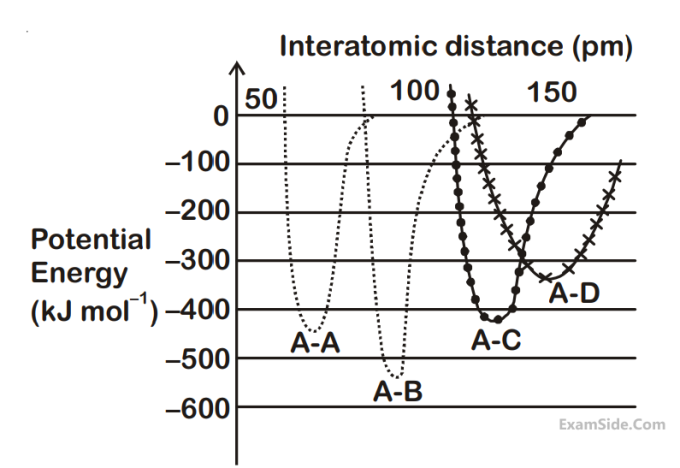

A.
A-B has the stiffest bond
B.
A-D has the shortest bond length
C.
A-A has the largest bond enthalpy
D.
D is more electronegative than other atoms
2020
Q188
JEE Mains
MCQ
14 Mar 2026
Of the species, NO, NO+, NO2+ and NO-
, the one with minimum bond strength is :
A.
NO–
B.
NO
C.
NO+
D.
NO2+
2020
Q189
JEE Mains
MCQ
14 Mar 2026
Match the type of interaction in column A with
the distance dependence of their interaction
energy in column B
| A | B |
|---|---|
| (i) ion-ion | (a) ${1 \over r}$ |
| (ii) dipole-dipole | (b) ${1 \over {{r^2}}}$ |
| (iii) London dispersion | (c) ${1 \over {{r^3}}}$ |
| (d) ${1 \over {{r^6}}}$ |
A.
(I)-(a), (II)-(b), (III)-(d)
B.
(I)-(b), (II)-(d), (III)-(c)
C.
(I)-(a), (II)-(b), (III)-(c)
D.
(I)-(a), (II)-(c), (III)-(d)
2020
Q190
JEE Mains
MCQ
14 Mar 2026
The shape / structure of [XeF5]– and XeO3F2,
respectively, are
A.
Pentagonal planar and trigonal bipyramidal
B.
Trigonal bipyramidal and pentagonal
planar
C.
Octahedral and square pyramidal
D.
Trigonal bipyramidal and trigonal
bipyramidal
2020
Q191
JEE Mains
MCQ
14 Mar 2026
The molecular geometry of SF6 is octahedral.
What is the geometry of SF4 (including lone
pair(s) of electrons, if any)?
A.
Tetrahedral
B.
Trigonal bipyramidal
C.
Square planar
D.
Pyramidal

2020
Q192
JEE Mains
MCQ
14 Mar 2026
If AB4 molecule is a polar molecule, a possible
geometry of AB4 is
A.
Tetrahedral
B.
see-saw
C.
Square pyramidal
D.
Square planar
2020
Q193
JEE Mains
MCQ
14 Mar 2026
The number of sp2 hybrid orbitals in a molecule
of benzene is :
A.
24
B.
12
C.
6
D.
18
2020
Q194
JEE Mains
MCQ
14 Mar 2026
If the magnetic moment of a dioxygen species
is 1.73 B.M, it may be :
A.
$O_2^ - $ or $O_2^ + $
B.
O2, $O_2^ - $ or $O_2^ + $
C.
O2 or $O_2^ + $
D.
O2 or $O_2^ - $
2020
Q195
JEE Mains
MCQ
14 Mar 2026
Arrange the following bonds according to their
average bond energies in descending order :
C–Cl, C–Br, C–F, C–I
C–Cl, C–Br, C–F, C–I
A.
C–Br > C–I > C–Cl > C–F
B.
C–Cl > C–Br > C–I > C–F
C.
C–I > C–Br > C–Cl > C–F
D.
C–F > C–Cl > C–Br > C–I
2020
Q196
JEE Mains
MCQ
14 Mar 2026
The bond order and the magnetic characteristics of CN-
are :
A.
3, paramagnetic
B.
$2{1 \over 2}$, paramagnetic
C.
3, diamagnetic
D.
$2{1 \over 2}$, diamagnetic
2020
Q197
JEE Mains
MCQ
14 Mar 2026
The relative strength of interionic/intermolecular forces in decreasing order is :
A.
dipole-dipole $>$ ion-dipole $>$ ion-ion
B.
ion-dipole $>$ dipole-dipole $>$ ion-ion
C.
ion-dipole $>$ ion-ion $>$ dipole-dipole
D.
ion-ion $>$ ion-dipole $>$ dipole-dipole
2020
Q198
JEE Mains
MCQ
14 Mar 2026
The dipole of CCl4, CHCl3 and CH4 are in the order :
A.
CCl4 < CH4 < CHCl3
B.
CH4 = CCl4 < CHCl3
C.
CH4 < CCl4 < CHCl3
D.
CHCl3 < CH4= CCl4
2020
Q199
JEE Mains
Numerical
14 Mar 2026
The number of Cl = O bonds in perchloric acid
is, "________".
Correct Answer: 3
Explanation:
The structure of perchloric acid is

The number Cl = O bonds in HClO4 is 3.
The number Cl = O bonds in HClO4 is 3.
2020
Q200
JEE Mains
Numerical
14 Mar 2026
Chlorine reacts with hot and concentrated NaOH and produces compounds (X) and (Y). Compound
(X) gives white precipitate with silver nitrate solution. The average bond order between CI and O
atoms in (Y) is.
Correct Answer: 1.66to1.67
Explanation:
3Cl2 + 6NaOH $ \to $ 5NaCl + NaClO3 + 3H2O
NaCl + AgNO3 $ \to $ AgCl- $ \downarrow $ + NaNO3
$ \therefore $ X = NaCl then Y = NaClO3
Here in anion ClO3- has bond between Cl and O atom.
Bond order of Cl–O Bond =
= ${5 \over 3}$ = 1.67
NaCl + AgNO3 $ \to $ AgCl- $ \downarrow $ + NaNO3
$ \therefore $ X = NaCl then Y = NaClO3
Here in anion ClO3- has bond between Cl and O atom.
Bond order of Cl–O Bond =
Total bond
Total resonating structure
.
= ${5 \over 3}$ = 1.67