Alcohols, Phenols and Ethers
184 Questions
Start JEE Mains Test
2019
Q151
JEE Mains
MCQ
14 Mar 2026
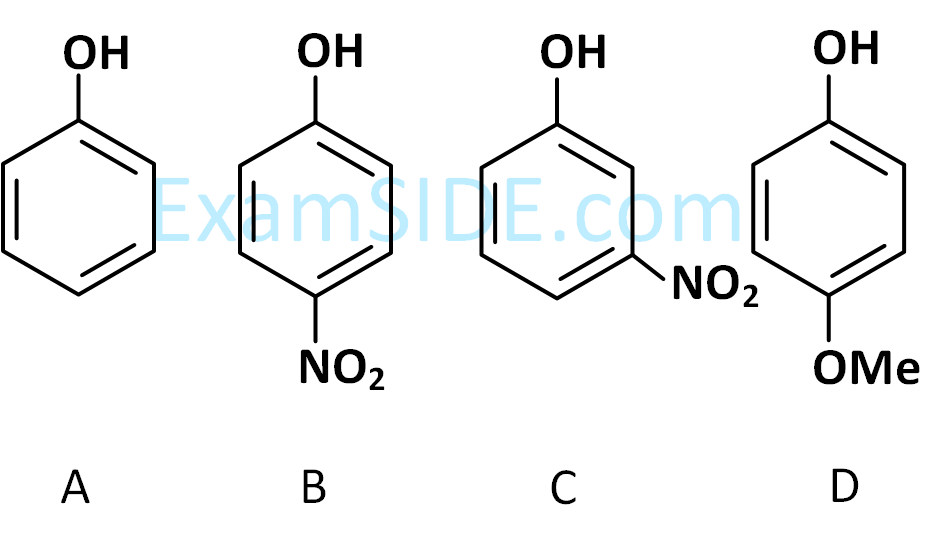
The increasing order of the pKa values of the following compounds is :
A.
B < C < D < A
B.
B < C < A < D
C.
D < A < C < B
D.
C < B < A < D

2019
Q152
JEE Mains
MCQ
14 Mar 2026
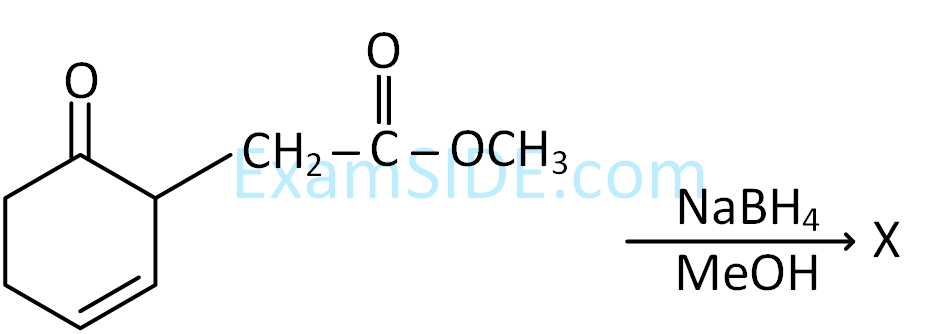
The major product 'X' formed in the following reaction is :
A.

B.

C.

D.


2019
Q153
JEE Mains
MSQ
14 Mar 2026
Which of the following compounds reacts with ethylmagnesium bromide and also decolourizes bromine water solution:
A.

B.

C.

D.

2018
Q154
JEE Mains
MCQ
14 Mar 2026
Phenol reacts with methyl chloroformate in the presence of NaOH to form product A. A reacts with Br2 to
form product B. A and B are respectively :
A.

B.

C.

D.


2018
Q155
JEE Mains
MCQ
14 Mar 2026
Phenol on treatment with CO2 in the presence of NaOH followed by acidification produces compound X as
the major product. X on treatment with (CH3CO)2O in the presence of catalytic amount of H2SO4 produces:
A.

B.

C.

D.


2018
Q156
JEE Mains
MCQ
14 Mar 2026
The major product formed in the following reaction is :

A.

B.

C.

D.


2018
Q157
JEE Mains
MCQ
14 Mar 2026
The total number of optically active compounds formed in the following reactio is :

A.
Two
B.
Four
C.
Six
D.
Zero
2018
Q158
JEE Mains
MCQ
14 Mar 2026
The major product of the following reaction is :

A.

B.

C.

D.


2017
Q159
JEE Mains
MCQ
14 Mar 2026
The increasing order of the boiling points for the following compounds is :

A.
(III) < (IV) < (II) < (I)
B.
(IV) < (III) < (I) < (II)
C.
(II) < (III) < (IV) < (I)
D.
(III) < (II) < (I) < (IV)
2017
Q160
JEE Mains
MCQ
14 Mar 2026
The major product of the following reaction is :

A.

B.

C.

D.


2016
Q161
JEE Mains
MCQ
14 Mar 2026
Bouveault-Blanc reduction reaction involves :
A.
Reduction of an acyl halide with H2/Pd.
B.
Reduction of an ester with Na/C2H5OH.
C.
Reduction of a carbonyl compound with Na/Hg and HCl.
D.
Reduction of an anhydride with LiAlH4.

2016
Q162
JEE Mains
MCQ
14 Mar 2026
The gas evolved on heating CH3MgBr in methanol is :
A.
HBr
B.
Methane
C.
Ethane
D.
Propane

2016
Q163
JEE Mains
MCQ
14 Mar 2026
$2$-chloro-$2$-methylpentane on reaction with sodium methoxide in methanol yields:

A.
All of these
B.
$(a)$ and $(c)$
C.
$(c)$ only
D.
$(a)$ and $(b)$

2016
Q164
JEE Mains
MCQ
14 Mar 2026
The product of the reaction given below is :

A.

B.

C.

D.


2014
Q165
JEE Mains
MCQ
14 Mar 2026
The most suitable reagent for the conversion of R - CH2 - OH $\to$ R - CHO is:
A.
CrO3
B.
PCC (Pyridinium Chlorochromate)
C.
KMnO4
D.
K2Cr2O7

2013
Q166
JEE Mains
MCQ
14 Mar 2026
An unknown alcohol is treated with the “Lucas reagent” to determine whether the alcohol is primary,
secondary or tertiary. Which alcohol reacts fastest and by what mechanism:
A.
tertiary alcohol by SN1
B.
secondary alcohol by SN2
C.
tertiary alcohol by SN2
D.
secondary alcohol by SN1

2013
Q167
JEE Mains
MCQ
14 Mar 2026
Arrange the following compounds in order of decreasing acidity :

A.
${\rm I}{\rm I} > {\rm I}V > {\rm I} > {\rm I}{\rm I}{\rm I}$
B.
${\rm I} > {\rm I}{\rm I} > {\rm I}{\rm I}{\rm I} > {\rm I}V$
C.
${\rm I}{\rm I}{\rm I} > {\rm I} > {\rm I}{\rm I} > {\rm I}V$
D.
${\rm I}V > {\rm I}{\rm I}{\rm I} > {\rm I} > {\rm I}{\rm I}$

2012
Q168
JEE Mains
MCQ
14 Mar 2026
Ortho–Nitrophenol is less soluble in water than p– and m– Nitrophenols because :
A.
o–Nitrophenol is more volatile in steam than those of m – and p–isomers
B.
o–Nitrophenol shows Intramolecular H–bonding
C.
o–Nitrophenol shows Intermolecular H–bonding
D.
Melting point of o–Nitrophenol is lower than those of m–and p–isomers.


2011
Q169
JEE Mains
MCQ
14 Mar 2026
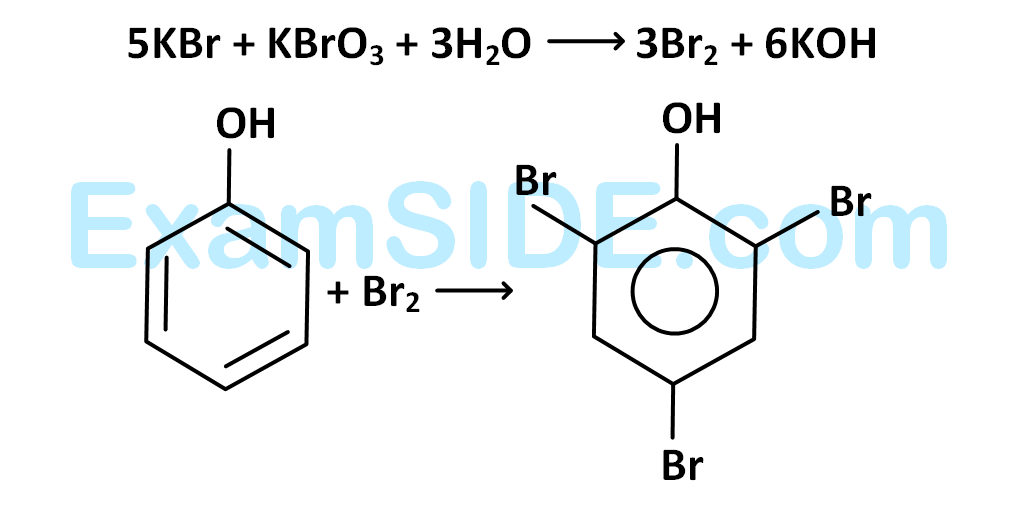
Phenol is heated with a solution of mixture of KBr and KBrO3. The major product obtained in the above
reaction is
A.
3-Bromophenol
B.
4-Bromophenol
C.
2, 4, 6- Tribromophenol
D.
2-Bromophenol
2010
Q170
JEE Mains
MCQ
14 Mar 2026
From amongst the following alcohols the one that would react fastest with conc. HCl and anhydrous
ZnCl2, is
A.
2–Butanol
B.
2–Methylpropan–2–ol
C.
2–Methylpropanol
D.
1–Butanol

2009
Q171
JEE Mains
MCQ
14 Mar 2026
The major product obtained on interaction of phenol with sodium hydroxide and carbon dioxide is :
A.
benzoic acid
B.
salicylaldehyde
C.
salicylic acid
D.
phthalic acid

2008
Q172
JEE Mains
MCQ
14 Mar 2026
Phenol, when it first reacts with concentrated sulphuric acid and then with concentrated nitric acid,
gives
A.
2,4,6-trinitrobenzene
B.
o-nitrophenol
C.
p-nitrophenol
D.
nitrobenzene


2007
Q173
JEE Mains
MCQ
14 Mar 2026
In the following sequence of reactions,
CH3CH2OH $\buildrel {P + {I_2}} \over \longrightarrow $ A $\mathrel{\mathop{\kern0pt\longrightarrow} \limits_{ether}^{Mg}} $ B $\buildrel {HCHO} \over \longrightarrow $ C $\buildrel {{H_2}O} \over \longrightarrow $ D
the compound ‘D’ is
CH3CH2OH $\buildrel {P + {I_2}} \over \longrightarrow $ A $\mathrel{\mathop{\kern0pt\longrightarrow} \limits_{ether}^{Mg}} $ B $\buildrel {HCHO} \over \longrightarrow $ C $\buildrel {{H_2}O} \over \longrightarrow $ D
the compound ‘D’ is
A.
butanal
B.
n-butyl alcohol
C.
n-propyl alcohol
D.
propanal

2006
Q174
JEE Mains
MCQ
14 Mar 2026
HBr reacts with CH2 = CH – OCH3 under anhydrous conditions at room temperature to give
A.
CH3CHO and CH3Br
B.
BrCH2CHO and CH3OH
C.
BrCH2 – CH2 – OCH3
D.
H3C – CHBr – OCH3

2006
Q175
JEE Mains
MCQ
14 Mar 2026
The structure of the compound that gives a tribromo derivative on treatment with bromine water is
A.

B.

C.

D.


2006
Q176
JEE Mains
MCQ
14 Mar 2026
Phenyl magnesium bromide reacts with methanol to give
A.
a mixture of anisole and Mg(OH)Br
B.
a mixture of benzene and Mg(OMe)Br
C.
a mixture of toluene and Mg(OH)Br
D.
a mixture of phenol and Mg(Me)Br
2006
Q177
JEE Mains
MCQ
14 Mar 2026
Among the following the one that gives positives iodoform test upon reaction with ${I_2}$ and $NaOH$ is
A.

B.
$PhCHOHC{H_3}$
C.
$C{H_3}C{H_2}CH\left( {OH} \right)C{H_2}C{H_3}$
D.
${C_6}{H_5}C{H_2}C{H_2}OH$
2006
Q178
JEE Mains
MCQ
14 Mar 2026
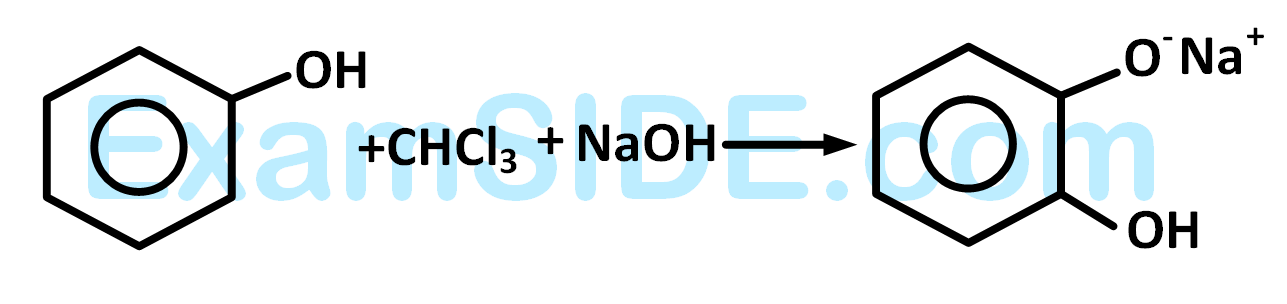
The electrophile involved in the above reaction is
A.

B.

C.

D.


2005
Q179
JEE Mains
MCQ
14 Mar 2026
The best reagent to convert pent -3- en-2-ol into pent -3-en-2-one is
A.
Acidic permanganate
B.
Acidic dichromate
C.
Chromic anhydride in glacial acetic acid
D.
Pyridinium chloro – chromate

2005
Q180
JEE Mains
MCQ
14 Mar 2026
Acid catalyzed hydration of alkenes except ethene leads to the formation of
A.
primary alcohol
B.
secondary or tertiary alcohol
C.
mixture of primary and secondary alcohols
D.
mixture of secondary and tertiary alcohols

2004
Q181
JEE Mains
MCQ
14 Mar 2026
Acetyl bromide reacts with excess of CH3MgI followed by treatment with a saturated solution
of NH4Cl given
A.
acetone
B.
acetyl iodide
C.
2- methyl -2- propanol
D.
acetamide

2004
Q182
JEE Mains
MCQ
14 Mar 2026
Among the following compounds which can be dehydrated very easily is
A.

B.

C.

D.


2003
Q183
JEE Mains
MCQ
14 Mar 2026
An ethar is more volatile than an alcohol having the same molecular formula. This is due to
A.
alcohols having resonance structures
B.
inter-molecular hydrogen bonding in ethers
C.
inter-molecular hydrogen bonding in alcohols
D.
dipole characters of ethers

2003
Q184
JEE Mains
MCQ
14 Mar 2026
During dehydration of alcohols to alkenes by heating with conc. H2SO4 the initiation step is
A.
formation of carbocation
B.
elimination of water
C.
formation of an ester
D.
protonation of alcohol molecule
