Alcohols, Phenols and Ethers
The reactions which produce alcohol as the product are :
A. $\mathrm{CH}_4 + \mathrm{O}_2 \xrightarrow{\mathrm{Mo}_2\mathrm{O}_3,\ \Delta} $
B. $2\mathrm{CH}_3\mathrm{CH}_3 + 3\mathrm{O}_2 \xrightarrow{(\mathrm{CH}_3\mathrm{COO})_2\mathrm{Mn},\ \Delta} $
C. $(\mathrm{CH}_3)_3\mathrm{CH} \xrightarrow{\mathrm{KMnO}_4} $
D. $ 2\mathrm{CH}_4 + \mathrm{O}_2 \xrightarrow{\mathrm{Cu}/523\ \mathrm{K}/100 \ \mathrm{atm}.} $
E. $\mathrm{CH}_3-\mathrm{CH}=\mathrm{CH}-\mathrm{CH}_3 \xrightarrow{\mathrm{KMnO}_4/\mathrm{H}^+} $
Choose the correct answer from the options given below :
B, D and E Only
A and D Only
A, C and E Only
C and D Only


$ \text { Consider the following reaction sequence } $
 Compound $(\mathrm{y})$ develops characteristic colour with neutral $\mathrm{FeCl}_3$ solution.
Identify the INCORRECT statement from the following for the above sequence.
Compound y will dissolve in $\mathrm{NaHCO}_3$ and evolve a gas.
Compound x is more acidic than compound y .
Both compounds x and y will dissolve in NaOH .
Both compounds x and y will burn with sooty flame.


$ \text { From the following, how many compounds contain at least one secondary alcohol?} $

Choose the correct answer from the options given below :
Three
Two
Four
Five
A hydroxy compound $(\mathrm{X})$ with molar mass $122 \mathrm{~g} \mathrm{~mol}^{-1}$ is acetylated with acetic anhydride, using a large excess of the reagent ensuring complete acetylation of all hydroxyl groups. The product obtained has a molar mass of $290 \mathrm{~g} \mathrm{~mol}^{-1}$. The number of hydroxyl groups present in compound $(\mathrm{X})$ is:
2
4
3
5

A mixed ether $(\mathrm{P})$, when heated with excess of hot concentrated hydrogen iodide produces two different alkyl iodides which when treated with aq. NaOH give compounds $(\mathrm{Q})$ and $(\mathrm{R})$. Both $(\mathrm{Q})$ and $(\mathrm{R})$ give yellow precipitate with NaOI . Identify the mixed ether $(\mathrm{P})$ :


$ \text { 3, 3-Dimethyl-2-butanol cannot be prepared by : } $

$ \text { Choose the correct answer from the options given below : } $
B and E Only
B, C and E Only
B and C Only
B Only

Given below are two statements :
Statement I : Phenol on treatment with $\mathrm{CHCl}_3$ /aq. KOH under refluxing condition, followed by acidification produces $p$-hydroxy benzaldehyde as the major product and $o$-hydroxy benzaldehyde as the minor product.
Statement II : The mixture of $p$-hydroxybenzaldehyde and $o$ hydroxybenzaldehyde can be easily separated through steam distillation.
In the light of the above statements, choose the correct answer from the options given below
Statement I is true but Statement II is false
Both Statement I and Statement II are true
Both Statement I and Statement II are false
Statement I is false but Statement II is true

$ \text { Consider the following reaction. } $

Statement I : In the above reaction, product formed will be a mixture of benzyl alcohol and iodobenzene.
Statement II : In the above reaction, the $-\mathrm{O}-\mathrm{CH}_2-$ bond is cleaved to give the product.
In the light of the above statements, choose the correct answer from the options given below :
Both Statement I and Statement II are true
Both Statement I and Statement II are false
Statement I is true but Statement II is false
Statement I is false but Statement II is true

Consider the following reactions. Total number of electrons in the $\pi$ bonds and lone pair of electrons in the product $(X)$ is :

12
16
14
18

Consider the following sequence of reactions

The major product P is :


Consider compounds $\mathrm{A}, \mathrm{B}$ and C with following structural formulae
$ \begin{aligned} & \mathrm{A}=\mathrm{CH}_3-\mathrm{CH}_2-\mathrm{CH}_2-\mathrm{CH}_2-\mathrm{CH}_2-\mathrm{OH} \\ & \mathrm{~B}=\mathrm{CH}_2=\mathrm{CH}-\mathrm{CH}_2-\mathrm{CH}_2-\mathrm{CH}_3 \\ & \mathrm{C}=\mathrm{HO}-\mathrm{CH}_2-\mathrm{CH}_2-\mathrm{CH}(\mathrm{OH})-\mathrm{CH}_3 \end{aligned} $
For the conversion of B from A , reagent (D) required is $\_\_\_\_$ and structural formula of product $(\mathrm{E})$ obtained when C undergoes same reaction using excess reagent (D) is $\_\_\_\_$ .
$ \begin{array}{|c|c|} \hline \text { D } & \text { E } \\ \hline \text { Conc. } \mathrm{H}_2 \mathrm{SO}_4 & \mathrm{CH}_2=\mathrm{CH}-\mathrm{CH}(\mathrm{OH}) \mathrm{CH}_3 \\ \hline \end{array} $
$ \begin{array}{|c|c|} \hline \mathrm{D} & \mathrm{E} \\ \hline \mathrm{PCC} & \mathrm{HO}-\mathrm{CH}_2-\mathrm{CH}_2-\mathrm{CH}=\mathrm{CH}_2 \\ \hline \end{array} $
$ \begin{array}{|c|c|} \hline \text { D } & \text { E } \\ \hline \text { PCC } & \mathrm{CH}_2=\mathrm{CH}-\mathrm{CH}=\mathrm{CH}_2 \\ \hline \end{array} $
$ \begin{array}{|c|c|} \hline \text { D } & \mathrm{E} \\ \hline \text { Conc. } \mathrm{H}_2 \mathrm{SO}_4 \text { or } \mathrm{H}_3 \mathrm{PO}_4 & \mathrm{CH}_2=\mathrm{CH}-\mathrm{CH}=\mathrm{CH}_2 \\ \hline \end{array} $

$ \text { Identify the colour of compound ' } \mathrm{X} \text { ' in the sequence of the reaction. } $

Violet
Green
Red
Colourless
4.7 g of phenol is heated with Zn to give product X . If this reaction goes to $60 \%$ completion then the number of moles of compound X formed will be
$\_\_\_\_$ $\times 10^{-2}$.(Nearest Integer)
(Given molar mass in $\mathrm{g} \mathrm{mol}^{-1}: \mathrm{H}: 1, \mathrm{C}: 12, \mathrm{O}: 16$ )
Explanation:

Given mass of phenol = 4.7 g
Molar mass of phenol (C6H6O) = (6 × 12) + (6 × 1) + 16 = 94 g/mol
So,
$ \text{Moles of phenol} = \frac{4.7}{94.0} = 0.05~\text{mol} $
From the reaction, 1 mole of phenol produces 1 mole of benzene (product X) if the reaction is complete (100% yield).
Therefore, 0.05 mol of phenol will give 0.05 mol of benzene at 100% completion.
The actual yield is 60% of the theoretical yield, so:
$ \text{Moles of X formed} = 0.05 \times 0.60 = 0.03~\text{mol} $
$ \text{Moles of X} = 3 \times 10^{-2}~\text{mol} $
Final Answer: (3)
One mole of phenol is treated with dilute $\mathrm{HNO}_3$ at 298 K to give a mixture of products. The mixture is separated by steam distillation. The steam volatile compound $(\mathrm{X})$ is separated. The increase in percentage of oxygen in $(\mathrm{X})$ with respect to phenol is $\_\_\_\_$ $\times 10^{-1} \%$
(Given molar mass in $\mathrm{g} \mathrm{mol}^{-1} \mathrm{H}: 1, \mathrm{C}: 12, \mathrm{~N}: 14, \mathrm{O}: 16$ )
Explanation:

Step 1: Calculate the percentage of oxygen in phenol.
The molecular formula of phenol is $ \mathrm{C_6H_6O} $. Its molecular mass is:
$ (6 \times 12) + (6 \times 1) + 16 = 94~\mathrm{g/mol} $
Percentage of oxygen in phenol:
$ \frac{16}{94} \times 100 = 17.02\% $
Step 2: Calculate the percentage of oxygen in o-nitrophenol.
When phenol reacts with dilute $ \mathrm{HNO_3} $, the steam-volatile product formed is o-nitrophenol ($ \mathrm{C_6H_5NO_3} $).
Molecular mass of o-nitrophenol:
$ (6 \times 12) + (5 \times 1) + 14 + (3 \times 16) = 139~\mathrm{g/mol} $
Percentage of oxygen in o-nitrophenol:
$ \frac{48}{139} \times 100 = 34.53\% $
Step 3: Find the percentage increase in oxygen.
Increase in oxygen percentage:
$ 34.53 - 17.02 = 17.5 $
Step 4: Express the answer in the required form.
The increase in percentage of oxygen with respect to phenol is:
$ 17.5 \times 10^{-1} = 175 $
Given below are two statements :
Statement I : Dimethyl ether is completely soluble in water. However, diethyl ether is soluble in water to a very small extent.
Statement II : Sodium metal can be used to dry diethyl ether and not ethyl alcohol.
In the light of given statements. choose the correct answer from the options given below
Benzene is treated with oleum to produce compound $(\mathrm{X})$ which when further heated with molten sodium hydroxide followed by acidification produces compound $(\mathrm{Y})$. The compound Y is treated with zinc metal to produce compound $(Z)$. Identify the structure of compound $(Z)$ from the following option.


Which one of the following, with HBr will give a phenol?


Given below are two statements :
Statement I : 
Statement II : In  , intramolecular substitution takes place first by involving lone pair of electrons on nitrogen.
In the light of the above statements, choose the most appropriate answer from the options given below

Given below are two statements :
Statement (I) : The boiling points of alcohols and phenols increase with increase in the number of C -atoms.
Statement (II) : The boiling points of alcohols and phenols are higher in comparison to other class of compounds such as ethers, haloalkanes.
In the light of the above statements, choose the correct answer from the options given below :
What amount of bromine will be required to convert 2 g of phenol into 2,4,6-tribromophenol?
(Given molar mass in $\mathrm{g} \mathrm{mol}^{-1}$ of $\mathrm{C}, \mathrm{H}, \mathrm{O}, \mathrm{Br}$ are $12,1,16,80$ respectively )


0.1 mole of compound ‘S’ will weigh ___________ g.
(Given molar mass in g mol−1 C : 12, H : 1, O : 16)
Explanation:

$\begin{aligned} &0.1 \text { mole of compound ( } \mathrm{S} \text { ) weight in gm }\\ &\begin{aligned} & =0.1 \times \text { molar mass of compound }(\mathrm{S}) \\ & =0.1 \times 130=13 \mathrm{gm} \end{aligned} \end{aligned}$
Match List I with List II

Choose the correct answer from the options given below :

Which one the following compounds will readily react with dilute $\mathrm{NaOH}$ ?
Identify the major products A and B respectively in the following set of reactions.


The major products formed :

A and B respectively are :


In Reimer - Tiemann reaction, phenol is converted into salicylaldehyde through an intermediate. The structure of intermediate is __________.


Consider the above reaction sequence and identify the major product P.

Which one of the following reactions is NOT possible?


Given below are two statement :
Statements I : Bromination of phenol in solvent with low polarity such as $\mathrm{CHCl}_3$ or $\mathrm{CS}_2$ requires Lewis acid catalyst.
Statements II : The Lewis acid catalyst polarises the bromine to generate $\mathrm{Br}^{+}$.
In the light of the above statements, choose the correct answer from the options given below :

For the Compounds :
(A) $\mathrm{H}_3 \mathrm{C}-\mathrm{CH}_2-\mathrm{O}-\mathrm{CH}_2-\mathrm{CH}_2-\mathrm{CH}_3$
(B) $\mathrm{H}_3 \mathrm{C}-\mathrm{CH}_2-\mathrm{CH}_2-\mathrm{CH}_2-\mathrm{CH}_3$
(C) 
(D) 
The increasing order of boiling point is :
Choose the correct answer from the options given below :
Common name of Benzene - 1,2 - diol is -

| List I (Reactants) | List II (Product) |
|---|---|
| (A) Phenol, Zn/Δ | (I) Salicylaldehyde |
| (B) Phenol, CHCl3, NaOH, HCl | (II) Salicylic acid |
| (C) Phenol, CO2, NaOH, HCl | (III) Benzene |
| (D) Phenol, Conc. HNO3 | (IV) Picric acid |
Choose the correct answer from the options given below :
Given below are two statements: One is labelled as Assertion A and the other is labelled as Reason R:
Assertion A: Alcohols react both as nucleophiles and electrophiles.
Reason R: Alcohols react with active metals such as sodium, potassium and aluminum to yield corresponding alkoxides and liberate hydrogen.
In the light of the above statements, choose the correct answer from the options given below:
Given below are two statements: One is labelled as Assertion A and the other is labelled as Reason R:
Assertion A: $\mathrm{pK}_{\mathrm{a}}$ value of phenol is 10.0 while that of ethanol is 15.9 .
Reason R: Ethanol is stronger acid than phenol.
In the light of the above statements, choose the correct answer from the options given below:
Phenol treated with chloroform in presence of sodium hydroxide, which further hydrolyzed in presence of an acid results

Match List I with List II
| List - I (Compound) |
List - II ($\mathrm{pK_a}$ value) |
||
|---|---|---|---|
| (A) | Ethanol | (I) | 10.0 |
| (B) | Phenol | (II) | 15.9 |
| (C) | m-Nitrophenol | (III) | 7.1 |
| (D) | p-Nitrophenol | (IV) | 8.3 |
Choose the correct answer from the options given below:
The major product(P) in the following reaction is


Major product formed in the following reaction is a mixture of :


Phenolic group can be identified by a positive:
Match List - I with List - II.
| List - I (Reaction) |
List - II (Reagent(s)) |
||
|---|---|---|---|
| (A) |  |
(I) | $\mathrm{Na_2Cr_2O_7,H_2SO_4}$ |
| (B) |  |
(II) | (i) $\mathrm(NaOH)$, (ii) $\mathrm{CH_3Cl}$ |
| (C) |  |
(III) | (i) $\mathrm{NaOH,CHCl_3}$, (ii) $\mathrm{NaOH}$, (iii) $\mathrm{HCl}$ |
| (D) |  |
(IV) | (i) $\mathrm{NaOH}$, (ii) $\mathrm{CO_2}$, (iii) $\mathrm{HCl}$ |
Choose the correct answer from the options given below :

Given below are two statements :
Statement (I) : p-nitrophenol is more acidic than m-nitrophenol and o-nitrophenol.
Statement (II) : Ethanol will give immediate turbidity with Lucas reagent.
In the light of the above statements, choose the correct answer from the options given below :

The ascending order of acidity of $-\mathrm{OH}$ group in the following compounds is :


Choose the correct answer from the options given below:

Consider the given chemical reaction sequence :

Total sum of oxygen atoms in Product A and Product B are ________.
Explanation:

Total no. of oxygen in A and B = 7 + 7 = 14
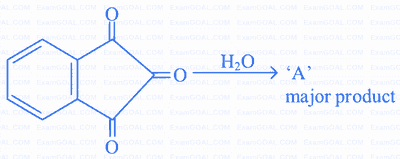
'A' formed in the above reaction is


The major product for the following reaction is:


Given below are two statements, one is labelled as Assertion A and the other is labelled as Reason R.
Assertion A : Order of acidic nature of the following compounds is A > B > C.

Reason R : Fluoro is a stronger electron withdrawing group than Chloro group.
In the light of the above statements, choose the correct answer from the options given below:
2-Methyl propyl bromide reacts with $\mathrm{C}_{2} \mathrm{H}_{5} \mathrm{O}^{-}$ and gives 'A' whereas on reaction with $\mathrm{C}_{2} \mathrm{H}_{5} \mathrm{OH}$ it gives 'B'. The mechanism followed in these reactions and the products 'A' and 'B' respectively are :
Correct statements for the given reaction are :

A. Compound '$\mathrm{B}$' is aromatic
B. The completion of above reaction is very slow
C. 'A' shows tautomerism
D. The bond lengths of C-C in compound $B$ are found to be same
Choose the correct answer from the options given below:


Compound 'B' is


Product [X] formed in the above reaction is :


