Welcome to iCON Education
AI Tool of Learning...
Select a concept from the sidebar to start learning.
JEE_Mains
1 1. Newton’s Second Law ($F=ma$) & Kinematics
This subtopic focuses on the fundamental relationship between force, mass, and acceleration, and how these quantities dictate the motion of a particle through space and time.
1. Newton’s Second Law of Motion
Definition: The acceleration of an object is directly proportional to the net force acting on it and inversely proportional to its mass. The direction of the acceleration is the same as the direction of the net force.
Fundamental Formulas:
- Vector Form: $\vec{F} = m\vec{a}$.
- Component Form: $F_x = ma_x$, $F_y = ma_y$, $F_z = ma_z$.
- Variable Mass/Thrust Force: When mass changes over time (e.g., a rocket or a leaking balloon), the force is related to the rate of mass change: $F = v_{rel} \frac{dm}{dt}$.
2. Kinematic Relationships
To solve these problems, Newton's Second Law is often combined with equations of motion to find position, velocity, or time.
Equations of Motion (Constant Acceleration):
- Velocity-Time: $\vec{v} = \vec{u} + \vec{a}t$.
- Position-Time: $\vec{s} = \vec{u}t + \frac{1}{2}\vec{a}t^2$.
- Velocity-Displacement: $v^2 = u^2 + 2as$.
Calculus-Based Kinematics: When force or acceleration is not constant, differentiation and integration are required:
- Acceleration from Position: $\vec{a} = \frac{d\vec{v}}{dt} = \frac{d^2\vec{r}}{dt^2}$.
- Velocity from Acceleration: $a = v \frac{dv}{dx}$.
- Momentum and Force: $\vec{F} = \frac{d\vec{p}}{dt}$, where $\vec{p} = m\vec{v}$.
3. Detailed Application Examples
-
Vertical Motion and Buoyancy: In systems like a rising balloon, the net force is the difference between the upward buoyancy force ($F$) and the downward weight ($Mg$). If mass is released to increase acceleration from $a$ to $3a$, the equations are:
- Initial: $F - Mg = Ma$
- After releasing mass $x$: $F - (M - x)g = (M - x)3a$ Solving these yields the required mass to be released: $x = \frac{2Ma}{g + 3a}$.
-
Force in Vector Fields: If a body of mass $m$ with an initial velocity $\vec{u}$ enters a constant force field $\vec{F}$, the acceleration $\vec{a} = \vec{F}/m$ is added to the velocity over time $t$. For a force $6\text{N}$ along the Z-axis acting on a $2\text{kg}$ mass, $\vec{a} = 3\hat{k} \text{ ms}^{-2}$.
-
Position Vectors and Direction: If the position of a particle is given as a function of time, such as $\vec{r} = 10t\hat{i} + 15t^2\hat{j} + 7\hat{k}$, the direction of the net force is found by differentiating $\vec{r}$ twice to get acceleration. In this case, $\vec{a} = 30\hat{j}$, meaning the force is directed along the positive y-axis.
-
Apparent Weight and Normal Reaction: In accelerating systems like elevators or descending blocks, the normal reaction ($R'$) differs from the actual weight ($Mg$). For a system accelerating downwards at $a$, the normal reaction is $R' = M(g - a)$.
-
Sliding on Frictionless Inclines: For any object (regardless of shape) sliding down a frictionless inclined plane, the acceleration is simply $a = g \sin \theta$. The vertical component of this acceleration is $a_y = g \sin^2 \theta$.
Loading Concept 2...
Loading Concept 3...
Loading Concept 4...
Loading Concept 5...
Loading Concept 6...
Loading Concept 7...
Loading Concept 8...
Loading Concept 9...
PYQ for: 1. Newton’s Second Law ($F=ma$) & Kinematics
Question 1
Question: A balloon and its content having mass M is moving up with an acceleration $a$. The mass that must be released from the content so that the balloon starts moving up with an acceleration $3a$ will be (Take $g$ as acceleration due to gravity). (Note: The source text contains some formatting artifacts, but the physics context and solution indicate these standard variables).
Options:
A. $\frac{3Ma}{2a+g}$
B. $\frac{2Ma}{3a+g}$
C. $\frac{3Ma}{2a-g}$
D. $\frac{2Ma}{3a-g}$
Correct Answer: B
Year: JEE Main 2025 (Online) 28th January Evening Shift
Solution: 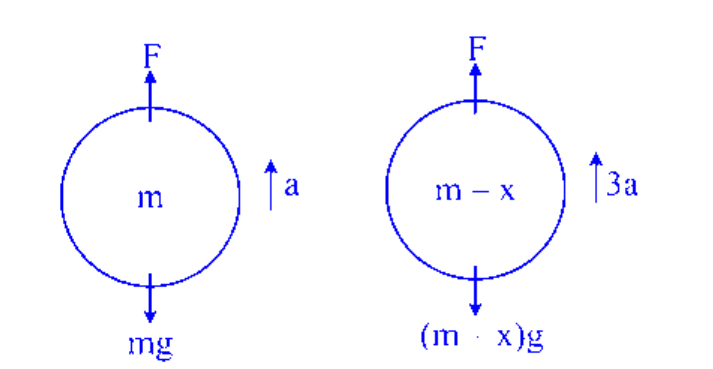
$F - mg = ma$
$F = ma + mg$
$F - (m - x)g = (m - x)3a$
Put $F$:
$ma + mg - mg + xg = 3ma - 3xa$
$x = \frac{2ma}{g + 3a}$
Step Solution:
1. Equation 1: For the initial state moving up with acceleration $a$: $F - Mg = Ma$, which gives the upward buoyancy force $F = M(g + a)$.
2. Equation 2: Let $x$ be the mass released. The new mass is $(M - x)$, and it moves up with acceleration $3a$: $F - (M - x)g = (M - x)3a$.
3. Substitution: Substitute $F$ from Step 1 into Equation 2: $M(g + a) - (M - x)g = (M - x)3a$.
4. Expansion: $Mg + Ma - Mg + xg = 3Ma - 3xa$.
5. Solving for x: Rearrange terms to get $xg + 3xa = 2Ma \rightarrow x(g + 3a) = 2Ma \rightarrow x = \frac{2Ma}{g + 3a}$.
Difficulty Level: Medium
The Concept Name: Newton’s Second Law ($F = ma$)
Short cut solution: Use the general formula for mass change in a balloon: $m_{released} = \frac{M(a_{final} - a_{initial})}{g + a_{final}}$. Here, $\frac{M(3a - a)}{g + 3a} = \frac{2Ma}{g + 3a}$.
Question 7
Question: A body of mass 2 kg moving with velocity of $\vec{v}_{in} = 3\hat{i} + 4\hat{j} \text{ ms}^{-1}$ enters into a constant force field of 6N directed along positive Z-axis. If the body remains in the field for a period of $\frac{5}{3}$ seconds, then velocity of the body when it emerges from force field is.
Options:
A. $3\hat{i} + 4\hat{j} + \sqrt{5}\hat{k}$
B. $4\hat{i} + 3\hat{j} + 5\hat{k}$
C. $3\hat{i} + 4\hat{j} - 5\hat{k}$
D. $3\hat{i} + 4\hat{j} + 5\hat{k}$
Correct Answer: D
Year: JEE Main 2025 (Online) 8th April Evening Shift
Solution:
$\vec{a} = \frac{\vec{F}}{m} = \frac{6\hat{k}}{2} = 3\hat{k} \text{ ms}^{-2}$
$\vec{u} = 3\hat{i} + 4\hat{j} \text{ ms}^{-1}$
$t = \frac{5}{3} \text{ seconds}$
$\vec{v} = \vec{u} + \vec{a}t = (3\hat{i} + 4\hat{j}) + 3\hat{k}(\frac{5}{3}) = 3\hat{i} + 4\hat{j} + 5\hat{k}$
Step Solution:
1. Identify Force Vector: The force is 6N along the positive Z-axis, so $\vec{F} = 6\hat{k}$.
2. Calculate Acceleration: Use $\vec{a} = \frac{\vec{F}}{m} = \frac{6\hat{k}}{2} = 3\hat{k} \text{ ms}^{-2}$.
3. Use Kinematic Equation: Apply $\vec{v} = \vec{u} + \vec{a}t$ for vector addition.
4. Substitute Values: $\vec{v} = (3\hat{i} + 4\hat{j}) + (3\hat{k} \times \frac{5}{3})$.
5. Simplify: The 3 in the acceleration and the 3 in the denominator of the time cancel out, leaving $5\hat{k}$. Result: $3\hat{i} + 4\hat{j} + 5\hat{k}$.
Difficulty Level: Easy
The Concept Name: Force and Kinematics in Vector Form
Short cut solution: Since the force is only in the Z-direction, the X and Y components of velocity remain unchanged ($3\hat{i} + 4\hat{j}$). Simply calculate the change in the Z component: $\Delta v_z = a_z t = (\frac{6}{2}) \times (\frac{5}{3}) = 5$. Add this to the initial velocity to get $3\hat{i} + 4\hat{j} + 5\hat{k}$.
Question 22
Question: A body of mass 4 kg experiences two forces. (Note: Total force is given in the solution as $8\hat{i} + 4\hat{j} + 4\hat{k}$). The acceleration acting on the body is.
Options:
A.$-2\hat{i} + \hat{j} + \hat{k}$
B. $4\hat{i} + 2\hat{j} + 2\hat{k}$
C. $2\hat{i} + \hat{j} + \hat{k}$
D. $2\hat{i} + 3\hat{j} + 3\hat{k}$
Correct Answer: C
Year: 1-Feb-2024 Shift 2
Solution:
Net force $= 8\hat{i} + 4\hat{j} + 4\hat{k}$
$\vec{a} = \frac{\vec{F}}{m} = \frac{8\hat{i} + 4\hat{j} + 4\hat{k}}{4} = 2\hat{i} + \hat{j} + \hat{k}$
Step Solution:
1. Determine Net Force: Sum the individual forces acting on the body (given as $8\hat{i} + 4\hat{j} + 4\hat{k}$).
2. Newton's Second Law: Use the vector form of the law: $\vec{a} = \frac{\vec{F}_{net}}{m}$.
3. Substitute Values: Divide the net force by the mass (4 kg): $\vec{a} = \frac{8\hat{i} + 4\hat{j} + 4\hat{k}}{4}$.
4. Vector Division: Divide each component individually: $a_x = \frac{8}{4}, a_y = \frac{4}{4}, a_z = \frac{4}{4}$.
5. Final Vector: Combine the components to get $\vec{a} = 2\hat{i} + \hat{j} + \hat{k}$.
Difficulty Level: Easy
The Concept Name: Newton’s Second Law (Vector Addition)
Short cut solution: Divide the magnitude of the net force components directly by the mass: $8/4=2, 4/4=1, 4/4=1$. The acceleration is $2\hat{i} + 1\hat{j} + 1\hat{k}$.
Question 28
Question: Force acts for 20 s on a body of mass 20 kg, starting from rest, after which the force ceases and then body describes 50m in the next 10s. The value of force will be.
Options:
A. 40N
B. 5N
C. 20N
D. 10N
Correct Answer: B
Year: 29-Jan-2023 Shift 2
Solution: 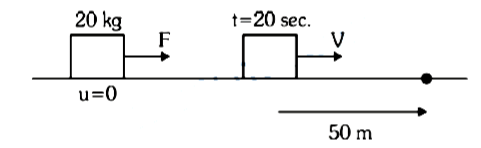
$50 = V \times 10 \Rightarrow V = 5 m/s$
$V = 0 + a \times 20$
$5 = a \times 20 \Rightarrow a = \frac{1}{4} m/s^2$
$F = ma = 20 \times \frac{1}{4} = 5 N$
Step Solution:
1. Find Final Velocity: After the force ceases, the body moves with constant velocity. $v = \frac{\text{distance}}{\text{time}} = \frac{50}{10} = 5 \text{ m/s}$.
2. Determine Acceleration: Use the first kinematic equation for the period the force was active: $v = u + at \rightarrow 5 = 0 + a(20)$.
3. Solve for $a$: $a = \frac{5}{20} = 0.25 \text{ m/s}^2$.
4. Newton's Second Law: Apply $F = m \times a$.
5. Final Calculation: $F = 20 \text{ kg} \times 0.25 \text{ m/s}^2 = 5 \text{ N}$.
Difficulty Level: Medium
The Concept Name: Newton’s Second Law and Kinematics
Short cut solution: The impulse $F \cdot \Delta t$ equals the change in momentum $m \cdot \Delta v$. Since it starts from rest, $F \times 20 = 20 \times 5$, which directly gives $F = 5 \text{ N}$.
Question 33
Question: As shown in figure, a 70 kg garden roller is pushed with a force of $\vec{F} = 200 \text{ N}$ at an angle of $30^\circ$ with horizontal. The normal reaction on the roller is.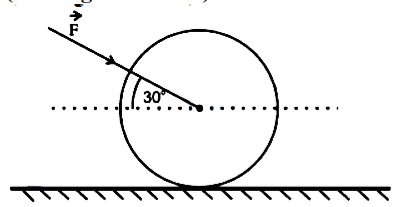
Options:
A. 800√2N
B. 600N
C. 800N
D. 200√3N
Correct Answer: C
Year: 2023 (Session Context)
Solution: 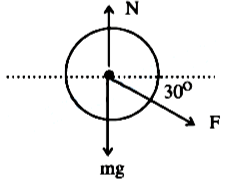
$N = mg + F \sin 30^\circ$
$= 700 + 200 \times \frac{1}{2} = 800 \text{ newton}$
Step Solution:
1. Identify Vertical Forces: The forces acting vertically are Weight ($mg$) down, the vertical component of push ($F \sin \theta$) down, and Normal reaction ($N$) up.
2. Equilibrium Equation: In the vertical direction, $N = mg + F \sin 30^\circ$.
3. Calculate Weight: $mg = 70 \text{ kg} \times 10 \text{ m/s}^2 = 700 \text{ N}$.
4. Calculate Push Component: $F \sin 30^\circ = 200 \text{ N} \times 0.5 = 100 \text{ N}$.
5. Calculate Total $N$: $N = 700 + 100 = 800 \text{ N}$.
Difficulty Level: Easy
The Concept Name: Resolution of Forces and Statics
Short cut solution: Pushing increases the normal reaction by the vertical component of the force. $N = \text{Weight} + F \sin \theta = 700 + 200(0.5) = 800 \text{ N}$.
Question 45
Question: The position vector of a particle related to time $t$ is given by $\vec{r} = (10t \hat{i} + 15t^2 \hat{j} + 7 \hat{k}) \text{ m}$. The direction of net force experienced by the particle is.
Options:
A. Positive z-axis
B. In x-y plane
C. Positive y-axis
D. Positive x-axis
Correct Answer: C
Year: 15-Apr-2023 Shift 1
Solution:
$\vec{v} = \frac{d\vec{r}}{dt} = 10 \hat{i} + 30t \hat{j}$
$\vec{a} = \frac{d\vec{v}}{dt} = 30 \hat{j}$
$\vec{F}$ along (+) y-axis
Step Solution:
1. Differentiate Position: Find the velocity vector $\vec{v}$ by differentiating $\vec{r}$ with respect to $t$: $\vec{v} = 10 \hat{i} + 30t \hat{j} + 0 \hat{k}$.
2. Differentiate Velocity: Find the acceleration vector $\vec{a}$ by differentiating $\vec{v}$ with respect to $t$: $\vec{a} = 0 \hat{i} + 30 \hat{j}$.
3. Apply Newton's Law: Force direction is the same as acceleration direction ($\vec{F} = m\vec{a}$).
4. Identify Direction: The acceleration is only in the $+ \hat{j}$ direction.
5. Final Result: The direction is the Positive y-axis.
Difficulty Level: Easy
The Concept Name: Vector Differentiation and Newton’s Second Law
Short cut solution: Look for the term with the highest power of $t$ that is at least $t^2$. Only $15t^2 \hat{j}$ will produce a non-zero acceleration upon double differentiation. Since the coefficient is positive and attached to $\hat{j}$, the force is along the positive y-axis.
Question 47
Question: A force on an object of mass 100g is $(10 \hat{i} + 5 \hat{j}) \text{ N}$. The position of that object at $t = 2\text{ s}$ is $(a\hat{i} + b\hat{j}) \text{ m}$ after starting from rest. The value of $a/b$ will be.
Options: (None provided in the source for this specific numerical-type question).
Correct Answer: 2.
Year: 25-Jun-2022-Shift-1.
Solution:
$\vec{F} = m\vec{a}$
$\Rightarrow \vec{a} = 100\hat{i} + 50\hat{j}$
So, $\vec{S} = \frac{1}{2}\vec{a}t^2 = \frac{1}{2}(100\hat{i} + 50\hat{j})2^2 = 200\hat{i} + 100\hat{j} \text{ m}$
so $a = 200 \text{ m}$ and $b = 100 \text{ m}$ so $a/b = 2$.
Step Solution:
1. Convert Mass: Convert the mass to kilograms: $m = 100 \text{ g} = 0.1 \text{ kg}$.
2. Find Acceleration: Use Newton's Second Law: $\vec{a} = \frac{\vec{F}}{m} = \frac{10\hat{i} + 5\hat{j}}{0.1} = 100\hat{i} + 50\hat{j} \text{ m/s}^2$.
3. Apply Displacement Formula: Since the object starts from rest, use $\vec{s} = \frac{1}{2}\vec{a}t^2$.
4. Calculate Position: Substitute $t = 2$: $\vec{s} = \frac{1}{2}(100\hat{i} + 50\hat{j})(2)^2 = 2(100\hat{i} + 50\hat{j}) = 200\hat{i} + 100\hat{j} \text{ m}$.
5. Calculate Ratio: Identify $a = 200$ and $b = 100$, then $\frac{a}{b} = \frac{200}{100} = 2$.
Difficulty Level: Easy
The Concept Name: Newton’s Second Law and Kinematics (Vector Form)
Short cut solution: Since the object starts from rest and both components of force are constant, the ratio of displacements $a/b$ is equal to the ratio of the force components $F_x/F_y = 10/5 = 2$.
Question 59
Question: A wire of length $L$ is hanging from a fixed support. The length changes to $L_1$ and $L_2$ when masses 1 kg and 2 kg are suspended respectively from its free end. Then the value of $L$ is equal to.
Options:
A. $\sqrt{L_1L_2}$
B. $L_1 + L_2$
C. $2L_1 - L_2$
D. $3L_1 - 2L_2$.
Correct Answer: C.
Year: 29-Jun-2022-Shift-1.
Solution:
By Hooke's Law so $F \propto \Delta L$
$\frac{F_1}{F_2} = \frac{\Delta L_1}{\Delta L_2}$
$\frac{10}{20} = \frac{(L_1 - L)}{(L_2 - L)}$
$L = 2L_1 - L_2$.
Step Solution:
1. State Proportionality: According to Hooke's Law, force is proportional to elongation: $F \propto (L_{final} - L_{original})$.
2. Set up Ratio: Create a ratio for the two cases: $\frac{F_1}{F_2} = \frac{L_1 - L}{L_2 - L}$.
3. Substitute Forces: Since $F = mg$, the ratio of forces is the ratio of masses: $\frac{1}{2} = \frac{L_1 - L}{L_2 - L}$.
4. Cross-Multiply: $L_2 - L = 2(L_1 - L) \rightarrow L_2 - L = 2L_1 - 2L$.
5. Rearrange for L: $2L - L = 2L_1 - L_2 \rightarrow L = 2L_1 - L_2$.
Difficulty Level: Easy
The Concept Name: Hooke’s Law (Elasticity)
Short cut solution: The elongation for a 1 kg mass is $(L_1 - L)$. Doubling the mass to 2 kg must double the elongation: $2(L_1 - L) = (L_2 - L)$. Solving this linear equation immediately gives $L = 2L_1 - L_2$.
Question 60
Question: A block of metal weighing 2 kg is resting on a frictionless plane. It is struck by a jet releasing water at a rate of $1 \text{ kg s}^{-1}$ and at a speed of $10 \text{ m s}^{-1}$. Then, the initial acceleration of the block, in $\text{m s}^{-2}$, will be.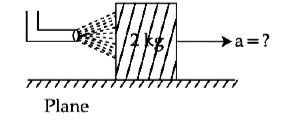
Options:
A. 3
B. 6
C. 5
D. 4.
Correct Answer: C.
Year: 29-Jun-2022-Shift-1.
Solution:
$F = \rho v^2 a$ (Note: This is given as the impact force formula in the source)
$\Rightarrow 10 \times 1 = 2 \times \text{acceleration}$
$\Rightarrow \text{Acc.} = 5 \text{ m/s}^2$.
Step Solution:
1. Identify Flow Rate: The rate at which water hits the block is $\frac{dm}{dt} = 1 \text{ kg/s}$.
2. Calculate Impact Force: The force exerted by the water jet is $F = v \frac{dm}{dt}$ (rate of change of momentum).
3. Substitute Values: $F = 10 \text{ m/s} \times 1 \text{ kg/s} = 10 \text{ N}$.
4. Apply Second Law: The acceleration of the block is $a = \frac{F}{M_{block}}$.
5. Final Calculation: $a = \frac{10 \text{ N}}{2 \text{ kg}} = 5 \text{ m/s}^2$.
Difficulty Level: Easy
The Concept Name: Newton’s Second Law (Thrust/Variable Mass)
Short cut solution: Acceleration $a = \frac{\text{Jet Velocity} \times \text{Flow Rate}}{\text{Block Mass}} = \frac{10 \times 1}{2} = 5 \text{ m/s}^2$.
Question 72
Question: A balloon has mass of 10g in air. The air escapes from the balloon at a uniform rate with velocity 4.5 cm/s. If the balloon shrinks in 5s completely. Then, the average force acting on that balloon will be (in dyne).
Options:
A. 3
B. 9
C. 12
D. 18
Correct Answer: B
Year: 28-Jul-2022-Shift-1
Solution: $F = \frac{dm}{dt} v$; $\Gamma = \frac{10g}{5s} (4.5 \frac{cm}{s}) = 9 \frac{g \cdot cm}{s^2} = 9$ dyne.
Step Solution:
1. Identify Given Values: Initial mass of air $m = 10 \text{ g}$, time to escape $t = 5 \text{ s}$, and velocity $v = 4.5 \text{ cm/s}$.
2. Calculate Mass Flow Rate: Determine the rate of mass change ($\frac{dm}{dt}$) by dividing total mass by time: $10 \text{ g} / 5 \text{ s} = 2 \text{ g/s}$.
3. Newton's Second Law for Variable Mass: Use the thrust force formula: $F = v \times (\frac{dm}{dt})$.
4. Substitute and Calculate: $F = 4.5 \text{ cm/s} \times 2 \text{ g/s}$.
5. Final Result: $F = 9 \text{ dyne}$.
Difficulty Level: Easy
The Concept Name: Newton’s Second Law (Variable Mass/Thrust Force)
Short cut solution: Average Force = $\frac{\Delta P}{\Delta t} = \frac{m \cdot v}{t} = \frac{10 \times 4.5}{5} = 9 \text{ dyne}$.
Question 77
Question: A boy pushes a box of mass 2kg with a force $\vec{F} = (20\hat{i} + 10\hat{j}) \text{ N}$ on a frictionless surface. If the box was initially at rest, then ........ m is displacement along the X-axis after 10s.
Options: (Numerical type question; no options provided in the source).
Correct Answer: 500
Year: 26 Feb 2021 Shift 1
Solution: $m = 2 \text{ kg}$; $F = 20\hat{i} + 10\hat{j} \text{ N}$; $u = 0$; $t = 10 \text{ s}$. $a = F/m = (20\hat{i} + 10\hat{j})/2 = 10\hat{i} + 5\hat{j}$. $s_x = u_x t + \frac{1}{2} a_x t^2 = 0 + \frac{1}{2} \times 10 \times (10)^2 = 500 \text{ m}$.
Step Solution:
1. Find Acceleration Vector: Use $\vec{a} = \vec{F}/m = \frac{20\hat{i} + 10\hat{j}}{2} = 10\hat{i} + 5\hat{j} \text{ m/s}^2$.
2. Extract X-component: The acceleration along the X-axis ($a_x$) is $10 \text{ m/s}^2$.
3. Initial Conditions: The box starts from rest, so $u_x = 0$.
4. Kinematic Equation: Apply $s_x = u_x t + \frac{1}{2} a_x t^2$ for the X-axis.
5. Final Calculation: $s_x = 0 + \frac{1}{2}(10)(10)^2 = 5 \times 100 = 500 \text{ m}$.
Difficulty Level: Easy
The Concept Name: Newton’s Second Law and Kinematics (Component Method)
Short cut solution: Displacement $s_x = \frac{1}{2} (\frac{F_x}{m}) t^2 = \frac{1}{2} (\frac{20}{2}) \times 100 = 5 \times 100 = 500 \text{ m}$.
Question 83
Question: A body of mass 2kg moves under a force of $(2\hat{i} + 3\hat{j} + 5\hat{k}) \text{ N}$. It starts from rest and was at the origin initially. After 4s, its new coordinates are (8, b, 20). The value of b is.
Options: (Numerical type question; answer rounded to nearest integer).
Correct Answer: 12
Year: 16 Mar 2021 Shift 2
Solution: $\vec{a} = \frac{\vec{F}}{m} = \frac{2\hat{i} + 3\hat{j} + 5\hat{k}}{2} = 1\hat{i} + 1.5\hat{j} + 2.5\hat{k}$. $s = ut + \frac{1}{2}at^2 = 0 + \frac{1}{2}(1\hat{i} + 1.5\hat{j} + 2.5\hat{k})(4)^2 = 8\hat{i} + 12\hat{j} + 20\hat{k}$. Comparing coordinates: $b = 12$.
Step Solution:
1. Calculate Acceleration: $\vec{a} = \frac{\vec{F}}{m} = \frac{2\hat{i} + 3\hat{j} + 5\hat{k}}{2} = 1\hat{i} + 1.5\hat{j} + 2.5\hat{k} \text{ m/s}^2$.
2. Focus on Y-component: To find '$b$', we only need the displacement along the Y-axis: $a_y = 1.5 \text{ m/s}^2$.
3. Kinematic Equation for Y: Since $u_y = 0$, $s_y = \frac{1}{2} a_y t^2$.
4. Substitute Values: $s_y = \frac{1}{2} \times 1.5 \times (4)^2 = 0.75 \times 16$.
5. Identify coordinate: $s_y = 12 \text{ m}$, therefore the coordinate $b = 12$.
Difficulty Level: Easy
The Concept Name: Newton’s Second Law and Kinematic Equations in Vector Form
Short cut solution: $b = \frac{1}{2} (\frac{F_y}{m}) t^2 = \frac{1}{2} (\frac{3}{2}) \times 16 = \frac{3}{4} \times 16 = 12$.
Question 96
Question: A force $\vec{F} = (40\hat{i} + 10\hat{j}) \text{ N}$ acts on a body of mass 5 kg. If the body starts from rest, its position vector $\vec{r}$ at time $t = 10\text{ s}$, will be :
Options:
A. $(100\hat{i} + 400\hat{j})\text{ m}$
B. $(100\hat{i} + 100\hat{j})\text{ m}$
C. $(400\hat{i} + 100\hat{j})\text{ m}$
D. $(400\hat{i} + 400\hat{j})\text{ m}$
Correct Answer: C
Year: 25 Jul 2021 Shift 2
Solution: $\frac{d\vec{v}}{dt} = \vec{a} = \frac{\vec{F}}{m} = (8\hat{i} + 2\hat{j}) \text{ m/s}^2$. $\vec{r} = (8\hat{i} + 2\hat{j})\frac{t^2}{2}\text{ m}$. At $t = 10 \text{ sec}$, $\vec{r} = [(8\hat{i} + 2\hat{j}) 50]\text{ m} \Rightarrow \vec{r} = (400\hat{i} + 100\hat{j})\text{ m}$.
Step Solution:
1. Find Acceleration: Use Newton's Second Law in vector form: $\vec{a} = \frac{\vec{F}}{m} = \frac{40\hat{i} + 10\hat{j}}{5} = 8\hat{i} + 2\hat{j} \text{ m/s}^2$.
2. State Kinematic Equation: Since the body starts from rest ($\vec{u} = 0$), the displacement is $\vec{r} = \frac{1}{2}\vec{a}t^2$.
3. Substitute Values: $\vec{r} = \frac{1}{2}(8\hat{i} + 2\hat{j})(10)^2$.
4. Simplify Squared Term: $\vec{r} = \frac{1}{2}(8\hat{i} + 2\hat{j}) \times 100$.
5. Calculate Final Vector: $\vec{r} = (4\hat{i} + 1\hat{j}) \times 100 = 400\hat{i} + 100\hat{j} \text{ m}$.
Difficulty Level: Easy
The Concept Name: Newton’s Second Law and Kinematics (Vector Form)
Short cut solution: The ratio of the components of the position vector ($x/y$) must be the same as the ratio of the components of the force ($40/10 = 4$). Only option C ($400/100 = 4$) satisfies this.
Question 100
Question: A steel block of 10 kg rests on a horizontal floor as shown. When three iron cylinders are placed on it as shown, the block and cylinders go down with an acceleration $0.2 \text{ m/s}^2$. The normal reaction $R'$ by the floor if mass of the iron cylinders are equal and of 20 kg each, is N. [Take $g = 10 \text{ m/s}^2$ and $\mu_s = 0.2$]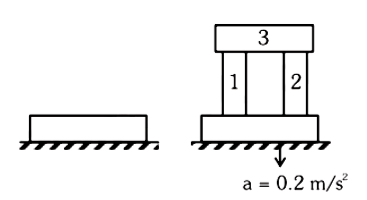
Options:
A. 716
B. 686
C. 714
D. 684
Correct Answer: B
Year: 20 Jul 2021 Shift 1
Solution: $a = 0.2 \text{ m/s}^2$. Writing force equation in vertical direction: $Mg - N = Ma$. $\Rightarrow 70g - N = 70 \times 0.2$. $\Rightarrow N = 70[g - 0.2] = 70 \times 9.8$. $N = 686$ Newton.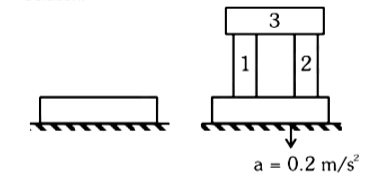
Step Solution:
1. Calculate Total Mass: Total mass $M = 10\text{ kg (steel block)} + 3 \times 20\text{ kg (iron cylinders)} = 70\text{ kg}$.
2. Identify Downward Force: The weight acting downwards is $Mg = 70 \times 10 = 700\text{ N}$.
3. Apply Newton’s Law: For a system accelerating downwards, the equation is $Mg - N = Ma$.
4. Rearrange for Normal Force: $N = M(g - a) = 70(10 - 0.2)$.
5. Calculate Final Value: $N = 70 \times 9.8 = 686\text{ N}$.
Difficulty Level: Easy
The Concept Name: Newton’s Second Law (Vertical Motion)
Short cut solution: Apparent weight $R'$ in a downward accelerating frame is $M(g - a)$. $70 \times (10 - 0.2) = 70 \times 9.8 = 686\text{ N}$.
Question 111
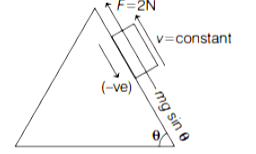
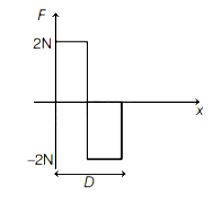
Question: An object of mass m is being moved with a constant velocity under the action of an applied force of 2N along a frictionless surface with following surface profile. The correct applied force versus distance graph will be.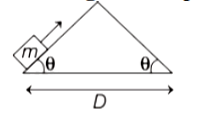
Options:
A.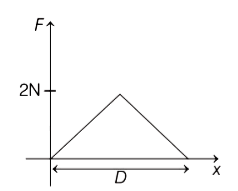
B.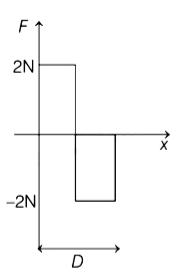
C.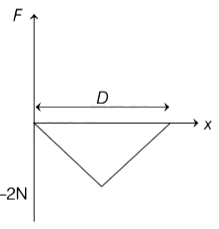
D.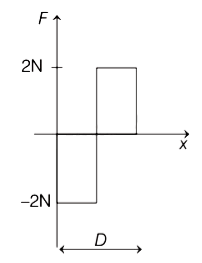
Correct Answer: B
Year: 1 Sep 2021 Shift 2
Solution: During the upward direction $F = 2N = (-ve)$ constant. During the upward motion, the force is positive constant and during the downward motion the force is negative constant.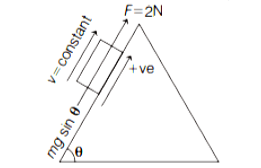 ;
; ;
;
Step Solution:
1. Constant Velocity Condition: Constant velocity means net force is zero ($F_{net} = 0$).
2. Analyze Upward Motion: To move up at constant velocity, the applied force must balance the component of gravity down the slope: $F_{applied} = mg \sin \theta$.
3. Analyze Downward Motion: To move down at constant velocity, gravity's component acts in the direction of motion, so the applied force must act in reverse to prevent acceleration: $F_{applied} = -mg \sin \theta$.
4. Identify Force Sign: This results in the applied force being a positive constant for upward slopes and a negative constant for downward slopes.
5. Select Graph: The graph must show discrete horizontal segments switching between positive and negative values based on the surface profile.
Difficulty Level: Medium
The Concept Name: Newton's First Law and Resolution of Forces
Short cut solution: Moving at constant velocity on a frictionless slope requires an applied force exactly equal and opposite to the gravitational component ($mg \sin \theta$). Since the slope angle is constant for each section, the force magnitude is constant, but its sign flips when the direction of the slope changes.
Question 116
Question: A spaceship in space sweeps stationary interplanetary dust. As a result, its mass increases at a rate $\frac{dM(t)}{dt} = bv^2(t)$, where $v(t)$ is its instantaneous velocity. The instantaneous acceleration of the satellite is :
Options:
A. $-bv^3(t)$
B. $- \frac{bv^3}{M(t)}$
Note: Options C and D involve different coefficients, but the correct derivation leads to B.
Correct Answer: B
Year: Sep. 05, 2020 (II)
Solution: From Newton's second law, $F = \frac{dp}{dt} = \frac{d(mv)}{dt} = v\left(\frac{dm}{dt}\right)$. We are given $\frac{dM(t)}{dt} = bv^2(t)$. Thrust on the satellite $F = -v\left(\frac{dm}{dt}\right) = -v(bv^2) = -bv^3$. Using $F = M(t)a$, we get $a = \frac{-bv^3}{M(t)}$.
Step Solution:
1. Rate of Mass Change: Identify the given mass increase rate: $\frac{dm}{dt} = bv^2$.
2. Thrust Force: Apply the thrust formula for a system accumulating stationary mass: $F = -v_{rel} \frac{dm}{dt}$. Here, $v_{rel} = v$.
3. Substitution: Substitute the mass rate into the force formula: $F = -v(bv^2) = -bv^3$.
4. Newton's Law: Relate the force to instantaneous acceleration: $M(t)a = F$.
5. Calculate Acceleration: $a = \frac{-bv^3}{M(t)}$.
Difficulty Level: Medium
The Concept Name: Newton’s Second Law (Variable Mass Systems)
Short cut solution: Acceleration $a = \frac{Force}{Mass}$. The retarding force due to accumulating stationary dust is $v(\frac{dm}{dt})$. Thus, $a = -\frac{v(bv^2)}{M} = -\frac{bv^3}{M}$.
Question 138
Question: A body of mass 5kg under the action of constant force $\vec{F} = F_x \hat{i} + F_y \hat{j}$ has velocity at $t = 0\text{ s}$ as $\vec{v} = (6\hat{i} - 2\hat{j}) \text{ m/s}$ and at $t = 10\text{ s}$ as $\vec{v} = + 6\hat{j} \text{ m/s}$. The force $\vec{F}$ is:
Options:
A. $(-3\hat{i} + 4\hat{j}) \text{ N}$
B. $\left(- \frac{3}{5}\hat{i} + \frac{4}{5}\hat{j}\right) \text{ N}$
C. $(3\hat{j} - 4\hat{j}) \text{ N}$
D. $\left(\frac{3}{5}\hat{i} - \frac{4}{5}\hat{j}\right) \text{ N}$
Correct Answer: A
Year: Online April 11, 2014
Solution: $u = (6\hat{i} - 2\hat{j}) \text{ m/s}$; $v = 6\hat{j} \text{ m/s}$. Acceleration $\vec{a} = \frac{\vec{v} - \vec{u}}{t} = \frac{6\hat{j} - (6\hat{i} - 2\hat{j})}{10} = \frac{-6\hat{i} + 8\hat{j}}{10} = \frac{-3\hat{i} + 4\hat{j}}{5} \text{ m/s}^2$. Force $\vec{F} = m\vec{a} = 5 \times \frac{(-3\hat{i} + 4\hat{j})}{5} = (-3\hat{i} + 4\hat{j}) \text{ N}$.
Step Solution:
1. Initial & Final Vectors: Define $\vec{u} = 6\hat{i} - 2\hat{j}$ and $\vec{v} = 6\hat{j}$.
2. Velocity Change: Calculate $\Delta \vec{v} = \vec{v} - \vec{u} = 6\hat{j} - 6\hat{i} + 2\hat{j} = -6\hat{i} + 8\hat{j}$.
3. Acceleration: Divide by time ($t=10$): $\vec{a} = \frac{-6\hat{i} + 8\hat{j}}{10} = -0.6\hat{i} + 0.8\hat{j}$.
4. Newton's Second Law: Multiply by mass ($m=5$): $\vec{F} = 5 \times (-0.6\hat{i} + 0.8\hat{j})$.
5. Result: $\vec{F} = -3\hat{i} + 4\hat{j} \text{ N}$.
Difficulty Level: Easy
The Concept Name: Newton’s Second Law and Kinematics (Vector Form)
Short cut solution: Use Impulse-Momentum: $\vec{F} \Delta t = m(\vec{v} - \vec{u})$. $\vec{F}(10) = 5(-6\hat{i} + 8\hat{j})$. Divide both sides by 10 to get $\vec{F} = \frac{1}{2}(-6\hat{i} + 8\hat{j}) = -3\hat{i} + 4\hat{j}$.
Question 158
Question: Two fixed frictionless inclined planes making an angle $30^\circ$ and $60^\circ$ with the vertical are shown in the figure. Two blocks A and B are placed on the two planes. What is the relative vertical acceleration of A with respect to B ?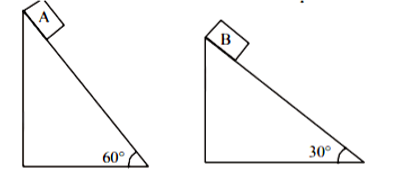
Options:
A. $4.9\text{ ms}^{-2}$ in horizontal direction
B. $9.8\text{ ms}^{-2}$ in vertical direction
C. Zero
D. $4.9\text{ ms}^{-2}$ in vertical direction
Correct Answer: D
Year: 2010
Solution: $mg \sin \theta = ma \rightarrow a = g \sin \theta$. Vertical component of acceleration $= a \sin \theta = g \sin^2 \theta$. Relative vertical acceleration of A with respect to B is $g(\sin^2 60^\circ - \sin^2 30^\circ) = g\left(\frac{3}{4} - \frac{1}{4}\right) = \frac{g}{2} = 4.9\text{ m/s}^2$ in vertical direction.
Step Solution:
1. Acceleration along Planes: For an angle $\theta$ with horizontal, $a = g \sin \theta$.
2. Determine Horizontal Angles: Since given angles are with the vertical, the horizontal angles are $(90-30)=60^\circ$ and $(90-60)=30^\circ$.
3. Vertical Acceleration Component: $a_y = a \sin \theta = g \sin^2 \theta$.
4. Individual Values: $a_{yA} = g \sin^2 60^\circ = 9.8 \times \frac{3}{4} = 7.35$; $a_{yB} = g \sin^2 30^\circ = 9.8 \times \frac{1}{4} = 2.45$.
5. Relative Calculation: $a_{rel} = a_{yA} - a_{yB} = 7.35 - 2.45 = 4.9\text{ ms}^{-2}$.
Difficulty Level: Medium
The Concept Name: Resolution of Acceleration on Inclined Planes
Short cut solution: Relative vertical acceleration $= g(\sin^2 \theta_1 - \sin^2 \theta_2)$. For horizontal angles $60^\circ$ and $30^\circ$, this is $g(0.75 - 0.25) = 0.5g = 4.9\text{ ms}^{-2}$.
Question 162
Question: A ball of mass 0.2 kg is thrown vertically upwards by applying a force by hand. If the hand moves 0.2 m while applying the force and the ball goes up to 2 m height further, find the magnitude of the force. (Consider $g = 10 \text{ m/s}^2$).
Options:
A. 4 N
B. 16 N
C. 20 N
D. 22 N
Correct Answer: D
Year: 2006
Solution: For the motion of ball, just after the throwing $v = 0$, $s = 2 \text{ m}$, $a = -g = -10 \text{ ms}^{-2}$. $v^2 - u^2 = 2as$ for upward journey $\Rightarrow -u^2 = 2(-10) \times 2 \Rightarrow u^2 = 40$. When the ball is in the hands of the thrower $u = 0$, $v = \sqrt{40} \text{ ms}^{-1}$, $s = 0.2 \text{ m}$. $v^2 - u^2 = 2as \Rightarrow 40 - 0 = 2(a)0.2 \Rightarrow a = 100 \text{ m/s}^2$. $\therefore F = ma = 0.2 \times 100 = 20 \text{ N}$. $\Rightarrow N - mg = 20 \Rightarrow N = 20 + 2 = 22 \text{ N}$.
Step Solution:
1. Velocity at Release: Calculate the velocity ($u$) of the ball when it leaves the hand using the height it reaches afterward: $v^2 - u^2 = 2gh \rightarrow 0^2 - u^2 = 2(-10)(2) \rightarrow u^2 = 40$.
2. Acceleration in Hand: Use the distance the hand moves ($0.2 \text{ m}$) to find the acceleration ($a$) applied by the hand: $v^2 - u^2 = 2as \rightarrow 40 - 0 = 2(a)(0.2)$.
3. Solve for $a$: $a = 40 / 0.4 = 100 \text{ m/s}^2$.
4. Equation of Motion: Apply Newton’s Second Law for the period the hand is pushing: $F_{net} = ma \rightarrow F - mg = ma$.
5. Calculate Total Force: $F = m(g + a) = 0.2(10 + 100) = 0.2(110) = 22 \text{ N}$.
Difficulty Level: Medium
The Concept Name: Newton’s Second Law and Kinematics
Short cut solution: Use the Work-Energy Theorem: $W_{hand} + W_{gravity} = \Delta K$. Since it starts and ends at rest, $\Delta K = 0$. Therefore, $F \times d_{hand} - mg \times (d_{hand} + h_{flight}) = 0 \Rightarrow F(0.2) = 0.2(10)(0.2 + 2) \Rightarrow F = 22 \text{ N}$.
Question 180
Question: A solid sphere, a hollow sphere and a ring are released from top of an inclined plane (frictionless) so that they slide down the plane. Then maximum acceleration down the plane is for (no rolling).
Options:
A. solid sphere
B. hollow sphere
C. ring
D. all same
Correct Answer: D
Year: 2002
Solution: This is a case of sliding (if plane is frictionless) and therefore the acceleration of all the bodies is same.
Step Solution:
1. Analyze Conditions: The plane is frictionless and the Question specifies "no rolling," which means all objects are sliding.
2. Identify Force: The only force acting along the inclined plane is the component of gravity: $F = mg \sin \theta$.
3. Newton's Second Law: Set the force equal to mass times acceleration: $ma = mg \sin \theta$.
4. Solve for $a$: Dividing by mass ($m$) shows that $a = g \sin \theta$.
5. Conclusion: Because $a$ depends only on gravity and the angle of the plane, it is independent of the object's mass or shape. Thus, all are the same.
Difficulty Level: Easy
The Concept Name: Newton’s Second Law on an Inclined Plane
Short cut solution: For any object sliding down a frictionless incline without rolling, the acceleration is always $a = g \sin \theta$, regardless of geometry.
Loading PYQ...
Loading PYQ...
Loading PYQ...
Loading PYQ...
Loading PYQ...
Loading PYQ...
Loading PYQ...
Loading PYQ...
Quiz for: 1. Newton’s Second Law ($F=ma$) & Kinematics
Ready to test your knowledge?
This quiz contains practice questions for 1. Newton’s Second Law ($F=ma$) & Kinematics.