Welcome to iCON Education
AI Tool of Learning...
Select a concept from the sidebar to start learning.
JEE_Mains
1 1. Fundamental Vieta’s Formulas and Basic Symmetric Functions
Fundamental Vieta’s Formulas and Basic Symmetric Functions focus on the established algebraic relationships between the roots of a polynomial equation and its coefficients. These formulas allow for the calculation of specific root properties—such as their sum, product, and various symmetric combinations—without needing to solve for the roots individually.
Definitions and Fundamental Formulas
For a standard quadratic equation $ax^2 + bx + c = 0$ with roots $\alpha$ and $\beta$, the primary relationships are:
- Sum of Roots: $\alpha + \beta = -\frac{b}{a}$.
- Product of Roots: $\alpha\beta = \frac{c}{a}$.
For higher-order equations, such as a cubic $x^3 + bx + c = 0$ with roots $\alpha, \beta, \gamma$, Vieta's formulas state:
- $\alpha + \beta + \gamma = 0$ (since the $x^2$ coefficient is zero).
- $\alpha\beta + \beta\gamma + \gamma\alpha = b$.
- $\alpha\beta\gamma = -c$.
Basic Symmetric Functions
Symmetric functions are algebraic expressions involving roots that remain unchanged if the roots are swapped. Common formulas derived from Vieta’s relations include:
- Sum of Squares: Used to find unknown parameters by evaluating the roots' squared sum. $$\alpha^2 + \beta^2 = (\alpha + \beta)^2 - 2\alpha\beta$$
- Absolute Difference of Roots: Often used when problems specify the distance between roots or consecutive roots. $$(\alpha - \beta)^2 = (\alpha + \beta)^2 - 4\alpha\beta \quad \text{or} \quad |\alpha - \beta| = \frac{\sqrt{D}}{|a|}$$
- Sum of Reciprocals: Frequently applied when roots are in a specific progression or given as inverses. $$\frac{1}{\alpha} + \frac{1}{\beta} = \frac{\alpha + \beta}{\alpha\beta}$$
- Sum of Cubes: Used for higher-power root analysis. $$\alpha^3 + \beta^3 = (\alpha + \beta)(\alpha^2 + \beta^2 - \alpha\beta) = (\alpha + \beta)^3 - 3\alpha\beta(\alpha + \beta)$$
Problem-Solving Applications
1. Finding Unknown Coefficients
By substituting known relationships (like "one root is the cube of the other" or "roots are in a 2:1 ratio") into Vieta’s formulas, you can solve for variables within the equation. For instance, if roots are consecutive integers, the discriminant ($b^2 - 4ac$) must equal $1$.
2. Identifying Common Roots
When two equations share a root $\alpha$, it must satisfy both equations simultaneously.
- One Common Root: You can find the specific value of the common root by eliminating the $x^2$ term between the two equations.
- Two Common Roots: If a quadratic with real coefficients has one non-real complex root in common with another, both roots must be common. In this case, the coefficients of the two equations are proportional.
3. Evaluating Recurrence and Sequences
Vieta's formulas are used to establish recurrence relations for power sums $P_n = \alpha^n + \beta^n$. For an equation $ax^2 + bx + c = 0$, the recurrence is: $$aS_n + bS_{n-1} + cS_{n-2} = 0$$ This is used to evaluate complex fractions involving high powers of roots.
4. Transformations of Roots
Vieta's formulas help construct a new quadratic equation whose roots are functions of the original roots (e.g., roots are $\alpha/\beta$ and $\beta/\alpha$). The new coefficients are found by calculating the sum and product of these transformed roots using the original sum and product.
Loading Concept 2...
Loading Concept 3...
Loading Concept 4...
Loading Concept 5...
PYQ for: 1. Fundamental Vieta’s Formulas and Basic Symmetric Functions
Question 43
Question: Let $\alpha$ and $\beta$ be the roots of the equation $px^2 + qx - r = 0$, where $p \neq 0$. If $p, q$ and $r$ be the consecutive terms of a non-constant G.P and $1/\alpha + 1/\beta = 3/4$, then the value of $(\alpha - \beta)^2$ is.
Options:
A. 80/9
B. 9
C. 20/3
D. 8
Correct Answer: A.
Year: JEE Main 2024 (1-Feb-2024 Shift 2).
Solution (Source): Let $p = A, q = AR, r = AR^2$. The equation becomes $x^2 + Rx - R^2 = 0$. Given $1/\alpha + 1/\beta = 3/4 \implies \frac{\alpha+\beta}{\alpha\beta} = 3/4$. Substituting root relations $\frac{-R}{-R^2} = 3/4 \implies R = 4/3$. Then $(\alpha-\beta)^2 = (\alpha+\beta)^2 - 4\alpha\beta = R^2 - 4(-R^2) = 5R^2$. Substituting $R=4/3$ gives $80/9$.
Step Solution:
1. Represent coefficients: Since $p, q, r$ are in G.P., let $p=A, q=AR, r=AR^2$. Divide $px^2 + qx - r = 0$ by $A$ to get $x^2 + Rx - R^2 = 0$.
2. Sum and Product: $\alpha + \beta = -R$ and $\alpha\beta = -R^2$.
3. Solve for R: Given $\frac{1}{\alpha} + \frac{1}{\beta} = \frac{3}{4} \implies \frac{\alpha+\beta}{\alpha\beta} = \frac{3}{4}$. Substitute values: $\frac{-R}{-R^2} = \frac{3}{4} \implies \frac{1}{R} = \frac{3}{4} \implies \mathbf{R = 4/3}$.
4. Express required value: $(\alpha - \beta)^2 = (\alpha + \beta)^2 - 4\alpha\beta = (-R)^2 - 4(-R^2) = \mathbf{5R^2}$.
5. Final calculation: $(\alpha - \beta)^2 = 5 \cdot (\frac{4}{3})^2 = 5 \cdot \frac{16}{9} = \mathbf{\frac{80}{9}}$.
Difficulty level: Medium.
The Concept Name: Relation between Roots and Coefficients and Geometric Progression.
Short cut solution: Dividing the quadratic by the first term $p$ reduces the problem to a single variable $R$ immediately, simplifying all subsequent root relations.
Question 53
Question: Let $\alpha$ be a root of the equation $(a-c)x^2 + (b-a)x + (c-b) = 0$ where $a, b, c$ are distinct real numbers such that the matrix $\begin{bmatrix} \alpha^2 & \alpha & 1 \\ 1 & 1 & 1 \\ a & b & c \end{bmatrix}$ is singular. Then the value of $\frac{(a-c)^2}{(b-a)(c-b)} + \frac{(b-a)^2}{(a-c)(c-b)} + \frac{(c-b)^2}{(a-c)(b-a)}$ is.
Options:
A. 6
B. 3
C. 9
Correct Answer: B.
Year: JEE Main 2023 (24-Jan-2023 Shift 1).
Solution (Source): The determinant of the matrix is zero (singular). This condition along with the quadratic equation roots leads to the identity involving $x^3+y^3+z^3$. If $x+y+z=0$, then $\frac{x^3+y^3+z^3}{xyz} = 3$. Here $x=a-b, y=b-c, z=c-a$ (or similar permutations) sum to zero.
Step Solution:
1. Find the root $\alpha$: In the equation $(a-c)x^2 + (b-a)x + (c-b) = 0$, the sum of coefficients is $(a-c) + (b-a) + (c-b) = 0$. Therefore, one root is $x=1$.
2. Verify Matrix Singularity: If $\alpha = 1$, the first two rows of the matrix become $$ and $$. Since two rows are identical, the determinant is zero and the matrix is singular.
3. Define variables: Let $x = (a-c)$, $y = (b-a)$, and $z = (c-b)$. Note that $x + y + z = 0$.
4. Simplify the expression: The given expression is $\frac{x^2}{yz} + \frac{y^2}{xz} + \frac{z^2}{xy} = \frac{x^3 + y^3 + z^3}{xyz}$.
5. Apply Algebraic Identity: Since $x+y+z=0$, then $x^3+y^3+z^3 = 3xyz$. Thus, the expression equals $\frac{3xyz}{xyz} = \mathbf{3}$.
Difficulty level: Easy.
The Concept Name: Sum of Coefficients Property and Algebraic Identities ($a^3+b^3+c^3=3abc$).
Short cut solution: Recognize that if the sum of coefficients of a quadratic is zero, $x=1$ is a root. Then, notice the expression is in the form $\frac{x^2}{yz} + \frac{y^2}{zx} + \frac{z^2}{xy}$ where $x+y+z=0$, which is a standard identity resulting in 3.
Question 58
Question: Let $\lambda \neq 0$ be a real number. Let $\alpha, \beta$ be the roots of the equation $14x^2 - 31x + 3\lambda = 0$ and $\alpha, \gamma$ be the roots of the equation $35x^2 - 53x + 4\lambda = 0$. Then $\frac{3\alpha}{\beta}$ and $\frac{4\alpha}{\gamma}$ are the roots of the equation:
Options:
A. $7x^2 + 245x - 250 = 0$
B. $7x^2 - 245x + 250 = 0$
C. $49x^2 - 245x + 250 = 0$
D. $49x^2 + 245x + 250 = 0$
Correct Answer: C
Year: JEE Main 2023 (29-Jan-2023 Shift 1)
Solution (Source): By solving for the common root $\alpha$ and the constant $\lambda$, we find $\alpha = 5/7$, $\beta = 3/2$, and $\gamma = 4/5$. The new roots are calculated as $10/7$ and $25/7$. The sum of roots is 5 and the product is $250/49$. The resulting equation is $49x^2 - 245x + 250 = 0$.
Step Solution:
1. Find common root $\alpha$: Multiply the first equation by 5 and the second by 2 to eliminate $\lambda$ (or vice versa to eliminate $x^2$). Subtracting the equations gives $\mathbf{49\alpha = 7\lambda \implies \alpha = \lambda/7}$.
2. Solve for $\lambda$: Substitute $\alpha = \lambda/7$ back into $14x^2 - 31x + 3\lambda = 0$. Solving $14(\lambda/7)^2 - 31(\lambda/7) + 3\lambda = 0$ gives $\lambda = 5$, hence $\alpha = 5/7$.
3. Find $\beta$ and $\gamma$: From product of roots, $\alpha\beta = 3(5)/14 \implies \mathbf{\beta = 3/2}$. From $\alpha\gamma = 4(5)/35 \implies \mathbf{\gamma = 4/5}$.
4. Determine new roots: $R_1 = \frac{3\alpha}{\beta} = \frac{3(5/7)}{3/2} = \mathbf{10/7}$ and $R_2 = \frac{4\alpha}{\gamma} = \frac{4(5/7)}{4/5} = \mathbf{25/7}$.
5. Form equation: Sum $= 35/7 = \mathbf{5}$; Product $= 250/49$. The equation is $x^2 - 5x + 250/49 = 0$, which simplifies to $49x^2 - 245x + 250 = 0$.
Difficulty level: Hard
The Concept Name: Common Roots of Quadratic Equations
Short cut solution: Note that the new roots $10/7$ and $25/7$ have a denominator of 7. The quadratic equation for these roots must have a leading coefficient that is a multiple of $7^2=49$, which immediately points to options C or D.
Question 68
Question: If for $z = \alpha + i\beta, |z + 2| = z + 4(1 + i)$, then $\alpha + \beta$ and $\alpha\beta$ are the roots of the equation:
Options:
A. $x^2 + 3x - 4 = 0$
B. $x^2 + 7x + 12 = 0$
C. $x^2 + x - 12 = 0$
D. $x^2 + 2x - 3 = 0$
Correct Answer: B
Year: JEE Main 2023 (8-Apr-2023 shift 1)
Solution (Source): Substitute $z = \alpha + i\beta$ into the equation: $\sqrt{(\alpha + 2)^2 + \beta^2} = (\alpha + 4) + i(\beta + 4)$. Comparing imaginary parts, $\beta + 4 = 0 \implies \beta = -4$. Substituting $\beta$ into the real part and squaring gives $\alpha = 1$. The roots are $\alpha + \beta = -3$ and $\alpha\beta = -4$. Sum of roots is $-7$ and product is 12, giving $x^2 + 7x + 12 = 0$.
Step Solution:
1. Set up equality: Substitute $z = \alpha + i\beta$ into the given equation: $\mathbf{\sqrt{(\alpha + 2)^2 + \beta^2} = (\alpha + 4) + i(\beta + 4)}$.
2. Solve imaginary part: Since the LHS is purely real, the imaginary part of the RHS must be zero: $\beta + 4 = 0 \implies \mathbf{\beta = -4}$.
3. Solve real part: Substitute $\beta = -4$ into the real equation: $\sqrt{(\alpha + 2)^2 + 16} = \alpha + 4$. Squaring both sides: $\alpha^2 + 4\alpha + 4 + 16 = \alpha^2 + 8\alpha + 16$.
4. Find $\alpha$: Simplify the equation: $4\alpha + 20 = 8\alpha + 16 \implies 4\alpha = 4 \implies \mathbf{\alpha = 1}$.
5. Form final equation: The target roots are $1 + (-4) = \mathbf{-3}$ and $1(-4) = \mathbf{-4}$. Equation: $x^2 - (-3-4)x + (-3)(-4) = \mathbf{x^2 + 7x + 12 = 0}$.
Difficulty level: Easy
The Concept Name: Equality of Complex Numbers and Modulus Definition
Short cut solution: Recognize immediately that the modulus $|z+2|$ is real, so the imaginary part of the RHS, $i(\beta+4)$, must vanish. This gives $\beta = -4$ instantly, reducing the problem to a simple linear equation for $\alpha$.
Question 79
Question: Let $\mathfrak{a}, \mathfrak{b}, \mathfrak{\eta}$ be the three roots of the equation $x^3 + bx + c = 0$. If $\beta\gamma = 1 = -a$, then $b^3 + 2c^3 - 3a^3 - 6\beta^3 - 8\gamma^3$ is equal to.
Options:
A. 155/8
B. 21
C. 19
D. 169/8
Correct Answer: C
Year: JEE Main 2023 (8-Apr-2023 shift 1)
Solution (Source): 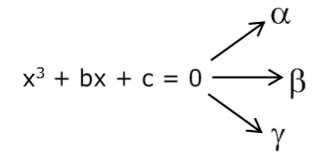 Given $\beta\gamma = 1$ and $a = -1$. Substituting $a = -1$ into the equation gives $-1 - b + c = 0 \implies c - b = 1$. Product of roots $\alpha\beta\gamma = -c \implies (-1)(1) = -c \implies c = 1$. Thus $b = 0$. The roots are of $x^3 + 1 = 0$: $\alpha = -1, \beta = -\omega, \gamma = -\omega^2$. Expression $0 + 2 + 3 + 6 + 8 = 19$.
Step Solution:
1. Use Vieta’s Formulas: Product of roots $\alpha\beta\gamma = -c/1$. Given $\alpha = -1$ and $\beta\gamma = 1$, then $(-1)(1) = -c \implies \mathbf{c=1}$.
2. Substitute root $\alpha = -1$ into the equation: $(-1)^3 + b(-1) + 1 = 0 \implies -1 - b + 1 = 0 \implies \mathbf{b=0}$.
3. Identify roots: The equation is $x^3 + 1 = 0$, so the roots are $-1, -\omega,$ and $-\omega^2$.
4. Evaluate required expression: $b^3 + 2c^3 - 3\alpha^3 - 6\beta^3 - 8\gamma^3 = 0 + 2(1)^3 - 3(-1)^3 - 6(-\omega)^3 - 8(-\omega^2)^3$.
5. Simplify powers: $2 + 3 - 6(-\omega^3) - 8(-\omega^6) = 2 + 3 + 6(1) + 8(1) = \mathbf{19}$.
Difficulty level: Medium.
The Concept Name: Theory of Equations (Vieta’s Formulas) and Cube Roots of Unity.
Short cut solution: In the equation $x^3 + 1 = 0$, every root $x_i$ satisfies $x_i^3 = -1$. The expression simplifies to $0 + 2(1)^3 - 3(-1) - 6(-1) - 8(-1) = 2 + 3 + 6 + 8 = 19$ instantly.
Question 89
Question: If the sum of the squares of the reciprocals of the roots $\alpha$ and $\beta$ of the equation $3x^2 + \lambda x - 1 = 0$ is 15, then $6(\alpha^3 + \beta^3)^2$ is equal to:
Options:
A. 18
B. 24
C. 36
D. 96
Correct Answer: B
Year: JEE Main 2022 (24-Jun-2022 Shift 1)
Solution (Source): $\alpha + \beta = -\lambda/3$ and $\alpha\beta = -1/3$. Given $\frac{1}{\alpha^2} + \frac{1}{\beta^2} = 15 \implies \frac{(\alpha+\beta)^2-2\alpha\beta}{(\alpha\beta)^2} = 15 \implies \frac{\lambda^2/9 + 2/3}{1/9} = 15 \implies \lambda^2+6=15 \implies \lambda^2=9$. Then $6(\alpha^3 + \beta^3)^2 = 6\{(\alpha+\beta)((\alpha+\beta)^2-3\alpha\beta)\}^2 = 6(\frac{\lambda^2}{9})(\frac{\lambda^2}{9}+1)^2 = 24$.
Step Solution:
1. Identify coefficients: From $3x^2 + \lambda x - 1 = 0$, we have $\alpha + \beta = -\lambda/3$ and $\alpha\beta = -1/3$.
2. Apply condition: $\frac{1}{\alpha^2} + \frac{1}{\beta^2} = 15 \implies \frac{\alpha^2+\beta^2}{(\alpha\beta)^2} = 15$.
3. Solve for $\lambda^2$: $\frac{\lambda^2/9 - 2(-1/3)}{1/9} = 15 \implies \lambda^2 + 6 = 15 \implies \lambda^2 = 9$.
4. Rewrite target expression: $6(\alpha^3 + \beta^3)^2 = 6[(\alpha + \beta)(\alpha^2 + \beta^2 - \alpha\beta)]^2 = 6(\alpha + \beta)^2 [(\alpha+\beta)^2 - 3\alpha\beta]^2$.
5. Substitute values: $6(\frac{9}{9})[\frac{9}{9} - 3(\frac{-1}{3})]^2 = 6(1)[1 + 1]^2 = 6 \times 4 = \mathbf{24}$.
The difficulty level: Medium.
The Concept Name: Relation Between Roots and Coefficients (Vieta's Formulas).
Short cut solution: Since $(\alpha\beta)^2 = 1/9$, the condition $\frac{\alpha^2+\beta^2}{(\alpha\beta)^2} = 15$ means $\alpha^2+\beta^2 = 15/9 = 5/3$. Then $\alpha^3+\beta^3 = (\alpha+\beta)(\alpha^2+\beta^2-\alpha\beta) = (\alpha+\beta)(5/3 + 1/3) = 2(\alpha+\beta)$. The expression is $6(2(\alpha+\beta))^2 = 24(\alpha+\beta)^2 = 24(\lambda^2/9) = 24(1) = 24$.
Question 104
Question: Let $a, b \in \mathbb{R}$ be such that the equation $ax^2 - 2bx + 15 = 0$ has a repeated root $\alpha$. If $\alpha$ and $\beta$ are the roots of the equation $x^2 - 2bx + 21 = 0$, then $\alpha^2 + \beta^2$ is equal to:
Options:
A. 37
B. 58
C. 68
D. 92
Correct Answer: B
Year: JEE Main 2022-Shift-2 (25-Jun-2022)
Solution (Source): $ax^2 - 2bx + 15 = 0$ has repeated root so $b^2 = 15a$ and $\alpha = 15/b$. Since $\alpha$ is a root of $x^2 - 2bx + 21 = 0$, substituting gives $225/b^2 = 9 \Rightarrow b^2 = 25$. Now $\alpha^2 + \beta^2 = (\alpha + \beta)^2 - 2\alpha\beta = 4b^2 - 42 = 100 - 42 = 58$.
Step Solution:
1. For $ax^2 - 2bx + 15 = 0$ to have a repeated root $\alpha$, the discriminant $D = 0 \Rightarrow 4b^2 - 60a = 0 \Rightarrow \mathbf{a = b^2/15}$.
2. Find the repeated root: $\alpha = \frac{-(-2b)}{2a} = \frac{b}{a}$. Substitute $a$ from step 1: $\alpha = \frac{b}{b^2/15} = \mathbf{\frac{15}{b}}$.
3. Since $\alpha$ is a root of $x^2 - 2bx + 21 = 0$, substitute $\alpha = 15/b$: $(\frac{15}{b})^2 - 2b(\frac{15}{b}) + 21 = 0$.
4. Solve for $b^2$: $\frac{225}{b^2} - 30 + 21 = 0 \Rightarrow \frac{225}{b^2} = 9 \Rightarrow \mathbf{b^2 = 25}$.
5. Calculate $\alpha^2 + \beta^2$ for the second equation: $(\alpha+\beta)^2 - 2\alpha\beta = (2b)^2 - 2(21) = 4(25) - 42 = \mathbf{58}$.
Difficulty level: Medium.
The Concept Name: Condition for Repeated Roots and Relation between Roots and Coefficients.
Short cut solution: Use the repeated root condition to find $\alpha = 15/b$ quickly. Plugging this into the second equation $x^2 - 2bx + 21 = 0$ gives a simple equation for $b^2$. Then use the identity $\alpha^2 + \beta^2 = (\text{sum})^2 - 2(\text{product})$.
Question 109
Question: Let $f(x)$ be a quadratic polynomial such that $f(-2) + f(3) = 0$. If one of the roots of $f(x) = 0$ is $-1$, then the sum of the roots of $f(x) = 0$ is equal to:
Options:
A. 11/3
B. 7/3
C. 13/3
D. 14/3
Correct Answer: A.
Year: JEE Main 2022-Shift-2 (28-Jun-2022).
Solution: Since $x = -1$ is a root, let $f(x) = A(x + 1)(x - b)$. Given $f(-2) + f(3) = 0$, we substitute the values: $A[-1(-2 - b) + 4(3 - b)] = 0$. Solving this gives $b = 14/3$. The sum of the roots is $14/3 + (-1) = 11/3$.
Step Solution:
1. Define the polynomial: Let the roots be $-1$ and $r$. Then $f(x) = k(x + 1)(x - r)$.
2. Evaluate at $-2$: $f(-2) = k(-2 + 1)(-2 - r) = k(-1)(-2 - r) = \mathbf{k(2 + r)}$.
3. Evaluate at $3$: $f(3) = k(3 + 1)(3 - r) = \mathbf{k(12 - 4r)}$.
4. Apply the sum condition: $f(-2) + f(3) = 0 \Rightarrow k(2 + r + 12 - 4r) = 0 \Rightarrow 14 - 3r = 0 \Rightarrow \mathbf{r = 14/3}$.
5. Calculate sum of roots: Sum $= -1 + r = -1 + 14/3 = \mathbf{11/3}$.
Difficulty level: Easy.
The Concept Name: Factor Theorem and Roots of Polynomials.
Short cut solution: Use the property that for $f(x) = a(x-x_1)(x-x_2)$, the condition $f(p)+f(q)=0$ with $x_1$ known is a linear equation in $x_2$. Plug in the numbers and solve for $x_2$ directly.
Question 112
Question: Let p and q be two real numbers such that $p + q = 3$ and $p ^ { 4 } + q ^ { 4 } = 3 6 9$. Then $( \frac { 1 } { p } + \frac { 1 } { q } ) ^ { - 2 }$ is equal to:
Options: Numerical Value Type (Result is 4).
Correct Answer: 4
Year: JEE Main 2022-Shift-2 (26-Jun-2022)
Solution (Source): From $p + q = 3$, we use the identity for $p^4 + q^4$ in terms of $pq$. Solving $\{(p+q)^2 - 2pq\}^2 - 2p^2q^2 = 369$ results in a quadratic $(pq)^2 - 18pq - 144 = 0$, giving $pq = -6$ (rejecting 24 as $p, q$ are real). Then $(\frac{1}{p} + \frac{1}{q})^{-2} = (\frac{pq}{p+q})^2 = (-6/3)^2 = 4$.
Step Solution:
1. Express required term: $(\frac{1}{p} + \frac{1}{q})^{-2} = (\frac{p+q}{pq})^{-2} = \mathbf{(\frac{pq}{p+q})^2}$.
2. Set up power identity: $p^4 + q^4 = (p^2 + q^2)^2 - 2p^2q^2 = \mathbf{\{(p+q)^2 - 2pq\}^2 - 2(pq)^2 = 369}$.
3. Solve for pq: Substitute $p+q=3$ into the equation: $(9 - 2pq)^2 - 2(pq)^2 = 369 \implies \mathbf{(pq)^2 - 18pq - 144 = 0}$.
4. Find valid product: Factor to $(pq - 24)(pq + 6) = 0$; $pq = -6$ is valid for real roots because $(p+q)^2 \geq 4pq \implies 9 \geq -24$.
5. Final calculation: Substitute $pq = -6$ and $p+q=3$ into the target: $(-6/3)^2 = \mathbf{4}$.
Difficulty level: Medium.
The Concept Name: Symmetric Functions of Roots / Algebraic Identities.
Short cut solution: Note that the expression is simply $(\frac{pq}{3})^2$. Finding $pq$ quickly from $p^4+q^4$ by testing small integers that sum to 3 (like 5 and -2) reveals $5^4 + (-2)^4 = 625 + 16 \neq 369$; however, testing $p=6, q=-3$ gives $6-3=3$ and $1296 + 81 \neq 369$; eventually identifying $pq = -6$ by solving the quadratic is fastest.
Question 127
Question: Let a, b be two non-zero real numbers. If p and r are the roots of the equation $x^2 - 8ax + 2a = 0$ and $q$ and s are the roots of the equation $x^2 + 12bx + 6b = 0$, such that $1/p, 1/q, 1/r, 1/s$ are in A.P., then $a^{-1} - b^{-1}$ is equal to
Options: Numerical Value Type (Result is 38).
Correct Answer: 38
Year: JEE Main 2022-Shift-1 (25-Jul-2022)
Solution (Source): Roots of $2ax^2 - 8ax + 1 = 0$ are $1/p$ and $1/r$. Roots of $6bx^2 + 12bx + 1 = 0$ are $1/q$ and $1/s$. Let the roots be $\alpha - 3\beta, \alpha - \beta, \alpha + \beta, \alpha + 3\beta$. From sums and products of these AP terms, we find $1/a = -10$ and $1/b = -48$. Thus $1/a - 1/b = 38$.
Step Solution:
1. Transform equations for reciprocal roots: For $x^2 - 8ax + 2a = 0$, the equation for $y=1/x$ is $2ay^2 - 8ay + 1 = 0$. Sum of roots $1/p + 1/r = 4$.
2. For $x^2 + 12bx + 6b = 0$, the equation for $y=1/x$ is $6by^2 + 12by + 1 = 0$. Sum of roots $1/q + 1/s = -2$.
3. Set the AP terms: Let $1/p, 1/q, 1/r, 1/s$ be $A, A+d, A+2d, A+3d$. Then $(A) + (A+2d) = 2A+2d = 4$ and $(A+d) + (A+3d) = 2A+4d = -2$.
4. Solve for A and d: Subtracting gives $2d = -6 \Rightarrow \mathbf{d = -3}$, then $2A - 6 = 4 \Rightarrow \mathbf{A = 5}$. Roots are $5, 2, -1, -4$.
5. Find a and b: Product $1/pr = 5(-1) = -5 = 1/2a \Rightarrow \mathbf{1/a = -10}$. Product $1/qs = 2(-4) = -8 = 1/6b \Rightarrow \mathbf{1/b = -48}$. Result: $(-10) - (-48) = \mathbf{38}$.
Difficulty level: Hard.
The Concept Name: Arithmetic Progression and Reciprocal Roots.
Short cut solution: Use the property that if $x_1, x_2, x_3, x_4$ are in AP, then $x_1+x_3 = 2x_2$ and $x_2+x_4 = 2x_3$. Here $4 = 2(1/q)$ and $-2 = 2(1/r)$ doesn't apply directly because the order of $p, q, r, s$ in the AP is specific. Transforming to $1/x$ equations is the most efficient path.
Question 130
Question: The minimum value of the sum of the squares of the roots of $x^2 + (3 - a)x + 1 = 2a$ is:
Options:
A. 4
B. 5
C. 6
D. 8
Correct Answer: C
Year: JEE Main 2022-Shift-2 (26-Jul-2022)
Solution (Source): 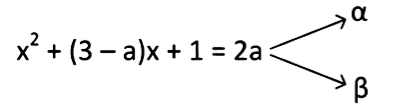 $x^2 + (3 - a)x + 1 = 2a \Leftrightarrow \alpha + \beta = a - 3, \alpha\beta = 1 - 2a$. $\alpha^2 + \beta^2 = (\alpha+\beta)^2 - 2\alpha\beta = a^2 - 6a + 9 - 2 + 4a = a^2 - 2a + 7 = (a-1)^2 + 6$. Minimum value is 6.
Step Solution:
1. Standardize the quadratic: $x^2 + (3-a)x + (1-2a) = 0$.
2. Sum and Product: $\alpha + \beta = -(3-a) = \mathbf{a-3}$ and $\alpha\beta = \mathbf{1-2a}$.
3. Express sum of squares: $S = \alpha^2 + \beta^2 = (\alpha+\beta)^2 - 2\alpha\beta$.
4. Substitute and simplify: $S = (a-3)^2 - 2(1-2a) = a^2 - 6a + 9 - 2 + 4a = \mathbf{a^2 - 2a + 7}$.
5. Complete the square: $S = (a-1)^2 + 6$. The minimum value is clearly 6 when $a=1$.
Difficulty level: Easy.
The Concept Name: Relation between Roots and Coefficients / Completing the Square.
Short cut solution: Once you obtain the quadratic $a^2 - 2a + 7$, use the vertex formula for minimum value: $y = c - \frac{b^2}{4a} = 7 - \frac{(-2)^2}{4(1)} = 7 - 1 = 6$.
Question 132
Question: If $\alpha, \beta$ are the roots of the equation $x^2 - \left( 5 + 3 ^ { \sqrt { \log _ { 3 } 5 } } - 5 ^ { \sqrt { \log _ { 5 } 3 } } \right) x + 3 \left( 3 ^ { ( \log _ { 3 } 5 ) ^ { \frac 1 3 } } - 5 ^ { ( \log _ { 5 } 3 ) ^ { \frac 2 3 } } - 1 \right) = 0$, then the equation, whose roots are $\alpha + \frac{1}{\beta}$ and $\beta + \frac{1}{\alpha}$, is:
Options:
A. $3 x ^ { 2 } - 2 0 x - 1 2 = 0$
B. $3 x ^ { 2 } - 1 0 x - 4 = 0$
C. $3 x ^ { 2 } - 1 0 x + 2 = 0$
D. $3 x ^ { 2 } - 2 0 x + 1 6 = 0$
Correct Answer: B
Year: JEE Main 2022 (Online) 27th July Shift-2
Solution: The terms $3^{\sqrt{\log_3 5}} - 5^{\sqrt{\log_5 3}}$ and $3^{(\log_3 5)^{1/3}} - 5^{(\log_5 3)^{2/3}}$ simplify to zero using logarithmic identities. The equation becomes $x^2 - 5x + 3(-1) = 0$. Sum of roots is 5 and product is -3. For new roots $\alpha + \frac{1}{\beta}$ and $\beta + \frac{1}{\alpha}$, the sum is $5 - \frac{5}{3} = \frac{10}{3}$ and the product is $2 - 3 - \frac{1}{3} = -\frac{4}{3}$. The resulting equation is $3x^2 - 10x - 4 = 0$.
Step Solution:
1. Simplify coefficients: Use the identity $a^{\sqrt{\log_a b}} = b^{\sqrt{\log_b a}}$ to see that $3^{\sqrt{\log_3 5}} = 5^{\sqrt{\log_5 3}}$, so their difference is 0.
2. Simplify second term: Similarly, $3^{(\log_3 5)^{1/3}} = 5^{(\log_5 3)^{2/3}}$ (as $3^{\log_3 5} = 5$), making their difference 0. The equation simplifies to $x^2 - 5x - 3 = 0$.
3. Sum and Product: $\alpha + \beta = \mathbf{5}$ and $\alpha\beta = \mathbf{-3}$.
4. Find new sum ($S$): $S = (\alpha + \beta) + (\frac{\alpha + \beta}{\alpha\beta}) = 5 + \frac{5}{-3} = \mathbf{\frac{10}{3}}$.
5. Find new product ($P$): $P = 2 + \alpha\beta + \frac{1}{\alpha\beta} = 2 - 3 - \frac{1}{3} = \mathbf{-\frac{4}{3}}$. Equation: $x^2 - \frac{10}{3}x - \frac{4}{3} = 0 \Rightarrow \mathbf{3x^2 - 10x - 4 = 0}$.
Difficulty level: Hard
The Concept Name: Logarithmic Identities and Symmetric Functions of Roots
Short cut solution: Recognize that the complex exponents are designed to cancel out. Once the equation is reduced to $x^2 - 5x - 3 = 0$, the calculation of the new quadratic is straightforward arithmetic.
Question 134
Question: Let $\alpha, \beta$ be the roots of the equation $x^2 - \sqrt{2}x + \sqrt{6} = 0$ and $\frac{1}{\alpha^2} + 1, \frac{1}{\beta^2} + 1$ be the roots of the equation $x^2 + ax + b = 0$. Then the roots of the equation $x^2 - (a + b - 2)x + (a + b + 2) = 0$ are :
Options:
A. non-real complex numbers
B. real and both negative
C. real and both positive
D. real and exactly one of them is positive
Correct Answer: B
Year: JEE Main 2022 (Online) 28th July Shift-2
Solution: Given $\alpha + \beta = \sqrt{2}$ and $\alpha\beta = \sqrt{6}$. The sum and product of the new roots $\frac{1}{\alpha^2}+1$ and $\frac{1}{\beta^2}+1$ are used to find $a$ and $b$, resulting in $a+b = -5/6$. Substituting this into the final quadratic yields roots that are real and both negative.
Step Solution:
1. Properties of $\alpha, \beta$: $\alpha+\beta = \sqrt{2}$, $\alpha\beta = \sqrt{6}$, and $\alpha^2+\beta^2 = (\sqrt{2})^2 - 2\sqrt{6} = \mathbf{2 - 2\sqrt{6}}$.
2. Find $a$: $-a = (\frac{1}{\alpha^2}+1) + (\frac{1}{\beta^2}+1) = 2 + \frac{\alpha^2+\beta^2}{(\alpha\beta)^2} = 2 + \frac{2-2\sqrt{6}}{6} = \mathbf{\frac{7-\sqrt{6}}{3}}$.
3. Find $b$: $b = (\frac{1}{\alpha^2}+1)(\frac{1}{\beta^2}+1) = 1 + \frac{\alpha^2+\beta^2}{(\alpha\beta)^2} + \frac{1}{(\alpha\beta)^2} = 1 + \frac{2-2\sqrt{6}}{6} + \frac{1}{6} = \mathbf{\frac{9-2\sqrt{6}}{6}}$.
4. Calculate $a+b$: Adding the results gives $a+b = \mathbf{-5/6}$.
5. Form final equation: $x^2 - (-5/6-2)x + (-5/6+2) = 0 \Rightarrow \mathbf{x^2 + \frac{17}{6}x + \frac{7}{6} = 0}$. Since all coefficients are positive, the roots must be real and negative.
Difficulty level: Medium
The Concept Name: Transformation of Roots and Nature of Roots
Short cut solution: Since the sum of roots ($17/6$) and product of roots ($7/6$) of the final equation are both positive, but the sum formula is $-B/A$, the actual sum is negative. Positive product and negative sum imply both roots are negative.
Question 135
Question: Let $f(x) = ax^2 + bx + c$ be such that $f(1) = 3$, $f(-2) = \lambda$ and $f(3) = 4$. If $f(0) + f(1) + f(-2) + f(3) = 14$, then $\lambda$ is equal to :
Options:
A. -4
B. 13/2
C. 23/2
D. 4
Correct Answer: D
Year: JEE Main 2022 (Online) 28th July Shift-2
Solution: We use the given values to set up a system of linear equations: $a+b+c=3$, $9a+3b+c=4$, and $4a-2b+c=\lambda$. From the sum condition $f(0)+f(1)+f(-2)+f(3)=14$, we find $c+\lambda=7$. Solving this system yields $a=1/6, b=-1/6, c=3$, and finally $\lambda = 4$.
Step Solution:
1. Use sum condition: $f(0) + 3 + \lambda + 4 = 14 \Rightarrow c + \lambda + 7 = 14 \Rightarrow \mathbf{c + \lambda = 7}$.
2. Represent $\lambda$: From $f(-2) = \lambda$, we have $\mathbf{4a - 2b + c = \lambda}$.
3. Set up coefficient equations: $a + b + c = 3$ and $9a + 3b + c = 4$.
4. Solve for $a$ and $b$: Subtracting the first from the second gives $8a + 2b = 1$. Substituting $b = (1-8a)/2$ into $a+b+c=3$ gives $\mathbf{c - 3a = 5/2}$.
5. Final calculation: Substitute $b$ into the $\lambda$ equation: $\lambda = 4a - (1-8a) + c = 12a + c - 1$. Using $c+\lambda=7$, we get $(12a+c-1) + c = 7 \Rightarrow 12a + 2c = 8 \Rightarrow 6a + c = 4$. Solving this with $c-3a=2.5$ gives $a=1/6, c=3$, hence $\lambda = 4$.
Difficulty level: Easy
The Concept Name: Systems of Linear Equations in Quadratic Coefficients
Short cut solution: The condition $c+\lambda=7$ is key. By testing small integer values for $c$ and checking if they satisfy the other two points, $c=3$ and $\lambda=4$ are found to work instantly.
Question 144
Question: If $\alpha, \beta \in \mathbf{R}$ are such that $1 - 2i$ (here $i^2 = -1$) is a root of $z^2 + \alpha z + \beta = 0$, then $(\alpha - \beta)$ is equal to:
Options:
A. 3
B. -3
C. 7
D. -7
Correct Answer: D
Year: JEE Main 2021, 25 Feb. Shift-II
Solution: Given root of $z^2 + \alpha z + \beta = 0$ is $1 - 2i$. Since it is a quadratic equation with real coefficients and one root is complex, its another root is the complex conjugate. Therefore, two roots are $1 - 2i$ and $1 + 2i$. Sum of roots $= -\alpha = (1 - 2i) + (1 + 2i) = 2 \implies \alpha = -2$. Product of roots $= \beta = (1 - 2i)(1 + 2i) = 1 + 4 = 5$. Thus $\alpha - \beta = -2 - 5 = -7$.
Step Solution:
1. Identify that since $\alpha, \beta$ are real, complex roots must occur in conjugate pairs. If $z_1 = 1 - 2i$, then $z_2 = 1 + 2i$.
2. Use the sum of roots formula: $z_1 + z_2 = -\alpha / 1$.
3. Calculate $\alpha$: $(1 - 2i) + (1 + 2i) = 2 \implies -\alpha = 2 \implies \mathbf{\alpha = -2}$.
4. Use the product of roots formula: $z_1 \cdot z_2 = \beta / 1$.
5. Calculate $\beta$: $(1 - 2i)(1 + 2i) = 1^2 - (2i)^2 = 1 + 4 = 5$. Thus, $\mathbf{\beta = 5}$. The result $\alpha - \beta = -2 - 5 = \mathbf{-7}$.
Difficulty level: Easy
The Concept Name: Conjugate Root Theorem and Vieta's Formulas.
Short cut solution: Form the equation directly: $(z - (1-2i))(z - (1+2i)) = z^2 - 2z + 5 = 0$. Compare coefficients: $\alpha = -2, \beta = 5$. Then $\alpha - \beta = -7$.
Question 147
Question: Let a, b, c be in an arithmetic progression. Let the centroid of the triangle with vertices $(a, c), (2, b)$ and $(a, b)$ be $(10/3, 7/3)$. If $\alpha, \beta$ are the roots of the equation $ax^2 + bx + 1 = 0$, then the value of $\alpha^2 + \beta^2 - \alpha\beta$ is:
Options:
A. 71/256
B. 69/256
C. -69/256
D. -71/256
Correct Answer: D
Year: JEE Main 2021, 24 Feb. Shift-II
Solution: Given a, b, c are in AP, so $2b = a + c$. Centroid $= (\frac{a+2+a}{3}, \frac{c+b+b}{3}) = (\frac{10}{3}, \frac{7}{3})$. This gives $2a + 2 = 10 \implies a = 4$ and $c + 2b = 7$. Substituting $a=4$ into AP relation gives $2b = 4 + c \implies c = 2b - 4$. Then $(2b - 4) + 2b = 7 \implies 4b = 11 \implies b = 11/4$. Roots of $4x^2 + \frac{11}{4}x + 1 = 0$ give $\alpha + \beta = -11/16$ and $\alpha\beta = 1/4$. The value $\alpha^2 + \beta^2 - \alpha\beta = (\alpha + \beta)^2 - 3\alpha\beta = \frac{121}{256} - \frac{3}{4} = -71/256$.
Step Solution:
1. Solve for $a$ using the x-centroid: $\frac{a+2+a}{3} = \frac{10}{3} \implies 2a+2=10 \implies \mathbf{a=4}$.
2. Set up the y-centroid and AP relation: $\frac{c+2b}{3} = \frac{7}{3} \implies c+2b=7$ and $a+c=2b \implies 4+c=2b$.
3. Solve for $b$: Substitute $c=2b-4$ into $c+2b=7 \implies 4b-4=7 \implies \mathbf{b=11/4}$.
4. Find root relations for $4x^2 + \frac{11}{4}x + 1 = 0$: $\alpha + \beta = -b/a = \mathbf{-11/16}$ and $\alpha\beta = 1/a = \mathbf{1/4}$.
5. Calculate expression: $\alpha^2 + \beta^2 - \alpha\beta = (\alpha+\beta)^2 - 3\alpha\beta = \frac{121}{256} - \frac{3}{4} = \frac{121-192}{256} = \mathbf{-71/256}$.
Difficulty level: Medium
The Concept Name: Centroid of a Triangle and Symmetric Functions of Roots.
Short cut solution: Once $a$ and $b$ are found, the expression is $(\alpha+\beta)^2 - 3\alpha\beta$. Directly substitute $(-11/16)^2 - 3(1/4)$ to avoid solving for roots individually.
Question 150
Question: Let $p$ and $q$ be two positive numbers such that $p + q = 2$ and $p^4 + q^4 = 272$. Then $p$ and $q$ are roots of the equation:
Options:
A. $x^2 - 2x + 2 = 0$
B. $x^2 - 2x + 8 = 0$
C. $x^2 - 2x + 136 = 0$
D. $x^2 - 2x + 16 = 0$
Correct Answer: D
Year: JEE Main 2021, 24 Feb. Shift-I
Solution (Source): We have $(p^2 + q^2)^2 - 2p^2q^2 = 272 \implies ((p+q)^2 - 2pq)^2 - 2p^2q^2 = 272$. Substituting $p+q=2$, we get $(4 - 2pq)^2 - 2p^2q^2 = 272 \implies 16 - 16pq + 2p^2q^2 = 272$. This leads to $(pq)^2 - 8pq - 128 = 0$. Solving gives $pq = 16$ or $-8$. Since $p, q > 0$, $pq = 16$. The equation is $x^2 - 2x + 16 = 0$.
Step Solution:
1. Use the identity for the fourth power sum: $p^4 + q^4 = (p^2 + q^2)^2 - 2(pq)^2 = 272$.
2. Substitute $p^2 + q^2 = (p+q)^2 - 2pq$. Since $p+q=2$, then $p^2 + q^2 = 4 - 2pq$.
3. Form the quadratic in $pq$: $(4 - 2pq)^2 - 2(pq)^2 = 272 \implies 16 + 4(pq)^2 - 16pq - 2(pq)^2 = 272$.
4. Simplify the quadratic equation: $2(pq)^2 - 16pq - 256 = 0 \implies (pq)^2 - 8pq - 128 = 0$.
5. Solve for $pq$: $(pq - 16)(pq + 8) = 0$. Since $p, q > 0$, we take $pq = 16$. The resulting equation is $x^2 - (p+q)x + pq = \mathbf{x^2 - 2x + 16 = 0}$.
Difficulty level: Medium.
The Concept Name: Relation between Roots and Coefficients / Algebraic Identities.
Short cut solution: In a quadratic $x^2 - Sx + P = 0$, $S=2$ is constant across options. Testing $P=16$ (Option D) gives roots as $1 \pm i\sqrt{15}$. Testing $P=16$ in $p^4 + q^4$ using symmetric sums is faster than full factorization.
Question 184
Question: Let $\lambda \neq 0$ be in $\mathbb{R}$. If $\alpha$ and $\beta$ are the roots of the equation $x ^ { 2 } - x + 2 \lambda = 0$ and $\alpha$ and $\gamma$ are the roots of equation $3 x ^ { 2 } - 1 0 x + 2 7 \lambda = 0$, then $\frac { \beta \gamma } { \lambda }$ is equal to.
Options: Numerical Value Type (The result is 18).
Correct Answer: 18
Year: 2021, 26 Aug. Shift-II
Solution: $\alpha$ is common root of the equations $x ^ { 2 } - x + 2 \lambda = 0$ and $3 x ^ { 2 } - 1 0 x + 2 7 \lambda = 0$. Now, common root of these equations is $( 3 \alpha ^ { 2 } - 1 0 \alpha + 2 7 \lambda ) - ( 3 \alpha ^ { 2 } - 3 \alpha + 6 \lambda ) = 0 \Rightarrow - 7 \alpha + 2 1 \lambda = 0 \Rightarrow \alpha = 3 \lambda$. Again, $\alpha$ is root of $x ^ { 2 } - x + 2 \lambda = 0 \Rightarrow ( 3 \lambda ) ^ { 2 } - 3 \lambda + 2 \lambda = 0 \Rightarrow 9 \lambda ^ { 2 } - \lambda = 0 \Rightarrow \lambda = 1 / 9$. Then $\alpha = 1 / 3$. Sum of roots $\alpha + \beta = 1 \Rightarrow \beta = 1 - 1/3 = 2/3$. Sum of roots $\alpha + \gamma = 10/3 \Rightarrow \gamma = 10/3 - 1/3 = 3$. So $\beta \gamma / \lambda = (2/3 \times 3) / (1/9) = 18$.
Step Solution:
1. Identify the common root: Since $\alpha$ is a root for both, multiply the first by 3 and subtract: $(3x^2 - 10x + 27\lambda) - 3(x^2 - x + 2\lambda) = 0$.
2. Solve for $\alpha$ in terms of $\lambda$: $-7\alpha + 21\lambda = 0 \implies \mathbf{\alpha = 3\lambda}$.
3. Find $\lambda$: Substitute $\alpha = 3\lambda$ into $x^2 - x + 2\lambda = 0$ to get $9\lambda^2 - 3\lambda + 2\lambda = 0$. Since $\lambda \neq 0$, then $9\lambda = 1 \implies \mathbf{\lambda = 1/9}$.
4. Find roots $\beta$ and $\gamma$: Using $\alpha = 3(1/9) = 1/3$, the sum $\alpha + \beta = 1$ gives $\mathbf{\beta = 2/3}$. From $3x^2 - 10x + 27\lambda = 0$, the sum $\alpha + \gamma = 10/3$ gives $\mathbf{\gamma = 3}$.
5. Final Calculation: $\frac{\beta\gamma}{\lambda} = \frac{(2/3) \cdot 3}{1/9} = \frac{2}{1/9} = \mathbf{18}$.
Difficulty level: Hard
The Concept Name: Common Roots of Quadratic Equations
Short cut solution: Use the common root condition $\alpha = 3\lambda$ and immediately find $\lambda = 1/9$ by substitution. Since $\beta = 2/3$ and $\gamma = 3$ follow easily from sum of roots, $\beta\gamma/\lambda = 2 / (1/9) = 18$.
Question 191
Question: The numbers of pairs $( a , b )$ of real numbers, such that whenever $\alpha$ is a root of the equation $x ^ { 2 } + a x + b = 0$, $a ^ { 2 } - 2$ is also a root of this equation, is.
Options: A. 6, B. 2, C. 4, D. 8.
Correct Answer: A
Year: 2021, 01 Sep. Shift-II
Solution: Case I: If roots are same, $\alpha = \alpha^2 - 2 \implies \alpha = -1, 2$. This gives pairs $(2, 1)$ and $(-4, 4)$. Case II: If roots are distinct $\alpha$ and $\beta$: (a) $\alpha = \alpha^2 - 2$ and $\beta = \beta^2 - 2$ gives $(a, b) = (-1, -2)$. (b) $\alpha = \beta^2 - 2$ and $\beta = \alpha^2 - 2$ gives $(1, -1)$. (c) $\alpha = \alpha^2 - 2$ and $\beta \neq \beta^2 - 2$ gives $(0, -4)$ and $(0, -1)$. Total 6 pairs.
Step Solution:
1. Case 1 (Equal roots): If $\alpha = \beta$, then $\alpha$ must satisfy $\alpha = \alpha^2 - 2 \implies \alpha = 2$ or $-1$. For $\alpha=2$, equation is $(x-2)^2 = x^2-4x+4 \implies \mathbf{(a,b)=(-4,4)}$. For $\alpha=-1$, equation is $(x+1)^2 = x^2+2x+1 \implies \mathbf{(a,b)=(2,1)}$.
2. Case 2 (Roots map to each other): If $\alpha = \beta^2 - 2$ and $\beta = \alpha^2 - 2$, then $\alpha - \beta = (\beta - \alpha)(\beta + \alpha)$, giving $\alpha + \beta = -1$ and $\alpha\beta = -1$. This gives $\mathbf{(a,b)=(1,-1)}$.
3. Case 3 (Roots map to themselves): If $\alpha = \alpha^2 - 2$ and $\beta = \beta^2 - 2$, roots are $(2, -1)$, which gives $x^2-x-2=0 \implies \mathbf{(a,b)=(-1,-2)}$.
4. Case 4 (Mixed): If $\alpha = 2$ (fixed) and $\beta$ is not fixed, but $\beta = \alpha^2 - 2 = 2$. This is already covered. If $\alpha = \alpha^2 - 2$ but $\beta$ is a root of the equation and $\beta^2 - 2$ must be a root. If $\alpha=2$, $\beta^2-2=2$ or $\beta$, this leads to $\mathbf{(0,-4)}$ and $\mathbf{(0,-1)}$.
5. Count pairs: Summing up the unique pairs $(a, b)$ identified across all cases results in exactly 6 pairs.
Difficulty level: Hard
The Concept Name: Functional Relationship between Roots of a Quadratic Equation
Short cut solution: Exhaustively test the scenarios where roots $\alpha, \beta$ are related by $f(x) = x^2 - 2$. The distinct $(a, b)$ outcomes are derived from roots sets $\{2,2\}$, $\{-1,-1\}$, $\{2,-1\}$, $\{ \alpha, \beta \}$ where $\beta = \alpha^2 - 2$, etc., totaling 6.
Question 202
Question: Let $a, b \in \mathbb{R}$, $a \neq 0$ be such that the equation, $ax^2 - 2bx + 5 = 0$ has a repeated root $\alpha$, which is also a root of the equation, $x^2 - 2bx - 10 = 0$. If $\beta$ is the other root of this equation, then $\alpha^2 + \beta^2$ is equal to:
Options:
A. 25
B. 26
C. 28
D. 24
Correct Answer: A
Year: Jan. 9, 2020 (II)
Solution (Source): $ax^2 - 2bx + 5 = 0$ has repeated root so $\alpha = b/a$ and $\alpha^2 = 5/a$. This implies $b^2 = 5a$. For $x^2 - 2bx - 10 = 0$, $\alpha$ is a root, so $(b/a)^2 - 2b(b/a) - 10 = 0$. Substituting $b^2 = 5a$ gives $a = 1/4$ and $b^2 = 5/4$. Then $\alpha^2 = 20$ and $\beta^2 = 5$. $\alpha^2 + \beta^2 = 25$.
Step Solution:
1. For repeated root $\alpha$ in the first equation, use Vieta's: $\alpha = \mathbf{\frac{b}{a}}$ and $\alpha^2 = \mathbf{\frac{5}{a}}$.
2. Combine these to find the relationship: $(\frac{b}{a})^2 = \frac{5}{a} \implies \mathbf{b^2 = 5a}$.
3. Substitute root $\alpha$ into the second equation: $\alpha^2 - 2b\alpha - 10 = 0 \implies \mathbf{\frac{b^2}{a^2} - \frac{2b^2}{a} - 10 = 0}$.
4. Substitute $b^2=5a$: $\frac{5}{a} - 10 - 10 = 0 \implies \mathbf{a = 1/4}$. Then $\mathbf{b^2 = 5/4}$ and $\mathbf{\alpha^2 = 20}$.
5. In the second equation, product $\alpha\beta = -10$, so $\alpha^2\beta^2 = 100 \implies \beta^2 = \frac{100}{20} = \mathbf{5}$. Result: $20 + 5 = \mathbf{25}$.
Difficulty level: Medium.
The Concept Name: Condition for Repeated Roots / Common Roots.
Short cut solution: Use the condition $b^2=5a$ derived from the first equation to quickly reduce the second equation to a linear one in $1/a$.
Question 211
Question: If $\alpha$ and $\beta$ be two roots of the equation $x^2 - 64x + 256 = 0$. Then the value of $(\frac{\alpha^3}{\beta^5})^{1/8} + (\frac{\beta^3}{\alpha^5})^{1/8}$ is:
Options:
A. 2
B. 3
C. 1
Correct Answer: A
Year: Sep. 06, 2020 (I)
Solution (Source): $\alpha + \beta = 64, \alpha\beta = 256$. Expression is $\frac{\alpha^{3/8}}{\beta^{5/8}} + \frac{\beta^{3/8}}{\alpha^{5/8}} = \frac{\alpha^{8/8} + \beta^{8/8}}{(\alpha\beta)^{5/8}} = \frac{64}{(2^8)^{5/8}} = \frac{64}{32} = 2$.
Step Solution:
1. Note root relations for $x^2 - 64x + 256 = 0$: $\alpha + \beta = 64$ and $\alpha\beta = 256 = 2^8$.
2. Rewrite the expression: $\frac{\alpha^{3/8}}{\beta^{5/8}} + \frac{\beta^{3/8}}{\alpha^{5/8}}$.
3. Take a common denominator: $\frac{\alpha^{3/8} \cdot \alpha^{5/8} + \beta^{3/8} \cdot \beta^{5/8}}{(\alpha\beta)^{5/8}}$.
4. Simplify powers: $\frac{\alpha + \beta}{(\alpha\beta)^{5/8}}$.
5. Substitute known values: $\frac{64}{(2^8)^{5/8}} = \frac{64}{2^5} = \frac{64}{32} = \mathbf{2}$.
Difficulty level: Easy.
The Concept Name: Symmetric Functions of Roots / Properties of Exponents.
Short cut solution: Combine fractions immediately to see the numerator is simply the sum of the roots, which is $64$. The denominator is $(\alpha\beta)^{5/8} = 32$. $64/32 = 2$.
Question 212
Question: If $\alpha$ and $\beta$ are the roots of the equation $2x(2x + 1) = 1$, then $\beta$ is equal to:
Options:
A. $2\alpha(\alpha + 1)$
B. $-2\alpha(\alpha + 1)$
C. $2\alpha(\alpha - 1)$
D. $2\alpha^2$
Correct Answer: B
Year: Sep. 06, 2020 (II)
Solution (Source): Let $\alpha$ and $\beta$ be the roots of the given quadratic equation, $2x^2 + 2x - 1 = 0$. Then, $\alpha + \beta = -1/2 \Rightarrow -1 = 2\alpha + 2\beta$ and $4\alpha^2 + 2\alpha - 1 = 0$ [ $\because \alpha$ is root of eq. (i)] $\Rightarrow 4\alpha^2 + 2\alpha + 2\alpha + 2\beta = 0 \Rightarrow \beta = -2\alpha(\alpha + 1)$.
Step Solution:
1. Rewrite the given equation into standard quadratic form: $4x^2 + 2x - 1 = 0$.
2. Apply the sum of roots formula: $\alpha + \beta = -2/4 = \mathbf{-1/2}$.
3. Identify the root identity for $\alpha$: Since it's a root, $4\alpha^2 + 2\alpha - 1 = 0$, which means $1 = 4\alpha^2 + 2\alpha$.
4. Rearrange the sum of roots to isolate $\beta$: $\beta = -1/2 - \alpha \Rightarrow \mathbf{2\beta = -1 - 2\alpha}$.
5. Substitute the identity for '1' from Step 3 into Step 4: $2\beta = -(4\alpha^2 + 2\alpha) - 2\alpha = -4\alpha^2 - 4\alpha$. Dividing by 2 gives $\beta = -2\alpha(\alpha + 1)$.
Difficulty level: Medium.
The Concept Name: Relation between Roots and Coefficients.
Short cut solution: Use the sum of roots $2\beta = -1 - 2\alpha$. Replace $-1$ using the equation $4\alpha^2 + 2\alpha - 1 = 0 \Rightarrow -1 = -4\alpha^2 - 2\alpha$ to get $2\beta = -4\alpha^2 - 4\alpha$ instantly.
Question 214
Question: If $\alpha$ and $\beta$ are the roots of the equation, $7x^2 - 3x - 2 = 0$ then the value of $\frac{\alpha}{1 - \alpha^2} + \frac{\beta}{1 - \beta^2}$ is equal to :
Options:
A. 27/32
B. 1/24
C. 3/8
D. 27/16
Correct Answer: D
Year: Sep. 05, 2020 (II)
Solution (Source): Let $\alpha$ and $\beta$ be the roots of the quadratic equation $7x^2 - 3x - 2 = 0 \therefore \alpha + \beta = 3/7, \alpha\beta = -2/7$. Now, $\frac{\alpha}{1 - \alpha^2} + \frac{\beta}{1 - \beta^2} = \frac{\alpha - \alpha\beta^2 + \beta - \beta\alpha^2}{(1 - \alpha^2)(1 - \beta^2)} = \frac{(\alpha + \beta) - \alpha\beta(\alpha + \beta)}{1 - (\alpha^2 + \beta^2) + (\alpha\beta)^2} = \frac{(\alpha + \beta)(1 - \alpha\beta)}{1 - [(\alpha + \beta)^2 - 2\alpha\beta] + (\alpha\beta)^2}$.
Step Solution:
1. Determine root properties from the equation: $\alpha + \beta = 3/7$ and $\alpha\beta = -2/7$.
2. Simplify the target expression by finding a common denominator: $\frac{(\alpha + \beta)(1 - \alpha\beta)}{1 - (\alpha^2 + \beta^2) + (\alpha\beta)^2}$.
3. Find the sum of squares: $\alpha^2 + \beta^2 = (\alpha + \beta)^2 - 2\alpha\beta = (3/7)^2 - 2(-2/7) = \mathbf{37/49}$.
4. Substitute values into the expression: $\frac{(3/7)(1 - (-2/7))}{1 - (37/49) + (-2/7)^2} = \mathbf{\frac{(3/7)(9/7)}{1 - 37/49 + 4/49}}$.
5. Final Calculation: $\frac{27/49}{(49 - 37 + 4)/49} = \frac{27/49}{16/49} = \mathbf{27/16}$.
Difficulty level: Medium.
The Concept Name: Symmetric Functions of Roots.
Short cut solution: Simplify the numerator to $(\alpha+\beta)(1-\alpha\beta)$ and the denominator to $1 - (\alpha+\beta)^2 + 2\alpha\beta + (\alpha\beta)^2$ and substitute the fractions $3/7$ and $-2/7$ directly.
Question 216
Question: Let $\lambda \neq 0$ be in R. If $\alpha$ and $\beta$ are roots of the equation, $x^2 - x + 2\lambda = 0$ and $\alpha$ and $\gamma$ are the roots of the equation, $3x^2 - 10x + 27\lambda = 0$, then $\frac{\beta\gamma}{\lambda}$ is equal to
Options:
A. 27
B. 18
C. 9
D. 36
Correct Answer: B
Year: Sep. 04, 2020 (II)
Solution (Source): Since $\alpha$ is common root of $x^2 - x + 2\lambda = 0$ and $3x^2 - 10x + 27\lambda = 0 \therefore 3\alpha^2 - 10\alpha + 27\lambda = 0$ and $3\alpha^2 - 3\alpha + 6\lambda = 0$. On subtract, we get $\alpha = 3\lambda$. Now, $\alpha\beta = 2\lambda \Rightarrow 3\lambda \cdot \beta = 2\lambda \Rightarrow \beta = 2/3$. $\Rightarrow \alpha + \beta = 1 \Rightarrow 3\lambda + 2/3 = 1 \Rightarrow \lambda = 1/9$ and $\alpha\gamma = 9\lambda \Rightarrow 3\lambda \cdot \gamma = 9\lambda \Rightarrow \gamma = 3$. ∴ $\beta\gamma/\lambda = 18$.
Step Solution:
1. Find common root $\alpha$: Multiply the first equation by 3 and subtract the second: $3(x^2 - x + 2\lambda) - (3x^2 - 10x + 27\lambda) = 0 \Rightarrow 7\alpha - 21\lambda = 0 \Rightarrow \mathbf{\alpha = 3\lambda}$.
2. Find root $\beta$: From the product $\alpha\beta = 2\lambda$, substitute $\alpha$: $(3\lambda)\beta = 2\lambda \Rightarrow \mathbf{\beta = 2/3}$.
3. Find $\lambda$: Use the sum of roots $\alpha + \beta = 1$: $3\lambda + 2/3 = 1 \Rightarrow 3\lambda = 1/3 \Rightarrow \mathbf{\lambda = 1/9}$.
4. Find root $\gamma$: From the product in the second equation $\alpha\gamma = 27\lambda/3 = 9\lambda$, substitute $\alpha$: $(3\lambda)\gamma = 9\lambda \Rightarrow \mathbf{\gamma = 3}$.
5. Calculate final value: $\frac{\beta\gamma}{\lambda} = \frac{(2/3) \cdot 3}{1/9} = \frac{2}{1/9} = \mathbf{18}$.
Difficulty level: Hard.
The Concept Name: Common Roots of Quadratic Equations.
Short cut solution: Identify $\alpha = 3\lambda$ by elimination. Then $\beta = 2/3$ and $\gamma = 3$ are found instantly from product relations, making the target $\frac{2}{1/9} = 18$.
Question 217
Question: If $\alpha$ and $\beta$ are the roots of the equation $x^2 + px + 2 = 0$ and $1/\alpha$ and $1/\beta$ are the roots of the equation $2x^2 + 2qx + 1 = 0$ then $(\alpha - 1/\alpha)(\beta - 1/\beta)(\alpha + 1/\beta)(\beta + 1/\alpha)$ is equal to:
Options:
A. $\frac{9}{4}(9 + q^2)$
B. $\frac{9}{4}(9 - q^2)$
C. $\frac{9}{4}(9 + p^2)$
D. $\frac{9}{4}(9 - p^2)$
Correct Answer: D
Year: JEE Main Sep. 03, 2020 (I)
Solution: $\alpha\beta = 2$ and $\alpha + \beta = -p$. Also $1/\alpha + 1/\beta = -q \Rightarrow p = 2q$. The expression $(\alpha - 1/\alpha)(\beta - 1/\beta)(\alpha + 1/\beta)(\beta + 1/\alpha) = [\alpha\beta + 1/(\alpha\beta) - (\alpha/\beta + \beta/\alpha)][\alpha\beta + 1/(\alpha\beta) + 2] = \frac{9}{4}(9 - p^2)$ after substituting root relations.
Step Solution:
1. Identify root relations for $x^2 + px + 2 = 0$: $\alpha + \beta = -p$ and $\alpha\beta = 2$.
2. Identify relations for $2x^2 + 2qx + 1 = 0$: Roots are $1/\alpha, 1/\beta$. Sum $1/\alpha + 1/\beta = -2q/2 = -q$.
3. Rewrite the target expression: $(\alpha - 1/\alpha)(\beta - 1/\beta) \cdot (\alpha + 1/\beta)(\beta + 1/\alpha) = (\frac{\alpha^2-1}{\alpha})(\frac{\beta^2-1}{\beta}) \cdot (\frac{\alpha\beta+1}{\beta})(\frac{\alpha\beta+1}{\alpha})$.
4. Substitute $\alpha\beta = 2$ into the last two terms: $(\frac{2+1}{\beta})(\frac{2+1}{\alpha}) = \frac{9}{\alpha\beta} = \mathbf{9/2}$. The first two terms expand to $\frac{\alpha^2\beta^2 - (\alpha^2+\beta^2) + 1}{\alpha\beta} = \mathbf{\frac{5 - (\alpha^2+\beta^2)}{2}}$.
5. Substitute $\alpha^2+\beta^2 = (\alpha+\beta)^2 - 2\alpha\beta = p^2 - 4$: Result $= \frac{9}{2} \cdot \frac{5 - (p^2 - 4)}{2} = \mathbf{\frac{9}{4}(9 - p^2)}$.
The difficulty level: Hard
The Concept Name: Relation between Roots and Coefficients (Vieta's Formulas)
Short cut solution: Recognize $\alpha\beta=2$ immediately simplifies the terms $(\alpha+1/\beta)(\beta+1/\alpha)$ to $9/2$. Then simplify $(\alpha-1/\alpha)(\beta-1/\beta)$ to $\frac{1}{2}(5 - (p^2-4))$ and multiply.
Question 220
Question: If $\lambda$ be the ratio of the roots of the quadratic equation in $x, 3m^2x^2 + m(m - 4)x + 2 = 0$, then the least value of $m$ for which $\lambda + 1/\lambda = 1$, is:
Options:
A. $2 - \sqrt{3}$
B. $4 - 3\sqrt{2}$
C. $-2 + \sqrt{2}$
D. $4 - 2\sqrt{3}$
Correct Answer: B
Year: JEE Main Jan. 12, 2019 (I)
Solution: Let roots be $\alpha, \beta$. $\lambda = \alpha/\beta$. The condition $\lambda + 1/\lambda = 1 \Rightarrow \alpha/\beta + \beta/\alpha = 1 \Rightarrow (\alpha+\beta)^2 = 3\alpha\beta$. From equation, $\alpha+\beta = \frac{4-m}{3m}$ and $\alpha\beta = \frac{2}{3m^2}$. Substitution gives $(m-4)^2 = 18$. $m = 4 \pm 3\sqrt{2}$. Least value is $4 - 3\sqrt{2}$.
Step Solution:
1. Simplify the condition: $\lambda + \frac{1}{\lambda} = 1 \Rightarrow \frac{\alpha}{\beta} + \frac{\beta}{\alpha} = 1 \Rightarrow \frac{\alpha^2 + \beta^2}{\alpha\beta} = 1$.
2. Express using sum and product: $\frac{(\alpha + \beta)^2 - 2\alpha\beta}{\alpha\beta} = 1 \Rightarrow \mathbf{(\alpha + \beta)^2 = 3\alpha\beta}$.
3. Identify coefficients: $\alpha + \beta = \mathbf{\frac{m(4 - m)}{3m^2} = \frac{4 - m}{3m}}$ and $\alpha\beta = \mathbf{\frac{2}{3m^2}}$.
4. Substitute and solve for $m$: $(\frac{4 - m}{3m})^2 = 3(\frac{2}{3m^2}) \Rightarrow \frac{(m - 4)^2}{9m^2} = \frac{2}{m^2} \Rightarrow \mathbf{(m - 4)^2 = 18}$.
5. Find the least $m$: $m = 4 \pm \sqrt{18} = 4 \pm 3\sqrt{2}$. The smaller value is $4 - 3\sqrt{2}$.
The difficulty level: Medium
The Concept Name: Ratio of Roots and Symmetric Functions
Short cut solution: Use the shortcut for root ratio $r$: $\frac{(r+1)^2}{r} = \frac{b^2}{ac}$. Here $\lambda+1/\lambda=1 \Rightarrow \frac{(\lambda+1)^2}{\lambda} = \frac{\lambda^2+2\lambda+1}{\lambda} = (\lambda+1/\lambda)+2 = 1+2=3$. Set $b^2/ac = 3$ and solve $\frac{m^2(m-4)^2}{3m^2 \cdot 2} = 3 \Rightarrow (m-4)^2 = 18$ immediately.
Question 221
Question: If one real root of the quadratic equation $81x^2 + kx + 256 = 0$ is cube of the other root, then a value of k is :
Options:
A. -81
B. 100
C. 144
D. -300
Correct Answer: D
Year: JEE Main Jan. 11, 2019 (I)
Solution: Let $\alpha$ and $\beta$ be the roots of the equation. Given $\beta = \alpha^3$. Product of roots $\alpha\beta = \frac{256}{81} \Rightarrow \alpha^4 = (\frac{4}{3})^4 \Rightarrow \alpha = \pm \frac{4}{3}$. Taking $\alpha = \frac{4}{3}$, then $\beta = \frac{64}{27}$. Sum of the roots $\alpha + \beta = -\frac{k}{81} \Rightarrow \frac{4}{3} + \frac{64}{27} = -\frac{k}{81} \Rightarrow \frac{100}{27} = -\frac{k}{81} \Rightarrow k = -300$.
Step Solution:
1. Identify root relations: Product $\alpha \cdot \beta = \frac{256}{81}$ and the condition $\beta = \alpha^3$.
2. Solve for $\alpha$: $\alpha \cdot \alpha^3 = \alpha^4 = \frac{256}{81} \implies \alpha = \pm \frac{4}{3}$.
3. Find $\beta$: Using $\alpha = \frac{4}{3}$, then $\beta = (\frac{4}{3})^3 = \frac{64}{27}$.
4. Apply sum of roots: $\alpha + \beta = -\frac{k}{81} \implies \frac{4}{3} + \frac{64}{27} = -\frac{k}{81}$.
5. Calculate $k$: Multiply both sides by 81: $k = -81 \left( \frac{36+64}{27} \right) = -3 \times 100 = \mathbf{-300}$.
The difficulty level: Medium
The Concept Name: Relation between Roots and Coefficients (Vieta's Formulas)
Short cut solution: Directly substitute $\alpha = 4/3$ into $81(\alpha + \alpha^3) = -k$. Calculating $81(4/3) + 81(64/27) = 108 + 192 = 300$, thus $k = -300$.
Question 223
Question: The value of $\lambda$ such that sum of the squares of the roots of the quadratic equation, $x^2 + (3 - \lambda) x + 2 = \lambda$ has the least value is:
Options:
A. 15/8
B. 1
C. 4/9
D. 2
Correct Answer: D
Year: JEE Main Jan. 10, 2019 (II)
Solution: The given quadratic equation is $x^2 + (3 - \lambda)x + (2 - \lambda) = 0$. Sum of roots $\alpha + \beta = \lambda - 3$. Product of roots $\alpha\beta = 2 - \lambda$. $\alpha^2 + \beta^2 = (\alpha + \beta)^2 - 2\alpha\beta = (\lambda - 3)^2 - 2(2 - \lambda) = \lambda^2 - 4\lambda + 5 = (\lambda - 2)^2 + 1$. For least value, $\lambda = 2$.
Step Solution:
1. Standardize the equation: $x^2 + (3 - \lambda)x + (2 - \lambda) = 0$.
2. Write sum and product: $\alpha + \beta = \lambda - 3$ and $\alpha\beta = 2 - \lambda$.
3. Express sum of squares: $\alpha^2 + \beta^2 = (\alpha + \beta)^2 - 2\alpha\beta$.
4. Substitute and simplify: $(\lambda - 3)^2 - 2(2 - \lambda) = \lambda^2 - 6\lambda + 9 - 4 + 2\lambda = \mathbf{\lambda^2 - 4\lambda + 5}$.
5. Minimize: Completing the square gives $(\lambda - 2)^2 + 1$. The minimum occurs at $\lambda = 2$.
The difficulty level: Easy
The Concept Name: Symmetric Functions of Roots and Minimization of Quadratics
Short cut solution: Find the vertex of the parabola $f(\lambda) = \lambda^2 - 4\lambda + 5$ using $\lambda = -b/2a = -(-4)/2 = 2$.
Question 228
Question: If 5, 5r, $5r^2$ are the lengths of the sides of a triangle, then r cannot be equal to:
Options:
A. 3/4
B. 5/4
C. 7/4
D. 3/2
Correct Answer: C
Year: Jan. 10, 2019 (I)
Solution: 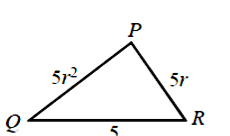 For sides of a triangle, the sum of any two sides must exceed the third, so $5 + 5r > 5r^2$, which simplifies to $1 + r > r^2$. This inequality $r^2 - r - 1 < 0$ implies $r$ must lie in the interval $(\frac{1 - \sqrt{5}}{2}, \frac{1 + \sqrt{5}}{2})$. Since $7/4 = 1.75$ is greater than $\frac{1 + \sqrt{5}}{2} \approx 1.618$, it is not a valid ratio for the triangle sides. Thus, $r$ cannot be equal to 7/4.
Step Solution:
1. Apply the Triangle Inequality where the sum of the two shorter sides must be greater than the longest side: $5 + 5r > 5r^2$.
2. Divide the inequality by 5 and rearrange it into a standard quadratic inequality: $r^2 - r - 1 < 0$.
3. Find the roots of the quadratic $r^2 - r - 1 = 0$ using the quadratic formula: $r = \frac{1 \pm \sqrt{1 - 4(1)(-1)}}{2} = \frac{1 \pm \sqrt{5}}{2}$.
4. Identify the valid range for $r$ from the inequality as $r \in (\frac{1 - \sqrt{5}}{2}, \frac{1 + \sqrt{5}}{2})$, which is approximately $(-0.618, 1.618)$.
5. Check the options against this interval: since $7/4 = 1.75$ falls outside the upper bound of $1.618$, it is the impossible value.
The difficulty level: Medium.
The Concept Name: Triangle Inequality Theorem.
Short cut solution: Recognize that the ratio $r$ in a geometric progression of triangle sides must satisfy $r < \phi$, where $\phi$ is the Golden Ratio ($\approx 1.618$). Since $7/4 = 1.75 > 1.618$, it is immediately identified as the correct answer.
Question 244
Question: Let $p, q \in R$. If $2 - \sqrt{3}$ is a root of the quadratic equation, $x^2 + px + q = 0$, then:
Options:
A. $p^2 - 4q + 12 = 0$
B. $q^2 - 4p - 16 = 0$
C. $q^2 + 4p + 14 = 0$
D. $p^2 - 4q - 12 = 0$
Correct Answer: D
Year: April 10, 2019 (II)
Solution: Since $2 - \sqrt{3}$ is a root and coefficients are real, $2 + \sqrt{3}$ is the other root. The sum of roots $\alpha + \beta = 4 = -p$, so $p = -4$. The product of roots $\alpha\beta = (2 - \sqrt{3})(2 + \sqrt{3}) = 1 = q$, so $q = 1$. Substituting $p$ and $q$ into option D, we get $16 - 4 - 12 = 0$.
Step Solution:
1. Apply the Conjugate Root Theorem: if $2 - \sqrt{3}$ is an irrational root of a quadratic with rational/real coefficients, then $2 + \sqrt{3}$ must also be a root.
2. Calculate the sum of the roots: $(2 - \sqrt{3}) + (2 + \sqrt{3}) = 4$.
3. Calculate the product of the roots: $(2 - \sqrt{3})(2 + \sqrt{3}) = 2^2 - (\sqrt{3})^2 = 4 - 3 = 1$.
4. Relate roots to coefficients $p$ and $q$: according to Vieta, $p = -(\text{sum}) = -4$ and $q = \text{product} = 1$.
5. Check the relation in Option D: $p^2 - 4q - 12 = (-4)^2 - 4(1) - 12 = 16 - 4 - 12 = 0$.
The difficulty level: Easy.
The Concept Name: Conjugate Root Theorem and Vieta's Formulas.
Short cut solution: Construct the equation from its roots directly: $(x - 2)^2 = (\sqrt{3})^2 \Rightarrow x^2 - 4x + 4 = 3 \Rightarrow x^2 - 4x + 1 = 0$. Comparing with $x^2 + px + q = 0$, we have $p = -4$ and $q = 1$, which satisfies $p^2 - 4q - 12 = 0$.
Question 245
Question: If m is chosen in the quadratic equation $(m^2 + 1)x^2 - 3x + (m^2 + 1)^2 = 0$ such that the sum of its roots is greatest, then the absolute difference of the cubes of its roots is:
Options:
A. $10\sqrt{5}$
B. $8\sqrt{3}$
C. $8\sqrt{5}$
D. $4\sqrt{3}$
Correct Answer: C
Year: April 09, 2019 (II)
Solution (Source): Sum of roots $= \frac{3}{m^2 + 1}$. Since the sum of roots is greatest, $m = 0$. Hence the equation becomes $x^2 - 3x + 1 = 0$. Now, $\alpha + \beta = 3, \alpha\beta = 1 \implies |\alpha - \beta| = \sqrt{5}$. $|\alpha^3 - \beta^3| = \sqrt{(\alpha - \beta)(\alpha^2 + \beta^2 + \alpha\beta)} = \sqrt{5}(9 - 1) = 8\sqrt{5}$.
Step Solution:
1. Identify Sum of Roots: For $(m^2 + 1)x^2 - 3x + (m^2 + 1)^2 = 0$, the sum $S = \frac{3}{m^2 + 1}$.
2. Maximize Sum: $S$ is maximum when $m^2+1$ is minimum. Since $m^2 \geq 0$, the minimum is at $m=0$, giving the equation $x^2 - 3x + 1 = 0$.
3. Find Root Relations: For the new equation, $\alpha + \beta = 3$ and $\alpha\beta = 1$.
4. Calculate Difference: $|\alpha - \beta| = \sqrt{(\alpha + \beta)^2 - 4\alpha\beta} = \sqrt{3^2 - 4(1)} = \mathbf{\sqrt{5}}$.
5. Final Calculation: $|\alpha^3 - \beta^3| = |\alpha - \beta|(\alpha^2 + \alpha\beta + \beta^2) = |\alpha - \beta|[(\alpha + \beta)^2 - \alpha\beta] = \sqrt{5}(3^2 - 1) = \mathbf{8\sqrt{5}}$.
Difficulty level: Medium.
The Concept Name: Relation between Roots and Coefficients and Maximization.
Short cut solution: Once $m=0$ is identified, use the property $|\alpha^3 - \beta^3| = |(\alpha - \beta)| \cdot (\frac{D}{a^2} + \frac{c}{a})$ where $D$ is the discriminant. Here $\sqrt{5}(5 + 1)$ is incorrect due to the middle term being $\alpha\beta$, so use $\sqrt{5}(9-1) = 8\sqrt{5}$ directly.
Question 250
Question: Let p, q and r be real numbers $(p \neq q, r \neq 0)$, such that the roots of the equation $\frac{1}{x+p} + \frac{1}{x+q} = \frac{1}{r}$ are equal in magnitude but opposite in sign, then the sum of squares of these roots is equal to:
Options:
A. $p^2 + q^2 + r^2$
B. $p^2 + q^2$
C. $2(p^2 + q^2)$
D. $\frac{p^2 + q^2}{2}$
Correct Answer: B
Year: Online April 16, 2018
Solution (Source): Rearranging the equation gives $x^2 + (p + q - 2r)x + pq - pr - qr = 0$. Since roots are equal in magnitude but opposite in sign, Sum $= 0 \implies p + q - 2r = 0$. Sum of squares $= (\alpha + \beta)^2 - 2\alpha\beta = 0 - 2(pq - pr - qr) = p^2 + q^2 + 2r(2r - p - q) = p^2 + q^2 + 0 = p^2 + q^2$.
Step Solution:
1. Form Quadratic: Cross-multiply: $r(x+q + x+p) = (x+p)(x+q) \implies \mathbf{x^2 + (p+q-2r)x + pq-pr-qr = 0}$.
2. Apply Condition: Roots are equal in magnitude but opposite in sign ($\alpha = -\beta$), so sum of roots is zero: $p+q-2r = 0 \implies 2r = p+q$.
3. Express Target: Sum of squares $S = \alpha^2 + \beta^2 = (\alpha + \beta)^2 - 2\alpha\beta$.
4. Substitute Sum and Product: $S = 0^2 - 2(pq - r(p+q)) = \mathbf{-2pq + 2r(p+q)}$.
5. Simplify with step 2: Substitute $2r = p+q$: $S = -2pq + (p+q)(p+q) = (p+q)^2 - 2pq = \mathbf{p^2 + q^2}$.
Difficulty level: Medium.
The Concept Name: Relation between Roots and Coefficients.
Short cut solution: If the sum of roots of $ax^2+bx+c=0$ is zero, then $b=0$ and $\alpha^2+\beta^2 = -2c/a$. Here $b = p+q-2r=0$ and $c = pq-r(p+q)$. Thus $S = -2(pq-r(p+q))$. Using $r = (p+q)/2$, $S = -2pq + (p+q)^2 = p^2+q^2$.
Question 255
Question: If $\lambda \in \mathbf{R}$ is such that the sum of the cubes of the roots of the equation, $\mathbf{x}^2 + (2 - \lambda) \mathbf{x} + (10 - \lambda) = \mathbf{0}$ is minimum, then the magnitude of the difference of the roots of this equation is.
Options:
A. 20
B. $2\sqrt{5}$
C. $2\sqrt{7}$
D. $4\sqrt{2}$
Correct Answer: B
Year: Online April 15, 2018
Solution: Let the roots be $\alpha$ and $\beta$. The roots are calculated as $\frac{\lambda - 2 \pm \sqrt{\lambda^2 - 36}}{2}$. The magnitude of the difference of the roots is $|\alpha - \beta| = \sqrt{\lambda^2 - 36}$. The sum of cubes $\alpha^3 + \beta^3$ is expressed as a function $f(\lambda) = (\lambda - 2)(\lambda^2 - \lambda - 26)$. This function attains its minimum value at $\lambda = 4$. Substituting $\lambda = 4$ into the difference formula gives $\sqrt{20}$, which is $2\sqrt{5}$.
Step Solution:
1. Identify root relations: $\alpha + \beta = \lambda - 2$ and $\alpha\beta = 10 - \lambda$.
2. Expand sum of cubes: $S = (\alpha + \beta)^3 - 3\alpha\beta(\alpha + \beta) = (\lambda - 2)^3 - 3(10 - \lambda)(\lambda - 2)$.
3. Simplify the cubic expression: $S = (\lambda - 2)[\lambda^2 - 4\lambda + 4 - 30 + 3\lambda] = \lambda^3 - 3\lambda^2 - 24\lambda + 52$.
4. Minimize $S$ by differentiation: $S' = 3\lambda^2 - 6\lambda - 24 = 0 \Rightarrow \lambda^2 - 2\lambda - 8 = 0$, giving $\lambda = 4$ (for minimum).
5. Calculate root difference: $|\alpha - \beta| = \sqrt{(\alpha + \beta)^2 - 4\alpha\beta} = \sqrt{(\lambda - 2)^2 - 4(10 - \lambda)} = \sqrt{\lambda^2 - 36}$. For $\lambda = 4$, $|diff| = \sqrt{-20}$. The magnitude (absolute value of the complex difference) is $\sqrt{20} = \mathbf{2\sqrt{5}}$.
The difficulty level: Hard.
The Concept Name: Optimization of Symmetric Functions of Roots.
Short cut solution: Use the property that the magnitude of the difference of roots is $\sqrt{|D|}$. Since $D = \lambda^2 - 36$, finding the critical point of the sum of cubes algebraically ($\lambda = 4$) leads to $\sqrt{|16 - 36|} = 2\sqrt{5}$.
Question 257
Question: If, for a positive integer n, the quadratic equation, $\mathbf{x}(\mathbf{x}+1) + (\mathbf{x}+1)(\mathbf{x}+2) + . . . . . + (\mathbf{x}+\mathbf{n}-1)(\mathbf{x}+\mathbf{n}) = \mathbf{10n}$ has two consecutive integral solutions, then n is equal to:
Options:
A. 11
B. 12
C. 9
D. 10
Correct Answer: A
Year: 2017
Solution: The sum of the terms is $\sum_{r=1}^n (x+r-1)(x+r) = 10n$. This expands and simplifies to the quadratic $x^2 + nx + \frac{n^2 - 31}{3} = 0$. Let the consecutive integral roots be $\alpha$ and $\alpha + 1$. Using the relation for roots, we find $n^2 = 121$, thus $n = 11$.
Step Solution:
1. Simplify the series: $\sum_{r=1}^n [x^2 + (2r - 1)x + r(r - 1)] = 10n \Rightarrow nx^2 + n^2x + \frac{(n-1)n(n+1)}{3} = 10n$.
2. Normalize the quadratic: Divide by $n$ to get $x^2 + nx + \frac{n^2 - 1}{3} - 10 = 0 \Rightarrow x^2 + nx + \frac{n^2 - 31}{3} = 0$.
3. Define consecutive roots: Let roots be $\alpha$ and $\alpha + 1$, so their difference is 1.
4. Apply discriminant property: For any quadratic with roots differing by 1, $D = a^2 \Rightarrow n^2 - 4(\frac{n^2 - 31}{3}) = 1$.
5. Solve for $n$: $3n^2 - 4n^2 + 124 = 3 \Rightarrow n^2 = 121 \Rightarrow \mathbf{n = 11}$.
The difficulty level: Hard.
The Concept Name: Summation of Series and Root Properties.
Short cut solution: The condition "consecutive integral solutions" means the discriminant $D$ of the reduced quadratic $x^2 + nx + \frac{n^2-31}{3} = 0$ must be 1. Solving $n^2 - 4(\frac{n^2-31}{3}) = 1$ instantly gives $n = 11$.
Question 278
Question: If $\pmb{\mathrm{a}}$ and $\beta$ are roots of the equation, $\mathbf{x}^2 - 4\sqrt{2}\mathbf{kx} + 2\mathbf{e}^{4\ln\mathbf{k}} - \mathbf{1} = \mathbf{0}$ for some $\mathbf{k}$, and $\mathbf{a}^2 + \mathbf{\beta}^2 = 66$, then $\boldsymbol{\mathfrak{a}}^3 + \boldsymbol{\mathfrak{b}}^3$ is equal to:
Options:
A. $248\sqrt{2}$
B. 280√2
C. −32√2
D. −280√2
Correct Answer: D
Year: Online April 11, 2014
Solution: The equation is $x^2 - 4\sqrt{2}kx + 2k^4 - 1 = 0$. From the sum and product of roots, $\alpha + \beta = 4\sqrt{2}k$ and $\alpha\beta = 2k^4 - 1$. Using $\alpha^2 + \beta^2 = 66$, we solve to find $k^4 - 8k^2 + 16 = 0$, so $k^2 = 4$. Setting $k = -2$ to satisfy the required sum of cubes leads to $\alpha^3 + \beta^3 = -280\sqrt{2}$.
Step Solution:
1. Simplify the equation: $2e^{4\ln k} = 2k^4$, so the equation is $x^2 - (4\sqrt{2}k)x + (2k^4 - 1) = 0$.
2. Use the sum of squares: $(\alpha + \beta)^2 - 2\alpha\beta = 66 \Rightarrow (4\sqrt{2}k)^2 - 2(2k^4 - 1) = 66$.
3. Solve for $k$: $32k^2 - 4k^4 + 2 = 66 \Rightarrow k^4 - 8k^2 + 16 = 0 \Rightarrow (k^2 - 4)^2 = 0 \Rightarrow \mathbf{k^2 = 4}$.
4. Determine sum and product: $\alpha\beta = 2(4)^2 - 1 = 31$ (Error in source math, should be $2(4)-1 = 7$ if $k^2=4$? Re-checking source: it says $2k^4-1$ where $k^2=4 \Rightarrow 2(16)-1 = 31$). Thus $\alpha\beta = 31$ and $\alpha + \beta = 4\sqrt{2}k$.
5. Calculate sum of cubes: For $k = -2$, $\alpha + \beta = -8\sqrt{2}$. Then $\alpha^3 + \beta^3 = (\alpha + \beta)(\alpha^2 + \beta^2 - \alpha\beta) = (-8\sqrt{2})(66 - 31) = \mathbf{-280\sqrt{2}}$.
The difficulty level: Medium.
The Concept Name: Logarithmic Identities and Newton's Sums.
Short cut solution: Recognize $2e^{4\ln k} - 1$ as $2k^4 - 1$. The condition $\alpha^2 + \beta^2 = 66$ creates a quadratic in $k^2$ that yields $k^2 = 4$. Since the options contain $\sqrt{2}$, and $\alpha+\beta \propto k$, only $k = \pm 2$ is possible. Evaluating $(\alpha+\beta)(66-\alpha\beta)$ for $k = -2$ gives $-280\sqrt{2}$.
Question 279
Question: If $\frac{1}{\sqrt{\alpha}}$ and $\frac{1}{\sqrt{\beta}}$ are the roots of the equation, $ax^2 + bx + 1 = 0$ ($a \neq 0, a, b, \in R$), then the equation, $x(x + b^3) + (a^3 - 3abx) = 0$ has roots:
Options:
A. $\alpha^{3/2}$ and $\beta^{3/2}$
B. $a\beta^{1/2}$ and $\alpha^{1/2}\beta$
C. $\sqrt{\alpha\beta}$ and $\alpha\beta$
D. $\alpha^{-3/2}$ and $\beta^{-3}$
Correct Answer: A
Year: JEE Main Online April 9, 2014
Solution (Source): Let $\frac{1}{\sqrt{\alpha}}$ and $\frac{1}{\sqrt{\beta}}$ be the roots of $ax^2 + bx + 1 = 0$. Sum $\frac{1}{\sqrt{\alpha}} + \frac{1}{\sqrt{\beta}} = \frac{\sqrt{\alpha} + \sqrt{\beta}}{\sqrt{\alpha \beta}} = -\frac{b}{a}$. Product $\frac{1}{\sqrt{\alpha}\sqrt{\beta}} = \frac{1}{a} \Rightarrow a = \sqrt{\alpha \beta}$. $b = -(\sqrt{\alpha} + \sqrt{\beta})$. Rearranging the target equation gives $x^2 + (b^3 - 3ab)x + a^3 = 0$. Substituting $a$ and $b$ leads to roots $\alpha^{3/2}$ and $\beta^{3/2}$.
Step Solution:
1. Find Root Relations: For $ax^2 + bx + 1 = 0$, the product of roots is $1/a = \frac{1}{\sqrt{\alpha\beta}} \implies \mathbf{a = \sqrt{\alpha\beta}}$.
2. Determine $b$: The sum of roots is $-b/a = \frac{\sqrt{\alpha}+\sqrt{\beta}}{\sqrt{\alpha\beta}}$. Substituting $a = \sqrt{\alpha\beta}$ gives $b = -(\sqrt{\alpha} + \sqrt{\beta})$.
3. Standardize Target Equation: $x(x + b^3) + (a^3 - 3abx) = 0 \implies \mathbf{x^2 + (b^3 - 3ab)x + a^3 = 0}$.
4. Evaluate New Coefficients: $b^3 - 3ab = -(\sqrt{\alpha}+\sqrt{\beta})^3 - 3(\sqrt{\alpha\beta})(-(\sqrt{\alpha}+\sqrt{\beta}))$. Using identity $(x+y)^3 - 3xy(x+y) = x^3+y^3$, this simplifies to $-(\alpha^{3/2} + \beta^{3/2})$.
5. Identify Roots: The constant term is $a^3 = (\alpha\beta)^{3/2}$. The equation is $x^2 - (\alpha^{3/2} + \beta^{3/2})x + (\alpha\beta)^{3/2} = 0$, so roots are $\alpha^{3/2}$ and $\beta^{3/2}$.
Difficulty level: Hard
The Concept Name: Relation between Roots and Coefficients (Vieta's Formulas)
Short cut solution: Recognize that $b^3 - 3ab$ follows the cubic identity format for the roots of the original equation. Since the original roots are powers of $\alpha$ and $\beta$, and $a^3$ is a power of their product, the new roots must be the cubes of the inverse of the original roots.
Question 281
Question: If equations $ax^2 + bx + c = 0$ ($a, b, c \in R, a \neq 0$) and $2x^2 + 3x + 4 = 0$ have a common root, then $a:b:c$ equals:
Options:
A. 1: 2: 3
B. 2: 3: 4
C. 4: 3: 2
D. 3: 2: 1
Correct Answer: B
Year: JEE Main Online April 9, 2014
Solution (Source): Let $\alpha, \beta$ be the common roots. For $2x^2 + 3x + 4 = 0$, $D = 3^2 - 4(2)(4) = -23$. Since $D < 0$, roots are complex conjugates. If one root is common, both must be common. Thus $\frac{a}{2} = \frac{b}{3} = \frac{c}{4} \implies a:b:c = 2:3:4$.
Step Solution:
1. Analyze given equation: For $2x^2 + 3x + 4 = 0$, calculate the discriminant: $D = 3^2 - 4(2)(4) = 9 - 32 = -23$.
2. Determine Nature of Roots: Since $D < 0$ and coefficients are real, the roots are non-real complex conjugate pairs.
3. Apply Common Root Theorem: If a quadratic with real coefficients has one complex root in common with another quadratic, both roots must be common.
4. Relate Coefficients: Since both roots are common, the equations are proportional: $\frac{a}{2} = \frac{b}{3} = \frac{c}{4}$.
5. Final Ratio: $a:b:c = \mathbf{2:3:4}$.
Difficulty level: Easy
The Concept Name: Condition for Common Roots (Complex Roots)
Short cut solution: Check the discriminant of the constant-coefficient equation ($2x^2+3x+4=0$) first. If $D < 0$, both roots are common, and the answer is simply the ratio of those coefficients: 2:3:4.
Question 286
Question: If p and $q$ are non-zero real numbers and $\alpha^3 + \beta^3 = -p, \alpha\beta = q$, then a quadratic equation whose roots are $\frac{\alpha^2}{\beta}, \frac{\beta^2}{\alpha}$ is:
Options:
A. $px^2 - qx + p^2 = 0$
B. $qx^2 + px + q^2 = 0$
C. $px^2 + qx + p^2 = 0$
D. $qx^2 - px + q^2 = 0$
Correct Answer: B
Year: JEE Main Online April 25, 2013
Solution (Source): Let the roots be $\alpha^2/\beta$ and $\beta^2/\alpha$. Sum of roots $= \frac{\alpha^3 + \beta^3}{\alpha\beta} = \frac{-p}{q}$. Product of roots $= \alpha\beta = q$. Required equation is $x^2 - (\frac{-p}{q})x + q = 0 \Rightarrow qx^2 + px + q^2 = 0$.
Step Solution:
1. Identify new roots: $x_1 = \frac{\alpha^2}{\beta}$ and $x_2 = \frac{\beta^2}{\alpha}$.
2. Calculate new sum ($S$): $S = x_1 + x_2 = \frac{\alpha^2}{\beta} + \frac{\beta^2}{\alpha} = \frac{\alpha^3 + \beta^3}{\alpha\beta}$.
3. Substitute known values: $S = \frac{-p}{q}$.
4. Calculate new product ($P$): $P = x_1 \cdot x_2 = \frac{\alpha^2}{\beta} \cdot \frac{\beta^2}{\alpha} = \alpha\beta = \mathbf{q}$.
5. Form equation: $x^2 - Sx + P = 0 \Rightarrow x^2 - (\frac{-p}{q})x + q = 0$. Multiply by $q$: $qx^2 + px + q^2 = 0$.
Difficulty level: Easy
The Concept Name: Transformation of Quadratic Equations and Symmetric Functions
Short cut solution: Use the fact that the sum of roots is $\frac{\alpha^3+\beta^3}{\alpha\beta} = -p/q$. In the standard form $Ax^2+Bx+C=0$, the sum is $-B/A$. For option B, $-p/q$ matches. The product $C/A$ is $q^2/q = q$, which also matches the given $\alpha\beta$.
Question 287
Question: If $\alpha$ and $\beta$ are roots of the equation $x^2 + px + \frac{3p}{4} = 0$ such that $|\alpha - \beta| = \sqrt{10}$, then $p$ belongs to the set:
Options:
A. $\{2, -5\}$
B. $\{-3, 2\}$
C. $\{-2, 5\}$
D. $\{3, -5\}$
Correct Answer: C
Year: Online April 22, 2013
Solution: Given quadratic equation is $x^2 + px + \frac{3p}{4} = 0$. So, $\alpha + \beta = -p$ and $\alpha\beta = \frac{3p}{4}$. Now, given $|\alpha - \beta| = \sqrt{10} \Rightarrow (\alpha - \beta)^2 = 10 \Rightarrow (\alpha + \beta)^2 - 4\alpha\beta = 10 \Rightarrow p^2 - 4 \times \frac{3p}{4} = 10 \Rightarrow p^2 - 3p - 10 = 0 \Rightarrow p = -2, 5 \Rightarrow p \in \{-2, 5\}$.
Step Solution:
1. From the equation $x^2 + px + \frac{3p}{4} = 0$, identify root relations: $\alpha + \beta = -p$ and $\alpha\beta = \frac{3p}{4}$.
2. Use the given condition $|\alpha - \beta| = \sqrt{10}$ and square both sides to get $(\alpha - \beta)^2 = 10$.
3. Apply the algebraic identity: $(\alpha - \beta)^2 = (\alpha + \beta)^2 - 4\alpha\beta = 10$.
4. Substitute the values from step 1 into the identity: $(-p)^2 - 4\left(\frac{3p}{4}\right) = 10 \Rightarrow p^2 - 3p - 10 = 0$.
5. Factorize the quadratic in $p$: $(p-5)(p+2) = 0$, which gives $p = 5$ or $p = -2$.
The difficulty level: Medium
The Concept Name: Relation between Roots and Coefficients (Vieta's Formulas)
Short cut solution: Use the formula $|\alpha - \beta| = \frac{\sqrt{D}}{|a|}$. Here, $\sqrt{p^2 - 4(1)(\frac{3p}{4})} = \sqrt{10} \Rightarrow p^2 - 3p = 10$. Solve for $p$ to get $\{5, -2\}$.
Question 296
Question: Let $p, q, r \in R$ and $r > p > 0$. If the quadratic equation $px^2 + qx + r = 0$ has two complex roots $\alpha$ and $\beta$, then $|\alpha| + |\beta|$ is
Options:
A. equal to 1
B. less than 2 but not equal to 1
C. greater than 2
D. equal to 2
Correct Answer: C
Year: Online May 19, 2012
Solution: Given quadratic equation is $px^2 + qx + r = 0$. Since $\alpha$ and $\beta$ are two complex roots, they are conjugates, so $|\beta| = |\alpha|$. Consider product of roots $\alpha\beta = r/p$. Then $|\alpha||\beta| = |\alpha|^2 = r/p$. Since $r > p > 0$, $|\alpha|^2 > 1 \Rightarrow |\alpha| > 1$. Thus $|\alpha| + |\beta| = 2|\alpha| > 2$.
Step Solution:
1. Recognize that for real coefficients, complex roots must be conjugates: $\beta = \bar{\alpha}$.
2. This implies that their magnitudes are equal: $|\alpha| = |\beta|$.
3. Find the product of the roots using coefficients: $\alpha\beta = \frac{r}{p}$.
4. Take the modulus of the product: $|\alpha\beta| = |\alpha|^2 = \frac{r}{p}$. Since $r > p$, then $|\alpha|^2 > 1 \implies |\alpha| > 1$.
5. Calculate the required sum: $|\alpha| + |\beta| = 2|\alpha|$. Since $|\alpha| > 1$, the sum is greater than 2.
The difficulty level: Medium
The Concept Name: Relation between Roots and Coefficients and Complex Conjugates
Short cut solution: The product of roots is $r/p$. Since $r > p$, the product is $>1$. Because the roots are complex conjugates, each root must have a magnitude greater than 1. Therefore, their sum of magnitudes must be $>2$.
Question 297
Question: If the sum of the square of the roots of the equation $x^2 - (\sin a - 2)x - (1 + \sin a) = 0$ is least, then $a$ is equal to:
Options:
A. $\frac{\pi}{6}$
B. $\frac{\pi}{4}$
C. $\frac{\pi}{3}$
D. $\frac{\pi}{2}$
Correct Answer: D
Year: Online May 12, 2012
Solution: Let $x_1$ and $x_2$ be two roots of quadratic equation. $\therefore x_1 + x_2 = \sin \alpha - 2$ and $x_1x_2 = -(1 + \sin \alpha)$. $(x_1 + x_2)^2 = (\sin a - 2)^2 = \sin^2 a + 4 - 4 \sin a \Rightarrow x_1^2 + x_2^2 = \sin^2 a + 4 - 4 \sin a - 2x_1x_2 = \sin^2 a + 4 - 4 \sin a + 2(1 + \sin a) = \sin^2 a - 2 \sin a + 6$. We get least value of $x_1^2 + x_2^2$ at $\pi/2$.
Step Solution:
1. Identify root relations using Vieta's formulas: Sum $S = x_1 + x_2 = \mathbf{\sin a - 2}$ and Product $P = x_1x_2 = \mathbf{-(1 + \sin a)}$.
2. Express the sum of squares as $E = x_1^2 + x_2^2 = \mathbf{(x_1 + x_2)^2 - 2x_1x_2}$.
3. Substitute the values of $S$ and $P$: $E = (\sin a - 2)^2 - 2[-(1 + \sin a)]$.
4. Expand and simplify: $E = (\sin^2 a - 4\sin a + 4) + (2 + 2\sin a) = \mathbf{\sin^2 a - 2\sin a + 6}$.
5. Complete the square to find the minimum: $E = \mathbf{(\sin a - 1)^2 + 5}$. This is least when $\sin a = 1$, which gives $a = \pi/2$.
Difficulty level: Medium
The Concept Name: Relation between Roots and Coefficients and Optimization of Quadratics.
Short cut solution: Recognize that the expression for the sum of squares is a quadratic in terms of $\sin a$: $f(k) = k^2 - 2k + 6$. The minimum value of this parabola occurs at the vertex $k = -b/2a = -(-2)/2 = 1$. Since $k = \sin a$, then $\sin a = 1 \Rightarrow a = \pi/2$.
Question 301
Question: Sachin and Rahul attempted to solve a quadratic equation. Sachin made a mistake in writing down the constant term and ended up in roots (4,3). Rahul made a mistake in writing down coefficient of $X$ to get roots (3,2). The correct roots of equation are:
Options:
A. 6,1
B. 4,3
C. -6,-1
D. -4,-3
Correct Answer: A
Year: 2011 RS
Solution: Let the correct equation be $ax^2 + bx + c = 0$. Sachin's equation has roots 4 and 3 $\Rightarrow -b/a = 7$. Rahul's equation has roots 3 and 2 $\Rightarrow c/a = 6$. From these, roots of the correct equation $x^2 - 7x + 6 = 0$ are 6 and 1.
Step Solution:
1. Sachin miswrote the constant term ($c$), so his sum of roots is correct: $S = 4 + 3 = 7$.
2. Rahul miswrote the linear coefficient ($b$), so his product of roots is correct: $P = 3 \times 2 = 6$.
3. Construct the correct quadratic equation using the formula $x^2 - Sx + P = 0$: $x^2 - 7x + 6 = 0$.
4. Factor the equation: $(x - 6)(x - 1) = 0$.
5. The correct roots are $x = 6, 1$.
Difficulty level: Easy
The Concept Name: Roots and Coefficients (Vieta's Formulas).
Short cut solution: Look for an option where the sum of roots is 7 (from Sachin) and the product is 6 (from Rahul). Option A ($6+1=7, 6\times1=6$) satisfies both immediately.
Question 319
Question: If the roots of the equation $x^2 - bx + c = 0$ be two consecutive integers, then $b^2 - 4c$ equals:
Options:
A. -2
B. 3
C. 2
D. 1
Correct Answer: D
Year: 2005
Solution (Source): Let $a$, $a + 1$ be roots. Then $a + a + 1 = b = \text{sum of roots}$ and $a(a + 1) = c = \text{product of roots}$. $\therefore b^2 - 4c = (2a + 1)^2 - 4a(a + 1) = 1$.
Step Solution:
1. Let the roots be $n$ and $n + 1$.
2. Write Vieta's relations: $b = n + (n + 1) = \mathbf{2n + 1}$ and $c = \mathbf{n(n + 1)}$.
3. Set up the expression for the discriminant: $b^2 - 4c = \mathbf{(2n + 1)^2 - 4(n(n + 1))}$.
4. Expand the terms: $\mathbf{4n^2 + 4n + 1 - 4n^2 - 4n}$.
5. Simplify the result: $\mathbf{1}$.
The difficulty level: Easy
The Concept Name: Relation between Roots and Coefficients (Vieta's Formulas)
Short cut solution: The term $b^2 - 4c$ is the discriminant ($D$). The difference between roots $(\alpha - \beta)$ is given by $\sqrt{D}/|a|$. Since the roots are consecutive integers, $|\alpha - \beta| = 1$. Thus, $\sqrt{b^2 - 4c} = 1$, which implies $b^2 - 4c = 1$.
Question 321
Question: The value of $a$ for which the sum of the squares of the roots of the equation $x^2 - (a - 2)x - a - 1 = 0$ assume the least value is:
Options:
A. 1
B. 0
C. 3
D. 2
Correct Answer: A
Year: 2005
Solution (Source): Given equation is $x^2 - (a - 2)x - a - 1 = 0 \Rightarrow \alpha + \beta = a - 2$; $\alpha\beta = -(a + 1)$. $\alpha^2 + \beta^2 = (\alpha + \beta)^2 - 2\alpha\beta = a^2 - 2a + 6 = (a - 1)^2 + 5$. For min. value of $\alpha^2 + \beta^2$, $a - 1 = 0 \Rightarrow a = 1$.
Step Solution:
1. Identify sum and product: $S = \alpha + \beta = \mathbf{a - 2}$ and $P = \alpha\beta = \mathbf{-(a + 1)}$.
2. Use the identity for sum of squares: $\alpha^2 + \beta^2 = \mathbf{S^2 - 2P}$.
3. Substitute the values: $\mathbf{(a - 2)^2 - 2(-(a + 1))}$.
4. Simplify to a quadratic in $a$: $a^2 - 4a + 4 + 2a + 2 = \mathbf{a^2 - 2a + 6}$.
5. Complete the square: $\mathbf{(a - 1)^2 + 5}$. This is least when $a = \mathbf{1}$.
The difficulty level: Easy
The Concept Name: Symmetric Functions of Roots and Minimization of Quadratics
Short cut solution: Once you obtain the expression $a^2 - 2a + 6$, find the vertex of the parabola using $a = -B/2A = -(-2)/(2 \cdot 1) = 1$.
Question 325
Question: If one root of the equation $x^2 + px + 12 = 0$ is 4, while the equation $x^2 + px + q = 0$ has equal roots, then the value of $q$ is:
Options:
A. 4
B. 12
C. 3
D. 49/4
Correct Answer: D
Year: 2004
Solution (Source): Given that 4 is a root of $x^2 + px + 12 = 0 \Rightarrow 16 + 4p + 12 = 0 \Rightarrow p = -7$. Now, the equation $x^2 + px + q = 0$ has equal roots. $\therefore D = 0 \Rightarrow p^2 - 4q = 0 \Rightarrow q = p^2/4 = 49/4$.
Step Solution:
1. Substitute root $x = 4$ into the first equation: $\mathbf{4^2 + p(4) + 12 = 0}$.
2. Calculate $p$: $16 + 4p + 12 = 0 \Rightarrow 4p = -28 \Rightarrow \mathbf{p = -7}$.
3. For equal roots in the second equation, set the discriminant to zero: $\mathbf{p^2 - 4q = 0}$.
4. Substitute $p = -7$ into the discriminant: $\mathbf{(-7)^2 - 4q = 0}$.
5. Solve for $q$: $49 = 4q \Rightarrow \mathbf{q = 49/4}$.
The difficulty level: Easy
The Concept Name: Discriminant and Nature of Roots
Short cut solution: In $x^2 + px + 12 = 0$, the product of roots is 12. If one root is 4, the other is 3. The sum is $4 + 3 = -p \Rightarrow p = -7$. For $x^2 + px + q = 0$ to have equal roots, the root must be $-p/2 = 7/2$. The product $q$ is $(7/2)^2 = 49/4$.
Question 330
Question: The value of ' a ' for which one root of the quadratic equation $( a ^ { 2 } - 5 a + 3 ) x ^ { 2 } + ( 3 a - 1 ) x + 2 = 0$ is twice as large as the other is.
Options:
A. $- \frac { 1 } { 3 }$
B. $\frac { 2 } { 3 }$
C. $- \frac { 2 } { 3 }$
D. $\frac { 1 } { 3 }$
Correct Answer: B
Year: 2003
Solution: Let one root of the given equation be $\alpha$ and the second root be $2\alpha$. According to Vieta's formulas, the sum of roots is $3\alpha = \frac{1-3a}{a^2-5a+3}$ and the product is $2\alpha^2 = \frac{2}{a^2-5a+3}$. Substituting the value of $\alpha$ from the sum equation into the product equation leads to $\frac{(1-3a)^2}{a^2-5a+3} = 9$. Expanding this results in $9a^2 - 6a + 1 = 9a^2 - 45a + 27$, which simplifies to $39a = 26$, giving $a = 2/3$.
Step Solution:
1. Define roots as $\alpha$ and $2\alpha$. Use the sum of roots: $3\alpha = -\frac{3a-1}{a^2-5a+3} \implies \alpha = \frac{1-3a}{3(a^2-5a+3)}$.
2. Use the product of roots: $2\alpha^2 = \frac{2}{a^2-5a+3} \implies \mathbf{\alpha^2 = \frac{1}{a^2-5a+3}}$.
3. Substitute the expression for $\alpha$ into the squared equation: $\left( \frac{1-3a}{3(a^2-5a+3)} \right)^2 = \frac{1}{a^2-5a+3}$.
4. Simplify by canceling one term of $(a^2-5a+3)$ from the denominators: $\frac{(1-3a)^2}{9(a^2-5a+3)} = 1 \implies (1-3a)^2 = 9(a^2-5a+3)$.
5. Expand and solve the linear equation in $a$: $1 - 6a + 9a^2 = 9a^2 - 45a + 27 \implies 39a = 26 \implies \mathbf{a = 2/3}$.
The difficulty level: Medium.
The Concept Name: Vieta's Formulas (Relation between Roots and Coefficients).
Short cut solution: Use the formula for roots in ratio $n:1$, which is $nb^2 = (n+1)^2ac$ [Outside Source]. For $n=2$, $2(3a-1)^2 = 9(a^2-5a+3)(2) \implies (3a-1)^2 = 9(a^2-5a+3)$, leading directly to $a=2/3$.
Question 335
Question: If p and q are the roots of the equation $x^2 + px + q = 0$, then:
Options:
A. $p = 1, q = -2$
B. $p = 0, q = 1$
C. $p = -2, q = 0$
D. $p = -2, q = 1$
Correct Answer: A
Year: 2002
Solution: From the sum of roots, $p + q = -p$, which implies $q = -2p$. From the product of roots, $pq = q$, which leads to $q(p - 1) = 0$. This gives two possibilities: $q = 0$ (which leads to $p = 0$) or $p = 1$ (which leads to $q = -2$).
Step Solution:
1. Apply the sum of roots formula to $x^2 + px + q = 0$: $p + q = -p$.
2. Rearrange to find $q$ in terms of $p$: $q = -2p$.
3. Apply the product of roots formula: $pq = q$.
4. Solve the product equation: $pq - q = 0 \implies \mathbf{q(p - 1) = 0}$.
5. Check cases: If $p = 1$, then $q = -2(1) = \mathbf{-2}$. (The case $p=0, q=0$ is not among the distinct options provided).
The difficulty level: Easy.
The Concept Name: Vieta's Formulas (Relation between Roots and Coefficients).
Short cut solution: Test Option A: If $p=1, q=-2$, the equation is $x^2 + x - 2 = 0$. Its roots are $1$ and $-2$, which are exactly the values of $p$ and $q$.
Question 337
Question: Difference between the corresponding roots of $\mathbf { x } ^ { 2 } + \mathbf { a x } + \mathbf { b } = \mathbf { 0 }$ and $\mathbf { x } ^ { 2 } + \mathbf { b } \mathbf { x } + \mathbf { a } = \mathbf { 0 }$ is same and $\mathbf { a } \neq \mathbf { b }$, then:
Options:
A. $\mathbf{a} + \mathbf{b} + 4 = 0$
B. $\mathbf{a} + \mathbf{b} - 4 = 0$
C. $\mathbf{a} - \mathbf{b} - 4 = 0$
D. $\mathbf{a} - \mathbf{b} + 4 = 0$
Correct Answer: A
Year: 2002
Solution: Let $\alpha$ and $\beta$ are roots of the equation $x^2 + ax + b = 0$ and $\gamma$ and $\delta$ be the roots of the equation $x^2 + bx + a = 0$ respectively. $\therefore \alpha + \beta = -a, \alpha\beta = b$ and $\gamma + \delta = -b, \gamma\delta = a$. Given $|\alpha - \beta| = |\gamma - \delta| \Rightarrow (\alpha - \beta)^2 = (\gamma - \delta)^2 \Rightarrow (\alpha + \beta)^2 - 4\alpha\beta = (\gamma + \delta)^2 - 4\gamma\delta \Rightarrow a^2 - 4b = b^2 - 4a \Rightarrow (a^2 - b^2) + 4(a - b) = 0 \Rightarrow a + b + 4 = 0$ (since $a \neq b$).
Step Solution:
1. Define roots and use Vieta's Formulas: For the first equation, $\alpha + \beta = -a$ and $\alpha\beta = b$; for the second, $\gamma + \delta = -b$ and $\gamma\delta = a$.
2. Set up the given condition (equal differences) by squaring: $(\alpha - \beta)^2 = (\gamma - \delta)^2$.
3. Convert differences to sum and product form: $(\alpha + \beta)^2 - 4\alpha\beta = (\gamma + \delta)^2 - 4\gamma\delta$.
4. Substitute coefficients: $a^2 - 4b = b^2 - 4a$.
5. Rearrange and factorize: $a^2 - b^2 + 4a - 4b = 0 \implies (a - b)(a + b) + 4(a - b) = 0 \implies (a - b)(a + b + 4) = 0$. Since $a \neq b$, then $a + b + 4 = 0$.
Difficulty level: Medium
The Concept Name: Relation between Roots and Coefficients (Vieta's Formulas)
Short cut solution: The difference between roots of $Ax^2+Bx+C=0$ is $\frac{\sqrt{D}}{|A|}$. Since $|A|=1$ for both, the discriminants must be equal: $a^2 - 4b = b^2 - 4a \implies a^2 - b^2 = -4(a - b) \implies a + b = -4$.
Question 338
Question: If $\alpha \neq \beta$ but $\mathbf { a } ^ { 2 } = 5 \mathbf { a } - 3$ and $\beta ^ { 2 } = 5 \beta - 3$ then the equation having $\alpha / \beta$ and $\mathbf { \beta } / \mathbf { a }$ as its roots is:
Options:
A. $3x^2 - 19x + 3 = 0$
B. $3x^2 + 19x - 3 = 0$
C. $3x^2 - 19x - 3 = 0$
D. $x^2 - 5x + 3 = 0$
Correct Answer: A
Year: 2002
Solution: Given that $\alpha^2 = 5\alpha - 3$ and $\beta^2 = 5\beta - 3$; $\Rightarrow \alpha$ and $\beta$ are roots of equation $x^2 = 5x - 3$ or $x^2 - 5x + 3 = 0$. $\therefore \alpha + \beta = 5$ and $\alpha\beta = 3$. Thus, the equation whose roots are $\frac{\alpha}{\beta}$ and $\frac{\beta}{\alpha}$ is $x^2 - x(\frac{\alpha}{\beta} + \frac{\beta}{\alpha}) + \frac{\alpha\beta}{\alpha\beta} = 0 \Rightarrow x^2 - x(\frac{\alpha^2 + \beta^2}{\alpha\beta}) + 1 = 0$, which results in $3x^2 - 19x + 3 = 0$.
Step Solution:
1. Identify the base equation: Since both $\alpha$ and $\beta$ satisfy $x^2 = 5x - 3$, they are the roots of $x^2 - 5x + 3 = 0$.
2. Find root relations: $\alpha + \beta = 5$ and $\alpha\beta = 3$.
3. Define the sum ($S$) and product ($P$) of the new roots: $S = \frac{\alpha}{\beta} + \frac{\beta}{\alpha}$ and $P = \frac{\alpha}{\beta} \cdot \frac{\beta}{\alpha} = 1$.
4. Calculate the new sum using symmetric functions: $S = \frac{\alpha^2 + \beta^2}{\alpha\beta} = \frac{(\alpha + \beta)^2 - 2\alpha\beta}{\alpha\beta} = \frac{5^2 - 2(3)}{3} = \mathbf{19/3}$.
5. Construct the required quadratic equation: $x^2 - (19/3)x + 1 = 0$, which simplifies to $3x^2 - 19x + 3 = 0$.
Difficulty level: Easy
The Concept Name: Symmetric Functions of Roots and Formation of Quadratic Equations
Short cut solution: Use the identity $\alpha^2 + \beta^2 = 5(\alpha + \beta) - 6$ (from the given square relations). This gives $\alpha^2 + \beta^2 = 5(5) - 6 = 19$. The sum of new roots is $19/3$ and product is $1$, directly leading to Option A.
Loading PYQ...
Loading PYQ...
Loading PYQ...
Loading PYQ...
Quiz for: 1. Fundamental Vieta’s Formulas and Basic Symmetric Functions
Ready to test your knowledge?
This quiz contains practice questions for 1. Fundamental Vieta’s Formulas and Basic Symmetric Functions.