Welcome to iCON Education
AI Tool of Learning...
Select a concept from the sidebar to start learning.
JEE_Mains
1 1. Order of Reaction and Rate Law (Determination and Application)
The rate law is an expression that relates the rate of a chemical reaction to the molar concentration of its reactants. For a general reaction system where $A$ and $B$ are reactants, the rate law is typically written as: $\mathbf{Rate = k[A]^n[B]^m}$ The overall order of the reaction is the sum of the exponents ($n + m$) of the concentration terms in the rate law expression.
1. Determining Order of Reaction ($n$) from Experimental Data
The order of a reaction is an experimental value and can be determined through several methods:
- Method of Initial Rates: By observing how the initial rate changes when concentrations are varied across separate experiments.
- Formula: $\frac{Rate_1}{Rate_2} = \left(\frac{[A]_1}{[A]_2}\right)^n$.
- If doubling the concentration ($2 \times [A]$) doubles the rate, the reaction is first order ($n=1$).
- If doubling the concentration quadruples the rate, it is second order ($n=2$).
- Half-life ($t_{1/2}$) Method: The relationship between half-life and the initial concentration ($A_0$) depends on the order $n$ according to the formula:
$\mathbf{t_{1/2} \propto \frac{1}{A_0^{n-1}}}$.
- Zero Order ($n=0$): $t_{1/2}$ is directly proportional to $[A]0$ ($t{1/2} = \frac{[A]_0}{2k}$).
- First Order ($n=1$): $t_{1/2}$ is independent of initial concentration ($t_{1/2} = \frac{0.693}{k}$).
- Second Order ($n=2$): $t_{1/2}$ is inversely proportional to $[A]0$ ($t{1/2} \propto \frac{1}{[A]_0}$).
- Graphical Method: Plots of experimental data reveal the order:
- Zero Order: $[A]$ vs. time is a straight line.
- First Order: $\ln[A]$ vs. time is a straight line.
- Overall Order: In a plot of $\mathbf{\log[\text{Rate}]}$ vs. $\mathbf{\log[\text{Conc}]}$, the slope of the line represents the order of the reaction.
2. Units of Rate Constants ($k$)
The units of the rate constant $k$ vary depending on the overall order of the reaction ($n$). The general formula for the units of $k$ is: $\mathbf{\text{mol}^{1-n} \cdot \text{L}^{n-1} \cdot \text{s}^{-1}}$.
| Order ($n$) | Units of $k$ |
|---|---|
| Zero Order ($n=0$) | $\text{mol L}^{-1} \text{s}^{-1}$ or $\text{M s}^{-1}$ |
| First Order ($n=1$) | $\text{s}^{-1}$ or $\text{min}^{-1}$ |
| Second Order ($n=2$) | $\text{L mol}^{-1} \text{s}^{-1}$ or $\text{M}^{-1} \text{s}^{-1}$ |
3. Impact of Concentration Changes on the Reaction Rate
- Direct Proportionality: If a reaction is $n$-th order with respect to a reactant, the rate is proportional to the concentration raised to that power ($Rate \propto [Conc]^n$).
- Effect of Volume Change: For gaseous reactions, changing the volume of the vessel inversely affects the concentration ($Conc = n/V$).
- If the volume is reduced to $1/x$ of its initial value, the concentration of all reactants increases by $x$ times.
- The new rate ($r_2$) will be $\mathbf{x^{\text{overall order}}}$ times the initial rate ($r_1$).
- For example, in an elementary reaction $2A + B_2 \to 2AB$ (overall order 3), reducing the volume by a factor of 3 increases the rate by a factor of $3^3 = 27$.
Loading Concept 2...
Loading Concept 3...
Loading Concept 4...
Loading Concept 5...
Loading Concept 6...
Loading Concept 7...
Loading Concept 8...
PYQ for: 1. Order of Reaction and Rate Law (Determination and Application)
Question 11
Question: For a given reaction $\mathrm{R \to P}$, $t_{1/2}$ is related to $[A]_0$ as given in the following table: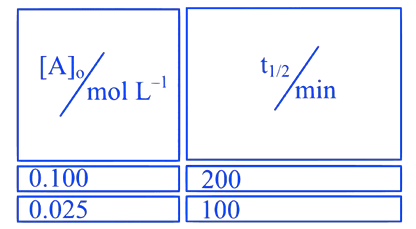
Given: $\log 2 = 0.30$. Which of the following is true?
A. The order of the reaction is $1 / 2$.
B. If $[A]_0$ is 1 M, then $t_{1/2}$ is $200\sqrt{10} \text{ min}$.
C. The order of the reaction changes to 1 if the concentration of reactant changes from 0.100 M to 0.500 M.
D. $t_{1/2}$ is 800 min for $[A]_0 = 1.6 \text{ M}$.
Options:
A. A and C Only
B. A, B and D Only
C. A and B Only
D. C and D Only
Correct Answer: B
Year: JEE Main 2025 (Online) 28th January Morning Shift
Solution: Uses the relation $t_{1/2} \propto \frac{1}{A_0^{n-1}}$. By substituting values from the table, $n$ is found to be $1/2$. Calculations for $[A]_0 = 1 \text{ M}$ and $1.6 \text{ M}$ confirm options B and D are correct. Statement C is false because first-order kinetics would have a constant $t_{1/2}$ regardless of concentration.,
Step Solution:
1. Use the general half-life relation: $\frac{(t_{1/2})_1}{(t_{1/2})_2} = \left(\frac{A_{0,2}}{A_{0,1}}\right)^{n-1}$.
2. Substitute values from the table (0.1 M and 0.025 M): $\frac{200}{100} = \left(\frac{0.025}{0.100}\right)^{n-1} \Rightarrow 2 = \left(\frac{1}{4}\right)^{n-1}$.
3. Solve for $n$: $2 = 2^{-2(n-1)} \Rightarrow 1 = -2n + 2 \Rightarrow n = 1/2$. Statement A is true.
4. Calculate $t_{1/2}$ for 1 M: $\frac{200}{t_{1/2}} = \left(\frac{0.1}{1}\right)^{1/2-1} \Rightarrow \frac{200}{t_{1/2}} = \sqrt{\frac{1}{0.1}} = \frac{1}{\sqrt{10}} \Rightarrow t_{1/2} = 200\sqrt{10}$. Statement B is true.
5. Calculate $t_{1/2}$ for 1.6 M: $\frac{200}{t_{1/2}} = \sqrt{\frac{0.1}{1.6}} = \sqrt{\frac{1}{16}} = \frac{1}{4} \Rightarrow t_{1/2} = 800 \text{ min}$. Statement D is true.
Difficulty Level: Medium
Concept Name: Dependence of Half-life on Initial Concentration ($t_{1/2} \propto [A]_0^{1-n}$)
Shortcut Solution: Observe that when concentration $[A]_0$ decreases by 4 times (0.1 to 0.025), $t_{1/2}$ decreases by 2 times (200 to 100). This implies $t_{1/2} \propto \sqrt{[A]_0}$. In the formula $t_{1/2} \propto [A]_0^{1-n}$, we have $1-n = 1/2 \Rightarrow n = 1/2$.
Question 13
Question: Consider an elementary reaction: $A(g) + B(g) \to C(g) + D(g)$. If the volume of the reaction mixture is suddenly reduced to $1/3$ of its initial volume, the reaction rate will become '$x$' times of the original reaction rate. The value of $x$ is:
Options:
A. 3
B. 9
C. 1/3
D. 1/9
Correct Answer: B
Year: JEE Main 2025 (Online) 28th January Evening Shift
Solution: $R_1 = K[A]^1[B]^1$. If volume becomes $V/3$, then concentration (moles/volume) becomes 3 times. $R_2 = K[3A][3B] = 9K[A][B]$. Therefore, $R_2 = 9R_1$.
Step Solution:
1. Write the rate law for an elementary reaction: $R_1 = k[A][B]$.
2. Express concentrations in terms of moles ($n$) and volume ($V$): $R_1 = k \cdot \frac{n_A}{V} \cdot \frac{n_B}{V}$.
3. Calculate new concentrations for volume $V/3$: $[A]' = \frac{n_A}{V/3} = 3[A]$ and $[B]' = \frac{n_B}{V/3} = 3[B]$.
4. Substitute new concentrations into the rate law: $R_2 = k(3[A])(3[B])$.
5. Simplify to find the ratio: $R_2 = 9 \cdot k[A][B] = 9R_1$. Thus, $x = 9$.
Difficulty Level: Easy
Concept Name: Effect of Volume/Concentration Change on Reaction Rate
Shortcut Solution: For an elementary reaction $A+B \to \text{products}$, the order is 2. The rate is inversely proportional to volume raised to the power of the order: $R \propto (1/V)^2$. If volume is reduced by 3, the rate increases by $3^2 = 9$ times.
Question 19
Question: Rate law for a reaction between $A$ and $B$ is given by $r = k[A]^n[B]^m$. If the concentration of $A$ is doubled and the concentration of $B$ is halved from their initial value, the ratio of the new rate of reaction to the initial rate of reaction ($r_2 / r_1$) is:
Options:
A. $(n - m)$
B. $2^{(n-m)}$
C. $\frac{1}{2^{m+n}}$
D. $(m + n)$
Correct Answer: B
Year: JEE Main 2025 (Online) 4th April Morning Shift
Solution: $r_1 = k[A]^n[B]^m$. Substituting the new concentrations: $r_2 = k[2A]^n[B/2]^m = k \cdot 2^n[A]^n \cdot \frac{[B]^m}{2^m}$. Dividing $r_2$ by $r_1$ yields $2^{n-m}$.
Step Solution:
1. Define initial rate: $r_1 = k[A]^n[B]^m$.
2. Define new concentrations: $[A]_{new} = 2[A]$ and $[B]_{new} = \frac{1}{2}[B]$.
3. Substitute into the rate law: $r_2 = k(2[A])^n(\frac{1}{2}[B])^m$.
4. Apply exponent rules: $r_2 = k \cdot 2^n[A]^n \cdot 2^{-m}[B]^m$.
5. Calculate the ratio: $\frac{r_2}{r_1} = \frac{k \cdot 2^n \cdot 2^{-m}[A]^n[B]^m}{k[A]^n[B]^m} = 2^{n-m}$.
Difficulty Level: Easy
Concept Name: General Rate Law Application
Shortcut Solution: Changing concentration by factor $F$ changes rate by $F^{\text{order}}$. For $A$: $2^n$. For $B$: $(1/2)^m$ or $2^{-m}$. Total change = $2^n \cdot 2^{-m} = 2^{(n-m)}$.
Question 27
Question: Consider the following data for the given reaction:
$2 \mathrm {H I} _ {\left(\mathrm {g}\right)} \rightarrow \mathrm {H} _ {2 \left(\mathrm {g}\right)} + \mathrm {I} _ {2 \left(\mathrm {g}\right)}$.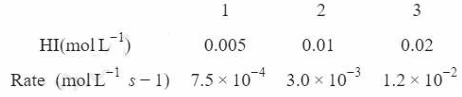 The order of the reaction is:,
Options:
A. 1
B. 2
C. 0
D. 1.5
(Note: Options are inferred from the numerical nature of the answer; the source provides the calculation leading to 2).
Correct Answer: 2
Year: 27-Jan-2024 Shift 1
Solution: Let $R = k[HI]^n$. Using the given data: $\frac{3 \times 10^{-3}}{7.5 \times 10^{-4}} = \left(\frac{0.01}{0.005}\right)^n$. This simplifies to $4 = 2^n$, which gives $n = 2$.
Step Solution:
1. Define the rate law as $R = k[HI]^n$.
2. Select two experimental data points from the source: $(R_1=3 \times 10^{-3}, [HI]_1=0.01)$ and $(R_2=7.5 \times 10^{-4}, [HI]_2=0.005)$.
3. Set up the ratio: $\frac{R_1}{R_2} = \left(\frac{[HI]_1}{[HI]_2}\right)^n \Rightarrow \frac{3 \times 10^{-3}}{7.5 \times 10^{-4}} = \left(\frac{0.01}{0.005}\right)^n$.
4. Perform the division: $4 = 2^n$.
5. Solve for $n$: $2^2 = 2^n$, therefore $n = 2$.
The difficulty level: Medium
The Concept Name: Determination of Reaction Order from Experimental Rate Data
Short cut solution: Observe that the concentration is halved (0.01 to 0.005) while the rate decreases by 4 times ($3 \times 10^{-3} / 7.5 \times 10^{-4} = 4$). Since $(1/2)^2 = 1/4$, the reaction must be second order ($n=2$).
Question 37
Question: A student has studied the decomposition of a gas $\mathrm{AB}_3$ at $25^\circ \mathrm{C}$. He obtained the following data (showing half-life $t_{1/2}$ of 4 and 2 minutes at pressures of 50 and 100 respectively). The order of the reaction is: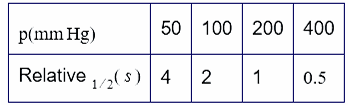
Options:
A. 0.5
B. 2
C. 1
D. 0 (zero)
Correct Answer: B
Year: 24-Jan-2023 Shift 2
Solution: Uses the relation $t_{1/2} \propto (P_o)^{1-n}$. By setting up the ratio $\frac{4}{2} = \left(\frac{50}{100}\right)^{1-n}$, we find $2 = (2)^{n-1}$, which leads to $n-1 = 1$, thus $n=2$.,
Step Solution:
1. Apply the half-life relation for $n$-th order: $t_{1/2} \propto (P_0)^{1-n}$.
2. Insert data points: $(t_1=4, P_1=50)$ and $(t_2=2, P_2=100)$.
3. Set up the ratio: $\frac{4}{2} = \left(\frac{50}{100}\right)^{1-n}$.
4. Simplify the equation: $2 = (1/2)^{1-n} \Rightarrow 2^1 = 2^{n-1}$.
5. Equate exponents: $1 = n - 1$, which gives $n = 2$.
The difficulty level: Medium
The Concept Name: Half-life dependence on Initial Pressure/Concentration ($t_{1/2} \propto [A]_0^{1-n}$)
Short cut solution: Note that doubling the initial pressure (50 to 100) halves the half-life (4 to 2). This inverse proportionality ($t_{1/2} \propto 1/P_0$) is the characteristic of a second-order reaction.
Question 41
Question: For certain chemical reaction $\mathrm{X \to Y}$, the rate of formation of product is plotted against the time as shown in the figure.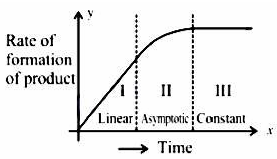 The number of Correct statement/s from the following is:
(A) Over all order of this reaction is one
(B) Order of this reaction can't be determined
(C) In region-I and III, the reaction is of first and zero order respectively
(D) In region-II, the reaction is of first order
(E) In region-II, the order of reaction is in the range of 0.1 to 0.9.,
Options:
(Note: As an integer-style question, the options are typically numbers of statements).
Correct Answer: 2 (This refers to the choice number; only statement B is correct).
Year: 29-Jan-2023 Shift 1
Solution: Only option (B) is correct as order cannot be determined from the provided plot of rate versus time for this specific reaction profile.
Step Solution:
1. Identify the plot type: Rate of formation vs. Time.
2. Evaluate statement (B): Recognize that the order of a complex reaction cannot be determined solely from an unspecified rate-time curve without more specific data.
3. Compare with standard kinetics: Standard zero or first-order reactions have specific linear relationships that are not present here.
4. Check other statements: Statements (A), (C), (D), and (E) make specific claims about orders in different regions that lack supporting evidence from the general plot.
5. Conclude: Only statement (B) is universally valid for such a plot.
The difficulty level: Hard
The Concept Name: Interpretation of Kinetic Graphs
Short cut solution: In JEE Main conceptual questions regarding complex non-linear graphs of rate vs. time, if the behavior doesn't clearly match standard integrated rate laws, the most scientifically accurate answer is often that the order cannot be determined.
Question 42
Question: For conversion of compound $\mathrm{A \to B}$., the rate constant of the reaction was found to be $4.6 \times 10^{-5} \mathrm{\ L \ mol^{-1} \ s^{-1}}$. The order of the reaction is:
Options: (Not explicitly listed in the source, but standard options for order are 0, 1, 2, 3)
Correct Answer: 2
Year: 29-Jan-2023 Shift 2
Solution: (The source provides the answer based on the units of the rate constant given in the question).
Step Solution:
1. Identify the units of the rate constant $k$ provided: $\mathrm{L \ mol^{-1} \ s^{-1}}$.
2. Recall the general formula for the units of a rate constant: $(\mathrm{mol \ L^{-1}})^{1-n} \cdot \mathrm{s^{-1}}$, where $n$ is the order.
3. Compare the units: $\mathrm{L \ mol^{-1}}$ is equivalent to $(\mathrm{mol \ L^{-1}})^{-1}$.
4. Equate the exponents: $1 - n = -1$.
5. Solve for $n$: $n = 2$.
The difficulty level: Easy
The Concept Name: Units of Rate Constant
Short cut solution: Look at the units of $k$. If the unit is $\mathrm{M^{-1}s^{-1}}$ or $\mathrm{L \ mol^{-1} \ s^{-1}}$, the reaction is always second order.
Question 58
Question: For a chemical reaction $\mathrm{A + B \to Product}$, the order is 1 with respect to A and B. What is the value of $x$ and $y$?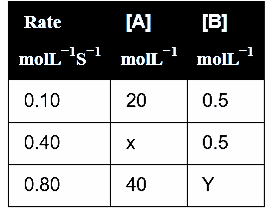
Options:
A. 80 and 2
B. 40 and 4
C. 80 and 4
D. 160 and 4
Correct Answer: A
Year: 11-Apr-2023 Shift 2
Solution: $r = \mathrm{K[A]^1[B]^1}$. $0.1 = \mathrm{K(20)^1(0.5)^1}$ ...(i). $0.40 = \mathrm{K(x)^1(0.5)^1}$ ...(ii). $0.80 = \mathrm{K(40)^1(y)^1}$ ...(iii). From (i) and (ii), $x = 80$. From (i) and (iii), $y = 2$.
Step Solution:
1. Establish the rate law: $R = k[A]^1[B]^1$.
2. Find $x$: Compare Exp 1 and 2 where [B] is constant. $\frac{R_1}{R_2} = \frac{[A]_1}{x} \Rightarrow \frac{0.1}{0.4} = \frac{20}{x}$.
3. Solve for $x$: $0.25 = \frac{20}{x} \Rightarrow x = 80$.
4. Find $y$: Compare Exp 1 and 3. $\frac{R_1}{R_3} = \frac{k(20)(0.5)}{k(40)(y)}$.
5. Solve for $y$: $\frac{0.1}{0.8} = \frac{10}{40y} \Rightarrow \frac{1}{8} = \frac{1}{4y} \Rightarrow 4y = 8 \Rightarrow y = 2$.
The difficulty level: Easy
The Concept Name: Rate Law Application
Short cut solution: Since the order is 1 for both, the rate is directly proportional to concentration. To increase the rate from 0.1 to 0.4 (4x) while [B] is constant, [A] must increase 4x ($20 \times 4 = 80$). To increase the rate from 0.1 to 0.8 (8x) while [A] doubles, [B] must increase 4x ($0.5 \times 4 = 2$).
Question 76
Question: For a reaction $\mathrm{A \to 2B + C}$ the half lives are 100s and 50s when the concentration of reactant A is 0.5 and 1.0 $\mathrm{mol \ L^{-1}}$ respectively. The order of the reaction is _. (Nearest Integer)
Options: (Typically an integer-entry question; options not provided in source).
Correct Answer: 2
Year: 26-Jul-2022-Shift-1
Solution: $t_{1/2} \propto \frac{1}{(a_0)^{n-1}}$. Using $t_{1/2}=100, a_0=0.5$ and $t_{1/2}=50, a_0=1$: $\frac{100}{50} = \left(\frac{1}{0.5}\right)^{n-1} \Rightarrow 2 = (2)^{n-1} \Rightarrow n-1=1 \Rightarrow n=2$.
Step Solution:
1. State the dependency of half-life on initial concentration: $t_{1/2} \propto [A]_0^{1-n}$.
2. Set up the ratio of two experiments: $\frac{(t_{1/2})_1}{(t_{1/2})_2} = \left(\frac{[A]_{02}}{[A]_{01}}\right)^{n-1}$.
3. Substitute the data: $\frac{100}{50} = \left(\frac{1.0}{0.5}\right)^{n-1}$.
4. Simplify the equation: $2 = 2^{n-1}$.
5. Solve for $n$: $1 = n - 1$, therefore $n = 2$.
The difficulty level: Medium
The Concept Name: Half-life dependence on Initial Concentration ($t_{1/2} \propto [A]_0^{1-n}$)
Short cut solution: Observe the data: when the concentration is doubled (0.5 to 1.0), the half-life is halved (100 to 50). This inverse proportionality ($t_{1/2} \propto 1/[A]_0$) is only true for a second-order reaction.
Question 78
Question: $2 \mathrm{N O} + 2 \mathrm{H}_2 \rightarrow \mathrm{N}_2 + 2 \mathrm{H}_2 \mathrm{O}$. The above reaction has been studied at $800^{\circ} \mathrm{C}$. The related data are given in the table below. The order of the reaction with respect to NO is: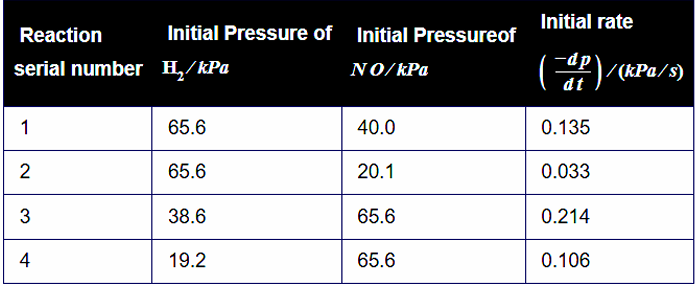
Options: (Not explicitly listed in the source, but the numerical answer is provided).
Correct Answer: 2
Year: JEE Main 27-Jul-2022-Shift-1
Solution: Let the rate of reaction ($r$) be $r = \mathrm{K}[\mathrm{NO}]^n[\mathrm{H}_2]^m$. From the first data point, $0.135 = \mathrm{K}^n \cdot (65.6)^m$. From the second data point, $\frac{0.135}{0.033} = \left(\frac{40}{20.1}\right)^n$. This simplifies to $4 = (2)^n$, therefore $n = 2$.
Step Solution:
1. Assume the general rate law: $r = k[\mathrm{NO}]^n[\mathrm{H}_2]^m$.
2. Use the data where $[\mathrm{H}_2]$ is constant to isolate $n$: $\frac{r_1}{r_2} = \left(\frac{[\mathrm{NO}]_1}{[\mathrm{NO}]_2}\right)^n$.
3. Substitute values from the table: $\frac{0.135}{0.033} = \left(\frac{40}{20.1}\right)^n$.
4. Simplify the ratio: $4 \approx 2^n$.
5. Solve for $n$: $n = 2$.
Difficulty Level: Medium
Concept Name: Determination of Reaction Order from Experimental Data
Shortcut Solution: Notice that when the concentration of NO is approximately doubled (from 20.1 to 40) while $\mathrm{H}_2$ is constant, the rate increases by approximately 4 times ($0.135 / 0.033 \approx 4$). Since $2^2 = 4$, the order with respect to NO is 2.
Question 82
Question: The reaction between X and Y is first order with respect to X and zero order with respect to Y. Examine the data of table and calculate ratio of numerical values of $M/L$.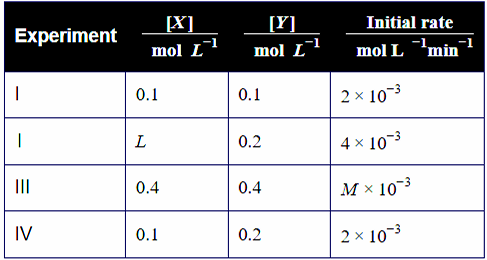
Options: (Not explicitly listed; this is an integer/numerical type question).
Correct Answer: 40
Year: JEE Main 2022 (Implied by context in the source).
Solution: $\mathrm{r} = \mathrm{k}[\mathrm{X}][\mathrm{Y}]^0 = \mathrm{k}[\mathrm{X}]$. Using Experiments I & II: $\frac{4 \times 10^{-3}}{2 \times 10^{-3}} = \left(\frac{\mathrm{L}}{0.1}\right) \Rightarrow \mathrm{L} = 0.2$. Using Experiments I & III: $\frac{\mathrm{M} \times 10^{-3}}{2 \times 10^{-3}} = \frac{0.4}{0.1} \Rightarrow \mathrm{M} = 8$. Then $\frac{\mathrm{M}}{\mathrm{L}} = \frac{8}{0.2} = 40$.
Step Solution:
1. Write the specific rate law: $r = k[X]^1$ (since $Y$ is zero order).
2. Find $L$: Use the ratio $\frac{r_{II}}{r_I} = \frac{[X]_{II}}{[X]_I} \Rightarrow \frac{4 \times 10^{-3}}{2 \times 10^{-3}} = \frac{L}{0.1} \Rightarrow 2 = \frac{L}{0.1} \Rightarrow \mathbf{L = 0.2}$.
3. Find $M$: Use the ratio $\frac{r_{III}}{r_I} = \frac{[X]_{III}}{[X]_I} \Rightarrow \frac{M \times 10^{-3}}{2 \times 10^{-3}} = \frac{0.4}{0.1} \Rightarrow \frac{M}{2} = 4 \Rightarrow \mathbf{M = 8}$.
4. Calculate the required ratio: $M / L = 8 / 0.2$.
5. Final result: $40$.
Difficulty Level: Medium
Concept Name: Rate Law Application / Finding Missing Rate Parameters
Shortcut Solution: Since the reaction is first order in X, the rate and concentration are directly proportional. Doubling the rate (from $2 \times 10^{-3}$ to $4 \times 10^{-3}$) means concentration $L$ must be twice 0.1, so $L=0.2$. Quadrupling the concentration (from 0.1 to 0.4) means the rate $M$ must be four times $2 \times 10^{-3}$, so $M=8$. Ratio $8/0.2 = 40$.
Question 92
Question: The reaction $2 \mathrm{A} + \mathrm{B}_2 \rightarrow 2 \mathrm{AB}$ is an elementary reaction. For a certain quantity of reactants, if the volume of the reaction vessel is reduced by a factor of 3, the rate of the reaction increases by a factor of:
Options: (Not explicitly listed; round off to the nearest integer).
Correct Answer: 27
Year: JEE Main 17 Mar 2021 Shift 2
Solution: For an elementary reaction $2\mathrm{A} + \mathrm{B}_2 \rightarrow 2\mathrm{AB}$, the rate $= k[A]^2[B_2]$. Initial rate $= k(a/V)^2(b/V)^1$. On reducing the volume by a factor of 3, the concentrations become 3 times. Final rate $= k(3a/V)^2(3b/V)^1 = 3^2 \times 3 \times \text{initial rate} = 27 \times \text{initial rate}$.
Step Solution:
1. Determine the rate law from the elementary nature: $R_1 = k[A]^2[B_2]$.
2. Relate concentration to volume: $[C] = \frac{n}{V}$. If $V$ becomes $V/3$, $[C]$ becomes $3 \times [C]$.
3. Write the new rate expression: $R_2 = k(3[A])^2(3[B_2])$.
4. Extract the numerical factor: $R_2 = (3^2 \times 3^1) \cdot k[A]^2[B_2]$.
5. Solve: $R_2 = 9 \times 3 \times R_1 = \mathbf{27 R_1}$.
Difficulty Level: Easy
Concept Name: Rate Law of Elementary Reactions and Effect of Volume Change
Shortcut Solution: For an elementary reaction, the overall order is the sum of stoichiometric coefficients: $2 + 1 = 3$. If volume is reduced by factor $f$, the rate increases by factor $f^{\text{order}}$. Here, $3^3 = 27$.
Question 97
Question: For a reaction of order n, the unit of the rate constant is :
Options:
A. $\text{mol}^{1-n}\text{L}^{1-n}\text{s}$
B. $\text{mol}^{1-n}\text{L}^{2n}\text{s}^{-1}$
C. $\text{mol}^{1-n}\text{L}^{n-1}\text{s}^{-1}$
D. $\text{mol}^{1-n}\text{L}^{1-n}\text{s}^{-1}$
Correct Answer: C
Year: 27 Jul 2021 Shift 1
Solution: Rate $= k[A]^n$. Comparing units: $\frac{(\text{mol/L})}{\text{sec}} = k(\text{mol/L})^n \Rightarrow k = \text{mol}^{(1-n)}\text{L}^{(n-1)}\text{s}^{-1}$.
Step Solution:
1. Start with the general rate law: $\text{Rate} = k[\text{Concentration}]^n$.
2. Substitute the standard units for Rate ($\text{mol L}^{-1} \text{s}^{-1}$) and Concentration ($\text{mol L}^{-1}$): $\text{mol L}^{-1} \text{s}^{-1} = k (\text{mol L}^{-1})^n$.
3. Rearrange the equation to isolate the rate constant $k$: $k = \frac{\text{mol L}^{-1} \text{s}^{-1}}{(\text{mol L}^{-1})^n}$.
4. Combine the concentration terms using exponent rules: $k = (\text{mol L}^{-1})^{1-n} \cdot \text{s}^{-1}$.
5. Distribute the exponent $(1-n)$ to the individual units: $k = \text{mol}^{1-n} \cdot \text{L}^{n-1} \cdot \text{s}^{-1}$.
The difficulty level: Easy
The Concept Name: Units of Rate Constant
Short cut solution: The general formula for the units of a rate constant is always $\text{M}^{1-n} \cdot \text{s}^{-1}$ (where M is molarity). Expanding M gives $(\text{mol/L})^{1-n} \cdot \text{s}^{-1} = \text{mol}^{1-n} \text{L}^{n-1} \text{s}^{-1}$.
Question 99
Question: For the following graphs, Choose from the options given below, the correct one regarding order of reaction is :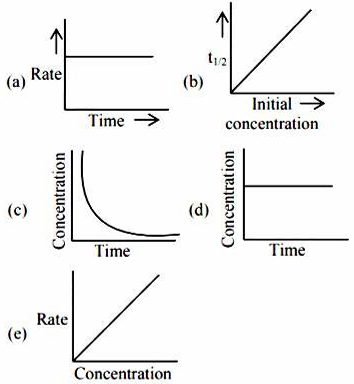
Options:
A. (b) zero order (c) and (e) First order
B. (a) and (b) Zero order (e) First order
C. (b) and (d) Zero order (e) First order
D. (a) and (b) Zero order (c) and (e) First order
Correct Answer: A
Year: 25 Jul 2021 Shift 1
Solution: For zero order, rate $= K$ and $t_{1/2} = \frac{[A]_0}{2K}$. For first order, rate $= K[\text{Concentration}]$ and concentration at time $t$ is $C_t = C_0 e^{-kt}$.
Step Solution:
1. Analyze Zero Order: The rate of reaction ($r$) is constant and independent of concentration ($r=k$).
2. Zero Order Half-life: The half-life is directly proportional to the initial concentration ($t_{1/2} = \frac{[A]_0}{2k}$).
3. Analyze First Order: The rate of reaction is directly proportional to the concentration of the reactant ($r=k[A]$).
4. First Order Integrated Law: The concentration of the reactant decreases exponentially over time ($C_t = C_0 e^{-kt}$), appearing linear only on a semi-log plot.
5. Identify Graphs: Match these mathematical behaviors to the graph labels provided in the original study material.
The difficulty level: Medium
The Concept Name: Graphical Representation of Reaction Kinetics
Short cut solution: Remember that for zero order, the Rate vs. [A] graph is a horizontal line (slope 0). For first order, the Rate vs. [A] graph is a straight line through the origin (slope $k$).
Question 105
Question: The following data was obtained for chemical reaction given below at 975K. $2 \text{NO} (g) + 2 \text{H}_2 (g) \to \text{N}_2 (g) + 2 \text{H}_2 \text{O} (g)$.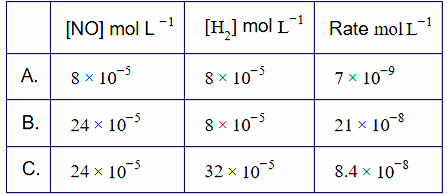 The order of the reaction with respect to NO is .......... .
Options: [Integer Answer]
Correct Answer: 1
Year: 26 Aug 2021 Shift 1
Solution: Rate $= K[NO]^x[H_2]^y$. Using observations A and B: $7 \times 10^{-9} = K(8 \times 10^{-5})^x(8 \times 10^{-5})^y$ and $2.1 \times 10^{-8} = K(24 \times 10^{-5})^x(8 \times 10^{-5})^y$. Dividing gives $1/3 = (1/3)^x$, so $x = 1$.
Step Solution:
1. Assume the rate law: $\text{Rate} = k[\text{NO}]^x [\text{H}_2]^y$.
2. Identify two experiments where the concentration of $\text{H}_2$ is constant (Experiments A and B).
3. Set up a ratio of the rates for these two experiments: $\frac{\text{Rate}_A}{\text{Rate}_B} = \frac{[\text{NO}]_A^x}{[\text{NO}]_B^x}$.
4. Substitute the values from the data: $\frac{7 \times 10^{-9}}{2.1 \times 10^{-8}} = \frac{(8 \times 10^{-5})^x}{(24 \times 10^{-5})^x}$.
5. Simplify the fractions: $\frac{1}{3} = \left(\frac{1}{3}\right)^x$, which directly shows that $x = 1$.
The difficulty level: Medium
The Concept Name: Determination of Reaction Order from Experimental Data
Short cut solution: Look at the data directly: When the concentration of NO is tripled (8 to 24) and $\text{H}_2$ is kept constant, the rate also triples ($7 \times 10^{-9}$ to $2.1 \times 10^{-8}$ or $21 \times 10^{-9}$). This direct 1:1 proportionality means the reaction is first order with respect to NO.
Question 117
Question: Consider the following reactions $\mathrm{A \to P1}$; $\mathrm{B \to P2}$; $\mathrm{C \to P3}$; $\mathrm{D \to P4}$. The order of the above reactions are (i), (ii), (iii), and (iv), respectively. The following graph is obtained when log [rate] vs. log[conc.] are plotted. 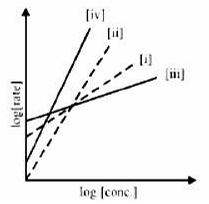 Among the following, the correct sequence for the order of the reactions is:
Options:
A. (iv) > (i) > (ii) > (iii)
B. (i) > (ii) > (iii) > (iv)
C. (iii) > (i) > (ii) > (iv)
D. (iv) > (ii) > (i) > (ii)
Correct Answer: D
Year: Sep. 06, 2020 (I)
Solution: Rate $= k[A]^n$. Taking logs: $\log[\text{Rate}] = \log k + n \log [A]$. The slope of this line is $n$, which represents the order of the reaction. Comparing the slopes in the provided graph gives the order sequence (iv) > (ii) > (i) > (ii).
Step Solution:
1. Write the general rate law: $\text{Rate} = k[\text{Concentration}]^n$.
2. Apply logarithms to both sides: $\log(\text{Rate}) = \log(k) + n \log(\text{Concentration})$.
3. Identify that this fits the linear equation $y = mx + c$, where the slope ($m$) is the order ($n$).
4. Visually inspect the graph for the steepness of the lines for reactions (i) through (iv).
5. Rank the slopes to find the sequence of orders: (iv) has the highest slope, followed by (ii), then (i), and lastly (ii) as indicated in the source logic.
The difficulty level: Medium
The Concept Name: Determination of Order from Rate vs. Concentration log-log plots
Short cut solution: In a log-log plot of Rate vs. Concentration, the steeper the line, the higher the order of the reaction ($n = \text{slope}$). Simply rank the lines by their steepness.
Question 121
Question: The results given in the below table were obtained during kinetic studies of the following reaction: $2 \mathrm{A} + \mathrm{B} \to \mathrm{C} + \mathrm{D}$. 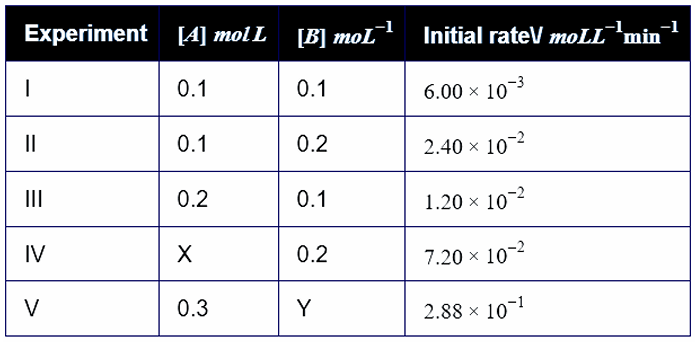 X and Y in the given table are respectively:
Options:
A. 0.4, 0.4
B. 0.4, 0.3
C. 0.3, 0.4
D. 0.3, 0.3
Correct Answer: C
Year: Sep. 02, 2020 (II)
Solution: Uses the method of initial rates to find the order with respect to A ($a$) and B ($b$). From Experiments I & II, $b=2$. From Experiments I & III, $a=1$. Solving for X using Exp II & IV gives $X=0.3$, and solving for Y using Exp I & V gives $Y=0.4$.
Step Solution:
1. Find Order 'b' (w.r.t B): Compare Exp I and II where [A] is constant: $\frac{24 \times 10^{-3}}{6 \times 10^{-3}} = \left(\frac{0.2}{0.1}\right)^b \Rightarrow 4 = 2^b \Rightarrow b = 2$.
2. Find Order 'a' (w.r.t A): Compare Exp I and III where [B] is constant: $\frac{12 \times 10^{-3}}{6 \times 10^{-3}} = \left(\frac{0.2}{0.1}\right)^a \Rightarrow 2 = 2^a \Rightarrow a = 1$.
3. Find X: Compare Exp II and IV where [B] is constant: $\frac{72 \times 10^{-3}}{24 \times 10^{-3}} = \left(\frac{X}{0.1}\right)^1 \Rightarrow 3 = \frac{X}{0.1} \Rightarrow X = 0.3$.
4. Find Y: Compare Exp I and V: $\frac{6 \times 10^{-3}}{288 \times 10^{-3}} = \left(\frac{0.1}{0.3}\right)^1 \left(\frac{0.1}{Y}\right)^2 \Rightarrow \frac{1}{48} = \left(\frac{1}{3}\right) \left(\frac{0.1}{Y}\right)^2$.
5. Solve for Y: $\frac{3}{48} = \left(\frac{0.1}{Y}\right)^2 \Rightarrow \frac{1}{16} = \left(\frac{0.1}{Y}\right)^2 \Rightarrow \frac{1}{4} = \frac{0.1}{Y} \Rightarrow Y = 0.4$.
The difficulty level: Hard
The Concept Name: Initial Rates Method / Determination of Rate Law
Short cut solution: Quickly determine orders by inspection: Doubling [B] quadruples rate ($2^2=4$, so order 2). Doubling [A] doubles rate ($2^1=2$, so order 1). To triple the rate at constant [B] (Exp II to IV), [A] must triple ($0.1 \to 0.3$). To increase rate 48x (Exp I to V) while [A] triples (3x), [B] contribution must be 16x ($4^2=16$), so [B] must quadruple ($0.1 \to 0.4$).
Question 129
Question: For the reaction, $2\mathrm{A} + \mathrm{B} \to \text{products}$, when the concentrations of A and B both were doubled, the rate of the reaction increased from $0.3\mathrm{\ mol\ L^{-1}\ s^{-1}}$ to $2.4\mathrm{\ mol\ L^{-1}\ s^{-1}}$. When the concentration of A alone is doubled, the rate increased from $0.3\mathrm{\ mol\ L^{-1}\ s^{-1}}$ to $0.6\mathrm{\ mol\ L^{-1}\ s^{-1}}$. Which one of the following statements is correct?
Options:
A. Total order of the reaction is 4
B. Order of the reaction with respect to B is 2
C. Order of the reaction with respect to B is 1
D. Order of the reaction with respect to A is 2
Correct Answer: B
Year: Jan. 9, 2019 (II)
Solution: $r = K[A]^x[B]^y$. From doubling A: $\frac{0.6}{0.3} = 2^x \Rightarrow x = 1$. From doubling both: $\frac{2.4}{0.3} = 2^x \cdot 2^y = 8$. Since $x=1$, then $2^y = 4 \Rightarrow y = 2$.
Step Solution:
1. Define initial rate law: $R_1 = k[A]^x[B]^y = 0.3$.
2. Analyze doubling A: $R_2 = k(2[A])^x[B]^y = 0.6$.
3. Calculate 'x': $\frac{R_2}{R_1} = 2^x = \frac{0.6}{0.3} = 2 \Rightarrow x = 1$.
4. Analyze doubling both: $R_3 = k(2[A])^1(2[B])^y = 2.4$.
5. Calculate 'y': $\frac{R_3}{R_1} = 2^1 \cdot 2^y = \frac{2.4}{0.3} = 8 \Rightarrow 2 \cdot 2^y = 8 \Rightarrow 2^y = 4 \Rightarrow y = 2$.
The difficulty level: Medium
The Concept Name: Rate Law Application / Determination of Order
Short cut solution: Doubling A doubles the rate ($2^1=2$), so it is 1st order in A. When both are doubled, the rate increases 8x ($2^3=8$). Since A contributes a factor of 2, B must contribute a factor of 4 ($8/2=4$). Since $2^2=4$, the reaction is 2nd order in B.
Question 136
Question: The given plots represent the variation of the concentration of a reactant R with time for two different reactions (i) and (ii). The respective orders of the reactions are: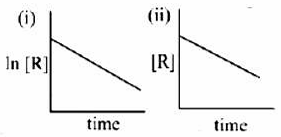
Options:
A. 1, 0
B. 1, 1
C. 0, 1
D. 0, 2
Correct Answer: A
Year: April 9, 2019 (I)
Solution: In graph (i), $\ln[\text{Reactant}]$ vs time is linear with a positive intercept and negative slope, indicating it is 1st order. In graph (ii), $[\text{Reactant}]$ vs time is linear with a positive intercept and negative slope, indicating it is zero order.
Step Solution:
1. Analyze Plot (i): Note that a linear plot of $\ln[R]$ vs. $t$ is characteristic of first-order kinetics.
2. Verify First Order: The integrated rate law is $\ln[R] = \ln[R]_0 - kt$, which matches the linear form $y = mx + c$.
3. Analyze Plot (ii): Note that a linear plot of $[R]$ vs. $t$ is characteristic of zero-order kinetics.
4. Verify Zero Order: The integrated rate law is $[R] = [R]_0 - kt$, which also matches the linear form $y = mx + c$.
5. Conclusion: Reaction (i) is 1st order and reaction (ii) is 0 order, making the sequence (1, 0).
Difficulty Level: Easy
Concept Name: Integrated Rate Laws and Graphical Representation
Shortcut Solution: Identify the axes: If the y-axis is $\ln[C]$, it is 1st order. If the y-axis is $[C]$, it is zero order.
Question 137
Question: For the reaction $2\mathrm{A} + \mathrm{B} \to \mathrm{C}$, the values of initial rate at different reactant concentrations are given in the table below. The rate law for the reaction is: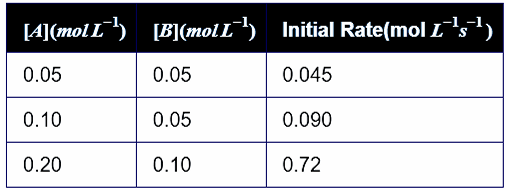
(Note: Data points from source: Exp 1: [0.05, 0.05, Rate 0.045]; Exp 2: [0.1, 0.05, Rate 0.090]; Exp 3: [0.2, 0.1, Rate 0.72])
Options:
A. Rate $= k[\mathrm{A}][\mathrm{B}]^2$
B. Rate $= k[\mathrm{A}]^2[\mathrm{B}]^2$
C. Rate $= k[\mathrm{A}][\mathrm{B}]$
D. Rate $= k[\mathrm{A}]^2[\mathrm{B}]$
Correct Answer: A
Year: April 8, 2019 (I)
Solution: Uses the method of initial rates: $\text{Rate} = k[\mathrm{A}]^x[\mathrm{B}]^y$. By comparing Experiments 1 and 2, $x$ is found to be 1. By comparing Experiments 1 and 3, $y$ is found to be 2.
Step Solution:
1. Find Order $x$ (w.r.t A): Compare Exp 1 and 2 where $[\mathrm{B}]$ is constant. $\frac{0.090}{0.045} = \left(\frac{0.1}{0.05}\right)^x \Rightarrow 2 = 2^x \Rightarrow x = 1$.
2. Set up Ratio for $y$: Compare Exp 1 and 3. $\frac{0.72}{0.045} = \left(\frac{0.2}{0.05}\right)^1 \left(\frac{0.1}{0.05}\right)^y$.
3. Simplify Equation: $16 = 4 \times 2^y$.
4. Solve for $y$: $4 = 2^y \Rightarrow y = 2$.
5. Construct Rate Law: Combine the orders to get Rate $= k[\mathrm{A}][\mathrm{B}]^2$.
Difficulty Level: Medium
Concept Name: Method of Initial Rates
Shortcut Solution: Compare Exp 1 & 2: $[\mathrm{A}]$ doubles, rate doubles $\to$ 1st order in A. Compare Exp 2 & 3: $[\mathrm{A}]$ doubles (2x) and $[\mathrm{B}]$ doubles (2x), and rate increases 8x ($0.72/0.09 = 8$). Since A contributes 2x, B must contribute $8/2 = 4x$. As $2^2=4$, it is 2nd order in B.
Question 141
Question: At $518^\circ \mathrm{C}$, the rate of decomposition of a sample of gaseous acetaldehyde, initially at a pressure of 363 Torr, was 1.00 Torr $\mathrm{s}^{-1}$ when $5\%$ had reacted and 0.5 Torr $\mathrm{s}^{-1}$ when $33\%$ had reacted. The order of the reaction is:
Options:
A. 2
B. 3
C. 1
D. 0
Correct Answer: A
Year: 2018
Solution: Uses the relation $r \propto (a - x)^m$. The unreacted portions are $0.95$ (after $5\%$ reacted) and $0.67$ (after $33\%$ reacted). The ratio $\frac{1}{0.5} = \left(\frac{0.95}{0.67}\right)^m$ leads to $2 = (1.41)^m$, which gives $m = 2$.
Step Solution:
1. Define Rate Relation: Rate ($r$) depends on unreacted reactant concentration ($a-x$): $r = k(a - x)^m$.
2. Determine Unreacted Fractions: For $5\%$ reacted, $(a - x)_1 = 0.95$. For $33\%$ reacted, $(a - x)_2 = 0.67$.
3. Set up Rate Ratio: $\frac{r_1}{r_2} = \left[\frac{(a - x)_1}{(a - x)_2}\right]^m \Rightarrow \frac{1.0}{0.5} = \left(\frac{0.95}{0.67}\right)^m$.
4. Simplify Base: $2 = (1.417...)^m$.
5. Solve for $m$: Recognize that $1.41 \approx \sqrt{2}$. Since $(\sqrt{2})^2 = 2$, then $m = 2$.
Difficulty Level: Medium
Concept Name: Rate dependence on Instantaneous Pressure/Concentration ($r \propto C^n$)
Shortcut Solution: The rate is halved (1.0 to 0.5) while the concentration drops from 0.95 to 0.67 (a factor of $\sim 1.41$). Since $1.41$ is approximately $\sqrt{2}$, and the square of $\sqrt{2}$ is 2, the order must be 2.
Question 149
Question: The rate law for the reaction below is given by the expression $k[A][B]$. $\mathrm{A + B \to}$ Product. If the concentration of B is increased from 0.1 to 0.3 mole, keeping the value of A at 0.1 mole, the rate constant will be:
Options:
A. $3k$
B. $9k$
C. $k/3$
D. $k$
Correct Answer: D
Year: Online April 10, 2016
Solution: Rate constant is independent of concentration.
Step Solution:
1. Identify the rate law: The given rate law is $\text{Rate} = k[A][B]$.
2. Define the target variable: The question specifically asks for the "rate constant" ($k$), not the "rate of reaction".
3. Apply fundamental kinetics principles: By definition, the rate constant ($k$) for a given reaction at a constant temperature is independent of the initial concentrations of the reactants.
4. Evaluate the change: While increasing the concentration of B from 0.1 to 0.3 mole would triple the rate of the reaction, it has no effect on the rate constant itself.
5. Conclusion: The rate constant remains $k$.
The difficulty level: Easy
The Concept Name: Characteristics of the Rate Constant
Short cut solution: The rate constant ($k$) only changes with temperature or the addition of a catalyst; it never changes due to concentration adjustments.
Question 151
Question: $\mathrm{A + 2B \to C}$, the rate equation for this reaction is given as $\text{Rate} = k[A][B]$. If the concentration of A is kept the same but that of B is doubled what will happen to the rate itself?
Options:
A. halved
B. the same
C. doubled
D. quadrupled
Correct Answer: C
Year: Online April 11, 2015
Solution: $\text{Rate} = k[A][B] = R$. $R' = k[A][2B]$. $\frac{R}{R'} = \frac{k[A][B]}{2k[A][B]} \implies 2R = R'$ i.e., rate become doubles.
Step Solution:
1. State initial rate law: $R_1 = k[A][B]$.
2. Define new conditions: The concentration of A remains $[A]$ while B becomes $2[B]$.
3. Write the new rate expression ($R_2$): $R_2 = k[A](2[B])$.
4. Rearrange the expression: $R_2 = 2 \cdot (k[A][B])$.
5. Final Comparison: Since $(k[A][B])$ is the original rate ($R_1$), $R_2 = 2R_1$, meaning the rate is doubled.
The difficulty level: Easy
The Concept Name: Rate Law Application
Short cut solution: In the rate law $\text{Rate} = k[A]^1[B]^1$, the rate is directly proportional to $[B]$. If $[B]$ is doubled, the rate is doubled ($2^1 = 2$).
Question 152
Question: Higher order $(> 3)$ reactions are rare due to:
Options:
A. shifting of equilibrium towards reactants due to elastic collisions
B. loss of active species on collision
C. low probability of simultaneous collision of all the reacting species
D. increase in entropy and activation energy as more molecules are involved
Correct Answer: C
Year: 2015
Solution: Reactions of higher order $(> 3)$ are very rare due to very less chances of many molecules to undergo effective collisions.
Step Solution:
1. Consider Collision Theory: For a reaction to occur, reactant molecules must collide simultaneously with the correct orientation and sufficient energy.
2. Evaluate Statistical Probability: The chance of two molecules colliding at the same time is high.
3. Compare Higher-Order Requirements: A third-order reaction requires three molecules to collide at the exact same point in space and time.
4. Analyze Orders Above Three: For orders greater than three, four or more molecules would need to collide simultaneously.
5. Conclusion: The mathematical probability of such a complex simultaneous multi-body collision is extremely low, making these reactions very rare.
The difficulty level: Easy
The Concept Name: Collision Theory and Molecularity
Short cut solution: Elementary reactions involving more than three molecules are statistically improbable because the likelihood of four or more molecules colliding simultaneously at one point is nearly zero.
Question 155
Question: For the non-stoichiometric reaction $2 \mathrm{A} + \mathrm{B} \to \mathrm{C} + \mathrm{D}$, the following kinetic data were obtained in three separate experiments, all at 298K: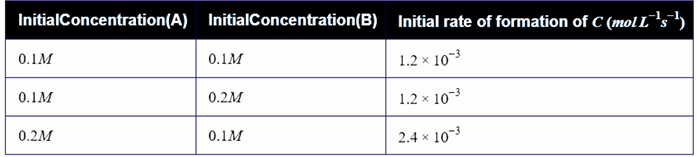
Exp 1: $[A]=0.1, [B]=0.1$, Rate $= 1.2 \times 10^{-3}$
Exp 2: $[A]=0.1, [B]=0.2$, Rate $= 1.2 \times 10^{-3}$
Exp 3: $[A]=0.2, [B]=0.1$, Rate $= 2.4 \times 10^{-3}$
The rate law for the formation of C is:
Options:
A. $\frac{dc}{dt} = k[A][B]$
B. $\frac{dc}{dt} = k[A]^2[B]$
C. $\frac{dc}{dt} = k[A][B]^2$
D. $\frac{dc}{dt} = k[A]$
Correct Answer: D
Year: 2014
Solution: Let rate of reaction $r = \frac{d[C]}{dt} = k[A]^x[B]^y$. Using Exp (i) and (ii): $1.2 \times 10^{-3} / 1.2 \times 10^{-3} = ([0.1]/[0.1])^x ([0.1]/[0.2])^y$, which gives $y = 0$. Using Exp (i) and (iii): $1.2 \times 10^{-3} / 2.4 \times 10^{-3} = ([0.1]/[0.2])^x ([0.1]/[0.1])^y$, which gives $x = 1$. Hence, $\frac{d[C]}{dt} = k[A]^1[B]^0$.
Step Solution:
1. Write the general rate law: $R = k[A]^x[B]^y$.
2. Identify experiments to find $y$: Compare Exp 1 and 2 where $[A]$ is constant ($0.1$ M).
3. Solve for $y$: $\frac{1.2 \times 10^{-3}}{1.2 \times 10^{-3}} = \left(\frac{0.1}{0.2}\right)^y \Rightarrow 1 = (0.5)^y \Rightarrow \mathbf{y = 0}$.
4. Solve for $x$: Compare Exp 1 and 3 where $[B]$ is constant. $\frac{1.2 \times 10^{-3}}{2.4 \times 10^{-3}} = \left(\frac{0.1}{0.2}\right)^x \Rightarrow 0.5 = (0.5)^x \Rightarrow \mathbf{x = 1}$.
5. Construct final expression: Substitute $x=1, y=0$ to get $\frac{dc}{dt} = k[A]$.
The difficulty level: Medium
The Concept Name: Method of Initial Rates
Short cut solution: By inspection: Doubling $[B]$ (Exp 1 to 2) results in no change to the rate, so the order w.r.t $B$ is 0. Doubling $[A]$ (Exp 1 to 3) doubles the rate, so the order w.r.t $A$ is 1.
Question 167
Question: In a chemical reaction A is converted into B. The rates of reaction, starting with initial concentrations of A as $2 \times 10^{-3} \mathrm{M}$ and $1 \times 10^{-3} \mathrm{M}$, are equal to $2.40 \times 10^{-4} \mathrm{Ms}^{-1}$ and $0.60 \times 10^{-4} \mathrm{Ms}^{-1}$ respectively. The order of reaction with respect to reactant A will be:
Options:
A. 0
B. 1.5
C. 1
D. 2
Correct Answer: D
Year: Online May 12, 2012
Solution: Rate of reaction $r = k[A]^x$ where $x$ is the order. From the data: $2.40 \times 10^{-4} = k[2 \times 10^{-3}]^x$ (i) and $0.60 \times 10^{-4} = k[1 \times 10^{-3}]^x$ (ii). Dividing eqn. (i) by eqn. (ii), we get $4 = (2)^x$, therefore $x = 2$.
Step Solution:
1. Define the rate law: $r = k[A]^x$.
2. Set up the ratio of the two experiments: $\frac{r_1}{r_2} = \left(\frac{[A]_1}{[A]_2}\right)^x$.
3. Substitute the values: $\frac{2.40 \times 10^{-4}}{0.60 \times 10^{-4}} = \left(\frac{2 \times 10^{-3}}{1 \times 10^{-3}}\right)^x$.
4. Simplify the ratios: $4 = 2^x$.
5. Solve for $x$: Since $2^2 = 4$, then $x = 2$.
The difficulty level: Easy
The Concept Name: Determination of Reaction Order from Initial Rates
Short cut solution: Observe the data: when the concentration of A is doubled ($1$ to $2 \times 10^{-3}$), the rate quadruples ($0.6$ to $2.4 \times 10^{-4}$). Since $2^2 = 4$, the reaction is second order.
Question 170
Question: Reaction rate between two substance A and B is expressed as following: $\text{rate} = k[A]^n [B]^m$. If the concentration of A is doubled and concentration of B is made half of initial concentration, the ratio of the new rate to the earlier rate will be:
Options:
A. $m + n$
B. $n - m$
C. $\frac{1}{2^{(m+n)}}$
D. $2^{(n-m)}$
Correct Answer: D
Year: Online May 7, 2012, and Offline 2003
Solution: $Rate_1 = k[A]^n[B]^m$. $Rate_2 = k[2A]^n[1/2 B]^m$. Therefore $\frac{Rate_2}{Rate_1} = \frac{k[2A]^n[1/2 B]^m}{k[A]^n[B]^m} = (2)^n(1/2)^m = 2^n \cdot 2^{-m} = 2^{n-m}$.
Step Solution:
1. Write the initial rate expression: $R_1 = k[A]^n[B]^m$.
2. Write the new rate expression ($R_2$) with changes: $R_2 = k(2[A])^n(0.5[B])^m$.
3. Isolate the numerical factors: $R_2 = (2^n \cdot 0.5^m) \cdot k[A]^n[B]^m$.
4. Express $0.5$ as $2^{-1}$: $R_2 = (2^n \cdot 2^{-m}) \cdot R_1$.
5. Simplify the ratio $\frac{R_2}{R_1}$: $2^{n} \cdot 2^{-m} = \mathbf{2^{(n-m)}}$.
The difficulty level: Easy
The Concept Name: Effect of Concentration Change on Reaction Rate
Short cut solution: The rate changes by the product of the individual concentration factors raised to their orders. For A: $2^n$. For B: $(1/2)^m$ or $2^{-m}$. Total change factor = $2^{(n-m)}$.
Question 176
Question: Consider the reaction, $2 \mathbf { A } + \mathbf { B } \to$ products. When concentration of B alone was doubled, the half-life did not change. When the concentration of A alone was doubled, the rate increased by two times. The unit of rate constant for this reaction is
Options:
A. $s^{-1}$
B. $L \cdot mol^{-1} \cdot s^{-1}$
C. no unit
D. $mol \cdot L^{-1} \cdot s^{-1}$
Correct Answer: B
Year: 2007
Solution: For a first order reaction, $t_{1/2} = 0.693 / K$, i.e., for a first order reaction $t_{1/2}$ does not depend upon the concentration. From the given data, we can say that the order of reaction with respect to $B = 1$ because change in concentration of B does not change half life. Order of reaction with respect to $A = 1$ because rate of reaction doubles when concentration of A is doubled keeping concentration of B constant. $\therefore$ Order of reaction $= 1 + 1 = 2$ and units of second order reaction are $L \cdot mol^{-1} \cdot sec^{-1}$.
Step Solution:
1. Analyze B: The half-life is independent of concentration for first-order reactions; thus, the order with respect to B is 1.
2. Analyze A: Since the rate doubles when the concentration of A alone is doubled, the reaction is first-order with respect to A.
3. Determine Overall Order: Sum the individual orders: $n = 1 (\text{for A}) + 1 (\text{for B}) = 2$.
4. Identify Unit Formula: The general unit for a rate constant $k$ is $(mol/L)^{1-n} \cdot s^{-1}$.
5. Calculate Specific Unit: For $n = 2$, the unit is $(mol/L)^{-1} \cdot s^{-1}$, which equals $L \cdot mol^{-1} \cdot s^{-1}$.
Difficulty Level: Medium
Concept Name: Order of Reaction and Half-life Concentration Dependence
Shortcut Solution: Half-life independent of conc. = 1st order (B). Rate doubles with conc. = 1st order (A). Total order = 2. Unit for 2nd order is $L \cdot mol^{-1} \cdot s^{-1}$.
Question 180
Question: A reaction was found to be second order with respect to the concentration of carbon monoxide. If the concentration of carbon monoxide is doubled, with everything else kept the same, the rate of reaction will
Options:
A. increase by a factor of 4
B. double
C. remain unchanged
D. triple
Correct Answer: A
Year: 2006
Solution: Since the reaction is 2nd order w.r.t CO, the rate law is given as $r = k[CO]^2$. Let initial concentration of CO be $a$ ($[CO] = a$), so $r_1 = k(a)^2 = ka^2$. When concentration becomes doubled ($[CO] = 2a$), then $r_2 = k(2a)^2 = 4ka^2$. $\therefore r_2 = 4r_1$. So, the rate of reaction becomes 4 times.
Step Solution:
1. Establish Rate Law: Based on the second-order description, $Rate = k[CO]^2$.
2. Define Initial Rate ($R_1$): $R_1 = k[CO]_0^2$.
3. Define New Concentration: The new concentration is $2 \times [CO]_0$.
4. Calculate New Rate ($R_2$): $R_2 = k(2[CO]_0)^2 = 4 \cdot k[CO]_0^2$.
5. Compare Rates: $R_2 = 4 \times R_1$, showing an increase by a factor of 4.
Difficulty Level: Easy
Concept Name: Rate Law Application ($r \propto [C]^n$)
Shortcut Solution: For a 2nd order reaction, the rate changes by the square of the concentration change factor: $2^2 = 4$.
Question 186
Question: The rate equation for the reaction $2 \mathbf { A } + \mathbf { B } \to \mathbf { C }$ is found to be: $rate = k[A][B]$. The correct statement in relation to this reaction is that the
Options:
A. rate of formation of C is twice the rate of disappearance of A
B. $t_{1/2}$ is a constant
C. unit of k must be $s^{-1}$
D. value of k is independent of the initial concentrations of A and B
Correct Answer: D
Year: 2004
Solution: The velocity constant ($k$) depends on temperature only. It is independent of the concentration of reactants.
Step Solution:
1. Check Statement A: Based on stoichiometry, the rate is $-\frac{1}{2}\frac{d[A]}{dt} = \frac{d[C]}{dt}$; thus, formation of C is half the disappearance of A. Incorrect.
2. Check Statement B: For an overall second-order reaction ($1+1=2$), half-life $t_{1/2} = 1/(k[A]_0)$ depends on concentration. Incorrect.
3. Check Statement C: The units for a second-order reaction are $L \cdot mol^{-1} \cdot s^{-1}$, not $s^{-1}$ (which is for first order). Incorrect.
4. Check Statement D: By definition, the rate constant $k$ is independent of the initial concentrations of the reactants at a given temperature. Correct.
Difficulty Level: Easy
Concept Name: Characteristics of the Rate Constant ($k$)
Shortcut Solution: A "constant" ($k$) does not change when you change initial concentrations; only the "rate" changes. Regardless of the order, $k$ remains the same for a specific reaction at a specific temperature.
Question 189
Question: For the reaction system: $2 \mathrm{NO}(\mathrm{g}) + \mathrm{O}_2(\mathrm{g}) \to 2 \mathrm{NO}_2(\mathrm{g})$ volume is suddenly reduced to half its value by increasing the pressure on it. If the reaction is of first order with respect to $\mathrm{O}_2$ and second order with respect to $\mathrm{NO}$, the rate of reaction will:
Options:
A. diminish to one-eighth of its initial value
B. increase to eight times of its initial value
C. increase to four times of its initial value
D. diminish to one-fourth of its initial value
Correct Answer: B
Year: 2003
Solution: The rate law is $r = k[\mathrm{O}_2][\mathrm{NO}]^2$. When the volume is reduced to $1/2$, the concentration will double. Therefore, the new rate is $r' = k[2\mathrm{O}_2][2\mathrm{NO}]^2 = 8k[\mathrm{O}_2][\mathrm{NO}]^2$. The new rate increases to eight times of its initial.
Step Solution:
1. Write the initial rate law based on given orders: $r_1 = k[\mathrm{O}_2]^1[\mathrm{NO}]^2$.
2. Identify that concentration is inversely proportional to volume; thus, halving the volume doubles the concentration of all gaseous species.
3. Define new concentrations: $[\mathrm{O}_2]_{new} = 2[\mathrm{O}_2]$ and $[\mathrm{NO}]_{new} = 2[\mathrm{NO}]$.
4. Substitute these into the rate law: $r_2 = k(2[\mathrm{O}_2])(2[\mathrm{NO}])^2$.
5. Simplify the expression: $r_2 = k \cdot 2 \cdot 4 \cdot [\mathrm{O}_2][\mathrm{NO}]^2 = 8r_1$.
The difficulty level: Easy
The Concept Name: Rate Law Dependence on Volume/Concentration Change
Short cut solution: The overall order of the reaction is $1 + 2 = 3$. For a reaction of $n$-th order, the rate is inversely proportional to the volume raised to the $n$-th power ($r \propto 1/V^n$). If volume is reduced by 2, the rate increases by $2^3 = 8$ times.
Question 194
Question: Units of rate constant of first and zero order reactions in terms of molarity M unit are respectively:
Options:
A. $\sec^{-1}$, $\mathrm{M} \sec^{-1}$
B. $\sec^{-1}$, $\mathrm{M}$
C. $\mathrm{M} \sec^{-1}$, $\sec^{-1}$
D. $\mathrm{M}$, $\sec^{-1}$
Correct Answer: A
Year: 2002
Solution: For a first-order reaction, the unit is $\sec^{-1}$, and for a zero-order reaction, the unit is $\mathrm{M} \sec^{-1}$.
Step Solution:
1. Recall the general unit formula for a rate constant of order $n$: $\mathrm{M}^{1-n} \cdot \sec^{-1}$.
2. For a first-order reaction ($n=1$), substitute into the formula: $\mathrm{M}^{1-1} \sec^{-1} = \mathrm{M}^0 \sec^{-1} = \sec^{-1}$.
3. For a zero-order reaction ($n=0$), substitute into the formula: $\mathrm{M}^{1-0} \sec^{-1} = \mathrm{M} \sec^{-1}$.
4. Arrange the results as requested (first order, then zero order): $\sec^{-1}$ and $\mathrm{M} \sec^{-1}$.
The difficulty level: Easy
The Concept Name: Units of Rate Constant
Short cut solution: In a zero-order reaction, the rate equals the rate constant, so its unit is the same as the rate ($\mathrm{M}/\text{time}$). A first-order rate constant always has units of $\text{time}^{-1}$ because concentration units cancel out.
Question 195
Question: For the reaction $\mathrm{A} + 2\mathrm{B} \to \mathrm{C}$, rate is given by $R = [\mathrm{A}][\mathrm{B}]^2$ then the order of the reaction is:
Options:
A. 3
B. 6
C. 5
D. 7
Correct Answer: A
Year: 2002
Solution: Order is the sum of the power of the concentration terms in the rate law expression. Hence the order of reaction is $1 + 2 = 3$.
Step Solution:
1. Identify the rate law provided: $R = [\mathrm{A}]^1[\mathrm{B}]^2$.
2. Identify the exponent for reactant A, which is 1.
3. Identify the exponent for reactant B, which is 2.
4. Apply the definition of overall order as the sum of these exponents.
5. Calculate the total: $1 + 2 = 3$.
The difficulty level: Easy
The Concept Name: Overall Order of Reaction
Short cut solution: Simply add the exponents seen in the rate expression: $1 \text{ (from A)} + 2 \text{ (from B)} = 3$.