Geometrical Optics

83 Questions Start NEET Test
2026 Q1 NEET MCQ
08 May 2026

A ray of monochromatic light is passing through an equilateral prism $(A B C)$ as shown in the figure. The refracted ray $(Q R)$ is parallel to its base $(B C)$ and the angle of incidence $(i)$ is $50^{\circ}$. Then the angle of deviation $(\delta)$ is:

NEET 2026 Physics - Geometrical Optics Question 4 English

A.

$45^{\circ}$

B.

$35^{\circ}$

C.

$40^{\circ}$

D.

$55^{\circ}$

2026 Q2 NEET MCQ
08 May 2026

In a concave lens, a ray of light emanating from the object parallel to the principal axis of the lens after refraction:

A.

passes through $2 F$, which is the radius of curvature of the lens.

B.

appears to diverge from the first principal focus.

C.

emerges parallel to the principal axis.

D.

passes through the second principal focus.

2026 Q3 NEET MCQ
28 Jun 2026

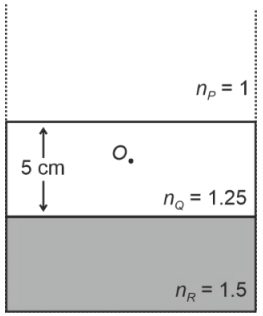
Consider three media $P, Q$ and $R$ with refractive indices $1,1.25$, and 1.5 respectively. The medium $Q$ having a thickness of 5 cm is placed between extended media $P$ and $R$ as shown in the figure. An object $O$ is placed at the centre of medium $Q$. If viewed from medium $P$ near the normal direction, the apparent depth of $O$ is $h_1$. For similar observation from medium $R$, the apparent depth is $h_2$. The value of $\left|h_1-h_2\right|$, in cm , is: RE-NEET 2026 Physics - Geometrical Optics Question 3 English
A.

3

B.

0

C.

1

D.

2

2026 Q4 NEET MCQ
28 Jun 2026

The lens combination as shown in the figure, consists of two lenses, $L_1$ and $L_2$, of the focal lengths +10 cm and -10 cm , respectively. The position of the image formed is:

RE-NEET 2026 Physics - Geometrical Optics Question 1 English
A.

60 cm to the right of the concave lens

B.

20 cm to the left of the concave lens

C.

60 cm to the left of the concave lens

D.

30 cm to the right of the concave lens

2026 Q5 NEET MCQ
28 Jun 2026

Which of the following measurements require 'index correction'?

A.

Measurement of speed of sound using resonance tube

B.

Measurement of resistance of a wire using meter bridge

C.

Measurement of gravitational acceleration using simple pendulum

D.

Measurement of focal length of lenses using optical bench

2025 Q6 NEET MCQ
10 Mar 2026

A microscope has an objective of focal length 2 cm , eyepiece of focal length 4 cm and the tube length of 40 cm . If the distance of distinct vision of eye is 25 cm , the magnification in the microscope is

A.
150
B.
250
C.
100
D.
125
2025 Q7 NEET MCQ
10 Mar 2026

In a certain camera, a combination of four similar thin convex lenses are arranged axially in contact. Then the power of the combination and the total magnification in comparison to the power ( $p$ ) and magnification ( $m$ ) for each lens will be, respectively

A.
$4 p$ and $m^4$
B.
$p^4$ and $m^4$
C.
$4 p$ and $4 m$
D.
$p^4$ and $4 m$
2024 Q8 NEET MCQ
10 Mar 2026

Given below are two statements:

Statement I : Image formation needs regular reflection and/or refraction.

Statement II : The variety in colour of objects we see around us is due to the constituent colours of the light incident on them.

In the light of the above statements, choose the most appropriate answer from the options given below :

A.
Statement I is correct but statement II is incorrect
B.
Statement I is incorrect but Statement II is correct
C.
Both Statement I and Statement II are correct
D.
Both Statement I and Statement II are incorrect
2024 Q9 NEET MCQ
10 Mar 2026

A light ray enters through a right angled prism at point $P$ with the angle of incidence $30^{\circ}$ as shown in figure. It travels through the prism parallel to its base $B C$ and emerges along the face $A C$. The refractive index of the prism is:

NEET 2024 Physics - Geometrical Optics Question 9 English

A.
$ \frac{\sqrt{5}}{4} $
B.
$ \frac{\sqrt{5}}{2} $
C.
$ \frac{\sqrt{3}}{4} $
D.
$ \frac{\sqrt{3}}{2} $
2024 Q10 NEET MCQ
10 Mar 2026

A small telescope has an objective of focal length $140 \mathrm{~cm}$ and an eye piece of focal length $5.0 \mathrm{~cm}$. The magnifying power of telescope for viewing a distant object is:

A.
34
B.
28
C.
17
D.
32
2023 Q11 NEET MCQ
10 Mar 2026

A lens is made up of 3 different transparent media as shown in figure. A point object O is placed on its axis beyond $2f$. How many real images will be obtained on the other side?

NEET 2023 Manipur Physics - Geometrical Optics Question 14 English

A.
2
B.
1
C.
No image will be formed
D.
3
2023 Q12 NEET MCQ
10 Mar 2026

$\epsilon_0$ and $\mu_0$ are the electric permittivity and magnetic permeability of free space respectively. If the corresponding quantities of a medium are $2 ~\epsilon_0$ and $1.5 ~\mu_0$ respectively, the refractive index of the medium will nearly be :

A.
$\sqrt{2}$
B.
$\sqrt{3}$
C.
3
D.
2
2023 Q13 NEET MCQ
10 Mar 2026

A horizontal ray of light is incident on the right angled prism with prism angle $6^{\circ}$. If the refractive index of the material of the prism is 1.5 , then the angle of emergence will be:

NEET 2023 Manipur Physics - Geometrical Optics Question 13 English

A.
$9^{\circ}$
B.
$10^{\circ}$
C.
$4^{\circ}$
D.
$6^{\circ}$
2023 Q14 NEET MCQ
10 Mar 2026

An object is mounted on a wall. Its image of equal size is to be obtained on a parallel wall with the help of a convex lens placed between these walls. The lens is kept at distance x in front of the second wall. The required focal length of the lens will be :

A.
less than $\frac{x}{4}$
B.
more than $\frac{x}{4}$ but less than $\frac{x}{2}$
C.
$\frac{x}{2}$
D.
$\frac{x}{4}$
2023 Q15 NEET MCQ
10 Mar 2026

Light travels a distance $\mathrm{x}$ in time $t_{1}$ in air and $10 \mathrm{x}$ in time $t_{2}$ in another denser medium. What is the critical angle for this medium?

A.
$\sin ^{-1}\left(\frac{10 \mathrm{t}_{2}}{\mathrm{t}_{1}}\right)$
B.
$\sin ^{-1}\left(\frac{t_{1}}{10 t_{2}}\right)$
C.
$\sin ^{-1}\left(\frac{10 t_{1}}{t_{2}}\right)$
D.
$\sin ^{-1}\left(\frac{t_{2}}{t_{1}}\right)$
2023 Q16 NEET MCQ
10 Mar 2026

In the figure shown here, what is the equivalent focal length of the combination of lenses (Assume that all layers are thin) ?

NEET 2023 Physics - Geometrical Optics Question 16 English

A.
$-40 \mathrm{~cm}$
B.
$-100 \mathrm{~cm}$
C.
$-50 \mathrm{~cm}$
D.
$40 \mathrm{~cm}$
2023 Q17 NEET MCQ
10 Mar 2026

Two thin lenses are of same focal lengths $(f)$, but one is convex and the other one is concave. When they are placed in contact with each other, the equivalent focal length of the combination will be :

A.
$f / 4$
B.
$f / 2$
C.
Infinite
D.
Zero
2022 Q18 NEET MCQ
10 Mar 2026

During a cloudy day, a primary and a secondary rainbow may be created, then the :

A.
secondary rainbow is due to single internal reflection and is formed above the primary one.
B.
primary rainbow is due to double internal reflection and is formed above the secondary one.
C.
primary rainbow is due to double internal reflection and is formed below the secondary one.
D.
secondary rainbow is due to double internal reflection and is formed above the primary one.
2022 Q19 NEET MCQ
10 Mar 2026

An astronomical refracting telescope is being used by an observer to observe planets in normal adjustment. The focal lengths of the objective and eye piece used in the construction of the telescope are 20 m and 2 cm respectively. Consider the following statements about the telescope :

(a) The distance between the objective and eye piece is 20.02 m

(b) The magnification of the telescope is ($-$) 1000

(c) The image of the planet is erect and diminished

(d) The aperture of eye piece is smaller than that of objective

The correct statements are :

A.
(a), (b) and (d)
B.
(a), (b) and (c)
C.
(b), (c) and (d)
D.
(c), (d) and (a)
2022 Q20 NEET MCQ
10 Mar 2026

A biconvex lens has radii of curvature, 20 cm each. If the refractive index of the material of the lens is 1.5, the power of the lens is

A.
+2 D
B.
+20 D
C.
+5 D
D.
Infinity
2022 Q21 NEET MCQ
10 Mar 2026

A light ray falls on a glass surface of refractive index $\sqrt3$, at an angle 60$^\circ$. The angle between the refracted and reflected rays would be

A.
30$^\circ$
B.
60$^\circ$
C.
90$^\circ$
D.
120$^\circ$
2022 Q22 NEET MCQ
10 Mar 2026

Two transparent media A and B are separated by a plane boundary. The speed of light in those media are 1.5 $\times$ 108 m/s and 2.0 $\times$ 108 m/s, respectively. The critical angle for a ray of light for these two media is

A.
sin$-$1 (0.500)
B.
sin$-$1 (0.750)
C.
tan$-$1 (0.500)
D.
tan$-$1 (0.750)
2021 Q23 NEET MCQ
10 Mar 2026
Find the value of the angle of emergence from the prism. Refractive index of the glass is $\sqrt 3 $

NEET 2021 Physics - Geometrical Optics Question 25 English
A.
90$^\circ$
B.
60$^\circ$
C.
30$^\circ$
D.
45$^\circ$
2021 Q24 NEET MCQ
10 Mar 2026
A convex lens 'A' of focal length 20 cm and a concave lens 'B' of focal length 5 cm are kept along the same axis with a distance 'd' between them. If a parallel beam of light falling on 'A' leaves 'B' as a parallel beam, then the distance 'd' in cm will be :
A.
30
B.
25
C.
15
D.
50
2021 Q25 NEET MCQ
10 Mar 2026
A lens of large focal length and large aperture is best suited as an objective of an astronomical telescope since :
A.
a large aperture contributes to the quality and visibility of the images.
B.
a large area of the objective ensures better light gathering power.
C.
a large aperture provides a better resolution.
D.
All the above.
2021 Q26 NEET MCQ
10 Mar 2026
A point object is placed at a distance of 60 cm from a convex lens of focal length 30 cm. If a plane mirror were put perpendicular to the principal axis of the lens and at a distance of 40 cm from it, the final image would be formed at a distance of -

NEET 2021 Physics - Geometrical Optics Question 23 English
A.
20 cm from the plane mirror, it would be a virtual image.
B.
20 cm from the lens, it would be a real image.
C.
30 cm from the lens, it would be a real image.
D.
30 cm from the plane mirror, it would be a virtual image.
2020 Q27 NEET MCQ
10 Mar 2026
A ray is incident at an angle of incidence i on one surface of a small angle prism (with angle of prism A) and emerges normally from the opposite surface. If the refractive index of the material of the prism is $\mu $, then the angle of incidence is nearly equal to :
A.
${{2A} \over \mu }$
B.
$\mu $A
C.
${{\mu A} \over 2}$
D.
${A \over {2\mu }}$
2020 Q28 NEET MCQ
10 Mar 2026
The Brewster's angle ib for an interface should be :
A.
30$^\circ $ < ib< 45$^\circ $
B.
45$^\circ $ < ib< 90$^\circ $
C.
ib = 90$^\circ $
D.
0$^\circ $ < ib< 30$^\circ $
2019 Q29 NEET MCQ
10 Mar 2026
In total internal reflection when the angle of incidence is equal to the critical angle for the pair of media in contact, what will be angle of refraction?
A.
equal to angle of incidence
B.
90o
C.
180o
D.
0o
2019 Q30 NEET MCQ
10 Mar 2026
Two similar thin equi-convex lenses, of focal length f each, are kept coaxially in contact with each other such that the focal length of the combination is F1. When the space between the two lenses is filled with glycerin (which has the same refractive index (m = 1.5) as that of glass) then the equivalent focal length is F2. The ratio F1 : F2 will be :
A.
1 : 2
B.
2 : 3
C.
3 : 4
D.
2 : 1
2019 Q31 NEET MCQ
10 Mar 2026
Pick the wrong answer in the context with rainbow.
A.
An observer can see a rainbow when his front is towards the sun.
B.
Rainbow is a combined effect of dispersion refraction and reflection of sunlight.
C.
When the light rays undergo two internal reflections in a water drop, a secondary rainbow is formed.
D.
The order of colours is reversed in the secondary rainbow.
2018 Q32 NEET MCQ
10 Mar 2026
The refractive index of the material of a prism is $\sqrt 2 $ and the angle of the prism is 30°. One of the two refracting surfaces of the prism is made a mirror inwards, by silver coating. A beam of monochromatic light entering the prism from the other face will retrace its path (after reflection from the silvered surface) if its angle of incidence on the prism is
A.
600
B.
450
C.
300
D.
zero
2018 Q33 NEET MCQ
10 Mar 2026
An astronomical refracting telescope will have large angular magnification and high angular resolution, when it has an objective lens of
A.
small focal length and large diameter
B.
large focal length and small diameter
C.
large focal length and large diameter
D.
small focal length and small diameter
2018 Q34 NEET MCQ
10 Mar 2026
An object is placed at a distance of 40 cm from a concave mirror of focal length 15 cm. If the object is displaced through a distance of 20 cm towards the mirror, the displacement of the image will be
A.
30 cm away from the mirror
B.
36 cm away from the mirror
C.
30 cm towards the mirror
D.
36 cm towards the mirror
2017 Q35 NEET MCQ
10 Mar 2026
A thin prism having refracting angle 10o is made of glass of refractive infex 1.42. This prism is combined with another thin prism of glass of refractive index 1.7. This combination producess dispersion without deviation. The refracting angle of second prism should be
A.
6o
B.
8o
C.
10o
D.
4o
2017 Q36 NEET MCQ
10 Mar 2026
A beam of light from a source L is incident normally on a plane mirror fixed at a certain distance x from the source. The beam is reflected back as a spot on a scale placed just above the source L. When the mirror is rotated through a small angle $\theta $, the spot of the light is found to move through a distance y on the scale. The angle $\theta $ is given by
A.
${y \over x}$
B.
${x \over {2y}}$
C.
${x \over {y}}$
D.
${y \over {2x}}$
2016 Q37 NEET MCQ
10 Mar 2026
An air bubble in a glass slab with refractive index 1.5 (near normal incidence) is 5 cm deep when viewed from one surface and 3 cm deep when viewed from the opposite face. The thickness (in cm) of the slab is
A.
8
B.
10
C.
12
D.
16
2016 Q38 NEET MCQ
10 Mar 2026
A person can see clearly objects only when they lie between 50 cm and 400 cm from his eyes . In order to increase the maximum distance of distinct vision to infinity, the type and power of the correcting lens, the person has to use. will be
A.
convex, + 2.25 diopter
B.
concave, $-$0.25 diopter
C.
concave, $-$0.2 diopter
D.
convex, + 0.15 diopter
2016 Q39 NEET MCQ
10 Mar 2026
Two identical glass ($\mu $g = 3/2) equiconvex lenses of focal length $f$ each are kept in contact. The space between the two lenses is filled with water $\left( {{\mu _w} = 4/3} \right)$. The focal length of the combination is
A.
$f/3$
B.
$f$
C.
$4f/3$
D.
$3f/4$
2016 Q40 NEET MCQ
10 Mar 2026
Match the corresponding entries of column 1 with column 2. [Where m is the magnification produced by the mirror]

Column 1 Column 2
(A) m = - 2 (p) Convex mirror
(B) m = -${1 \over 2}$ (q) Concave mirror
(C) m = +2 (r) Real image
(D) m = +${1 \over 2}$ (s) Virtual image
A.
A  $ \to $  p   and   s;   B $ \to $ q and r;   C $ \to $ q and s;   D $ \to $ q and r
B.
A  $ \to $  r   and   s;   B $ \to $ q and s;   C $ \to $ q and r;   D $ \to $ p and s
C.
A  $ \to $  q  and  r;   B $ \to $ q and r;   C $ \to $ q and s;   D $ \to $ p and s
D.
A  $ \to $  p   and   r;   B $ \to $ p and s;   C $ \to $ p and q;   D $ \to $ r and s
2016 Q41 NEET MCQ
10 Mar 2026
The angle of incidence for a ray of light at a refracting surface of a prism is 45o. The angle of prism is 60o. If the ray suffers minimum deviation through the prism, the angle of minimum deviation and refractive index of the material of the prism respectively, are
A.
${45^o};\sqrt 2 $
B.
${30^o};{1 \over {\sqrt 2 }}$
C.
${45^o};{1 \over {\sqrt 2 }}$
D.
${30^o};\sqrt 2 $
2016 Q42 NEET MCQ
10 Mar 2026
A astronomical telescope has objective and eyepiece of focal lengths 40 cm and 4 cm respectively. To view an object 200 cm away from the objective, the lenses must be separated by a distance
A.
50.0 cm
B.
54.0 cm
C.
37.3 cm
D.
46.0 cm
2015 Q43 NEET MCQ
10 Mar 2026
In an astronomical telescope in normal adjustment a straight black line of length L is drawn on inside part of objective lens. The eye-piece forms a real image of this line. The length of this image is $I$. The magnification of the telescope is
A.
${{L + I} \over {L - I}}$
B.
${L \over I}$
C.
${L \over I} + 1$
D.
${L \over I} - 1$
2015 Q44 NEET MCQ
10 Mar 2026
A beam of light consisting of red, green and blue colours is incifent on a right angled prism. The refractive index of the material of the prism for the above red, green and blue wavelengths are 1.39, 1.44 and 1.47 respectively.

AIPMT 2015 Physics - Geometrical Optics Question 75 English
The prism will
A.
not separate the three colours at all
B.
separate the red colour part from the green and blue colours
C.
separate the blue colour part from the red and green colours
D.
separate all the three colours from one another
2015 Q45 NEET MCQ
10 Mar 2026
Two identical thin plano-convex glass lenses (refractive index 1.5) each having radius of curvature of 20 cm are placed with their convex surfaces in contact at the centre. The intervening space is filled with oil of refractive index 1.7. The focal length of the combination is
A.
$-$ 50 cm
B.
50 cm
C.
$-$ 20 cm
D.
$-$ 25 cm
2015 Q46 NEET MCQ
10 Mar 2026
The refracting angle of a prism is A, and refractive index of the material of the prism is cot (A/2). The angle of minimum deviation is
A.
90o $-$ A
B.
180o + 2A
C.
180o $-$ 3A
D.
180o $-$ 2A
2014 Q47 NEET MCQ
10 Mar 2026
The angle of a prism is A. One of its refracting surfaces is silvered. Light rays falling at an angle of incidence 2 A on the first surface returns back through the same path after suffering reflection at the silvered surface.

The refractive index $\mu $, of the prism is
A.
2sinA
B.
2cosA
C.
${1 \over 2}$cosA
D.
tanA
2014 Q48 NEET MCQ
10 Mar 2026
If the focal length of objective lens is increased then magnifying power of
A.
microscope will increase but that of telescope decrease.
B.
microscope and telescope both will increase.
C.
microscope and telescope both will decrease.
D.
microscope will decrease but that of telescope will increase.
2013 Q49 NEET MCQ
10 Mar 2026
Two plane mirrors are inclined at 70o. A ray incident on one mirror at angle, $\theta $ after reflection falls on second mirror and is reflected from there parallel to first mirror. The value of $\theta $ is
A.
45o
B.
30o
C.
55o
D.
50o
2013 Q50 NEET MCQ
10 Mar 2026
A plano convex lens fits exactly into a plano concave lens. Their plane surfaces are parallel to each other. If lenses are made of different materials of refractive indices $\mu $1 and $\mu $2 and R is the radius of curvature of the curved surface of the lenses, then the focal length of the combination is
A.
${R \over {\left( {{\mu _1} - {\mu _2}} \right)}}$
B.
${{2R} \over {\left( {{\mu _2} - {\mu _1}} \right)}}$
C.
${R \over {2\left( {{\mu _1} + {\mu _2}} \right)}}$
D.
${R \over {2\left( {{\mu _1} - {\mu _2}} \right)}}$