Sets and Relations
121 Questions
Start JEE Mains Test
2020
Q101
JEE Mains
MCQ
14 Mar 2026
If A = {x $ \in $ R : |x| < 2} and B = {x $ \in $ R : |x – 2| $ \ge $ 3};
then :
A.
A – B = [–1, 2)
B.
A $ \cup $ B = R – (2, 5)
C.
A $ \cap $ B = (–2, –1)
D.
B – A = R – (–2, 5)

2020
Q102
JEE Mains
Numerical
14 Mar 2026
Set A has m elements and set B has n elements. If the total number of subsets of A is 112 more
than the total number of subsets of B, then the value of m.n is ______.
Correct Answer: 28
Explanation:
Number of subsets of A = 2m
Number of subsets of B = 2n
Given = 2m – 2n = 112
$ \therefore $ m = 7, n = 4 (27 – 24 = 112)
$ \therefore $ m $ \times $ n = 7 $ \times $ 4 = 28
Number of subsets of B = 2n
Given = 2m – 2n = 112
$ \therefore $ m = 7, n = 4 (27 – 24 = 112)
$ \therefore $ m $ \times $ n = 7 $ \times $ 4 = 28
2020
Q103
JEE Mains
Numerical
14 Mar 2026
Let X = {n $ \in $ N : 1 $ \le $ n $ \le $ 50}. If
A = {n $ \in $ X: n is a multiple of 2} and
B = {n $ \in $ X: n is a multiple of 7}, then the number of elements in the smallest subset of X containing both A and B is ________.
A = {n $ \in $ X: n is a multiple of 2} and
B = {n $ \in $ X: n is a multiple of 7}, then the number of elements in the smallest subset of X containing both A and B is ________.
Correct Answer: 29
Explanation:
X = {1, 2, 3, 4, …, 50}
A = {2, 4, 6, 8, …, 50} = 25 elements
B = {7, 14, 21, 28, 35, 42, 49} = 7 elements
Here n(A$ \cup $B) = n(A) + n(B) – n(A$ \cap $B)
= 25 + 7 – 3 = 29
A = {2, 4, 6, 8, …, 50} = 25 elements
B = {7, 14, 21, 28, 35, 42, 49} = 7 elements
Here n(A$ \cup $B) = n(A) + n(B) – n(A$ \cap $B)
= 25 + 7 – 3 = 29
2019
Q104
JEE Mains
MCQ
14 Mar 2026
Let A, B and C be sets such that $\phi $ $ \ne $ A $ \cap $ B $ \subseteq $ C. Then which of the following statements is not true ?
A.
If (A – B) $ \subseteq $ C, then A $ \subseteq $ C
B.
B $ \cap $ C $ \ne $ $\phi $
C.
(C $ \cup $ A) $ \cap $ (C $ \cup $ B) = C
D.
If (A – C) $ \subseteq $ B, then A $ \subseteq $ B


2019
Q105
JEE Mains
MCQ
14 Mar 2026
Two newspapers A and B are published in a city.
It is known that 25% of the city populations reads
A and 20% reads B while 8% reads both A and
B. Further, 30% of those who read A but not B
look into advertisements and 40% of those who
read B but not A also look into advertisements,
while 50% of those who read both A and B look
into advertisements. Then the percentage of the
population who look into advertisement is :-
A.
13.5
B.
13
C.
12.8
D.
13.9

2019
Q106
JEE Mains
MCQ
14 Mar 2026
Let Z be the set of integers.
If A = {x $ \in $ Z : 2(x + 2) (x2 $-$ 5x + 6) = 1} and
B = {x $ \in $ Z : $-$ 3 < 2x $-$ 1 < 9},
then the number of subsets of the set A $ \times $ B, is
If A = {x $ \in $ Z : 2(x + 2) (x2 $-$ 5x + 6) = 1} and
B = {x $ \in $ Z : $-$ 3 < 2x $-$ 1 < 9},
then the number of subsets of the set A $ \times $ B, is
A.
212
B.
218
C.
210
D.
215
2019
Q107
JEE Mains
MCQ
14 Mar 2026
Let S = {1, 2, 3, … , 100}. The number of non-empty subsets A of S such that the product of elements in A is even is :
A.
250 – 1
B.
250 (250 $-$ 1)
C.
2100 $-$ 1
D.
250 + 1
2019
Q108
JEE Mains
MCQ
14 Mar 2026
In a class of 140 students numbered 1 to 140, all even numbered students opted Mathematics course, those whose number is divisible by 3 opted Physics course and those whose number is divisible by 5 opted Chemistry course. Then the number of students who did not opt for any of the three courses is
A.
42
B.
102
C.
1
D.
38
2018
Q109
JEE Mains
MCQ
14 Mar 2026
Let N denote the set of all natural numbers. Define two binary relations on N as R = {(x, y) $ \in $ N $ \times $ N : 2x + y = 10} and R2 = {(x, y) $ \in $ N $ \times $ N : x + 2y = 10}. Then :
A.
Range of R1 is {2, 4, 8).
B.
Range of R2 is {1, 2, 3, 4}.
C.
Both R1 and R2 are symmetric relations.
D.
Both R1 and R2 are transitive relations.
2018
Q110
JEE Mains
MCQ
14 Mar 2026
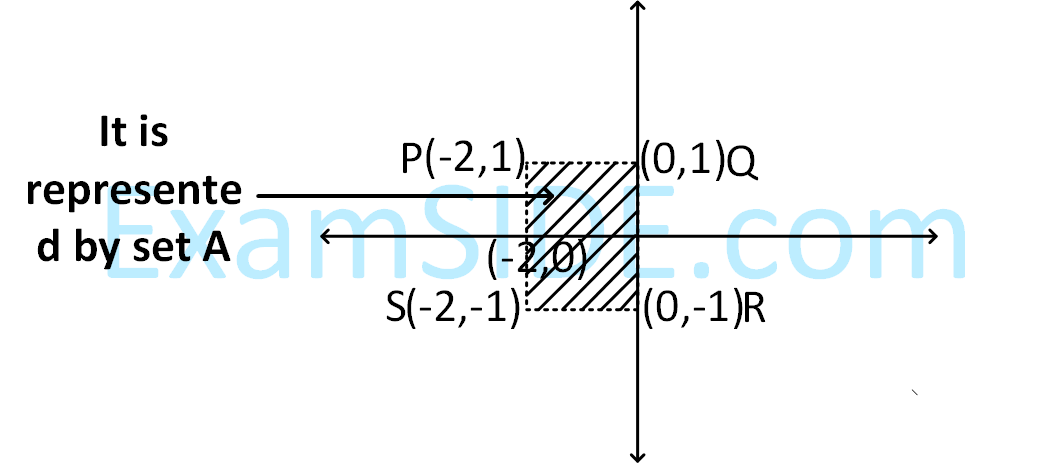
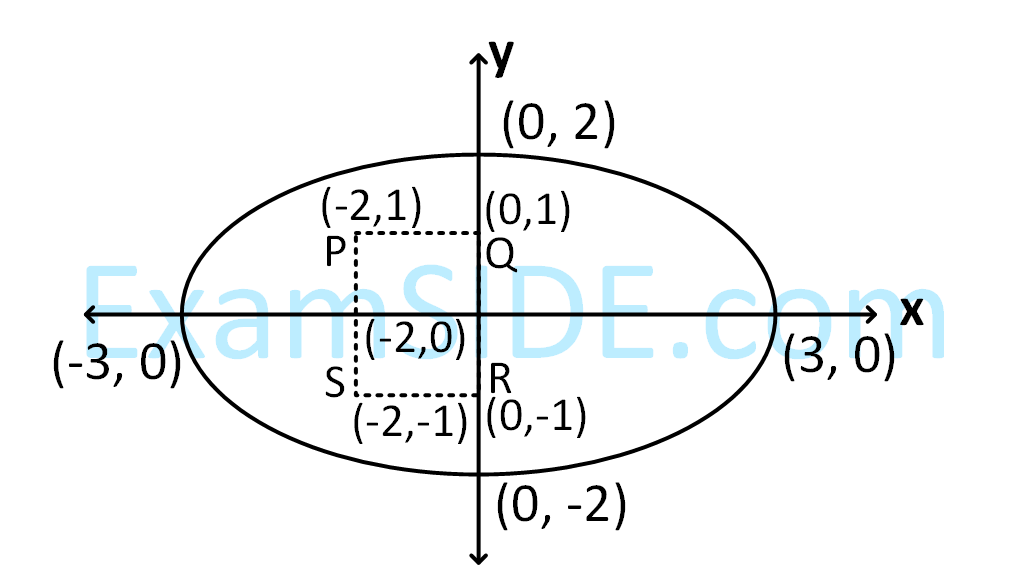
Two sets A and B are as under :
A = {($a$, b) $ \in $ R $ \times $ R : |$a$ - 5| < 1 and |b - 5| < 1};
B = {($a$, b) $ \in $ R $ \times $ R : 4($a$ - 6)2 + 9(b - 5)2 $ \le $ 36 };
Then
A = {($a$, b) $ \in $ R $ \times $ R : |$a$ - 5| < 1 and |b - 5| < 1};
B = {($a$, b) $ \in $ R $ \times $ R : 4($a$ - 6)2 + 9(b - 5)2 $ \le $ 36 };
Then
A.
neither A $ \subset $ B nor B $ \subset $ A
B.
B $ \subset $ A
C.
A $ \subset $ B
D.
A $ \cap $ B = $\phi $ ( an empty set )

2018
Q111
JEE Mains
MCQ
14 Mar 2026
Consider the following two binary relations on the set A = {a, b, c} :
R1 = {(c, a), (b, b), (a, c), (c, c), (b, c), (a, a)} and
R2 = {(a, b), (b, a), (c, c), (c, a), (a, a), (b, b), (a, c)}.
Then :
R1 = {(c, a), (b, b), (a, c), (c, c), (b, c), (a, a)} and
R2 = {(a, b), (b, a), (c, c), (c, a), (a, a), (b, b), (a, c)}.
Then :
A.
both R1 and R2 are not symmetric.
B.
R1 is not symmetric but it is transitive.
C.
R2 is symmetric but it is not transitive.
D.
both R1 and R2 are transitive.
2016
Q112
JEE Mains
MCQ
14 Mar 2026
Let P = {$\theta $ : sin$\theta $ $-$ cos$\theta $ = $\sqrt 2 \,\cos \theta $}
and Q = {$\theta $ : sin$\theta $ + cos$\theta $ = $\sqrt 2 \,\sin \theta $} be two sets. Then
and Q = {$\theta $ : sin$\theta $ + cos$\theta $ = $\sqrt 2 \,\sin \theta $} be two sets. Then
A.
P $ \subset $ Q and Q $-$ P $ \ne $ $\phi $
B.
Q $ \not\subset $ P
C.
P $ \not\subset $ Q
D.
P = Q
2015
Q113
JEE Mains
MCQ
14 Mar 2026
Let A and B be two sets containing four and
two elements respectively. Then, the number
of subsets of the set A $\times$ B , each having atleast
three elements are
A.
219
B.
256
C.
275
D.
510
2012
Q114
JEE Mains
MCQ
14 Mar 2026
Let X = {1, 2, 3, 4, 5}. The number of different ordered pairs (Y, Z) that can be formed such that Y $ \subseteq $ X, Z $ \subseteq $ X and Y $ \cap $ Z is empty, is :
A.
35
B.
25
C.
53
D.
52
2011
Q115
JEE Mains
MCQ
14 Mar 2026
Let $R$ be the set of real numbers.
Statement I : $A=\{(x, y) \in R \times R: y-x$ is an integer $\}$ is an equivalence relation on $R$.
Statement II : $ B=\{(x, y) \in R \times R: x=\alpha y$ for some rational number $\alpha\}$ is an equivalence relation on $R$.
Statement I : $A=\{(x, y) \in R \times R: y-x$ is an integer $\}$ is an equivalence relation on $R$.
Statement II : $ B=\{(x, y) \in R \times R: x=\alpha y$ for some rational number $\alpha\}$ is an equivalence relation on $R$.
A.
Statement I is true, Statement II is true; Statement II is not a correct explanation for Statement I.
B.
Statement I is true, Statement II is false.
C.
Statement I is false, Statement II is true.
D.
Statement I is true, Statement II is true; Statement II is a correct explanation for Statement I.
2010
Q116
JEE Mains
MCQ
14 Mar 2026
Consider the following relations
$R=\{(x, y) \mid x, y$ are real numbers and $x=w y$ for some rational number $w\}$;
$S=\left\{\left(\frac{m}{n}, \frac{p}{q}\right) \mid m, n, p\right.$ and $q$ are integers such that $n, q \neq 0$ and $q m=p m\}$. Then
$R=\{(x, y) \mid x, y$ are real numbers and $x=w y$ for some rational number $w\}$;
$S=\left\{\left(\frac{m}{n}, \frac{p}{q}\right) \mid m, n, p\right.$ and $q$ are integers such that $n, q \neq 0$ and $q m=p m\}$. Then
A.
$R$ is an equivalence relation but $S$ is not an equivalence relation
B.
Neither $R$ nor $S$ is an equivalence relation
C.
$S$ is an equivalence relation but $R$ is not an equivalence relation
D.
$R$ and $S$ both are equivalence relations
2009
Q117
JEE Mains
MCQ
14 Mar 2026
If $A, B$ and $C$ are three sets such that $A \cap B=A \cap C$ and $A \cup B=A \cup C$, then :
A.
$A=C$
B.
$B=C$
C.
$A \cap B=\phi$
D.
$A=B$
2008
Q118
JEE Mains
MCQ
14 Mar 2026
Let R be the real line. Consider the following subsets of the plane $R \times R$ :
$S = \left\{ {(x,y):y = x + 1\,\,and\,\,0 < x < 2} \right\}$
$T = \left\{ {(x,y): x - y\,\,\,is\,\,an\,\,{\mathop{\rm int}} eger\,} \right\}$,
$S = \left\{ {(x,y):y = x + 1\,\,and\,\,0 < x < 2} \right\}$
$T = \left\{ {(x,y): x - y\,\,\,is\,\,an\,\,{\mathop{\rm int}} eger\,} \right\}$,
Which one of the following is true ?
A.
Neither S nor T is an equivalence relation on R
B.
Both S and T are equivalence relation on R
C.
S is an equivalence relation on R but T is not
D.
T is an equivalence relation on R but S is not
2006
Q119
JEE Mains
MCQ
14 Mar 2026
Let $W$ denote the words in the English dictionary. Define the relation $R$ by
$R=\{(x, y) \in W \times W \mid$ the words $x$ and $y$ have at least one letter in common}. Then, $R$ is
$R=\{(x, y) \in W \times W \mid$ the words $x$ and $y$ have at least one letter in common}. Then, $R$ is
A.
reflexive, symmetric and not transitive
B.
reflexive, symmetric and transitive
C.
reflexive, not symmetric and transitive
D.
not reflexive, symmetric and transitive
2005
Q120
JEE Mains
MCQ
14 Mar 2026
Let $R=\{(3,3),(6,6),(9,9),(12,12),(6,12)$, $(3,9),(3,12),(3,6)\}$ be a relation on the set $A=\{3,6,9,12\}$. The relation is :
A.
reflexive and symmetric only
B.
an equivalence relation
C.
reflexive only
D.
reflexive and transitive only
2004
Q121
JEE Mains
MCQ
14 Mar 2026
Let $R=\{(1,3),(4,2),(2,4),(2,3),(3,1)\}$ be a relation on the set $A=\{1,2,3,4\}$. The relation $R$ is :
A.
a function
B.
transitive
C.
not symmetric
D.
reflexive