Matrices and Determinants
375 Questions
Start JEE Mains Test
2019
Q301
JEE Mains
MCQ
14 Mar 2026
The total number of matrices
$A = \left( {\matrix{ 0 & {2y} & 1 \cr {2x} & y & { - 1} \cr {2x} & { - y} & 1 \cr } } \right)$
(x, y $ \in $ R,x $ \ne $ y) for which ATA = 3I3 is :-
$A = \left( {\matrix{ 0 & {2y} & 1 \cr {2x} & y & { - 1} \cr {2x} & { - y} & 1 \cr } } \right)$
(x, y $ \in $ R,x $ \ne $ y) for which ATA = 3I3 is :-
A.
3
B.
4
C.
2
D.
6
2019
Q302
JEE Mains
MCQ
14 Mar 2026
If $\left[ {\matrix{
1 & 1 \cr
0 & 1 \cr
} } \right]\left[ {\matrix{
1 & 2 \cr
0 & 1 \cr
} } \right]$$\left[ {\matrix{
1 & 3 \cr
0 & 1 \cr
} } \right]$....$\left[ {\matrix{
1 & {n - 1} \cr
0 & 1 \cr
} } \right] = \left[ {\matrix{
1 & {78} \cr
0 & 1 \cr
} } \right]$,
then the inverse of $\left[ {\matrix{ 1 & n \cr 0 & 1 \cr } } \right]$ is
then the inverse of $\left[ {\matrix{ 1 & n \cr 0 & 1 \cr } } \right]$ is
A.
$\left[ {\matrix{
1 & { 0} \cr
{12} & 1 \cr
} } \right]$
B.
$\left[ {\matrix{
1 & { 0} \cr
{13} & 1 \cr
} } \right]$
C.
$\left[ {\matrix{
1 & { - 13} \cr
0 & 1 \cr
} } \right]$
D.
$\left[ {\matrix{
1 & { - 12} \cr
0 & 1 \cr
} } \right]$
2019
Q303
JEE Mains
MCQ
14 Mar 2026
Let $\alpha $ and $\beta $ be the roots of the equation
x2 + x + 1 = 0. Then for y $ \ne $ 0 in R,
$$\left| {\matrix{ {y + 1} & \alpha & \beta \cr \alpha & {y + \beta } & 1 \cr \beta & 1 & {y + \alpha } \cr } } \right|$$ is equal to
$$\left| {\matrix{ {y + 1} & \alpha & \beta \cr \alpha & {y + \beta } & 1 \cr \beta & 1 & {y + \alpha } \cr } } \right|$$ is equal to
A.
y(y2 – 1)
B.
y(y2 – 3)
C.
y3
D.
y3 – 1
2019
Q304
JEE Mains
MCQ
14 Mar 2026
Let the number 2,b,c be in an A.P. and
A = $\left[ {\matrix{ 1 & 1 & 1 \cr 2 & b & c \cr 4 & {{b^2}} & {{c^2}} \cr } } \right]$. If det(A) $ \in $ [2, 16], then c lies in the interval :
A = $\left[ {\matrix{ 1 & 1 & 1 \cr 2 & b & c \cr 4 & {{b^2}} & {{c^2}} \cr } } \right]$. If det(A) $ \in $ [2, 16], then c lies in the interval :
A.
[2, 3)
B.
[4, 6]
C.
(2 + 23/4, 4)
D.
[3, 2 + 23/4]
2019
Q305
JEE Mains
MCQ
14 Mar 2026
The greatest value of c $ \in $ R for which the system
of linear equations
x – cy – cz = 0
cx – y + cz = 0
cx + cy – z = 0
has a non-trivial solution, is :
x – cy – cz = 0
cx – y + cz = 0
cx + cy – z = 0
has a non-trivial solution, is :
A.
-1
B.
0
C.
1/2
D.
2
2019
Q306
JEE Mains
MCQ
14 Mar 2026
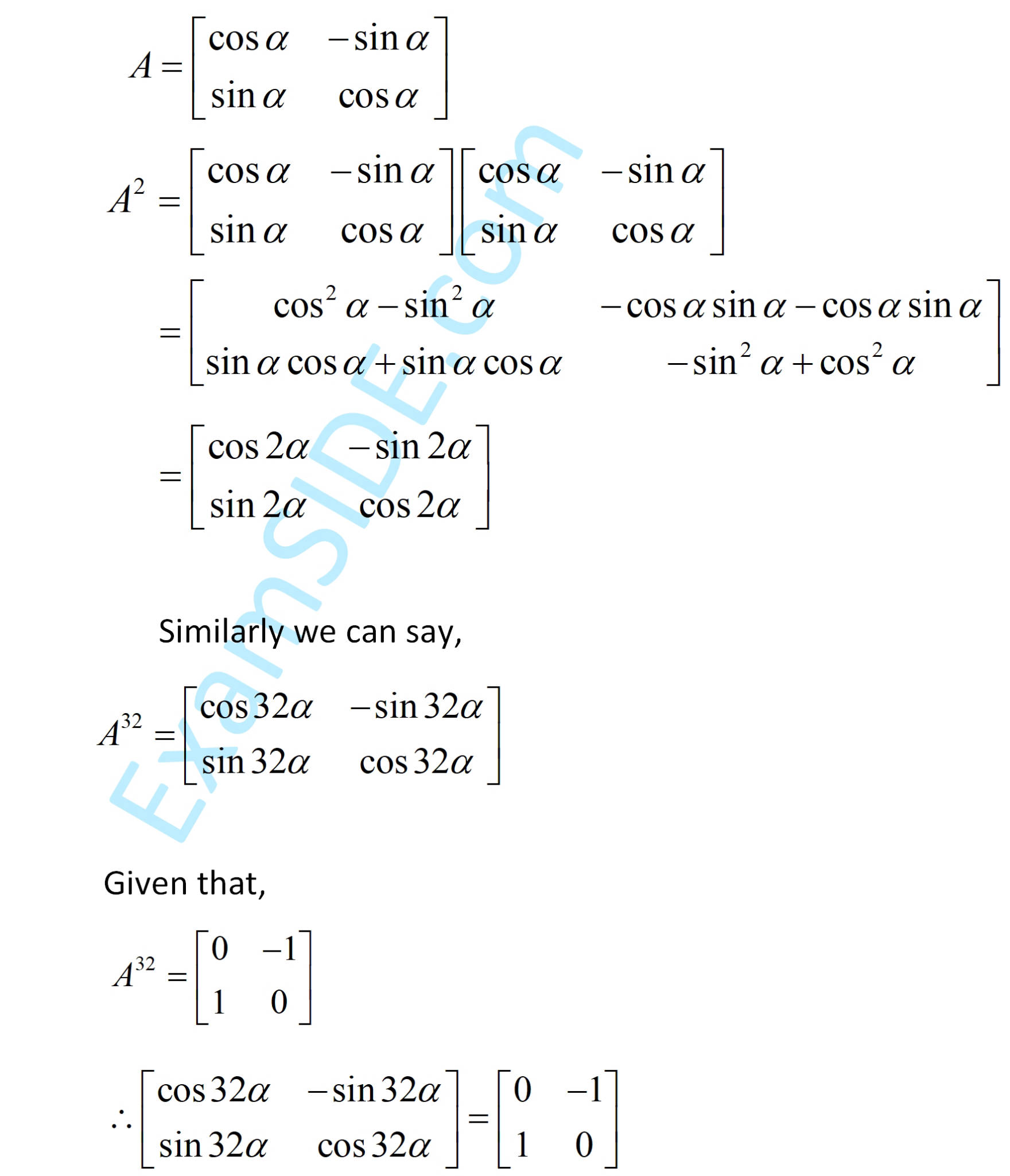
Let $A = \left( {\matrix{
{\cos \alpha } & { - \sin \alpha } \cr
{\sin \alpha } & {\cos \alpha } \cr
} } \right)$, ($\alpha $ $ \in $ R)
such that ${A^{32}} = \left( {\matrix{ 0 & { - 1} \cr 1 & 0 \cr } } \right)$ then a value of $\alpha $ is
such that ${A^{32}} = \left( {\matrix{ 0 & { - 1} \cr 1 & 0 \cr } } \right)$ then a value of $\alpha $ is
A.
0
B.
${\pi \over {16}}$
C.
${\pi \over {32}}$
D.
${\pi \over {64}}$
2019
Q307
JEE Mains
MCQ
14 Mar 2026
The set of all values of $\lambda $ for which the system of linear equations
x – 2y – 2z = $\lambda $x
x + 2y + z = $\lambda $y
– x – y = $\lambda $z
has a non-trivial solutions :
x – 2y – 2z = $\lambda $x
x + 2y + z = $\lambda $y
– x – y = $\lambda $z
has a non-trivial solutions :
A.
is an empty set
B.
contains more than two elements
C.
is a singleton
D.
contains exactly two elements
2019
Q308
JEE Mains
MCQ
14 Mar 2026
If A = $\left[ {\matrix{
1 & {\sin \theta } & 1 \cr
{ - \sin \theta } & 1 & {\sin \theta } \cr
{ - 1} & { - \sin \theta } & 1 \cr
} } \right]$;
then for all $\theta $ $ \in $ $\left( {{{3\pi } \over 4},{{5\pi } \over 4}} \right)$, det (A) lies in the interval :
then for all $\theta $ $ \in $ $\left( {{{3\pi } \over 4},{{5\pi } \over 4}} \right)$, det (A) lies in the interval :
A.
$\left( {{3 \over 2},3} \right]$
B.
$\left( {0,{3 \over 2}} \right]$
C.
$\left[ {{5 \over 2},4} \right)$
D.
$\left( {1,{5 \over 2}} \right]$
2019
Q309
JEE Mains
MCQ
14 Mar 2026
Let P = $\left[ {\matrix{
1 & 0 & 0 \cr
3 & 1 & 0 \cr
9 & 3 & 1 \cr
} } \right]$ and Q = [qij] be two 3 $ \times $ 3 matrices such that Q – P5 = I3.
Then ${{{q_{21}} + {q_{31}}} \over {{q_{32}}}}$ is equal to :
Then ${{{q_{21}} + {q_{31}}} \over {{q_{32}}}}$ is equal to :
A.
15
B.
9
C.
135
D.
10
2019
Q310
JEE Mains
MCQ
14 Mar 2026
An ordered pair ($\alpha $, $\beta $) for which the system of linear equations
(1 + $\alpha $) x + $\beta $y + z = 2
$\alpha $x + (1 + $\beta $)y + z = 3
$\alpha $x + $\beta $y + 2z = 2
has a unique solution, is :
(1 + $\alpha $) x + $\beta $y + z = 2
$\alpha $x + (1 + $\beta $)y + z = 3
$\alpha $x + $\beta $y + 2z = 2
has a unique solution, is :
A.
(–3, 1)
B.
(1, –3)
C.
(–4, 2)
D.
(2, 4)
2019
Q311
JEE Mains
MCQ
14 Mar 2026
If $\left| {\matrix{
{a - b - c} & {2a} & {2a} \cr
{2b} & {b - c - a} & {2b} \cr
{2c} & {2c} & {c - a - b} \cr
} } \right|$
= (a + b + c) (x + a + b + c)2, x $ \ne $ 0,
then x is equal to :
= (a + b + c) (x + a + b + c)2, x $ \ne $ 0,
then x is equal to :
A.
–2(a + b + c)
B.
2(a + b + c)
C.
abc
D.
–(a + b + c)
2019
Q312
JEE Mains
MCQ
14 Mar 2026
Let A and B be two invertible matrices of order 3 $ \times $ 3. If det(ABAT) = 8 and det(AB–1) = 8,
then det (BA–1 BT) is equal to :
then det (BA–1 BT) is equal to :
A.
${1 \over 4}$
B.
16
C.
${1 \over {16}}$
D.
1
2019
Q313
JEE Mains
MCQ
14 Mar 2026
If the system of linear equations
2x + 2y + 3z = a
3x – y + 5z = b
x – 3y + 2z = c
where a, b, c are non zero real numbers, has more one solution, then :
2x + 2y + 3z = a
3x – y + 5z = b
x – 3y + 2z = c
where a, b, c are non zero real numbers, has more one solution, then :
A.
b – c – a = 0
B.
a + b + c = 0
C.
b – c + a = 0
D.
b + c – a = 0
2019
Q314
JEE Mains
MCQ
14 Mar 2026
Let A = $\left( {\matrix{
0 & {2q} & r \cr
p & q & { - r} \cr
p & { - q} & r \cr
} } \right).$ If AAT = I3, then $\left| p \right|$ is :
A.
${1 \over {\sqrt 2 }}$
B.
${1 \over {\sqrt 5 }}$
C.
${1 \over {\sqrt 6 }}$
D.
${1 \over {\sqrt 3 }}$
2019
Q315
JEE Mains
MCQ
14 Mar 2026
Let A = $\left[ {\matrix{
2 & b & 1 \cr
b & {{b^2} + 1} & b \cr
1 & b & 2 \cr
} } \right]$ where b > 0.
Then the minimum value of ${{\det \left( A \right)} \over b}$ is -
Then the minimum value of ${{\det \left( A \right)} \over b}$ is -
A.
$\sqrt 3 $
B.
$-$ $2\sqrt 3 $
C.
$ - \sqrt 3 $
D.
$2\sqrt 3 $
2019
Q316
JEE Mains
MCQ
14 Mar 2026
The number of values of $\theta $ $ \in $ (0, $\pi $) for which the system of linear equations
x + 3y + 7z = 0
$-$ x + 4y + 7z = 0
(sin3$\theta $)x + (cos2$\theta $)y + 2z = 0.
has a non-trival solution, is -
x + 3y + 7z = 0
$-$ x + 4y + 7z = 0
(sin3$\theta $)x + (cos2$\theta $)y + 2z = 0.
has a non-trival solution, is -
A.
two
B.
one
C.
four
D.
three
2019
Q317
JEE Mains
MCQ
14 Mar 2026
If the system of equations
x + y + z = 5
x + 2y + 3z = 9
x + 3y + az = $\beta $
has infinitely many solutions, then $\beta $ $-$ $\alpha $ equals -
x + y + z = 5
x + 2y + 3z = 9
x + 3y + az = $\beta $
has infinitely many solutions, then $\beta $ $-$ $\alpha $ equals -
A.
8
B.
21
C.
18
D.
5
2019
Q318
JEE Mains
MCQ
14 Mar 2026
Let d $ \in $ R, and
$A = \left[ {\matrix{ { - 2} & {4 + d} & {\left( {\sin \theta } \right) - 2} \cr 1 & {\left( {\sin \theta } \right) + 2} & d \cr 5 & {\left( {2\sin \theta } \right) - d} & {\left( { - \sin \theta } \right) + 2 + 2d} \cr } } \right],$
$\theta \in \left[ {0,2\pi } \right]$ If the minimum value of det(A) is 8, then a value of d is -
$A = \left[ {\matrix{ { - 2} & {4 + d} & {\left( {\sin \theta } \right) - 2} \cr 1 & {\left( {\sin \theta } \right) + 2} & d \cr 5 & {\left( {2\sin \theta } \right) - d} & {\left( { - \sin \theta } \right) + 2 + 2d} \cr } } \right],$
$\theta \in \left[ {0,2\pi } \right]$ If the minimum value of det(A) is 8, then a value of d is -
A.
$-$ 7
B.
$2\left( {\sqrt 2 + 2} \right)$
C.
$-$ 5
D.
$2\left( {\sqrt 2 + 1} \right)$
2019
Q319
JEE Mains
MCQ
14 Mar 2026
If the system of linear equations
x $-$ 4y + 7z = g
3y $-$ 5z = h
$-$2x + 5y $-$ 9z = k
is consistent, then :
x $-$ 4y + 7z = g
3y $-$ 5z = h
$-$2x + 5y $-$ 9z = k
is consistent, then :
A.
g + 2h + k = 0
B.
g + h + 2k = 0
C.
2g + h + k = 0
D.
g + h + k = 0
2019
Q320
JEE Mains
MCQ
14 Mar 2026
If $A = \left[ {\matrix{
{{e^t}} & {{e^{ - t}}\cos t} & {{e^{ - t}}\sin t} \cr
{{e^t}} & { - {e^{ - t}}\cos t - {e^{ - t}}\sin t} & { - {e^{ - t}}\sin t + {e^{ - t}}co{\mathop{\rm s}\nolimits} t} \cr
{{e^t}} & {2{e^{ - t}}\sin t} & { - 2{e^{ - t}}\cos t} \cr
} } \right]$
then A is :
then A is :
A.
invertible for all t$ \in $R.
B.
invertible only if t $=$ $\pi $
C.
not invertible for any t$ \in $R
D.
invertible only if t $=$ ${\pi \over 2}$.
2019
Q321
JEE Mains
MCQ
14 Mar 2026
The system of linear equations
x + y + z = 2
2x + 3y + 2z = 5
2x + 3y + (a2 – 1) z = a + 1 then
x + y + z = 2
2x + 3y + 2z = 5
2x + 3y + (a2 – 1) z = a + 1 then
A.
has infinitely many solutions for a = 4
B.
has a unique solution for |a| = $\sqrt3$
C.
is inconsistent when |a| = $\sqrt3$
D.
is inconsistent when a = 4
2019
Q322
JEE Mains
MCQ
14 Mar 2026
If $A = \left[ {\matrix{
{\cos \theta } & { - \sin \theta } \cr
{\sin \theta } & {\cos \theta } \cr
} } \right]$, then the matrix A–50 when $\theta $ = $\pi \over 12$, is equal to :
A.
$\left[ {\matrix{
{ {{\sqrt 3 } \over 2}} & { - {1 \over 2}} \cr
{{{ 1} \over 2}} & {{{\sqrt 3 } \over 2}} \cr
} } \right]$
B.
$\left[ {\matrix{
{{1 \over 2}} & -{{{\sqrt 3 } \over 2}} \cr
{{{\sqrt 3 } \over 2}} & {{{ - 1} \over 2}} \cr
} } \right]$
C.
$\left[ {\matrix{
{{{\sqrt 3 } \over 2}} & {{1 \over 2}} \cr
-{{1 \over 2}} & {{{\sqrt 3 } \over 2}} \cr
} } \right]$
D.
$\left[ {\matrix{
{{1 \over 2}} & {{{\sqrt 3 } \over 2}} \cr
{-{{\sqrt 3 } \over 2}} & {{{ 1} \over 2}} \cr
} } \right]$
2018
Q323
JEE Mains
MCQ
14 Mar 2026
Let A = $\left[ {\matrix{
1 & 0 & 0 \cr
1 & 1 & 0 \cr
1 & 1 & 1 \cr
} } \right]$ and B = A20. Then the sum of the elements of the first column of B is :
A.
210
B.
211
C.
231
D.
251
2018
Q324
JEE Mains
MCQ
14 Mar 2026
The number of values of k for which the system of linear equations,
(k + 2)x + 10y = k
kx + (k +3)y = k -1
has no solution, is :
(k + 2)x + 10y = k
kx + (k +3)y = k -1
has no solution, is :
A.
1
B.
2
C.
3
D.
infinitely many
2018
Q325
JEE Mains
MCQ
14 Mar 2026
If $\left| {\matrix{
{x - 4} & {2x} & {2x} \cr
{2x} & {x - 4} & {2x} \cr
{2x} & {2x} & {x - 4} \cr
} } \right| = \left( {A + Bx} \right){\left( {x - A} \right)^2}$
then the ordered pair (A, B) is equal to :
then the ordered pair (A, B) is equal to :
A.
(4, 5)
B.
(-4, -5)
C.
(-4, 3)
D.
(-4, 5)
2018
Q326
JEE Mains
MCQ
14 Mar 2026
If the system of linear equations
x + ky + 3z = 0
3x + ky - 2z = 0
2x + 4y - 3z = 0
has a non-zero solution (x, y, z), then ${{xz} \over {{y^2}}}$ is equal to
x + ky + 3z = 0
3x + ky - 2z = 0
2x + 4y - 3z = 0
has a non-zero solution (x, y, z), then ${{xz} \over {{y^2}}}$ is equal to
A.
30
B.
-10
C.
10
D.
-30
2018
Q327
JEE Mains
MCQ
14 Mar 2026
If the system of linear equations
x + ay + z = 3
x + 2y + 2z = 6
x + 5y + 3z = b
has no solution, then :
x + ay + z = 3
x + 2y + 2z = 6
x + 5y + 3z = b
has no solution, then :
A.
a = $-$ 1, b = 9
B.
a = $-$ 1, b $ \ne $ 9
C.
a $ \ne $ $-$ 1, b = 9
D.
a = 1, b $ \ne $ 9
2018
Q328
JEE Mains
MCQ
14 Mar 2026
Suppose A is any 3$ \times $ 3 non-singular matrix and ( A $-$ 3I) (A $-$ 5I) = O where I = I3 and O = O3. If $\alpha $A + $\beta $A-1 = 4I, then $\alpha $ + $\beta $ is equal to :
A.
8
B.
7
C.
13
D.
12
2018
Q329
JEE Mains
MCQ
14 Mar 2026
Let $A$ be a matrix such that $A.\left[ {\matrix{
1 & 2 \cr
0 & 3 \cr
} } \right]$ is a scalar matrix and |3A| = 108.
Then A2 equals :
Then A2 equals :
A.
$\left[ {\matrix{
4 & { - 32} \cr
0 & {36} \cr
} } \right]$
B.
$\left[ {\matrix{
{36} & 0 \cr
{ - 32} & 4 \cr
} } \right]$
C.
$\left[ {\matrix{
4 & 0 \cr
{ - 32} & {36} \cr
} } \right]$
D.
$\left[ {\matrix{
{36} & { - 32} \cr
0 & 4 \cr
} } \right]$
2018
Q330
JEE Mains
MCQ
14 Mar 2026
Let S be the set of all real values of k for which the systemof linear equations
x + y + z = 2
2x + y $-$ z = 3
3x + 2y + kz = 4
has a unique solution. Then S is :
x + y + z = 2
2x + y $-$ z = 3
3x + 2y + kz = 4
has a unique solution. Then S is :
A.
an empty set
B.
equal to {0}
C.
equal to R
D.
equal to R $-$ {0}
2017
Q331
JEE Mains
MCQ
14 Mar 2026
For two 3 × 3 matrices A and B, let A + B = 2BT and 3A + 2B = I3, where BT is
the transpose of B and I3 is 3 × 3 identity matrix. Then :
A.
5A + 10B = 2I3
B.
10A + 5B = 3I3
C.
B + 2A = I3
D.
3A + 6B = 2I3
2017
Q332
JEE Mains
MCQ
14 Mar 2026
The number of real values of $\lambda $ for which the system of linear equations
2x + 4y $-$ $\lambda $z = 0
4x + $\lambda $y + 2z = 0
$\lambda $x + 2y + 2z = 0
has infinitely many solutions, is :
2x + 4y $-$ $\lambda $z = 0
4x + $\lambda $y + 2z = 0
$\lambda $x + 2y + 2z = 0
has infinitely many solutions, is :
A.
0
B.
1
C.
2
D.
3

2017
Q333
JEE Mains
MCQ
14 Mar 2026
Let A be any 3 $ \times $ 3 invertible matrix. Then which one of the following is not always true ?
A.
adj (A) = $\left| \right.$A$\left| \right.$.A$-$1
B.
adj (adj(A)) = $\left| \right.$A$\left| \right.$.A
C.
adj (adj(A)) = $\left| \right.$A$\left| \right.$2.(adj(A))$-$1
D.
adj (adj(A)) = $\left| \, \right.$A $\left| \, \right.$.(adj(A))$-$1
2017
Q334
JEE Mains
MCQ
14 Mar 2026
If
$S = \left\{ {x \in \left[ {0,2\pi } \right]:\left| {\matrix{ 0 & {\cos x} & { - \sin x} \cr {\sin x} & 0 & {\cos x} \cr {\cos x} & {\sin x} & 0 \cr } } \right| = 0} \right\},$
then $\sum\limits_{x \in S} {\tan \left( {{\pi \over 3} + x} \right)} $ is equal to :
$S = \left\{ {x \in \left[ {0,2\pi } \right]:\left| {\matrix{ 0 & {\cos x} & { - \sin x} \cr {\sin x} & 0 & {\cos x} \cr {\cos x} & {\sin x} & 0 \cr } } \right| = 0} \right\},$
then $\sum\limits_{x \in S} {\tan \left( {{\pi \over 3} + x} \right)} $ is equal to :
A.
$4 + 2\sqrt 3 $
B.
$ - 2 + \sqrt 3 $
C.
$ - 2 - \sqrt 3 $
D.
$-\,\,4 - 2\sqrt 3 $
2017
Q335
JEE Mains
MCQ
14 Mar 2026
If S is the set of distinct values of 'b' for which the following system of linear equations
x + y + z = 1
x + ay + z = 1
ax + by + z = 0
has no solution, then S is :
x + y + z = 1
x + ay + z = 1
ax + by + z = 0
has no solution, then S is :
A.
an empty set
B.
an infinite set
C.
a finite set containing two or more elements
D.
a singleton
2017
Q336
JEE Mains
MCQ
14 Mar 2026
If $A = \left[ {\matrix{
2 & { - 3} \cr
{ - 4} & 1 \cr
} } \right]$,
then adj(3A2 + 12A) is equal to
then adj(3A2 + 12A) is equal to
A.
$\left[ {\matrix{
{51} & {63} \cr
{84} & {72} \cr
} } \right]$
B.
$\left[ {\matrix{
{51} & {84} \cr
{63} & {72} \cr
} } \right]$
C.
$\left[ {\matrix{
{72} & {-63} \cr
{-84} & {51} \cr
} } \right]$
D.
$\left[ {\matrix{
{72} & {-84} \cr
{-63} & {51} \cr
} } \right]$
2016
Q337
JEE Mains
MCQ
14 Mar 2026
If A = $\left[ {\matrix{
{ - 4} & { - 1} \cr
3 & 1 \cr
} } \right]$,
then the determinant of the matrix (A2016 − 2A2015 − A2014) is :
then the determinant of the matrix (A2016 − 2A2015 − A2014) is :
A.
2014
B.
$-$ 175
C.
2016
D.
$-$ 25
2016
Q338
JEE Mains
MCQ
14 Mar 2026
Let A be a 3 $ \times $ 3 matrix such that A2 $-$ 5A + 7I = 0
Statement - I :
A$-$1 = ${1 \over 7}$ (5I $-$ A).
Statement - II :
The polynomial A3 $-$ 2A2 $-$ 3A + I can be reduced to 5(A $-$ 4I).
Then :
Statement - I :
A$-$1 = ${1 \over 7}$ (5I $-$ A).
Statement - II :
The polynomial A3 $-$ 2A2 $-$ 3A + I can be reduced to 5(A $-$ 4I).
Then :
A.
Statement-I is true, but Statement-II is false.
B.
Statement-I is false, but Statement-II is true.
C.
Both the statements are true.
D.
Both the statements are false
2016
Q339
JEE Mains
MCQ
14 Mar 2026
If P = $\left[ {\matrix{
{{{\sqrt 3 } \over 2}} & {{1 \over 2}} \cr
{ - {1 \over 2}} & {{{\sqrt 3 } \over 2}} \cr
} } \right],A = \left[ {\matrix{
1 & 1 \cr
0 & 1 \cr
} } \right]\,\,\,$
Q = PAPT, then PT Q2015 P is :
Q = PAPT, then PT Q2015 P is :
A.
$\left[ {\matrix{
0 & {2015} \cr
0 & 0 \cr
} } \right]$
B.
$\left[ {\matrix{
{2015} & 1 \cr
0 & {2015} \cr
} } \right]$
C.
$\left[ {\matrix{
{2015} & 0 \cr
1 & {2015} \cr
} } \right]$
D.
$\left[ {\matrix{
1 & {2015} \cr
0 & 1 \cr
} } \right]$
2016
Q340
JEE Mains
MCQ
14 Mar 2026
The number of distinct real roots of the equation,
$\left| {\matrix{ {\cos x} & {\sin x} & {\sin x} \cr {\sin x} & {\cos x} & {\sin x} \cr {\sin x} & {\sin x} & {\cos x} \cr } } \right| = 0$ in the interval $\left[ { - {\pi \over 4},{\pi \over 4}} \right]$ is :
$\left| {\matrix{ {\cos x} & {\sin x} & {\sin x} \cr {\sin x} & {\cos x} & {\sin x} \cr {\sin x} & {\sin x} & {\cos x} \cr } } \right| = 0$ in the interval $\left[ { - {\pi \over 4},{\pi \over 4}} \right]$ is :
A.
4
B.
3
C.
2
D.
1
2016
Q341
JEE Mains
MCQ
14 Mar 2026
The system of linear equations
$\matrix{ {x + \lambda y - z = 0} \cr {\lambda x - y - z = 0} \cr {x + y - \lambda z = 0} \cr } $
has a non-trivial solution for :
A.
infinitely many values of $\lambda .$
B.
exactly one value of $\lambda .$
C.
exactly two values of $\lambda .$
D.
exactly three values of $\lambda .$
2016
Q342
JEE Mains
MCQ
14 Mar 2026
If $A = \left[ {\matrix{
{5a} & { - b} \cr
3 & 2 \cr
} } \right]$ and $A$ adj $A=A$ ${A^T},$ then $5a+b$ is equal to :
A.
$4$
B.
$13$
C.
$-1$
D.
$5$
2015
Q343
JEE Mains
MCQ
14 Mar 2026
If $A = \left[ {\matrix{
1 & 2 & 2 \cr
2 & 1 & { - 2} \cr
a & 2 & b \cr
} } \right]$ is a matrix satisfying the equation
$A{A^T} = 9\text{I},$ where $I$ is $3 \times 3$ identity matrix, then the ordered
pair $(a, b)$ is equal to :
$A{A^T} = 9\text{I},$ where $I$ is $3 \times 3$ identity matrix, then the ordered
pair $(a, b)$ is equal to :
A.
$(2, 1)$
B.
$(-2, -1)$
C.
$(2, -1)$
D.
$(-2, 1)$
2015
Q344
JEE Mains
MCQ
14 Mar 2026
The set of all values of $\lambda $ for which the system of linear equations:
$\matrix{ {2{x_1} - 2{x_2} + {x_3} = \lambda {x_1}} \cr {2{x_1} - 3{x_2} + 2{x_3} = \lambda {x_2}} \cr { - {x_1} + 2{x_2} = \lambda {x_3}} \cr } $
has a non-trivial solution
$\matrix{ {2{x_1} - 2{x_2} + {x_3} = \lambda {x_1}} \cr {2{x_1} - 3{x_2} + 2{x_3} = \lambda {x_2}} \cr { - {x_1} + 2{x_2} = \lambda {x_3}} \cr } $
has a non-trivial solution
A.
contains two elements
B.
contains more than two elements
C.
in an empty set
D.
is a singleton
2014
Q345
JEE Mains
MCQ
14 Mar 2026
If $A$ is a $3 \times 3$ non-singular matrix such that $AA'=A'A$ and
$B = {A^{ - 1}}A',$ then $BB'$ equals:
$B = {A^{ - 1}}A',$ then $BB'$ equals:
A.
${B^{ - 1}}$
B.
$\left( {{B^{ - 1}}} \right)'$
C.
$I+B$
D.
$I$
2014
Q346
JEE Mains
MCQ
14 Mar 2026
If $\alpha ,\beta \ne 0,$ and $f\left( n \right) = {\alpha ^n} + {\beta ^n}$ and
$$\left| {\matrix{
3 & {1 + f\left( 1 \right)} & {1 + f\left( 2 \right)} \cr
{1 + f\left( 1 \right)} & {1 + f\left( 2 \right)} & {1 + f\left( 3 \right)} \cr
{1 + f\left( 2 \right)} & {1 + f\left( 3 \right)} & {1 + f\left( 4 \right)} \cr
} } \right|$$
$ = K{\left( {1 - \alpha } \right)^2}{\left( {1 - \beta } \right)^2}{\left( {\alpha - \beta } \right)^2},$ then $K$ is equal to :
$ = K{\left( {1 - \alpha } \right)^2}{\left( {1 - \beta } \right)^2}{\left( {\alpha - \beta } \right)^2},$ then $K$ is equal to :
A.
$1$
B.
$-1$
C.
$\alpha \beta $
D.
${1 \over {\alpha \beta }}$
2013
Q347
JEE Mains
MCQ
14 Mar 2026
The number of values of $k$, for which the system of equations : $$\matrix{
{\left( {k + 1} \right)x + 8y = 4k} \cr
{kx + \left( {k + 3} \right)y = 3k - 1} \cr
} $$
has no solution, is
has no solution, is
A.
infinite
B.
1
C.
2
D.
3
2013
Q348
JEE Mains
MCQ
14 Mar 2026
If $P = \left[ {\matrix{
1 & \alpha & 3 \cr
1 & 3 & 3 \cr
2 & 4 & 4 \cr
} } \right]$ is the adjoint of a $3 \times 3$ matrix $A$ and
$\left| A \right| = 4,$ then $\alpha $ is equal to :
$\left| A \right| = 4,$ then $\alpha $ is equal to :
A.
$4$
B.
$11$
C.
$5$
D.
$0$
2012
Q349
JEE Mains
MCQ
14 Mar 2026
Let $P$ and $Q$ be $3 \times 3$ matrices $P \ne Q.$ If ${P^3} = {Q^3}$ and
${P^2}Q = {Q^2}P$ then determinant of $\left( {{P^2} + {Q^2}} \right)$ is equal to :
${P^2}Q = {Q^2}P$ then determinant of $\left( {{P^2} + {Q^2}} \right)$ is equal to :
A.
$-2$
B.
$1$
C.
$0$
D.
$-1$
2012
Q350
JEE Mains
MCQ
14 Mar 2026
Let $A = \left( {\matrix{
1 & 0 & 0 \cr
2 & 1 & 0 \cr
3 & 2 & 1 \cr
} } \right)$. If ${u_1}$ and ${u_2}$ are column matrices such
that $A{u_1} = \left( {\matrix{ 1 \cr 0 \cr 0 \cr } } \right)$ and $A{u_2} = \left( {\matrix{ 0 \cr 1 \cr 0 \cr } } \right),$ then ${u_1} + {u_2}$ is equal to :
that $A{u_1} = \left( {\matrix{ 1 \cr 0 \cr 0 \cr } } \right)$ and $A{u_2} = \left( {\matrix{ 0 \cr 1 \cr 0 \cr } } \right),$ then ${u_1} + {u_2}$ is equal to :
A.
$\left( {\matrix{
-1 \cr
1 \cr
0 \cr
} } \right)$
B.
$\left( {\matrix{
-1 \cr
1 \cr
-1 \cr
} } \right)$
C.
$\left( {\matrix{
-1 \cr
-1 \cr
0 \cr
} } \right)$
D.
$\left( {\matrix{
1 \cr
-1 \cr
-1 \cr
} } \right)$