Application of Derivatives
230 Questions
2021
JEE Mains
MCQ
JEE Main 2021 (Online) 27th August Evening Shift
A box open from top is made from a rectangular sheet of dimension a $\times$ b by cutting squares each of side x from each of the four corners and folding up the flaps. If the volume of the box is maximum, then x is equal to :
A.
${{a + b - \sqrt {{a^2} + {b^2} - ab} } \over {12}}$
B.
${{a + b - \sqrt {{a^2} + {b^2} + ab} } \over 6}$
C.
${{a + b - \sqrt {{a^2} + {b^2} - ab} } \over 6}$
D.
${{a + b + \sqrt {{a^2} + {b^2} + ab} } \over 6}$
2021
JEE Mains
MCQ
JEE Main 2021 (Online) 27th August Morning Shift
A wire of length 20 m is to be cut into two pieces. One of the pieces is to be made into a square and the other into a regular hexagon. Then the length of the side (in meters) of the hexagon, so that the combined area of the square and the hexagon is minimum, is :
A.
${5 \over {2 + \sqrt 3 }}$
B.
${{10} \over {2 + 3\sqrt 3 }}$
C.
${5 \over {3 + \sqrt 3 }}$
D.
${{10} \over {3 + 2\sqrt 3 }}$
2021
JEE Mains
MCQ
JEE Main 2021 (Online) 26th August Evening Shift
The local maximum value of the function $f(x) = {\left( {{2 \over x}} \right)^{{x^2}}}$, x > 0, is
A.
${\left( {2\sqrt e } \right)^{{1 \over e}}}$
B.
${\left( {{4 \over {\sqrt e }}} \right)^{{e \over 4}}}$
C.
${(e)^{{2 \over e}}}$
D.
1
2021
JEE Mains
MCQ
JEE Main 2021 (Online) 25th July Morning Shift
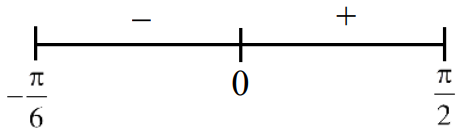
Let $f(x) = 3{\sin ^4}x + 10{\sin ^3}x + 6{\sin ^2}x - 3$, $x \in \left[ { - {\pi \over 6},{\pi \over 2}} \right]$. Then, f is :
A.
increasing in $\left( { - {\pi \over 6},{\pi \over 2}} \right)$
B.
decreasing in $\left( {0,{\pi \over 2}} \right)$
C.
increasing in $\left( { - {\pi \over 6},0} \right)$
D.
decreasing in $\left( { - {\pi \over 6},0} \right)$
2021
JEE Mains
MCQ
JEE Main 2021 (Online) 22th July Evening Shift
Let f : R $\to$ R be defined as
$f(x) = \left\{ {\matrix{ { - {4 \over 3}{x^3} + 2{x^2} + 3x,} & {x > 0} \cr {3x{e^x},} & {x \le 0} \cr } } \right.$. Then f is increasing function in the interval
A.
$\left( { - {1 \over 2},2} \right)$
B.
(0,2)
C.
$\left( { - 1,{3 \over 2}} \right)$
D.
($-$3, $-$1)
2021
JEE Mains
MCQ
JEE Main 2021 (Online) 20th July Evening Shift
The sum of all the local minimum values of the twice differentiable function f : R $\to$ R defined by $f(x) = {x^3} - 3{x^2} - {{3f''(2)} \over 2}x + f''(1)$ is :
A.
$-$22
B.
5
C.
$-$27
D.
0
2021
JEE Mains
MCQ
JEE Main 2021 (Online) 20th July Morning Shift
Let $A = [{a_{ij}}]$ be a 3 $\times$ 3 matrix, where ${a_{ij}} = \left\{ {\matrix{
1 & , & {if\,i = j} \cr
{ - x} & , & {if\,\left| {i - j} \right| = 1} \cr
{2x + 1} & , & {otherwise.} \cr
} } \right.$
Let a function f : R $\to$ R be defined as f(x) = det(A). Then the sum of maximum and minimum values of f on R is equal to:
A.
$ - {{20} \over {27}}$
B.
${{88} \over {27}}$
C.
${{20} \over {27}}$
D.
$ - {{88} \over {27}}$
2021
JEE Mains
MCQ
JEE Main 2021 (Online) 20th July Morning Shift
Let 'a' be a real number such that the function f(x) = ax2 + 6x $-$ 15, x $\in$ R is increasing in $\left( { - \infty ,{3 \over 4}} \right)$ and decreasing in $\left( {{3 \over 4},\infty } \right)$. Then the function g(x) = ax2 $-$ 6x + 15, x$\in$R has a :
A.
local maximum at x = $-$ ${{3 \over 4}}$
B.
local minimum at x = $-$${{3 \over 4}}$
C.
local maximum at x = ${{3 \over 4}}$
D.
local minimum at x = ${{3 \over 4}}$
2021
JEE Mains
MCQ
JEE Main 2021 (Online) 17th March Evening Shift
Consider the function f : R $ \to $ R defined by
$f(x) = \left\{ \matrix{ \left( {2 - \sin \left( {{1 \over x}} \right)} \right)|x|,x \ne 0 \hfill \cr 0,\,\,x = 0 \hfill \cr} \right.$. Then f is :
A.
not monotonic on ($-$$\infty $, 0) and (0, $\infty $)
B.
monotonic on (0, $\infty $) only
C.
monotonic on ($-$$\infty $, 0) only
D.
monotonic on ($-$$\infty $, 0) $\cup$ (0, $\infty $)
2021
JEE Mains
MCQ
JEE Main 2021 (Online) 16th March Evening Shift
Let f be a real valued function, defined on R $-$ {$-$1, 1} and given by
f(x) = 3 loge $\left| {{{x - 1} \over {x + 1}}} \right| - {2 \over {x - 1}}$.
Then in which of the following intervals, function f(x) is increasing?
f(x) = 3 loge $\left| {{{x - 1} \over {x + 1}}} \right| - {2 \over {x - 1}}$.
Then in which of the following intervals, function f(x) is increasing?
A.
($-$$\infty $, $-$1) $\cup$ $\left( {[{1 \over 2},\infty ) - \{ 1\} } \right)$
B.
($-$$\infty $, $\infty $) $-$ {$-$1, 1)
C.
($-$$\infty $, ${{1 \over 2}}$] $-$ {$-$1}
D.
($-$1, ${{1 \over 2}}$]
2021
JEE Mains
MCQ
JEE Main 2021 (Online) 16th March Evening Shift
The maximum value of
$f(x) = \left| {\matrix{ {{{\sin }^2}x} & {1 + {{\cos }^2}x} & {\cos 2x} \cr {1 + {{\sin }^2}x} & {{{\cos }^2}x} & {\cos 2x} \cr {{{\sin }^2}x} & {{{\cos }^2}x} & {\sin 2x} \cr } } \right|,x \in R$ is :
A.
$\sqrt 5 $
B.
${3 \over 4}$
C.
5
D.
$\sqrt 7 $
2021
JEE Mains
MCQ
JEE Main 2021 (Online) 26th February Evening Shift
Let slope of the tangent line to a curve at any point P(x, y) be given by ${{x{y^2} + y} \over x}$. If the curve intersects the line x + 2y = 4 at x = $-$2, then the value of y, for which the point (3, y) lies on the curve, is :
A.
$ - {{18} \over {19}}$
B.
$ - {{4} \over {3}}$
C.
${{18} \over {35}}$
D.
$ - {{18} \over {11}}$
2021
JEE Mains
MCQ
JEE Main 2021 (Online) 26th February Morning Shift
The maximum slope of the curve $y = {1 \over 2}{x^4} - 5{x^3} + 18{x^2} - 19x$ occurs at the point :
A.
$\left( {3,{{21} \over 2}} \right)$
B.
(0, 0)
C.
(2, 9)
D.
(2, 2)
2021
JEE Mains
MCQ
JEE Main 2021 (Online) 26th February Morning Shift
Let f be any function defined on R and let it satisfy the condition : $|f(x) - f(y)|\, \le \,|{(x - y)^2}|,\forall (x,y) \in R$
If f(0) = 1, then :
If f(0) = 1, then :
A.
f(x) can take any value in R
B.
$f(x) < 0,\forall x \in R$
C.
$f(x) > 0,\forall x \in R$
D.
$f(x) = 0,\forall x \in R$
2021
JEE Mains
MCQ
JEE Main 2021 (Online) 25th February Morning Shift
If the curves, ${{{x^2}} \over a} + {{{y^2}} \over b} = 1$ and ${{{x^2}} \over c} + {{{y^2}} \over d} = 1$ intersect each other at an angle of 90$^\circ$, then which of the following relations is TRUE?
A.
a $-$ c = b + d
B.
a + b = c + d
C.
$ab = {{c + d} \over {a + b}}$
D.
a $-$ b = c $-$ d
2021
JEE Mains
MCQ
JEE Main 2021 (Online) 25th February Morning Shift
If Rolle's theorem holds for the function $f(x) = {x^3} - a{x^2} + bx - 4$, $x \in [1,2]$ with $f'\left( {{4 \over 3}} \right) = 0$, then ordered pair (a, b) is equal to :
A.
($-$5, $-$8)
B.
(5, $-$8)
C.
($-$5, 8)
D.
(5, 8)
2021
JEE Mains
MCQ
JEE Main 2021 (Online) 24th February Evening Shift
For which of the following curves, the line $x + \sqrt 3 y = 2\sqrt 3 $ is the tangent at the point $\left( {{{3\sqrt 3 } \over 2},{1 \over 2}} \right)$?
A.
$2{x^2} - 18{y^2} = 9$
B.
${y^2} = {1 \over {6\sqrt 3 }}x$
C.
${x^2} + 9{y^2} = 9$
D.
${x^2} + {y^2} = 7$
2021
JEE Mains
MCQ
JEE Main 2021 (Online) 24th February Evening Shift
Let $f:R \to R$ be defined as
$f(x) = \left\{ {\matrix{ { - 55x,} & {if\,x < - 5} \cr {2{x^3} - 3{x^2} - 120x,} & {if\, - 5 \le x \le 4} \cr {2{x^3} - 3{x^2} - 36x - 336,} & {if\,x > 4,} \cr } } \right.$
Let A = {x $ \in $ R : f is increasing}. Then A is equal to :
$f(x) = \left\{ {\matrix{ { - 55x,} & {if\,x < - 5} \cr {2{x^3} - 3{x^2} - 120x,} & {if\, - 5 \le x \le 4} \cr {2{x^3} - 3{x^2} - 36x - 336,} & {if\,x > 4,} \cr } } \right.$
Let A = {x $ \in $ R : f is increasing}. Then A is equal to :
A.
$( - 5,\infty )$
B.
$( - \infty , - 5) \cup (4,\infty )$
C.
$( - 5, - 4) \cup (4,\infty )$
D.
$( - \infty , - 5) \cup ( - 4,\infty )$
2021
JEE Mains
MCQ
JEE Main 2021 (Online) 24th February Evening Shift
If the curve y = ax2 + bx + c, x$ \in $R, passes through the point (1, 2) and the tangent line to this curve at origin is y = x, then the possible values of a, b, c are :
A.
a = $-$ 1, b = 1, c = 1
B.
a = 1, b = 1, c = 0
C.
a = ${1 \over 2}$, b = ${1 \over 2}$, c = 1
D.
a = 1, b = 0, c = 1
2021
JEE Mains
MCQ
JEE Main 2021 (Online) 24th February Morning Shift
The function
f(x) = ${{4{x^3} - 3{x^2}} \over 6} - 2\sin x + \left( {2x - 1} \right)\cos x$ :
A.
increases in $\left( { - \infty ,{1 \over 2}} \right]$
B.
decreases in $\left( { - \infty ,{1 \over 2}} \right]$
C.
increases in $\left[ {{1 \over 2},\infty } \right)$
D.
decreases in $\left[ {{1 \over 2},\infty } \right)$
2021
JEE Mains
MCQ
JEE Main 2021 (Online) 24th February Morning Shift
If the tangent to the curve y = x3 at the point P(t, t3) meets the curve again at Q, then the
ordinate of the point which divides PQ internally in the ratio 1 : 2 is :
A.
0
B.
2t3
C.
-2t3
D.
-t3
2021
JEE Mains
Numerical
JEE Main 2021 (Online) 31st August Evening Shift
Let f(x) be a cubic polynomial with f(1) = $-$10, f($-$1) = 6, and has a local minima at x = 1, and f'(x) has a local minima at x = $-$1. Then f(3) is equal to ____________.
Correct Answer: 22
Explanation:
Let f(x) = ax3 + bx2 + cx + d
f'(x) = 3ax2 + 2bx + c $\Rightarrow$ f''(x) = 6ax + 2b
f'(x) has local minima at x = $-$1, so
$\because$ f''($-$1) = 0 $\Rightarrow$ $-$6a + 2b = 0 $\Rightarrow$ b = 3a ..... (i)
f(x) has local minima at x = 1
f'(1) = 0
$\Rightarrow$ 3a + 6a + c = 0
$\Rightarrow$ c = $-$9a ..... (ii)
f(1) = $-$10
$\Rightarrow$ $-$5a + d = $-$10 ..... (iii)
f($-$1) = 6
$\Rightarrow$ 11a + d = 6 ..... (iv)
Solving Eqs. (iii) and (iv)
a = 1, d = $-$5
From Eqs. (i) and (ii),
b = 3, c = $-$9
$\therefore$ f(x) = x3 + 3x2 $-$ 9x $-$ 5
So, f(3) = 27 + 27 $-$ 27 $-$ 5 = 22
2021
JEE Mains
Numerical
JEE Main 2021 (Online) 31st August Morning Shift
If 'R' is the least value of 'a' such that the function f(x) = x2 + ax + 1 is increasing on [1, 2] and 'S' is the greatest value of 'a' such that the function f(x) = x2 + ax + 1 is decreasing on [1, 2], then
the value of |R $-$ S| is ___________.
Correct Answer: 2
Explanation:
f(x) = x2 + ax + 1
f'(x) = 2x + a
when f(x) is increasing on [1, 2]
2x + a $\ge$ 0 $\forall$ x$\in$[1, 2]
a $\ge$ $-$2x $\forall$ x$\in$[1, 2]
R = $-$4
when f(x) is decreasing on [1, 2]
2x + a $\le$ 0 $\forall$ x$\in$[1, 2]
a $\le$ $-$2 $\forall$ x$\in$[1, 2]
S = $-$2
|R $-$ S| = | $-$4 + 2 | = 2
f'(x) = 2x + a
when f(x) is increasing on [1, 2]
2x + a $\ge$ 0 $\forall$ x$\in$[1, 2]
a $\ge$ $-$2x $\forall$ x$\in$[1, 2]
R = $-$4
when f(x) is decreasing on [1, 2]
2x + a $\le$ 0 $\forall$ x$\in$[1, 2]
a $\le$ $-$2 $\forall$ x$\in$[1, 2]
S = $-$2
|R $-$ S| = | $-$4 + 2 | = 2
2021
JEE Mains
Numerical
JEE Main 2021 (Online) 27th August Morning Shift
The number of distinct real roots of the equation 3x4 + 4x3 $-$ 12x2 + 4 = 0 is _____________.
Correct Answer: 4
Explanation:
3x4 + 4x3 $-$ 12x2 + 4 = 0
So, let f(x) = 3x4 + 4x3 $-$ 12x2 + 4
$\therefore$ f'(x) = 12x(x2 + x $-$ 2)
= 12x (x + 2) (x $-$ 1)
$ \therefore $ f'(x) = 12x3 + 12x2 – 24x = 12x(x + 2) (x – 1)
Points of extrema are at x = 0, –2, 1
f(0) = 4
f(–2) = –28
f(1) = –1
So, 4 Real Roots
So, let f(x) = 3x4 + 4x3 $-$ 12x2 + 4
$\therefore$ f'(x) = 12x(x2 + x $-$ 2)
= 12x (x + 2) (x $-$ 1)
$ \therefore $ f'(x) = 12x3 + 12x2 – 24x = 12x(x + 2) (x – 1)
Points of extrema are at x = 0, –2, 1
f(0) = 4
f(–2) = –28
f(1) = –1
So, 4 Real Roots
2021
JEE Mains
Numerical
JEE Main 2021 (Online) 26th August Morning Shift
A wire of length 36 m is cut into two pieces, one of the pieces is bent to form a square and the other is bent to form a circle. If the sum of the areas of the two figures is minimum, and the circumference of the circle is k (meter), then $\left( {{4 \over \pi } + 1} \right)k$ is equal to _____________.
Correct Answer: 36
Explanation:
Let x + y = 36
x is perimeter of square and y is perimeter of circle side of square = x/4
radius of circle = ${y \over {2\pi }}$
Sum Areas = ${\left( {{x \over 4}} \right)^2} + \pi {\left( {{y \over {2\pi }}} \right)^2}$
$ = {{{x^2}} \over {16}} + {{{{(36 - x)}^2}} \over {4\pi }}$
For min Area :
$x = {{144} \over {\pi + 4}}$
$\Rightarrow$ Radius = y = 36 $-$ ${{144} \over {\pi + 4}}$
$\Rightarrow$ k = ${{36\pi } \over {\pi + 4}}$
$\left( {{4 \over \pi } + 1} \right)k$ = 36
x is perimeter of square and y is perimeter of circle side of square = x/4
radius of circle = ${y \over {2\pi }}$
Sum Areas = ${\left( {{x \over 4}} \right)^2} + \pi {\left( {{y \over {2\pi }}} \right)^2}$
$ = {{{x^2}} \over {16}} + {{{{(36 - x)}^2}} \over {4\pi }}$
For min Area :
$x = {{144} \over {\pi + 4}}$
$\Rightarrow$ Radius = y = 36 $-$ ${{144} \over {\pi + 4}}$
$\Rightarrow$ k = ${{36\pi } \over {\pi + 4}}$
$\left( {{4 \over \pi } + 1} \right)k$ = 36
2021
JEE Mains
Numerical
JEE Main 2021 (Online) 17th March Evening Shift
Let f : [$-$1, 1] $ \to $ R be defined as f(x) = ax2 + bx + c for all x$\in$[$-$1, 1], where a, b, c$\in$R such that f($-$1) = 2, f'($-$1) = 1 for x$\in$($-$1, 1) the maximum value of f ''(x) is ${{1 \over 2}}$. If f(x) $ \le $ $\alpha$, x$\in$[$-$1, 1], then the least value of $\alpha$ is equal to _________.
Correct Answer: 5
Explanation:
$f(x) = a{x^2} + bx + c$
$f'(x) = 2ax + b,$
$f''(x) = 2a$
Given, $f''( - 1) = {1 \over 2}$
$ \Rightarrow a = {1 \over 4}$
$f'( - 1) = 1 \Rightarrow b - 2a = 1$
$ \Rightarrow b = {3 \over 2}$
$f( - 1) = a - b + c = 2$
$ \Rightarrow c = {{13} \over 4}$
Now, $f(x) = {1 \over 4}({x^2} + 6x + 13),x \in [ - 1,1]$
$f'(x) = {1 \over 4}(2x + 6) = 0$
$ \Rightarrow x = - 3 \notin [ - 1,1]$
$f(1) = 5,f( - 1) = 2$
$f(x) \le 5$
So, $\alpha$minimum = 5
$f'(x) = 2ax + b,$
$f''(x) = 2a$
Given, $f''( - 1) = {1 \over 2}$
$ \Rightarrow a = {1 \over 4}$
$f'( - 1) = 1 \Rightarrow b - 2a = 1$
$ \Rightarrow b = {3 \over 2}$
$f( - 1) = a - b + c = 2$
$ \Rightarrow c = {{13} \over 4}$
Now, $f(x) = {1 \over 4}({x^2} + 6x + 13),x \in [ - 1,1]$
$f'(x) = {1 \over 4}(2x + 6) = 0$
$ \Rightarrow x = - 3 \notin [ - 1,1]$
$f(1) = 5,f( - 1) = 2$
$f(x) \le 5$
So, $\alpha$minimum = 5
2021
JEE Mains
Numerical
JEE Main 2021 (Online) 26th February Evening Shift
Let the normals at all the points on a given curve pass through a fixed point (a, b). If the curve passes through (3, $-$3) and (4, $-$2$\sqrt 2 $), and given that a $-$ 2$\sqrt 2 $ b = 3,
then (a2 + b2 + ab) is equal to __________.
Correct Answer: 9
Explanation:
Let the equation of normal is Y $-$ y = $-$${1 \over m}(X - x)$, where, m = ${{dy} \over {dx}}$
As it passes through (a, b)
$b - y = - {1 \over m}(a - x) = - {{dx} \over {dy}}(a - x)$
$ \Rightarrow (b - y)dy = (x - a)dx$
by $ - {{{y^2}} \over 2} = {{{x^2}} \over 2} - ax + c$ ..... (i)
It passes through (3, $-$3) & (4, $-$2$\sqrt 2 $)
$ \therefore $ $ - 3b - {9 \over 2} = {9 \over 2} - 3a + c$
$ \Rightarrow - 6b - 9 = 9 - 6a + 2c$
$ \Rightarrow 6a - 6b - 2c = 18$
$ \Rightarrow 3a - 3b - c = 9$ .... (ii)
Also,
$ - 2\sqrt 2 b - 4 = 8 - 4a + c$
$4a - 2\sqrt 2 b - c = 12$ .... (iii)
Also, $a - 2\sqrt 2 \,b = 3$ .... (iv) (given)
$(ii) - (iii) \Rightarrow - a + \left( {2\sqrt 2 - 3} \right)b = - 3$ ... (v)
$(iv) + (v) \Rightarrow b = 0,a = 3$
$ \therefore $ ${a^2} + {b^2} + ab = 9$
As it passes through (a, b)
$b - y = - {1 \over m}(a - x) = - {{dx} \over {dy}}(a - x)$
$ \Rightarrow (b - y)dy = (x - a)dx$
by $ - {{{y^2}} \over 2} = {{{x^2}} \over 2} - ax + c$ ..... (i)
It passes through (3, $-$3) & (4, $-$2$\sqrt 2 $)
$ \therefore $ $ - 3b - {9 \over 2} = {9 \over 2} - 3a + c$
$ \Rightarrow - 6b - 9 = 9 - 6a + 2c$
$ \Rightarrow 6a - 6b - 2c = 18$
$ \Rightarrow 3a - 3b - c = 9$ .... (ii)
Also,
$ - 2\sqrt 2 b - 4 = 8 - 4a + c$
$4a - 2\sqrt 2 b - c = 12$ .... (iii)
Also, $a - 2\sqrt 2 \,b = 3$ .... (iv) (given)
$(ii) - (iii) \Rightarrow - a + \left( {2\sqrt 2 - 3} \right)b = - 3$ ... (v)
$(iv) + (v) \Rightarrow b = 0,a = 3$
$ \therefore $ ${a^2} + {b^2} + ab = 9$
2021
JEE Mains
Numerical
JEE Main 2021 (Online) 26th February Evening Shift
Let a be an integer such that all the real roots of the polynomial
2x5 + 5x4 + 10x3 + 10x2 + 10x + 10 lie in the interval (a, a + 1). Then, |a| is equal to ___________.
Correct Answer: 2
Explanation:
Let, $f(x) = 2{x^5} + 5{x^4} + 10{x^3} + 10{x^2} + 10x + 10$
$ \Rightarrow f'(x) = 10({x^4} + 2{x^3} + 3{x^2} + 2x + 1)$
$ = 10\left( {{x^2} + {1 \over {{x^2}}} + 2\left( {x + {1 \over x}} \right) + 3} \right)$
$ = 10\left( {{{\left( {x + {1 \over x}} \right)}^2} + 2\left( {x + {1 \over x}} \right) + 1} \right)$
$ = 10{\left( {\left( {x + {1 \over x}} \right) + 1} \right)^2} > 0;\forall x \in R$
$ \therefore $ f(x) is strictly increasing function. Since, it is an odd degree polynomial it will have exactly one real root.
Now, by observation.
$f( - 1) = 3 > 0$
$f( - 2) = - 64 + 80 - 80 + 40 - 20 + 10$
$ = - 34 < 0$
$ \Rightarrow f(x)$ has at least one root in $( - 2, - 1) \equiv (a,a + 1)$
$ \Rightarrow a = - 2$
$ \Rightarrow $ |a| = - 2
$ \Rightarrow f'(x) = 10({x^4} + 2{x^3} + 3{x^2} + 2x + 1)$
$ = 10\left( {{x^2} + {1 \over {{x^2}}} + 2\left( {x + {1 \over x}} \right) + 3} \right)$
$ = 10\left( {{{\left( {x + {1 \over x}} \right)}^2} + 2\left( {x + {1 \over x}} \right) + 1} \right)$
$ = 10{\left( {\left( {x + {1 \over x}} \right) + 1} \right)^2} > 0;\forall x \in R$
$ \therefore $ f(x) is strictly increasing function. Since, it is an odd degree polynomial it will have exactly one real root.
Now, by observation.
$f( - 1) = 3 > 0$
$f( - 2) = - 64 + 80 - 80 + 40 - 20 + 10$
$ = - 34 < 0$
$ \Rightarrow f(x)$ has at least one root in $( - 2, - 1) \equiv (a,a + 1)$
$ \Rightarrow a = - 2$
$ \Rightarrow $ |a| = - 2
2021
JEE Mains
Numerical
JEE Main 2021 (Online) 25th February Evening Shift
If the curves x = y4 and xy = k cut at right angles, then (4k)6 is equal to __________.
Correct Answer: 4
Explanation:
$x = {y^4}$ and $xy = k$
for intersection ${y^5} = k$ ..... (1)
Also $x = {y^4}$
$ \Rightarrow 1 = 4{y^3}{{dy} \over {dx}} \Rightarrow {{dy} \over {dx}} = {1 \over {4{y^3}}}$
for $xy = k \Rightarrow x = {k \over y}$
$ \Rightarrow 1 = - {k \over {{y^2}}}.{{dy} \over {dx}}$
$ \Rightarrow {{dy} \over {dx}} = {{ - {y^2}} \over k}$
$ \because $ Curve cut orthogonally
$ \Rightarrow {1 \over {4{y^3}}} \times \left( {{{ - {y^2}} \over k}} \right) = - 1$
$ \Rightarrow y = {1 \over {4k}}$
$ \therefore $ from (1), ${y^5} = k$
$ \Rightarrow {1 \over {{{(4k)}^5}}} = k$
$ \Rightarrow 4 = {(4k)^6}$
for intersection ${y^5} = k$ ..... (1)
Also $x = {y^4}$
$ \Rightarrow 1 = 4{y^3}{{dy} \over {dx}} \Rightarrow {{dy} \over {dx}} = {1 \over {4{y^3}}}$
for $xy = k \Rightarrow x = {k \over y}$
$ \Rightarrow 1 = - {k \over {{y^2}}}.{{dy} \over {dx}}$
$ \Rightarrow {{dy} \over {dx}} = {{ - {y^2}} \over k}$
$ \because $ Curve cut orthogonally
$ \Rightarrow {1 \over {4{y^3}}} \times \left( {{{ - {y^2}} \over k}} \right) = - 1$
$ \Rightarrow y = {1 \over {4k}}$
$ \therefore $ from (1), ${y^5} = k$
$ \Rightarrow {1 \over {{{(4k)}^5}}} = k$
$ \Rightarrow 4 = {(4k)^6}$
2021
JEE Mains
Numerical
JEE Main 2021 (Online) 25th February Morning Shift
Let f(x) be a polynomial of degree 6 in x, in which the coefficient of x6 is unity and it has extrema at x = $-$1 and x = 1. If $\mathop {\lim }\limits_{x \to 0} {{f(x)} \over {{x^3}}} = 1$, then $5.f(2)$ is equal to _________.
Correct Answer: 144
Explanation:
$f(x) = {x^6} + a{x^5} + b{x^4} + {x^3}$
$\therefore$ $f'(x) = 6{x^5} + 5a{x^4} + 4b{x^3} + 3{x^2}$
Roots 1 & $-$1
$ \therefore $ $6 + 5z + 4b + 3 = 0$ & $ - 6 + 5a - 4b + 3 = 0$ solving
$a = - {3 \over 5}$
$b = - {3 \over 2}$
$ \therefore $ $f(x) = {x^6} - {3 \over 5}{x^5} - {3 \over 2}{x^4} + {x^3}$
$ \therefore $ $5.f(2) = 5\left[ {64 - {{96} \over 5} - 24 + 8} \right] = 144$
$\therefore$ $f'(x) = 6{x^5} + 5a{x^4} + 4b{x^3} + 3{x^2}$
Roots 1 & $-$1
$ \therefore $ $6 + 5z + 4b + 3 = 0$ & $ - 6 + 5a - 4b + 3 = 0$ solving
$a = - {3 \over 5}$
$b = - {3 \over 2}$
$ \therefore $ $f(x) = {x^6} - {3 \over 5}{x^5} - {3 \over 2}{x^4} + {x^3}$
$ \therefore $ $5.f(2) = 5\left[ {64 - {{96} \over 5} - 24 + 8} \right] = 144$
2021
JEE Mains
Numerical
JEE Main 2021 (Online) 24th February Morning Shift
The minimum value of $\alpha $ for which the
equation ${4 \over {\sin x}} + {1 \over {1 - \sin x}} = \alpha $ has at least one solution in $\left( {0,{\pi \over 2}} \right)$ is .......
Correct Answer: 9
Explanation:
$f(x) = {4 \over {\sin x}} + {1 \over {1 - \sin x}}$
Let sinx = t $ \because $ $x \in \left( {0,{\pi \over 2}} \right) \Rightarrow 0 < t < 1$
$f(t) = {4 \over t} + {1 \over {1 - t}}$
$f'(t) = {{ - 4} \over {{t^2}}} + {1 \over {{{(1 - t)}^2}}}$
$ = {{{t^2} - 4{{(1 - t)}^2}} \over {{t^2}{{(1 - t)}^2}}}$
$ = {{(t - 2(1 - t))(t + 2(1 - t))} \over {{t^2}{{(1 - t)}^2}}}$
$ = {{(3t - 2)(2 - t)} \over {{t^2}{{(1 - t)}^2}}}$
${f_{\min }}$ at $t = {2 \over 3}$
${\alpha _{\min }} = f\left( {{2 \over 3}} \right) = {4 \over {{2 \over 3}}} + {1 \over {1 - {2 \over 3}}}$
$ = 6 + 3$
$ = 9$
Let sinx = t $ \because $ $x \in \left( {0,{\pi \over 2}} \right) \Rightarrow 0 < t < 1$
$f(t) = {4 \over t} + {1 \over {1 - t}}$
$f'(t) = {{ - 4} \over {{t^2}}} + {1 \over {{{(1 - t)}^2}}}$
$ = {{{t^2} - 4{{(1 - t)}^2}} \over {{t^2}{{(1 - t)}^2}}}$
$ = {{(t - 2(1 - t))(t + 2(1 - t))} \over {{t^2}{{(1 - t)}^2}}}$
$ = {{(3t - 2)(2 - t)} \over {{t^2}{{(1 - t)}^2}}}$
${f_{\min }}$ at $t = {2 \over 3}$
${\alpha _{\min }} = f\left( {{2 \over 3}} \right) = {4 \over {{2 \over 3}}} + {1 \over {1 - {2 \over 3}}}$
$ = 6 + 3$
$ = 9$
2020
JEE Mains
MCQ
JEE Main 2020 (Online) 6th September Evening Slot
If the tangent to the curve, y = f (x) = xloge x,
(x > 0) at a point (c, f(c)) is parallel to the line-segment
joining the points (1, 0) and (e, e), then c is equal to :
(x > 0) at a point (c, f(c)) is parallel to the line-segment
joining the points (1, 0) and (e, e), then c is equal to :
A.
${{e - 1} \over e}$
B.
${e^{\left( {{1 \over {1 - e}}} \right)}}$
C.
${e^{\left( {{1 \over {e - 1}}} \right)}}$
D.
${1 \over {e - 1}}$
2020
JEE Mains
MCQ
JEE Main 2020 (Online) 6th September Evening Slot
The set of all real values of $\lambda $ for which the
function
$f(x) = \left( {1 - {{\cos }^2}x} \right)\left( {\lambda + \sin x} \right),x \in \left( { - {\pi \over 2},{\pi \over 2}} \right)$
has exactly one maxima and exactly one minima, is :
$f(x) = \left( {1 - {{\cos }^2}x} \right)\left( {\lambda + \sin x} \right),x \in \left( { - {\pi \over 2},{\pi \over 2}} \right)$
has exactly one maxima and exactly one minima, is :
A.
$\left( { - {3 \over 2},{3 \over 2}} \right) - \left\{ 0 \right\}$
B.
$\left( { - {3 \over 2},{3 \over 2}} \right)$
C.
$\left( { - {1 \over 2},{1 \over 2}} \right) - \left\{ 0 \right\}$
D.
$\left( { - {1 \over 2},{1 \over 2}} \right)$
2020
JEE Mains
MCQ
JEE Main 2020 (Online) 6th September Morning Slot
The position of a moving car at time t is
given by f(t) = at2 + bt + c, t > 0, where a, b and c are real numbers greater than 1. Then the average speed of the car over the time interval [t1 , t2 ] is attained at the point :
A.
${{\left( {{t_1} + {t_2}} \right)} \over 2}$
B.
${{\left( {{t_2} - {t_1}} \right)} \over 2}$
C.
2a(t1
+ t2) + b
D.
a(t2
– t1) + b
2020
JEE Mains
MCQ
JEE Main 2020 (Online) 5th September Evening Slot
Which of the following points lies on the
tangent to the curve
x4ey + 2$\sqrt {y + 1} $ = 3 at the point (1, 0)?
A.
(2, 2)
B.
(–2, 4)
C.
(2, 6)
D.
(–2, 6)
2020
JEE Mains
MCQ
JEE Main 2020 (Online) 5th September Evening Slot
If x = 1 is a critical point of the function
f(x) = (3x2 + ax – 2 – a)ex , then :
A.
x = 1 is a local maxima and x = $ - {2 \over 3}$ is a
local minima of f.
B.
x = 1 and x = $ - {2 \over 3}$ are local maxima of f.
C.
x = 1 and x = $ - {2 \over 3}$ are local minima of f.
D.
x = 1 is a local minima and x = $ - {2 \over 3}$ is a local
maxima of f.
2020
JEE Mains
MCQ
JEE Main 2020 (Online) 5th September Morning Slot
If the point P on the curve, 4x2 + 5y2 = 20 is
farthest from the point Q(0, -4), then PQ2 is equal to:
A.
36
B.
48
C.
21
D.
29
2020
JEE Mains
MCQ
JEE Main 2020 (Online) 4th September Evening Slot
The area (in sq. units) of the largest rectangle ABCD whose vertices A and B lie on the x-axis and vertices C and D lie on the parabola, y = x2–1 below the x-axis, is :
A.
${1 \over {3\sqrt 3 }}$
B.
${2 \over {3\sqrt 3 }}$
C.
${4 \over {3\sqrt 3 }}$
D.
${4 \over 3}$
2020
JEE Mains
MCQ
JEE Main 2020 (Online) 4th September Morning Slot
Let f be a twice differentiable function on (1, 6). If f(2) = 8, f’(2) = 5, f’(x) $ \ge $ 1 and f''(x) $ \ge $ 4, for all x $ \in $ (1, 6), then :
A.
f(5) $ \le $ 10
B.
f(5) + f'(5) $ \ge $ 28
C.
f(5) + f'(5) $ \le $ 26
D.
f'(5) + f''(5) $ \le $ 20
2020
JEE Mains
MCQ
JEE Main 2020 (Online) 3rd September Evening Slot
If the surface area of a cube is increasing at a
rate of 3.6 cm2/sec, retaining its shape; then
the rate of change of its volume (in cm3/sec),
when the length of a side of the cube is
10 cm, is :
A.
9
B.
10
C.
18
D.
20
2020
JEE Mains
MCQ
JEE Main 2020 (Online) 3rd September Morning Slot
The function, f(x) = (3x – 7)x2/3, x $ \in $ R, is
increasing for all x lying in :
A.
$\left( { - \infty ,0} \right) \cup \left( {{3 \over 7},\infty } \right)$
B.
$\left( { - \infty ,0} \right) \cup \left( {{{14} \over {15}},\infty } \right)$
C.
$\left( { - \infty ,{{14} \over {15}}} \right)$
D.
$\left( { - \infty ,{{14} \over {15}}} \right) \cup \left( {0,\infty } \right)$
2020
JEE Mains
MCQ
JEE Main 2020 (Online) 2nd September Evening Slot
The equation of the normal to the curve
y = (1+x)2y + cos 2(sin–1x) at x = 0 is :
A.
y = 4x + 2
B.
x + 4y = 8
C.
y + 4x = 2
D.
2y + x = 4
2020
JEE Mains
MCQ
JEE Main 2020 (Online) 2nd September Evening Slot
Let f : (–1,
$\infty $)
$ \to $ R be defined by f(0) = 1 and
f(x) = ${1 \over x}{\log _e}\left( {1 + x} \right)$, x $ \ne $ 0. Then the function f :
A.
decreases in (–1, $\infty $)
B.
decreases in (–1, 0) and increases in (0, $\infty $)
C.
increases in (–1, $\infty $)
D.
increases in (–1, 0) and decreases in (0, $\infty $)
2020
JEE Mains
MCQ
JEE Main 2020 (Online) 2nd September Morning Slot
If p(x) be a polynomial of degree three that has
a local maximum value 8 at x = 1 and a local
minimum value 4 at x = 2; then p(0) is equal to :
A.
6
B.
12
C.
-12
D.
-24
2020
JEE Mains
MCQ
JEE Main 2020 (Online) 2nd September Morning Slot
Let P(h, k) be a point on the curve
y = x2 + 7x + 2, nearest to the line, y = 3x – 3.
Then the equation of the normal to the curve at P is :
y = x2 + 7x + 2, nearest to the line, y = 3x – 3.
Then the equation of the normal to the curve at P is :
A.
x – 3y – 11 = 0
B.
x – 3y + 22 = 0
C.
x + 3y – 62 = 0
D.
x + 3y + 26 = 0
2020
JEE Mains
MCQ
JEE Main 2020 (Online) 2nd September Morning Slot
If the tangent to the curve y = x + sin y at a point
(a, b) is parallel to the line joining $\left( {0,{3 \over 2}} \right)$ and $\left( {{1 \over 2},2} \right)$, then :
A.
b = a
B.
|b - a| = 1
C.
$b = {\pi \over 2}$ + a
D.
|a + b| = 1
2020
JEE Mains
MCQ
JEE Main 2020 (Online) 9th January Morning Slot
A spherical iron ball of 10 cm radius is
coated with a layer of ice of uniform
thickness the melts at a rate of 50 cm3/min.
When the thickness of ice is 5 cm, then the rate
(in cm/min.) at which of the thickness of ice
decreases, is :
A.
${1 \over {18\pi }}$
B.
${1 \over {36\pi }}$
C.
${1 \over {54\pi }}$
D.
${5 \over {6\pi }}$
2020
JEE Mains
MCQ
JEE Main 2020 (Online) 8th January Evening Slot
The length of the perpendicular from the origin,
on the normal to the curve,
x2 + 2xy – 3y2 = 0 at the point (2,2) is
A.
$\sqrt 2 $
B.
$4\sqrt 2 $
C.
2
D.
$2\sqrt 2 $
2020
JEE Mains
MCQ
JEE Main 2020 (Online) 8th January Morning Slot
Let ƒ(x) = xcos–1(–sin|x|), $x \in \left[ { - {\pi \over 2},{\pi \over 2}} \right]$, then
which of the following is true?
A.
ƒ' is decreasing in $\left( { - {\pi \over 2},0} \right)$ and increasing
in $\left( {0,{\pi \over 2}} \right)$
B.
ƒ '(0) = ${ - {\pi \over 2}}$
C.
ƒ is not differentiable at x = 0
D.
ƒ' is increasing in $\left( { - {\pi \over 2},0} \right)$ and decreasing
in $\left( {0,{\pi \over 2}} \right)$
2020
JEE Mains
MCQ
JEE Main 2020 (Online) 8th January Morning Slot
If c is a point at which Rolle's theorem holds
for the function,
f(x) = ${\log _e}\left( {{{{x^2} + \alpha } \over {7x}}} \right)$ in the interval [3, 4], where a $ \in $ R, then ƒ''(c) is equal to
A.
${1 \over {12}}$
B.
${{\sqrt 3 } \over 7}$
C.
$-{1 \over {12}}$
D.
$-{1 \over {24}}$